

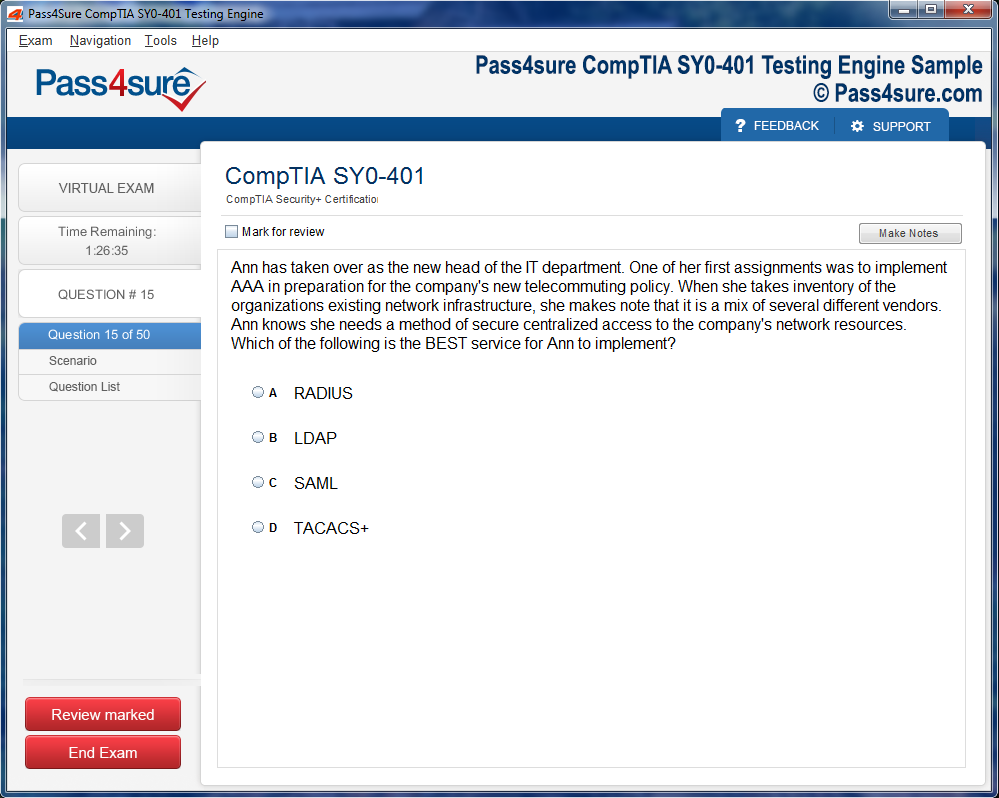
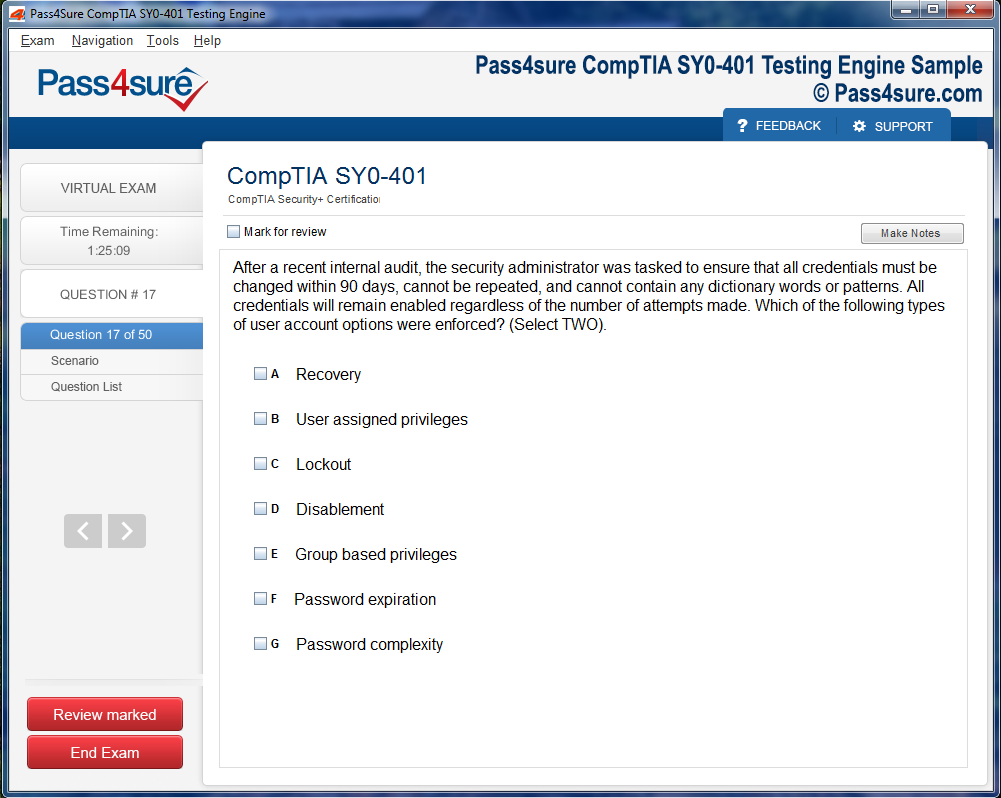
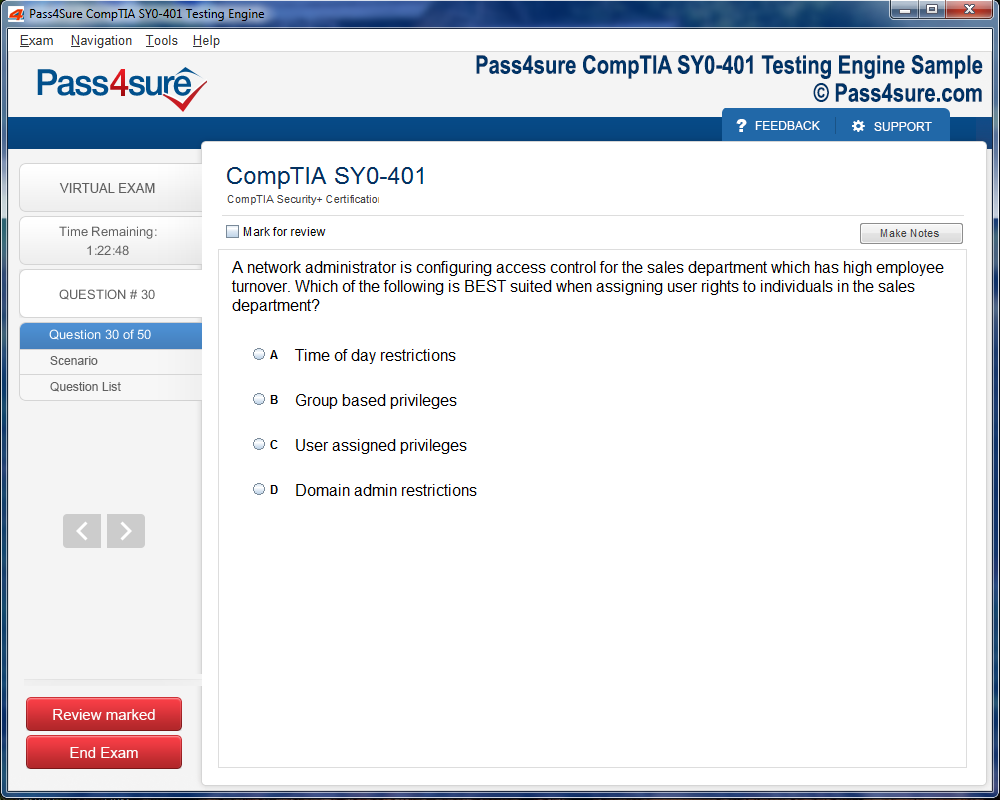
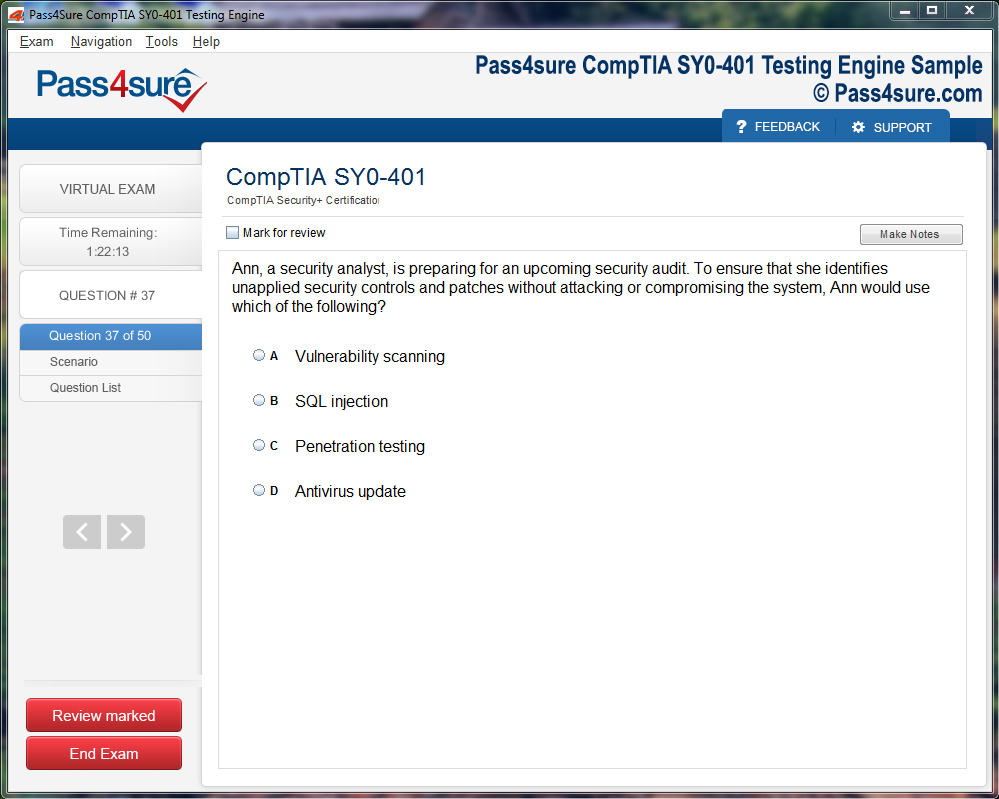
Product Screenshots
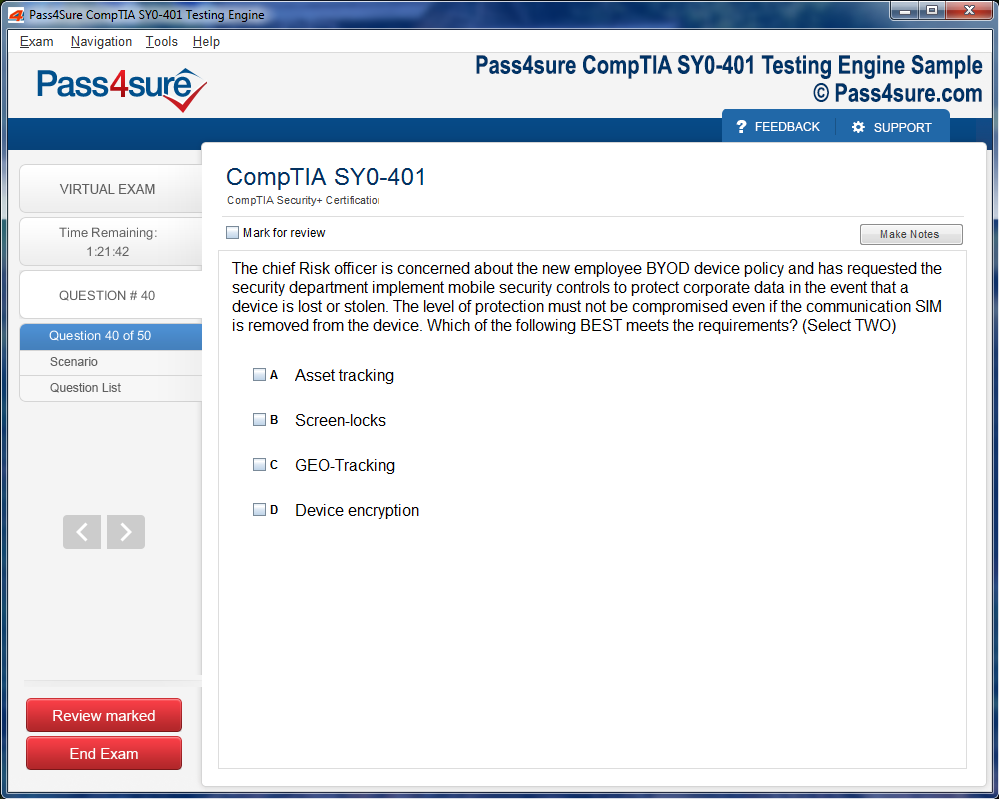
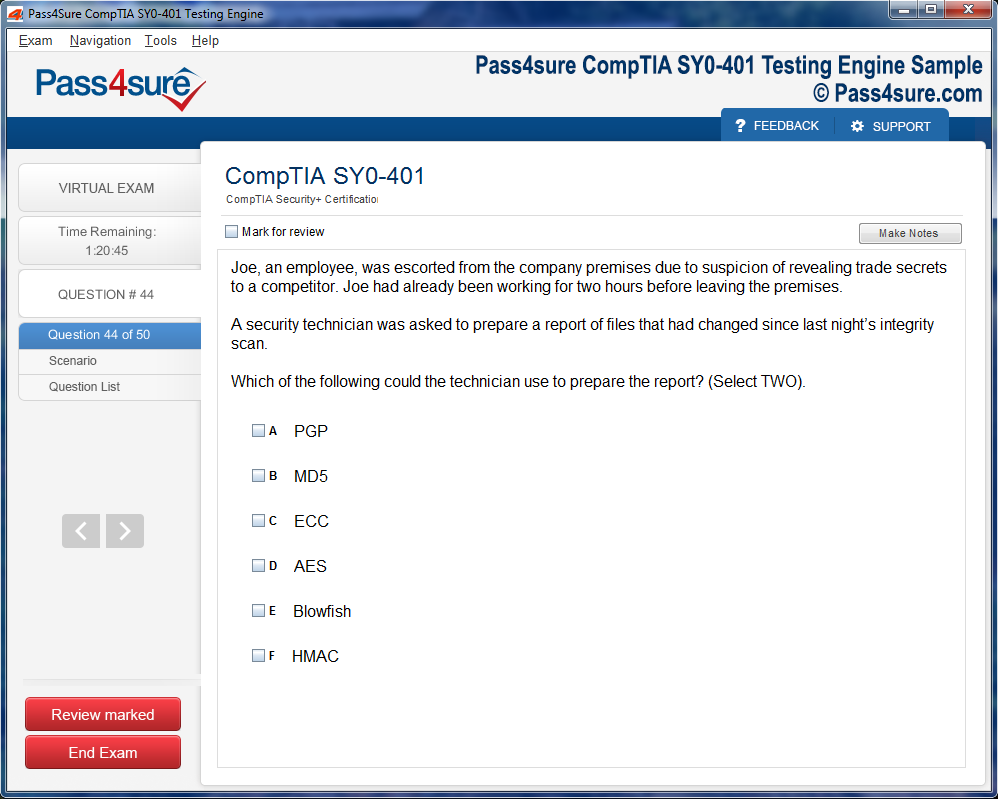
Frequently Asked Questions
How does your testing engine works?
Once download and installed on your PC, you can practise test questions, review your questions & answers using two different options 'practice exam' and 'virtual exam'. Virtual Exam - test yourself with exam questions with a time limit, as if you are taking exams in the Prometric or VUE testing centre. Practice exam - review exam questions one by one, see correct answers and explanations.
How can I get the products after purchase?
All products are available for download immediately from your Member's Area. Once you have made the payment, you will be transferred to Member's Area where you can login and download the products you have purchased to your computer.
How long can I use my product? Will it be valid forever?
Pass4sure products have a validity of 90 days from the date of purchase. This means that any updates to the products, including but not limited to new questions, or updates and changes by our editing team, will be automatically downloaded on to computer to make sure that you get latest exam prep materials during those 90 days.
Can I renew my product if when it's expired?
Yes, when the 90 days of your product validity are over, you have the option of renewing your expired products with a 30% discount. This can be done in your Member's Area.
Please note that you will not be able to use the product after it has expired if you don't renew it.
How often are the questions updated?
We always try to provide the latest pool of questions, Updates in the questions depend on the changes in actual pool of questions by different vendors. As soon as we know about the change in the exam question pool we try our best to update the products as fast as possible.
How many computers I can download Pass4sure software on?
You can download the Pass4sure products on the maximum number of 2 (two) computers or devices. If you need to use the software on more than two machines, you can purchase this option separately. Please email sales@pass4sure.com if you need to use more than 5 (five) computers.
What are the system requirements?
Minimum System Requirements:
- Windows XP or newer operating system
- Java Version 8 or newer
- 1+ GHz processor
- 1 GB Ram
- 50 MB available hard disk typically (products may vary)
What operating systems are supported by your Testing Engine software?
Our testing engine is supported by Windows. Andriod and IOS software is currently under development.
GCX-GCD Exam Made Easy: Smart Preparation Tips That Work
The GCX-GCD exam is less an assessment of memory and more an exploration of cognitive dexterity. Each question functions as a microcosm of problem-solving acumen, inviting candidates to navigate through layers of nuance. Conceptual fluidity, rather than static knowledge, becomes paramount. Aspiring candidates must cultivate the ability to pivot between abstract theory and pragmatic execution with ease.
This cognitive terrain requires intellectual elasticity. Questions often embed subtleties that demand interpretation beyond superficial understanding. Analytical acumen is the linchpin of success, compelling candidates to dissect problems meticulously and synthesize solutions from fragmented data. Developing this skill is akin to sharpening a finely honed instrument: consistent practice and reflection are indispensable.
Moreover, mental resilience is frequently underestimated. The exam’s structure can induce cognitive fatigue due to its density and the sophistication of its scenarios. Integrating mindfulness practices, strategic pauses, and cognitive warm-ups into your study regimen can sustain focus and enhance retention. Approaching preparation as a holistic mental endeavor, rather than a mere content absorption exercise, distinguishes top performers.
Architecting a Strategic Study Paradigm
Success in GCX-GCD necessitates a meticulously engineered study paradigm. Haphazard preparation is a precursor to mediocrity; instead, deliberate structuring catalyzes mastery. Begin by delineating core domains and assigning hierarchical priorities. Identifying high-yield topics versus peripheral ones enables judicious allocation of cognitive resources.
Interleaving study techniques has proven efficacy in consolidating knowledge. Alternating between conceptual reviews, practical exercises, and reflective assessments enhances neural encoding, fostering long-term retention. This polyphonic approach circumvents the pitfalls of monotony and reinforces comprehension through diversified cognitive pathways.
Incorporating meta-cognition further amplifies efficacy. By continuously evaluating your understanding, recognizing misconceptions, and recalibrating study strategies, you cultivate self-regulatory proficiency. This iterative feedback loop transforms passive study into an active exploration of intellectual frontiers.
Harnessing Simulation and Scenario Analysis
A salient dimension of GCX-GCD preparation lies in the emulation of real-world scenarios. Simulation exercises bridge the chasm between theoretical comprehension and practical application. Candidates who routinely engage in scenario-based problem-solving acquire an intuitive grasp of complex dynamics, enhancing both speed and precision.
Scenario analysis also develops anticipatory reasoning. By contemplating multiple outcomes and evaluating contingencies, candidates internalize a strategic mindset, enabling fluid navigation through unfamiliar challenges. This cognitive rehearsal mirrors experiential learning, embedding adaptive heuristics that are invaluable under exam conditions.
Furthermore, collaborative simulations magnify insights. Engaging with peers in structured problem-solving sessions exposes candidates to diverse cognitive approaches, fostering lateral thinking and illuminating latent blind spots. The synergy derived from shared analysis often accelerates mastery more effectively than solitary study.
Cultivating Analytical Fluency and Pattern Recognition
Analytical fluency is the intellectual currency of GCX-GCD success. Beyond understanding content, candidates must develop the capacity to recognize recurring patterns, infer underlying principles, and extrapolate solutions in novel contexts. This skill is not innate; it is cultivated through deliberate exposure to varied problem sets and reflective evaluation.
Pattern recognition transcends mere repetition; it demands abstraction. By discerning structural commonalities amidst apparent heterogeneity, candidates achieve cognitive economization, allowing complex scenarios to be parsed efficiently. This fluency also underpins predictive reasoning, enabling anticipation of question trajectories and optimal strategic responses.
Deliberate practice of micro-analytical exercises—such as deconstructing multifaceted case studies—fortifies this capability. Each iteration enhances the ability to isolate critical variables, evaluate causal relationships, and construct coherent solution frameworks with minimal cognitive friction.
Psychological Fortitude and Motivational Sustainment
The GCX-GCD journey is as much psychological as it is intellectual. Sustained motivation, resilience in the face of setbacks, and confidence under pressure are decisive determinants of performance. Candidates often overlook the subtle interplay between emotional regulation and cognitive execution.
Techniques such as visualization, cognitive reframing, and incremental goal-setting can potentiate mental fortitude. Visualizing successful navigation through challenging questions primes neural pathways for achievement, while reframing errors as opportunities for growth mitigates anxiety and self-doubt.
Equally critical is cultivating intrinsic motivation. Anchoring your preparation in long-term professional aspirations—beyond the immediate objective of passing the exam—imbues each study session with purposeful intensity. Celebrating incremental achievements reinforces momentum, transforming preparation from a laborious obligation into an intellectually invigorating odyssey.
The Quintessence of Strategic Exam Preparation
Success in the GCX-GCD examination transcends mere rote memorization; it is an orchestration of cognitive dexterity and methodical rigor. Instead of succumbing to marathon study sessions, discerning aspirants adopt a calculated blueprint of intellectual exertion. A perspicacious study plan is not a mere timetable—it is an intricate architecture, scaffolding knowledge from rudimentary precepts to labyrinthine concepts with precision.
Decoding the Syllabus: Hierarchies and Nuances
The initial step in crafting an efficacious plan is the meticulous dissection of the syllabus. Every subsection must be parsed and categorized into foundational, intermediate, and advanced tiers. Foundational concepts, often underestimated, form the substratum upon which more abstruse notions are anchored. Comprehending these elemental principles is indispensable; neglecting them is akin to constructing an edifice on a fragile substructure.
Prioritization: The Art of Intellectual Triaging
Not all syllabus segments are created equal. Certain topics wield disproportionate influence over the final score, demanding disproportionate attention. Allocating time judiciously, while ensuring no segment is neglected, is a sophisticated exercise in cognitive triage. The judicious scholar layers study sessions, revisiting topics cyclically to cement long-term retention, thus obviating the peril of last-minute cognitive contortions.
The Alchemy of Active Learning
Active engagement is the linchpin of durable learning. Rather than passively perusing texts, the aspirant transmutes information into personally meaningful representations. Summarization in idiosyncratic terminology, alongside schematic devices such as mind maps, charts, and diagrams, transforms ephemeral abstractions into enduring mental constructs. This alchemy not only facilitates comprehension but also accelerates recall under the duress of examination conditions.
Simulated Practice: The Crucible of Familiarity
Practice, when orchestrated under simulated conditions, metamorphoses from mundane repetition into a crucible of preparedness. Mock examinations, mimicking temporal constraints and question intricacies, cultivate resilience against anxiety and sharpen time management acuity. Equally imperative is the forensic review of errors. Each misstep is a portal to deeper understanding, illuminating conceptual lacunae that warrant remediation.
Technological Symbiosis: Tools Without Dependency
In the contemporary milieu, technology offers a vast repertoire of didactic instruments. Interactive applications, educational platforms, and multimedia tutorials present alternative cognitive perspectives and explanations. However, prudence dictates moderation; over-reliance on digital scaffolding risks superficial comprehension. Optimal results arise from a harmonious amalgamation of traditional problem-solving and innovative technological engagement.
Cognitive Ergonomics: Synchronizing Mind and Body
Intellectual exertion flourishes when paired with holistic wellness. Brief interludes of physical activity, meditation, and restorative breaks enhance attentional focus and neurocognitive plasticity. The synapse thrives in a milieu where body and mind are in equilibrium, facilitating the assimilation and application of intricate knowledge with finesse.
Layered Revision: Spaced Repetition and Mastery
The cerebrally adept employ layered revision strategies. By revisiting topics at progressively increasing intervals, the learner leverages the principle of spaced repetition. This methodology converts transient familiarity into enduring mastery, insulating against the erosion of memory that often accompanies crammed preparation.
Visualization and Mnemonic Techniques
Complex information is rendered more tractable through mnemonic devices and visualization strategies. Symbolic representations, allegorical analogies, and phonetic mnemonics act as cognitive anchors. These tools allow intricate constructs to be stored in the memory as interconnected nodes, facilitating rapid retrieval under examination exigencies.
Precision in Problem-Solving
A core dimension of preparation is not merely theoretical understanding but the development of precision in problem-solving. Analytical acuity, pattern recognition, and methodical reasoning distinguish high performers from those reliant solely on superficial familiarity. Systematic decomposition of multifaceted problems enhances not only accuracy but also efficiency, a critical determinant in timed assessments.
Emotional Resilience: Cultivating Exam Fortitude
Equally vital is the fortification of emotional resilience. Test anxiety, if unchecked, can vitiate even the most thorough preparation. Techniques such as mindfulness, deep-breathing exercises, and cognitive reframing convert stress into productive arousal. The aspirant learns to approach examination challenges with equanimity, transforming potential impediments into cognitive leverage.
Iterative Feedback Loops
Feedback is the linchpin of progressive mastery. Detailed analysis of mock examinations, peer discussions, and mentor consultations generate iterative feedback loops. These cycles of reflection and recalibration ensure that preparation is not static but dynamically responsive to evolving proficiency levels.
Integrative Cross-Referencing
Knowledge silos are a cognitive hazard. Integrative cross-referencing, wherein interrelated concepts are juxtaposed, reinforces understanding. Drawing connections across subjects or themes cultivates a holistic perspective, enabling the aspirant to tackle integrative or multidimensional questions with alacrity.
Temporal Optimization: The Science of Scheduling
Temporal allocation is as crucial as content mastery. Structured schedules, segmented into focused bursts of activity interspersed with restorative intervals, exploit the brain’s ultradian rhythms. The strategic interplay of study and recovery phases maximizes cognitive yield while minimizing fatigue and burnout.
Leveraging Analogical Reasoning
Analogical reasoning empowers the learner to apply familiar schemas to novel problems. By identifying structural similarities between disparate concepts, aspirants cultivate flexible thinking, a skill indispensable for tackling unconventional or abstract examination questions.
Sustaining Motivation: Intrinsic and Extrinsic Catalysts
Long-term preparation demands sustained motivational vigor. Intrinsic drivers, such as intellectual curiosity and personal ambition, complemented by extrinsic reinforcements like recognition or competitive benchmarks, create a resilient motivational ecosystem. Periodic goal-setting and progress tracking transform preparation from a passive endeavor into an engaging, goal-directed pursuit.
Adaptive Resource Management
Resource selection and adaptation is another pillar of strategic preparation. Optimal learners do not indiscriminately consume materials; they evaluate quality, relevance, and alignment with personal learning modalities. Customizing study resources to individual cognitive predilections enhances efficiency and comprehension, yielding maximal returns on invested effort.
Cognitive Flexibility and Contingency Planning
Finally, the aspirant must cultivate cognitive flexibility. Unexpected topics, novel question formats, or shifting exam dynamics demand rapid adaptation. Contingency planning—anticipating potential difficulties and devising alternative approaches—ensures resilience against unforeseen challenges, solidifying preparedness on multiple fronts.
Cultivating Intellectual Tenacity
Intellectual tenacity is the hidden fulcrum behind high-achievement in rigorous examinations. It is not mere diligence but the art of sustained, strategic effort against cognitive fatigue. Developing this trait involves structured mental conditioning. Begin by partitioning study sessions into micro-cycles, punctuated with reflective pauses. During these intervals, contemplate the nuances of learned material rather than passively reviewing it. Such reflective assimilation solidifies neural pathways and sharpens cognitive resilience.
Additionally, adopting a mindset of iterative refinement enhances tenacity. Do not accept superficial comprehension; interrogate concepts relentlessly. When encountering a challenging problem, dissect it into elemental constituents, analyze dependencies, and reconstruct it mentally. This fractal approach to learning transforms intimidating material into navigable, coherent structures.
Leveraging Cognitive Elasticity
Cognitive elasticity denotes the ability to stretch intellectual faculties into unfamiliar domains without compromising accuracy. High performers demonstrate this through fluid transitions between conceptual frameworks. To cultivate it, expose yourself to variant problem formats that require cross-domain synthesis. For example, a seemingly isolated statistical problem might be solvable using a combinatorial lens. Practicing such mental gymnastics strengthens the mind’s agility, making adaptive reasoning instinctive rather than laborious.
Visual metaphors and mental simulations can amplify cognitive elasticity. Mapping abstract ideas onto tangible analogs allows the brain to retain intricate relationships more intuitively. In this way, theoretical abstraction becomes a playground rather than a labyrinth.
Harnessing the Alchemy of Metacognition
Metacognition, often described as thinking about thinking, operates as the cerebral crucible where raw knowledge transmutes into strategic wisdom. Engage in meta-analysis by routinely assessing your comprehension accuracy. After completing a set of problems, scrutinize your approach: which assumptions were valid, which heuristics misled you, and how could alternative strategies yield superior outcomes? Documenting these reflections externalizes cognition, transforming ephemeral insights into enduring schematics.
Moreover, metacognitive awareness fosters self-regulated learning. It allows for the detection of cognitive blind spots, encouraging recalibration before misconceptions ossify. In essence, metacognition is the navigator ensuring that intellectual energy is not squandered on redundant or erroneous paths.
Orchestrating Temporal Dynamics
Time management transcends simple scheduling; it is the orchestration of cognitive rhythms aligned with peak performance windows. Identify periods of heightened alertness and allocate complex, high-stakes tasks to these intervals. Conversely, reserve routine reviews or lighter exercises for temporal troughs. Understanding your circadian cognitive patterns optimizes efficiency, minimizing wasted effort.
Furthermore, micro-temporal tactics such as the Pomodoro technique or interval-based sprints introduce a kinetic discipline to study sessions. By combining these with prioritized concept targeting, one achieves a symphony of focus where every cognitive note resonates with purpose.
Embedding Knowledge Through Experiential Application
True mastery emerges when knowledge transcends theoretical abstraction into practical execution. Integrate experiential learning by simulating real-world scenarios where concepts are applied under dynamic conditions. Engage in hypothetical problem-solving exercises that mimic the unpredictability of exam questions. For instance, manipulate variables within case studies to observe cascading effects, thereby internalizing both methodology and context.
Additionally, interdisciplinary application fortifies retention. Applying analytical frameworks across diverse domains—finance, logic, or even philosophical reasoning—enhances the versatility of conceptual scaffolds. This cross-pollination ensures that knowledge is not siloed but readily adaptable.
Amplifying Retention via Mnemonic Innovation
Mnemonic innovation involves the creation of idiosyncratic memory scaffolds that leverage imagination and associative reasoning. Rather than rote memorization, encode information through symbolic, visual, or narrative structures. For instance, transforming sequential formulas into a narrative journey or constructing emblematic mental diagrams significantly accelerates retrieval speed.
Pairing mnemonics with active recall exercises exponentially reinforces long-term retention. The act of reconstructing information from memory, especially after temporal gaps, embeds knowledge more securely than passive review. In this alchemical process, memory evolves from brittle storage into a resilient, malleable asset.
Fostering Dialogical Synergy
Dialogical synergy arises when collaborative discourse enhances individual cognition. Engaging in high-caliber discussion with peers exposes latent assumptions, introduces alternative heuristics, and nurtures the ability to articulate complex reasoning with precision. The act of teaching or debating a concept crystallizes understanding while revealing areas that demand further refinement.
Select interlocutors strategically—those who challenge ideas rigorously yet constructively. Such dialectical friction stimulates intellectual growth, converting study sessions from monologic repetition into dynamic, generative exchange.
Navigating Cognitive Fatigue with Strategic Pauses
Cognitive fatigue is a stealthy adversary capable of undermining even the most meticulous preparation. Combat it through deliberate rest strategies. Micro-breaks, meditative interludes, and light physical activity rejuvenate neural circuits and enhance subsequent absorption. Counterintuitively, stepping away from intense problem-solving often yields sudden insights, as the subconscious mind continues analytical processing in the background.
Additionally, nutrition, hydration, and sleep function as foundational pillars of sustained cognition. Optimal mental performance is inseparable from physiological equilibrium, underscoring the inseparability of mind and body in peak intellectual endeavor.
Sculpting Conceptual Hierarchies
Rather than treating knowledge as a flat repository, sculpt it into hierarchical architectures. Identify macro-concepts as primary nodes and subordinate ideas as branching sub-nodes. This structured mental taxonomy enables rapid navigation of complex subjects, facilitating both retrieval and synthesis. Visual representations, such as mind maps or flow diagrams, can externalize these hierarchies, serving as cognitive scaffolds during intensive study periods.
Furthermore, hierarchization aids in prioritization. Recognize which concepts act as keystones supporting extensive knowledge networks, and allocate effort proportionally. This ensures that foundational understanding is robust before tackling derivative complexities.
Cognitive Scaffolding and Neural Assimilation
Learning is not mere accumulation of facts; it is an intricate weaving of neural pathways. Cognitive scaffolding ensures that new knowledge is anchored onto pre-existing mental frameworks. When a learner repeatedly integrates concepts through deliberate, structured practice, the brain undergoes neural assimilation, transforming transient understanding into durable mastery.
Employ mnemonics, analogical reasoning, and spatial visualization to fortify comprehension. Analogies, particularly idiosyncratic ones, spark synaptic connectivity by linking seemingly disparate ideas. Visualization, on the other hand, converts abstract principles into perceptible mental architectures, which enhances recall under pressure.
Deliberate Variability in Practice
Uniform repetition fosters familiarity but not versatility. Deliberate variability—systematically altering problem contexts—cultivates cognitive agility. For example, when solving quantitative problems, alter initial conditions, manipulate constraints, or reverse outcomes. This trains the mind to adapt rapidly, reducing susceptibility to cognitive inertia during high-stakes assessments.
Incorporate lateral thinking exercises alongside conventional drills. Puzzles that demand non-linear solutions amplify creative reasoning and prevent rigid adherence to rote methods. Over time, this nurtures an intuitive problem-solving lexicon that is both expansive and resilient.
Metacognitive Calibration
Metacognition, the art of thinking about thinking, is the linchpin of effective preparation. Students must frequently interrogate their own understanding: Which concepts are nebulous? Which procedures are reflexive yet error-prone? By maintaining a metacognitive ledger, learners illuminate blind spots invisible during cursory review.
Self-questioning techniques, such as hypothesizing potential pitfalls or predicting examiner tendencies, cultivate anticipatory intelligence. Coupled with reflective journaling, this iterative feedback loop sharpens discernment and instills self-regulatory discipline essential for exam success.
Temporal Optimization of Study Cycles
Time, when strategically segmented, magnifies retention. The principle of spaced repetition—interspersing review sessions across increasing intervals—exploits the brain’s propensity to consolidate memory during rest periods. Conversely, massed cramming yields ephemeral familiarity without enduring retention.
Layer temporal scaffolding with interleaved retrieval practice. Alternate problem types, rotate conceptual themes, and periodically simulate exam conditions. This temporal heterogeneity solidifies neural encoding and fosters cognitive robustness capable of withstanding stress-induced degradation during real evaluations.
Affective Conditioning and Motivation Amplification
Emotions are catalysts for cognition. Positive affect enhances plasticity, enabling accelerated absorption of complex material. Cultivate intrinsic motivation by framing challenges as opportunities for intellectual conquest rather than obligatory drudgery. Micro-rewards and gamification reinforce engagement, while mindfulness techniques temper performance anxiety.
Visualization of success, coupled with anticipatory goal-setting, engenders a proactive mindset. The amalgamation of motivation, emotional regulation, and deliberate practice forms a triad that maximizes the probability of peak performance under scrutiny.
Strategic Error Taxonomy
Not all mistakes are equal; discerning their provenance is paramount. Categorize errors into conceptual misapprehension, procedural lapse, or calculation oversight. Conceptual errors indicate gaps in foundational understanding, requiring deep conceptual excavation. Procedural mistakes suggest the need for methodical rehearsal and algorithmic familiarization. Calculation oversights demand precision drills and attentional reinforcement.
Implement an error-diary approach: document the type, frequency, and context of each misstep. Over time, patterns emerge, enabling preemptive countermeasures and the fortification of cognitive defenses against recurring pitfalls.
Integrative Synthesis Across Disciplines
Mastery emerges when knowledge is not siloed but integrated. Cross-disciplinary synthesis nurtures lateral connections, allowing solutions to emerge from unconventional angles. For instance, applying principles from logic, probability, and pattern recognition in concert yields insights unattainable by isolated focus.
Engage in comparative analysis and concept mapping to visually delineate intersections. Such exercises foster mental elasticity, equipping learners to pivot seamlessly across problem domains and to recognize latent interdependencies within complex questions.
Exam Day Primordial Mindset
Embarking upon an examination day necessitates more than mere rote memorization; it demands an orchestrated alignment of cognition, affect, and corporeal readiness. The cerebral theatre is most malleable when nurtured through deliberate pre-exam rituals. Sleep, often underrated, functions as a synaptic consolidator, embedding intricate neural networks forged during revision. Nutrition, too, is not mere sustenance; it is the substrate upon which mental acuity flourishes. Micronutrients, complex carbohydrates, and hydration act synergistically to optimize reactionary alacrity and prevent cognitive lethargy. Neglecting these elements often precipitates a fog of indecision, a sluggishness of the mind that can render even familiar material elusive.
Ritualized Morning Cadence
The embryonic hours of exam day offer a golden crucible for attuning the mind. Cultivating a ritualized morning cadence instills serenity and sharpens attentional focus. Gentle kinetic movement, such as yoga sequences or ambulation in ambient light, stimulates circulation, enhancing cerebral oxygenation. Breathing techniques—especially diaphragmatic patterns—engage the parasympathetic system, mitigating the vagaries of anxiety. Meditation, even brief, fosters a state of hyperawareness coupled with equanimity, rendering the mind less susceptible to distractive tangents. Arriving early at the examination locus permits sensory acclimatization, allowing one to internalize the spatial and temporal rhythm of the environment without the perturbation of external commotion.
Strategic Temporal Navigation
Examinations are, at their essence, arenas of temporal negotiation. Time, a finite and unyielding vector, must be mastered rather than merely tolerated. Upon receiving the examination dossier, a panoramic survey is prudent: identify facile interrogatives that promise immediate accrual of confidence and points. This initial momentum is invaluable; it engenders a psychological scaffolding, reducing the intimidating aura of more formidable tasks. Subsequently, tackle the labyrinthine queries with deliberate deliberation, ensuring that cognitive reserves are not prematurely expended. Compartmentalizing tasks and allocating temporal micro-reserves enables sustained engagement across the entire examination continuum, preventing precipitous fatigue or lapses in concentration.
Cognitive Alchemy of Complex Questions
Encountering abstruse or convoluted problems need not induce panic; rather, it invites the deployment of analytical alchemy. Logical elimination, pattern recognition, and heuristic triangulation serve as instruments of insight. Educated conjecture, far from a sign of desperation, often bridges lacunae in certainty, converting ambiguity into a calculable probability of success. The mind’s associative networks are frequently catalytic: addressing related questions can illuminate previously obscured pathways, turning initial opacity into clarity. Mastery of complex interrogatives is less about brute force memory and more about dynamic cognitive flexibility and adaptive problem-solving.
Physiological Anchors of Composure
Mental fortitude is inexorably intertwined with corporeal stability. Subtle physiological manipulations—such as postural alignment, muscle relaxation, and ocular rest intervals—fortify attentional continuity. Even micro-pauses, when strategically inserted, allow the nervous system to recalibrate, preventing the accrual of cumulative stress. Hydration, often underestimated, exerts a profound influence on neurotransmission and synaptic efficacy; minor deficits can precipitate distractibility or cognitive sluggishness. In this domain, foresight and preemptive self-care constitute strategic investments in both immediate performance and enduring neural resilience.
Emotional Calibration and Confidence
Confidence, while intangible, manifests palpably in performance metrics. The examination milieu is not merely a cognitive battlefield but an affective one. Emotional calibration—balancing anticipation with measured optimism—prevents the corrosive effects of anxiety. Positive self-reinforcement, rooted in acknowledgment of diligent preparation, fosters a psychological equilibrium conducive to incisive reasoning. Viewing the examination as a systematic challenge rather than an insurmountable test transforms apprehension into focused engagement. Composure, when consistently maintained, becomes an invisible ally, augmenting decision-making speed and accuracy.
Adaptive Focus and Situational Awareness
Exemplary exam performance hinges upon the synthesis of adaptive focus with acute situational awareness. Peripheral distractions must be relegated to cognitive background noise, while attention remains riveted on the present task. The strategic sequencing of question types—oscillating between high-confidence and demanding items—preserves both momentum and mental resilience. Awareness of temporal thresholds, coupled with an understanding of one’s personal energy cycles, allows for precise modulation of cognitive intensity, ensuring sustained efficacy throughout the examination interval.
Kinesthetic and Sensorial Modulation
Examination readiness is enhanced when kinesthetic and sensorial modalities are harmonized. Subtle bodily gestures, such as rhythmic hand movements or posture adjustments, can modulate mental alertness. Environmental cues—light, ambient temperature, and spatial orientation—interact with cognitive performance more profoundly than is often acknowledged. Attunement to these factors transforms them from potential distractors into performance catalysts. By consciously integrating kinesthetic awareness, the examinee establishes a dynamic feedback loop, reinforcing concentration and mitigating episodic lapses in attention.
Mental Rehearsal and Visualization
Visualization, the cognitive simulation of task execution, is an underutilized yet potent strategy. Mentally rehearsing the sequence of problem-solving steps, imagining the articulation of answers, or envisaging successful completion primes neural circuits for real-time application. Such pre-activation enhances fluidity, reduces latency in response, and minimizes the cognitive friction that arises from unexpected complexity. Combined with measured breath control, visualization serves as both a rehearsal and a psychological anchor, aligning the subconscious and conscious faculties for optimal performance.
Nutritional and Hydration Micro-Strategics
The subtleties of micro-nutrition on exam day cannot be overstated. Glycemic modulation through complex carbohydrates ensures a sustained energy supply, while omega-rich lipids facilitate neurochemical efficiency. Micronutrients such as magnesium and B-vitamins support synaptic plasticity, enhancing recall and reasoning. Hydration, strategically managed in small, frequent intakes, prevents desiccation-induced cognitive decline without inducing the disruption of frequent bathroom breaks. When orchestrated intentionally, these micro-strategics become silent enhancers, augmenting both endurance and acuity across the exam duration.
Postural Poise and Micro-Interventions
Physical poise is not merely cosmetic; it directly interfaces with cognitive function. Ergonomic alignment of spine and limbs optimizes oxygen transport and reduces neuromuscular fatigue. Micro-interventions—brief stretches, shoulder rolls, or ocular focus shifts—serve to reset neurophysiological equilibrium. Such actions, subtle yet impactful, prevent cumulative strain and sustain attentional depth. In high-stakes examinations, these minor calibrations differentiate between episodic lapses and consistent performance excellence.
Tactical Question Sequencing
A sophisticated approach to question sequencing can yield disproportionate gains. Initiating with high-confidence items builds psychological momentum, enhancing both accuracy and temporal efficiency. Transitioning to intermediate challenges allows cognitive processes to adaptively calibrate, while deferring the most complex interrogatives ensures maximum attentional and analytical reserves. Periodic reassessment of progress, coupled with flexible adaptation of the plan, allows for real-time optimization. This dynamic strategy transforms examination navigation from a static task into a deliberate, responsive performance art.
Post-Exam Reflection and Metacognitive Awareness
After completing the GCX-GCD exam, introspection becomes a crucible for cognitive refinement. Metacognitive awareness—the conscious scrutiny of one’s thought processes—illuminates patterns of comprehension, lapses in attention, and moments of inadvertent brilliance. Recording immediate reflections in a dedicated log facilitates granular insight into problem-solving proclivities. Such documentation serves as an invaluable compass, guiding both retrospective assessment and prospective learning trajectories.
Analytical Deconstruction of Errors
Exam missteps are not mere setbacks; they are reservoirs of latent intelligence. Dissecting errors with surgical precision uncovers systemic weaknesses—be it conceptual gaps, lapses in logical sequencing, or misinterpretation of nuanced questions. Categorizing errors into thematic clusters allows the practitioner to address recurring pitfalls methodically. This deliberate analytic deconstruction fosters a mindset of iterative enhancement, transforming each error into a scaffold for advanced proficiency.
Iterative Refinement of Study Modalities
Optimal learning is seldom linear. Post-exam analysis necessitates the recalibration of study modalities to maximize cognitive retention and synaptic plasticity. Techniques such as spaced repetition, interleaving diverse problem types, and mnemonic scaffolding can exponentially amplify recall. Incorporating reflective pauses and metacognitive checkpoints during study sessions fortifies comprehension, while simultaneous evaluation of temporal allocation ensures energy is strategically expended on high-yield areas.
Cognitive Resilience and Adaptive Tenacity
Enduring professional challenges requires cognitive resilience—the capacity to maintain equanimity amidst uncertainty and intellectual strain. Post-exam reflection cultivates this resilience by converting perceived failures into instructive experiences. Adaptive tenacity, characterized by the ability to modify strategies in real-time, enhances the probability of subsequent success. Practitioners who internalize these principles are better equipped to navigate evolving academic landscapes and complex real-world problem sets.
Collaborative Knowledge Synthesis
Learning in isolation can lead to epistemic bottlenecks, whereas collaborative engagement fosters emergent intelligence. Sharing post-exam insights with peers creates a lattice of communal knowledge, where individual observations catalyze collective understanding. Group discourse promotes the juxtaposition of divergent perspectives, allowing participants to reconcile inconsistencies and consolidate cognitive schemas. Peer feedback not only reinforces retention but also enhances critical thinking through dialectical reasoning.
Archival Methodologies for Long-Term Mastery
The creation of a meticulously curated knowledge archive ensures that learning persists beyond the immediacy of exams. This archive might include annotated problem sets, thematic summaries, and meta-analytical reflections. By indexing these resources in a systematized repository, learners can engage in rapid retrieval and cross-referential study, facilitating continuous growth. Over time, the accumulation of such resources transforms episodic learning into a comprehensive, enduring intellectual corpus.
Integration of Experiential Insights
Every exam experience is imbued with tacit knowledge that extends beyond explicit content mastery. Capturing these experiential insights—such as decision-making heuristics, temporal pacing strategies, and psychological self-regulation techniques—elevates future performance. Integrating these learnings into daily practice routines encourages automaticity in cognitive processing and refines judgment under pressure, establishing a robust foundation for advanced professional undertakings.
Nuanced Cognitive Calibration
Beyond mere reflection, post-exam analysis requires nuanced cognitive calibration. This involves scrutinizing the interplay between working memory, long-term retention, and attention allocation during the exam. Mapping moments of heightened clarity against periods of cognitive fatigue can illuminate patterns of mental efficiency, allowing learners to optimize subsequent preparation cycles. Engaging in such calibration fosters an intimate awareness of personal cognitive rhythms, transforming learning from rote repetition into a dynamic, adaptive process.
Temporal Optimization and Circadian Synchronization
Time is not merely a metric but a malleable dimension in the orchestration of learning efficacy. Synchronizing study schedules with circadian peaks can dramatically enhance focus and memory consolidation. Early empirical observation of one’s optimal cognitive windows, whether morning lucidity or nocturnal precision, allows for strategic allocation of high-complexity tasks. Coupled with deliberate interspersing of restorative intervals, temporal optimization ensures sustained performance and mitigates burnout during intensive exam preparation phases.
Meticulous Microanalysis of Problem Archetypes
Post-exam deconstruction is incomplete without an in-depth study of problem archetypes encountered. Categorizing questions into taxonomies—conceptual, procedural, inferential, or integrative—enables identification of recurring cognitive demands. Mapping personal proficiency across these archetypes highlights latent strengths and exposes vulnerabilities, providing actionable intelligence for targeted remediation. By constructing a matrix of performance versus question typology, learners develop predictive insight into the intellectual terrain of future examinations.
Emotional Resonance and Affective Intelligence
Exam experiences are not purely cognitive; they are interwoven with affective dimensions that shape performance outcomes. Cultivating affective intelligence involves recognizing emotional triggers—stress spikes, self-doubt, overconfidence—and integrating regulatory strategies such as mindfulness, diaphragmatic breathing, and cognitive reframing. This emotional attunement enhances executive functioning, stabilizes decision-making under pressure, and fosters a resilient mindset. Repeated engagement with these affective strategies transforms emotional responses from potential hindrances into strategic assets.
Reflexive Metacognition and Adaptive Rehearsal
Reflexive metacognition extends beyond superficial reflection into the domain of self-directed adaptive rehearsal. After each exam, learners can simulate hypothetical variations of questions encountered, engaging in mental reenactment to consolidate synaptic pathways. This rehearsal, punctuated by deliberate error simulation, enhances problem-solving agility and fortifies neural encoding. By iteratively rehearsing both successes and missteps, practitioners cultivate a repertoire of adaptive responses, preparing the mind to navigate unanticipated cognitive challenges with dexterity.
Semantic Networking and Associative Retention
To ensure post-exam insights translate into enduring mastery, learners can employ semantic networking—a method of connecting discrete knowledge nodes into a cohesive lattice of understanding. By forming associative links between conceptual frameworks, procedural rules, and real-world applications, information becomes anchored in multiple cognitive pathways. This associative retention not only strengthens memory recall but also promotes integrative thinking, enabling learners to apply knowledge creatively across novel contexts.
Strategic Resource Curation
High-level post-exam analysis is complemented by strategic resource curation. Beyond personal notes and solved papers, learners benefit from constructing meta-libraries that juxtapose multiple perspectives on key topics. Integrating annotated references, thematic summaries, mnemonic compendia, and reflective commentaries creates a multi-dimensional knowledge ecosystem. This curated repository functions as both a cognitive scaffold for future exam cycles and a living archive of professional intellectual growth, adaptable to emerging trends and advanced certifications.
Dialectical Engagement with Peers
Learning is exponentially amplified when integrated with dialectical engagement. Collaborative discussion post-exam fosters synthesis of divergent interpretations and exposes subtle misconceptions that might otherwise remain latent. Through Socratic dialogue, peers challenge assumptions, refine reasoning, and co-construct nuanced understandings. This interactive process not only reinforces retention but also cultivates meta-analytic thinking, as learners negotiate competing viewpoints and reconcile inconsistencies within their cognitive frameworks.
Neuroplasticity-Driven Reinforcement
The human brain is remarkably adaptable, and post-exam strategies can harness neuroplasticity to solidify learning. Engaging in deliberate practice, particularly on areas previously identified as weak, stimulates the formation of new synaptic connections. Coupled with reflective journaling, retrieval practice, and iterative testing, these strategies convert transient comprehension into long-term expertise. By consciously leveraging neuroplastic mechanisms, learners convert ephemeral exposure into durable, high-fidelity cognitive assets.
Experiential Synthesis and Tacit Knowledge Codification
Each examination provides a unique repository of tacit knowledge—subtle insights often inaccessible through explicit study. Codifying this tacit knowledge involves documenting heuristics, mnemonic shortcuts, and decision-making cues employed under temporal pressure. Over time, this practice transforms episodic experiences into a structured framework of strategic intuition, enabling accelerated problem-solving and refined judgment. Such codification ensures that experiential learning persists beyond isolated exam cycles, embedding itself into professional competency.
Iterative Feedback Loops and Self-Directed Enhancement
Continuous improvement is inherently iterative. Establishing self-directed feedback loops—where outcomes are continuously analyzed, hypotheses about performance are tested, and strategies are refined—facilitates exponential growth. Feedback may derive from past exam analysis, peer consultations, or self-assessment tools. By institutionalizing these loops, learners engage in a cyclical process of evaluation and refinement, ensuring that each iteration progressively enhances efficiency, accuracy, and cognitive agility.
Multi-Sensory Encoding and Retrieval Strategies
Retention and recall are significantly enhanced when learning engages multiple sensory modalities. Incorporating auditory, visual, and kinesthetic elements into post-exam review—such as diagrammatic representations, verbal explanations, and physical annotation—fortifies memory networks. Multi-sensory encoding, when combined with spaced retrieval practices, ensures robust information accessibility. This method also encourages flexible thinking, allowing learners to reconstruct knowledge from diverse cognitive entry points under examination conditions.
Strategic Mindset Realignment
Exams are crucibles not only of knowledge but also of mindset. Post-exam analysis provides the opportunity to recalibrate cognitive orientation toward strategic growth. By embracing a growth-centric paradigm—viewing setbacks as informative rather than punitive—learners cultivate perseverance, intellectual curiosity, and a resilient self-concept. Mindset realignment encourages adaptive experimentation, continuous refinement, and an enduring commitment to mastery that transcends individual assessments.
Neurocognitive Priming
Optimal performance hinges upon neurocognitive priming, a deliberate activation of synaptic pathways before high-stakes cognitive engagement. This involves mental scaffolding: revisiting core principles, rehearsing problem-solving heuristics, and engaging in light cognitive drills. These exercises awaken dormant neural networks, enhancing plasticity and reactionary acuity. Cognitive priming is not merely rehearsal; it transforms latent knowledge into immediate accessibility, reducing the latency of recall when under temporal constraints. Engaging in mnemonic visualization or rapid associative mapping prior to the exam creates an anticipatory scaffold upon which reasoning can operate with greater fluidity.
Emotional Resonance and Self-Regulation
Emotional resonance, the ability to attune affective states to situational demands, plays a pivotal role in exam efficacy. Emotional turbulence can erode attentional depth, whereas intentional self-regulation fosters resilience. Techniques such as labeling emotions, employing micro-cognitive reframing, or self-directed affirmations act as stabilizing agents, preventing anxiety from cascading into performance deficits. By consciously monitoring affective fluctuations, examinees transform emotional energy into strategic momentum, leveraging subtle shifts in mood to enhance cognitive clarity and endurance.
Micro-Sleep and Circadian Optimization
Sleep is a well-acknowledged pillar of cognitive readiness, yet the nuanced exploitation of micro-sleep and circadian rhythms is frequently overlooked. Short naps, strategically timed in accordance with one’s ultradian cycles, can replenish attentional reserves and consolidate recent learning. Aligning examination schedules with peak circadian arousal phases—typically mid-morning or early afternoon for most individuals—maximizes reaction speed and executive functioning. Neglecting these temporal nuances often results in suboptimal synaptic responsiveness, delayed problem-solving, and susceptibility to cognitive fatigue.
Sensory Attunement and Environmental Calibration
Examination spaces are rife with sensory variables that subtly influence cognitive performance. Ambient temperature, lighting gradients, and acoustic resonance interact with attentional networks in non-obvious ways. Proactive sensory calibration—selecting seating with optimal light exposure, minimal auditory distraction, and ergonomic comfort—minimizes peripheral interference. Even tactile factors, such as grip on writing instruments or surface texture, influence motor precision and mental fluidity. The judicious orchestration of these environmental elements converts them from potential stressors into performance enhancers.
Cognitive Elasticity and Adaptive Problem-Solving
Complex examinations necessitate cognitive elasticity: the capacity to flexibly shift between divergent and convergent thinking modalities. Divergent cognition allows for ideation, pattern recognition, and creative hypothesis generation, while convergent reasoning focuses on linear deduction and verification. Alternating between these modes in response to problem complexity enhances both efficiency and accuracy. Adaptive problem-solving requires ongoing meta-cognition—monitoring thought processes, evaluating effectiveness, and recalibrating strategies in real-time. This dynamic interplay ensures that rigidity does not compromise performance under evolving cognitive demands.
Micro-Interventions for Stress Mitigation
Stress, though often unavoidable, can be modulated through micro-interventions. Subtle acts, such as progressive muscle relaxation between questions, ocular convergence exercises, or paced nasal breathing, can attenuate physiological arousal. The nervous system, particularly the hypothalamic-pituitary-adrenal axis, responds acutely to these interventions, resulting in lowered cortisol spikes and improved attentional control. Even a few seconds of mindful recalibration can restore composure, sharpen focus, and prevent anxiety from metastasizing into cognitive interference.
Strategic Energy Allocation
Cognitive stamina is finite, and judicious energy allocation determines sustained examination performance. Early investment in high-yield questions preserves attentional reserves, while intermittent micro-breaks serve to restore neural efficiency. Energy allocation is both physiological and psychological: pacing the distribution of cognitive resources, maintaining hydration and nutrient intake, and consciously modulating stress responses. Overexertion at early stages can precipitate mental depletion, whereas strategic pacing transforms endurance into a competitive advantage.
Heuristic Triangulation and Logical Filtration
When confronted with intricate questions, heuristic triangulation offers a pragmatic route to solution discovery. This involves cross-referencing multiple cognitive cues—pattern recognition, contextual knowledge, and deductive logic—to isolate probable outcomes. Logical filtration, in tandem, eliminates implausible options, narrowing cognitive focus to the most viable solutions. These methodologies reduce cognitive clutter, allowing the mind to operate with precision under temporal pressure. Cultivating familiarity with these processes prior to examination enhances adaptive flexibility, ensuring readiness for unforeseen problem structures.
Kinesthetic Integration and Cognitive Synergy
The interplay between bodily motion and cognition is a subtle yet potent enhancer of performance. Kinesthetic integration, the alignment of motor patterns with mental processes, facilitates neural synchronization, memory retrieval, and problem-solving fluency. Light hand movements, finger tapping, or even postural adjustments serve as neuro-physical catalysts, priming synaptic networks for active reasoning. Cognitive synergy emerges when mental focus is amplified through controlled physical activity, transforming the body into an instrument of intellectual performance rather than a passive vessel.
Micro-Nutritional Timing and Cognitive Peaks
The timing of nutrition can significantly influence mental acuity. Small, carefully calibrated intake of protein and complex carbohydrates within the hour preceding examination can stabilize blood glucose, enhancing concentration and minimizing distractibility. Antioxidant-rich foods reduce oxidative stress, supporting neurochemical efficiency, while hydration with electrolyte-balanced fluids preserves synaptic function. Understanding personal metabolic rhythms—when cognitive peaks occur relative to nutrient absorption—allows for strategic intervention, converting nutrition from mere sustenance into an active cognitive tool.
Temporal Mindfulness and Strategic Pausing
Time awareness extends beyond simple clock-watching; temporal mindfulness involves attuning one’s pace to task complexity and energy levels. Strategic pausing—brief, intentional breaks to reassess problem-solving progress—enhances efficiency and prevents the tunnel vision often induced by prolonged fixation. These micro-pauses also serve as physiological resets, alleviating muscular tension and stabilizing heart rate. Temporal mindfulness transforms the examination into a controlled sequence of cognitive engagements rather than a continuous, exhausting ordeal.
Confidence Anchoring and Positive Priming
Self-efficacy, the belief in one’s own cognitive competence, is both a psychological shield and a performance amplifier. Confidence anchoring involves invoking past successes, rehearsed skills, and preparation milestones as reminders of capability. Positive priming—mental reinforcement of achievable goals and attainable outcomes—counteracts self-doubt and anxiety. The synergistic effect of anchoring and priming fosters mental resilience, ensuring that the examinee remains grounded, focused, and optimally responsive throughout the examination duration.
Strategic Error Management
Error inevitability is an accepted reality in high-stakes assessments. Strategic error management transforms mistakes from performance threats into informational assets. Reviewing incorrect answers for patterns, identifying misinterpretation tendencies, and applying corrective heuristics allows for real-time recalibration. Rather than fostering discouragement, proactive error analysis cultivates adaptability and reduces repetition of preventable mistakes. Mastery lies not in error elimination but in adaptive response and cognitive agility.
Neuroplasticity and Adaptive Expertise
Learning is less about the passive absorption of information and more about the active remodeling of the brain’s architecture. Neuroplasticity—the brain’s capacity to rewire synaptic connections—thrives under conditions of novelty and challenge. Adaptive expertise arises when learners not only solve familiar problems with ease but also deploy knowledge fluidly in unanticipated contexts.
To cultivate this, alternate between familiar exercises and paradoxical or counterintuitive problems. When confronted with anomalies, the brain is forced to construct new neural scaffolds, enhancing cognitive elasticity. Repetition without variation consolidates memory but fails to trigger the adaptive rewiring essential for mastery under pressure.
Cognitive Load Modulation
Effective preparation is contingent upon the careful modulation of cognitive load. Overburdening working memory induces fatigue and superficial learning, while under-challenging tasks generate complacency. Identify the optimal cognitive sweet spot where effortful engagement catalyzes durable learning without precipitating mental exhaustion.
Techniques such as chunking information, hierarchical organization of concepts, and progressive complexity calibration help maintain equilibrium. Chunking converts overwhelming material into digestible cognitive parcels, while hierarchical mapping creates a scaffold for sequential mastery. By modulating cognitive load, learners achieve high-efficiency encoding that persists beyond the study session.
Strategic Anticipation of Exam Cognition
Examiners often craft questions that test not just knowledge but cognitive flexibility. Strategic anticipation involves hypothesizing potential problem types, predicting patterns, and preemptively rehearsing novel solution pathways. This anticipatory approach reduces cognitive friction during the actual assessment and mitigates the paralysis induced by unfamiliar question phrasing.
Simulation exercises should mimic exam unpredictability. Randomize problem selection, alter initial conditions, and interleave high- and low-complexity questions. Such stochastic practice environments prime the mind for fluid adaptability, fostering a readiness to confront cognitive ambiguity with composure and ingenuity.
Semantic Network Expansion
The richness of mental representation correlates with the breadth and density of one’s semantic network. Each concept mastered is a node, and each interconnection amplifies retrieval efficiency. To expand this network, pursue lateral learning: integrate peripheral knowledge, explore analogical domains, and cultivate associative reasoning.
Engage with materials that challenge conventional perspectives. Reading widely across unrelated disciplines—history, physics, literature—generates cross-modal connections that enhance problem-solving acumen. Metaphorical reasoning, when applied to abstract concepts, strengthens memory retention by anchoring the unfamiliar in the familiar.
Oscillation Between Divergent and Convergent Thinking
Effective practice oscillates between divergent exploration and convergent refinement. Divergent thinking generates multiple approaches, encourages experimentation, and uncovers latent solution strategies. Convergent thinking, in contrast, hones in on the optimal path, refining efficiency and precision.
During study sessions, alternate between ideation phases—brainstorming multiple solution pathways—and synthesis phases—selecting, evaluating, and optimizing methods. This oscillatory practice cultivates cognitive dexterity, allowing learners to navigate both ambiguous problems and formulaic structures with equal proficiency.
Micro-Reflection Intervals
Incorporating micro-reflection intervals transforms practice from mechanical to meta-cognitive. Every 20–30 minutes, pause to reflect: Which methods felt intuitive? Where did confusion arise? What patterns emerged? These mini-assessments anchor awareness and prevent the unconscious reinforcement of faulty strategies.
Micro-reflections also facilitate metacognitive calibration, revealing subtle trends in error generation. By embedding these contemplative pauses within intensive practice, learners develop an internal feedback system that operates continuously, rather than solely during post-practice review.
Multi-Sensory Encoding
Cognition is enriched when information engages multiple sensory modalities. Reading alone activates visual circuits; verbalization recruits auditory pathways; gestural enactment engages motor networks. The confluence of multi-sensory encoding enhances retention and supports the formation of robust, retrievable memory traces.
Practical applications include reciting solutions aloud, diagramming problem flows, and employing tactile tools such as manipulatives or sketches. Even unconventional methods, like rhythmic tapping of steps or using color-coded schemas, reinforce neural connections and accelerate recall under duress.
Error Anticipation and Preemptive Correction
Beyond cataloging mistakes, elite learners anticipate likely errors before they manifest. This proactive stance, akin to chess grandmasters visualizing opponent moves, reduces error frequency and improves efficiency. For example, in complex calculations, identify points where misalignment is probable and apply verification heuristics preemptively.
Develop a checklist of high-risk error nodes, such as sign reversals, unit miscalculations, or misapplied formulas. By embedding these anticipatory safeguards into practice routines, learners create a cognitive safety net, allowing attention to focus on higher-order problem-solving rather than low-level lapses.
Cognitive Resilience Under Temporal Duress
Examinations impose artificial temporal constraints, often provoking stress-induced cognitive decline. Cultivating resilience involves simulating time pressure during practice, gradually intensifying the tempo to match or exceed expected conditions. Time-bound drills develop not just speed but the ability to prioritize effectively, filter distractions, and maintain mental clarity.
Incorporate breathing techniques, micro-pauses, and mental cueing to counteract stress-induced cognitive narrowing. Over time, repeated exposure to simulated duress strengthens neurochemical responses, ensuring that working memory and executive functions remain operative even under peak pressure.
The Role of Interleaved Learning
Traditional blocked practice—focusing on a single topic exhaustively before moving on—limits transferability. Interleaved learning, which alternates topics within a session, promotes discriminative learning and adaptive retrieval. This technique forces learners to identify the relevant principles dynamically rather than relying on situational cues.
For example, alternate algebra, geometry, and combinatorics problems within a single session. The brain must continually parse and apply distinct frameworks, fostering flexibility and reinforcing the ability to transition seamlessly between problem types in examination scenarios.
Reflexive Consolidation
After every practice session, allocate time for reflexive consolidation: synthesizing what was learned, mapping emerging patterns, and linking new insights to established frameworks. This step converts fleeting comprehension into long-term retention, solidifying a web of interconnected knowledge that can be deployed with agility.
Create visual summaries, conceptual mind maps, or narrative explanations of problem-solving processes. These artifacts externalize cognition, making abstract connections tangible and reinforcing synaptic strengthening. Reflexive consolidation transforms passive exposure into active mastery, ensuring practice translates into performance.
Incremental Complexity Escalation
Mastery is rarely linear; it requires systematically escalating challenges. Begin with foundational problems to cement core understanding, then progressively layer complexity. This incremental approach prevents cognitive overload while continually stretching neural adaptability.
Introduce multi-step problems, integrate cross-topic dependencies, and explore edge cases. Each incremental escalation hones analytical acuity, improves error detection, and reinforces strategic foresight. Over successive cycles, learners develop both depth and breadth, equipping them to tackle the full spectrum of potential examination scenarios.
Adaptive Feedback Loops
Effective learners cultivate adaptive feedback loops, continuously assessing performance, diagnosing weaknesses, and recalibrating strategies. This iterative cycle transforms experience into actionable intelligence. Each misstep becomes a diagnostic signal, guiding subsequent practice with precision.
Implement feedback loops through structured journaling, peer review, or self-generated quizzes. By quantifying progress and documenting corrective measures, learners transform ephemeral insights into a durable repository of expertise. The result is an evolving, self-correcting cognitive ecosystem, optimized for continual improvement.
Contextual Immersion
Immersing oneself in the context of the exam environment enhances encoding specificity. This involves simulating exam conditions—not merely in timing but in ambience, stress level, and procedural rigor. Contextual immersion strengthens associative memory, making recall more robust when under authentic examination conditions.
Vary environmental factors subtly: different seating positions, ambient noise, or simulated interruptions. Each variation reinforces cognitive adaptability, ensuring that retrieval is not overly dependent on a single, idealized context. Over time, the brain develops resilience against situational variability, preserving performance fidelity.
Harnessing the Synergy of Analogical Reasoning
Analogical reasoning is a cerebral supercharger that allows the mind to traverse domains with uncanny efficiency. By mapping unfamiliar problems onto previously mastered scenarios, you convert cognitive friction into seamless insight. This requires an active inventory of past experiences and concepts, cataloged meticulously for cross-referencing. For example, a probability question may mirror structural patterns from a combinatorial exercise, or a logic problem may parallel decision-making frameworks in operational strategy.
To refine this skill, deliberately seek patterns across seemingly unrelated disciplines. By recognizing underlying structural isomorphisms, your mind develops a repertoire of reusable mental templates, enabling rapid synthesis under time pressure.
Cultivating the Architecture of Curiosity
Curiosity, far from being a passive trait, is an operational mechanism in high-performing cognition. Cultivate it by framing every problem as an opportunity for discovery rather than a mere obstacle. Pose recursive questions: why does this solution function as it does, how could it fail, and in what novel contexts might it apply? Each query deepens comprehension, transforming rote preparation into an exploratory intellectual journey.
Moreover, intellectual curiosity fosters resilience. When confronted with perplexing material, the inquisitive learner persists not out of obligation but from intrinsic engagement. This subtle psychological shift converts fatigue into motivation, ensuring sustained effort across extended preparation timelines.
Strategic Layering of Conceptual Complexity
Rather than attempting to internalize every concept in isolation, approach learning as a stratified process. Begin with foundational axioms, gradually integrating intermediate and advanced layers, creating a multi-tiered cognitive lattice. This scaffolded method enables retention under cognitive stress and facilitates flexible adaptation during examinations.
Integrate complexity incrementally, testing comprehension at each level through applied exercises. This not only ensures mastery of basics but primes the mind to absorb higher-order subtleties with minimal confusion. Layering transforms overwhelming subject matter into a series of digestible, interlinked constructs.
Dynamic Calibration of Mental Models
Mental models are the conceptual lenses through which problems are interpreted. Dynamic calibration involves continuously adjusting these lenses based on feedback and experience. After solving a problem, critically assess the alignment between your model and the actual mechanics of the solution. Identify discrepancies and refine the model to better approximate reality.
This iterative process transforms rigid understanding into a flexible, adaptive intelligence. By maintaining a portfolio of calibrated models, the mind becomes capable of swiftly navigating novel problem spaces without reliance on rote methods alone.
Integrating Multisensory Encoding
Memory and comprehension are exponentially enhanced when multiple sensory modalities are engaged. Transform abstract concepts into auditory, visual, and kinesthetic experiences. For instance, narrate a problem aloud while sketching diagrams and manipulating physical objects to simulate dynamics. This multisensory encoding creates redundant neural pathways, making recall faster and more resilient under pressure.
Additionally, integrating sensory modalities fosters deeper engagement. When the mind is simultaneously stimulated visually, verbally, and physically, it forms a richer, more intricate cognitive tapestry, ensuring that knowledge is both durable and versatile.
Exploiting the Momentum of Micro-Wins
Psychological momentum plays a subtle yet profound role in sustained preparation. Strategically pursue micro-wins—small, attainable victories that reinforce confidence and motivate continued effort. Completing a challenging problem, mastering a nuanced concept, or even accurately predicting a solution fosters a sense of forward motion, amplifying engagement and resilience.
Over time, these cumulative micro-wins compound into substantial psychological advantage. By consciously designing your study strategy to include frequent success points, you harness the brain’s reward system to accelerate mastery.
Strategic Modulation of Cognitive Load
Cognitive load refers to the mental effort required to process information. Excessive load impedes comprehension, whereas optimally calibrated load maximizes learning efficiency. Apply chunking strategies to break complex information into manageable units. Interleave study topics to prevent monotony and cognitive saturation.
Furthermore, periodically shift between high-intensity analytical tasks and lighter review activities. This modulation ensures the brain remains in a productive zone, balancing challenge and recuperation to optimize assimilation and long-term retention.
Metaphoric Thinking as an Analytical Catalyst
Metaphoric thinking allows the intellect to translate abstract complexity into familiar schemas. Construct metaphorical frameworks that liken challenging problems to tangible phenomena. For example, envision data flow as a river, probability distributions as landscapes, or logic circuits as decision-making networks. This approach not only enhances comprehension but facilitates imaginative reasoning and problem extrapolation.
Frequent practice in metaphorical abstraction trains the mind to recognize equivalences across contexts, turning cognitive novelty into approachable terrain. Such skills are particularly valuable when encountering unprecedented questions in examinations.
Orchestrating Knowledge Networks
Rather than storing information in discrete silos, high performers create interconnected knowledge networks. Concepts are linked through relational threads, forming a dynamic lattice that mirrors the underlying structure of the subject. This networked approach allows rapid navigation, efficient retrieval, and innovative synthesis during problem-solving.
Mind maps, relational diagrams, and hyperlinked notes externalize these networks, providing tangible frameworks for strategic revision. The resultant cognitive architecture mirrors expert reasoning, enabling intuitive leaps rather than linear, laborious deduction.
Engaging the Mechanisms of Productive Struggle
Cognitive struggle, when approached strategically, is a catalyst for deep learning. Deliberately confronting problems that push the boundaries of current competence stimulates neural growth and consolidates understanding. Embrace temporary confusion as an essential phase of mastery, resisting the temptation of immediate resolution through superficial shortcuts.
Pair productive struggle with metacognitive reflection. After resolving a complex problem, analyze the pathways of difficulty: which heuristics faltered, which assumptions were misleading, and how might alternative strategies perform? This iterative deconstruction transforms struggle into a disciplined engine of cognitive refinement.
Optimizing Environmental Contours
The physical and psychological environment exerts a subtle but decisive influence on cognitive performance. Minimize distractions, regulate ambient conditions, and curate sensory inputs to support focused engagement. Even minor adjustments—ergonomic seating, controlled lighting, background acoustics—can amplify concentration, retention, and problem-solving efficiency.
Moreover, environmental cues can be leveraged as mnemonic anchors. Associating particular study locations or rituals with specific topics enhances retrieval, creating spatial and contextual reinforcement for memory networks.
Cultivating Strategic Question Framing
High-level mastery involves not only answering questions but framing them strategically. Learn to dissect problem statements, identifying implicit assumptions, constraints, and objectives. Rewriting questions in your own cognitive schema clarifies intent and reveals alternative solution pathways.
This skill also allows anticipation of variations in exam patterns. By understanding the underlying logic of question construction, one develops foresight, reducing uncertainty and enhancing confidence under timed conditions.
Leveraging the Iterative Feedback Loop
Feedback is the compass guiding cognitive growth. Engage in systematic cycles of attempt, evaluation, and refinement. After every problem-solving exercise, critically examine errors, partial successes, and response patterns. Document insights in a feedback log to trace progress and identify persistent weaknesses.
When feedback is integrated iteratively, the learning process becomes self-reinforcing. Mistakes are transformed into actionable intelligence rather than sources of discouragement, creating a trajectory of continual improvement.
Neurocognitive Priming: Optimizing Mental Readiness
Cognitive priming is a subtle yet potent mechanism in high-performance studying. By deliberately activating neural circuits associated with specific skills before focused study sessions, learners enhance synaptic efficiency. This can involve brief exercises, contextual recall, or even targeted mental rehearsals that orient the mind toward specific topics. Such priming reduces cognitive inertia, allowing new information to integrate seamlessly into pre-existing knowledge schemas.
Microlearning Intervals: Harnessing Brief Intensity Bursts
Instead of protracted study marathons, microlearning leverages short, intensive bursts of engagement. Fifteen to twenty-minute concentrated sessions, interspersed with brief restorative intervals, exploit attentional peaks and prevent cognitive saturation. When combined with active recall exercises, these micro-intervals yield a disproportionately high retention rate compared to traditional long-form study periods.
Semantic Mapping: The Architecture of Conceptual Networks
Semantic mapping, a sophisticated form of diagrammatic representation, enables learners to visualize relational hierarchies between concepts. By mapping nodes and interconnections, abstract ideas gain tangible structure, facilitating lateral thinking. This method is particularly advantageous for the GCX-GCD exam, where interdisciplinary reasoning and integrative application are often tested.
Metacognitive Calibration: The Art of Self-Monitoring
Metacognition—thinking about one’s own thinking—is indispensable for strategic preparation. Learners who continuously evaluate their understanding, anticipate potential pitfalls, and recalibrate strategies exhibit significantly higher retention and problem-solving acuity. Calibration exercises, such as explaining concepts aloud or teaching peers, reveal gaps in comprehension that may otherwise remain invisible.
Interleaving Practice: Disrupting Cognitive Complacency
Rather than sequentially mastering one topic, interleaving involves alternating between subjects or problem types. This technique prevents habituation, forcing the brain to continually adapt and recognize patterns across different contexts. Empirical studies demonstrate that interleaved practice strengthens retrieval pathways and fosters durable, flexible knowledge application.
Cognitive Anchoring Through Storytelling
Narrative structures can transform esoteric material into memorable frameworks. By embedding concepts within a story or scenario, learners create cognitive anchors that enhance both retention and recall. For example, abstract principles in the GCX-GCD syllabus can be woven into illustrative cases or mnemonic tales, converting complex logic into accessible, story-driven recollection.
Strategic Error Mining
Mistakes are often undervalued as learning tools. Strategic error mining, a deliberate approach to analyzing incorrect responses, identifies systematic weaknesses rather than isolated lapses. By cataloging errors and tracing their cognitive origins—be it conceptual misunderstanding, calculation oversight, or time mismanagement—learners convert failures into targeted opportunities for refinement.
Multi-Sensory Integration
The integration of auditory, visual, and kinesthetic learning modalities strengthens memory consolidation. Reading material aloud, creating tactile diagrams, or employing color-coded visual aids can engage multiple neural circuits simultaneously, reinforcing the encoding of information. Multi-sensory integration enhances both comprehension and recall, particularly under the time pressure of examination conditions.
The Psychology of Motivation: Reward Systems and Dopamine Optimization
Sustained preparation requires meticulous motivational management. Structuring micro-rewards for completed milestones exploits dopaminergic pathways, reinforcing consistent engagement. These rewards need not be extravagant; even small, pleasurable acknowledgments for accomplishing study targets can maintain momentum over prolonged periods of preparation.
Cognitive Load Management
High cognitive load can impede learning efficacy. Effective study plans distribute complex topics into manageable segments, balancing intrinsic, extraneous, and germane cognitive load. By avoiding mental oversaturation and structuring incremental challenge progression, learners optimize their capacity for deep processing and higher-order reasoning.
Reflective Journaling: A Cognitive Feedback Tool
Documenting insights, strategies, and challenges in a reflective journal cultivates introspection and metacognitive awareness. This practice externalizes internal thought processes, clarifies conceptual ambiguities, and tracks evolution over time. Reviewing journal entries periodically transforms experiential learning into structured knowledge consolidation.
Adaptive Questioning Techniques
The caliber of practice is often more critical than quantity. Adaptive questioning, where problems are progressively escalated in difficulty or varied in context, forces deeper cognitive engagement. Instead of repetitive drilling of familiar questions, this approach ensures learners can transfer knowledge to novel scenarios—a critical skill for complex GCX-GCD examination items.
Cognitive Resilience Through Stress Inoculation
Examination stress can undermine even the most meticulous preparation. Stress inoculation training, involving graded exposure to simulated pressure scenarios, enhances emotional resilience. Techniques include timed problem-solving under observation, mock exams with artificial interruptions, and controlled high-stakes mental simulations. Over time, these exercises desensitize the learner to stress-induced cognitive disruption.
Conceptual Synthesis: Integrating Disparate Knowledge Domains
True mastery emerges when learners synthesize knowledge across traditionally discrete domains. Drawing analogies, identifying overarching principles, and constructing meta-concepts enhances cognitive flexibility. This integrative synthesis enables rapid identification of solution strategies for unfamiliar questions, transforming rote memorization into adaptive intelligence.
Neuroplasticity and Skill Reinforcement
Frequent, varied, and challenging cognitive activity strengthens neuroplastic pathways. The brain thrives on novelty, complexity, and repetition. Introducing diverse problem formats, unconventional study materials, and interleaved topics stimulates neural growth, reinforcing both memory consolidation and analytical agility.
Mindful Consumption of Educational Media
Digital resources are abundant but must be curated thoughtfully. Mindful engagement entails selecting materials that complement, rather than overwhelm, existing knowledge. Passive scrolling through content offers minimal retention; active interrogation, note-taking, and reflective discussion convert information into usable intelligence.
Chronobiology in Study Scheduling
Aligning study periods with natural circadian rhythms maximizes cognitive efficiency. Morning sessions often favor analytical problem-solving, while afternoon or evening periods may enhance creativity and integrative reasoning. Tailoring study schedules to personal chronotypes can enhance focus, information retention, and problem-solving acuity.
Emotional Containment Strategies
Examination preparation is as much an emotional endeavor as an intellectual one. Emotional containment techniques—such as controlled breathing, progressive relaxation, or cognitive reframing—allow learners to approach complex or unfamiliar topics without cognitive interference from anxiety or frustration. Maintaining equanimity improves decision-making speed and accuracy during examination conditions.
Cognitive Redundancy Planning
Redundancy in study approaches ensures robustness of knowledge. By learning the same concept through multiple modalities—reading, visualization, discussion, and practice problems—learners safeguard against gaps in understanding or memory decay. Cognitive redundancy functions as an intellectual insurance policy for high-stakes examinations.
Ritualization of Study Habits
Ritualized routines prime the mind for focus and consistency. Pre-study rituals, such as brief mindfulness exercises, specific preparatory sequences, or environmental cues, trigger cognitive readiness. Over time, these rituals reduce initiation friction and enhance the efficiency of study sessions.
Peer-Based Cognitive Acceleration
Collaborative learning, when strategically managed, accelerates comprehension. Engaging in peer discussions, debate, or collaborative problem-solving exposes learners to alternative reasoning strategies and uncovers latent misconceptions. Social cognition enriches individual understanding, often catalyzing insight beyond solitary study capabilities.
Adaptive Retrieval Practice
Retrieval practice is most effective when dynamically adjusted to the learner’s evolving proficiency. Adaptive flashcards, targeted self-testing, and retrieval scheduling based on difficulty and prior success rates ensure that cognitive effort is optimally allocated, reinforcing neural pathways most in need of consolidation.
Cognitive Immersion Through Thematic Blocks
Thematic immersion involves clustering related topics into intensive, contextually coherent blocks. By concentrating on conceptually linked subjects in a contiguous timeframe, learners exploit associative memory pathways, enhancing both comprehension and long-term retention. This technique also minimizes cognitive fragmentation caused by frequent topic switching.
Strategic Use of Analogies and Metaphors
Complex GCX-GCD concepts often benefit from the cognitive leverage provided by analogical reasoning. Constructing personalized analogies or metaphors translates abstract material into familiar experiential contexts. This not only accelerates initial comprehension but also enables rapid retrieval under temporal pressure.
Sleep-Integrated Consolidation
Sleep is not merely restorative; it is an active cognitive consolidation period. Structured study plans should integrate sleep cycles to optimize memory stabilization, synaptic pruning, and cognitive recalibration. Short naps after intensive learning sessions can further augment memory retention and problem-solving acuity.
Cognitive Diversification
Engaging multiple cognitive domains—logical reasoning, spatial visualization, linguistic comprehension—prevents domain-specific fatigue and fosters holistic intellectual development. Diversified cognitive exercises enhance mental elasticity, preparing the aspirant to confront the multifaceted challenges characteristic of the GCX-GCD examination.
Mastering Conceptual Topography
The GCX-GCD exam demands not merely familiarity with concepts but mastery of conceptual topography—the nuanced landscape in which ideas interconnect, diverge, and coalesce. Candidates who succeed consistently exhibit an ability to traverse this terrain with precision, identifying salient nodes of knowledge and mapping their interdependencies.
Conceptual topography involves discerning hierarchies of importance. Not all information carries equivalent weight; some principles underpin the entire framework, while others serve as embellishments. Recognizing these distinctions allows candidates to allocate cognitive bandwidth judiciously. Moreover, understanding the relational architecture of concepts facilitates rapid retrieval, an asset when navigating intricate questions under temporal constraints.
Visualization techniques can significantly augment comprehension. Concept maps, mind graphs, and schema representations render abstract relationships tangible, converting ephemeral ideas into concrete cognitive constructs. This strategy not only consolidates memory but also fosters insight, enabling the candidate to perceive systemic patterns that might otherwise remain obscure.
Integrating Multidimensional Problem Solving
GCX-GCD questions frequently demand multidimensional problem-solving, wherein candidates must simultaneously account for technical, procedural, and strategic considerations. This layered complexity necessitates an agile intellect capable of compartmentalizing, synthesizing, and executing multi-tiered reasoning.
A useful approach is the decomposition method: breaking down complex problems into constituent elements, solving each individually, and then integrating solutions cohesively. This mirrors algorithmic thinking, wherein intricate processes are rendered tractable through modularity. Regular practice with increasingly complex scenarios strengthens this skill, fostering cognitive dexterity and minimizing the risk of oversight under pressure.
Another dimension of multidimensional problem-solving is lateral thinking. Conventional linear reasoning often proves insufficient; candidates must occasionally employ unconventional heuristics to identify solutions that are elegant yet non-obvious. Exercises that stimulate creativity—puzzles, strategic games, or hypothetical case challenges—can cultivate this type of cognitive flexibility.
Temporal Calibration and Cognitive Endurance
Time is a subtle yet decisive adversary in GCX-GCD. Beyond content mastery, candidates must cultivate temporal calibration—the ability to allocate attention efficiently and maintain consistent performance across protracted periods of mental exertion. Temporal mismanagement can render even well-prepared candidates vulnerable, as cognitive fatigue undermines reasoning and recall.
Developing cognitive endurance requires structured practice under simulated conditions. Full-length mock exams, time-bound exercises, and interval-based study sessions acclimate the mind to sustained focus. Coupled with deliberate rest strategies, such practices ensure that peak cognitive performance is preserved throughout the examination window.
In addition, micro-management of time during the exam itself is crucial. Prioritization frameworks, such as triaging questions based on difficulty or familiarity, enable candidates to maximize scoring potential while mitigating the anxiety induced by complex or unexpected challenges.
Elevating Analytical Sophistication
Analytical sophistication transcends the ability to solve problems—it embodies the capacity to discern subtle interconnections, anticipate repercussions, and evaluate solutions critically. This skill transforms mere correctness into mastery, allowing candidates to navigate questions with nuanced judgment rather than rote memorization.
One effective technique is comparative analysis. By juxtaposing similar case scenarios and examining divergences, candidates develop an intuitive sense of context-sensitive reasoning. This not only sharpens judgment but also cultivates anticipatory insights, enabling the prediction of likely exam trajectories and thematic patterns.
Reflective practice complements this approach. After each practice session, candidates should evaluate decision pathways, identify heuristic shortcuts, and internalize lessons from missteps. This meta-analytical process embeds adaptive intelligence, enhancing both efficiency and accuracy in future problem-solving contexts.
Leveraging Cognitive Interleaving
Cognitive interleaving, the strategic alternation between diverse topics or problem types, is a potent tool for consolidating understanding and promoting durable learning. Unlike massed practice, which often fosters superficial familiarity, interleaving challenges the mind to form connections across disparate domains, enhancing flexibility and recall.
For GCX-GCD aspirants, this translates to alternating study sessions between conceptual reviews, case simulations, and analytical exercises. Such interleaving not only reinforces memory but also mirrors the cognitive demands of the exam itself, where questions often require rapid transitions between domains.
Additionally, interleaving supports the development of transferability—the ability to apply knowledge across contexts. By repeatedly engaging with varied problem types, candidates cultivate mental agility, ensuring that even unfamiliar scenarios can be approached with confidence and systematic reasoning.
Refining Pattern Anticipation
Pattern anticipation is an underappreciated yet decisive competency. Many GCX-GCD questions, while superficially unique, adhere to underlying structural patterns. Recognizing these allows candidates to navigate unfamiliar questions efficiently, leveraging prior experience to predict potential solution pathways.
Pattern anticipation requires active engagement with diverse problem sets. By analyzing commonalities, identifying recurring motifs, and cataloging strategic approaches, candidates construct an internal repository of heuristics. This repository functions as a cognitive scaffold, facilitating rapid inference even under the pressure of novel challenges.
To enhance this skill, candidates may employ reflective journaling. Documenting problem types, solution strategies, and cognitive errors creates a tangible record for review and reinforces the internalization of patterns. Over time, this process sharpens both speed and accuracy, converting intuition into reliable analytical competency.
Strategic Cognitive Recalibration
Even the most prepared candidate may encounter moments of cognitive dissonance or uncertainty during the exam. Strategic cognitive recalibration—the ability to pause, reassess, and adjust thinking pathways—is critical in these instances. It prevents hasty errors and maximizes adaptive reasoning under duress.
Recalibration techniques include brief mental resets, heuristic reevaluation, and scenario re-framing. By temporarily disengaging from entrenched perspectives and reapproaching the problem with fresh insight, candidates can uncover overlooked pathways or identify misjudgments.
Moreover, cultivating an attitude of cognitive humility—acknowledging limitations while remaining open to iterative adjustment—enhances recalibration efficacy. Candidates who embrace recalibration as an integral component of problem-solving consistently outperform those who rigidly adhere to initial assumptions.
Integrating Emotional Cognizance
The interplay of emotion and cognition significantly influences performance. Emotional cognizance—the ability to recognize, interpret, and regulate affective states—enables candidates to maintain equilibrium under pressure. Anxiety, frustration, or overconfidence can subtly erode decision-making, even in well-prepared individuals.
Mindfulness exercises, deep-breathing techniques, and positive self-talk are practical tools for fostering emotional balance. By cultivating awareness of internal states and employing deliberate modulation strategies, candidates preserve clarity of thought, enhance concentration, and mitigate stress-induced errors.
Furthermore, emotional cognizance informs strategic decision-making. Recognizing when fatigue or emotional bias may be impairing judgment allows candidates to adjust pacing, allocate time differently, or revisit questions with renewed perspective. This meta-emotional intelligence complements analytical skills, producing a holistic, resilient approach to exam performance.
Conclusion
Mastering the GCX-GCD exam is not merely about memorizing concepts; it is about cultivating a mindset of clarity, strategy, and adaptability. Success comes from understanding the exam structure, focusing on core principles, and practicing intelligently under realistic conditions. By creating a smart study plan, mastering key concepts, and refining problem-solving strategies, candidates can approach the exam with confidence rather than apprehension.
Equally important is mental and physical readiness. A calm, focused mind, paired with disciplined preparation, allows candidates to navigate complex questions with poise. Even beyond the exam, continuous reflection and adaptation transform each experience into an opportunity for growth, ensuring long-term professional development.
Ultimately, the GCX-GCD exam is a test of both knowledge and strategy. Those who combine dedication, effective planning, and adaptive thinking not only excel in the exam but also cultivate skills that extend far beyond it. With the right approach, preparation becomes not a chore but a journey—one that leads to achievement, confidence, and a deeper mastery of your chosen field.
Top Genesys Exams
- GCP-GCX - Genesys Cloud CX Certified Professional - Consolidated
- GCX-GCD - Genesys Cloud CX: Developer
- GCP-GC-ARC - Genesys Cloud Architect Certified Specialist
- GC-AI-DB - Genesys Cloud: AI - Digital Bots & Knowledge
- GCP-GC-IMP - Genesys Cloud Certified Professional - Implementation
- GCP-GC-ADM - Genesys Cloud Certified Professional - Contact Center Admin
- GCP-GC-REP - Genesys Cloud Certified Professional - Reporting and Analytics
- GCX-ARC - Genesys Cloud CX: Architect