

Exam Code: 156-585
Exam Name: Check Point Certified Troubleshooting Expert
Certification Provider: Checkpoint
Corresponding Certification: CCTE
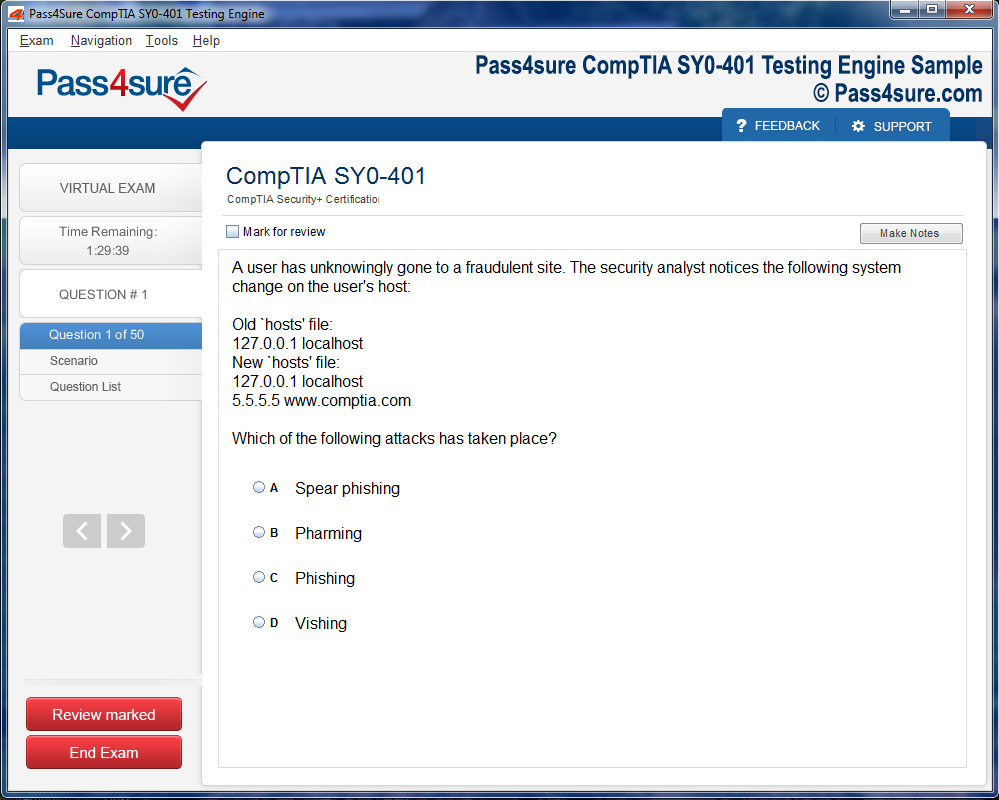
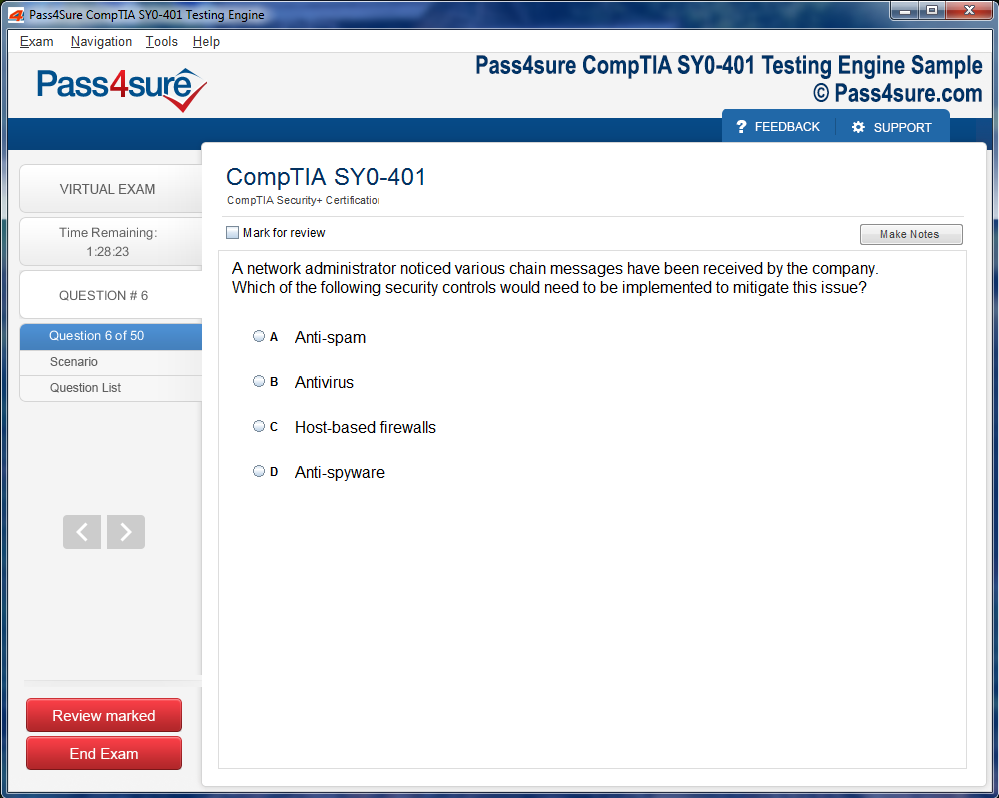
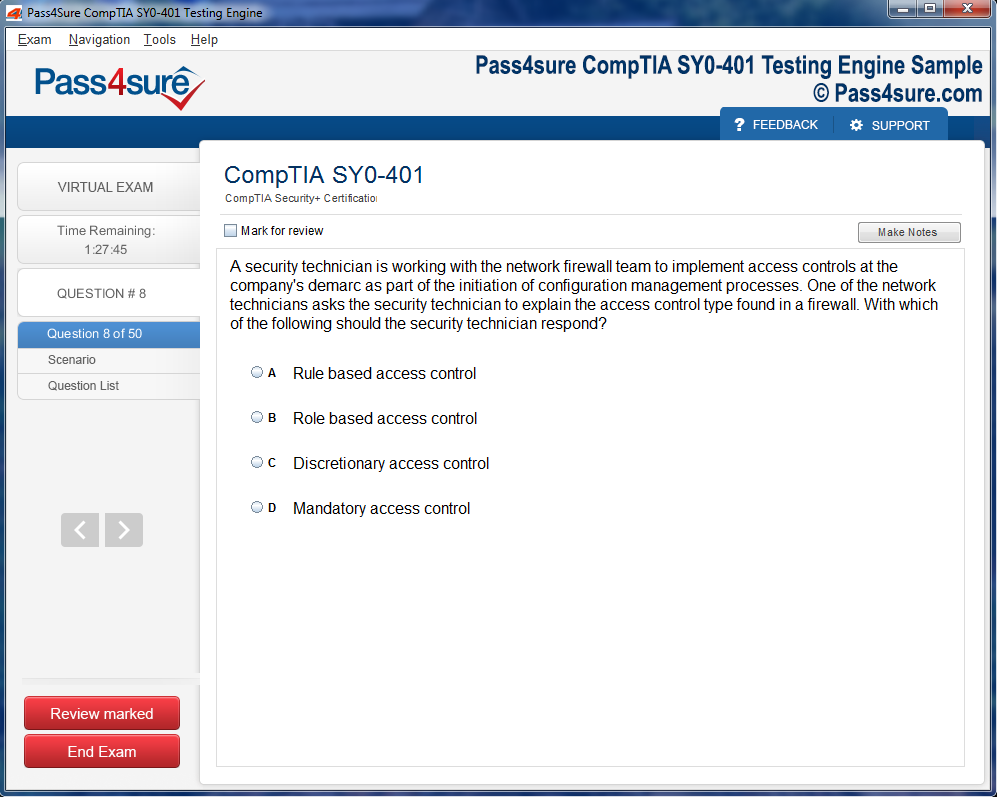
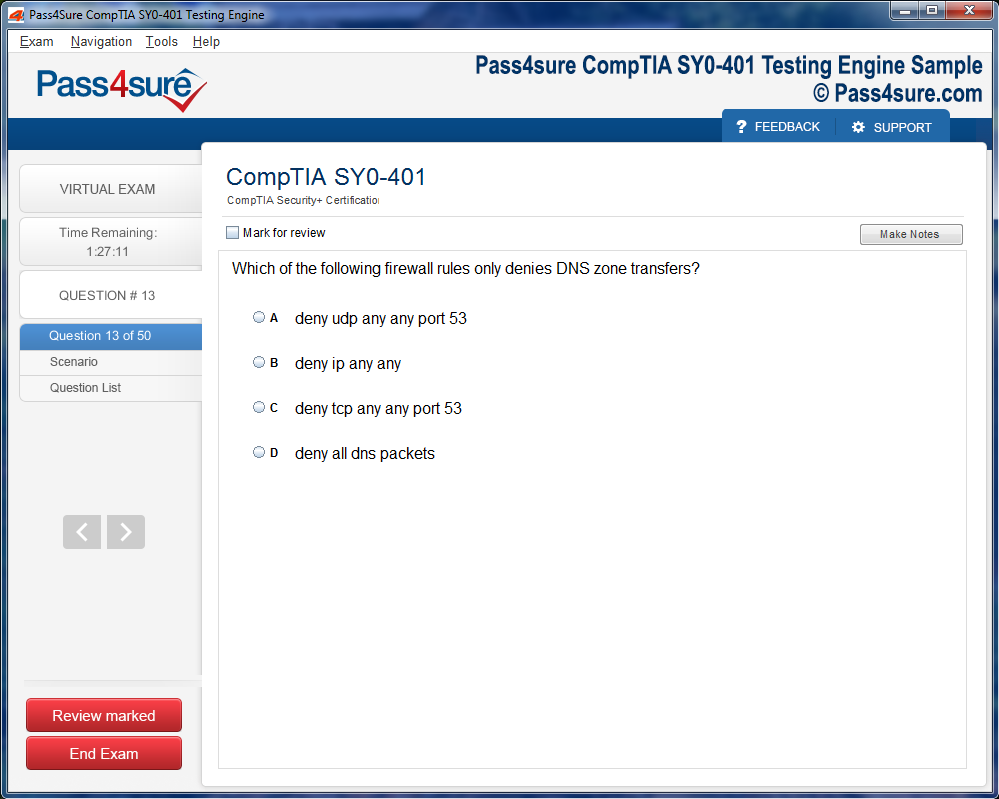
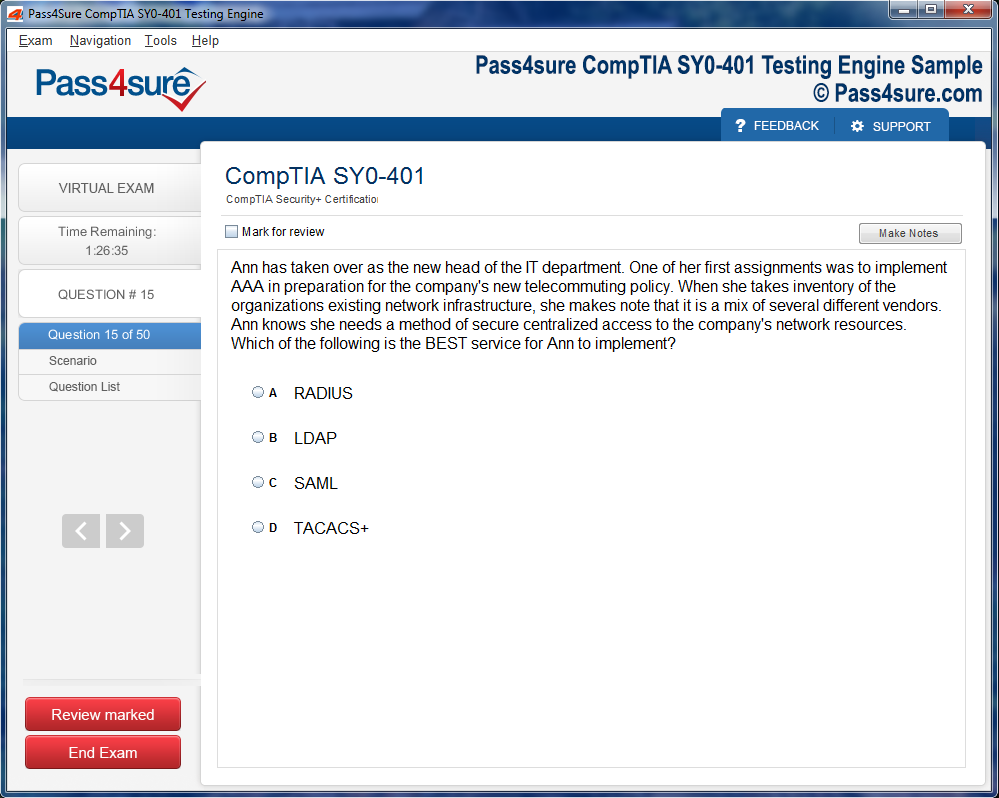
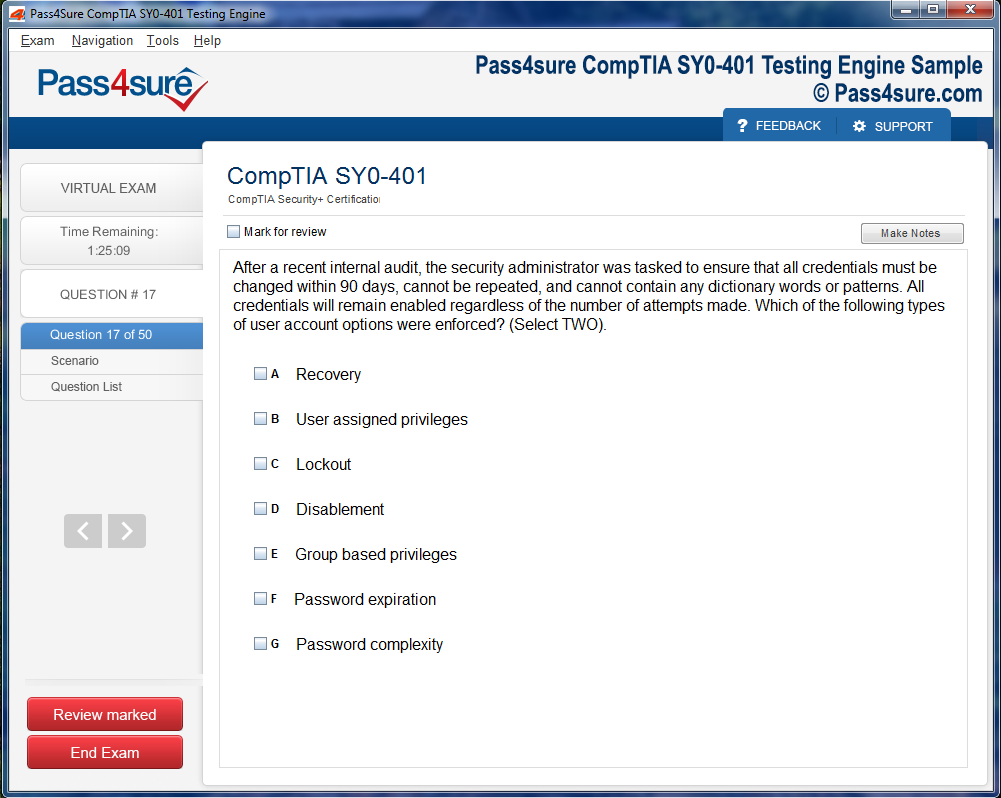
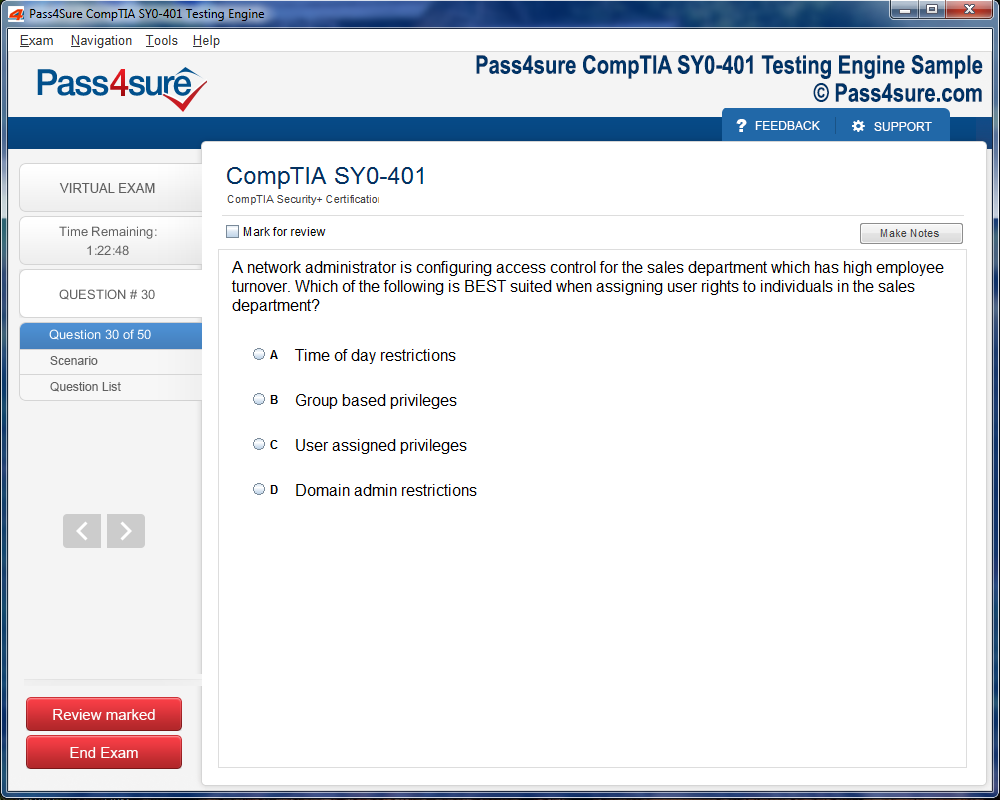
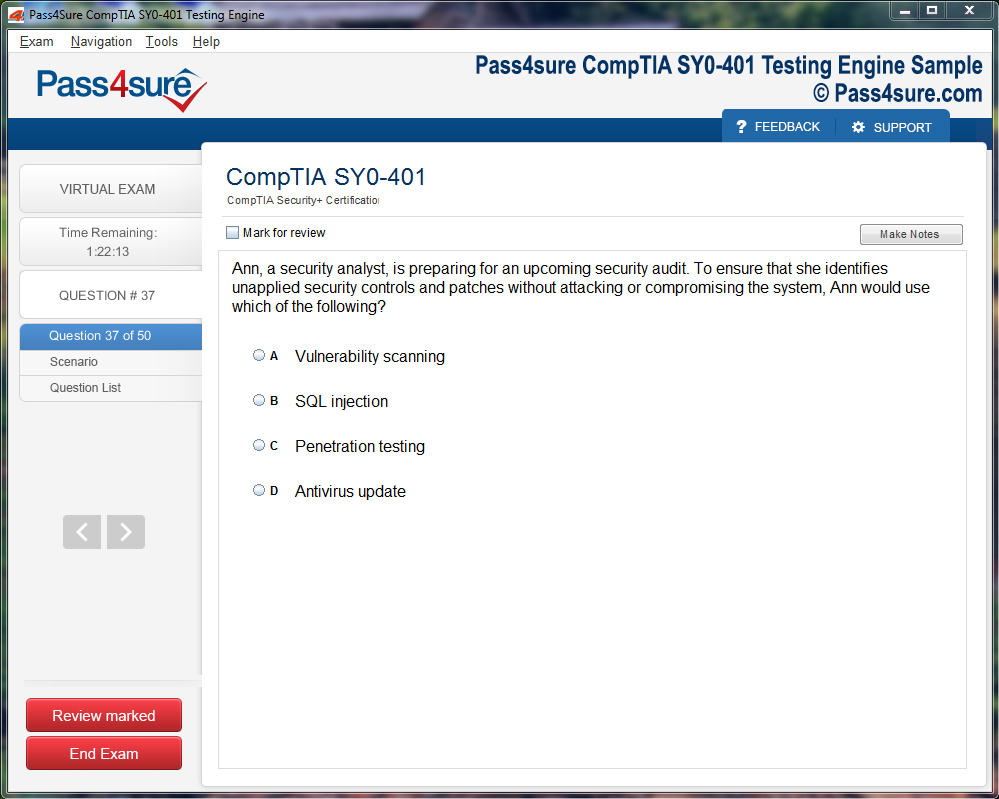
Product Screenshots
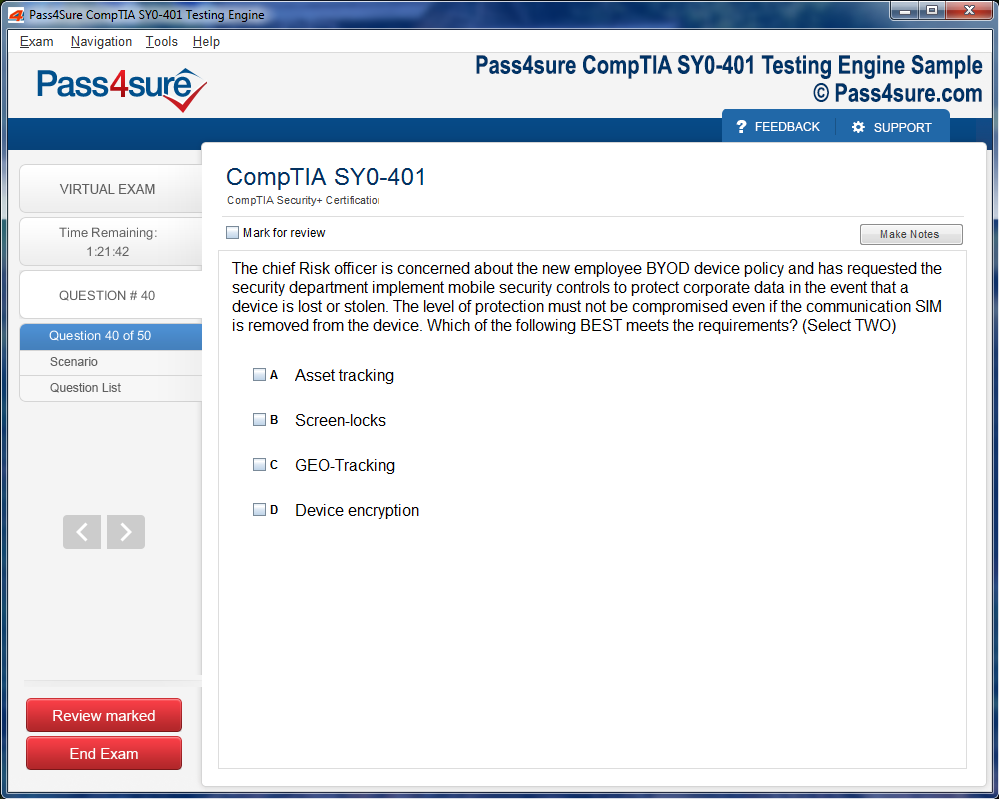
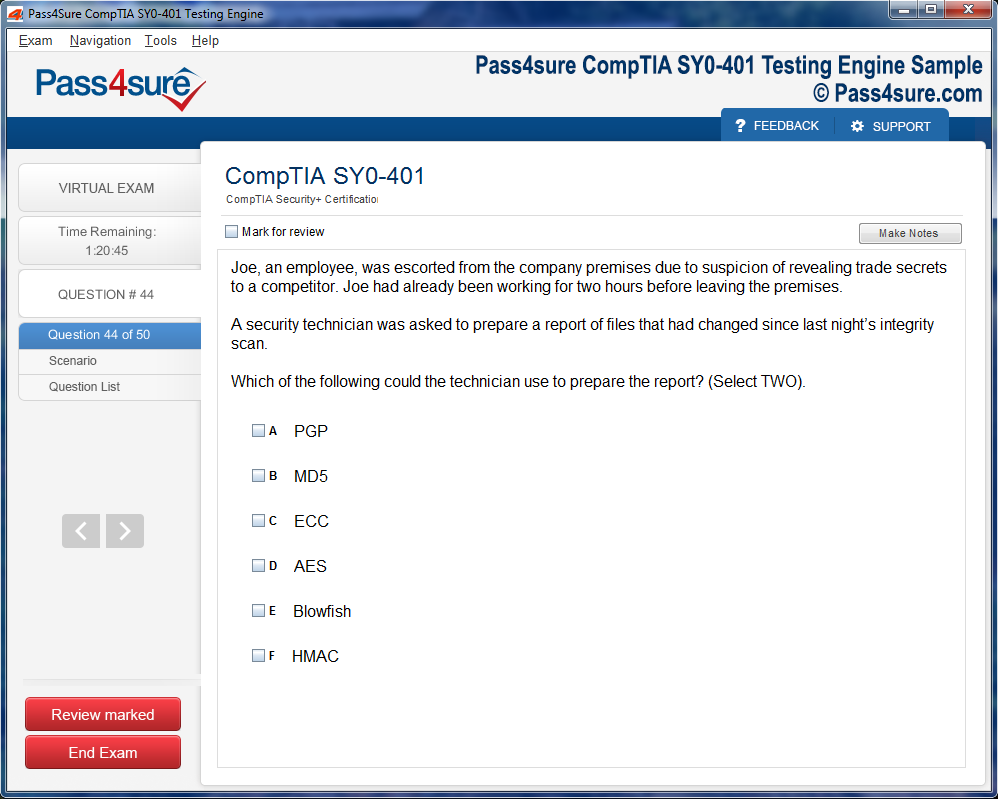
Frequently Asked Questions
How does your testing engine works?
Once download and installed on your PC, you can practise test questions, review your questions & answers using two different options 'practice exam' and 'virtual exam'. Virtual Exam - test yourself with exam questions with a time limit, as if you are taking exams in the Prometric or VUE testing centre. Practice exam - review exam questions one by one, see correct answers and explanations.
How can I get the products after purchase?
All products are available for download immediately from your Member's Area. Once you have made the payment, you will be transferred to Member's Area where you can login and download the products you have purchased to your computer.
How long can I use my product? Will it be valid forever?
Pass4sure products have a validity of 90 days from the date of purchase. This means that any updates to the products, including but not limited to new questions, or updates and changes by our editing team, will be automatically downloaded on to computer to make sure that you get latest exam prep materials during those 90 days.
Can I renew my product if when it's expired?
Yes, when the 90 days of your product validity are over, you have the option of renewing your expired products with a 30% discount. This can be done in your Member's Area.
Please note that you will not be able to use the product after it has expired if you don't renew it.
How often are the questions updated?
We always try to provide the latest pool of questions, Updates in the questions depend on the changes in actual pool of questions by different vendors. As soon as we know about the change in the exam question pool we try our best to update the products as fast as possible.
How many computers I can download Pass4sure software on?
You can download the Pass4sure products on the maximum number of 2 (two) computers or devices. If you need to use the software on more than two machines, you can purchase this option separately. Please email sales@pass4sure.com if you need to use more than 5 (five) computers.
What are the system requirements?
Minimum System Requirements:
- Windows XP or newer operating system
- Java Version 8 or newer
- 1+ GHz processor
- 1 GB Ram
- 50 MB available hard disk typically (products may vary)
What operating systems are supported by your Testing Engine software?
Our testing engine is supported by Windows. Andriod and IOS software is currently under development.
How to Pass 156-585: Step-by-Step Roadmap for Troubleshooting Experts
The backbone of any Check Point environment is its system architecture, an intricate lattice of interdependent modules, services, and policies. Grasping this architecture requires more than superficial acquaintance; it demands an appreciation for the orchestration of gateways, management servers, SmartConsole integrations, and software blades that collectively determine operational fidelity. Each layer harbors its own potential for aberration, and recognizing these latent failure points is crucial for preemptive troubleshooting.
Start by envisioning the environment as a living ecosystem. Gateways are not mere packet filters—they are sentinels orchestrating rule evaluation, session tracking, and stateful inspections. Management servers serve as the cerebral cortex, dictating policies, distributing updates, and collating logs from distributed nodes. The synchronization between these entities often delineates success from frustration: latency in policy deployment, asymmetric routing, or version mismatches can ripple across the network, manifesting as opaque failures. Observing these interactions in a controlled lab environment imbues your understanding with nuance unattainable through theory alone.
Software blades introduce another layer of sophistication. VPN, IPS, Anti‑Virus, and URL Filtering blades interlace, creating dependencies that are invisible until they malfunction. The inter-blade dynamics necessitate a detective-like mindset, probing logs and tracing packet flows while considering cascading effects. Grasping this lattice allows you to anticipate emergent behavior, where seemingly minor misconfigurations precipitate disproportionate operational anomalies.
The architecture also encompasses ancillary services: High Availability clusters, monitoring probes, and the ubiquitous log servers. Each is a node of potential divergence. A subtle misalignment in cluster heartbeats or logging intervals can obscure the root cause of failure. The aspirant who appreciates the ecosystem holistically will navigate these complexities with agility, distinguishing between symptomatic noise and the locus of dysfunction.
Mastering Policy and Rule Interdependencies
In Check Point environments, policy is law, and the interplay of rules dictates system behavior. This interdependence can resemble a chessboard of infinite permutations, where a single misplaced rule can cascade into network paralysis. Understanding this dynamic requires a shift from memorization to analytical cognition—recognizing patterns, foreseeing rule collisions, and appreciating the precedence hierarchy that governs traffic evaluation.
The novice often underestimates the subtleties inherent in rule configuration. Shadows, redundancies, and implied rules create a labyrinth that only experience can demystify. Troubleshooting requires discerning not just which rule triggered, but why it did so in context with others. Logs become your cartography, mapping packet journeys and illuminating policy decisions. Within this space, attention to detail is paramount: a slight misalignment between topology definitions or an overlooked object reference can masquerade as a systemic failure.
VPN policies further exemplify the subtleties of interdependencies. Tunnel negotiations, encryption suites, and authentication mechanisms intersect with core firewall rules in ways that are rarely linear. Misdiagnosis often stems from isolating one element without considering the ripple across dependent services. Cultivating an integrative perspective enables anticipation of multifaceted disruptions and accelerates corrective action.
Performance Tuning – The Invisible Leverage
Performance is the unsung dimension of troubleshooting, often underestimated until throughput degradation becomes overt. Tuning a Check Point environment transcends mere parameter adjustments; it is a meticulous dance of resource allocation, session management, and process prioritization. A gateway under duress can exhibit latency, dropped connections, or erratic logging behavior, each symptomatic of underlying resource contention.
Profiling system performance demands a combination of empirical measurement and intuitive foresight. CPU spikes, memory saturation, and I/O bottlenecks are not isolated metrics—they interlock, producing emergent behavior that can obfuscate root causes. Mastery arises from recognizing subtle precursors: incremental increases in connection tables, anomalous thread utilization, or shifts in disk latency patterns. Each anomaly is a signal amidst the noise, directing attention toward actionable interventions.
Performance tuning also extends to software blades, whose collective consumption can dramatically impact throughput. Strategically enabling or disabling blades, adjusting inspection modes, or redistributing traffic flows allows for nuanced optimization. The aspirant who appreciates these interdependencies transforms performance tuning from reactive firefighting into proactive orchestration, ensuring resilience under both nominal and stress conditions.
Log Analysis – Deciphering the Digital Palimpsest
Logs are the DNA of troubleshooting, encoding the history of every transaction, policy evaluation, and system anomaly. Yet, they are also a digital palimpsest: layers of information, overwritten, obfuscated, and occasionally contradictory. The ability to decipher this code is less about pattern recognition alone and more about cultivating an investigative sensibility—anticipating where critical signals may hide and interpreting them against the backdrop of system complexity.
Effective log analysis begins with understanding their provenance and granularity. Gateway logs, SmartEvent records, and management server audits each provide different perspectives, akin to viewing a cityscape from ground level versus a drone. The analyst must synthesize these perspectives, triangulating evidence to identify discrepancies, correlations, and causal threads. Minute details—timestamp mismatches, session anomalies, or unexpected protocol flags—often carry disproportionate significance.
Moreover, logs reflect not only technical states but operational behaviors. Misconfigurations, policy conflicts, and failed updates imprint themselves in patterns that, once internalized, accelerate diagnosis. The expert learns to read beyond literal messages, interpreting systemic intent, emergent trends, and potential future failures. Over time, log analysis evolves from a mechanical activity into a form of digital intuition.
Core System Dynamics and Interdependency
The Check Point universe operates less like a linear machine and more like a symphonic ecosystem. Every daemon, kernel module, and database domain participates in an intricate choreography of stateful awareness and event-driven reaction. Misunderstanding one facet can cascade into unexpected perturbations across the network. The logging engine, for instance, is deceptively unassuming yet pivotal; it translates ephemeral packets into structured records, mediating between ephemeral memory buffers and the persistent database. Its misalignment, whether due to misconfigured rotation policies or delayed write operations, can obfuscate forensic investigations. Observing these conduits in situ allows one to appreciate not merely their function but their latent interdependence.
High-throughput environments illustrate this complexity vividly. SecureXL, designed to accelerate traffic, does so by offloading cryptographic operations and bypassing superfluous inspection paths. Yet when combined with resource-intensive VPN tunnels, the system may encounter contention at kernel boundaries, manifesting as transient packet drops or erratic latency. Only by constructing multi-tiered simulations can one apprehend the nuanced interplay between acceleration modules, kernel packet hooks, and VPN negotiation engines.
Kernel and Daemon Symbiosis
The kernel firewall is the fulcrum of system integrity, anchoring policy enforcement at a level where user-space abstractions cannot intrude. Its symbiosis with user-space daemons such as fwm, vpn, and cpwd extends beyond mere instruction relay; it is a dance of synchronization, error handling, and state mirroring. Misconfigurations within policy tables or routing heuristics ripple across daemons, sometimes producing opaque behaviors that challenge even seasoned engineers. Each kernel invocation, each logging write, carries with it a potential for emergent properties—unexpected behaviors arising not from explicit errors but from complex interdependent states.
Understanding this symbiosis requires both analytical and empirical rigor. Kernel-level counters, tcpdump traces, and daemon logs provide a narrative of systemic health, but only when interpreted through the lens of intercomponent relationships do they reveal actionable insights. A packet drop may seem trivial until one realizes it occurs concurrently with log queue saturation and SecureXL offload anomalies, indicating a deeper systemic stress. Developing intuition for these interdependencies is akin to cultivating a sixth sense within the infrastructure.
High Availability and Redundancy Complexity
High availability introduces layers of cognitive and operational complexity that are often underappreciated. Redundant gateways and management clustering are not mere duplications; they are stateful mirrors that must negotiate consistency across asynchronous channels. Failover events, while seemingly instantaneous, involve a delicate sequence of session handoffs, state reconciliation, and policy verification. Subtle deviations—out-of-order database writes, temporary desynchronization of security associations—can manifest as transient lapses in connectivity or inconsistent log aggregation.
Multi-domain installations compound these challenges. Segregated policy and object spaces necessitate rigorous domain boundary awareness. Cross-domain interactions, such as shared VPN topologies or centralized reporting, expose latent vulnerabilities. Engineers who approach these environments superficially risk misattributing failures, mistaking surface symptoms for root causes. Immersion in simulated failovers, deliberate log corruption, and controlled latency injections enables a practitioner to internalize these phenomena experientially rather than abstractly.
Logging and Database Domain Intricacies
The logging architecture within Check Point infrastructure exemplifies the marriage of procedural rigor and emergent complexity. Logs traverse ephemeral memory buffers before settling into persistent domains, undergoing indexing, aggregation, and optional replication across management servers. Each domain—System, User, Global, and Log—encapsulates a unique subset of operational reality. Corruption, misallocation, or asynchronous writes in any domain propagate subtle inconsistencies that may surface only under peak load or during incident triage.
Examining log latency and write contention reveals patterns otherwise invisible in static documentation. A delayed VPN event, a kernel drop counter, or a duplicated alert may signal underlying misalignment in database transaction sequences. Awareness of these nuances allows a practitioner to preemptively adjust indexing strategies, balance write workloads, or recalibrate session persistence, transforming routine administration into anticipatory system orchestration.
VPN Negotiation and Encryption Nuances
VPN tunnels are deceptively simple in conceptual diagrams yet profoundly intricate in real-world operation. IKE negotiations, encryption suite selection, and key rotation are tightly coupled with kernel hooks, daemon threads, and traffic acceleration pathways. Misalignment at any phase—be it an unsupported cipher negotiation or truncated key lifetime—can induce silent failures that are challenging to detect without layered monitoring. Observing tunnel establishment in high-churn environments illuminates subtle timing dependencies, session churn thresholds, and ephemeral packet sequencing anomalies.
Practitioners must engage in controlled experimentation, deliberately manipulating key lifetimes, introducing asymmetric latency, and simulating abrupt failovers. Such exercises expose how the system prioritizes state retention, retransmission, and policy enforcement under duress. Mastery emerges not from rote memorization but from repeated exposure to nuanced failure modes and the mental mapping of these behaviors to theoretical architecture.
Observational Learning Through Simulation
Abstract comprehension is insufficient when confronting the unpredictability inherent in distributed security systems. Practical simulation, therefore, becomes a pedagogical imperative. By constructing isolated labs that replicate multi-gateway topologies, high-load traffic patterns, and artificial latency spikes, one internalizes the system’s reflexive behaviors. Observing how log replication handles partial corruption, how state tables reconcile during failover, or how packet acceleration interacts with kernel hooks builds an intuitive model unavailable in textual documentation.
The process of observation, error induction, and reflective analysis cultivates deep expertise. Mistakes become educational vectors, triumphs solidify conceptual understanding, and repeated cycles reinforce the mental model of interdependent systems. This approach transforms theoretical knowledge into operational wisdom, enabling a practitioner to navigate novel scenarios with confidence and agility.
Embracing the Diagnostic Mindset
The crucible of network troubleshooting is not merely technical knowledge, but a cultivated diagnostic mindset. To navigate the labyrinthine intricacies of contemporary architectures, one must fuse meticulous observation with intuitive foresight. Every anomaly is a cipher, every log an incunabulum of latent meaning, waiting to be deciphered. The practitioner’s first imperative is to attune to anomalies before they burgeon into catastrophic failures. High CPU oscillations, cryptic tunnel negotiation failures, or log indexing aberrations are not isolated phenomena; they are signposts signaling hidden discord. Recognition is therefore an act of both vigilance and discernment—a proactive reconnaissance of system physiology.
Isolation as Cartography of Chaos
Once a disturbance is detected, the next phase is isolation, akin to cartography in a chaotic terrain. Here, the aim is to delineate the locus of dysfunction: network pathways, policy matrices, performance nodes, or infrastructural substrates. Tools such as kernel debug probes, management server diagnostics, or traffic capture instruments serve as the cartographer’s instruments, allowing one to chart anomalies with precision. The process involves capturing ephemeral evidence—traces of traffic, daemon statuses, packet drops, or database latencies. Each fragment of data becomes a coordinate in the multidimensional map of system behavior. Misinterpretation is the cardinal sin; lagging or imprecise logs can mislead even the most sagacious diagnostician.
Analytical Exegesis of Systemic Behavior
After isolating the errant domain, the analytical phase begins—a meticulous exegesis of systemic behavior. The diagnostician interprets traffic flows, kernel interventions, and policy enforcements through a lens sharpened by architectural familiarity. Questions proliferate: Why is the VPN negotiation perpetually arrested? Is SecureXL erroneously bypassed? Does a subtle rule shadow obfuscate traffic flow? Analysis demands a fusion of deductive reasoning and imaginative foresight; one must mentally traverse packet pathways, anticipate interactions, and construct probabilistic hierarchies of causality. Root causes are ranked by likelihood and operational impact, guiding subsequent remediation with judicious precision.
Remediation and Experimental Rectification
The execution of remediation is a deliberate choreography informed by the preceding analytical labor. Adjusting kernel parameters, exempting interfaces from acceleration, modifying firewall directives, or re-synchronizing clusters are not ad hoc actions—they are hypothesis-driven interventions. Following remediation, validation is paramount; performance metrics, log integrity, and tunnel negotiation behaviors must be scrutinized to ensure alignment with expected states. If anomalies persist, the workflow recursively loops to isolation, refined by new insights. The iterative nature of this process cultivates an empirical discipline, transforming troubleshooting from reactive improvisation into structured inquiry.
Forensic Logging and Pattern Cultivation
A critical but often neglected element is forensic logging. Recording the anatomy of every incident—symptoms, diagnostic tools, corrective measures, and outcome—is tantamount to constructing a repository of arcane wisdom. Over time, recurring patterns emerge: kernel anomalies correlate with specific daemon behaviors, indexing failures signal systemic bottlenecks. These case studies are not mere documentation; they are cognitive scaffolds that accelerate diagnostic acuity, enabling practitioners to recognize subtle cues with prescient immediacy. Each entry enriches the diagnostician’s cognitive repository, fostering pattern recognition that transcends rote procedure.
Lab-Driven Chaos Engineering
Practical familiarity is cemented through deliberate lab-induced chaos. By simulating misconfigured policies, degraded links, or synthetic CPU spikes, one cultivates agility in recognizing and resolving anomalies under duress. These contrived perturbations mirror real-world uncertainty: error messages may be cryptic, root causes obscured, and system responses unpredictable. Through repeated exposure, the practitioner internalizes the mental models necessary for swift hypothesis formulation, testing, and refinement. Laboratory chaos thus becomes the crucible of experiential mastery, sharpening both analytical and operational reflexes.
Iterative Feedback and Cognitive Amplification
Troubleshooting is inherently iterative. Each diagnostic cycle amplifies cognitive resonance, reinforcing neural pathways that encode both systemic understanding and procedural memory. The interplay between recognition, isolation, analysis, remediation, and validation forms a recursive continuum—a cognitive feedback loop. As one navigates successive cycles, the ability to predict interactions, anticipate bottlenecks, and preempt anomalies becomes almost second nature. This iterative discipline transmutes experiential encounters into refined expertise, where intuition is guided by rigorous empirical grounding.
Strategic Integration of Toolsets
A proficient diagnostician must wield an arsenal of specialized tools with both dexterity and discernment. Kernel debuggers, traffic analyzers, daemon monitors, and policy inspection utilities are not mere instruments—they are extensions of the diagnostician’s cognitive apparatus. Mastery involves knowing not only their operational mechanics but also their epistemic limitations. Misapplied tools can generate misleading data, while judicious application transforms complexity into intelligibility. Strategic integration of toolsets accelerates workflow efficiency and enhances the precision of remedial action.
Cognitive Resilience and Mental Ergonomics
High-stakes troubleshooting demands more than technical skill; it necessitates cognitive resilience. When alarms blare and logs overflow, maintaining mental clarity becomes essential. Structured workflows serve as stabilizing scaffolds, mitigating panic and cognitive overload. Mental ergonomics—allocating attention judiciously, sequencing investigative steps, and pacing analytical effort—enables sustained performance under stress. Cultivating this resilience transforms chaotic incidents into navigable challenges, where analytical poise supplants reactive anxiety.
Pattern Recognition and Predictive Diagnostics
With accumulated experience, pattern recognition evolves into predictive diagnostics. Recurrent anomalies crystallize into archetypal failure signatures. The diagnostician begins to anticipate systemic failures, preemptively adjusting configurations or resources before a disturbance escalates. This prescient capability is a byproduct of methodical observation, forensic logging, and iterative practice. It transcends mere reaction; it becomes a proactive orchestration of system stability, where insight is leveraged as a strategic advantage.
The Symbiosis of Architecture and Workflow
Ultimately, diagnostic efficacy is contingent upon the symbiosis between architectural comprehension and workflow discipline. Architecture supplies the map—an intricate topography of interdependencies, policy hierarchies, and infrastructural nodes. Workflow provides the route—a methodical sequence of investigative and corrective actions. Together, they empower the practitioner to navigate complexity with confidence, transforming seemingly opaque failures into intelligible phenomena. Continuous practice, meticulous logging, and deliberate experimentation further reinforce this symbiosis, cultivating both skill and assurance.
Intricacies of Performance Under Duress
Performance in network security gateways is often an arcane labyrinth. Gateways under sustained traffic may exhibit enigmatic CPU spikes, labyrinthine queues, or lethargic packet forwarding. Culprits often hide in the esoteric recesses of kernel parameters, misconfigured ring buffers, or overlooked acceleration bypasses. The SecureXL mechanism, a keystone for high-throughput processing, can itself become a paradoxical bottleneck when its bypass modes are misunderstood. Adjusting interface parameters, such as rx‑ringsize, is no mere mechanical step; it demands a perspicacious understanding of packet queue orchestration and the daemonic processes that orchestrate traffic flow. A misaligned daemon on the management server can reverberate across the network like an unseen tremor, slowing the entire ecosystem. Mastery emerges not from rote repetition but from discerning these hidden causal threads and experimenting with the subtle interplay of system components.
The Labyrinthine Realm of VPN Tunnels
VPN tunnels, the sinews of secure communication, harbor a multitude of arcana. Tunnel negotiation is an intricate choreography of cryptographic handshakes and policy synchronizations, where a minor misalignment can cascade into cryptic failures. Phase one and phase two of IKE negotiation are more than procedural steps; they are the rhythm of a delicate dance. Capturing traffic at both tunnel termini and parsing kernel-level clues reveals whether failures emanate from asymmetric routing, MTU incongruities, or encryption discordances. Clustered gateways add a further dimension: state synchronization is often a covert saboteur, rendering a seemingly functional configuration treacherous under real traffic. To navigate these tunnels, one must cultivate the acuity to trace a stalled phase to its subtle origin, transforming apparent chaos into comprehensible patterns.
Log Architecture and Management Server Enigmas
Logs and management servers constitute the neural fabric of administrative oversight. When indexing falters or database domains degrade, systemic opacity ensues. Missing logs, delayed query responses, or unresponsive daemons are manifestations of deeper structural perturbations. Comprehending the interplay between critical processes—cpd, solr, fwssd—and discerning which domain houses a misconfiguration is a nuanced art. System, global, log, and user domains each possess distinct behavioral signatures, and their aberrations propagate uniquely across the networked environment. Experimental disruption—disabling a daemon, observing log delays, tracing domain-level anomalies—cultivates the diagnostic acuity required to disentangle these sophisticated interactions. Knowledge of these interdependencies elevates a practitioner from mere operator to analytical virtuoso.
Experimental Methodologies for Mastery
True proficiency arises from deliberate experimentation rather than passive absorption. Inducing high-traffic scenarios elucidates SecureXL’s dynamic behaviors, while intentionally mismatched VPN encryption unravels the mechanics of tunnel failures. Observing the cascade of consequences when a logging daemon is disabled illuminates latent dependencies and exposes systemic fragility. Maintaining meticulous lab notes during such exercises transforms ephemeral observations into enduring expertise. Each deviation from normalcy, every subtle anomaly, becomes a building block for a mental schema of fault diagnosis. This iterative interplay between experimentation and documentation fosters an intuitive grasp of cause and effect, enhancing both practical skills and exam preparedness.
Domain-Specific Diagnostic Reflexes
At the zenith of preparation, one develops a cognitive agility to traverse domains seamlessly. Differentiating performance-induced latencies from policy-induced restrictions, discerning network-layer VPN glitches from cryptographic misalignments, and recognizing that a log server failure may originate from a corrupted database domain are exercises in refined intuition. These reflexes are not merely technical—they are cognitive heuristics, honed through repeated exposure to abnormal scenarios and analytical deduction. The capacity to pivot quickly between potential fault origins, armed with precise empirical evidence, is the hallmark of advanced proficiency. The practitioner who internalizes these reflexes navigates the exam environment with a deftness that transcends formulaic memorization.
The Art of Exam Simulation and Cognitive Conditioning
As the terminal date for your examination approaches, the realm of learning transmogrifies from passive absorption into kinetic engagement. The cerebral muscle requires more than rote memorization; it necessitates rehearsal under quasi-authentic conditions, a choreography of cognition and instinct. Practice examinations emerge not merely as assessment tools but as crucibles in which mental acuity is honed and neural pathways crystallize into operational fluency. Each trial is a microcosm of the real test, an arena where temporal pressure coalesces with intellectual dexterity.
Temporal Precision and the Mechanics of Practice Exams
Embark upon full-length practice sessions under rigorously timed conditions, for these are the antechambers to mastery. The cadence of questioning, the rhythm of problem-solving, and the symphony of analytical reasoning are all internalized during these orchestrated drills. Yet superficial scoring is insufficient; each misstep demands forensic scrutiny. Was the error architectural, interpretive, or procedural? Did the mental schema misalign with the exigencies of the prompt? Cataloging these lapses in a personal compendium fosters meta-cognitive growth and ensures iterative refinement.
Hybrid Fault Environments and Complexity Escalation
Transitioning to simulated laboratories, complexity becomes the fulcrum of skill consolidation. Simple, isolated exercises give way to multifaceted scenarios wherein multiple anomalies converge simultaneously. Performance degradation may intertwine with high-load conditions, policy misconfigurations, and cluster instability, presenting a labyrinthine landscape akin to production environments. Navigating these intricacies cultivates a cognitive resilience indispensable for real examination conditions, engendering a mindset unflappable in the face of compounded anomalies.
The Dossier of Case Studies as Mental Calibration
By this juncture, a curated dossier of case studies functions as both a compendium and a mental lodestar. Entries such as network phase misalignments, gateway CPU saturations, or service log failures crystallize into instinctual cues. Revisiting this repository prior to each simulation session amplifies retention, ensuring that prior experiential insights are seamlessly integrated into current problem-solving strategies. These vignettes, stored in cognitive memory banks, provide immediate heuristics during high-stress evaluative scenarios.
Refinement, Recuperation, and Cognitive Consolidation
The penultimate days before examination warrant a paradigm shift from exhaustive input to meticulous refinement. Cramming, though seductive, offers diminishing returns and risks cognitive saturation. Instead, focus on synthesis: traverse architectural schematics, review procedural checklists, and internalize command syntaxes that frequently induce error. Mental conditioning is paramount; restorative sleep, strategic pauses, and controlled simulation of exam conditions fortify both mind and reflexes. The brain, primed through calibrated rehearsal, transforms recall into rapid, precise execution.
Embodied Reflexes and Exam-Day Execution
On the day of reckoning, perception and reflex operate as a symbiotic pair. The exam ceases to be an enigma; it metamorphoses into a sequence of familiar patterns, from packet captures and kernel inspections to policy rule diagnostics and VPN negotiation conundrums. The disciplined workflow cultivated during prior simulations manifests as intuitive maneuvering across complex questions. Calm focus replaces anxiety, and each query becomes an arena where rehearsed cognition meets real-time problem-solving with elegance and precision.
Integrating Procedural Memory with Adaptive Reasoning
Procedural memory, the silent substrate of expertise, interlaces with adaptive reasoning as the examination unfolds. Rehearsed sequences, now automated, allow cognitive bandwidth to divert toward novel problem elements. This interplay between ingrained routines and dynamic analysis constitutes the apex of exam preparedness, converting learned reflexes into versatile cognitive instruments capable of navigating unforeseen contingencies.
Mental Fortification Through Environmental Emulation
Replicating exam conditions is more than a perfunctory exercise; it is a form of cognitive conditioning. Silence, temporal constraints, and uninterrupted focus create an environment where stress inoculation occurs naturally. By habituating the mind to the pressures intrinsic to formal assessment, each question faced during the actual exam becomes an echo of practiced experience, reducing panic and enhancing strategic deliberation.
The Synthesis of Knowledge, Skill, and Instinct
Ultimately, mastery in the final preparatory stages is a symphony of knowledge, applied skill, and instinctive acumen. Simulations, practice exams, and meticulously documented case studies converge to form an integrative framework. Within this lattice, intellectual agility flourishes, response time sharpens, and mental models attain a state of operational perfection, ensuring that the culmination of preparation manifests as both confidence and precision.
The Aftermath of Examination Endeavors
Once the examination ordeal concludes, the intellectual and operational odyssey persists beyond mere results. Passing the test is not merely a triumph but a declaration of technical sagacity and methodical acumen. Failing, on the contrary, is a didactic juncture, an invitation to scrutinize cognitive missteps, recalibrate analytical schemas, and enrich experiential logs. Both outcomes are crucibles of professional refinement, shaping a practitioner into one who navigates complexity with equanimity.
The act of preparation itself is a repository of tacit knowledge. Lab simulations, diagnostic workflows, and architectural schematics amalgamate into a cognitive toolkit that extends far beyond the examination room. Engaging with tangible systems post-exam allows for the transmutation of abstract theory into operational dexterity. By immersing oneself in authentic troubleshooting scenarios, one consolidates procedural fluency and deepens the intuitive grasp of systemic interdependencies.
Translating Certification into Career Capital
A credential is only as potent as the narrative that surrounds it. Presenting a newly earned certification demands more than mere enumeration—it requires the orchestration of professional identity around expertise. By integrating credentials into résumés, digital portfolios, and personal branding, one signals not just competence but the capacity to orchestrate intricate troubleshooting across multifaceted technological landscapes. This metamorphosis from a generalist title to a specialized architect of solutions elevates visibility in career trajectories.
Harnessing the certification also entails targeting high-stakes projects. Engagement with complex gateway configurations, high-availability clusters, performance optimization endeavors, and exhaustive log analytics transforms theoretical knowledge into palpable outcomes. Each project serves as a nexus of experiential reinforcement, where strategic application intersects with emergent problem-solving, cultivating both confidence and reputation.
Sustaining Momentum in a Dynamic Domain
Technological milieus are perpetually evolving, and static knowledge rapidly attenuates without deliberate cultivation. The practitioner must attune to evolving software iterations, shifting threat paradigms, and emergent bottlenecks. Maintaining relevancy demands a triad of vigilance: continuous experimentation within lab environments, adaptive engagement with new tools, and the ceaseless pursuit of problem-solving opportunities. Mastery, thus, is not a terminal point but a continuum of deliberate and reflective practice.
Beyond technical maintenance lies cognitive expansion. Delving into peripheral yet allied domains—such as automated diagnostics, anomaly detection, or predictive analytics—augments foundational expertise. The certified professional is thereby positioned not just as a reactor to issues but as a proactive architect of systemic resilience, preemptively mitigating emergent complications and fortifying operational ecosystems.
Institutionalizing Knowledge Through Reflection
Reflection transforms experience into enduring acumen. Post-exam introspection allows practitioners to identify lacunae in comprehension, recognize patterns of recurring difficulty, and refine cognitive heuristics. Maintaining comprehensive logs of troubleshooting exercises, case studies, and iterative resolutions converts episodic experiences into structured repositories of wisdom. This practice fosters meta-cognitive awareness, enabling practitioners to navigate unprecedented scenarios with agility and discernment.
Integrating reflection into organizational culture amplifies both individual and collective capacity. Sharing insights, documenting anomalies, and mentoring peers disseminates hard-won expertise across teams, creating a self-reinforcing cycle of proficiency. Certification, therefore, becomes both a personal milestone and a catalyst for institutional competence, enhancing systemic robustness beyond individual achievement.
The Interplay of Curiosity and Expertise
Certifications, while emblematic of accomplishment, flourish most when intertwined with insatiable curiosity. The inquisitive professional interrogates assumptions, challenges established protocols, and probes latent system behaviors. This perpetual quest for understanding transforms rote competence into nuanced insight, revealing subtleties invisible to the untrained eye. Engagement with emergent troubleshooting paradigms, coupled with experimental audacity, fosters a mindset attuned to innovation as much as resolution.
Curiosity also nurtures resilience. Complex systems invariably harbor unpredictable interactions, and the ability to persist, recalibrate, and iterate becomes the defining trait of an adept troubleshooter. By cultivating intellectual agility alongside procedural rigor, professionals ensure that certification functions not as a terminus but as a launchpad for continuous mastery and strategic impact.
Navigating the Subtle Currents of Professional Identity
Certification is a cartographic instrument for one’s professional identity, delineating contours of expertise that differentiate mere practitioners from architects of systemic clarity. It is not simply a badge of accomplishment but a semiotic signal to peers, collaborators, and stakeholders that one possesses both dexterity and discernment in navigating complex technological ecosystems. Embracing this identity requires conscious curation of reputation, professional narrative, and demonstrable impact.
Practitioners must consider the subtle alchemy of perception and performance. Publicly articulating problem-solving experiences, engaging in peer discourse, and contributing to knowledge repositories all solidify the cognitive and social scaffolding that underpins expert identity. Certification thus becomes a catalyst for professional gravitas, a lens through which one’s actions are evaluated not only for technical accuracy but for strategic insight and ingenuity.
Embedding Certification into Experiential Frameworks
Knowledge, once formalized through certification, attains greater potency when woven into practical experience. The post-exam phase should not merely be contemplative; it must be operational, embedding theoretical comprehension into real-world workflows. This embedding involves a deliberate search for opportunities that mirror exam conditions, translating abstract concepts into actionable interventions within live systems.
In practice, this may manifest as deep-dive analyses of systemic inefficiencies, predictive tuning of performance anomalies, or the orchestration of multi-node deployments under constrained conditions. Each intervention crystallizes principles internalized during preparation, transforming intellectual abstraction into tactile expertise. By doing so, the practitioner bridges the chasm between learned theory and operational execution, cultivating an enduring sense of mastery.
The Semiotics of Certification in Organizational Ecosystems
Certification communicates competence across organizational strata, serving as a lingua franca of technical credibility. It is a symbolic token that conveys readiness for complex problem-solving tasks and nuanced decision-making. Yet, the semiotics of certification extends beyond the individual: it informs team dynamics, project allocations, and stakeholder confidence.
Organizations often unconsciously calibrate expectations based on credentialed expertise. A certified professional is perceived as a steward of reliability, an arbiter of procedural rigor, and a harbinger of innovative troubleshooting. By understanding this perception, practitioners can strategically position themselves for roles that maximize both impact and visibility, leveraging the credential not only as a personal milestone but as an instrument of systemic influence.
Cultivating Adaptive Expertise Beyond Certification
Static knowledge, no matter how comprehensive, risks obsolescence in rapidly evolving technological landscapes. Certification, therefore, should be viewed as a springboard rather than a terminus. Adaptive expertise arises from the interplay between foundational knowledge and emergent challenges, where the practitioner continually recalibrates skills, integrates novel methodologies, and anticipates the shifting contours of systems.
Developing adaptive expertise necessitates deliberate engagement with unfamiliar problem sets, exposure to heterogeneous network architectures, and iterative experimentation under controlled perturbations. By navigating ambiguity with methodological rigor, professionals cultivate cognitive elasticity, enabling them to transfer knowledge fluidly across domains and to innovate in contexts previously unencountered.
The Reflexive Practitioner: Reflection as Strategic Instrument
Reflection is not passive rumination; it is a deliberate, methodical process of self-examination that converts experience into strategic intelligence. Post-certification reflection encompasses multiple dimensions: procedural efficacy, conceptual clarity, and situational adaptability. Practitioners document anomalies, synthesize recurring patterns, and interrogate the causal architecture of failures and successes alike.
By maintaining reflective repositories—comprising detailed case studies, annotated logs, and analytic frameworks—professionals cultivate meta-cognitive faculties. These faculties enhance situational acuity, allowing one to anticipate emergent complications and to craft proactive remediation strategies. Reflection thus becomes both a lens for understanding the past and a compass for navigating the uncertainties of future engagements.
Leveraging Networks and Knowledge Ecosystems
Certification gains exponential value when integrated into broader networks of knowledge exchange. Engaging with peer communities, participating in forums, and contributing to collective problem-solving initiatives amplifies the cognitive returns of preparation. These ecosystems provide not only access to rare insights but also opportunities for collaborative innovation and benchmarking against emerging standards of excellence.
Knowledge ecosystems also function as crucibles for reputational capital. Active participation signals curiosity, commitment, and competence, enhancing one’s visibility and credibility within professional circles. By synthesizing individual expertise with collective intelligence, practitioners create a dynamic interplay where personal skill development and communal advancement are mutually reinforcing.
Embodying the Principles of Resilient Problem Solving
Resilience in troubleshooting extends beyond technical acumen; it encompasses psychological fortitude, methodological patience, and strategic adaptability. Post-certification professionals encounter scenarios that defy textbook paradigms, requiring an equilibrium between systematic investigation and creative improvisation. Embodying resilience entails maintaining composure amidst ambiguity, iteratively testing hypotheses, and extracting insights from iterative failures.
The cultivation of resilient problem-solving also benefits from narrative framing. Viewing challenges as episodic learning opportunities rather than terminal failures fosters cognitive elasticity. Over time, this approach engenders a habitual orientation toward exploration, risk calibration, and innovative solution design, reinforcing the practitioner’s capacity to navigate complexity with confidence.
Strategic Projection of Credentialed Expertise
The projection of expertise is an intentional act, where certification serves as both credential and conduit. Professionals must consciously curate how their capabilities are perceived across diverse contexts—from executive briefings to peer collaborations, from project proposals to cross-functional initiatives. Effective projection involves articulating both methodological sophistication and pragmatic value, translating technical skill into strategic advantage.
By strategically showcasing credentialed expertise, professionals gain access to high-stakes assignments, leadership opportunities, and innovative project streams. The credential, therefore, operates as a lever, amplifying the reach of one’s capabilities while signaling readiness to operate at the intersection of technical depth and organizational impact.
The Synergy of Curiosity and Methodical Rigor
Curiosity, when fused with methodical rigor, catalyzes deep professional evolution. Certification validates foundational knowledge, but curiosity drives exploration beyond conventional boundaries, prompting practitioners to investigate latent system behaviors, emergent inefficiencies, and uncharted optimization pathways. Methodical rigor ensures that this exploration yields actionable intelligence rather than unstructured observation.
This synergy engenders a virtuous cycle: curiosity prompts experimentation, experimentation refines methodology, and refined methodology deepens understanding. Practitioners who cultivate this interplay position themselves not merely as responders to operational challenges but as proactive architects of systemic intelligence, continually expanding the frontiers of expertise.
Integrating Certification into Long-Term Professional Trajectory
A credential should be seamlessly interwoven into a broader vision of career evolution. Strategic integration involves identifying domains where certification confers distinct advantage, mapping potential growth pathways, and aligning experiential opportunities with long-term professional aspirations. By embedding certification into the trajectory itself, one ensures that its value compounds over time, reinforcing both skill development and strategic positioning.
Long-term integration also necessitates vigilance against stagnation. Practitioners must periodically reassess skill relevance, seek advanced certifications or specialized modules, and remain attuned to industry trends. This proactive orientation transforms certification from a static milestone into a dynamic instrument of continuous advancement.
Layered Simulation and Cognitive Elasticity
As your preparation intensifies, simulation evolves beyond mere replication into a nuanced calibration of cognitive elasticity. Each scenario, deliberately layered with intertwined faults, functions as a training ground for mental adaptability. The mind is compelled to navigate concurrent anomalies, parsing each signal amidst noise. This deliberate complexity cultivates the capacity to maintain equilibrium under informational overload, a skill critical when encountering unanticipated permutations in the actual examination. By internalizing these hybrid scenarios, candidates transform procedural knowledge into reflexive expertise, rendering seemingly chaotic situations into manageable, methodical workflows.
Temporal Acuity and Exam Rhythm Synchronization
Temporal acuity becomes indispensable in the penultimate phase of exam readiness. The mind must internalize the rhythm of questioning, attuning itself to pacing subtleties that influence decision accuracy. Practice exams, administered under strict timing, cultivate an intrinsic sense of temporal orchestration. This attunement extends beyond mere time management: it fosters anticipatory cognition, allowing candidates to preempt bottlenecks, allocate attention efficiently, and optimize cognitive resources. Through repetitive exposure to timed trials, neural circuits associated with both rapid recall and meticulous analysis are strengthened, creating a harmonious synchronization between cognition and chronometry.
Cognitive Triage and Prioritization Under Duress
Simulated examinations and intricate lab scenarios teach the art of cognitive triage. Under duress, the ability to discern which anomalies demand immediate intervention versus those suitable for deferred resolution is critical. By practicing prioritization in high-pressure simulations, candidates develop heuristic frameworks that optimize diagnostic efficiency. Mental triage reduces cognitive clutter, enabling the mind to operate within its peak functional bandwidth. This capacity to strategically allocate attention becomes a differentiating factor between proficient performance and reactive fumbling, especially when confronted with multi-layered, intertwined problems in real exam conditions.
Iterative Refinement Through Error Analysis
Errors in practice exercises are not failures but invaluable data points for iterative refinement. Meticulous analysis of missteps—whether misinterpretation, oversight, or incomplete procedures—facilitates the construction of a feedback loop that accelerates mastery. Candidates are encouraged to document errors with granularity, annotating the cognitive or procedural lapse that precipitated each mistake. Revisiting these records transforms isolated errors into actionable insights, embedding corrective strategies into long-term memory. This reflective practice, sustained over successive simulations, forges a resilient, self-correcting problem-solving approach.
Multidimensional Scenario Integration
By now, simulations encompass multidimensional scenarios that integrate networking anomalies, system performance irregularities, and configuration inconsistencies. These synthetic landscapes mirror the multidomain challenges of professional practice, demanding simultaneous application of theoretical knowledge, diagnostic reasoning, and procedural precision. Navigating such compounded scenarios not only reinforces technical proficiency but also sharpens adaptive cognition. Candidates learn to anticipate ripple effects, identify hidden dependencies, and implement interventions that are both immediate and sustainable. Each simulation thus functions as a rehearsal for complex, real-world problem-solving under pressure.
Embodied Memory and Procedural Fluency
Repetition of high-fidelity simulations nurtures embodied memory—a cognitive state where procedures become instinctive, almost reflexive. Embodied memory allows the candidate to bypass conscious deliberation for routine sequences, freeing cognitive bandwidth for novel or unexpected contingencies. Procedural fluency, derived from countless iterations of simulation, transforms laborious steps into automated actions, enhancing both speed and accuracy. This deep integration of action and cognition ensures that exam scenarios, regardless of their complexity, can be approached with poised efficiency and strategic insight.
Adaptive Heuristics and Dynamic Problem-Solving
Beyond rote procedural knowledge, successful candidates cultivate adaptive heuristics—flexible mental shortcuts informed by prior experience and simulation exposure. These heuristics empower rapid assessment of novel problems, allowing for immediate triage and targeted intervention. Dynamic problem-solving becomes a dance between pattern recognition and analytical reasoning, where instinct is guided by a scaffold of practiced methodologies. The mind, conditioned by layers of scenario complexity, can identify critical paths amidst a tangle of variables, reducing ambiguity and enhancing the precision of decisions under temporal and cognitive pressure.
Integrating Technical Knowledge with Situational Awareness
Technical expertise is insufficient in isolation; situational awareness amplifies its efficacy. Each practice session and simulation cultivates a meta-cognitive understanding of the exam environment, including the interdependencies between system components, the typical flow of anomalies, and the emergent behaviors of complex infrastructures. By internalizing these systemic patterns, candidates develop anticipatory reasoning, capable of predicting potential failures and implementing preemptive corrections. This integration of granular knowledge with holistic awareness enhances both confidence and performance under authentic exam conditions.
Mental Fortification Through Stress Conditioning
Simulated environments also function as arenas for cognitive stress conditioning. Exposure to high-pressure scenarios in controlled settings allows candidates to habituate to the emotional and physiological responses triggered by time constraints, unexpected problem sequences, and escalating complexity. Repeated immersion in such conditions strengthens resilience, ensuring that the mind remains composed and analytical when confronted with the real exam. Stress conditioning transforms potential panic into focused concentration, enabling candidates to leverage heightened arousal for optimal cognitive performance.
Procedural Sequencing and Decision Pathways
Every successful intervention relies on procedural sequencing—the strategic ordering of diagnostic and corrective actions. Through iterative simulations, candidates internalize decision pathways, developing an intuitive sense of causality and effect within complex systems. This internalized sequencing reduces hesitation, streamlines interventions, and mitigates the risk of compounding errors. By rehearsing multiple pathways across varied scenarios, the mind becomes adept at selecting the most efficient trajectory toward resolution, ensuring both speed and reliability in high-stakes situations.
Cognitive Redundancy and Error Containment
An often-overlooked aspect of advanced preparation is the cultivation of cognitive redundancy. Candidates develop parallel analytical strategies to cross-verify findings and anticipate secondary effects, creating a mental fail-safe against oversight. Redundant cognition serves as an error containment mechanism, ensuring that minor miscalculations do not cascade into systemic failure. This layered analytical approach transforms each problem into a controlled experiment, where multiple lenses converge to confirm diagnosis and intervention accuracy.
Mental Economy and Focused Attention
The final stages of preparation demand a heightened economy of mental effort. Attention, a finite resource, must be allocated judiciously. By refining focus during simulations, candidates learn to recognize the most diagnostically salient cues while filtering extraneous information. Mental economy ensures that cognitive energy is expended on high-value processes, preserving clarity under duress. The disciplined deployment of attention, honed through practice exams and scenario replication, maximizes efficiency and minimizes error in the actual examination.
Intricacies of Performance Under Duress
Performance anomalies often masquerade behind innocuous metrics. A gateway may appear stable while queues silently burgeon, kernel threads become ensnared in mutex contention, or packet processing daemons succumb to starvation. Such conditions are rarely evident from superficial monitoring, requiring a perspicacious eye to discern latent stress. Misconfigured ring buffers, particularly the rx‑ringsize parameter, can produce subtle yet consequential latency. By artificially constraining interface buffers or inducing high packet-per-second flows, the practitioner witnesses the gateway’s microcosmic reaction: minor oscillations in CPU usage, ephemeral drops in throughput, and the sporadic bypass of SecureXL acceleration. These manifestations, while seemingly trivial, are harbingers of deeper systemic misalignments. The ability to interpret these tremors, correlating them with underlying daemon activity and interface configurations, constitutes expertise beyond rote memorization.
When performance degrades under duress, daemons such as fwssd, fwm, and cpwd frequently reveal their presence through unusual log entries or delayed response cycles. Kernel parameters, including rx‑ringsize, rx‑coalescing, and ring buffer thresholds, require meticulous calibration to reconcile throughput with CPU efficiency. Adjusting these parameters without empirical validation can exacerbate bottlenecks; conversely, informed modulation can transform a beleaguered gateway into a paragon of responsiveness. Such interventions are not mere configuration exercises—they are an orchestration of hardware, kernel, and daemon symphonics, where each parameter resonates within a broader performance ecology. Practitioners must cultivate an almost tactile awareness of these interdependencies, sensing performance oscillations as one might perceive a musical cadence.
The Labyrinthine Realm of VPN Tunnels
VPN tunnels are conduits of encrypted flux, their failures often inscrutable without deliberate analysis. Phase one (IKE SA establishment) and phase two (IPSec SA establishment) failures manifest in diverse, sometimes counterintuitive ways. A phase one completion followed by a phase two stall may seem innocuous until scrutinized through packet captures or log examination. Asymmetric routing can introduce ephemeral packet loss, causing retransmissions that are misinterpreted as cryptographic failures. MTU misconfigurations precipitate fragmentation, further obfuscating the diagnostic trail.
Clustered gateway environments amplify these complexities. When two nodes attempt state synchronization amidst transient network jitter, phase transitions can desynchronize, creating phantom tunnel failures that vanish upon stabilization. NAT traversal, often treated as a peripheral concern, interacts with tunnel encapsulation in subtle ways: certain NAT devices inadvertently truncate encapsulation headers, or modify sequence numbers, producing intermittent failures that are profoundly challenging to replicate in lab conditions.
Mastering tunnel diagnostics involves a triad of observation: live packet capture, meticulous log analysis, and controlled misconfiguration experiments. By deliberately introducing mismatched encryption, expired lifetimes, or non-uniform proposals, one cultivates the capacity to recognize root causes amid ostensibly chaotic symptoms. This deliberate confrontation with failure trains the mind to anticipate subtle aberrations, enabling rapid rectification in production environments where mistakes carry tangible consequences.
Log Architecture and Management Server Enigmas
Logs are the cerebral cortex of network security management. When indexing falters, when daemons succumb to unresponsiveness, or when database domains fragment, visibility into the network’s operational state becomes compromised. The ramifications are multifaceted: search queries may return incomplete datasets, alerting thresholds may be bypassed silently, and analytical dashboards may convey misleading impressions of system health.
Understanding the interplay among core processes such as cpwd, solr, and fwssd is imperative. Each interacts with specific database domains—system, global, log, user—each of which manifests errors in characteristic ways. A misaligned solr instance may propagate latency across multiple domains, whereas a misconfigured cpwd may induce erratic heartbeat signals, masking genuine failures. Controlled experiments—disabling individual daemons, corrupting log indices, or redirecting traffic flows—allow the practitioner to map the causality between symptoms and root conditions. Such exercises cultivate a mental topology of the management server ecosystem, where dependencies and failure modes are intuitively understood.
Beyond process-level interactions, the physical storage and indexing mechanisms also influence performance. Fragmented log files, delayed writes, and I/O contention can mimic daemon-level failures. Distinguishing these layers—kernel, daemon, database—is crucial for accurate diagnosis. Logging is not merely about record-keeping; it is a diagnostic discipline that demands analytical rigor and experimental validation.
Experimental Methodologies for Mastery
Empirical experimentation is the crucible in which theoretical knowledge is transmuted into practical mastery. To understand performance, one must engineer high-throughput conditions, monitoring SecureXL’s bypass behavior, interface queues, and CPU microstates. For VPN tunnels, introducing controlled encryption mismatches or asymmetric routing conditions reveals the nuanced interdependencies of negotiation phases. With logs, selectively disabling daemons or corrupting database domains uncovers latent fault propagation paths and clarifies systemic interrelationships.
Maintaining detailed lab journals during these experiments is essential. Recording deviations, environmental variables, and remedial actions converts ephemeral observations into a durable knowledge corpus. Such meticulous documentation not only reinforces memory but also establishes a reference framework for future troubleshooting scenarios. Over time, this iterative cycle of experimentation, observation, and documentation fosters an intuitive, almost instinctual diagnostic capability that transcends conventional study methods.
Domain-Specific Diagnostic Reflexes
Expertise is distinguished not by the ability to follow instructions but by the capacity to traverse problem domains with agility. Performance-related issues, policy-induced restrictions, VPN misalignments, and log server anomalies often share overlapping symptoms, requiring a nuanced understanding to differentiate. Identifying the true locus of a failure demands rapid contextual assessment: discerning whether latency stems from kernel-level congestion, encryption negotiation, or misindexed logs.
Reflexive diagnostic thinking emerges from repeated exposure to diverse fault scenarios. Each encounter strengthens pattern recognition, enabling the practitioner to hypothesize and validate root causes with minimal latency. This cognitive agility is reinforced by the systematic integration of experimental data, where observed behavior is mapped to underlying architecture. Practitioners cultivate the capacity to anticipate cascading effects, predict systemic responses, and implement corrective measures with precision. In high-stakes examination environments, these reflexes confer a decisive advantage, converting complex, multi-layered problems into solvable constructs.
Latency Oscillations and Microburst Dynamics
High-speed traffic does not flow evenly; it pulses in microbursts that stress hardware and software asymmetrically. These oscillations often manifest as fleeting latency spikes or transient packet drops, imperceptible under conventional monitoring. Understanding the microburst dynamics requires capturing metrics at millisecond granularity, analyzing CPU core distribution, and correlating traffic patterns with SecureXL acceleration behavior.
The human tendency is to attribute such phenomena to external network instability, but experienced practitioners recognize the telltale signatures of internal misconfiguration: ring buffers overwhelmed, daemons delayed, kernel queues saturating. By systematically varying traffic patterns, observing latency oscillations, and adjusting kernel parameters, one can normalize microburst effects and enhance throughput stability. This sophisticated understanding transforms ephemeral anomalies into actionable insights, reinforcing the practitioner’s diagnostic toolkit.
Recursive Hypothesis Formulation
In complex environments, initial remediation attempts rarely yield absolute resolution. The expert diagnostician engages in recursive hypothesis formulation, where each intervention is treated as an experiment, and every result is data for the next iteration. This recursive process transforms troubleshooting into a dynamic dialogue with the system, an ongoing negotiation between expectation and reality. When a VPN tunnel remains obstinately down or traffic drops inexplicably despite rule alignment, hypotheses must be reframed. Perhaps timing discrepancies in cluster synchronization or latent state corruption in management databases are at play. By iteratively refining conjectures, one cultivates the ability to anticipate emergent behavior rather than merely reacting to it.
Temporal Analysis of System Dynamics
A crucial but often overlooked facet of troubleshooting is temporal analysis. Systems are not static; they are dynamic organisms whose behaviors unfold over time. Intermittent packet loss, sporadic CPU spikes, or ephemeral session timeouts often elude instant observation, demanding longitudinal scrutiny. Tools that provide temporal granularity—such as advanced logging engines, time-stamped packet captures, and historical performance matrices—allow the diagnostician to perceive patterns invisible in snapshots. Understanding temporal behavior transforms troubleshooting from a reactive exercise into a form of chronometric discernment, where timing irregularities illuminate underlying causality.
Multi-Domain Correlation and Contextual Intelligence
Troubleshooting in isolation is a Sisyphean endeavor. Rarely does a fault reside in a single domain; more often, anomalies span network, policy, performance, and infrastructure. Multi-domain correlation, therefore, is essential. By synthesizing data from disparate sources—firewall logs, kernel traces, daemon metrics, and network performance graphs—the diagnostician cultivates contextual intelligence. Contextual intelligence is the capacity to discern interdependencies and latent interactions, identifying how a policy misalignment in one domain propagates latency in another. This intellectual triangulation transforms fragments of evidence into coherent insight, enabling more precise interventions.
Cognitive Cartography and Mental Simulation
The seasoned practitioner internalizes the architecture into a mental map, a cognitive cartography that allows simulation of packet flows and policy evaluation in silico. Mental simulation is a form of proactive anticipation: one visualizes packet trajectories, predicts potential bottlenecks, and mentally tests corrective measures before executing them in reality. This cognitive rehearsal reduces trial-and-error cycles and mitigates operational risk. By continuously updating this internal map with real-world feedback from diagnostics and lab experiments, the practitioner cultivates a living mental model capable of handling unprecedented anomalies with remarkable agility.
Dynamic Resource Reallocation Strategies
In scenarios of high CPU utilization, memory contention, or degraded throughput, static interventions are insufficient. Dynamic resource reallocation is a critical skill, encompassing both manual and automated strategies. By temporarily adjusting kernel parameters, throttling specific processes, or prioritizing critical flows, one stabilizes the system while diagnostic investigations continue. This approach mirrors principles in chaos engineering: controlled perturbation to identify thresholds and resilience points. Such interventions require a balance between immediate stabilization and minimal disruption, ensuring that remediation does not inadvertently trigger secondary failures.
Root Cause Taxonomy and Failure Archetypes
Developing a taxonomy of root causes is a powerful cognitive tool. By classifying past incidents into archetypal failure categories—configuration drift, daemon corruption, policy shadowing, cluster desynchronization, or hardware degradation—the diagnostician establishes a heuristic framework for rapid triage. When a new issue arises, it is compared against this taxonomy, narrowing hypotheses and accelerating resolution. Over time, the taxonomy evolves into an intuitive matrix, where even subtle deviations from normal behavior suggest probable categories of failure, enhancing both speed and accuracy of diagnostics.
Forensic Data Fidelity and Evidence Hierarchies
Not all diagnostic data are created equal. The principle of forensic fidelity demands that evidence be accurate, timely, and contextualized. Kernel traces, log indexes, and daemon outputs vary in reliability, and recognizing this hierarchy is essential. Misinterpreted or stale data can cascade into flawed conclusions, wasting valuable time. Establishing an evidence hierarchy—prioritizing real-time traces over delayed logs, corroborating multiple sources, and validating anomalous readings—creates a disciplined approach to information synthesis. This methodology ensures that interventions are informed by the most reliable and actionable intelligence available.
Emulation and Scenario Stress Testing
Lab simulations are enhanced when combined with emulation and stress testing. By recreating production-scale conditions, including high throughput, simultaneous VPN sessions, and concurrent policy enforcement events, one observes system behavior under near-real conditions. This exposes latent vulnerabilities that deterministic testing may overlook. Emulation also facilitates exploration of “what-if” scenarios: What if a cluster node fails during peak traffic? What if SecureXL is bypassed on multiple gateways? What if indexing delays cascade into management server timeouts? Each scenario, explored in a controlled environment, enhances readiness for analogous real-world contingencies.
Feedback Loops and Continuous Improvement
Each troubleshooting cycle generates insight, and each insight feeds a feedback loop that propels continuous improvement. This process is not merely technical—it is cognitive. After remediation, reflection on the workflow, the hypotheses, and the tools employed consolidates learning. Which steps were optimal? Where did assumptions mislead? What tools were most effective under which conditions? By systematically analyzing each cycle, practitioners transform isolated experiences into generalized knowledge, improving not only future problem resolution but also their predictive capabilities.
Integrating Automation with Analytical Oversight
While human intuition remains indispensable, strategic automation can augment diagnostic workflows. Scripts for log parsing, automated traffic tracing, and cluster health monitoring reduce the cognitive load and accelerate data collection. However, automation without analytical oversight is perilous: misconfigured scripts or unvalidated metrics may introduce false positives or obscure critical anomalies. The optimal approach integrates automation with human judgment, allowing the practitioner to focus on higher-order analysis, hypothesis formulation, and intervention strategy while routine monitoring and data aggregation are efficiently handled by automated tools.
Anomaly Detection as Cognitive Amplifier
Anomaly detection is more than a technical tool; it is a cognitive amplifier. By highlighting deviations from expected norms, anomaly detection focuses attention on signals most likely to indicate root cause events. The practitioner must calibrate detection thresholds carefully: overly sensitive systems generate noise, while insensitive systems miss early warnings. Coupled with forensic logging and mental simulation, anomaly detection transforms a reactive mindset into a proactive stance, enabling anticipation of failure patterns before they escalate into critical incidents.
Psychological Fortitude in High-Stakes Diagnostics
The human dimension of troubleshooting is often underestimated. High-stakes scenarios—where mission-critical services falter under pressure—require psychological fortitude. Panic and cognitive overload are insidious adversaries, capable of undermining even the most skilled practitioner. Structured workflows, methodical logging, and mental rehearsals serve as stabilizing anchors. Cognitive resilience allows sustained analytical focus, enabling one to maintain clarity and discernment amidst alarms, cascading errors, and pressure from stakeholders. The diagnostic mindset is thus as much psychological as it is technical.
Knowledge Codification and Intellectual Capital
Finally, the accumulation of knowledge through meticulous logging, taxonomy development, lab experimentation, and post-mortem reflection constitutes intellectual capital. This codification transforms ephemeral experiences into enduring resources. Over time, the diagnostician builds a compendium of case studies, failure archetypes, and validated remediation strategies—a personal grimoire of systemic insight. This intellectual capital not only accelerates future diagnostics but also elevates problem-solving capacity to a strategic level, where foresight and anticipation rival the immediacy of reactive intervention.
Conclusion
Preparing for the 156‑585 exam is a journey that blends knowledge, practice, and mindset. It is not merely about memorizing commands or policies, but about understanding the architecture, mastering diagnostic workflows, and developing the intuition to navigate complex troubleshooting scenarios. From laying the groundwork to mastering core systems, refining specialized topics like VPNs, performance, and logs, to simulating real-world scenarios and applying lessons after the exam, every step builds toward expert-level proficiency.
Success comes from consistency, hands-on practice, and reflective learning. By integrating theoretical understanding with lab experiments, documenting your case studies, and practicing under timed conditions, you internalize patterns and develop problem-solving agility. Passing the 156‑585 exam demonstrates not only your technical skills but also your ability to approach challenges methodically and resiliently.
Ultimately, this roadmap is more than a preparation guide—it is a framework for becoming a confident, capable, and resourceful troubleshooting expert. Embrace the process, stay curious, and continue refining your skills beyond the exam. Your certification is a milestone, but your growth as a troubleshooting professional is an ongoing journey.
Top Checkpoint Exams
- 156-215.82 - Check Point Certified Security Administrator R82
- 156-315.82 - Check Point Certified Security Expert - R82 (CCSE)
- 156-587 - Check Point Certified Troubleshooting Expert - R81.20 (CCTE)
- 156-536 - Check Point Certified Harmony Endpoint Specialist - R81.20 (CCES)
- 156-590 - Check Point Certified Threat Prevention Specialist (CTPS)
- 156-835 - Check Point Certified Maestro Expert
- 156-560 - Check Point Certified Cloud Specialist (CCCS)
- 156-582 - Check Point Certified Troubleshooting Administrator - R81.20 (CCTA)
- 156-315.81.20 - Check Point Certified Security Expert - R81.20
- 156-215.81.20 - Check Point Certified Security Administrator - R81.20 (CCSA)