

Exam Code: 156-835
Exam Name: Check Point Certified Maestro Expert
Certification Provider: Checkpoint
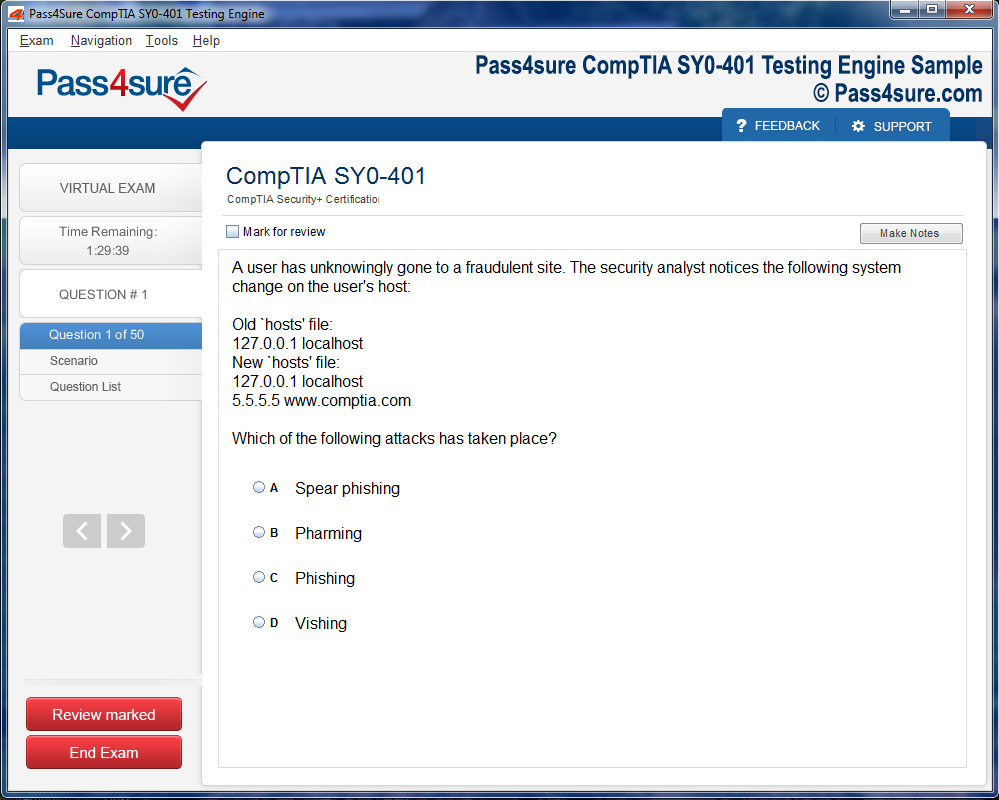
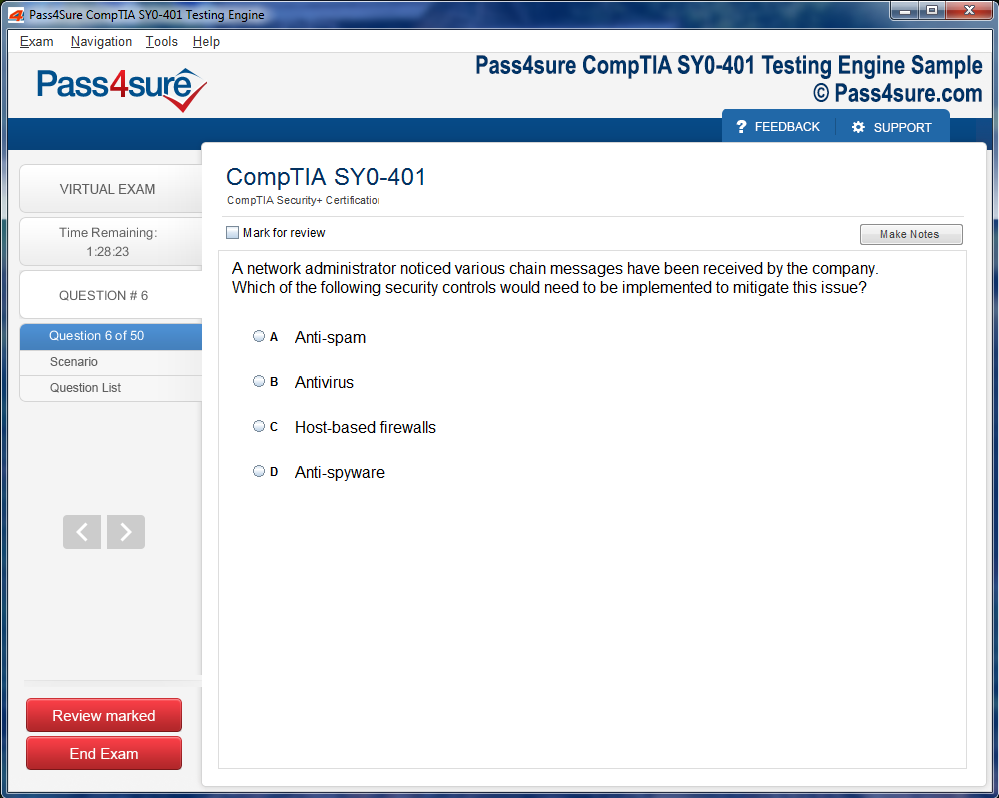
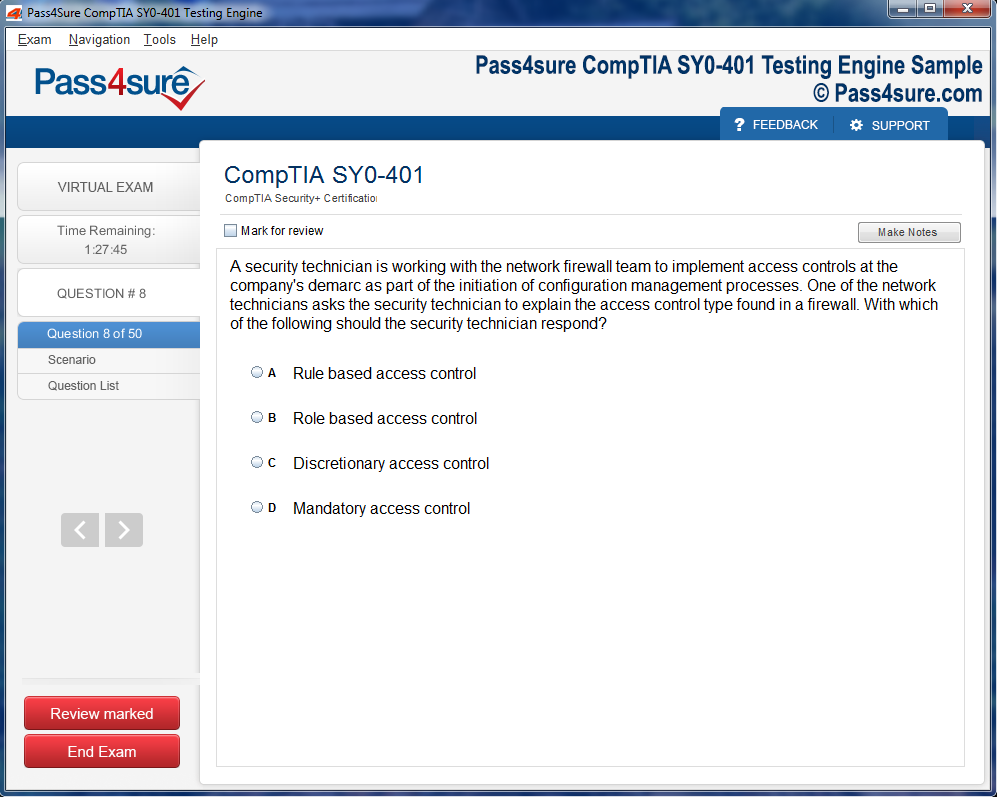
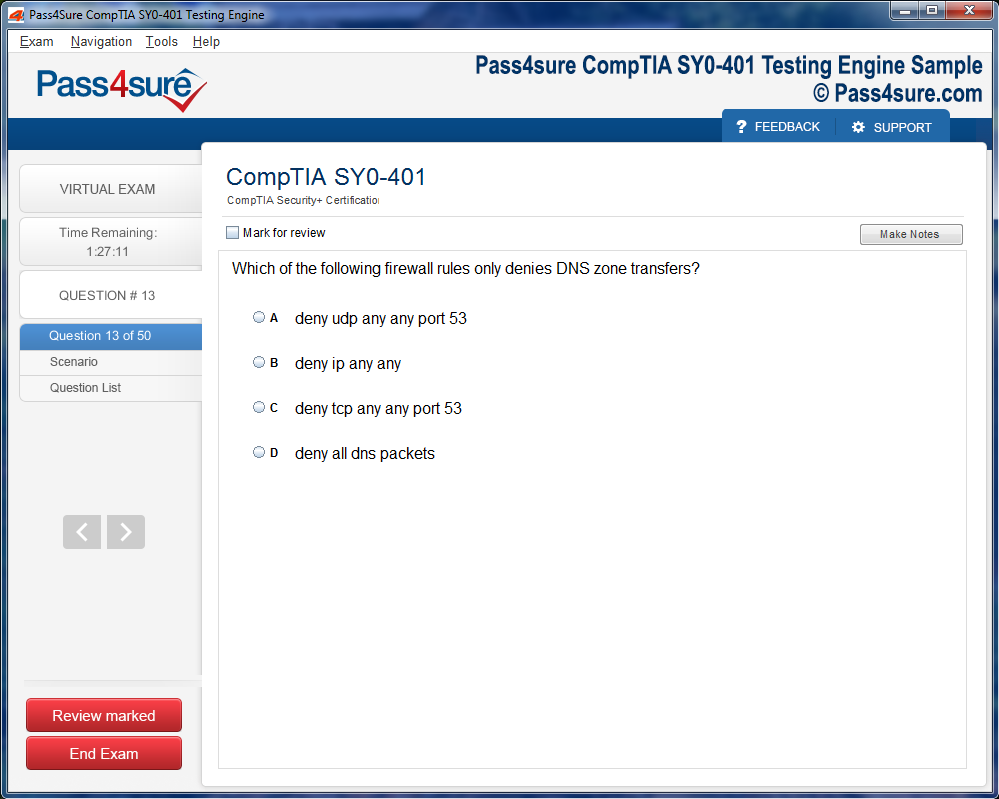
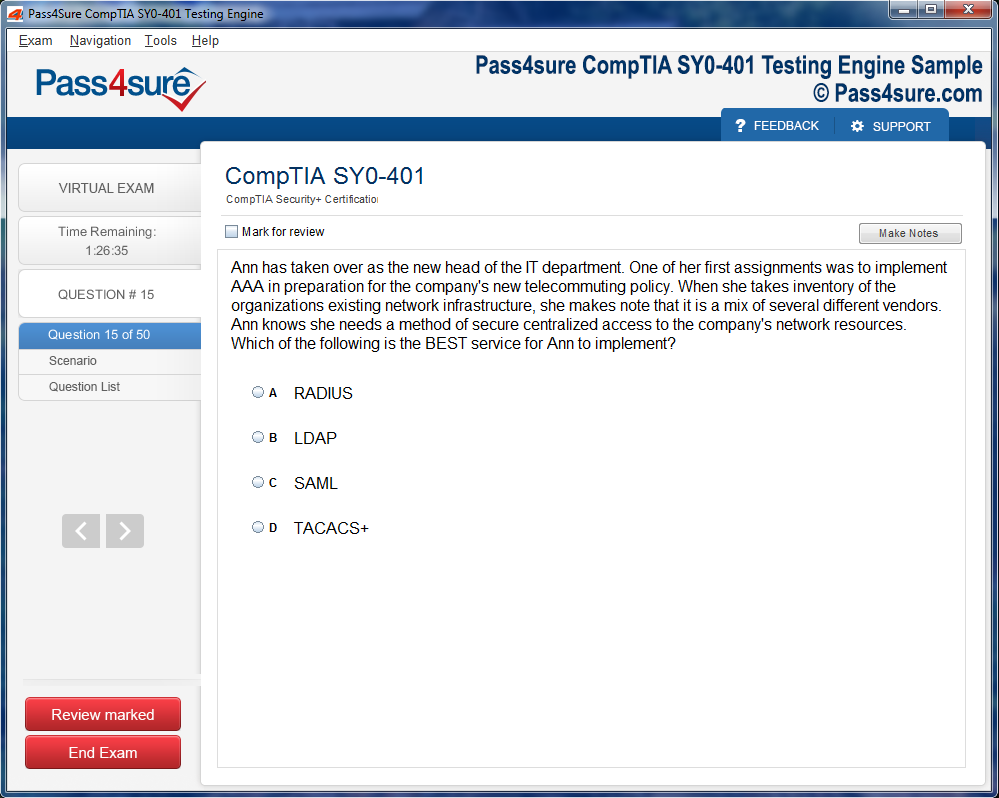
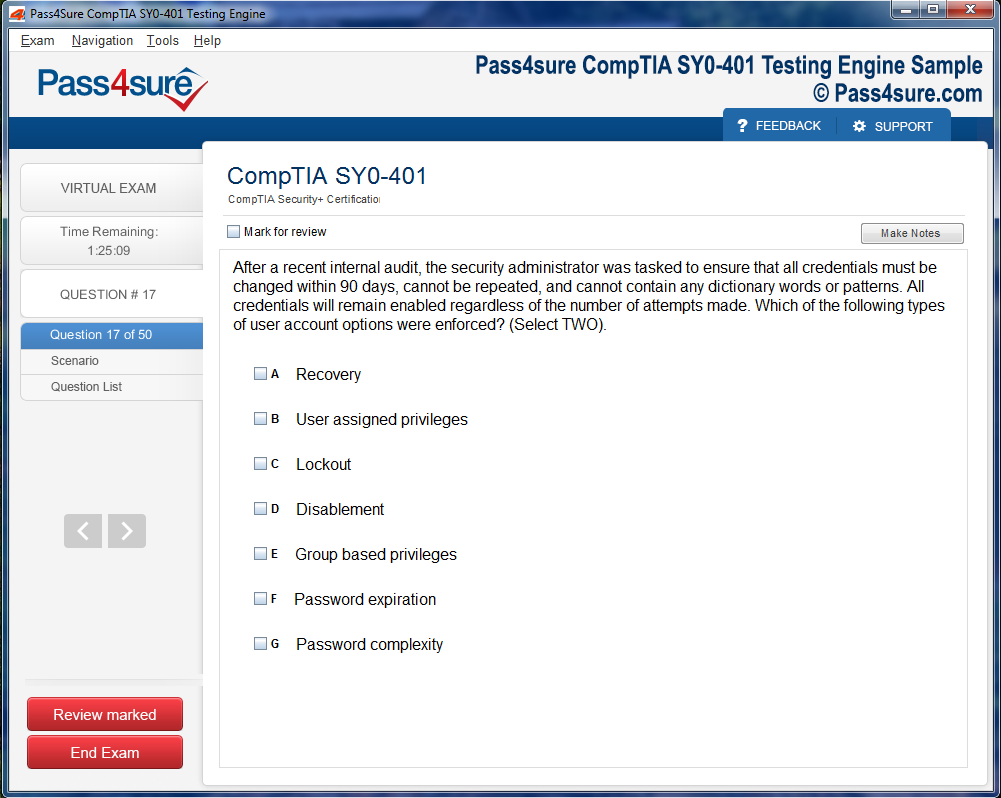
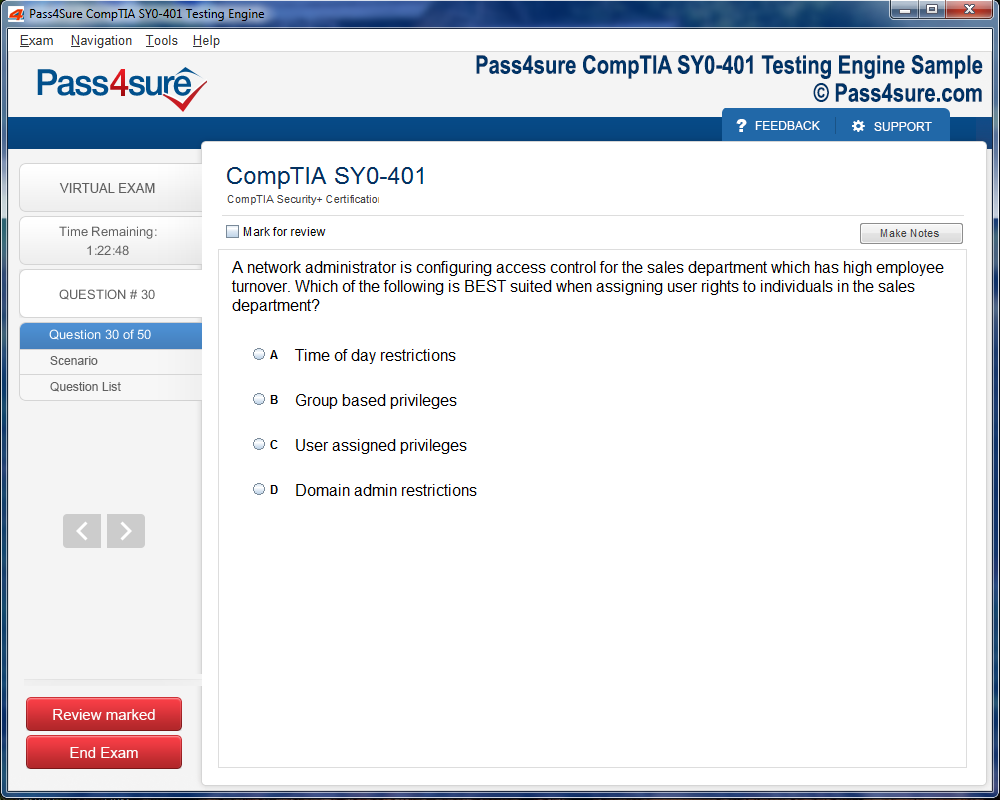
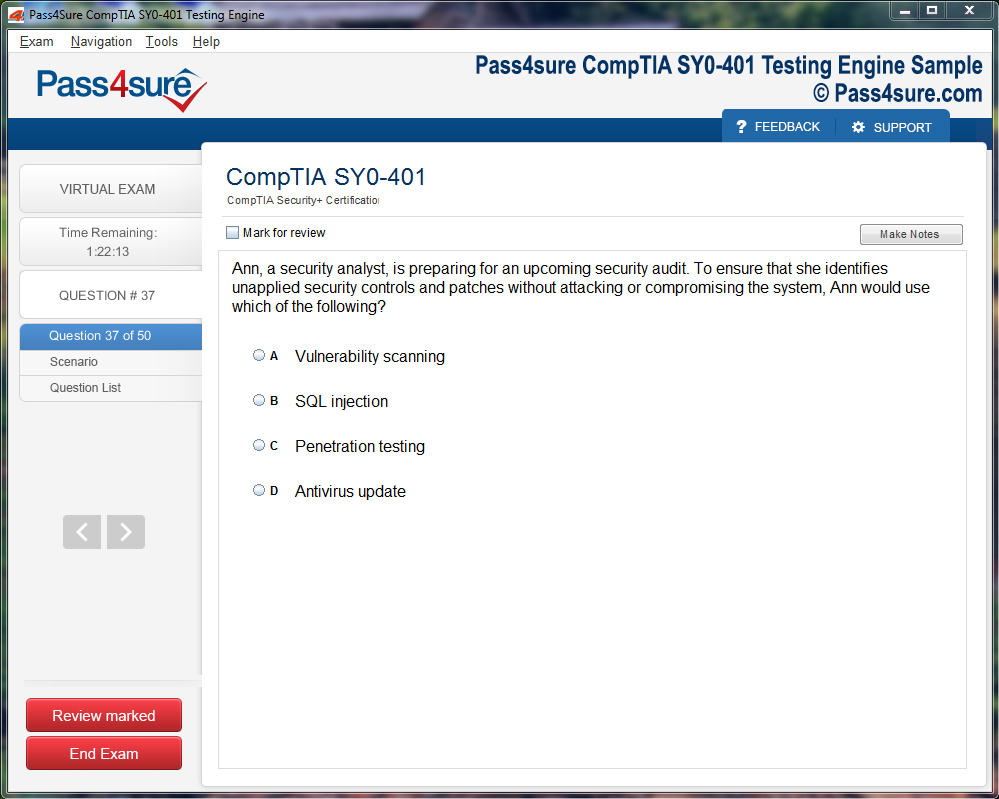
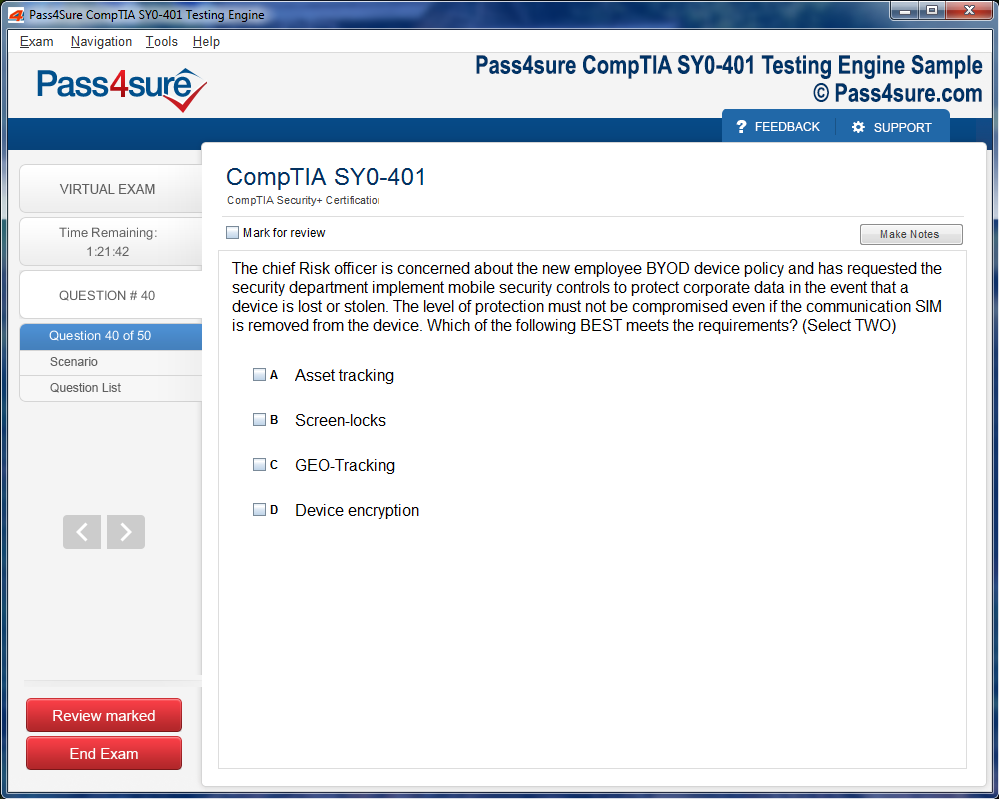
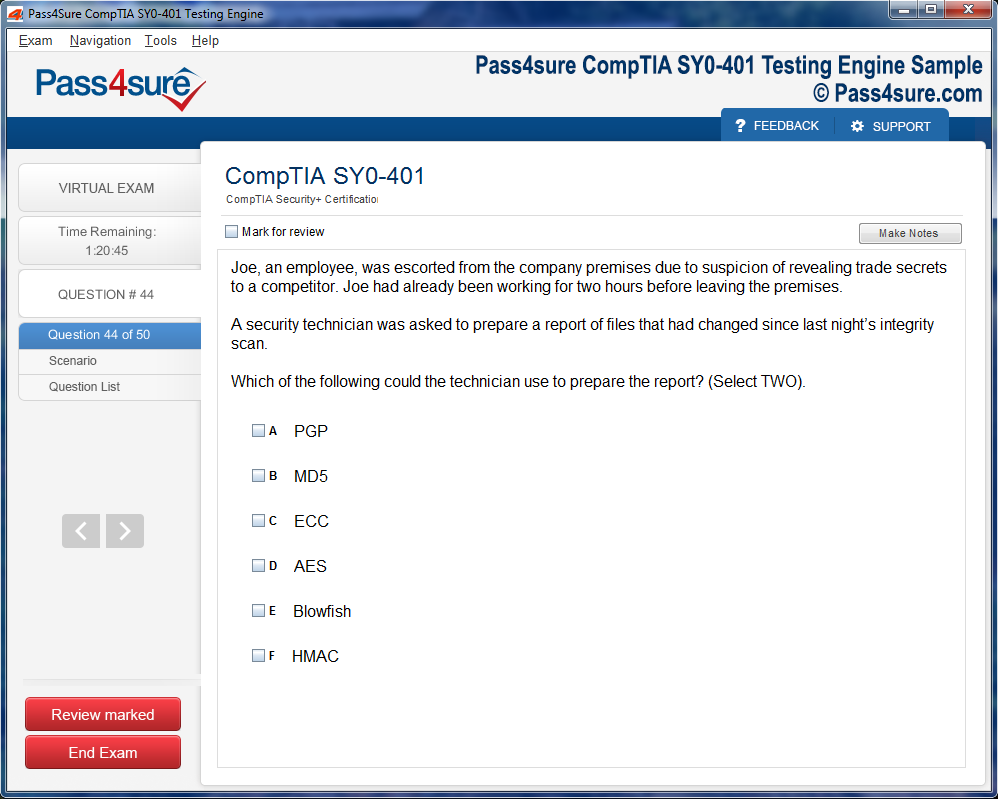
Product Screenshots
Frequently Asked Questions
How does your testing engine works?
Once download and installed on your PC, you can practise test questions, review your questions & answers using two different options 'practice exam' and 'virtual exam'. Virtual Exam - test yourself with exam questions with a time limit, as if you are taking exams in the Prometric or VUE testing centre. Practice exam - review exam questions one by one, see correct answers and explanations.
How can I get the products after purchase?
All products are available for download immediately from your Member's Area. Once you have made the payment, you will be transferred to Member's Area where you can login and download the products you have purchased to your computer.
How long can I use my product? Will it be valid forever?
Pass4sure products have a validity of 90 days from the date of purchase. This means that any updates to the products, including but not limited to new questions, or updates and changes by our editing team, will be automatically downloaded on to computer to make sure that you get latest exam prep materials during those 90 days.
Can I renew my product if when it's expired?
Yes, when the 90 days of your product validity are over, you have the option of renewing your expired products with a 30% discount. This can be done in your Member's Area.
Please note that you will not be able to use the product after it has expired if you don't renew it.
How often are the questions updated?
We always try to provide the latest pool of questions, Updates in the questions depend on the changes in actual pool of questions by different vendors. As soon as we know about the change in the exam question pool we try our best to update the products as fast as possible.
How many computers I can download Pass4sure software on?
You can download the Pass4sure products on the maximum number of 2 (two) computers or devices. If you need to use the software on more than two machines, you can purchase this option separately. Please email sales@pass4sure.com if you need to use more than 5 (five) computers.
What are the system requirements?
Minimum System Requirements:
- Windows XP or newer operating system
- Java Version 8 or newer
- 1+ GHz processor
- 1 GB Ram
- 50 MB available hard disk typically (products may vary)
What operating systems are supported by your Testing Engine software?
Our testing engine is supported by Windows. Andriod and IOS software is currently under development.
Avoid Common Mistakes When Preparing for 156‑835 Check Point Certification
The 156‑835 Check Point Certification is an initial waypoint in a broader odyssey of cybersecurity mastery. Beyond the ephemeral validation of passing an examination lies the imperative of experiential acumen. Professionals must cultivate a cerebral landscape wherein practical deployment and theoretical understanding intertwine seamlessly. Routine engagement with multifarious network architectures and the orchestration of security policies engenders not merely procedural familiarity but intuitive comprehension. Through this continuous praxis, ephemeral knowledge crystallizes into enduring skill.
Proactive Dexterity in Systematic Problem-Solving
The cultivation of proactive dexterity is indispensable for sustaining cybersecurity prowess. Engaging consistently in log analysis, firewall orchestration, and threat simulation exercises sharpens cognitive agility. Candidates who immerse themselves in iterative problem-solving refine their capacity to anticipate adversarial maneuvers, thereby transforming reactive tactics into anticipatory strategy. This iterative methodology instills confidence, not as a byproduct of rote memorization, but as a manifestation of practical fluency.
Mentorship as a Catalyst for Intellectual Fortification
Knowledge dissemination serves as a catalyst for profound professional fortification. Mentorship, whether through guiding peers, authoring technical exegeses, or moderating collaborative forums, consolidates conceptual understanding. Translating abstruse principles into lucid discourse compels practitioners to interrogate their own assumptions, elucidate ambiguities, and internalize best practices. The act of teaching thus becomes an alchemical process, transmuting experience into immutable expertise while simultaneously reinforcing reputational gravitas within the cybersecurity milieu.
Reflective Analysis as a Vector for Resilience
Erroneous configurations, failed simulations, or misinterpretations encountered during professional practice should be reframed as pedagogical instruments rather than setbacks. Reflective analysis enables the practitioner to dissect missteps, discern latent vulnerabilities in reasoning, and implement remedial stratagems. This disciplined introspection not only fortifies technical competence but cultivates resilience—a psychological elasticity essential for navigating the dynamic exigencies of cybersecurity threats. Learning from failure, rather than avoiding it, accelerates the evolution from novice proficiency to expert command.
Cultivating Intellectual Plasticity in a Dynamic Landscape
The cybersecurity domain is a protean ecosystem, perpetually reshaped by emergent protocols, threat vectors, and technological paradigms. Sustained professional efficacy necessitates intellectual plasticity—the capacity to assimilate new information, adapt methodologies, and synthesize innovative solutions. Practitioners who actively pursue continuous learning, monitor emerging trends, and interrogate novel tools cultivate a strategic advantage. Intellectual curiosity thus functions as both compass and engine, guiding professionals through evolving landscapes while energizing the iterative refinement of skillsets.
Embedding Competence in Everyday Professional Rituals
Competence is most durable when embedded within quotidian professional rituals. Regular configuration exercises, vulnerability assessments, and scenario-based drills transform discrete learning episodes into habitual expertise. These micro-practices compound over time, yielding a granular familiarity with both systemic intricacies and emergent anomalies. By integrating practice into routine workflow, professionals avoid the atrophy of dormant knowledge and ensure that proficiency remains operationally deployable when exigencies arise.
Synergizing Theoretical Knowledge and Practical Application
Enduring mastery arises from the synergy of theoretical acumen and hands-on application. Understanding protocol architecture, security algorithms, and policy hierarchies is insufficient in isolation. Integration into practical contexts—network segmentation, intrusion mitigation, and traffic inspection—enables practitioners to validate conceptual constructs against real-world conditions. This harmonization not only solidifies understanding but fosters an adaptive mindset, wherein knowledge becomes actionable intelligence rather than static memorization.
Fostering Collaborative Intelligence Through Networks of Peers
The cultivation of professional networks extends competence beyond individual capacity. Collaboration with peers facilitates exposure to diverse perspectives, alternative methodologies, and emerging best practices. Engaging in knowledge exchange cultivates a dynamic feedback loop, wherein each interaction amplifies cognitive breadth. These networks serve as living repositories of collective intelligence, enhancing both problem-solving capabilities and strategic insight in rapidly evolving cybersecurity contexts.
Immersive Engagement With Emerging Threat Vectors
Remaining at the forefront of cybersecurity requires immersive engagement with novel threat vectors. Professionals must actively dissect contemporary attack methodologies, evaluate defensive technologies, and simulate adversarial scenarios. This immersion enables anticipation of vulnerabilities prior to exploitation, reinforcing both tactical readiness and strategic foresight. Continuous confrontation with evolving threats cultivates a mindset of vigilance and preemptive action, transforming competence from static validation into actionable resilience.
Integrating Analytical Rigor With Creative Adaptation
The most formidable cybersecurity practitioners harmonize analytical rigor with creative adaptation. Methodical evaluation of system vulnerabilities, protocol deviations, and configuration anomalies must be complemented by imaginative strategizing. This duality fosters solutions that are not merely technically sound but contextually innovative. Practitioners who synthesize logic with inventiveness can navigate unforeseen scenarios with agility, transcending the constraints of conventional frameworks to deliver sophisticated, anticipatory defenses.
Immersing oneself in Check Point architecture requires more than superficial acquaintance. Each component—the Security Gateway, SmartConsole, and Management Server—interacts in an intricate choreography that dictates network security posture. The gateway functions as both sentinel and adjudicator, scrutinizing traffic with deterministic precision. Understanding its packet inspection methodology and the role of Stateful Inspection versus Stateless Inspection is indispensable. Candidates often stumble when they fail to appreciate the nuanced interplay between inspection engines and policy layers.
The Management Server, often perceived as a passive repository, is in fact a dynamic orchestrator of rules and logs. It governs the life cycle of security policies, synchronizes updates across gateways, and aggregates telemetry for analytical purposes. Exam questions frequently probe the aspirant’s comprehension of these relationships, expecting them to extrapolate the behavior of one component based on modifications in another. Developing mental models of these interactions can transform abstract schematics into cognitive touchstones for rapid problem-solving.
SmartConsole, the user interface portal, is deceptively simple but hides profound operational depth. Mastery entails fluency in navigating policy rules, accessing logs, and leveraging monitoring tools to diagnose anomalies. Fluency in this interface converts theoretical knowledge into executable skill, a transition crucial not only for examination but for real-world threat mitigation. Repeated lab exercises fortify this fluency, embedding procedural memory that complements conceptual understanding.
The Art and Science of Traffic Analysis
Traffic analysis is where intuition and analytics converge. It is insufficient to merely recognize packet headers or IP schema; one must cultivate the capacity to anticipate threats, understand flow patterns, and discern subtle deviations that may herald compromise. Advanced filtering techniques, inspection of stateful connections, and anomaly detection are pillars of expertise. Aspirants who develop a granular understanding of these concepts find themselves better equipped to tackle scenario-driven questions that simulate real-time breaches.
Equally vital is the capacity to correlate disparate log entries to construct a cohesive narrative of network events. An alert in isolation is merely noise; a sequence of correlated events unveils patterns, exposes vulnerabilities, and suggests preemptive actions. Candidates who internalize this investigative approach gain a competitive edge, transforming each challenge into an opportunity to demonstrate analytical prowess rather than rote recall.
Policy Design and Implementation Nuances
Designing security policies is a domain where strategic foresight meets operational rigor. Crafting rules involves more than syntax—it demands consideration of network topology, business priorities, and threat models. Novices often err by either over-restricting, causing operational bottlenecks, or under-restricting, leaving critical paths exposed. The 156‑835 exam tests the ability to balance these competing imperatives with judicious decision-making.
Layered policy frameworks offer redundancy and resilience, ensuring that a single misconfiguration does not compromise the entire network. Understanding when and how to apply global versus local rules, the significance of order and precedence, and the impact of clean-up policies is critical. Practice exercises in replicating enterprise scenarios, replete with user groups, application controls, and segmented networks, sharpen the candidate’s ability to design robust, fault-tolerant policies.
Incident Response and Threat Mitigation Strategies
The realm of incident response is where theoretical knowledge faces practical crucibles. Candidates must develop agility in diagnosing alerts, tracing their origins, and applying corrective measures swiftly. Familiarity with threat landscapes, attack vectors, and exploitation techniques informs the selection of mitigation strategies. Preparing for this aspect of the exam involves simulating breaches, conducting root cause analyses, and exploring mitigation hierarchies that prioritize containment before eradication.
Understanding the subtleties of threat signatures, anomaly detection thresholds, and firewall rule exceptions is critical. Candidates who merely memorize attack types without appreciating operational countermeasures often falter. Scenario-based exercises, in which multiple threats intersect, hone the capacity to maintain composure and apply layered responses—a skill that mirrors real-world exigencies.
Authentication Ecosystems and Access Management
Identity and access management is more than a procedural requirement; it is a conceptual architecture that governs trust relationships across networks. The 156‑835 certification demands comprehension of authentication protocols, multi-factor implementations, and role-based access hierarchies. Recognizing how these elements integrate with firewall policies, VPN configurations, and audit mechanisms is essential.
A nuanced understanding of authentication failures, privilege escalation risks, and session management pitfalls equips candidates to anticipate questions that probe systemic vulnerabilities. Laboratory simulations involving user role creation, access control testing, and authentication troubleshooting cultivate a pragmatic grasp that elevates both exam performance and operational competence.
Cultivating Analytical Fluency Through Labs
Laboratory exercises are the crucible in which theoretical understanding is transformed into actionable intelligence. Repetition, experimentation, and controlled failure in lab environments foster a deep-seated intuition for Check Point systems. Candidates who engage with complex, evolving lab scenarios develop adaptive reasoning skills, allowing them to navigate unfamiliar problem spaces with confidence.
Logging, monitoring, and real-time traffic analysis within labs mirror the conditions of live networks, providing invaluable insight into both normal and anomalous behaviors. This immersive approach enhances pattern recognition, hones diagnostic acumen, and reinforces memory retention through experiential learning. The iterative nature of labs ensures that knowledge is layered, interwoven, and readily retrievable under the pressure of examination conditions.
Interpreting Stateful Dynamics Beyond Superficial Understanding
Delving into stateful inspection unveils a world of intricate session orchestration, far beyond simplistic packet filtering. The firewall becomes a sentient gatekeeper, cognizant of traffic ancestry and intent. Understanding how half-open sessions are recognized and transient anomalies are logged cultivates a practitioner’s ability to predict system behavior. This cognitive resonance, where observation meets deduction, transforms rote memorization into strategic acumen, vital for nuanced exam scenarios.
Navigating the Labyrinth of NAT Intricacies
NAT policies often masquerade as mundane configurations, yet their implications ripple through entire network topologies. Static NAT may appear trivial, but its permanence harbors hidden risks when applied indiscriminately. Dynamic NAT, with ephemeral address assignments, demands awareness of concurrent session loads and potential translation collisions. Hide NAT, deceptively simple, conceals internal structures from external observation while introducing subtleties in inbound connectivity. Grasping these nuances fosters an ability to anticipate and rectify misconfigurations that could otherwise compromise both security and operational fluidity.
Dissecting High Availability and Clustered Resilience
Check Point clusters are symphonies of synchronization, where failover triggers, heartbeat exchanges, and session persistence intertwine in meticulous choreography. Misjudging cluster dynamics can lead to cascading failures, unnoticed session drops, or asymmetric traffic routing. Engaging with clustered topologies through simulated failovers engenders an intuitive understanding of redundancy mechanics. Observing node priority, convergence intervals, and state synchronization cultivates the analytical intuition necessary to anticipate anomalies in production environments and hypothetical exam simulations alike.
Cryptography and VPNs in Applied Context
Encryption, often fetishized in theory, assumes its truest form within operational contexts. VPN tunnels are more than conduits; they are dynamic contracts of trust between endpoints. Mastery arises from practical application: configuring key exchanges, negotiating cipher suites, and observing tunnel establishment behaviors under duress. Remote access and site-to-site deployments expose the subtle interplay between authentication mechanisms and encryption overhead. Experiential familiarity imbues candidates with the confidence to address scenario-driven questions that probe both conceptual understanding and practical implementation.
Analytical Vigilance Through Logging and Event Correlation
Logs, often dismissed as ancillary artifacts, are in fact rich repositories of contextual intelligence. Beyond policy configuration, the capacity to correlate seemingly disparate events and discern anomalous patterns is critical. Developing proficiency in log interpretation cultivates forensic acuity, enabling preemptive mitigation of threats. This analytical mindset not only reinforces exam readiness but mirrors the practical skill set demanded by real-world cybersecurity environments, where reactive measures alone are insufficient.
The Imperative of Adaptation in a Dynamic Threat Landscape
Cybersecurity is a perpetually shifting mosaic of vulnerabilities, exploits, and countermeasures. Check Point’s ecosystem evolves continuously, reflecting emergent threats and updated defense mechanisms. Candidates who rely exclusively on static study guides risk conceptual stagnation. Immersing oneself in current vendor documentation, release notes, and interactive forums fosters both awareness and adaptive thinking. This proactive engagement ensures preparedness for questions reflecting the latest technological paradigms while cultivating the cognitive flexibility necessary to navigate unforeseen operational challenges.
Cognitive Agility as a Differentiator
Mastery of advanced firewall concepts transcends memorization; it is the cultivation of cognitive agility. Candidates must perceive networks as interconnected ecosystems, anticipate policy interactions, and intuitively respond to complex stimuli. This intellectual dexterity, grounded in observation, analysis, and iterative experimentation, differentiates successful candidates from those whose preparation is linear or superficial. It is the symbiosis of theory and practice, of foresight and adaptability, that cements competence in both examinations and real-world cybersecurity applications.
Lab Practice Strategies to Avoid Common Pitfalls
Immersive engagement in laboratory environments transcends the confines of theoretical preparation, yet a multitude of aspirants succumb to perfunctory routines that stifle intellectual agility. Laboratories must be perceived not as mechanistic checkpoints but as intricate cognitive arenas wherein experimentation elucidates hidden intricacies. Approaching each scenario as a conundrum rather than a checklist cultivates acumen that theory alone cannot furnish, rendering the learning experience both dynamic and enduring.
Cultivating Adaptive Experimentation
Repetition devoid of variation engenders a deceptive familiarity, insulating candidates from the exigencies of real-world problem solving. Introducing deliberate perturbations—such as reconfiguring subnet topologies, modulating firewall policies, or enacting simulated breach vectors—propagates an enriched comprehension of systemic interrelations. These calculated deviations prepare aspirants for examination dilemmas that deviate subtly from canonical templates, fostering nimbleness in analysis and application.
Strategic Temporal Management in Labs
Temporal allocation within lab sessions frequently betrays novice practitioners. A myopic focus on singular tasks at the expense of holistic engagement cultivates fragmented knowledge. Structured temporal frameworks, progressing from rudimentary configurations to labyrinthine deployments, ensure comprehensive exposure to all pivotal competencies. Integrating multifaceted objectives within a single session—such as synchronizing VPN orchestration with meticulous log scrutiny—illuminates the interplay of disparate yet interdependent skills.
Meticulous Documentation Practices
The art of documentation is often underestimated, yet meticulous records of configurations, anomalies, and procedural outcomes amplify both retention and cognitive clarity. Systematic archiving not only facilitates revision but also mirrors industry paradigms where precision underpins operational integrity. Candidates who engrain this discipline exhibit heightened diagnostic acuity, translating seamlessly into examination efficacy and professional adeptness.
Collaborative Cognitive Enhancement
Intellectual symbiosis with peers amplifies the richness of laboratory engagement. Dialogues on procedural choices, cross-examination of outcomes, and critique of methodologies engender expansive perspectives, catalyzing a more holistic understanding of Check Point architectures. While solitary immersion cultivates introspection, collaborative interaction fosters versatility, revealing latent strategies and broadening the conceptual palette.
Embracing Error as Pedagogical Catalyst
Erroneous outcomes, often perceived as setbacks, constitute invaluable pedagogical instruments. Investigating the root cause of VPN disruptions or misfiring firewall directives unveils the undercurrents of network behavior, crystallizing principles that the 156‑835 examination rigorously interrogates. Developing a mindset that valorizes iterative learning over faultless execution enhances resilience, cognitive elasticity, and the capacity for innovative troubleshooting.
Integrative Reinforcement of Theory and Practice
Synchronizing theoretical comprehension with immediate laboratory application consolidates knowledge into a cohesive cognitive framework. Abstract concepts explored in literature or digital resources gain tangible form when instantiated in controlled lab environments. This symbiosis fortifies confidence, mitigates exam-induced anxiety, and ensures that procedural fluency is undergirded by a nuanced understanding of core principles.
Cognitive Alchemy in Mastering Check Point Concepts
The art of transmuting complex network security knowledge into actionable comprehension demands cognitive dexterity. Candidates often err by compartmentalizing discrete concepts rather than synthesizing them into a coherent mental schema. True mastery emerges when learners interlace firewall architectures, intrusion prevention mechanisms, and VPN configurations into a dynamic mental framework. This form of cognitive alchemy transforms rote familiarity into intuitive problem-solving acuity.
Engaging in deliberate mental simulations, where one envisions hypothetical network breaches or misconfigurations, fortifies this integration. By mentally navigating cascading system responses, candidates cultivate anticipatory reasoning, an asset far exceeding memorization of static procedures. Such cerebral rehearsal sharpens pattern recognition and accelerates decision-making under examination pressure.
Epistemic Vigilance Against Knowledge Degradation
Knowledge in the realm of cybersecurity is mercurial; what is canonical today may be obsolete tomorrow. Candidates must maintain epistemic vigilance to forestall the ossification of outdated paradigms. This entails continuous cross-referencing of vendor updates, patch notes, and evolving threat landscapes. Overconfidence in dated manuals or static practice questions fosters brittle understanding, which can fracture under novel scenarios.
Periodic immersion in contemporary research, whitepapers, and advanced threat analyses nourishes an adaptive intellect. By integrating cutting-edge developments with foundational principles, candidates establish a resilient cognitive lattice capable of accommodating unforeseen examination scenarios.
Experiential Synergy Through Lab Orchestration
Laboratory exercises, when orchestrated with deliberate intent, generate experiential synergy that magnifies learning retention. Passive execution of tutorials seldom engenders deep comprehension; active manipulation of configurations, stress-testing protocols, and simulating multi-vector attacks catalyze neural embedding of knowledge.
Candidates should design experiments that challenge assumptions, provoke troubleshooting, and require iterative refinement. This approach transforms the lab from a procedural rehearsal space into a crucible of applied expertise. Recording outcomes, anomalies, and heuristic insights not only consolidates knowledge but also creates a personalized compendium of reference for future professional application.
Perceptual Acuity in Network Anomaly Detection
Developing perceptual acuity for network anomalies is paramount. The 156‑835 exam emphasizes not merely procedural competence but the ability to discern subtle deviations indicative of latent vulnerabilities. Candidates must attune themselves to minute configuration discrepancies, traffic pattern irregularities, and system log aberrations.
Exercises that cultivate this acuity include scenario-based analysis, comparative log audits, and temporal trend mapping. By habituating the mind to detect irregularities amidst a deluge of information, candidates develop anticipatory insight—an invaluable asset during both examination simulations and real-world security administration.
Iterative Refinement Through Reflective Praxis
Reflection is not an ancillary activity but a strategic instrument in knowledge consolidation. Iterative refinement, achieved through cyclical assessment and recalibration of study strategies, optimizes cognitive efficiency. Candidates should meticulously document strengths, vulnerabilities, and recurring errors to craft adaptive learning schemas.
Integrating reflective praxis with scenario-based drills allows candidates to internalize lessons beyond superficial comprehension. This method cultivates metacognitive awareness, enabling strategic adjustments in real time and enhancing resilience against cognitive fatigue.
Semiotic Interpretation of Security Protocols
Understanding security protocols transcends procedural familiarity; it requires semiotic interpretation—decoding symbolic interactions between network components, encryption sequences, and authentication hierarchies. Candidates who merely memorize packet flows or policy templates may stumble when confronted with novel system architectures.
Analyzing protocols as symbolic systems allows learners to extrapolate behavior in atypical configurations. This semiotic lens fosters anticipatory reasoning, enabling prediction of systemic responses and rapid adaptation to anomalous scenarios. Such interpretative sophistication is critical for excelling in both exam environments and operational cybersecurity roles.
Synergistic Cognition in Peer Collaboration
While solitary study reinforces internalization, peer collaboration cultivates synergistic cognition. Engaging with colleagues or professional networks exposes candidates to alternative heuristics, diverse troubleshooting methodologies, and real-world scenarios not encapsulated in manuals.
Discussion-driven learning encourages dialectical reasoning, wherein candidates confront conflicting perspectives and synthesize integrated solutions. This not only fortifies conceptual depth but also enhances agility in applying knowledge under the cognitive pressure of timed assessments.
Navigating Cognitive Pitfalls in Cybersecurity Mastery
Cognitive pitfalls often masquerade as self-assuredness, ensnaring even the most diligent aspirants in labyrinthine errors. The allure of oversimplified heuristics, where complex rule interactions are presumed linear, frequently derails strategic reasoning. In Check Point firewalls, for instance, policy dependencies weave an intricate tapestry, where the misplacement of a single rule can cascade into unforeseen vulnerabilities. Cultivating an appreciation for these interdependencies fosters meticulousness and anticipatory thinking, transforming rote configuration into a disciplined exercise of foresight.
Demystifying VPNs and Encryption Paradoxes
Virtual private networks and encryption protocols inhabit a dual realm of abstraction and application. Theoretical comprehension is insufficient when disentangling practical deployment intricacies. Many practitioners conflate algorithmic elegance with operational efficacy, leading to suboptimal configurations that compromise both security and performance. Engaging in iterative experimentation within controlled sandboxes elucidates nuanced behaviors, from handshake anomalies to cryptographic degradation under divergent conditions. This dialectic between theory and praxis cultivates an intuitive grasp that textbooks alone cannot instill.
The Art of Analytical Log Scrutiny
Logs, often dismissed as quotidian artifacts, conceal profound insights into systemic integrity and adversarial dynamics. Superficial perusal generates false confidence, whereas rigorous exegesis exposes latent patterns of intrusion, policy lapses, and emergent threats. Each log entry is a semiotic fragment, demanding a synthesis of temporal sequencing, correlation with network events, and contextual interpretation. Developing a methodological approach to log analysis metamorphoses this laborious task into a cerebral discipline, where interpretive acuity becomes a differentiator between competent and exceptional practitioners.
Guarding Against Overconfidence Bias
Overconfidence is an insidious impediment, subtly eroding diligence through the veneer of competence. Familiarity with rudimentary concepts often breeds complacency, masking gaps in advanced comprehension. The antidote lies in deliberate cognitive friction: engaging with intricate scenarios, probing edge cases, and simulating adversarial maneuvers. This deliberate cognitive stretch fortifies adaptive reasoning, ensuring that familiarity is not mistaken for mastery and that latent misconceptions are progressively surfaced and rectified.
Temporal Management and Exam Resilience
Time, as a constraining variable, interacts subtly with cognitive load to influence decision-making under duress. Exam conditions magnify this interplay, where even minor lapses in pacing precipitate cascading errors. Practicing under simulated temporal pressures cultivates strategic allocation of attention, enabling nuanced questions to receive commensurate consideration without sacrificing efficiency on foundational items. By internalizing these temporal heuristics, candidates develop resilience, ensuring that stress is transmuted into focused, purposeful cognition rather than reactive anxiety.
Synthesizing Complexity into Strategic Foresight
The zenith of cybersecurity proficiency resides not merely in the retention of discrete facts but in the synthesis of multifaceted dynamics into coherent, anticipatory strategies. Misconceptions and mental traps are not merely obstacles; they are signals indicating the boundaries of comprehension. By interrogating assumptions, rigorously testing configurations, and iteratively refining interpretive frameworks, candidates cultivate a meta-cognitive awareness that elevates technical skill into strategic foresight. The ability to anticipate emergent consequences, recognize latent dependencies, and adapt fluidly to evolving scenarios delineates the threshold between competent technicians and visionary practitioners.
Iterative Refinement Through Simulated Environments
Simulated environments offer a crucible for iterative refinement of cybersecurity acumen. By constructing virtualized networks and orchestrating mock intrusions, practitioners engage in a dialectic of action and evaluation. Each simulated breach or misconfiguration serves as a diagnostic instrument, illuminating gaps in comprehension and operational execution. Unlike theoretical study, immersive experimentation cultivates tacit knowledge—an instinctive understanding of system behaviors, protocol interactions, and threat manifestations that is difficult to achieve through static study alone.
Cognitive Resilience in the Face of Complex Threats
Cognitive resilience is an essential attribute for professionals navigating multifaceted threats. The modern threatscape is characterized by polymorphic malware, advanced persistent threats, and coordinated cyber campaigns that challenge conventional response paradigms. Practitioners who develop mental elasticity—capable of analyzing conflicting data, maintaining composure under duress, and recalibrating strategies in real-time—achieve a distinctive advantage. This mental resilience complements technical expertise, ensuring that strategic decisions are both informed and adaptable under pressure.
Ethical Vigilance as a Professional Imperative
Sustained competence extends beyond technical mastery into the realm of ethical vigilance. Cybersecurity practitioners operate at the intersection of technology, privacy, and societal trust. Ethical lapses can compromise not only system integrity but professional credibility. Vigilance requires a conscientious adherence to principles, including confidentiality, responsible disclosure, and equitable access. Cultivating ethical sensibility transforms routine tasks into deliberate, principled actions, reinforcing the professional’s role as both a protector and a steward of digital ecosystems.
Deepening Mastery Through Cross-Domain Exploration
Competence is amplified by cross-domain exploration, whereby practitioners traverse adjacent disciplines to enrich their cybersecurity perspective. Knowledge of cloud architectures, cryptographic methodologies, behavioral analytics, and regulatory frameworks enhances the capacity to interpret complex threat vectors holistically. Interdisciplinary exploration promotes cognitive flexibility, enabling practitioners to synthesize disparate insights into cohesive defensive strategies. This broadened purview transcends the constraints of narrow specialization, cultivating a professional capable of adaptive, multidimensional problem-solving.
Reflexive Learning Through Continuous Feedback Loops
The establishment of continuous feedback loops accelerates professional evolution. By systematically reviewing operational outcomes, peer evaluations, and simulation results, practitioners engage in reflexive learning—an ongoing recalibration of strategies informed by evidence. This disciplined approach ensures that lessons from past encounters inform future interventions, reducing the recurrence of errors and fostering a trajectory of progressive refinement. Feedback loops act as the connective tissue between experience and expertise, converting episodic learning into sustained competence.
Narrative Cognition for Threat Anticipation
An often-overlooked dimension of cybersecurity mastery is narrative cognition—the ability to construct mental models that anticipate adversarial behavior. By contextualizing technical indicators within probable attack narratives, practitioners can preemptively identify weak points, predict escalation patterns, and deploy countermeasures with foresight. This narrative approach transforms raw data into actionable intelligence, bridging the gap between abstract analysis and operational readiness. Cultivating narrative cognition sharpens situational awareness and enhances strategic anticipation across evolving threat landscapes.
Ritualizing Knowledge Acquisition for Cognitive Durability
Embedding structured rituals of knowledge acquisition ensures cognitive durability over time. Daily or weekly engagement with research papers, technical manuals, and emerging threat reports creates a scaffold of incremental learning. Ritualization transforms sporadic study into habitual mastery, mitigating the erosion of technical memory and maintaining the relevance of expertise. By formalizing these learning routines, practitioners reinforce their mental schema, internalize complex principles, and sustain a trajectory of continuous intellectual growth.
Experiential Networking to Augment Collective Intelligence
Active participation in professional networks extends competence through collective intelligence. Collaboration with experienced peers and thought leaders exposes practitioners to unconventional methodologies, novel threat perspectives, and emergent best practices. These exchanges create a dynamic ecosystem of knowledge, wherein individual insights are amplified and refined through communal discourse. Engaging deeply in these networks cultivates strategic foresight, enabling practitioners to anticipate industry shifts and adapt with agility while simultaneously enhancing their reputational capital.
Synthesis of Tactical Acumen and Strategic Vision
Effective cybersecurity practice demands the synthesis of tactical acumen and strategic vision. Tactical expertise involves precise operational execution—configuring systems, analyzing logs, and neutralizing immediate threats. Strategic vision, by contrast, entails understanding long-term implications, predicting adversary evolution, and aligning defensive posture with organizational objectives. Practitioners who integrate these dimensions operate not merely as responders but as architects of resilient digital environments, capable of shaping security landscapes proactively rather than reactively.
Adaptive Methodologies for Evolving Protocol Landscapes
Protocol evolution is a constant in the cybersecurity domain, with new standards, encryption techniques, and communication frameworks emerging at a rapid cadence. Competence requires adaptive methodologies that accommodate this flux, integrating continuous learning, experimentation, and scenario analysis. By cultivating flexibility in approach, practitioners can implement defensive measures that are both current and forward-compatible, avoiding obsolescence and ensuring operational resilience. Adaptability transforms competence into a dynamic, perpetually relevant asset rather than a static credential.
Integrating Forensic Insight Into Routine Practice
Forensic insight—understanding the traces left by past activity—enhances both preventative and responsive capacities. By analyzing logs, audit trails, and anomalous behavior, practitioners uncover latent vulnerabilities and reconstruct potential attack scenarios. Integrating forensic awareness into daily practice fortifies the ability to detect, diagnose, and mitigate threats with precision. This dimension of expertise bridges historical analysis with real-time application, transforming experience into predictive foresight that informs both policy and practice.
Cognitive Alchemy: Turning Knowledge Into Actionable Foresight
The ultimate measure of professional competence lies in the alchemy of transforming acquired knowledge into actionable foresight. It is insufficient to merely understand protocols, threat signatures, or system architectures; mastery is demonstrated through the anticipatory application of this understanding. By envisioning probable attack trajectories, simulating outcomes, and deploying preemptive safeguards, practitioners convert abstract comprehension into tangible defense mechanisms. This cognitive alchemy distinguishes ephemeral knowledge from enduring expertise, rendering the practitioner both effective and indispensable.
Iterative Mastery Through Persistent Curiosity
Persistent curiosity is the engine driving iterative mastery. Practitioners who relentlessly interrogate assumptions, explore alternative solutions, and experiment with unconventional methodologies cultivate a depth of understanding inaccessible through passive learning. Curiosity fuels ongoing engagement, ensuring that professional development is self-propelling rather than externally imposed. In the labyrinthine landscape of cybersecurity, this inquisitive drive is both compass and catalyst, guiding practitioners toward nuanced insights and continually expanding the horizon of competence.
The Subtle Architecture of Firewall Rule Interdependencies
In the labyrinthine architecture of Check Point firewalls, rules seldom function in isolation. Each policy represents a nexus of dependencies, where the repositioning of a single directive can induce a ripple effect across multiple segments of a network. Novices often succumb to reductionist thinking, assuming sequential application without feedback loops, but seasoned practitioners recognize that the firewall’s operational matrix is inherently recursive. By simulating scenarios where multiple rules interact—allowing some to trigger conditionally while others cascade—you illuminate hidden vectors of misconfiguration. This cognitive rehearsal fosters a form of mental elasticity, enabling one to anticipate how seemingly minor adjustments reverberate through complex infrastructures.
The misapprehension of rule sequencing is particularly perilous in dynamic environments. When policies are stacked without comprehension of precedence, a benign rule may inadvertently override critical security measures, producing silent vulnerabilities. Hence, the exercise is not merely procedural but deeply analytical: one must envision the firewall as a living system, responsive to input yet constrained by latent hierarchies. This mindset transcends rote memorization, cultivating a heuristic framework that guides decision-making in both practical labs and high-stakes examination settings.
VPN Implementation Beyond Theoretical Constructs
Encryption and VPN protocols inhabit a duality of abstraction and execution. Many candidates can recite the theoretical constructs of AES, SHA-2, or IPsec tunnels yet falter when faced with the real-world entanglement of network heterogeneity. Misconceptions often arise when theoretical elegance is erroneously equated with practical infallibility. Protocols manifest differently under varying configurations: latency introduces handshake anomalies, mismatched key exchanges precipitate authentication failures, and misaligned encryption parameters can degrade throughput.
Pragmatic mastery emerges from iterative sandboxing. By systematically adjusting parameters—modifying tunnel endpoints, testing multi-hop configurations, and inducing controlled packet loss—aspirants develop an experiential understanding that theory alone cannot impart. This process also sharpens pattern recognition, allowing one to anticipate failure modes and implement preemptive safeguards. Such practical intuition becomes indispensable not only for exams but for operational environments where theoretical knowledge alone cannot avert breaches.
Decoding Logs as Semiotic Artefacts
Logs are more than inert strings of text; they are semiotic artefacts, encoding the narrative of a network’s existence. Superficial scanning yields little beyond the obvious, but rigorous exegesis reveals patterns of intrusion, operational bottlenecks, and systemic inconsistencies. Each entry is a fragment of a temporal mosaic, requiring correlation with preceding and subsequent events to reconstruct causality. Analytical log review demands both micro and macro perspectives: micro, to identify subtle anomalies such as repeated failed authentications; macro, to discern systemic patterns indicative of persistent threats or policy inefficacies.
One effective strategy involves stratified log analysis, categorizing entries by severity, protocol, and source. This approach transforms a chaotic stream of data into an intelligible map of network behavior. Beyond pattern recognition, aspirants cultivate inferential reasoning, hypothesizing potential vulnerabilities and then validating them against empirical evidence. Over time, the practice hones cognitive agility, converting what is often treated as rote monitoring into an advanced skill of predictive cybersecurity intelligence.
The Cognitive Dangers of Overconfidence
Overconfidence is an insidious cognitive distortion, often masquerading as competence. Candidates may traverse basic concepts with ease, yet this superficial fluency frequently camouflages gaps in advanced comprehension. The antidote lies in deliberately introducing cognitive friction: engaging with convoluted scenarios, integrating multi-layered policies, or simulating adversarial strategies that subvert conventional logic. This process exposes hidden weaknesses and compels adaptive thinking.
Moreover, overconfidence manifests subtly in exam settings. Familiarity with prior material can engender complacency, prompting premature assumptions about questions or solution pathways. Developing meta-cognitive vigilance—actively questioning one’s reasoning, seeking alternative interpretations, and rehearsing failure scenarios—mitigates this bias. By embracing uncertainty and complexity as integral to the learning process, candidates cultivate intellectual humility, which paradoxically strengthens mastery and enhances long-term retention.
Temporal Cognition and Exam Strategy
Time pressure interacts profoundly with cognitive performance. Examinations are not merely tests of knowledge but also of temporal management, requiring a delicate balance between speed and analytical depth. Candidates often expend disproportionate energy on ostensibly simple questions, sacrificing thoroughness on complex items. Effective preparation involves timed simulations, which condition both mental pacing and stress resilience.
Temporal cognition extends beyond mere clock-watching; it is the strategic allocation of attention. By segmenting exam periods into cognitive phases—initial assessment, deep analysis, verification—aspirants develop a rhythm that optimizes both accuracy and efficiency. This structured engagement reduces reactive anxiety, transforming temporal constraints from an obstacle into a scaffold for disciplined reasoning. Over repeated exposure, candidates internalize these heuristics, enabling fluent navigation of high-pressure evaluative contexts.
Iterative Experimentation and Adaptive Learning
Adaptive learning thrives on iterative experimentation, a principle equally applicable to labs, simulations, and conceptual exercises. Engaging in controlled “what-if” scenarios allows candidates to probe the consequences of unconventional configurations without incurring operational risk. Such exercises not only elucidate hidden dependencies but also reinforce cognitive flexibility, training the mind to oscillate fluidly between hypothesis, testing, and refinement.
For instance, deliberately misconfiguring a firewall rule and tracing its effect through network logs cultivates anticipatory reasoning. Observing emergent anomalies encourages reflective analysis, compelling one to adjust strategies proactively rather than reactively. Over time, this iterative cycle fosters an instinctive grasp of systemic interconnectivity and enhances problem-solving acuity. Mastery, in this sense, is less about memorization and more about cultivating a dynamic interplay between observation, experimentation, and synthesis.
Mental Models and Heuristic Refinement
The cultivation of robust mental models is paramount for navigating complex cybersecurity landscapes. Mental models act as cognitive scaffolds, allowing one to anticipate consequences, detect anomalies, and plan strategic interventions. Refinement of these models occurs through continuous feedback loops: simulation, observation, reflection, and adjustment. Overreliance on static heuristics is perilous; adaptive models evolve with exposure to increasingly sophisticated scenarios.
Heuristics, when calibrated properly, expedite reasoning under pressure but require vigilant oversight to prevent cognitive rigidity. For instance, a candidate may develop a heuristic that all VPN failures originate from misaligned keys. While useful as a first approximation, this assumption must be tested against diverse network conditions to avoid oversight. By iteratively refining heuristics through evidence-based feedback, aspirants cultivate a mental toolkit capable of navigating both predictable and anomalous conditions.
Resilience Through Cognitive Endurance
Resilience is not merely emotional stamina but a cognitive attribute that enables sustained analytical performance under strain. Cybersecurity exams often challenge not only knowledge but also attention, memory, and adaptability. Developing cognitive endurance involves a combination of strategic practice, controlled exposure to complexity, and reflective synthesis. Exercises such as extended lab sessions, layered problem-solving tasks, and simulated crisis scenarios condition the mind to maintain clarity amidst cognitive load.
Endurance also intersects with metacognition: the ability to monitor and regulate one’s thought processes. Candidates who practice deliberate reflection—assessing the effectiveness of strategies, identifying errors, and recalibrating approaches—enhance both accuracy and adaptability. Over time, this conscious regulation fosters a form of intellectual resilience that transcends the boundaries of exam preparation and extends into operational competence.
Temporal Cognition and Exam Readiness
The temporal dimension of study is frequently underestimated. Candidates who cram material in a condensed timeframe often experience ephemeral retention, with neural pathways insufficiently reinforced. Temporal cognition—strategically spacing study sessions to exploit the spacing effect—ensures long-term consolidation of complex Check Point concepts.
In practice, candidates should alternate between intensive, focused sessions and interludes of reflective rest. During these intervals, subconscious processing allows previously encountered configurations, policies, and troubleshooting sequences to coalesce into durable mental schemata. Moreover, revisiting challenging topics at strategically spaced intervals mitigates the forgetting curve and strengthens retrieval fluency.
Integrating temporal cognition with active problem-solving creates a dynamic rhythm of learning. Exercises such as reconfiguring VPNs after a period of study or re-analyzing firewall logs after intervals of rest reinforce procedural memory and deepen conceptual understanding simultaneously.
Heuristic Navigation of Multifaceted Security Scenarios
Examinations test not only declarative knowledge but also the capacity for heuristic navigation—efficiently selecting problem-solving pathways amidst ambiguity. Candidates must cultivate a flexible mental toolkit capable of adapting principles to unfamiliar configurations and multi-layered network environments.
Relying solely on rote solutions fosters rigidity; in contrast, heuristic strategies enable rapid assessment of scenario parameters, prioritization of intervention points, and deployment of contextually appropriate security measures. Deliberate practice with progressively complex lab simulations sharpens these heuristics, preparing candidates for the nuanced challenges of the 156‑835 exam.
Mnemonic Architecture Beyond Rote Recall
Memory aids are indispensable, but their potency derives from structural sophistication rather than sheer quantity. Candidates should employ mnemonic architecture—crafting interconnected memory frameworks that mirror system relationships rather than isolated facts.
For instance, visualizing the interaction between security policies, NAT rules, and threat prevention modules as a layered lattice strengthens relational understanding. Linking these mental constructs with tangible lab experiences further cements the knowledge, rendering recall automatic under examination pressure. Mnemonic architecture transforms memorization from superficial accumulation into deeply embedded cognitive scaffolding.
Cybersemiotic Literacy in Threat Interpretation
The modern cybersecurity landscape demands cybersemiotic literacy—the ability to decode and interpret complex signals embedded within network behavior. Beyond recognizing explicit alerts, candidates must discern patterns of covert intrusion, subtle misconfigurations, and emergent vulnerabilities.
Engaging with real-world traffic captures, anomaly logs, and threat intelligence feeds trains the candidate to interpret these semiotic cues with precision. The capacity to intuit systemic intentions and anticipate malicious maneuvers elevates comprehension from procedural to strategic, a critical differentiator in both exam performance and operational security proficiency.
Lab-Driven Iterative Cognition
Laboratory exercises serve as crucibles for iterative cognition, where concepts are stress-tested against practical scenarios. Passive replication of tutorials seldom suffices; candidates must manipulate configurations, provoke error conditions, and intentionally breach system policies to observe cascading effects.
This iterative approach cultivates adaptive intelligence. Each cycle of experimentation and reflection reinforces conceptual frameworks, highlights latent knowledge gaps, and fosters anticipatory problem-solving. The cognitive imprint left by such experiential learning exceeds the retention afforded by conventional study methods.
Metacognitive Calibration and Self-Audit
Metacognition—the awareness of one’s own learning processes—is an underutilized yet powerful tool for exam preparation. Candidates should engage in regular self-audit, evaluating comprehension depth, procedural fluency, and scenario adaptability.
Self-assessment extends beyond error correction; it informs strategic recalibration of study focus, prioritizing weak domains while reinforcing strong foundations. By iteratively adjusting study methodologies, candidates cultivate cognitive resilience and avoid stagnation in inefficient learning cycles.
Network Topology Semantics and Conceptual Mapping
Network topology is more than a schematic arrangement; it is a semantic ecosystem, each node and connection embodying functional interdependencies. Candidates must interpret topologies not merely as diagrams but as dynamic systems, where policy adjustments reverberate across multiple layers of security architecture.
Conceptual mapping—creating mental or digital representations linking components, rules, and behavioral outcomes—enhances comprehension of these interdependencies. By visualizing potential propagation of threats or policy misalignments, learners internalize systemic logic, facilitating both exam problem-solving and operational decision-making.
Polymorphic Learning Through Scenario Variation
Static repetition breeds superficial familiarity. Polymorphic learning, wherein candidates encounter multiple variations of a single scenario, encourages flexible application of knowledge. By altering variables—such as network size, device configuration, or attack vector—learners develop adaptable strategies and robust procedural fluency.
This approach mirrors real-world security environments, where identical attacks seldom manifest in identical contexts. Candidates trained through polymorphic scenarios exhibit enhanced pattern recognition, anticipate anomalies, and deploy corrective measures with agility and precision.
Cybernetic Reflexes in Troubleshooting
Proficiency in the 156‑835 exam extends to cultivating cybernetic reflexes—automatic, precise responses to network anomalies. Reflexive troubleshooting emerges from repeated engagement with lab simulations, where iterative exposure to faults, misconfigurations, and attacks fosters rapid, instinctual problem-solving.
Candidates should document these reflex patterns, noting both triggers and corrective sequences. Over time, these reflexes coalesce into a repertoire of instantaneous responses, reducing cognitive load and enabling higher-order analytical reasoning during complex examination tasks.
Semi-Structured Knowledge Networks
Rigid linear study frameworks limit the depth of understanding. Candidates benefit from constructing semi-structured knowledge networks, where concepts, procedures, and principles are linked non-linearly according to functional relationships.
Such networks enable associative recall, permitting the learner to traverse interconnected domains of knowledge fluidly. For example, understanding the interplay between identity awareness policies, VPN tunneling, and intrusion prevention rules as a network enhances both conceptual depth and practical application.
Adaptive Fluency in Protocol Dynamics
Protocol comprehension transcends rote memorization of headers and sequences; it demands adaptive fluency—the ability to anticipate protocol behavior under non-standard conditions. Candidates should interrogate the boundaries of protocol functionality, considering edge cases, exception handling, and inter-protocol interactions.
Exercises that simulate fragmented packets, latency anomalies, or asymmetric routing conditions develop this fluency. Through repeated exposure, candidates internalize protocol dynamics, equipping them to handle unanticipated scenarios with strategic precision.
Semantic Resonance in Security Policies
Security policies are not static directives; they are semantic instruments whose implications ripple across system architectures. Candidates must cultivate an understanding of semantic resonance—the cascading effects that a single policy alteration may generate.
By simulating policy adjustments and observing their impact across interconnected systems, learners develop a nuanced appreciation of cause-and-effect relationships. This insight fosters anticipatory reasoning, enabling candidates to predict outcomes and implement safeguards proactively.
Experiential Metaphor in Knowledge Encoding
Analogical thinking enhances retention by embedding abstract concepts within familiar experiential frameworks. Candidates may employ experiential metaphors, equating firewall chains to urban defense perimeters or intrusion detection alerts to sentinel patrols.
Such metaphorical encoding transforms abstract configurations into cognitively accessible constructs. By anchoring new knowledge to tangible mental models, learners accelerate comprehension and fortify long-term retention, particularly under the cognitive pressures of high-stakes examinations.
Navigating Complex Lab Topologies
The labyrinthine nature of Check Point environments demands a nuanced appreciation of topological intricacies. Superficial familiarity with linear network layouts is insufficient; candidates must develop the ability to anticipate interdependencies and emergent behaviors in multifaceted architectures. Encountering multi-tiered VPN deployments or intricate rule hierarchies presents opportunities to cultivate a predictive mindset, wherein outcomes are extrapolated prior to execution. This proactive engagement transforms the lab from a mere operational exercise into a cognitive crucible for analytical refinement.
Simulating Adversarial Scenarios
Constructing synthetic threat landscapes enhances both technical dexterity and situational awareness. By orchestrating controlled intrusion attempts or policy bypass simulations, aspirants gain insights into systemic vulnerabilities and response mechanisms. These exercises foster a profound understanding of firewall rule precedence, session handling, and anomaly detection. Additionally, exposure to contrived attack vectors promotes an intuitive grasp of risk mitigation strategies that transcend rote memorization, equipping candidates with adaptable problem-solving skills for unforeseen scenarios.
Iterative Troubleshooting Methodologies
Laboratory practice becomes exponentially more valuable when framed around iterative troubleshooting. Encountering unexpected behaviors should be perceived as an invitation to explore causality with methodical rigor. Techniques such as packet tracing, log dissection, and configuration comparison illuminate latent errors and reinforce systemic understanding. Cultivating patience and precision in this iterative exploration transforms uncertainty into an engine of insight, embedding procedural memory alongside conceptual comprehension.
Cognitive Load Management in Extended Labs
Extended laboratory sessions present a subtle challenge: cognitive saturation. The human capacity for attentional focus is finite, and sustained engagement without structured intermissions can degrade performance. Integrating deliberate intervals for reflection and mental consolidation enhances information retention and prevents superficial processing. During these pauses, aspirants can synthesize observations, annotate anomalies, and mentally rehearse procedural sequences, thereby transforming raw experience into durable expertise.
Contextualizing Configurations within Operational Ecosystems
Isolated configuration tasks gain profound meaning when contextualized within the broader operational ecosystem. Understanding how firewall rules interact with routing protocols, intrusion prevention systems, and logging frameworks cultivates holistic comprehension. Candidates benefit from mentally simulating downstream effects of seemingly innocuous changes, fostering foresight in both exam scenarios and real-world deployments. This systemic perspective elevates laboratory practice from mechanical repetition to strategic cognition.
Leveraging Scenario-Based Variability
Exposing oneself to diverse scenario permutations is instrumental in cultivating agility. Minor modifications to network segmentation, NAT policies, or access control directives compel candidates to recalibrate their assumptions continually. Such deliberate perturbations prevent overfitting to textbook exercises and foster an adaptable mindset capable of tackling unpredictable examination challenges. The cognitive elasticity developed through scenario variability directly correlates with performance in high-pressure, dynamic problem-solving environments.
Integrating Log Analysis with Practical Execution
The synthesis of log scrutiny and operational configuration constitutes a pivotal skill. Anomalous entries, subtle patterns, or repeated failures often reveal deeper systemic dynamics that are not immediately apparent through superficial observation. Engaging in proactive log analysis during lab exercises cultivates a dual perspective: operational mastery coupled with diagnostic acuity. This integrated approach not only enhances technical competence but also reinforces strategic thinking, as candidates learn to anticipate outcomes and preempt errors.
Fostering Reflective Practice
Reflective practice serves as a cognitive accelerant, transforming episodic experience into crystallized knowledge. Post-lab debriefing—wherein candidates interrogate the rationale behind each action, assess the efficacy of strategies, and extrapolate lessons—enhances meta-cognition. This layer of self-analysis engenders a heightened awareness of cognitive biases, habitual errors, and overlooked contingencies. By embedding reflection into routine practice, aspirants develop both intellectual sophistication and procedural fluency.
The Role of Mental Modeling in Lab Mastery
Constructing internal representations of network flows, packet journeys, and policy hierarchies amplifies comprehension. Mental models allow candidates to predict system behaviors prior to hands-on intervention, thereby reducing trial-and-error dependency. By iteratively refining these models through laboratory experimentation, aspirants cultivate a capacity for anticipatory reasoning. Such cognitive scaffolding is invaluable in high-stakes examinations, where rapid analysis and accurate inference supersede rote procedural recall.
Adaptive Error Recognition Techniques
Error recognition is not merely reactive; it can be anticipatory. Skilled candidates learn to identify subtle indicators of impending misconfigurations or rule conflicts before they manifest fully. Pattern recognition, heuristic reasoning, and cross-referencing previous lab experiences converge to create a preemptive error detection framework. This proactive vigilance enhances efficiency, deepens understanding, and mirrors professional operational standards, where foresight and mitigation are paramount.
Cross-Domain Application of Skills
Laboratory mastery in one domain often provides transferable insights across related areas. For instance, understanding VPN tunneling intricacies can inform policy configuration strategies in access control environments. Recognizing these cross-domain synergies enables aspirants to navigate complex questions with greater dexterity and apply foundational principles to novel scenarios. The capacity to abstract and generalize is a hallmark of expertise, distinguishing superficial familiarity from profound comprehension.
Developing Procedural Resilience
Resilience in laboratory practice entails the capacity to recover from misconfigurations or failed simulations without cognitive disruption. Candidates who cultivate this resilience maintain composure, methodically backtrack, and reconstruct configurations with minimal frustration. Procedural resilience is reinforced through repeated exposure to controlled failure, promoting adaptability and ensuring that examination pressure does not precipitate hasty or error-prone decisions.
Contextual Experimentation with Policy Layers
Firewall policies operate within stratified layers, and mastery requires an appreciation of interlayer dependencies. Candidates benefit from manipulating policies at different hierarchical levels, observing how rule precedence, negation logic, and exception handling manifest in practical outcomes. This layered experimentation enhances comprehension of complex interactions, fostering the analytical flexibility required for nuanced problem-solving.
Harnessing Anomalies as Learning Vectors
Unexpected outcomes, often dismissed as trivial, are potent catalysts for insight. Anomalous behaviors—such as misrouted traffic, unlogged connections, or unexpected alert triggers—serve as portals into systemic subtleties that standard exercises may obscure. Treating anomalies as investigative prompts rather than nuisances cultivates intellectual curiosity, sharpens diagnostic skills, and solidifies the conceptual scaffolding necessary for proficient examination performance.
The Subtle Art of Policy Interdependencies
Firewall rules do not exist in isolation; they are interwoven in a lattice of conditional precedence and implicit hierarchies. Overlooking the cascading effects of seemingly trivial rules can precipitate unforeseen access paths or inadvertently allow prohibited traffic. Seasoned practitioners discern the subtle interplay between policy layers, evaluating how base rules influence higher-order exceptions. This nuanced comprehension transforms rule management from rote tasking into a proactive exercise in anticipatory design. Observing packet traversal in real-time, noting how stateful engines interact with each rule, cultivates an intuition for preemptive troubleshooting that rote study cannot replicate.
Temporal Mechanics in Session Tracking
Sessions are ephemeral, yet their temporal dynamics conceal layers of complexity. Half-open sessions, for instance, persist with latent potential to impact concurrent traffic flows. Mastery demands an awareness of session aging, timeout policies, and the interplay with NAT translations. Practical exercises, such as simulating traffic floods or injecting malformed packets, reveal how stateful engines reconcile temporal inconsistencies. This experiential insight converts abstract principles into tangible operational competence, equipping candidates to navigate exam scenarios that probe temporal anomalies and session-specific behaviors.
Advanced Threat Emulation and Mitigation
The contemporary threat landscape is rife with polymorphic malware, protocol evasions, and sophisticated intrusion vectors. Check Point’s advanced threat prevention modules, when understood in depth, reveal the architecture’s capacity for predictive defense. Candidates often falter by memorizing signatures rather than internalizing detection heuristics. Observing sandboxing behavior, threat emulation processes, and automated anomaly flagging illuminates the subtleties of real-time defense. This experiential understanding transforms theoretical awareness into actionable strategy, enhancing both exam performance and practical security acumen.
Nuances of NAT in Complex Topologies
While basic NAT implementations are straightforward, intricate network topologies expose hidden ramifications. Bidirectional traffic may be subject to compounded translation layers, creating subtle latency or routing anomalies. Understanding these interactions necessitates a granular comprehension of IP pools, interface assignments, and translation precedence. Experimenting with nested NAT scenarios, observing packet header transformations, and analyzing resultant session behavior instills the deep intuition that separates superficial familiarity from operational mastery.
Cluster Synchronization: Observing Invisible Forces
Clusters are not merely redundant nodes; they are ecosystems of interdependent processes synchronized through delicate protocols. Heartbeat exchanges, topology awareness, and session mirroring occur in a continuous ballet that often eludes cursory observation. Simulating node failures, adjusting synchronization intervals, and monitoring failover behavior fosters an understanding of systemic resilience. Candidates gain insight into the invisible forces that preserve uptime, a perspective that enriches both exam preparedness and practical network stewardship.
Encryption Interoperability and Protocol Harmony
Encryption is a multilayered discipline, where VPN protocols, cipher suites, and authentication mechanisms interact in complex choreography. Misalignment between key lifetimes, algorithm choices, and endpoint compatibility can produce subtle failures, often misdiagnosed as network issues. Engaging in controlled deployments, modifying parameters, and observing negotiation sequences cultivates an intuitive sense for cryptographic harmony. This depth of understanding empowers candidates to troubleshoot nuanced connectivity issues and comprehend the operational implications of their configuration choices.
Logging as Forensic Compass
Firewall logs are more than static repositories; they are navigational instruments for forensic exploration. Candidates often underestimate the interpretive skill required to parse timestamps, correlate events, and detect anomalies embedded in voluminous data streams. Developing analytical frameworks for log examination—identifying patterns, flagging deviations, and tracing event propagation—bridges the gap between procedural knowledge and investigative competence. This expertise enhances both real-world operational effectiveness and exam performance in scenario-based questions that demand nuanced interpretation.
Dynamic Adaptation to Emerging Vulnerabilities
The velocity of cyber threats demands perpetual adaptation. Check Point’s iterative updates reflect this imperative, embedding protections against newly identified exploits and evolving attack vectors. Candidates must cultivate a mindset of vigilance, integrating release notes, vendor advisories, and simulated threat injections into their study regimen. This proactive engagement ensures awareness of contemporary defense strategies and fosters cognitive elasticity, allowing candidates to extrapolate from foundational principles to address previously unencountered scenarios.
The Interstitial Realm of Policy Conflicts
Within firewall administration exists a subtle, often invisible realm where policy conflicts manifest. Rules may inadvertently override one another, log priorities may obscure critical events, and implicit exceptions may propagate unintended access. Developing sensitivity to these interstitial anomalies requires both observation and experimental manipulation. Candidates who engage with these latent dynamics cultivate an anticipatory mindset, capable of identifying, isolating, and correcting policy friction before it manifests in operational compromise.
Scenario-Based Cognition and Strategic Foresight
Exam simulations frequently demand the capacity to synthesize multiple concepts into cohesive analysis. Candidates must navigate complex traffic scenarios, anticipate interactions among NAT policies, stateful inspections, and cluster behaviors, and determine optimal mitigation strategies. This synthesis is not purely intellectual; it is experiential. Repeated engagement with controlled lab environments, iterative problem solving, and observation of system reactions cultivates a form of strategic foresight that transcends textbook understanding. The practitioner becomes an analyst, anticipating consequences before they materialize and navigating emergent complexity with confidence.
Protocol Anomalies and Behavioral Recognition
Network protocols, though standardized, are subject to subtle deviations that may indicate both misconfigurations and potential intrusions. Understanding the expected behavioral cadence of protocols such as TCP, UDP, and ICMP enables rapid anomaly detection. Candidates who immerse themselves in packet-level analysis develop a sensitivity to irregular patterns, distinguishing between benign deviations and malicious exploits. This skill is particularly valuable when combined with stateful inspection insights, creating a holistic awareness of traffic behavior that informs both policy decisions and investigative strategies.
Cognitive Layering in Threat Anticipation
Effective firewall administration is as much a cognitive exercise as a technical one. Successful practitioners cultivate layered mental models: the mechanistic understanding of rules, the temporal awareness of sessions, the behavioral intuition of traffic flows, and the adaptive recognition of emerging threats. This multilayered cognition enables rapid, contextually informed decision-making. For exam candidates, fostering these layered mental representations allows rapid synthesis of complex scenarios, bridging the gap between conceptual understanding and operational application.
Experiential Feedback Loops in Lab Environments
The crucible of mastery lies in iterative experimentation. Lab environments serve not merely as practice arenas but as feedback loops where hypotheses about firewall behavior are tested, observed, and refined. Candidates who engage deeply with these environments develop both procedural fluency and anticipatory intuition. They witness firsthand how minute configuration changes ripple through policy hierarchies, affect session states, and alter traffic dynamics. This empirical approach cements abstract principles into operationally relevant knowledge.
Conclusion
Preparing for the 156‑835 Check Point Certification is more than memorizing rules or completing practice exams; it is a journey of thoughtful exploration and deliberate practice. Avoiding common mistakes begins with establishing a strong foundation, integrating theory with hands-on lab experience, and approaching every scenario with curiosity and analytical rigor. Candidates who embrace experimentation, reflect on errors, and engage with evolving threats cultivate not only exam readiness but also long-lasting professional competence.
The path to success demands balance—between foundational knowledge and advanced concepts, between theory and practice, and between focused study and strategic review. By managing time wisely, leveraging high-quality resources, and maintaining a mindset of adaptability, aspirants can navigate complex firewall architectures, VPN configurations, and log analysis with confidence.
Ultimately, mastery of Check Point principles extends beyond passing the 156‑835 exam. It is about developing resilience, intellectual agility, and practical problem-solving skills that remain relevant throughout a cybersecurity career. Candidates who approach preparation with dedication, curiosity, and thoughtful reflection emerge not only as certified professionals but as capable, versatile guardians of network security.
Top Checkpoint Exams
- 156-215.82 - Check Point Certified Security Administrator R82
- 156-315.82 - Check Point Certified Security Expert - R82 (CCSE)
- 156-587 - Check Point Certified Troubleshooting Expert - R81.20 (CCTE)
- 156-590 - Check Point Certified Threat Prevention Specialist (CTPS)
- 156-536 - Check Point Certified Harmony Endpoint Specialist - R81.20 (CCES)
- 156-835 - Check Point Certified Maestro Expert
- 156-560 - Check Point Certified Cloud Specialist (CCCS)
- 156-582 - Check Point Certified Troubleshooting Administrator - R81.20 (CCTA)
- 156-315.81.20 - Check Point Certified Security Expert - R81.20
- 156-215.81.20 - Check Point Certified Security Administrator - R81.20 (CCSA)