

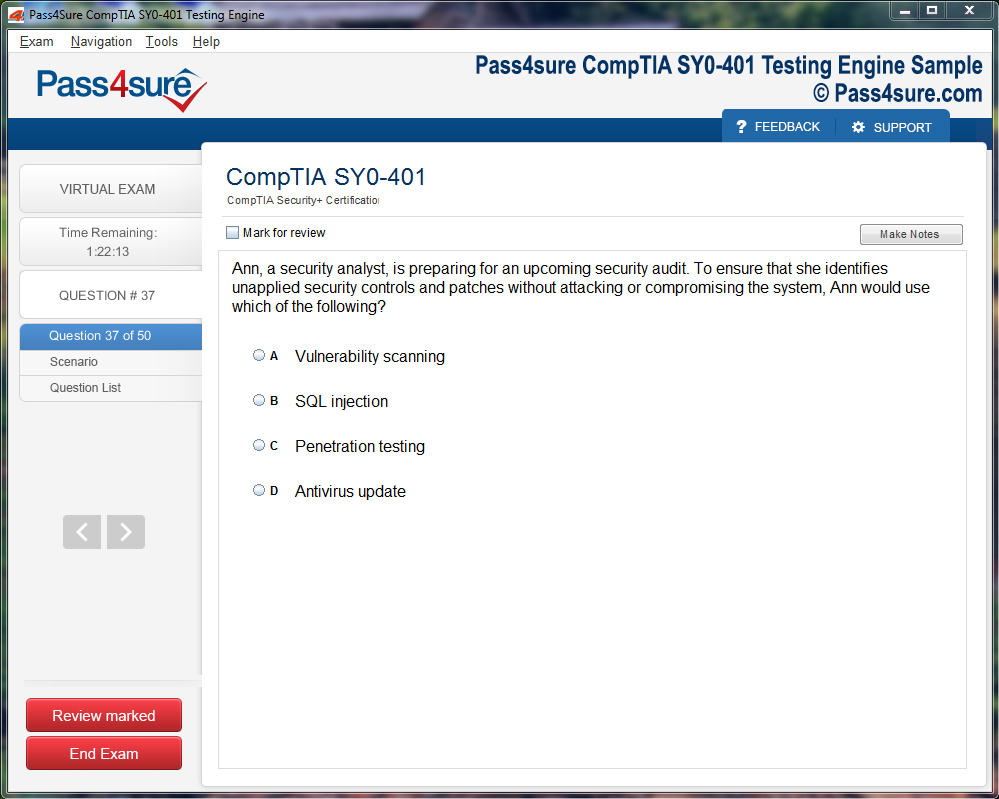
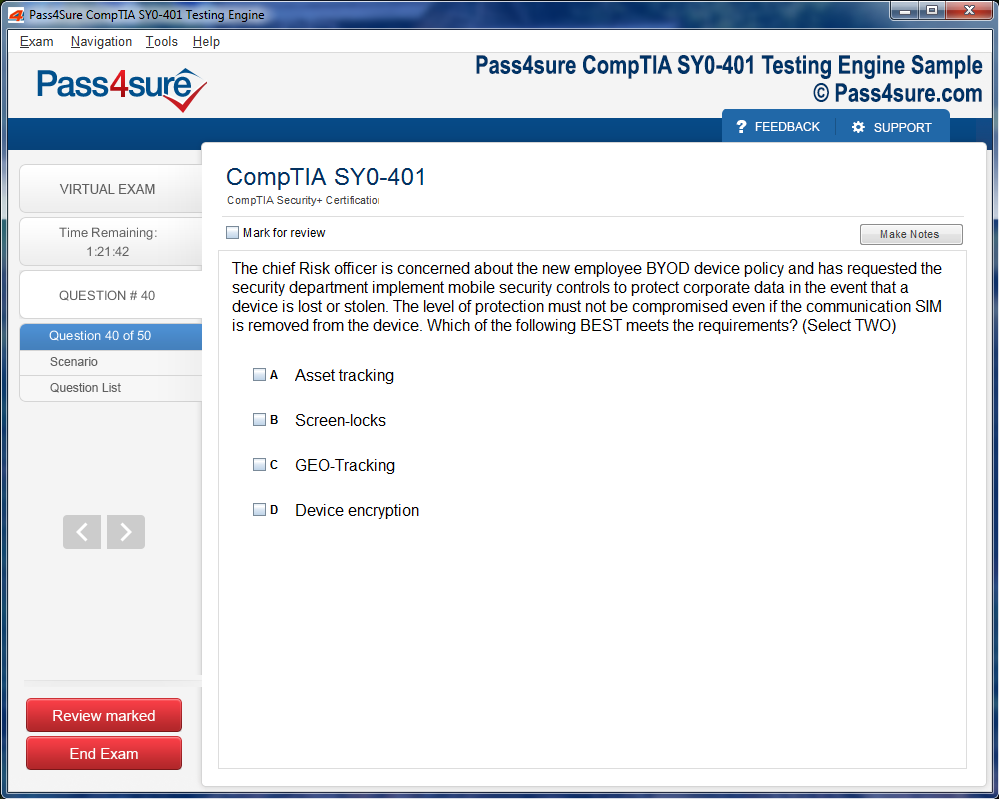
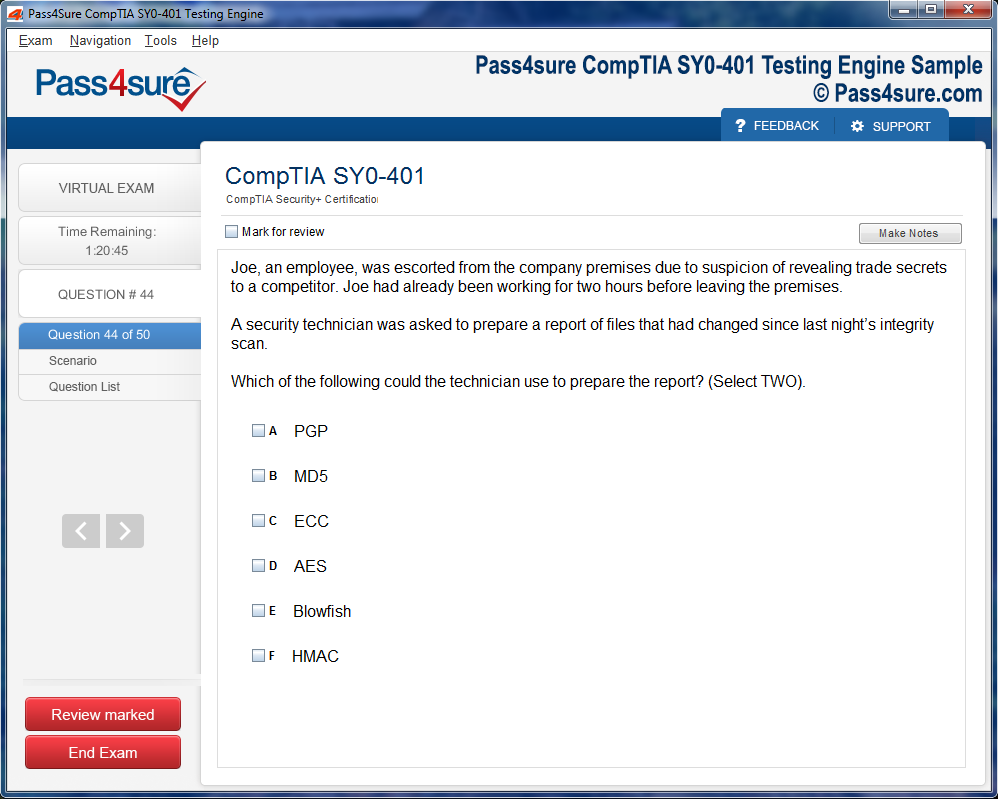
Product Screenshots


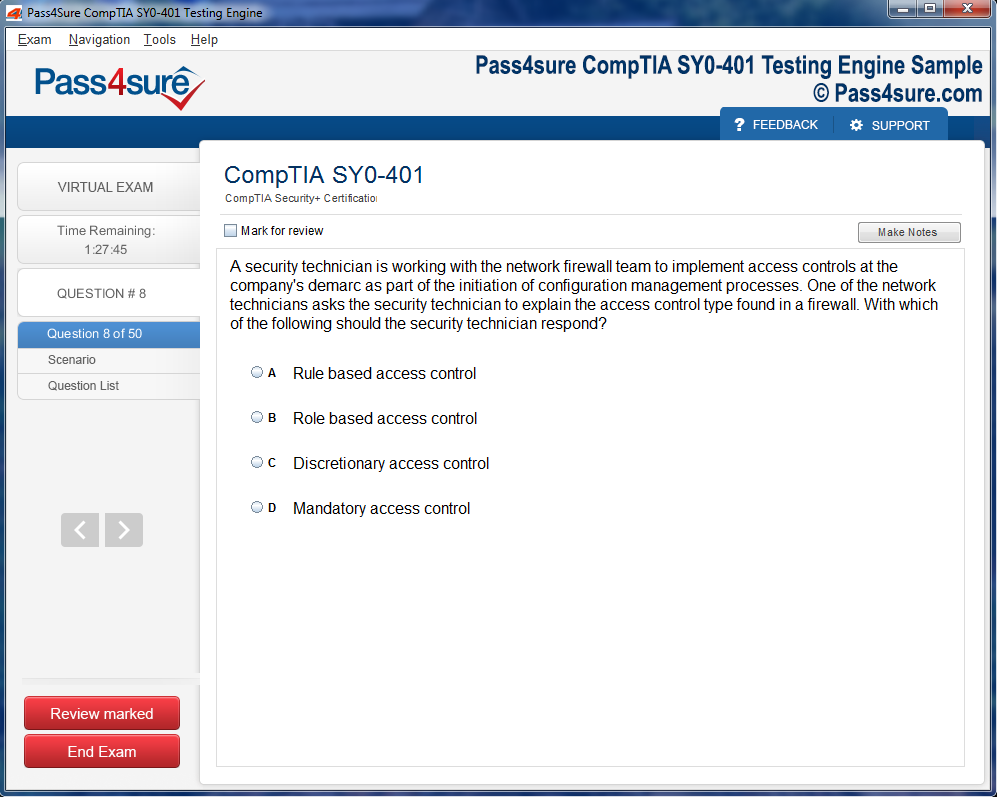

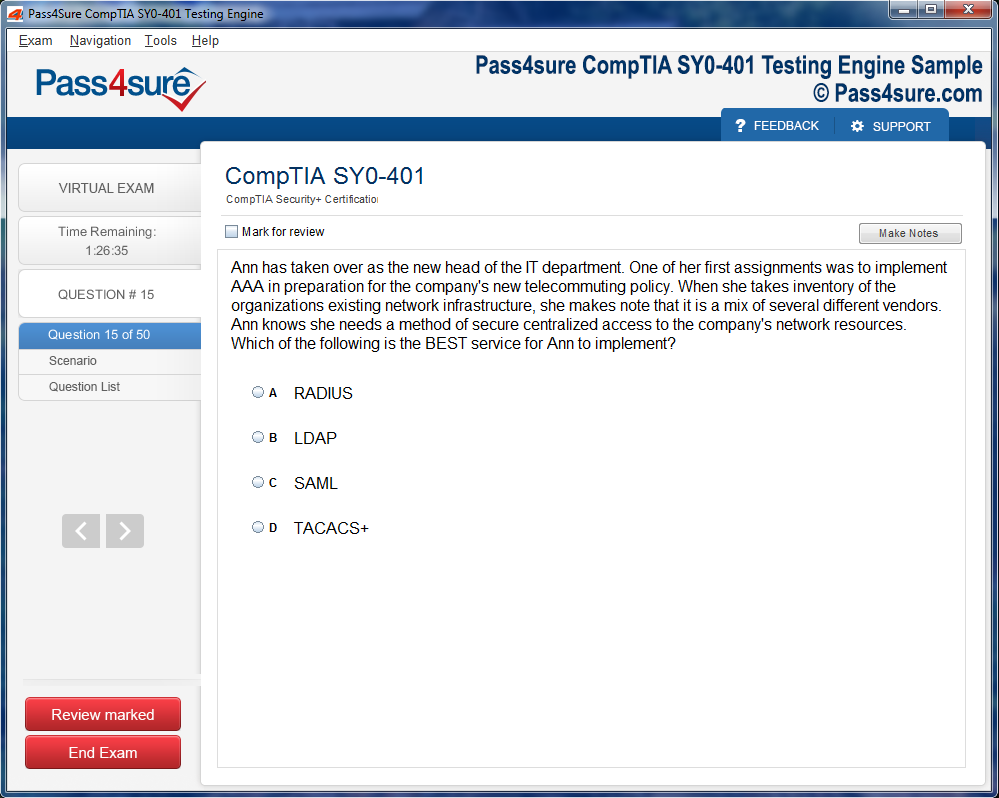
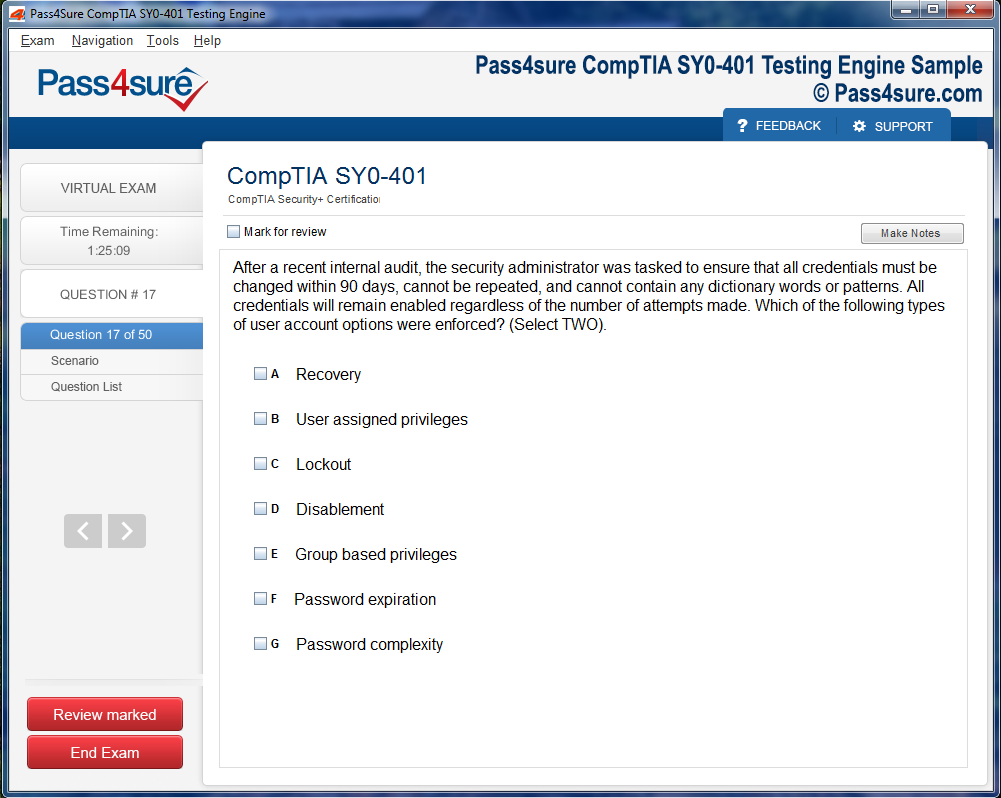
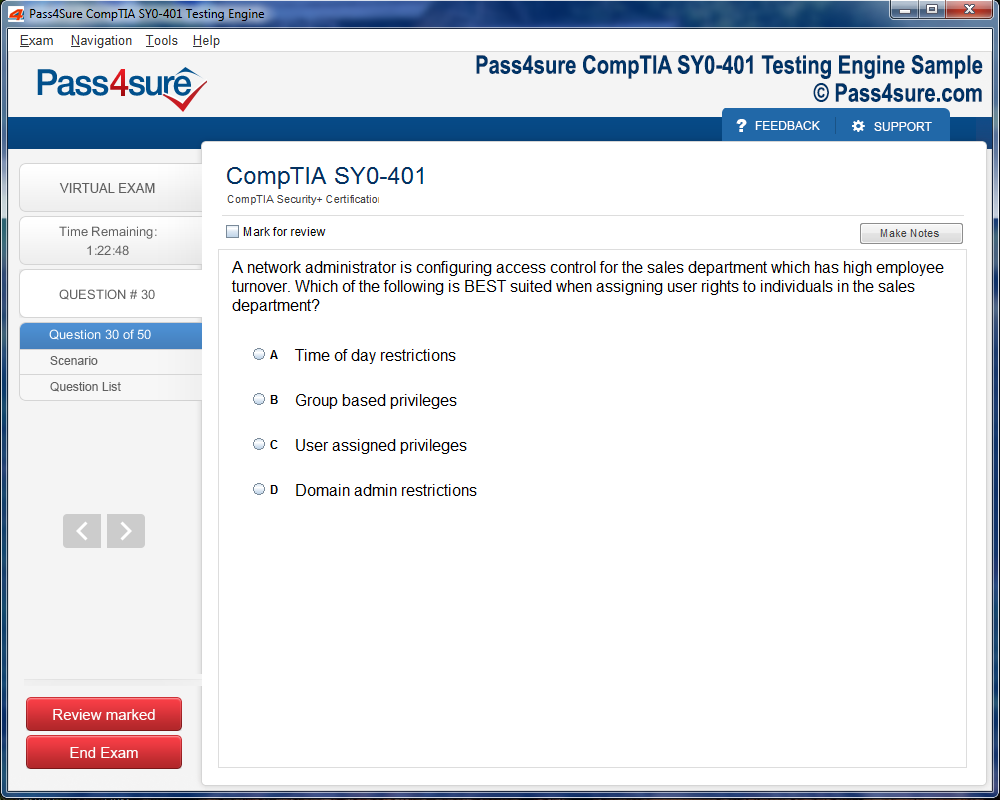
Frequently Asked Questions
How does your testing engine works?
Once download and installed on your PC, you can practise test questions, review your questions & answers using two different options 'practice exam' and 'virtual exam'. Virtual Exam - test yourself with exam questions with a time limit, as if you are taking exams in the Prometric or VUE testing centre. Practice exam - review exam questions one by one, see correct answers and explanations.
How can I get the products after purchase?
All products are available for download immediately from your Member's Area. Once you have made the payment, you will be transferred to Member's Area where you can login and download the products you have purchased to your computer.
How long can I use my product? Will it be valid forever?
Pass4sure products have a validity of 90 days from the date of purchase. This means that any updates to the products, including but not limited to new questions, or updates and changes by our editing team, will be automatically downloaded on to computer to make sure that you get latest exam prep materials during those 90 days.
Can I renew my product if when it's expired?
Yes, when the 90 days of your product validity are over, you have the option of renewing your expired products with a 30% discount. This can be done in your Member's Area.
Please note that you will not be able to use the product after it has expired if you don't renew it.
How often are the questions updated?
We always try to provide the latest pool of questions, Updates in the questions depend on the changes in actual pool of questions by different vendors. As soon as we know about the change in the exam question pool we try our best to update the products as fast as possible.
How many computers I can download Pass4sure software on?
You can download the Pass4sure products on the maximum number of 2 (two) computers or devices. If you need to use the software on more than two machines, you can purchase this option separately. Please email sales@pass4sure.com if you need to use more than 5 (five) computers.
What are the system requirements?
Minimum System Requirements:
- Windows XP or newer operating system
- Java Version 8 or newer
- 1+ GHz processor
- 1 GB Ram
- 50 MB available hard disk typically (products may vary)
What operating systems are supported by your Testing Engine software?
Our testing engine is supported by Windows. Andriod and IOS software is currently under development.
Comprehensive Guide to Network Appliance Certified Technology Associate NS0-004
In the realm of NS0-004, storage architectures transcend conventional paradigms, embracing hybrid, converged, and hyper-converged designs that optimize performance and operational dexterity. Virtualization acts as the linchpin, abstracting physical resources into malleable pools that allow dynamic provisioning and efficient utilization. Understanding the nuances of thin provisioning, deduplication, and tiering strategies is critical for architects aiming to balance cost, speed, and resilience.
Architectural exploration delves into modular storage units capable of scaling horizontally without sacrificing coherence or latency. Learners are encouraged to examine the interplay between front-end host interfaces and back-end disk arrangements, scrutinizing protocols such as Fibre Channel, iSCSI, and NVMe over Fabrics. These protocols define the contours of throughput, command queuing, and multi-path access, forming the bedrock for enterprise-grade deployments.
Equally significant is the integration of software-defined storage principles. By decoupling control and data planes, organizations gain unprecedented flexibility, enabling policy-driven automation, self-healing capabilities, and predictive analytics. Mastery of these concepts prepares professionals to design infrastructures that respond adaptively to fluctuating workloads, emergent bottlenecks, and evolving business requirements.
Data Protection and Continuity Mechanisms
Data sanctity and availability remain paramount in advanced storage landscapes. NS0-004 emphasizes the orchestration of multifaceted protection schemes that encompass replication, erasure coding, and continuous data protection. Synchronous replication ensures atomic consistency across geographically dispersed arrays, while asynchronous replication balances latency with resource optimization.
Snapshots and versioning techniques allow temporal agility, providing point-in-time recoverability without imposing extensive storage overheads. Professionals are trained to discern between shallow snapshots optimized for rapid rollback and deep snapshots suited for archival integrity. Complementing these strategies, backup frameworks must be meticulously aligned with recovery time objectives and recovery point objectives to ensure organizational resilience.
The curriculum also incorporates disaster recovery simulations, compelling learners to architect failover mechanisms that withstand both localized disruptions and systemic outages. Emphasis is placed on the choreography of storage clustering, replication zoning, and automated failback procedures. Such exercises cultivate a nuanced understanding of both operational continuity and the latent complexities inherent in global-scale infrastructures.
Security Paradigms in Storage Ecosystems
Modern storage systems inhabit a landscape riddled with cybersecurity exigencies. NS0-004 positions data security not as a peripheral concern but as an integral architectural principle. Encryption at rest and in transit, coupled with granular access controls, mitigates the risk of unauthorized exfiltration. Advanced key management practices, including hardware security modules and automated rotation policies, are explored to safeguard cryptographic integrity.
Identity and access management frameworks intertwine with auditing and compliance mandates. Professionals learn to navigate regulatory landscapes, ensuring alignment with data sovereignty laws, industry standards, and internal governance policies. Emphasis is placed on proactive threat modeling, anomaly detection, and the deployment of adaptive controls that evolve in tandem with emerging threat vectors.
Security is further intertwined with operational efficiency through the adoption of role-based access, separation of duties, and context-aware authorization. Such measures not only protect sensitive assets but also maintain operational fluidity, allowing legitimate processes to proceed unhindered while minimizing exposure to latent vulnerabilities.
Performance Optimization and Analytical Insights
NS0-004 underscores the necessity of performance vigilance and continuous optimization. Professionals are introduced to telemetry-driven frameworks that monitor IOPS, latency, and throughput at granular levels. By leveraging predictive analytics and trend extrapolation, storage administrators can preemptively address bottlenecks, rebalance workloads, and optimize data placement strategies.
The curriculum emphasizes the symbiosis between hardware acceleration and software intelligence. NVMe caching, persistent memory, and hybrid flash arrays are analyzed in conjunction with algorithmic scheduling, load balancing, and deduplication schemes. This holistic perspective ensures that high-performance storage ecosystems can sustain peak workloads without compromising reliability.
Furthermore, the certification promotes a culture of iterative refinement. Storage tuning is not a one-time exercise but a continuous endeavor that incorporates workload characterization, adaptive caching strategies, and periodic reallocation of storage tiers. By internalizing these principles, candidates develop an operational intuition that extends beyond static configurations into proactive, data-driven management.
Operational Automation and Management
Automation emerges as the keystone for contemporary storage operations. NS0-004 immerses learners in policy-based orchestration frameworks that reduce manual intervention, enhance consistency, and accelerate provisioning cycles. Scripts, APIs, and orchestration engines converge to create a symphony of automated tasks, from volume creation to snapshot lifecycle management.
Monitoring frameworks employ real-time metrics, anomaly detection algorithms, and predictive alerts to empower administrators with actionable insights. Professionals are trained to interpret telemetry not as raw data but as a narrative revealing systemic stress, potential degradation, and emergent inefficiencies.
The integration of artificial intelligence and machine learning further augments operational dexterity. Predictive analytics forecast capacity exhaustion, anticipate hardware failures, and suggest optimal workload redistribution. This intelligent automation ensures that storage ecosystems remain agile, resilient, and aligned with dynamic business objectives, while freeing human operators to focus on strategic initiatives rather than repetitive maintenance tasks.
Architecture and Components in NS0-004
Building upon the foundational precepts, NS0-004 accentuates the architectural intricacies and elemental constituents that underpin resilient and high-performance storage ecosystems. Achieving fluency in these domains is pivotal for orchestrating systems that balance scalability, responsiveness, and fault tolerance.
At the core of NS0-004 infrastructures lie storage arrays, spanning all-flash, hybrid, and traditional disk-based paradigms. Each configuration is scrutinized for operational idiosyncrasies, including latency fluctuations, throughput variability, and IOPS performance under diverse workloads. A nuanced comprehension of hardware-software synergies empowers practitioners to calibrate systems for maximal responsiveness and resource efficiency.
Data stewardship and protection mechanisms are quintessential in NS0-004 architecture. Scholars dissect replication methodologies, instantaneous snapshots, and continuous data protection frameworks. Analytical focus rests on performance ramifications, restoration velocity, and contextual appropriateness of each strategy. Professionals cultivate the acumen to tailor protective measures in alignment with regulatory mandates and organizational risk appetites.
Network topologies and connectivity protocols constitute another cornerstone of NS0-004. Fibre Channel, iSCSI, and NAS paradigms are deconstructed to reveal operational advantages and potential pitfalls. Candidates assimilate the principles of path configuration, multipath orchestration, and connectivity diagnostics, fostering seamless enterprise integration. A profound understanding of network dynamics enhances availability while mitigating latency-induced performance bottlenecks.
Operational monitoring and performance tuning are indispensable for system stewardship. NS0-004 learners interact with diagnostic frameworks that quantify latency, throughput, and IOPS distribution. Such empirical insights inform workload orchestration and predictive tuning, enabling preemptive mitigation of performance degradation. The equilibrium between strategic insight and technical vigilance epitomizes operational excellence in storage management.
Security protocols permeate every layer of NS0-004 infrastructure. Role-based access control, granular encryption schemas, and meticulous auditing practices form the defensive lattice safeguarding sensitive information. Mastery of these principles ensures systems remain resilient against internal and external threats while retaining the flexibility essential for dynamic operational environments.
Component interplay is further enriched by the orchestration of virtualized storage constructs and tiered data placement strategies. Candidates explore the integration of storage virtualization technologies, leveraging abstraction layers to optimize utilization and streamline management. Tiered architectures facilitate intelligent data migration across performance strata, enhancing responsiveness and cost-efficiency.
Storage orchestration is increasingly intertwined with automation frameworks. NS0-004 emphasizes the deployment of scripts, APIs, and policy-driven management paradigms to diminish manual intervention. Automated provisioning, replication scheduling, and self-healing workflows exemplify contemporary operational methodologies, allowing administrators to focus on strategic initiatives rather than routine operational minutiae.
Performance tuning extends into the realm of predictive analytics. By harnessing historical metrics and workload patterns, practitioners anticipate bottlenecks and preconfigure system thresholds. This proactive stance minimizes disruptions and ensures that storage environments maintain consistent service levels, even under fluctuating demand scenarios.
Interoperability is a recurrent theme in NS0-004. Modern enterprises often deploy heterogeneous storage solutions, necessitating fluency in cross-platform integration. Understanding protocol translation, multiprotocol environments, and vendor-specific idiosyncrasies enables seamless operation within multi-vendor landscapes. The capacity to navigate interoperability challenges is crucial for maintaining cohesive, high-performing storage fabrics.
Finally, the NS0-004 curriculum underscores the synthesis of architectural theory with pragmatic application. Candidates are encouraged to design, simulate, and optimize storage ecosystems that reflect real-world operational pressures. Such experiential learning fosters the analytical dexterity and adaptive mindset required to excel in complex data-centric environments.
Advanced Operational Techniques in NS0-004
With mastery of core architecture and foundational principles, NS0-004 learners delve into the realm of advanced operational techniques, where strategy converges with execution in high-stakes storage environments. This segment emphasizes the intricacies of efficiency, scalability, and resilience, essential for modern enterprise infrastructures.
Capacity prognostication serves as a cornerstone of advanced operations. Candidates engage with sophisticated methodologies to anticipate storage growth, analyze temporal workload fluctuations, and align resource allocation with strategic objectives. Such predictive insights empower administrators to circumvent bottlenecks, optimize resource utilization, and maintain a seamless operational continuum. The subtle art of foresight in capacity planning ensures infrastructures remain agile under dynamic data influxes.
Performance orchestration forms the next critical frontier. NS0-004 cultivates proficiency in workload harmonization, tiered storage stratagems, and intelligent caching frameworks. Learners explore the dynamic allocation of computational and storage resources, balancing throughput maximization with latency minimization. This dual focus equips practitioners to maintain operational excellence across heterogeneous workloads while making data-driven decisions under fluctuating demand patterns.
Resilience strategies underscore operational sophistication. Disaster recovery and business continuity protocols are rigorously explored, encompassing cross-site replication, automated failover mechanisms, and rapid restoration workflows. Immersive simulations of system disruptions hone candidates’ abilities to anticipate contingencies, refine recovery procedures, and safeguard service integrity. Such practices cultivate an ethos of operational reliability and reinforce the imperative of continuity in enterprise environments.
Automation emerges as a transformative force in modern storage management. NS0-004 emphasizes the orchestration of repetitive tasks through scripting, API-driven integrations, and policy-based frameworks. By embedding automation into operational workflows, administrators reduce susceptibility to human error, accelerate procedural execution, and maintain consistency across sprawling storage ecosystems. This strategic embrace of automation magnifies both efficiency and governance precision.
Analytical rigor extends into troubleshooting and root cause diagnostics. Advanced practitioners in NS0-004 are trained to dissect complex performance anomalies, uncover subtle misconfigurations, and remediate systemic faults with methodological exactitude. Through experiential exercises and scenario-based problem solving, candidates cultivate resilience in decision-making and confidence in sustaining high-performance, mission-critical storage infrastructures.
Security considerations interlace with operational strategies. NS0-004 integrates protocols for access governance, encryption standards, and compliance adherence, ensuring that operational sophistication does not compromise data integrity. Candidates learn to embed security controls within automation and performance workflows, blending operational agility with robust risk mitigation.
Advanced monitoring and telemetry are integral to operational acuity. Learners explore the deployment of sophisticated diagnostic tools, real-time performance dashboards, and predictive analytics to discern emergent anomalies before they escalate. The ability to synthesize telemetry insights into actionable operational decisions represents a defining hallmark of NS0-004 proficiency.
Ultimately, Part Three immerses candidates in a confluence of strategic foresight, operational dexterity, and technical acumen. By mastering capacity foresight, performance orchestration, resilience engineering, automation, and analytical troubleshooting, NS0-004 learners ascend to a level of operational sophistication capable of sustaining dynamic, large-scale storage ecosystems. This phase cultivates professionals who are not only adept at managing contemporary infrastructures but also anticipatory in navigating the evolving landscape of enterprise data operations.
Practical Application Scenarios in NS0-004
Understanding advanced methodologies alone is insufficient without actual operationalization. NS0-004 accentuates the transmutation of theoretical acumen into tangible outcomes, exemplifying the pragmatic benefits of sophisticated storage orchestration.
Enterprise data stewardship epitomizes a primary theater of application. NS0-004 elucidates the orchestration of storage assets, harmonizing resource allocation while amplifying throughput and guaranteeing fault-tolerant architectures. Immersive exercises delineate how meticulously engineered infrastructures bolster extensive operational ecosystems without compromising efficiency or dependability.
Data fortification and recuperation constitute essential procedural imperatives. Within NS0-004, candidates master the orchestration of snapshots, replication topologies, and restorative protocols. Simulated contingencies cultivate rapidity and precision in retrieving mission-critical information, underscoring the imperative of anticipatory planning and methodical oversight.
Performance calibration and workload choreography emerge as pivotal domains. Learners navigate scenarios featuring high-velocity applications, stratified storage hierarchies, and latency-intolerant processes. Applying optimization heuristics enables alignment of infrastructural configurations with strategic enterprise objectives, rendering demonstrable operational value.
Regulatory and security paradigms form a cornerstone of practical exploration. NS0-004 immerses candidates in the deployment of access governance, cryptographic safeguards, and audit frameworks within controlled environments. Such exercises accentuate the nexus between compliance fidelity and the protection of sensitive organizational assets.
Hybridization and cloud amalgamation are increasingly salient. NS0-004 prescribes methodologies for synthesizing on-premises systems with expansive cloud infrastructures, meticulously balancing scalability with performance thresholds. Learners engage with migration schemas, replication modalities, and monitoring mechanisms, ensuring seamless interoperability across heterogeneous architectures.
Operational simulations within NS0-004 cultivate an experiential understanding that bridges the chasm between abstract theory and applied proficiency. Through meticulously crafted scenarios, learners internalize the dynamics of contemporary storage ecosystems, equipping them for real-world deployments and certification readiness alike.
Strategies for NS0-004 Certification Preparation
Achieving mastery in NS0-004 demands an orchestrated confluence of intellectual rigor, practical dexterity, and meticulous strategic planning. Certification is not merely an evaluation of knowledge; it is an odyssey requiring candidates to navigate the intricacies of storage architectures, operational paradigms, and problem-solving scenarios with precision and acumen.
Structured Study Paradigms
A deliberate and methodical study framework forms the cornerstone of NS0-004 preparation. Candidates benefit from segmenting their learning into progressive strata, beginning with foundational principles, advancing to complex configurations, and culminating in applied exercises. Iterative review, interleaved practice, and reflective synthesis enable retention to move beyond rote memorization, transforming information into operational fluency. Conceptual scaffolding through comparative analysis and scenario mapping fosters an intuitive grasp of interdependent systems and emergent behaviors within storage infrastructures.
Experiential and Practical Immersion
Theoretical comprehension alone is insufficient; NS0-004 emphasizes tactile engagement with systems to cultivate operational confidence. Simulations, lab exercises, and real-world problem-solving scenarios replicate the dynamic pressures of enterprise storage environments. Candidates refine proficiency in configuration management, performance optimization, and fault resolution through hands-on experimentation. This active engagement cultivates both procedural memory and adaptive expertise, allowing learners to anticipate contingencies and apply solutions with agility.
Cognitive Reinforcement and Knowledge Integration
Conceptual reinforcement is essential for enduring mastery. NS0-004 preparation encourages candidates to forge mental linkages between abstract principles and operational execution. Employing techniques such as iterative recall, mind mapping, and scenario extrapolation embeds knowledge into long-term memory. Integrative exercises challenge learners to synthesize multiple concepts, translating theoretical understanding into actionable expertise that resonates under examination conditions and real-world operations alike.
Analytical Assessment and Feedback Loops
Self-evaluation and reflective practice accelerate proficiency. Mock assessments, practice simulations, and targeted quizzes illuminate knowledge gaps while reinforcing areas of strength. Systematic analysis of performance data guides refinement of preparation strategies, ensuring efficient allocation of study time and cognitive resources. These feedback loops cultivate strategic awareness and self-efficacy, both of which are pivotal for navigating the rigorous demands of the NS0-004 examination.
Psychological Acumen and Exam Resilience
NS0-004 success is equally predicated upon psychological readiness. Candidates must cultivate sustained focus, composure under duress, and adaptive pacing strategies. Mindfulness techniques, structured rest intervals, and time management heuristics mitigate cognitive fatigue, enhancing clarity of thought and decision-making acuity. Developing resilience transforms the exam from a stress-inducing obstacle into a deliberate performance opportunity.
Synthesis of Technical and Strategic Mastery
Ultimately, NS0-004 preparation is a synergistic interplay of technical expertise, experiential practice, and cognitive strategy. Candidates emerge not merely as repositories of knowledge, but as agile practitioners capable of navigating complex storage ecosystems, diagnosing challenges, and implementing solutions with precision. Strategic preparation, therefore, becomes a multifaceted journey of intellectual enrichment, practical refinement, and disciplined self-regulation, ensuring readiness for both examination rigor and professional excellence.
Emerging Paradigms in NS0-004
NS0-004 transcends mere certification, inviting practitioners into a realm where perpetual learning and adaptive cognition govern mastery of storage ecosystems. The framework encourages a symbiotic relationship between foundational knowledge and emergent technological landscapes, guiding learners toward operational dexterity and foresight.
The advent of cloud-native storage exemplifies a pivotal transformation. NS0-004 delineates methodologies for hybrid deployments, facilitating seamless integration between on-premises infrastructure and cloud-based repositories. Dynamic resource orchestration allows systems to scale responsively, optimizing efficiency while maintaining operational equilibrium. Learners explore architectural nuances that reconcile latency, redundancy, and cost, cultivating a sophisticated understanding of contemporary storage topologies.
Automation and AI-infused governance are redefining storage management paradigms. Through NS0-004, candidates engage with predictive analytics frameworks that anticipate system stressors, automated tuning protocols that enhance throughput, and intelligent provisioning strategies that allocate resources with precision. The cognitive load traditionally borne by operators is mitigated, while system resiliency and responsiveness are amplified.
Security and regulatory fidelity remain paramount within the NS0-004 ethos. Encryption schemes, privacy-centric technologies, and compliance frameworks are not peripheral but integral to curriculum objectives. Practitioners develop acumen in deploying mechanisms that safeguard data integrity without compromising operational agility. They learn to harmonize risk mitigation with performance imperatives, fostering environments where trust and efficiency coalesce.
Interdisciplinary Synthesis and Adaptive Expertise
NS0-004 underscores the imperative of interdisciplinary integration, situating storage management within broader IT landscapes. Networking intricacies, application delivery dynamics, and enterprise operations converge within its pedagogical scope, equipping learners to craft holistic, interconnected solutions. The framework cultivates adaptive expertise, enabling professionals to navigate complexity, anticipate systemic interdependencies, and innovate proactively.
Lifelong learning constitutes a cornerstone of NS0-004 philosophy. Continuous professional development is not a perfunctory pursuit but a deliberate, iterative process. Through reflective practice, experimental engagement, and iterative knowledge acquisition, practitioners remain attuned to technological evolution. Curiosity, flexibility, and creativity are cultivated as professional habits, engendering resilience and sustained impact within ever-shifting operational landscapes.
NS0-004 challenges learners to reconcile technical rigor with strategic insight. Its paradigm fosters practitioners capable of not only maintaining infrastructure but transforming organizational capacity through informed decision-making. The curriculum is simultaneously a roadmap, a toolkit, and a cognitive scaffolding, supporting growth from foundational literacy to sophisticated, anticipatory practice.
Cognitive Foresight and Operational Ingenuity
In the milieu of NS0-004, operational ingenuity emerges as a defining trait. Candidates are trained to interpret system metrics with nuance, forecast emergent bottlenecks, and deploy corrective strategies preemptively. Data-driven decision-making is augmented by conceptual frameworks that elucidate causality, optimize resource distribution, and enhance systemic resilience.
The integration of AI-assisted management elevates strategic thinking. Intelligent orchestration of storage resources leverages predictive insights to streamline provisioning, automate repetitive tasks, and dynamically calibrate system parameters. Practitioners develop a dual competency: technical fluency and anticipatory problem-solving, enabling them to navigate both present operational demands and future uncertainties.
Experiential Learning and Adaptive Reflexivity
NS0-004 promotes an experiential learning ethos, privileging iterative engagement and reflective insight. Practical labs, scenario-based simulations, and experimental deployments are central to cultivating adaptive reflexivity. Candidates refine their ability to respond to unanticipated system behaviors, reconcile performance trade-offs, and innovate within constrained environments.
The emphasis on reflective practice nurtures cognitive agility. By critically evaluating outcomes, discerning emergent patterns, and iteratively adjusting methodologies, learners internalize principles that extend beyond rote operational procedures. They cultivate meta-cognitive awareness, positioning themselves to anticipate technological shifts and operational contingencies.
Strategic Evolution in Storage Operations
NS0-004 invites practitioners into an evolving landscape where storage operations are no longer isolated technical exercises but intricate ecosystems intertwined with enterprise strategy. The framework emphasizes the symbiotic nature of technical proficiency and strategic foresight. Professionals are trained to evaluate operational choices not merely in terms of immediate performance metrics but through a lens of organizational resilience, scalability, and long-term value creation.
Hybrid and multi-cloud paradigms are at the forefront of this evolution. Candidates explore the subtleties of orchestrating resources across heterogeneous environments, reconciling latency constraints, redundancy requirements, and cost optimization. NS0-004 underscores the importance of fluidity—storage infrastructures must adapt dynamically, deploying capacity where it is most efficient while mitigating risk of oversaturation or bottleneck phenomena. Practitioners acquire dexterity in crafting deployment topologies that balance local autonomy with global orchestration.
Intelligent Automation and Predictive Stewardship
Automation in NS0-004 is conceived as both operational expedience and strategic instrument. Beyond rudimentary task scheduling, the curriculum delves into AI-enhanced stewardship of storage environments. Predictive algorithms parse historical performance metrics, system logs, and utilization patterns to forecast potential stressors or anomalies. Candidates learn to leverage these insights to preemptively reallocate resources, tune parameters, and orchestrate failover contingencies.
Intelligent provisioning extends this paradigm further. Through NS0-004, learners gain the ability to implement automated policies that dynamically adjust capacity, enforce compliance constraints, and optimize throughput. Manual intervention is minimized, freeing operators to focus on higher-order analytical and strategic tasks. The emergent skill set fosters operational nimbleness, enabling storage teams to respond to volatile workloads with precision and minimal latency.
Security, Compliance, and Ethical Stewardship
Data security within NS0-004 transcends technical implementation; it is a principle of ethical stewardship. Encryption methodologies, privacy-preserving protocols, and regulatory adherence frameworks are integral to the curriculum, ensuring that candidates internalize security as a foundational operational imperative. Practitioners explore end-to-end data lifecycle management, balancing accessibility and performance with confidentiality and integrity imperatives.
Compliance considerations are deeply embedded within NS0-004. Beyond mere adherence to regulatory frameworks, the curriculum emphasizes proactive strategies that anticipate evolving legal landscapes, data sovereignty requirements, and emerging privacy standards. Candidates learn to craft architectures that embed compliance in operational workflows rather than treating it as a peripheral constraint. The ability to harmonize security, regulatory fidelity, and performance outcomes constitutes a hallmark of advanced NS0-004 expertise.
Cross-Domain Integration and Organizational Synergy
A distinguishing feature of NS0-004 is its insistence on cross-domain integration. Storage management is framed not as a siloed discipline but as an enabler of broader enterprise functionality. Practitioners examine the interplay between storage, networking, application delivery, and enterprise IT governance. By understanding these interdependencies, candidates cultivate the ability to design systems that enhance organizational coherence, optimize workflow, and reduce friction across operational silos.
Interdisciplinary integration also reinforces strategic adaptability. NS0-004 equips learners to anticipate systemic impacts of technological interventions, enabling a holistic approach to problem-solving. This multidimensional perspective fosters foresight, allowing operators to anticipate emergent bottlenecks, optimize resource distribution, and contribute to organizational decision-making at strategic levels.
Continuous Cognitive Enrichment and Lifelong Learning
Central to NS0-004 philosophy is the principle of continuous cognitive enrichment. Learning is conceived as an iterative, lifelong process rather than a bounded, episodic activity. Practitioners are encouraged to cultivate intellectual curiosity, engage in reflective practice, and continuously challenge assumptions about technology, operations, and strategic alignment.
Experimentation is actively promoted. Candidates undertake scenario-based simulations, pilot deployments, and iterative optimizations to refine operational intuition. These activities are not merely technical exercises; they are cognitive laboratories where analytical rigor, creative problem-solving, and strategic insight coalesce. Practitioners learn to embrace uncertainty, adapt to emergent technologies, and innovate responsibly within complex, dynamic ecosystems.
Adaptive Expertise and Meta-Cognitive Awareness
NS0-004 emphasizes adaptive expertise, a dual competency that combines operational fluency with strategic cognition. Candidates are trained to navigate ambiguity, anticipate technological inflection points, and design solutions that are both robust and flexible. The curriculum fosters meta-cognitive awareness, enabling practitioners to reflect on decision-making processes, recognize cognitive biases, and iteratively enhance problem-solving frameworks.
In practice, adaptive expertise manifests through anticipatory resource management, intelligent automation, and context-sensitive system optimization. Practitioners learn to balance operational imperatives with strategic foresight, dynamically adjusting storage configurations, provisioning policies, and monitoring protocols in response to real-time feedback. This reflexive capability distinguishes NS0-004-certified professionals from those with static, procedural expertise.
Innovation as Operational Imperative
Innovation is not a peripheral aspiration within NS0-004 but an operational imperative. Candidates are encouraged to challenge conventional paradigms, experiment with novel architectures, and integrate emergent technologies into practical workflows. The framework emphasizes that transformative innovation is iterative, grounded in empirical observation, and guided by analytical rigor.
AI-driven management, containerized storage frameworks, and software-defined paradigms provide fertile ground for experimentation. Practitioners explore techniques to automate provisioning, optimize performance, and enhance resilience while simultaneously evaluating trade-offs in latency, cost, and redundancy. By fostering a culture of iterative improvement, NS0-004 equips professionals to pioneer solutions that deliver measurable impact and operational advantage.
Reflective Practice and Experiential Mastery
Reflective practice forms the epistemological backbone of NS0-004. Through structured review of system outcomes, practitioners refine analytical acumen and deepen operational intuition. Each deployment, simulation, or optimization exercise becomes a repository of insight, enabling learners to recognize patterns, anticipate anomalies, and extrapolate strategic lessons.
Experiential mastery is achieved through deliberate engagement with complex, real-world scenarios. Candidates are challenged to reconcile conflicting operational demands, optimize multifaceted system parameters, and evaluate emergent risks. This immersion cultivates resilience, cognitive flexibility, and an ability to synthesize technical knowledge with strategic decision-making.
Anticipatory Strategy and Forward-Looking Competence
NS0-004 fosters anticipatory strategy, encouraging learners to project the implications of technological trends on storage operations. By analyzing emerging patterns in data proliferation, cloud evolution, and AI-driven orchestration, practitioners develop foresight that informs both tactical and strategic planning.
Forward-looking competence encompasses risk anticipation, resource scalability, and adaptive policy formulation. Candidates learn to design infrastructures that remain resilient under stress, dynamically scale to accommodate demand fluctuations, and integrate seamlessly with broader enterprise ecosystems. This predictive capacity ensures that storage systems are not merely reactive but proactively aligned with organizational objectives.
Strategies for NS0-004 Certification Preparation
Attaining NS0-004 certification is not merely an exercise in memorization; it is a multidimensional expedition that demands cognitive dexterity, practical agility, and strategic foresight. Success in this arena requires candidates to cultivate a profound understanding of storage architectures, operational paradigms, and emergent system behaviors while simultaneously refining the soft skills that enable composure and acuity under high-stakes conditions. Preparation is thus an integrative endeavor, where theoretical erudition intersects with practical proficiency and psychological resilience.
Structured Study Paradigms
Structured and methodical study strategies form the bedrock of NS0-004 preparation. Candidates who thrive are those who eschew haphazard learning in favor of disciplined segmentation. Foundational knowledge in storage technologies, protocols, and data management principles must first be internalized before progressing to more intricate topics such as replication, clustering, disaster recovery, and performance optimization.
Iterative review plays a pivotal role in retention. By revisiting topics cyclically and interleaving them with adjacent concepts, candidates cultivate a robust mental schema, allowing disparate technical elements to coalesce into coherent operational understanding. Active recall, an evidence-based cognitive strategy, further enhances memory consolidation. Through self-quizzing, scenario-based exercises, and mental simulation of system operations, knowledge transcends rote memorization and evolves into functional expertise.
Scenario-based learning is particularly indispensable. By conceptualizing real-world system challenges—such as mitigating latency spikes, orchestrating failover protocols, or performing multi-tiered storage migrations—candidates develop anticipatory problem-solving skills. This strategic foresight ensures that abstract principles are immediately translatable into operational solutions, a competency that NS0-004 rigorously evaluates.
Moreover, comparative analysis provides intellectual scaffolding. Evaluating multiple configurations, architectures, or operational approaches against one another illuminates subtle trade-offs and reinforces nuanced understanding. Candidates learn not only what actions to take but why they are preferable in specific contexts, embedding both tactical and strategic discernment into their skillset.
Experiential and Practical Immersion
Hands-on engagement is the fulcrum of NS0-004 preparation. Conceptual knowledge, however sophisticated, must be complemented with experiential mastery. Immersive lab exercises, simulations, and controlled troubleshooting scenarios allow candidates to internalize procedures in a tactile, operationally meaningful manner.
Through simulation environments, candidates encounter challenges that mirror production-level incidents, from cascading system failures to complex data recovery operations. This experiential exposure nurtures procedural fluency, enabling candidates to navigate unexpected contingencies with poise.
Operational confidence grows through repetitive, deliberate practice. Tasks such as system configuration, resource allocation, performance tuning, and fault diagnosis are not mere exercises—they are opportunities to develop muscle memory for decision-making under pressure. Candidates emerge from such training not only competent but anticipatorily agile, capable of diagnosing latent system inefficiencies before they manifest as critical issues.
Practical immersion also enhances conceptual integration. Encountering real-world scenarios forces candidates to reconcile abstract principles with tangible outcomes, creating cognitive linkages that strengthen both understanding and retention. Knowledge becomes actionable rather than theoretical, fostering the nuanced judgment that distinguishes proficient practitioners from mere exam-takers.
Cognitive Reinforcement and Knowledge Integration
Conceptual reinforcement and integrative learning are indispensable for deep mastery. NS0-004 preparation encourages candidates to transcend linear memorization and adopt multi-layered cognitive strategies. Techniques such as mind mapping, knowledge chaining, and reflective synthesis enable learners to form durable mental architectures connecting disparate concepts into a coherent operational whole.
Iterative recall, particularly through scenario replication, ensures that knowledge is flexible and retrievable under diverse contexts. By repeatedly revisiting complex topics—such as multi-protocol storage interactions, deduplication strategies, or encryption mechanisms—learners cultivate a nuanced appreciation of interdependencies. This mental scaffolding ensures that candidates can analyze and synthesize novel problems during examinations or real-world deployments.
Moreover, integrative exercises challenge learners to synthesize multiple concepts simultaneously. For example, orchestrating data migration in a clustered environment requires knowledge of networking, storage provisioning, performance tuning, and error recovery. Such exercises train candidates to operate in high-dimensional problem spaces, fostering intellectual agility and operational confidence.
Reflective synthesis is another pivotal tool. After each practical session or mock assessment, candidates should engage in post-mortem analysis: what worked, what failed, and why. These reflections embed lessons into long-term memory and develop adaptive strategies for future challenges, making preparation iterative, purposeful, and cumulatively transformative.
Analytical Assessment and Feedback Loops
Mock assessments and systematic self-evaluation provide indispensable feedback. NS0-004 candidates must understand that assessment is not solely a measure of performance but a diagnostic instrument guiding preparation refinement. Practice exams, timed simulations, and targeted quizzes illuminate strengths and weaknesses with precision, allowing learners to optimize study time and cognitive investment.
Feedback loops foster self-regulatory learning. By analyzing errors, candidates develop meta-cognitive awareness of their decision-making processes, enabling them to anticipate pitfalls and adjust strategies preemptively. For instance, recurring missteps in configuring replication protocols may signal a conceptual gap rather than a procedural oversight, prompting focused remedial study.
Strategic practice is essential. High-quality preparation is not measured by quantity alone but by the deliberate targeting of weak points while reinforcing areas of competence. This dual focus ensures comprehensive readiness and transforms preparation from rote repetition into a sophisticated, adaptive learning journey.
Time management within mock assessments is another critical dimension. Candidates must practice pacing themselves, allocating attention to challenging topics while maintaining efficiency. By simulating the temporal pressures of the exam, learners cultivate both endurance and precision, essential traits for navigating NS0-004’s rigorous evaluation framework.
Psychological Acumen and Exam Resilience
Technical mastery must be paired with psychological preparedness. Cognitive performance under duress is often the differentiating factor between competent candidates and top performers. NS0-004 preparation emphasizes strategies for sustained focus, composure under pressure, and strategic mental pacing.
Mindfulness and controlled breathing techniques are proven methods for maintaining clarity during high-pressure tasks. Candidates who integrate short, deliberate mindfulness exercises into their study routines report improved concentration, reduced anxiety, and heightened recall during assessments.
Structured rest and recovery cycles are equally critical. Cognitive fatigue can impair judgment and hinder retention, making strategic breaks a vital component of preparation. Alternating focused study sessions with restorative periods ensures sustained mental acuity and facilitates deeper consolidation of complex concepts.
Resilience is further cultivated through exposure to challenging scenarios. By deliberately engaging with difficult or counterintuitive problems during practice, candidates acclimate to cognitive stressors, transforming potential anxiety into proactive problem-solving energy. This approach fosters both confidence and adaptability, critical traits for both certification exams and real-world operational environments.
Synthesis of Technical and Strategic Mastery
NS0-004 preparation is, at its essence, a symbiotic synthesis of technical expertise, practical fluency, and strategic foresight. Candidates who achieve mastery do not merely accumulate knowledge—they cultivate the ability to apply principles dynamically, diagnose latent system inefficiencies, and implement optimal solutions with precision.
Strategic preparation, therefore, encompasses three intertwined dimensions: intellectual rigor, practical immersion, and psychological fortitude. Intellectual rigor ensures conceptual clarity and operational comprehension. Practical immersion transforms theoretical knowledge into tactile competence. Psychological fortitude guarantees performance under pressure, converting preparation into confident execution.
By integrating these dimensions, candidates transcend superficial familiarity and develop true operational mastery. Preparation becomes not merely a precursor to examination success but a transformative journey, embedding principles of system design, problem-solving, and adaptive decision-making that persist well beyond certification.
Through deliberate practice, cognitive reinforcement, and resilient focus, candidates emerge as versatile professionals capable of navigating the complexities of enterprise storage systems with both confidence and acuity. NS0-004 success is therefore the culmination of a holistic, multifaceted approach, where knowledge, skill, and mental discipline converge in sustained excellence.
Practical Application Scenarios in NS0-004
The translation of conceptual frameworks into actionable workflows is a cornerstone of NS0-004’s pedagogical philosophy. Learners are encouraged to traverse beyond mere comprehension of storage architectures, venturing into the orchestration of complex environments where performance, resilience, and efficiency intersect. This pragmatic lens accentuates not just the functional deployment of storage assets but also the strategic optimization that underpins enterprise data ecosystems.
In enterprise consolidation scenarios, NS0-004 equips candidates to integrate disparate storage silos into coherent, manageable infrastructures. Organizations often grapple with heterogeneous storage resources—ranging from legacy arrays to modern all-flash configurations. By applying NS0-004 methodologies, learners orchestrate seamless convergence, harmonizing storage tiers while mitigating latency bottlenecks and optimizing input/output operations per second. Through these exercises, the subtle interplay between capacity planning, throughput management, and service-level adherence becomes palpably clear, reinforcing the value of meticulous architecture design.
Backup orchestration extends beyond simple data duplication. NS0-004 emphasizes nuanced strategies for snapshot scheduling, synchronous and asynchronous replication, and tiered recovery sequences. Candidates engage with scenarios simulating catastrophic hardware failures, data corruption, and accidental deletions. These simulated stressors cultivate reflexive mastery, enabling practitioners to restore operations with minimal downtime. The exercises illuminate the delicate balance between recovery time objectives and storage resource utilization, reinforcing the principle that effective backup management is as much strategic as it is operational.
Performance tuning in NS0-004 scenarios encompasses granular adjustments to storage arrays, network configurations, and workload allocations. High-intensity applications—such as transactional databases or analytics engines—require precise calibration of IOPS, latency thresholds, and caching hierarchies. Learners employ advanced heuristics to distribute workloads across storage tiers, prioritizing critical data while optimizing secondary datasets for cost efficiency. By navigating these intricacies, candidates internalize a dynamic understanding of system behavior, appreciating how subtle adjustments can yield exponential performance gains.
Security management in applied contexts is treated with rigorous attention. NS0-004 scenarios integrate multi-faceted security paradigms, including role-based access controls, granular permission schemas, encryption protocols, and audit logging. Candidates simulate attempts at unauthorized access and insider threats within controlled environments, learning to deploy mitigations that uphold both data integrity and compliance with regulatory frameworks. This dimension underscores that storage administration transcends mechanical tasks, encompassing strategic stewardship of sensitive organizational intelligence.
Hybrid storage landscapes, combining on-premises resources with cloud platforms, present an intricate set of operational considerations. NS0-004 provides learners with techniques to orchestrate seamless migrations, synchronize replication schedules, and monitor hybrid workloads in real-time. By simulating hybrid cloud topologies, candidates understand latency trade-offs, network bandwidth considerations, and failover contingencies. These exercises elucidate the operational calculus required to balance cost-effectiveness with performance fidelity, enabling organizations to extract maximal value from multi-modal storage ecosystems.
Advanced replication and disaster recovery exercises challenge learners to develop end-to-end strategies encompassing multi-site deployments. NS0-004 scenarios involve asynchronous replication across geographies, testing the resiliency of failover mechanisms and the integrity of replicated datasets. Learners simulate complex failure conditions, from partial node outages to total datacenter disruptions, honing the skills needed to ensure business continuity. These immersive exercises reinforce a mindset of preemptive risk mitigation and strategic redundancy.
Workload orchestration forms another axis of practical application. NS0-004 scenarios include dynamic provisioning of storage based on fluctuating workload demands, policy-driven data placement, and adaptive tiering. Candidates explore the use of automated scripts and orchestration tools to dynamically adjust storage allocations, optimizing resource utilization while maintaining performance thresholds. Such practical exercises cultivate operational agility, teaching learners how to anticipate workload patterns and implement preemptive adjustments.
Monitoring and analytics exercises within NS0-004 elevate operational awareness. Candidates utilize synthetic workloads, performance counters, and diagnostic telemetry to identify potential bottlenecks and anomalous behavior. Through these exercises, learners develop an investigative mindset, diagnosing latent inefficiencies before they escalate into operational failures. Real-world applicability is emphasized, as practitioners gain experience correlating performance data with architectural adjustments, enhancing predictive maintenance capabilities.
Lifecycle management and storage provisioning are explored through scenario-based tasks. Learners simulate onboarding new storage arrays, decommissioning legacy hardware, and reallocating storage pools to support evolving workloads. The exercises highlight the temporal dimension of storage administration—how decisions made today impact scalability, operational costs, and long-term performance. Candidates emerge with a nuanced understanding of lifecycle economics, operational pragmatism, and strategic foresight.
NS0-004 also emphasizes the integration of emerging storage technologies. Candidates encounter scenarios involving NVMe-oF deployments, containerized storage solutions, and software-defined storage orchestration. By applying these technologies in practical exercises, learners gain firsthand experience with performance optimization, architectural alignment, and troubleshooting in cutting-edge environments. These exercises expand the candidate’s operational repertoire, bridging traditional storage management with contemporary paradigms.
Automation and scripting form a critical component of applied exercises. NS0-004 scenarios require candidates to implement repeatable workflows using scripting languages and orchestration tools, enhancing operational efficiency and reducing human error. Learners explore automated provisioning, replication, backup, and monitoring routines, appreciating how automation accelerates task execution while ensuring consistency. This practical skill set is particularly salient in large-scale enterprises, where manual operations are often insufficient to manage complex storage topologies.
The interplay of compliance, auditing, and operational transparency is reinforced in simulated governance scenarios. NS0-004 teaches learners to implement meticulous logging, report generation, and data lifecycle governance. Candidates practice aligning storage operations with legal, regulatory, and organizational policies, ensuring that audits can be conducted efficiently and transparently. These exercises instill an awareness that operational excellence is inseparable from regulatory adherence, reinforcing the strategic dimension of storage management.
Capacity planning exercises immerse learners in predictive modeling, trend analysis, and resource forecasting. Candidates analyze historical usage patterns, simulate peak workloads, and anticipate future growth trajectories. NS0-004 emphasizes that proactive capacity management is foundational to maintaining performance and avoiding operational bottlenecks. Learners emerge capable of making data-driven decisions, allocating resources intelligently, and aligning storage infrastructure with evolving organizational demands.
Through holistic application scenarios, NS0-004 cultivates a synthesis of knowledge domains: performance optimization, security management, hybrid integration, automation, compliance, and lifecycle orchestration. Each practical exercise is designed to mirror real-world challenges, providing candidates with a deeply immersive, operationally relevant experience. By engaging in these scenarios, learners acquire not only technical proficiency but also strategic insight into the orchestration of modern storage environments.
Advanced Operational Techniques in NS0-004
In the sphere of advanced NS0-004 operations, efficiency and foresight coalesce into a sophisticated framework of practices that govern enterprise storage management. Beyond foundational principles, candidates encounter a labyrinth of operational intricacies that demand analytical precision, strategic anticipation, and adaptive execution. The advanced practitioner must navigate environments where system elasticity, performance fidelity, and data sovereignty intersect, creating a tapestry of challenges that cannot be solved through rote procedures alone.
Capacity orchestration extends beyond simple forecasting; it involves a granular understanding of data topography, growth velocity, and workload temperament. Candidates cultivate the ability to dissect historical utilization trends and correlate them with predictive models, enabling the preemptive redistribution of resources. Such dexterity ensures that storage infrastructures remain nimble and responsive even as data ecosystems proliferate. The subtlety of capacity orchestration lies not merely in expansion but in intelligent anticipation, where administrators synchronize storage provisioning with organizational exigencies and operational cadence.
Performance orchestration is not merely about throughput; it is an exercise in harmonizing systemic elements under dynamic loads. Tiered storage strategies demand a keen understanding of hot and cold data gradients, enabling the migration of information across media types with surgical precision. Caching paradigms are leveraged to mitigate latency, while algorithmic scheduling aligns workloads to optimize both hardware utilization and application responsiveness. The NS0-004 practitioner becomes a conductor of digital symphonies, orchestrating the interaction between CPUs, storage arrays, and network interconnects to achieve a seamless performance continuum.
The architecture of resilience is paramount in advanced operations. Disaster recovery protocols are dissected into atomic components, encompassing synchronous and asynchronous replication, quorum-based failover mechanisms, and cross-site orchestration. Candidates simulate high-fidelity failure scenarios, from array-level disruptions to site-wide outages, cultivating a muscle memory in decision-making under duress. Such exercises engender confidence in restoring operational equilibrium rapidly, minimizing downtime, and safeguarding the organizational continuity imperative.
Automation represents the apex of operational evolution. NS0-004 elevates candidates from manual intervention toward policy-driven orchestration, where repetitive tasks are abstracted into scripts, APIs, and intelligent automation frameworks. Dynamic provisioning, system remediation, and performance tuning become seamless under automated governance, freeing administrators to focus on strategic initiatives rather than tactical minutiae. The practitioner internalizes the principle that operational efficiency is magnified not merely by human expertise but by the synergy of human insight and automated precision.
Troubleshooting within NS0-004 transcends symptomatic resolution, demanding a forensic approach to performance anomalies and systemic faults. Root cause analysis requires a layered comprehension of storage internals, network latency dynamics, and application-specific I/O patterns. Through methodical investigation, candidates identify latent misconfigurations, misaligned resource allocations, and subtle degradations in service quality. The capacity to preemptively detect and rectify these issues underpins the reliability and robustness of large-scale storage deployments.
Security, intricately interwoven with operational fidelity, is addressed with rigor. Advanced NS0-004 operations mandate a thorough grasp of access control paradigms, encryption mechanisms, and compliance frameworks. Candidates explore the integration of security protocols into automated workflows, ensuring that performance and resilience do not compromise data integrity. In this context, operational excellence becomes inseparable from security stewardship, as the enterprise storage environment is both a critical asset and a potential vulnerability.
Monitoring and telemetry constitute the nervous system of advanced storage ecosystems. NS0-004 emphasizes the deployment of real-time dashboards, predictive analytics, and anomaly detection frameworks that translate raw data into actionable intelligence. Candidates are trained to interpret subtle deviations in IOPS, latency, and bandwidth consumption, correlating these indicators with potential operational threats. This proactive monitoring allows administrators to anticipate disruptions, optimize workloads dynamically, and maintain equilibrium across heterogeneous storage resources.
Strategic scalability challenges candidates to harmonize expansion with sustainability. Horizontal scaling strategies, incorporating distributed storage nodes and federated clusters, are explored alongside vertical scaling of high-performance arrays. Candidates assess trade-offs between redundancy, latency, and throughput, learning to construct systems that adapt organically to fluctuating demand. Such strategic acumen ensures that infrastructures are not merely reactive but capable of evolving in anticipation of future enterprise needs.
Interoperability and integration represent advanced operational dimensions within NS0-004. Candidates explore the fusion of heterogeneous storage platforms, cross-protocol replication, and multi-vendor orchestration. Mastery in this arena requires understanding idiosyncrasies of differing storage architectures, protocol translations, and compatibility constraints. By navigating these complexities, practitioners construct cohesive, resilient infrastructures capable of supporting diverse workloads while mitigating vendor lock-in risks.
Advanced data lifecycle management further refines operational sophistication. Candidates learn to classify, archive, and retire data with precision, aligning retention policies with regulatory mandates and business priorities. Intelligent tiering strategies, combined with automated archival workflows, enable cost-efficient storage utilization without compromising accessibility. NS0-004 learners internalize the delicate equilibrium between immediate availability, long-term retention, and operational cost optimization.
Emergent technologies, such as storage-class memory, NVMe fabrics, and hyperconverged frameworks, are integrated into the operational discourse. Candidates examine the implications of these innovations on performance, reliability, and automation. Hands-on labs simulate hybrid environments where traditional arrays coexist with cutting-edge storage modalities, preparing candidates for the heterogeneous realities of modern data centers. This exploration fosters adaptability, enabling practitioners to incorporate emerging paradigms into operational strategies with minimal disruption.
Operational decision-making within NS0-004 is inherently data-driven. Candidates engage in scenario-based exercises that blend quantitative metrics, predictive modeling, and risk assessment. Through iterative experimentation and performance evaluation, learners cultivate an instinct for prioritizing interventions, balancing short-term remediation with long-term strategic goals. This analytical rigor underpins the operational philosophy of NS0-004, where precision and foresight converge to sustain enterprise-scale storage ecosystems.
Interdependencies between storage, compute, and network resources are meticulously analyzed. Candidates explore how latency-sensitive workloads, synchronous replication, and backup operations interact within the broader infrastructure fabric. Understanding these interconnections allows practitioners to orchestrate holistic optimization strategies, ensuring that interventions in one domain do not precipitate unintended consequences elsewhere. This systems-level comprehension differentiates advanced NS0-004 operators from generalists, enabling them to manage complex environments with confidence and agility.
The human element is also addressed within advanced operations. NS0-004 emphasizes collaboration, communication, and documentation as integral to sustaining operational excellence. Automation, monitoring, and optimization are most effective when coordinated with cross-functional teams, ensuring that operational insights translate into actionable organizational knowledge. Candidates develop protocols for knowledge sharing, escalation management, and incident reporting, embedding operational practices into the organizational culture.
Finally, advanced NS0-004 operations cultivate a mindset of anticipatory management. Rather than reacting to failures or bottlenecks, candidates learn to perceive latent trends, emerging risks, and potential optimizations before they materialize. This anticipatory approach is the hallmark of mastery, blending technical acumen, strategic foresight, and operational dexterity into a cohesive skill set capable of sustaining enterprise storage ecosystems through volatility, expansion, and innovation.
Advanced Storage Architectures in NS0-004
The evolution of storage architectures in NS0-004 is characterized by the fusion of performance, resilience, and operational malleability. Candidates explore multi-tiered configurations that harmonize flash, hybrid, and magnetic disk technologies to achieve an optimal equilibrium of cost efficiency and speed. Flash layers offer ultra-low latency for mission-critical workloads, while spinning disks provide economical storage for archival or infrequently accessed datasets. Hybrid configurations present a sophisticated choreography, dynamically migrating data between tiers based on usage patterns and predictive algorithms.
An essential aspect of advanced architecture is the deployment of scale-out arrays. Unlike traditional scale-up solutions, which enlarge existing nodes, scale-out architectures proliferate additional nodes to expand capacity and performance in a linear fashion. Candidates study inter-node communication protocols, data distribution methodologies, and cluster management strategies to ensure seamless scalability. This paradigm facilitates the creation of storage fabrics capable of sustaining exponential growth without compromising throughput or reliability.
Storage virtualization remains a linchpin of modern architectures. By abstracting physical hardware into logical units, virtualization fosters flexibility, simplifies management, and enhances resource utilization. NS0-004 emphasizes the design of virtualized storage pools, thin provisioning mechanisms, and dynamic resource allocation. Learners acquire the skills to balance virtual capacity against actual physical resources, mitigating the risk of over-provisioning while maintaining optimal performance for critical applications.
Data reduction techniques such as deduplication and compression are vital tools for maximizing storage efficiency. Candidates examine algorithmic approaches that identify redundant data and compress it without loss of fidelity, thereby conserving capacity and reducing operational expenditure. These mechanisms, when integrated with replication and backup frameworks, enable organizations to maintain high levels of data integrity while optimizing storage footprint.
Resiliency and High Availability
Resiliency is the fulcrum of NS0-004 architecture. Understanding fault domains, redundancy strategies, and failure mitigation is essential for designing storage systems that endure both predictable and unanticipated disruptions. Candidates explore RAID configurations, erasure coding, and distributed parity schemes to comprehend how data can be preserved even when multiple components fail. The curriculum emphasizes the selection of redundancy models that balance performance overhead against the level of protection required for various workloads.
High availability extends beyond hardware redundancy, encompassing network paths, software orchestration, and automated failover mechanisms. NS0-004 instructs candidates to design systems where service continuity is maintained even under catastrophic failure scenarios. Multipath I/O, synchronous replication, and quorum-based cluster management are explored as mechanisms to ensure uninterrupted access and consistent data integrity. Practitioners are trained to simulate failure conditions, validate recovery workflows, and measure system robustness against predefined service-level objectives.
Data Protection and Recovery Strategies
Robust data protection strategies are indispensable in NS0-004. Replication techniques, whether synchronous or asynchronous, form the backbone of data resilience. Synchronous replication guarantees near-zero recovery point objectives by committing writes to both primary and secondary sites concurrently, whereas asynchronous replication offers bandwidth efficiency at the cost of slight latency in data consistency. Candidates learn to evaluate the trade-offs inherent in each approach and align replication methods with organizational objectives.
Snapshot technology provides a complementary protective layer. By capturing point-in-time images of storage volumes, snapshots enable rapid rollback to known good states without impacting ongoing operations. Continuous data protection (CDP) extends this concept by recording every write operation, allowing restoration to any specific moment in time. NS0-004 emphasizes the judicious application of snapshots and CDP to balance performance impact against the granularity of recovery.
Disaster recovery planning is a critical competency. Candidates are taught to architect geographically dispersed replication sites, design failover sequences, and integrate automated orchestration tools to minimize downtime. Testing and validation protocols are highlighted, ensuring that recovery strategies function as intended under real-world contingencies. This comprehensive approach underscores the necessity of marrying technical mechanisms with operational planning to achieve resilient storage ecosystems.
Networking and Connectivity
Efficient network design is vital for NS0-004 environments, as storage traffic often traverses complex enterprise fabrics. Fibre Channel remains a mainstay for high-performance, low-latency requirements, whereas iSCSI provides IP-based storage connectivity suitable for cost-sensitive deployments. Network-attached storage (NAS) introduces file-level access paradigms, allowing shared storage over standard TCP/IP networks. Candidates learn to architect topologies that minimize congestion, implement multipathing for redundancy, and troubleshoot protocol-specific anomalies.
Advanced networking considerations include zoning, fabric management, and congestion mitigation. By isolating workloads within dedicated zones, administrators reduce contention and enhance performance predictability. Fabric management tools offer visibility into path utilization, switch health, and latency hotspots, facilitating proactive intervention. NS0-004 emphasizes an analytical approach to network design, where traffic patterns, workload characteristics, and failover scenarios inform connectivity strategies.
Performance Monitoring and Optimization
Performance monitoring transcends reactive troubleshooting in NS0-004. Candidates engage with comprehensive diagnostic suites that provide real-time metrics on latency, bandwidth utilization, IOPS distribution, and queue depths. Advanced analysis includes trend identification, anomaly detection, and predictive modeling to anticipate workload surges or bottlenecks. By correlating metrics with application performance requirements, administrators can prioritize tuning efforts and allocate resources more effectively.
Workload optimization extends to storage placement strategies. Hot data may be allocated to low-latency flash tiers, while cold data migrates to cost-effective disk arrays. NS0-004 explores automated tiering solutions that dynamically adjust data placement in response to access patterns, reducing manual intervention and improving overall efficiency. Additionally, candidates study the interplay between host-side caching, storage controller algorithms, and network latency, ensuring holistic performance optimization.
Security and Compliance
Security in NS0-004 environments is both foundational and pervasive. Role-based access control (RBAC) enforces principle-of-least-privilege policies, limiting exposure of sensitive datasets. Encryption mechanisms, whether at rest or in transit, safeguard data from unauthorized access and meet regulatory mandates. Candidates gain expertise in configuring key management systems, integrating hardware-based encryption, and ensuring auditability across distributed environments.
Auditing and logging capabilities allow administrators to monitor access patterns, detect anomalous behavior, and generate compliance reports. By synthesizing security, performance, and operational metrics, NS0-004 practitioners develop a holistic view of the storage ecosystem, ensuring that protective measures do not impede efficiency or scalability.
Automation and Orchestration
The NS0-004 paradigm increasingly relies on automation to streamline operations and reduce human error. Scripting languages, APIs, and policy-driven orchestration tools empower administrators to automate provisioning, replication scheduling, and failover workflows. Candidates are encouraged to design repeatable, verifiable automation sequences that maintain consistency and enhance operational agility.
Policy-based management frameworks extend automation to the governance of performance, availability, and compliance. By codifying organizational standards into machine-executable policies, administrators can enforce data placement rules, retention schedules, and access restrictions systematically. This approach reduces manual intervention, ensures adherence to best practices, and accelerates response times for routine and exceptional events.
Interoperability and Multi-Vendor Environments
Modern enterprises rarely rely on a single vendor solution. NS0-004 emphasizes the design and management of heterogeneous storage fabrics. Candidates study protocol translation, multiprotocol support, and cross-vendor management tools to achieve operational coherence. Interoperability challenges are addressed through standardized interfaces, abstraction layers, and orchestration frameworks that unify disparate storage arrays into cohesive operational units.
Integration extends beyond storage, encompassing compute, network, and cloud resources. Hybrid architectures require fluency in API-driven management, cloud replication models, and multi-site synchronization. NS0-004 equips learners with the analytical and technical dexterity to navigate these complex landscapes while maintaining high performance, resilience, and compliance.
Conclusion
The journey through NS0-004 encompasses a deep exploration of storage systems, operational management, and enterprise-level solutions. From foundational concepts to advanced operational techniques, learners acquire a robust understanding of storage architectures, data protection, performance optimization, and network integration. Each phase of learning builds upon the previous, ensuring that knowledge is both theoretical and applicable in real-world scenarios.
Mastery of NS0-004 requires practical engagement, analytical reasoning, and adaptive thinking. By understanding storage arrays, replication methods, network protocols, and disaster recovery strategies, practitioners gain the skills to design, implement, and manage resilient, high-performing storage environments. Practical applications reinforce these competencies, demonstrating how technical knowledge translates into measurable operational impact across enterprise and hybrid environments.
Certification preparation in NS0-004 emphasizes structured study, hands-on practice, and strategic readiness. Mock assessments, lab exercises, and reflective learning enable candidates to consolidate knowledge, build confidence, and refine problem-solving skills. Psychological preparedness, including time management and composure under pressure, ensures optimal performance during the examination.
Looking ahead, NS0-004 highlights the importance of adaptability and lifelong learning. Emerging trends in cloud-native storage, AI-driven automation, and evolving security frameworks require practitioners to remain agile, innovative, and informed. Continuous learning ensures that skills remain relevant and that professionals can navigate the dynamic landscape of modern storage management effectively.
Ultimately, NS0-004 is more than a certification; it is a pathway to operational excellence, strategic foresight, and professional growth. Those who embrace its principles emerge as competent, confident, and forward-thinking storage management professionals, equipped to drive efficiency, resilience, and transformative impact in any organization.
Top Network Appliance Exams
- NS0-165 - NetApp Certified Data Administrator, ONTAP
- NS0-005 - NetApp Certified Technology Solutions Professional
- NS0-094 - NetApp Hardware Support Engineer Professional
- NS0-194 - NetApp Certified Support Engineer
- NS0-004 - Technology Solutions
- NS0-604 - Hybrid Cloud - Architect
- NS0-521 - NetApp Certified Implementation Engineer - SAN, ONTAP
- NS0-528 - NetApp Certified Implementation Engineer - Data Protection