

Exam Code: 4A0-M10
Exam Name: Nokia 5G Packet Core Architecture
Certification Provider: Nokia
Corresponding Certification: Nokia Cloud Packet Core Expert
Product Screenshots

Frequently Asked Questions
How does your testing engine works?
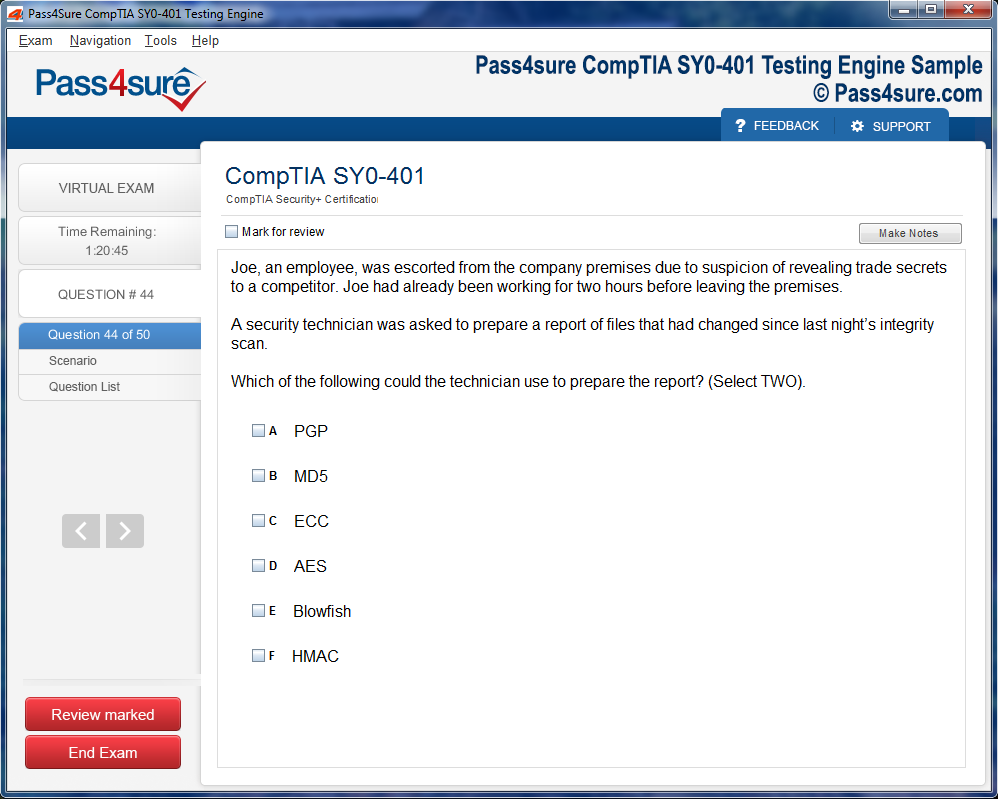
Once download and installed on your PC, you can practise test questions, review your questions & answers using two different options 'practice exam' and 'virtual exam'. Virtual Exam - test yourself with exam questions with a time limit, as if you are taking exams in the Prometric or VUE testing centre. Practice exam - review exam questions one by one, see correct answers and explanations.
How can I get the products after purchase?
All products are available for download immediately from your Member's Area. Once you have made the payment, you will be transferred to Member's Area where you can login and download the products you have purchased to your computer.
How long can I use my product? Will it be valid forever?
Pass4sure products have a validity of 90 days from the date of purchase. This means that any updates to the products, including but not limited to new questions, or updates and changes by our editing team, will be automatically downloaded on to computer to make sure that you get latest exam prep materials during those 90 days.
Can I renew my product if when it's expired?
Yes, when the 90 days of your product validity are over, you have the option of renewing your expired products with a 30% discount. This can be done in your Member's Area.
Please note that you will not be able to use the product after it has expired if you don't renew it.
How often are the questions updated?
We always try to provide the latest pool of questions, Updates in the questions depend on the changes in actual pool of questions by different vendors. As soon as we know about the change in the exam question pool we try our best to update the products as fast as possible.
How many computers I can download Pass4sure software on?
You can download the Pass4sure products on the maximum number of 2 (two) computers or devices. If you need to use the software on more than two machines, you can purchase this option separately. Please email sales@pass4sure.com if you need to use more than 5 (five) computers.
What are the system requirements?
Minimum System Requirements:
- Windows XP or newer operating system
- Java Version 8 or newer
- 1+ GHz processor
- 1 GB Ram
- 50 MB available hard disk typically (products may vary)
What operating systems are supported by your Testing Engine software?
Our testing engine is supported by Windows. Andriod and IOS software is currently under development.
Nokia 5G Packet Core Professional: 4A0-M10 Exam Success
The evolution of telecommunications has reached a pinnacle with the emergence of 5G technology, and the Nokia 5G Packet Core stands as a beacon in this technological revolution. Designed to support massive data traffic, low-latency applications, and ultra-reliable connectivity, Nokia's 5G Packet Core combines flexibility, scalability, and advanced orchestration to meet modern network demands. Professionals seeking certification in the 4A0-M10 exam are expected to grasp not only the architecture and operational principles but also the practical applications that distinguish Nokia’s solutions from competing technologies.
Significance of the 4A0-M10 Certification
The 4A0-M10 certification validates an individual's expertise in deploying, configuring, and troubleshooting Nokia's 5G Packet Core network solutions. For network engineers, telecom architects, and technical consultants, this credential demonstrates a profound understanding of the intricacies of 5G core network functions, service-based architecture (SBA), and end-to-end deployment strategies. Attaining this certification is a hallmark of professional credibility and opens avenues for advanced roles in network design, optimization, and implementation.
Understanding 5G Packet Core Architecture
The Nokia 5G Packet Core is built upon a cloud-native, modular architecture that emphasizes agility and efficiency. It consists of several key components, each fulfilling a unique role in data routing, session management, and policy enforcement. Core elements include the User Plane Function (UPF), Access and Mobility Management Function (AMF), Session Management Function (SMF), and Policy Control Function (PCF). These elements interact dynamically using a service-based architecture to facilitate seamless connectivity between devices, applications, and networks.
User Plane Function and Traffic Optimization
At the heart of the Packet Core is the User Plane Function, responsible for forwarding user data with minimal latency and maximum efficiency. The UPF supports flexible traffic steering, load balancing, and network slicing, allowing operators to offer differentiated services tailored to specific applications such as IoT, autonomous vehicles, and AR/VR experiences. Understanding UPF configuration and optimization is critical for the 4A0-M10 exam, as it forms the foundation of high-performance 5G networks.
Control Plane Functions and Session Management
The control plane of the Nokia 5G Packet Core governs the establishment, modification, and termination of sessions. The Access and Mobility Management Function ensures seamless handovers, mobility tracking, and device authentication, while the Session Management Function orchestrates data sessions and allocates resources dynamically. Mastery of control plane procedures enables professionals to optimize network efficiency, reduce latency, and guarantee service continuity—core competencies assessed in the 4A0-M10 examination.
Policy Control and Quality of Service
Policy enforcement is pivotal in a 5G network where diverse services coexist. The Policy Control Function dictates Quality of Service (QoS) parameters, prioritizes traffic, and applies service-level agreements to ensure performance consistency. Understanding PCF integration, policy rule creation, and real-time adjustments is essential for engineers preparing for the Nokia 4A0-M10 certification, as it demonstrates the ability to manage complex network behaviors and deliver differentiated services reliably.
Network Slicing and Customized Services
Network slicing represents one of the most transformative features of the 5G Packet Core. By partitioning a physical network into multiple virtual networks, operators can tailor performance characteristics to individual service requirements. Each slice can support a distinct use case, whether ultra-low-latency industrial automation or high-bandwidth multimedia streaming. Proficiency in slice configuration, monitoring, and orchestration is a high-value skill evaluated in the 4A0-M10 exam.
Cloud-Native Deployment and Virtualization
The Nokia 5G Packet Core leverages cloud-native principles, enabling dynamic scaling, automated orchestration, and efficient resource utilization. Virtualization technologies such as NFV (Network Functions Virtualization) and containerization allow network functions to run on commodity hardware while maintaining carrier-grade performance. Exam candidates must understand deployment models, orchestration tools, and the nuances of cloud-native service lifecycle management to ensure successful certification.
Security and Threat Mitigation in 5G Core Networks
Security in 5G networks is paramount, as the proliferation of connected devices increases potential attack vectors. The Nokia 5G Packet Core integrates advanced security mechanisms, including encryption, authentication, and anomaly detection, to safeguard network integrity. Professionals must grasp threat identification, mitigation strategies, and security best practices to ensure compliance and reliability—a key component of the 4A0-M10 examination syllabus.
Orchestration and Automation
Automation reduces operational complexity in expansive 5G networks. Nokia’s orchestration framework provides centralized management, automated provisioning, and intelligent monitoring. By leveraging analytics and AI-driven decision-making, operators can enhance network resilience, predict failures, and optimize resource allocation. Mastery of orchestration tools and automation workflows is essential for aspirants of the 4A0-M10 exam to demonstrate hands-on expertise in operational efficiency.
Troubleshooting and Performance Optimization
Proficiency in troubleshooting is crucial for network reliability. Candidates must be adept at identifying network anomalies, diagnosing root causes, and applying corrective actions swiftly. Performance optimization involves monitoring KPIs, analyzing traffic patterns, and tuning network parameters to maintain SLA compliance. The 4A0-M10 exam emphasizes practical problem-solving skills to ensure professionals can maintain high-performing, resilient 5G networks.
Integration with Legacy Networks
Despite the advent of 5G, interoperability with 4G LTE and other legacy networks remains vital. The Nokia 5G Packet Core supports smooth interworking, including non-standalone (NSA) deployments and dual connectivity scenarios. Exam candidates must understand integration methodologies, signaling procedures, and migration strategies to ensure seamless service continuity during network evolution.
Real-World Deployment Scenarios
Hands-on exposure to real-world scenarios strengthens exam readiness. Candidates benefit from understanding urban and rural deployment challenges, backhaul configurations, multi-vendor interoperability, and network slicing in practice. Familiarity with these operational contexts allows professionals to connect theoretical knowledge with practical implementation, a critical aspect of the 4A0-M10 exam.
Exam Preparation Strategies
Success in the 4A0-M10 exam requires a systematic preparation strategy. Key steps include studying Nokia’s technical documentation, practicing configuration exercises in lab environments, and reviewing past deployment case studies. Focused attention on core areas such as UPF, AMF, SMF, PCF, network slicing, security, and orchestration ensures a comprehensive understanding. Time management and iterative learning techniques enhance retention and practical competence.
Simulation Labs and Hands-On Practice
Practical exposure in simulation labs bridges the gap between theoretical knowledge and operational expertise. Utilizing virtualized environments, candidates can practice configuration, monitoring, troubleshooting, and performance optimization in controlled settings. These labs help internalize complex network behaviors and cultivate confidence in real-world deployment scenarios—an indispensable component of successful exam preparation.
Advanced Topics in 5G Core
Beyond fundamental knowledge, the 4A0-M10 exam rewards proficiency in advanced topics. Edge computing, AI-assisted network management, predictive analytics, and ultra-reliable low-latency communication (URLLC) scenarios represent areas where candidates can demonstrate deep technical understanding. Mastery of these subjects positions professionals as experts capable of driving innovation in cutting-edge 5G deployments.
Exam Day Readiness and Mindset
Approaching the exam with a strategic mindset improves performance significantly. Candidates should be familiar with the exam format, time allocation, and question types. Maintaining composure, focusing on problem-solving, and applying practical insights from labs and case studies enhances accuracy and confidence. Psychological preparation, alongside technical readiness, ensures a holistic approach to achieving certification success.
Career Benefits of 4A0-M10 Certification
Certification validates technical skills and positions professionals for career advancement. Nokia 5G Packet Core experts are highly sought after in telecom operators, system integrators, and technology consultancies. With rising demand for 5G expertise, certified professionals gain access to leadership roles, higher compensation, and opportunities to contribute to strategic network projects. The credential also signals commitment to continuous learning and professional growth.
Continuing Education and Skill Development
The 5G ecosystem is dynamic, requiring ongoing education. Post-certification, professionals should stay updated with emerging technologies, standards updates, and innovations in 5G core networks. Participation in webinars, technical forums, and advanced courses fosters lifelong learning and ensures sustained relevance in a rapidly evolving industry. Continuous skill development complements the 4A0-M10 credential, maintaining professional competitiveness.
Industry Trends and Emerging Technologies
5G networks are evolving beyond traditional telecom services. Integration with IoT, smart cities, autonomous vehicles, and immersive media applications requires advanced core network capabilities. Nokia’s 5G Packet Core supports these trends through modular, flexible, and scalable architecture. Professionals who understand industry trajectories, technology convergence, and emerging standards gain a strategic advantage, making their expertise highly valuable and future-proof.
The evolution of mobile networks has transcended incremental improvements, ushering in an epochal shift with the advent of 5G. This generational leap is not a mere augmentation of throughput or latency but a profound reconceptualization of network orchestration, where data streams, signaling, and services are interwoven in an intricate tapestry of connectivity. The 5G packet core embodies this transformation, functioning as the fulcrum upon which ultra-low latency, high-bandwidth applications, and ubiquitous network services pivot. Within this lattice of innovation, immersive virtual realities, autonomous systems, and mission-critical industrial communications find fertile ground, enabled by a network core that is simultaneously agile, secure, and dynamically scalable.
The Architecture of Dynamism
Unlike the rigidity of legacy networks, the modern 5G packet core is a paradigmatic exemplar of modularity and virtualization. Service-based architecture dissolves the constraints of monolithic hardware, allowing network functions to manifest as virtualized entities interconnected through standardized interfaces. This architectural fluidity empowers networks to instantiate services with unprecedented alacrity, respond to fluctuating traffic patterns, and optimize resource allocation in real time. Candidates delving into certification frameworks must apprehend the nuanced interplay between control plane and user plane separation, as these delineations orchestrate signaling, mobility management, and subscriber policy enforcement with precision.
Control Plane and User Plane Dissection
At the heart of operational excellence lies the distinction between control plane and user plane functions. The control plane serves as the cerebral cortex of the network, governing session management, mobility, and policy enforcement, while the user plane functions as the vascular system, ferrying data streams with exacting quality-of-service standards. Decoupling these planes begets elasticity, resiliency, and operational efficiency. Control nodes meticulously maintain subscriber context, orchestrate seamless mobility across heterogeneous networks, and adjudicate policy rules for diverse services. Meanwhile, user plane nodes navigate data through low-latency conduits, ensuring performance metrics remain uncompromised even under dynamic load conditions. Mastery of this dichotomy is indispensable for both operational proficiency and examination success.
Embedded Security Paradigms
Security permeates every stratum of the 5G packet core. The multiplicity of dynamic interfaces, virtualized nodes, and network slices introduces novel attack vectors that demand vigilant oversight. Authentication, authorization, encryption, and integrity protection coalesce into a defensive lattice, safeguarding both signaling and payload data. Understanding these mechanisms extends beyond rote memorization; it encompasses the ability to architect, configure, and manage networks that preserve service fidelity and subscriber trust. The interplay of security with orchestration, slicing, and virtualization underscores the strategic significance of protective measures in contemporary network design.
Subscriber Context and Mobility Management
The continuum of subscriber management underpins the operational heartbeat of the packet core. From registration through authentication, session instantiation, mobility handling, and termination, control plane nodes maintain an unbroken narrative of subscriber state. Virtualized functions perpetuate continuity, propagating context across nodes to facilitate seamless user experiences. Missteps in subscriber handling can precipitate service interruptions, dropped connections, or inconsistent network behavior. Exam aspirants must internalize the mechanisms through which subscriber context is curated, updated, and synchronized, as these processes dictate operational stability and service reliability.
Network Slicing and Policy Orchestration
A hallmark of 5G is its capacity to fragment physical resources into virtualized network slices tailored to distinct service paradigms. Ultra-reliable low-latency communications, massive machine-type communications, and enhanced mobile broadband each inhabit discrete slices governed by meticulous policy frameworks. Dynamic traffic management, coupled with rule-based resource allocation, ensures that each slice adheres to its service-level agreement. Candidates must comprehend the lifecycle of network slices, the mechanisms of traffic classification, and the application of policies that harmonize performance objectives with resource constraints.
Virtualization and Cloud Integration
Modern packet cores are symbiotic with virtualization and cloud paradigms. Network functions reside in virtual machines or containerized environments, orchestrated by sophisticated management platforms that govern instantiation, scaling, and decommissioning in real time. This abstraction from static hardware fosters redundancy, fault tolerance, and performance optimization. Aspirants must grapple with orchestration workflows, automated deployment mechanisms, and the cascading implications of virtualized interdependencies. Competence in this domain enhances both exam preparedness and real-world operational efficacy.
Performance Metrics and Analytical Insights
Sustaining service excellence necessitates vigilant monitoring and analytics. Latency, throughput, handover success rates, and resource utilization are continuously evaluated to extract actionable intelligence. Analytical acumen allows candidates to correlate anomalies with causative factors, anticipate emergent performance bottlenecks, and implement corrective interventions. Mastery of KPI interpretation not only strengthens operational oversight but also cultivates the diagnostic intuition critical for managing dynamic network ecosystems.
Fault Diagnostics and Resilience Strategies
The inherently volatile nature of virtualized networks renders fault management an essential competency. Failures manifest across control and user planes in intricate patterns, demanding systematic diagnosis. Understanding alarm hierarchies, severity levels, and propagation dynamics equips candidates to trace disruptions from origin to manifestation. Effective fault mitigation entails isolating malfunctions, deploying corrective strategies, and verifying resolution through iterative validation. This discipline of resilience ensures continuity in mission-critical services and underpins professional credibility.
Scenario-Based Proficiency
Certification preparation emphasizes applied cognition over abstract memorization. Candidates are often presented with scenarios replicating realistic network conditions: surges in signaling traffic, misconfigured slices, mobility-induced session transitions, or dynamic scaling events. Visualizing network functions, tracing data and signaling flows, and applying structured problem-solving techniques are essential to navigate these challenges. Immersive lab environments and simulations enhance comprehension, fostering an intuitive grasp of complex interdependencies that written theory alone cannot impart.
Operational Documentation and Process Rigor
Operational excellence extends beyond functional competence into meticulous documentation. Recording configuration changes, node instantiation procedures, orchestration workflows, and performance observations ensures traceability and facilitates troubleshooting. Candidates who internalize the interplay between documentation, operational decisions, and network behavior cultivate procedural discipline that translates directly into efficient management and exam readiness.
Rapid Service Innovation and Network Agility
5G networks are engineered for adaptability, supporting a continual influx of novel services and vertical-specific requirements. The confluence of service-based architecture, orchestrated virtualization, and dynamic policy enforcement underpins this agility. Candidates who understand these mechanisms can anticipate deployment challenges, orchestrate new service lifecycles efficiently, and sustain operational integrity. The capacity to innovate rapidly while preserving security, latency, and throughput benchmarks is a defining trait of contemporary mobile networks.
Analytical Mindset and Cognitive Dexterity
Successful candidates exhibit curiosity, analytical reasoning, and structured cognition. Understanding network behaviors demands probing not merely how components operate, but why specific configurations, orchestration strategies, and architectural decisions were implemented. Scenario analysis, reflective practice, and iterative problem-solving cultivate a cognitive dexterity that bridges theoretical understanding with practical proficiency. This mindset engenders a holistic comprehension essential for navigating the intricate landscape of 5G packet core operations.
The Paradigm of 5G Core Architecture
The 5G core architecture embodies an unprecedented metamorphosis in telecommunication networks. Diverging from the ossified frameworks of legacy systems, it embraces a service-based topology where discrete network functions operate as interconnected, autonomous services rather than static, monolithic entities. This modularity confers unparalleled elasticity and scalability, allowing operators to orchestrate complex network behaviors dynamically. In this ecosystem, each function, protocol, and interface assumes a meticulously calibrated role in facilitating ultra-reliable low-latency communications, prodigious throughput, and bespoke network slices. For candidates aspiring toward mastery, comprehending these interrelationships is not merely academic; it is imperative for practical proficiency.
Control Plane Intricacies
The control plane forms the cerebral cortex of the 5G core, managing signaling, session orchestration, subscriber context, policy enforcement, and mobility governance. Within this domain, the Access and Mobility Management Function, Session Management Function, Unified Data Management, Policy Control Function, and Network Repository Function operate as pivotal nodes. Communication between these nodes leverages service-based interfaces with rigorously standardized protocols, ensuring signaling flows remain coherent and decision-making remains expedient. Candidates must internalize the choreography of interactions, as the efficacy of mobility handling, session continuity, and policy execution hinges upon this orchestration. Misunderstanding these relationships can precipitate cascading network inefficiencies, undermining both operational competence and theoretical understanding.
User Plane Dynamics
The user plane assumes the responsibility of transporting tangible data traffic, encompassing video streams, voice communications, and broadband access. Unlike the control plane, it functions as a dynamically virtualized fabric capable of scaling in real time to accommodate fluctuating traffic demands. The separation of control and user planes permits each to undergo optimization without impinging upon the other. Interaction between user plane nodes and their control plane counterparts is mediated via protocols such as PFCP, enabling nuanced traffic routing, quality-of-service enforcement, and session continuity. A nuanced comprehension of these linkages equips candidates to reason about network efficiency, congestion mitigation, and latency reduction in high-stakes scenarios.
Orchestration and Lifecycle Management
Orchestration within the 5G core constitutes the invisible hand governing deployment, scaling, and lifecycle operations of virtualized network functions. Orchestrators facilitate near-instantaneous instantiation, automated configuration, and seamless failover of control and user plane functions alike. Deep familiarity with orchestration workflows, service templates, and policy-driven automation is crucial. This knowledge allows practitioners to envision scenarios where nodes must migrate, scale, or undergo maintenance without interrupting ongoing sessions. The orchestration layer thus transforms theoretical configurations into operational realities, marrying automation with reliability in a highly complex environment.
Network Slicing Paradigms
Network slicing exemplifies the quintessence of 5G’s transformative potential, allowing operators to conjure multiple virtual networks atop a shared physical substrate. Each slice can be meticulously tailored to unique service exigencies, from enhanced mobile broadband to ultra-reliable low-latency communications and massive IoT connectivity. Mastery of slice creation, resource orchestration, traffic segregation, and policy enforcement is paramount, as mismanagement can precipitate congestion, erratic quality-of-service performance, or violation of service-level commitments. Candidates must envision the interplay between physical resources and virtual constructs, appreciating how policy, priority, and capacity intersect to shape user experience.
Integrated Security Mechanisms
Security permeates every stratum of the 5G core, functioning as both sentinel and enabler. Control plane nodes authenticate subscribers, enforce access policies, and secure signaling pathways, whereas user plane functions preserve traffic confidentiality and apply quality-of-service rules while safeguarding sensitive data. Orchestration layers extend security through access control, audit trails, and automated verification of configurations. A sophisticated understanding of these security paradigms allows candidates to anticipate vulnerabilities, ensure compliance, and maintain operational integrity across complex, interwoven network services. Security is not ancillary; it is embedded within every operational vector, influencing signaling, data transport, and orchestration alike.
Fault Tolerance and Redundancy
High availability is an axiomatic principle within the 5G core. Replicated instances, state synchronization, and automated failover mechanisms ensure service continuity even under node failure or scheduled maintenance. Candidates must internalize how redundancy manifests across control and user planes, including how signaling congestion, node outages, or user plane interruptions are mitigated through proactive replication strategies. Understanding these mechanisms transcends rote memorization; it empowers candidates to simulate failure scenarios, devise contingency strategies, and uphold service continuity with minimal disruption.
Performance Monitoring and Analytics
Performance assessment within the 5G core hinges upon sophisticated monitoring frameworks that deliver actionable insights into network health. Metrics such as latency, throughput, session success rate, handover efficacy, and resource utilization inform decisions regarding scaling, optimization, and fault remediation. Candidates must comprehend the intimate connection between metrics and network design, appreciating how analytical insight guides operational refinement. By cultivating an ability to diagnose anomalies, extrapolate trends, and implement targeted interventions, network engineers transform raw data into strategic advantage.
Interplay of Control, User, and Orchestration Layers
The symbiotic relationship between control plane, user plane, and orchestration layers undergirds the performance and resilience of the 5G core. Control plane nodes orchestrate policies and signaling, user plane nodes facilitate the tangible transport of traffic, and orchestration layers harmonize deployment, scaling, and lifecycle management. A holistic understanding of this tripartite interaction allows candidates to anticipate network behavior, troubleshoot inefficiencies, and optimize both virtual and physical resources. Misalignment among these layers can compromise latency, throughput, and reliability, highlighting the importance of integrated operational insight.
Dynamic Scalability and Elasticity
Elasticity within the 5G core architecture ensures that network functions adapt fluidly to real-time demand fluctuations. Virtualized instances scale vertically or horizontally, guided by orchestration policies and network analytics. Understanding the mechanisms of dynamic scaling, load balancing, and adaptive resource allocation empowers candidates to architect networks that maintain performance even during peak traffic surges. The capacity to anticipate traffic patterns and preemptively allocate resources is emblematic of advanced operational acumen, bridging the gap between theoretical knowledge and pragmatic network management.
The Nexus of Network Innovation
5G core architecture epitomizes a nexus where innovation, modularity, and intelligence converge. From ultra-reliable low-latency communications to massive IoT integration, each network function, interface, and orchestration layer is meticulously engineered to deliver tailored services with surgical precision. Candidates must embrace a mindset that visualizes signaling, data flows, and orchestration sequences as an integrated whole. This perspective illuminates the path toward mastering network slicing, fault tolerance, and performance optimization, enabling both exam success and operational excellence in the rapidly evolving domain of 5G technologies.
Configuration Paradigms in 5G Packet Core
The orchestration of 5G packet core networks necessitates a meticulous choreography of virtualized nodes, each imbued with precise configurations to ensure seamless interoperability. Node instantiation is not merely a procedural step but a deliberate exercise in aligning access and mobility management with session continuity and policy control frameworks. Each functional element must resonate with exacting parameters, facilitating an ecosystem where control and user planes operate in synchronous harmony. The deployment lifecycle encompasses instantiation, elasticity-driven scaling, iterative upgrading, and eventual decommissioning, demanding both foresight and operational acumen from engineers.
Subscriber Context and Lifecycle Governance
The management of subscriber data transcends rudimentary registration and authentication; it embodies the orchestration of ephemeral yet persistent session constructs. Control plane entities curate subscriber contexts, applying policy directives, quality of service mandates, and session parameters with unwavering consistency. Interaction with unified data management repositories ensures that subscriber information is propagated judiciously across heterogeneous network fabrics. A misalignment in subscriber management risks service discontinuities, rendering the seamlessness of user experience an unattainable ideal.
Session Continuity and Bearer Architectonics
Session management is an intricate lattice of IP allocations, bearer path delineations, and traffic governance rules. Control plane nodes act as vigilant custodians, liaising with user plane entities to preserve traffic fidelity amid mobility events or dynamic slice transitions. Understanding the session lifecycle—comprising initialization, modification, handover orchestration, and eventual termination—is paramount. Erroneous configuration can precipitate dropped calls, interrupted data streams, or erratic service behavior, undermining both reliability and user confidence.
Mobility Orchestration Across Heterogeneous Domains
Mobility management in 5G networks presents a labyrinthine challenge, requiring precise handling of handovers across cells, base stations, and divergent slices or radio access technologies. Configuration entails tuning tracking areas, hysteresis thresholds, and signaling prioritization to mitigate latency and preserve session integrity. Intra- and inter-slice mobility introduces additional complexity, necessitating coordination across orchestrated network domains to prevent jitter, packet loss, or service degradation.
Security Integration in Deployment Schema
Security is not an adjunct but an intrinsic element interwoven with configuration and deployment. Authentication schemas, cryptographic parameters, and access governance policies must permeate every node with consistent rigor. Control and user planes alike rely on secure signaling pathways, subscriber data sanctity, and policy enforcement mechanisms to forestall vulnerabilities. Inattention to security configuration can manifest as performance bottlenecks, protocol anomalies, or policy contradictions, compromising both service quality and network resilience.
Orchestration Mechanisms and Automation Efficacy
Orchestration platforms provide a meta-layer for deployment rationalization, employing automation workflows, policy-driven templates, and service chaining paradigms. Rapid instantiation, scaling, and failover recovery are rendered feasible through these orchestrated constructs. Familiarity with orchestration dashboards, templating methodologies, and scenario-based simulations equips candidates with the competence to navigate dynamic network environments, optimizing operational efficiency while minimizing manual intervention.
Performance Tuning and KPI Harmonization
Monitoring and performance calibration form the sinews of network stability. Fine-grained adjustments of throughput thresholds, traffic routing heuristics, load-balancing parameters, and resource allocation schemas are essential for sustaining optimal session quality. Understanding the interplay between KPIs, latency mitigation, and throughput consistency enables engineers to uphold the delicate equilibrium between performance excellence and infrastructural resilience, ensuring the network responds agilely to fluctuating demand patterns.
Documentation and Operational Continuity
Meticulous recording of deployment schematics, configuration rationales, and version histories underpins operational continuity. Documentation serves not merely as a procedural archive but as a cognitive repository facilitating troubleshooting, audits, and knowledge perpetuation. Engineers who cultivate this discipline contribute to both organizational memory and professional mastery, translating ephemeral operational decisions into enduring best practices.
Interfacing Subscriber Management with Policy Enforcement
Subscriber handling interfaces intimately with policy enforcement nodes, dictating traffic shaping, access privileges, and QoS parameters. The dynamic propagation of policy rules ensures that subscribers experience uniform service quality irrespective of mobility events or slice transitions. Engineers must comprehend the intricate interdependencies between session constructs, subscriber contexts, and policy application to forestall inconsistencies that could degrade user satisfaction.
Intricacies of Alarm Correlation and Severity Stratification
In 5G packet core ecosystems, the labyrinthine nature of alarms necessitates a sophisticated approach to correlation and stratification. Each alarm, whether ephemeral or persistent, carries metadata that hints at underlying systemic perturbations. Candidates must cultivate the ability to parse voluminous alarm streams and discern patterns indicative of cascading failures. Severity stratification hinges on understanding the operational ramifications of faults, differentiating between transient anomalies and critical systemic impairments. The judicious interpretation of correlated alarms accelerates resolution timelines and fortifies network resiliency against latent threats.
Probing KPIs for Predictive Insights
Performance indicators extend beyond mere quantitative measurements; they encapsulate the nuanced health of the network fabric. Latency oscillations, jitter deviations, and anomalous throughput fluctuations often presage intricate bottlenecks or misaligned configurations. Candidates should develop an acumen for translating KPI oscillations into actionable insights, employing trend analysis to anticipate service perturbations before they escalate. Predictive analytics, reinforced by historical data patterns, transforms reactive troubleshooting into preemptive orchestration, mitigating subscriber impact and elevating operational efficacy.
Protocol Deciphering and Traffic Forensics
Delving into signaling protocols and user plane trajectories unveils the hidden choreography of network interactions. Diagnostic tools allow practitioners to traverse packet headers, dissect control plane messaging, and scrutinize encapsulated payloads for anomalies. The forensic examination of traffic flows, when combined with orchestration telemetry, exposes subtle malconfigurations or latent interface inconsistencies. Candidates must hone the ability to correlate these findings with node performance metrics, leveraging a holistic perspective to identify root causes that are not immediately apparent through superficial observation.
Virtualization Complexities and Node Synchronization
Virtualized network functions introduce a dynamic topology, where ephemeral instances and elastic resource allocation challenge conventional fault management paradigms. Synchronization across virtualized nodes is pivotal; discrepancies in state replication or orchestration oversight can precipitate session disruption or signaling deadlocks. Candidates must grasp the mechanics of state mirroring, failover orchestration, and distributed consensus, ensuring seamless continuity even amid node churn or hypervisor-level anomalies. Mastery of these subtleties underpins operational stability in highly decoupled architectures.
Anomalous Behaviors and Security Intersections
Fault manifestations frequently overlap with security incidents, obfuscating the diagnostic process. Erroneous policy enforcement, intrusions, or credential compromise can mimic hardware or software malfunctions. Candidates must possess a dual-lens approach, concurrently evaluating fault indicators and potential security vectors. Integrating anomaly detection frameworks with threat intelligence feeds enables precise discrimination between genuine network faults and malevolent interventions, preserving integrity without inducing collateral instability.
Temporal Analysis and Trend Extrapolation
Temporal patterns within network metrics often reveal insidious inefficiencies that elude immediate detection. By employing time-series analysis, candidates can extrapolate trends that illuminate progressive degradation in handover efficacy, session retention, or load distribution. These insights empower preemptive recalibration of resources, such as dynamic slice allocation or load-balancing heuristics, forestalling performance deterioration. The synthesis of temporal intelligence with real-time monitoring cultivates a proactive operational paradigm.
Orchestration Feedback Loops and Corrective Measures
Integrated orchestration platforms furnish automated and semi-automated feedback loops that bridge monitoring and corrective execution. Candidates must understand how telemetry-driven policies trigger resource adjustments, scale network functions, and rectify transient anomalies without human intervention. Observing the feedback loop dynamics and fine-tuning orchestration parameters enhances resiliency, ensuring that fault rectification aligns with overarching network performance objectives. This synergy between observation and automated mitigation defines the next generation of network reliability practices.
Documentation and Knowledge Codification
The capture of fault resolution narratives is paramount for institutional memory and procedural refinement. Meticulous documentation encompasses alarm triggers, investigative methodologies, corrective actions, and post-resolution metrics. Such codification not only standardizes operational responses but also provides an invaluable knowledge repository for future anomaly scenarios. Candidates should cultivate rigorous documentation habits, enabling iterative learning and continuous improvement across multifaceted 5G deployments.
Service Continuity Through Redundant Architectures
Redundancy is not merely a safeguard but a strategic enabler for service continuity. Active-active configurations, synchronous replication, and geographically distributed failover nodes mitigate the impact of localized disturbances. Candidates must internalize the principles of redundancy management, including the orchestration of resource pools, load sharing, and graceful degradation techniques. Understanding these principles ensures that subscribers experience minimal disruption even amid compounded failures or maintenance interventions.
Proactive Maintenance and Operational Vigilance
Proactive fault management extends beyond immediate anomaly resolution into strategic maintenance foresight. Predictive monitoring, capacity forecasting, and automated diagnostic triggers enable the anticipation of resource exhaustion or configuration drift. Candidates should embrace an operational mindset that prioritizes vigilance, continuous validation of KPIs, and preemptive intervention, transforming network administration from reactive firefighting into structured stewardship.
Optimization Paradigms in 5G Core Networks
Optimization in 5G networks transcends mere traffic steering, delving into sophisticated orchestration of resources and predictive network intelligence. The contemporary operator must harness an intricate ballet of load balancing, latency mitigation, and throughput maximization to elevate subscriber experiences. Traffic management evolves from reactive adjustment to anticipatory orchestration, leveraging historical telemetry and real-time analytics to preempt congestion. Dynamic resource allocation ensures that nodes neither languish idle nor succumb to saturation, fostering an equilibrium where efficiency and performance coexist seamlessly. The subtleties of quality-of-service configuration require an understanding of nuanced prioritization schemas, ensuring that mission-critical flows traverse the network with minimal jitter, while non-essential traffic is accommodated without disruption.
Predictive intelligence lies at the heart of modern optimization. Machine-learning models, trained on longitudinal traffic patterns, empower the network to anticipate peak loads, dynamically adjust routing policies, and even preemptively instantiate additional virtual nodes. Such foresight minimizes bottlenecks and elevates the deterministic qualities of 5G packet core networks. Candidates preparing for proficiency in this domain must appreciate the symbiotic relationship between measurement, prediction, and automated remediation, as each element compounds the network’s capacity to operate fluidly under fluctuating demand.
Scaling Dynamics in Virtualized Environments
Scaling in 5G is not merely about augmenting capacity; it encompasses strategic elasticity within a virtualized and cloud-native ecosystem. Network functions, instantiated as virtual entities or containers, can be orchestrated to expand, contract, or migrate seamlessly in response to temporal traffic shifts. Understanding the triggers for orchestration, the thresholds for instantiation, and the policies guiding automated scaling is pivotal for maintaining both performance and operational economy. Through meticulous configuration of scaling parameters, operators can circumvent the pitfalls of resource over-provisioning while sustaining service continuity during peak utilization.
Elastic scaling extends beyond node quantity to include computational prioritization, memory allocation, and interconnect bandwidth management. Sophisticated orchestration frameworks allow these parameters to adjust dynamically, aligning network performance with fluctuating service demands. This elasticity is particularly vital for latency-sensitive applications, where microsecond-level delays can compromise the quality of experience. Candidates must grasp how horizontal and vertical scaling interact to preserve network equilibrium and avoid performance oscillations that degrade user satisfaction.
Security Interwoven with Optimization and Scaling
Security in the 5G core is no longer a discrete concern; it is intricately interwoven with optimization and scaling strategies. In a landscape dominated by virtualized nodes and ephemeral containers, authentication protocols, encryption standards, and role-based access controls become foundational to maintaining operational integrity. Misconfigurations in scaling policies or optimization routines can inadvertently expose vulnerabilities, rendering the network susceptible to unauthorized access, session hijacking, or policy conflicts.
Encryption mechanisms must be adaptable, maintaining confidentiality while enabling low-latency traffic flows. Similarly, secure orchestration ensures that the dynamic instantiation of network functions does not compromise the integrity of control or user planes. Candidates should internalize the concept of security as a continuous feedback loop, where policy enforcement, anomaly detection, and automated remediation converge to create resilient, self-healing systems.
Energy-Conscious Orchestration
Emergent priorities in 5G core management include energy efficiency and environmental sustainability. Optimization and scaling, when executed intelligently, can reduce energy consumption without sacrificing performance. By modulating node activity according to real-time demand, operators can conserve computational and power resources, aligning operational strategy with sustainability objectives. Energy-aware orchestration considers the interplay between traffic patterns, node efficiency, and dynamic scaling to minimize the environmental footprint of network operations.
Candidates should explore scenarios where energy conservation interacts with service quality, understanding the trade-offs between reducing active nodes and maintaining throughput. Intelligent algorithms can predict periods of low demand, temporarily hibernating specific nodes while ensuring rapid wake-up capabilities for sudden traffic surges. Such strategies exemplify the convergence of operational prudence, environmental responsibility, and technological sophistication within 5G networks.
Scenario-Based Synthesis
Practical comprehension emerges most effectively through scenario-based exercises. By simulating real-world conditions, candidates can experiment with scaling thresholds, parameter adjustments, and security enforcement in controlled environments. Documenting these exercises facilitates reflective learning, enabling operators to discern the intricate interdependencies between optimization, scaling, and security. For instance, scaling a node in response to anticipated congestion might inadvertently trigger security conflicts if policy propagation is delayed, underscoring the necessity for holistic awareness.
These exercises also emphasize the importance of adaptive decision-making. The network is a dynamic organism, constantly responding to unpredictable user behavior, fluctuating demand, and potential security threats. Mastery requires more than theoretical knowledge; it demands intuitive recognition of patterns, foresight in orchestration, and proactive risk mitigation.
Interdependent Pillars of 5G Core Management
Optimization, scaling, and security collectively form the trinity underpinning robust 5G core networks. Each pillar is interdependent: optimized traffic flows facilitate efficient scaling, scaling decisions influence security postures, and security measures safeguard optimization processes from exploitation. Candidates must appreciate this interconnectedness, understanding that excellence in one domain is contingent upon competence across all dimensions. Beyond examination preparation, this integrated perspective equips operators to manage live networks with resilience, adaptability, and strategic foresight.
Exam Preparation Strategies and Cognitive Fortitude
Navigating the labyrinthine intricacies of 4A0-M10 examination demands more than rote memorization; it requires cognitive dexterity and strategic foresight. Candidates must cultivate a perspicacious understanding of packet core architecture, harmonizing theoretical knowledge with empirical observation. Immersive engagement with network topologies, signaling labyrinths, and slice orchestration cultivates an intuitive grasp of interdependent functionalities. The ability to envision data flows, identify latency bottlenecks, and anticipate congestion phenomena transforms rote familiarity into analytical acuity.
Scenario-Based Reasoning and Operational Dexterity
Practical scenarios simulate the stochastic nature of modern 5G networks, challenging candidates to reason through perturbations in real time. Signal congestion, node desynchronization, slice misalignments, and unexpected traffic surges demand methodical problem-solving and adaptive heuristics. By dissecting each scenario, learners internalize the subtleties of fault propagation, resilience mechanisms, and load-balancing strategies. This iterative rehearsal of contingencies enhances cognitive elasticity, allowing candidates to respond with precision under temporal pressure.
Case Studies and Experiential Synthesis
Immersion in real-world case studies bridges the chasm between abstract principles and operational praxis. Deployment narratives elucidate the nuanced choreography of orchestrating multi-node networks, integrating mobility management functions, and configuring policy control frameworks. Troubleshooting exegeses unveil latent dependencies between core elements, demonstrating the domino effect of misconfigurations. Optimization vignettes reveal the delicate calibration of resource allocation, latency reduction, and throughput maximization, fostering a holistic operational vision that transcends rote theoretical knowledge.
Structured Study Regimens and Reflective Practice
A meticulous study regimen scaffolds the assimilation of voluminous information. Deliberate engagement with KPI analytics, alarm diagnostics, configuration audits, and policy verification instills procedural fluency. Mock examinations and simulated fault injection exercises crystallize conceptual understanding while fortifying decision-making frameworks. Reflection on erroneous assumptions catalyzes cognitive refinement, encouraging metacognition and anticipatory reasoning. Through this systematic reinforcement, candidates cultivate the capacity to navigate complex network scenarios with composure and analytical precision.
Stress Modulation and Analytical Equanimity
Cognitive endurance and emotional regulation are indispensable in high-stakes certification environments. Maintaining equanimity amidst intricate problem sets allows for methodical evaluation of trade-offs and rational prioritization. Strategic mental partitioning of node interactions, signaling sequences, and traffic orchestration prevents cognitive overload and mitigates error propensity. Cultivating mindfulness and adaptive focus strengthens the interplay between conceptual mastery and practical application, ensuring sustained analytical clarity under temporal constraints.
Integrative Application and Network Intuition
Proficiency emerges at the nexus of conceptual comprehension and experiential execution. Candidates who harmonize theoretical constructs with hands-on exercises, orchestration simulations, and diagnostic case studies develop a visceral network intuition. This integrative cognition enables preemptive fault anticipation, judicious scaling decisions, and resilient architecture design. By internalizing both the microcosmic behavior of individual nodes and the macrocosmic orchestration of distributed systems, learners acquire the dexterity to navigate dynamic, high-throughput environments with sagacious precision.
Predictive Analytics and Autonomous Orchestration
The emergence of predictive analytics in 5G core networks represents a paradigm shift in operational intelligence. Rather than relying solely on reactive interventions, networks now leverage historical telemetry, anomaly detection, and statistical inference to anticipate congestion, resource depletion, and latency spikes. Autonomous orchestration synthesizes these insights into actionable policies, enabling nodes to scale, migrate, or reconfigure without human intervention. Candidates must understand the interplay between predictive algorithms and operational heuristics, recognizing that autonomous orchestration is only as robust as the data streams informing it.
Telemetry acquisition in a 5G core environment extends beyond simple throughput counters or packet loss metrics. Deep insights into buffer utilization, link jitter, session handoffs, and microburst occurrences provide a rich substrate for machine-learning models. These models, trained on multivariate datasets spanning temporal, spatial, and topological dimensions, can forecast transient congestion hotspots with remarkable precision. Such foresight allows dynamic rerouting of traffic, preemptive instantiation of virtual nodes, and adjustment of quality-of-service parameters, ensuring that subscriber experience remains resilient even during unprecedented load patterns.
Latency Optimization and Edge Integration
Latency remains a defining performance metric in 5G, particularly for applications demanding real-time responsiveness, such as augmented reality, industrial automation, and autonomous vehicular communication. Optimization strategies must therefore incorporate not only centralized orchestration but also intelligent edge integration. By positioning computational and storage resources closer to end-users, operators reduce round-trip times and improve determinism.
Candidates should examine the intricate balance between edge deployment density and network efficiency. Overpopulating the edge with micro-instances increases operational overhead, whereas sparse deployment risks violating stringent latency thresholds. Optimization policies must account for geographic distribution, traffic heterogeneity, and service criticality. Moreover, the dynamic allocation of workloads between central cores and edge nodes requires continuous monitoring and predictive adjustment to avoid resource underutilization or congestion.
Adaptive Resource Allocation and Network Slicing
Network slicing, a cornerstone of 5G architecture, transforms resource allocation into a multidimensional orchestration challenge. Each slice is a virtualized network partition with defined performance objectives, security policies, and operational parameters. Candidates must understand how optimization and scaling policies operate within the context of slices, ensuring that each virtual network meets its service-level agreements while coexisting harmoniously with other slices.
Adaptive resource allocation involves the continuous tuning of CPU cycles, memory bandwidth, packet queues, and interconnect capacities to match slice-specific demands. Predictive scaling ensures that latency-sensitive slices receive preferential treatment during peak load, while bandwidth-intensive slices dynamically adjust their throughput expectations. Candidates should appreciate the complexity of this orchestration, recognizing that slice isolation, inter-slice fairness, and priority inversion prevention are crucial to maintaining operational integrity.
Security Intelligence and Threat Mitigation
The proliferation of dynamic, virtualized nodes amplifies the potential attack surface within the 5G core. Security intelligence now encompasses both proactive and reactive measures, blending anomaly detection, behavior profiling, and automated remediation. Unauthorized access attempts, misconfigured orchestration triggers, and compromised virtual functions must be identified and mitigated before they propagate across slices or service domains.
Candidates must understand the significance of zero-trust principles in this environment, where no component is implicitly trusted, and authentication, authorization, and encryption occur continuously across both user and control planes. Security orchestration must integrate seamlessly with scaling and optimization policies, ensuring that automatic node instantiation does not circumvent policy enforcement. For example, scaling triggers should automatically validate the security posture of new nodes before traffic is allowed, creating a self-healing and resilient operational environment.
Energy Efficiency and Sustainable Networking
Energy-aware orchestration is no longer a peripheral consideration; it is a central design philosophy in next-generation 5G deployments. By intelligently modulating node activity and dynamically reallocating resources, operators can achieve a delicate equilibrium between service quality and power consumption. Predictive analytics identifies periods of low traffic where nodes can be temporarily hibernated, while high-demand intervals prompt intelligent scaling to maintain performance.
Candidates should explore the use of energy-cost models to evaluate trade-offs between latency, throughput, and power efficiency. For example, consolidating workloads into fewer active nodes reduces energy expenditure but may introduce marginal latency increases. Conversely, distributing workloads more broadly enhances responsiveness but increases operational costs. Mastery involves understanding how optimization policies, predictive scaling, and energy-conscious orchestration converge to produce a sustainable, resilient network.
Real-Time Traffic Steering and Congestion Avoidance
Real-time traffic steering extends the principles of optimization beyond static configuration, employing continuous feedback loops to dynamically adjust routing paths and resource allocation. Congestion avoidance mechanisms, informed by telemetry, predictive modeling, and automated decision-making, maintain fluidity even under high-demand scenarios. Candidates should explore methods such as flow prioritization, multipath routing, and adaptive queuing to preserve service quality.
Traffic steering also interfaces with scaling strategies. For instance, anticipating a surge in video streaming demand may trigger the instantiation of additional virtual nodes, while simultaneously redistributing traffic to underutilized paths. This synergy ensures not only stability but also maximal utilization of network resources. Candidates must internalize the interdependency of these mechanisms, recognizing that isolated optimization efforts without coordinated scaling may yield suboptimal or unstable results.
Resilience Engineering and Fault Recovery
Resilience in 5G core networks requires foresight, redundancy, and rapid fault recovery. Nodes may fail, links may degrade, or slices may experience transient anomalies, necessitating immediate corrective measures. Candidates must understand the principles of fault tolerance, including automated failover, state replication, and rapid node reconstitution. Optimization and scaling strategies enhance resilience by ensuring that redundant resources are available and can be activated with minimal disruption.
Predictive modeling also supports resilience engineering by forecasting potential points of failure before they manifest. For example, unusually high buffer occupancy, repeated handover failures, or anomalous session terminations may indicate impending node degradation. Proactive mitigation—such as preemptive traffic rerouting or temporary node instantiation—preserves continuity and enhances subscriber experience.
Orchestration Policy Design and Governance
The design of orchestration policies is a delicate art, blending automation with rule-based governance. Candidates should explore the creation of hierarchical policies that account for operational thresholds, priority hierarchies, and security constraints. Policies must be flexible, allowing dynamic adaptation without compromising stability or compliance. For example, scaling triggers should consider both network load and slice-specific service requirements, while security policies should enforce zero-trust principles across all automated decisions.
Governance also involves continuous monitoring, auditing, and adjustment. Automated logs, policy enforcement metrics, and telemetry dashboards provide visibility into network behavior, enabling candidates to refine orchestration rules iteratively. Mastery requires an appreciation of policy interdependencies: an adjustment in optimization parameters may necessitate corresponding changes in scaling thresholds or security validation processes to maintain overall harmony.
Advanced Use Cases: IoT, Autonomous Vehicles, and AR/VR
The application of optimization, scaling, and security principles manifests vividly in advanced 5G use cases. Internet-of-Things networks, autonomous vehicles, and augmented or virtual reality applications impose stringent requirements on latency, reliability, and security. Candidates must explore how orchestration policies adapt to these demands, dynamically scaling edge and core resources, optimizing routing for real-time performance, and enforcing rigorous security controls.
IoT networks often involve massive device populations with sporadic traffic bursts. Optimization strategies ensure efficient aggregation, traffic shaping, and prioritization, while scaling policies dynamically instantiate microservices to handle peak bursts. Autonomous vehicles rely on ultra-low-latency, deterministic communication, requiring precise coordination between edge nodes and central cores. AR/VR applications demand high-throughput, low-jitter pathways with resilient failover mechanisms to preserve immersive user experiences. Each scenario highlights the intricate interplay of optimization, scaling, and security in high-stakes environments.
Cognitive Architectures for Mastery
Achieving mastery in 4A0-M10 demands an internal cognitive architecture that mirrors the networks under study. Mental schemata must be intricately layered, mapping core network functions, interdependencies, and dynamic behavior under stress. Candidates should cultivate an anticipatory cognitive framework, visualizing signaling flows, user-plane interactions, and node hierarchies with the acuity of an orchestrator. Mental rehearsal of rare contingencies—mobility disruptions, slice misalignments, policy conflicts—creates an adaptive reflex that transforms theoretical knowledge into operational instinct.
Retention is not merely about memorizing topology diagrams or KPI thresholds. It involves synaptic consolidation through repetitive simulation, scenario dissection, and critical reflection. By mentally reconstructing network incidents, learners internalize causality chains, latency implications, and resilience mechanisms. This cognitive scaffolding allows rapid adaptation when novel problems arise during the examination or in real-world network operations.
Immersive Scenario Simulations
High-fidelity scenario simulations are invaluable for internalizing network dynamics. Candidates should approach simulations as controlled chaos laboratories, where failure modes, load imbalances, and node desynchronizations are deliberately induced. Observing the cascading effects of minor misconfigurations teaches the importance of preemptive monitoring and risk mitigation. For instance, a single misrouted user-plane function can trigger signaling congestion, which in turn can precipitate slice inefficiencies—a microcosm of operational interconnectivity.
Scenario-based exercises also reinforce the practice of decision triage. Candidates learn to evaluate the relative criticality of alarms, prioritize interventions, and predict downstream impacts. Simulations encourage mental agility, prompting learners to pivot strategies when initial assumptions prove untenable. This iterative exposure to dynamic problem sets cultivates both confidence and cognitive flexibility, essential for high-stakes exams and professional network management.
Temporal Reasoning and Analytical Sequencing
Temporal reasoning—the ability to perceive and anticipate sequences of network events—is a cornerstone of exam success. Candidates must internalize the rhythm of signaling exchanges, packet flows, and protocol negotiations. Understanding temporal dependencies allows learners to forecast congestion points, predict latency spikes, and anticipate node interactions with a near-prescient accuracy. By visualizing microsecond-level events within macro-level system behavior, candidates develop a nuanced perception of cause-and-effect relationships.
Analytical sequencing further enhances problem-solving. Approaching complex scenarios requires methodical deconstruction: identifying the initial fault, mapping its propagation, evaluating mitigations, and validating resolution. Each step demands careful reflection, avoiding impulsive assumptions while maintaining operational momentum. Cultivating this discipline ensures that candidates can navigate labyrinthine questions without succumbing to cognitive overload.
Orchestration of Knowledge and Practice
True proficiency emerges when knowledge is orchestrated across multiple layers of cognition. Candidates must harmonize architectural theory with deployment practice, security considerations, and performance optimization. Hands-on labs serve as the crucible for this synthesis, translating conceptual familiarity into tangible skill. Experimenting with KPIs, alarm thresholds, and policy frameworks in simulated environments reinforces procedural memory and hones troubleshooting intuition.
This orchestration extends beyond technical mechanics. Learners should integrate pattern recognition, probabilistic reasoning, and heuristic analysis. By discerning recurrent motifs in network behavior, candidates anticipate faults before they manifest, prioritize remediation actions, and calibrate scaling strategies with precision. Such integrated cognition converts rote knowledge into a fluid operational competency.
Adaptive Stress Management
The cognitive demands of 4A0-M10 exams are compounded by psychological stress. Candidates face intricate problem sets under time constraints, requiring both intellectual acuity and emotional resilience. Adaptive stress management techniques—mindfulness, controlled breathing, and structured pacing—facilitate sustained concentration and enhance decision-making clarity. Candidates who maintain equanimity amidst complexity outperform peers who succumb to cognitive fatigue or panic-induced errors.
Equally vital is the cultivation of analytical detachment. When faced with confounding scenarios, candidates must suppress instinctive shortcuts and methodically evaluate each variable. This detached focus allows rational assessment of trade-offs, enabling optimal solutions even under temporal pressure. Integrating stress modulation with cognitive rigor ensures consistent performance and preserves mental stamina throughout the examination.
Deep Dive into Fault Management
Fault management represents a nexus of criticality and complexity. Candidates must comprehend the taxonomy of faults, their propagation, and the interrelation with monitoring systems. Active faults, silent degradations, and intermittent failures each demand distinct diagnostic approaches. Visualization of alarm cascades and correlation analysis allows candidates to trace the root cause with surgical precision. The ability to differentiate between symptomatic manifestations and root-level malfunctions is pivotal to both exam success and operational excellence.
Exploring fault scenarios in a controlled environment cultivates predictive insight. By simulating node failures, slice disruptions, or signaling bottlenecks, candidates develop heuristics for early detection and remediation. Engaging with these scenarios repetitively builds an intuitive model of network resilience, ensuring swift, accurate responses in examination conditions or live operational contexts.
Scaling and Optimization Dynamics
Scaling in 5G packet core networks requires an appreciation of both quantitative metrics and qualitative impacts. Candidates must evaluate user-plane throughput, signaling efficiency, and resource allocation with granular scrutiny. Optimization extends beyond maximizing performance; it encompasses energy efficiency, latency reduction, and holistic network stability. By experimenting with variable configurations, learners observe the emergent effects of scaling on interdependent systems, internalizing the nuanced balance between expansion and stability.
Optimization exercises also reinforce strategic reasoning. Candidates explore the consequences of prioritizing one KPI over another, assessing trade-offs between latency, reliability, and throughput. This deliberate exploration of system sensitivities cultivates a versatile operational mindset, enabling adaptive responses to real-world network fluctuations and high-stakes examination questions.
Policy, Security, and Governance Synthesis
Security considerations are interwoven with performance, scaling, and fault management. Candidates must comprehend policy enforcement, access control, and threat mitigation within the dynamic environment of 5G packet cores. Case studies that illustrate the consequences of policy lapses or misconfigurations underscore the criticality of governance frameworks. By analyzing these examples, learners internalize best practices for secure, resilient network operations.
Governance also extends to operational discipline. Maintaining configuration integrity, auditing changes, and aligning procedures with security policies ensure network reliability and exam readiness. Integrating security awareness with functional mastery allows candidates to approach each scenario with comprehensive situational cognizance, reducing vulnerability to both conceptual and procedural oversights.
Metacognitive Refinement and Exam Simulation
Reflection upon past performance is a cornerstone of learning consolidation. Candidates benefit from iterative self-assessment, where errors are meticulously dissected and alternative strategies are mentally rehearsed. Metacognitive refinement enhances anticipatory reasoning, improving the capacity to predict consequences and evaluate mitigation strategies before encountering analogous scenarios in examinations.
Simulated exams serve as crucibles for cognitive calibration. By replicating temporal constraints, scenario complexity, and multifaceted problem sets, candidates develop procedural fluency and situational endurance. Each simulation reinforces memory retention, hones analytical reasoning, and cultivates the adaptive judgment necessary for success. Mental rehearsal of these simulations fosters a state of operational readiness that transcends rote memorization.
Holistic Integration of Knowledge Domains
Proficiency in 4A0-M10 emerges not from isolated mastery of discrete modules, but from holistic integration across multiple domains. Candidates must synthesize architectural principles, mobility management, fault resolution, performance optimization, and security enforcement into a cohesive operational schema. This multidimensional cognition allows dynamic adaptation to emergent challenges, transforming theoretical understanding into actionable intelligence. Integrating these domains cultivates a professional intuition capable of navigating complex, high-velocity network environments with precision and confidence.
Strategic Visualization and Network Anticipation
Visualization techniques amplify understanding and predictive capacity. By constructing mental models of node interrelations, signaling topologies, and traffic patterns, candidates internalize network dynamics with remarkable clarity. This mental rehearsal enables rapid identification of bottlenecks, preemptive fault detection, and anticipatory optimization. Coupled with iterative scenario analysis, visualization transforms abstract concepts into actionable operational foresight.
Anticipation also requires temporal acuity. Candidates learn to perceive not only the immediate effects of actions but also the ripple consequences across network slices, nodes, and signaling paths. This foresight allows the construction of mitigation strategies that are both proactive and resilient, enhancing exam performance and professional competency in parallel.
Conclusion
The Nokia 5G Packet Core Professional 4A0-M10 certification represents both a technical milestone and a career-defining achievement. Mastery of user plane and control plane functions, policy control, network slicing, security, orchestration, and practical deployment skills equips professionals to excel in complex, high-performance 5G environments. By combining rigorous preparation, hands-on experience, and a strategic mindset, candidates can achieve exam success and unlock significant career opportunities. As 5G technology continues to expand globally, the 4A0-M10 credential remains a testament to professional excellence, technical acumen, and a forward-looking approach to network innovation.
Top Nokia Exams
- 4A0-D01 - Nokia Data Center Fabric Fundamentals
- 4A0-100 - Nokia IP Networks and Services Fundamentals
- 4A0-112 - Nokia IS-IS Routing Protocol
- 4A0-C03 - Nokia NRS II Composite: IS-IS version
- 4A0-116 - Nokia Segment Routing
- 4A0-205 - Nokia Optical Networking Fundamentals
- 4A0-104 - Nokia Services Architecture
- 4A0-107 - Nokia Quality of Service
- 4A0-115 - Nokia Ethernet Virtual Private Network Services
- 4A0-D03 - Nokia SR Linux EVPN and Data Center Interconnect
- 4A0-103 - Nokia Multiprotocol Label Switching