

Exam Code: NSE6_FAC-6.1
Exam Name: Fortinet NSE 6 - FortiAuthenticator 6.1
Certification Provider: Fortinet
Corresponding Certification: NSE6
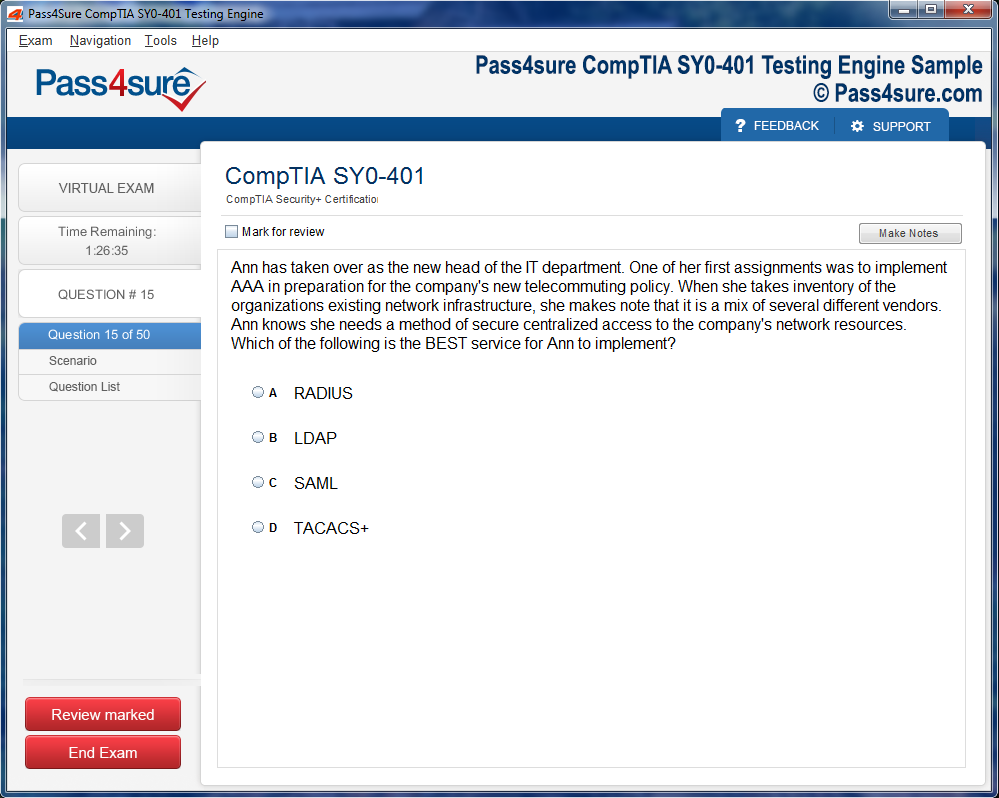
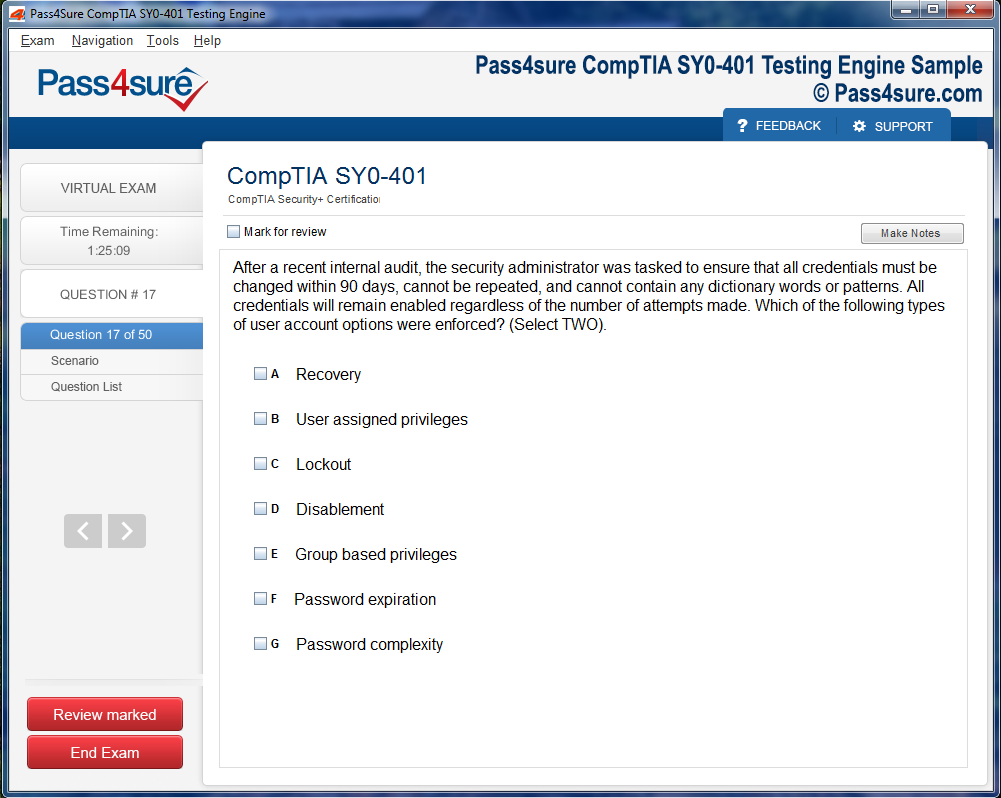
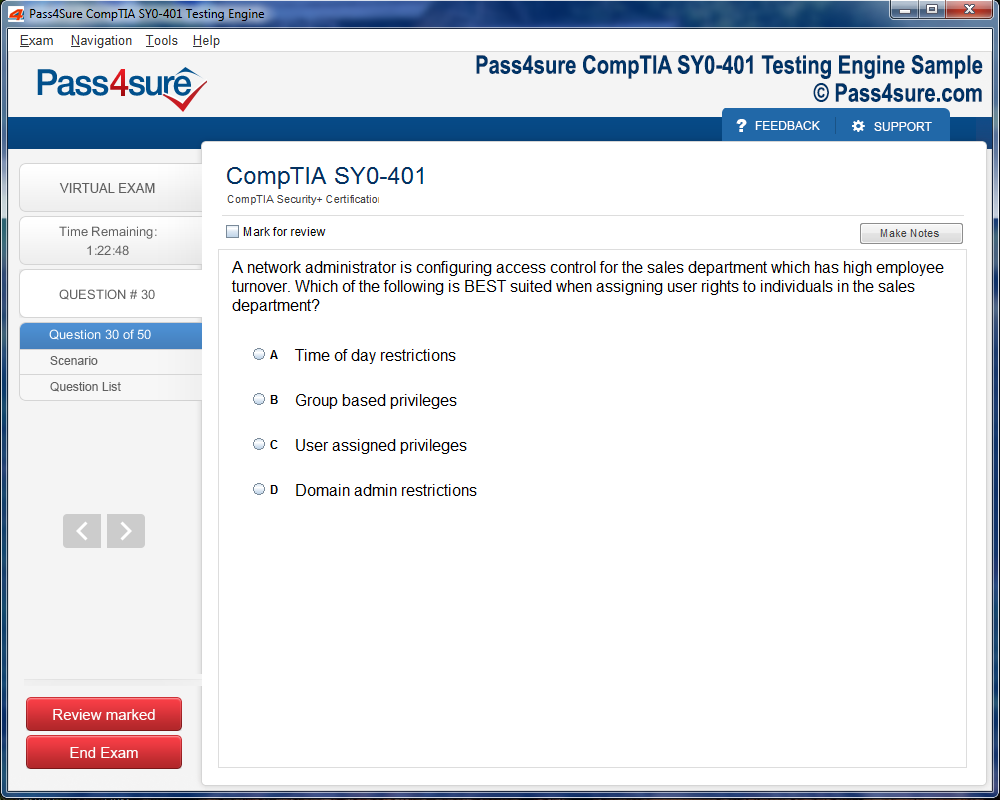
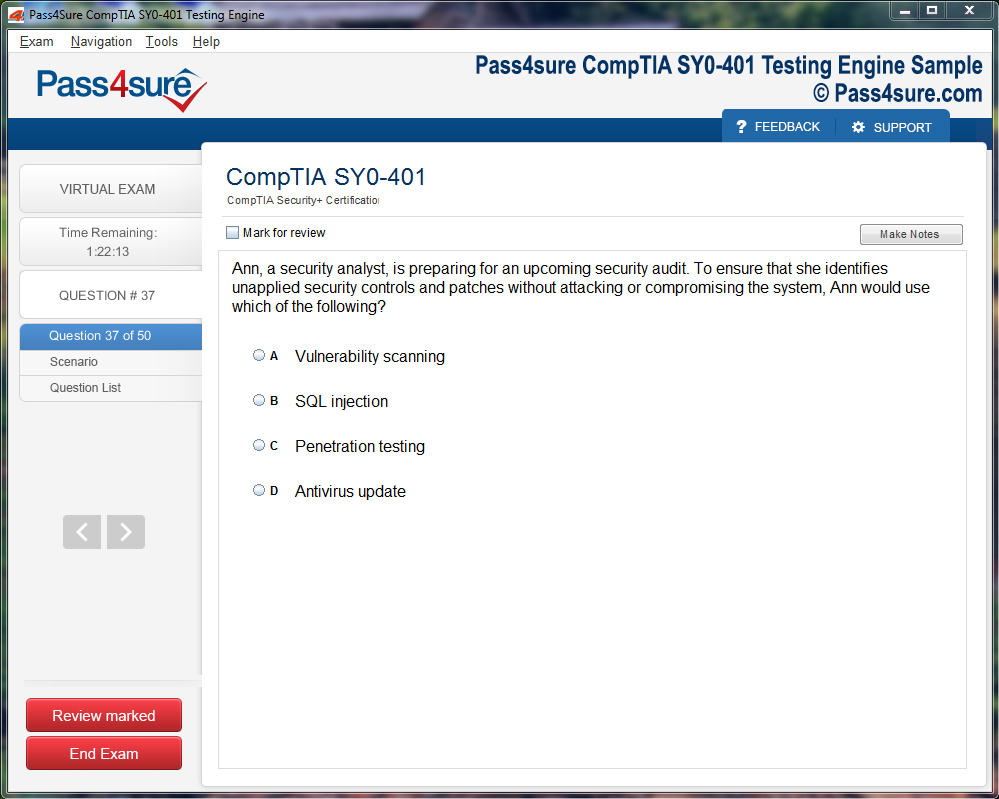
Product Screenshots
Frequently Asked Questions
How does your testing engine works?
Once download and installed on your PC, you can practise test questions, review your questions & answers using two different options 'practice exam' and 'virtual exam'. Virtual Exam - test yourself with exam questions with a time limit, as if you are taking exams in the Prometric or VUE testing centre. Practice exam - review exam questions one by one, see correct answers and explanations.
How can I get the products after purchase?
All products are available for download immediately from your Member's Area. Once you have made the payment, you will be transferred to Member's Area where you can login and download the products you have purchased to your computer.
How long can I use my product? Will it be valid forever?
Pass4sure products have a validity of 90 days from the date of purchase. This means that any updates to the products, including but not limited to new questions, or updates and changes by our editing team, will be automatically downloaded on to computer to make sure that you get latest exam prep materials during those 90 days.
Can I renew my product if when it's expired?
Yes, when the 90 days of your product validity are over, you have the option of renewing your expired products with a 30% discount. This can be done in your Member's Area.
Please note that you will not be able to use the product after it has expired if you don't renew it.
How often are the questions updated?
We always try to provide the latest pool of questions, Updates in the questions depend on the changes in actual pool of questions by different vendors. As soon as we know about the change in the exam question pool we try our best to update the products as fast as possible.
How many computers I can download Pass4sure software on?
You can download the Pass4sure products on the maximum number of 2 (two) computers or devices. If you need to use the software on more than two machines, you can purchase this option separately. Please email sales@pass4sure.com if you need to use more than 5 (five) computers.
What are the system requirements?
Minimum System Requirements:
- Windows XP or newer operating system
- Java Version 8 or newer
- 1+ GHz processor
- 1 GB Ram
- 50 MB available hard disk typically (products may vary)
What operating systems are supported by your Testing Engine software?
Our testing engine is supported by Windows. Andriod and IOS software is currently under development.
Learn Faster and Score Higher in NSE6_FAC-6.1 with These Proven Methods
The NSE6_FAC-6.1 exam is a crucible where theoretical acumen meets operational dexterity. FortiGate devices, with their intricate interplay of security fabrics and traffic orchestration, require aspirants to navigate an intricate lattice of concepts. Understanding the nuanced architecture of FortiGate systems is pivotal; it transcends rote memorization, demanding cognitive dexterity and anticipatory reasoning.
Security policies are not mere procedural checklists; they constitute an elaborate choreography where firewall rules, inspection profiles, and access control lists interact in dynamic flux. Candidates who internalize this choreography can predict outcomes before executing configurations, turning uncertainty into preemptive clarity.
Mastering VPNs and Remote Access Paradigms
Virtual Private Networks (VPNs) serve as the neural conduits of secure communications. NSE6_FAC-6.1 challenges candidates to grasp not only configuration syntax but also the underlying rationale of IPsec, SSL VPNs, and remote access methodologies. Conceptualizing VPNs as secure conduits bridging digital topologies enhances intuitive understanding.
The subtle distinctions between tunnel modes, encryption ciphers, and authentication protocols can spell the difference between operational proficiency and superficial comprehension. Real-world analogies, such as imagining data encapsulated within secure, unbreachable vessels, aid retention and accelerate recall during high-stakes assessments.
Navigating NAT, Routing, and Network Topologies
Network Address Translation and routing are the connective tissue of FortiGate networks. A sophisticated candidate perceives NAT not simply as a translation function but as a regulatory lens controlling ingress and egress flows. Static and dynamic routing, often underestimated, underpin both connectivity and resilience, necessitating mastery of protocol hierarchies and route prioritization.
Visualizing packet journeys through complex topologies or simulating routing recalculations during network perturbations fosters deep comprehension. This multi-dimensional mental mapping primes candidates for scenario-based questions, transforming theoretical understanding into actionable expertise.
High Availability, Redundancy, and Resilience Engineering
High Availability (HA) clusters represent a pinnacle of FortiGate operational philosophy. Beyond technical configuration, HA embodies principles of redundancy, failover orchestration, and continuity engineering. Candidates must appreciate that HA scenarios are a dance of synchronization intervals, heartbeat mechanisms, and cluster state transitions.
Exemplifying resilience, HA is more than uptime—it is a philosophical framework for anticipating failures, designing mitigations, and maintaining operational equilibrium under duress. The cognitive leap from configuration mechanics to resilience strategy distinguishes proficient candidates from those who merely follow procedural scripts.
Logging, Monitoring, and Analytical Cognition
Logs are the ephemeral footprints of network activity; mastery of logging and monitoring transforms raw data into actionable intelligence. FortiAnalyzer tools enable candidates to transcend mundane observation, unveiling patterns, anomalies, and latent vulnerabilities.
Analytical cognition thrives when aspirants engage with temporal sequences of events, correlate disparate alerts, and extrapolate potential security incidents. This mental discipline reinforces memory pathways, creating a cognitive scaffold that supports rapid retrieval during examination pressures.
Interlacing Security Fabric and Advanced Integrations
Security Fabric integration epitomizes holistic network defense, fusing FortiGate devices with supplementary services to create a synaptic security ecosystem. Candidates must grasp the interplay between endpoint telemetry, threat intelligence feeds, and automated response protocols.
Advanced integrations extend beyond technical proficiency; they demand anticipatory reasoning, pattern recognition, and strategic foresight. Visualizing Security Fabric as a living, adaptive organism allows aspirants to intuit interdependencies and operational ramifications, cementing both theoretical and practical comprehension.
Cognitive Techniques for Accelerated Retention
Success in NSE6_FAC-6.1 hinges on cognitive optimization. Employing rare mnemonic strategies such as loci-based memory palaces, narrative chaining, and schema mapping amplifies retention. Chunking complex configurations into semantically coherent modules mitigates cognitive overload.
Interleaving topics—alternating between VPNs, NAT, and HA clusters—fosters mental agility, cultivating the ability to switch contexts seamlessly. Teaching learned concepts, either in study groups or as reflective exercises, crystallizes neural pathways, converting ephemeral knowledge into durable competence.
Crafting a Precision-Oriented Study Regimen
A study regimen infused with both strategic foresight and tactical precision ensures maximal efficacy. Diagnostic assessments, followed by targeted resource curation, prevent redundant effort. Structured segmentation of domains, coupled with iterative lab simulations, transforms abstract comprehension into operational intuition.
Periodic review cycles, reinforced with spaced repetition and scenario-based exercises, amplify recall velocity. Mock examinations act as cognitive accelerators, simulating the pressure, timing, and unpredictability inherent in the actual assessment, enabling candidates to internalize not only content but also composure.
Psychological Conditioning for Exam Mastery
Cognitive mastery is incomplete without psychological calibration. Anticipatory visualization—envisioning successful navigation of complex exam scenarios—conditions the mind for performance under duress. Confidence, reinforced by repeated exposure to simulations, diminishes exam anxiety and enhances retrieval efficiency.
Candidates benefit from micro-breaks, mindfulness techniques, and adaptive pacing, which collectively optimize neural efficiency. Recognizing psychological states as integral components of preparation bridges the gap between technical proficiency and exam-day performance.
Leveraging Experiential Knowledge and Community Intelligence
While formal study materials provide foundational knowledge, community-driven insights unveil the subtleties often absent in official documentation. Discussion forums, knowledge-sharing collectives, and experienced mentors introduce unconventional troubleshooting approaches, atypical question patterns, and idiosyncratic problem-solving strategies.
Engaging with such communities cultivates adaptive thinking, encouraging candidates to approach challenges from multiple perspectives. This meta-cognitive skill—anticipating problems, hypothesizing solutions, and iteratively refining understanding—imbues aspirants with a distinctive strategic advantage.
Cognitive Priming and Memory Encoding
Understanding how the mind encodes information is paramount for NSE6_FAC-6.1 aspirants. Cognitive priming exploits associative networks in the brain, creating pathways for rapid retrieval during high-pressure exams. Begin each study session by briefly revisiting previously learned concepts, which activates neural circuits and enhances retention.
Rare Insight: Use “contextual anchoring” by connecting complex FortiGate configurations to familiar real-world analogies. For instance, consider VPN tunnels as secure courier routes, where packets are parcels, encryption as wrapping, and firewall policies as customs checks. This analogy bridges abstract networking jargon to intuitive understanding.
Strategic Mnemonics for Complex Configurations
Memory palaces and interleaved mnemonics can revolutionize retention. Instead of rote memorization of policy sequences, construct narratives or spatial maps in your mind. A firewall rule sequence could become a journey through a fortress, with each rule as a gate and each security profile as a sentinel.
Pro Tip: Employ bizarre or hyperbolic imagery; the stranger the visualization, the stronger the mnemonic imprint. For example, imagine an SSL VPN tunnel guarded by a robotic octopus juggling encrypted packets. The absurdity aids recall under exam duress.
Temporal Segmentation for Enhanced Focus
Long, uninterrupted study sessions may induce cognitive atrophy. Temporal segmentation breaks material into digestible micro-units, enhancing focus and encoding. Use 25–40 minute study intervals, interspersed with micro-breaks. During breaks, engage in unrelated mental tasks—solving riddles, sketching, or brief physical exercises—to reset cognitive load.
Rare Insight: “Inverted rest” methodology can be applied: review a topic in the first segment, then attempt recall during the subsequent break before checking answers. This paradoxical technique reinforces memory by exploiting slight cognitive tension.
Error-Centric Learning and Feedback Loops
Mistakes are pedagogical goldmines if systematically analyzed. After every lab or simulation, catalog errors in a structured feedback loop:
Identify the misstep.
Determine root cause (conceptual misunderstanding, misconfiguration, oversight).
Apply corrective measures and reattempt the exercise.
Rare Tip: Maintain a tri-layer error journal—Conceptual, Procedural, and Operational. Revisiting this tri-layered log before exams reinforces not only “what went wrong” but “why it went wrong,” deepening mastery beyond superficial memorization.
Scenario-Based Hypothetical Drills
Realistic, hypothetical scenarios sharpen analytical agility. Construct pseudo-exams using varied network topologies, policy conflicts, and multi-site VPN scenarios. Challenge yourself to anticipate error messages and simulate troubleshooting without reference materials.
Pro Insight: Introduce randomized parameters such as unconventional IP ranges, overlapping subnets, or atypical routing loops. Confronting uncommon configurations strengthens cognitive flexibility, making standard exam questions appear trivial.
Multi-Domain Integration Exercises
NSE6_FAC-6.1 demands not isolated knowledge but the synthesis of multiple domains—firewall policies, VPNs, logging, routing, and HA operations. Integrate exercises that span domains:
Configure a policy while simultaneously testing VPN traffic.
Introduce routing changes and monitor impact on HA cluster synchronization.
Generate simulated logs and correlate with user traffic patterns.
This approach promotes “cognitive entanglement,” where mastery is not sequential but holistic, mirroring real-world network operations.
Auditory Encoding and Narrative Reinforcement
Auditory learning complements visual and kinesthetic methods. Record yourself explaining configurations or policies in narrative form. Listening back allows identification of gaps and reinforces memory through dual-sensory encoding.
Rare Technique: Use storytelling cadence; narrate firewall events as episodic adventures. For example, a packet encountering a NAT translation becomes a character navigating through layers of security checkpoints. This narrative form amplifies recall under stress.
Reflective Journaling for Conceptual Solidification
Beyond mere lab notes, reflective journaling transforms experience into conceptual mastery. After each study or lab session, write concise reflections:
What concept was intuitive, and what required effort?
Which errors illuminated a gap in understanding?
How would you explain this to a peer with zero background?
Pro Tip: Revisit these reflections weekly, then convert them into a mind-map or condensed cheat-sheet. The act of reflection converts procedural memory into declarative mastery, facilitating rapid retrieval.
Cognitive Variability and Challenge-Induced Learning
Exposing oneself to cognitive variability—novel problems, irregular configurations, and time-pressured simulations—enhances neural plasticity. Randomly shuffle exercises, impose unusual constraints, or simulate real-time troubleshooting to strengthen adaptive problem-solving.
Rare Insight: “Error inversion” drills, where you intentionally misconfigure a setup and then correct it, produce exponential retention by compelling the brain to reconstruct correct logic from flawed inputs.
Cross-Modal Reinforcement with Peer Collaboration
Engaging with peers in collaborative drills adds a social dimension to learning. Teaching or explaining configurations to another candidate forces precision of thought, uncovers assumptions, and catalyzes cross-modal reinforcement.
Pro Tip: Use peer roleplay—one acts as a network engineer posing problems while the other solves them live. The interaction mirrors high-stakes exam pressure, training both competence and composure.
The Quintessence of Experiential Mastery in Fortinet NSE6 Preparation
In the esoteric realm of network fortification, theoretical literacy is merely the overture. True proficiency in NSE6_FAC-6.1 emanates from tactile immersion—manipulating devices, orchestrating policies, and witnessing the choreography of packets across a labyrinthine topology. Scholars who merely ingest manuals may know the lexicon, but virtuosos internalize the praxis.
Imperative of Hands-On Lab Immersion
Laboratories are not adjuncts; they are crucibles of cognition. By interfacing directly with FortiGate devices, one cultivates:
Fluency in the dialect of firewall policies and VPN architectures.
Perspicacity into traffic peregrinations under multifarious conditions.
Acumen in diagnosing and rectifying systemic anomalies.
The alchemy of converting arcane theory into actionable competence.
A seldom-discussed stratagem involves brief, quotidian lab encounters. Half an hour per diem, executed with concentrated focus, outperforms marathon but sporadic sessions, entraining durable synaptic consolidation.
Architecting Lab Sessions for Maximum Efficacy
A haphazard approach begets superficial grasp. Instead, a deliberate, scaffolded methodology ensures comprehensive mastery:
Basic Firewall Policy Fabrication
Commence with rudimentary rule sets. Log every transaction, and scrutinize access control behavior. Sequentially escalate to nuanced security profiles and application controls, observing the metamorphosis of network flow as policies evolve.
VPN Experimentation
Deploy SSL and IPsec VPNs, emulating remote access exigencies. Examine encryption paradigms, authentication schemas, and phase negotiation nuances. By simulating both ingress and egress perspectives, candidates gain holistic visibility.
Routing and NAT Exploration
Orchestrate static and dynamic routing, then interlace NAT translation. Observe packet trajectories meticulously; visualizing hop-by-hop passage enhances conceptual retention of routing logic.
High Availability (HA) Configurations
Implement HA clusters and provoke failover events. Monitor synchronization cadence between peers. This experiential knowledge is pivotal for both examination scenarios and real-world deployments.
Logging and Surveillance
Activate exhaustive logging protocols. Inject synthetic traffic, then parse results via FortiAnalyzer or native dashboards. Rapid interpretation of logs is a frequently understated, yet exam-critical, competency.
An ancillary tip: maintain a meticulously documented lab compendium, with screenshots, configuration snippets, and commentary. This personalized archive becomes an invaluable reference during intensive revision periods.
Synthesis of Theory and Practice
Conceptual assimilation is fortified when immediately translated into execution:
Post-study of firewall tenets, construct policies, route test traffic, and iterate based on anomalies.
Following VPN theoretical exploration, instantiate client-server scenarios to ensure end-to-end comprehension.
This iterative praxis engenders a cyclical reinforcement, converting cerebral abstractions into applied dexterity.
Augmenting Lab Productivity
Efficiency within the lab environment catalyzes cognitive yield:
Leverage virtualized FortiGate instances, circumventing physical hardware constraints while permitting extensive network simulations.
Utilize configuration snapshots to facilitate rapid rollback, conserving mental bandwidth for strategic troubleshooting.
Script or batch repetitive routines, reserving manual attention for complex, cognitively demanding scenarios.
Construct visual schematics of network topology, annotating VLANs, subnets, and policy loci to mirror enterprise-level practices.
A contrarian technique involves deliberate misconfiguration. Provoking errors intentionally and resolving them cultivates anticipatory troubleshooting prowess, invaluable for high-stakes examinations.
Documentation and Progress Tracking
An often-overlooked dimension of hands-on mastery is reflective journaling. Each lab session should chronicle:
Task Description: Specify configuration intentions.
Outcome Analysis: Did the configuration yield anticipated results? Document aberrations.
Lessons Codification: Capture pivotal insights, rectifications, and best practices.
Maintaining such a journal constructs a compendium of experiential knowledge, highlighting recurrent pitfalls and illuminating cognitive blind spots. This iterative reflection transforms repetitive exposure into profound understanding.
Cultivating Analytical Dexterity through Lab Challenges
Beyond routine configurations, cultivating analytical agility requires intentional exposure to ambiguous or complex scenarios. Examples include:
Multi-policy collision detection and resolution, where overlapping rules provoke unpredictable access behaviors.
Intricate VPN topology with nested tunnels, demanding precise phase alignment and cryptographic scrutiny.
HA cluster failover under asymmetric traffic load, challenging synchronization fidelity.
These exercises foster a mindset of anticipatory troubleshooting, cultivating resilience under examination pressure.
Employing Metacognitive Techniques in Lab Practice
Meta-awareness—the consciousness of one’s own cognitive processes—can dramatically enhance retention and comprehension:
Pre-lab Planning: Formulate hypotheses regarding expected network behaviors.
Active Experimentation: Execute configurations methodically while observing deviations from predictions.
Post-lab Reflection: Analyze discrepancies, extract principles, and refine mental models.
This triad ensures that hands-on engagement transcends rote repetition, nurturing genuine expertise.
Leveraging Scenario-Based Simulations
Simulation of real-world incidents magnifies experiential relevance. Construct scenarios encompassing:
Rogue device detection and quarantine within segmented VLANs.
Policy escalation and rollback under emergent threats.
Temporal traffic surges testing NAT and QoS configurations.
Each scenario reinforces both procedural memory and adaptive reasoning, skills that examinations aim to probe indirectly.
Recursive Learning through Iterative Labs
Repetition alone is insufficient without progressive complexity. Recursive exposure, where foundational exercises are revisited with incremental difficulty, cultivates both confidence and cognitive flexibility. For instance:
Revisiting firewall policies with the introduction of multiple VLAN intersections.
Enhancing VPN configurations with multifactor authentication and redundant paths.
Stress-testing HA clusters with simultaneous node failures.
This graduated escalation ensures enduring mastery rather than ephemeral familiarity.
Exploiting Automation for Cognitive Bandwidth Optimization
Automation, when judiciously applied, permits focus on conceptual understanding over mundane execution:
Scripting configuration templates for recurrent firewall rules.
Automating traffic generation to simulate user behavior and test policy enforcement.
Implementing monitoring scripts to flag anomalies proactively.
Such automation converts time from mechanical labor into reflective observation, amplifying learning efficiency.
Integrating Observational Learning in Lab Practice
Observation of system behaviors, beyond direct configuration, is a rich source of insight. Tracking packet flows, latency variations, and policy interactions cultivates an intuitive grasp of network dynamics that textual study rarely imparts.
Rarely mentioned, but supremely effective: passive monitoring sessions where no direct configuration is made, but every traffic permutation is annotated, significantly sharpens anticipatory troubleshooting skills.
FortiGate Security Policies: The Keystone of Network Fortification
At the nexus of FortiGate administration lie security policies, intricate constructs that dictate the choreography of network traffic. These policies act as sentinels, scrutinizing each packet with meticulous discernment. Understanding their architecture involves dissecting elements such as source, destination, service, action, logging, and temporal scheduling.
Security policies operate hierarchically, evaluated sequentially from the apex to the nadir. This linear scrutiny ensures that higher-priority policies preempt lower ones, averting inadvertent misconfigurations. Analogizing traffic flow as a river coursing through sluice gates can elucidate this concept. Each policy functions as a checkpoint, filtering, permitting, or denying the flow, shaping network behavior with surgical precision.
Enhancing policies with security profiles—encompassing antivirus, web filtering, and application control—transforms them from mere traffic regulators into multifaceted guardians of data sanctity. Mastery lies in visualizing not just the policy itself but the entire ecosystem it governs, predicting interactions and emergent effects before they manifest.
VPN Configurations: Constructing Secure Digital Arteries
Virtual Private Networks are the sinews of secure connectivity, linking disparate endpoints across precarious public networks. Mastery of VPNs requires both conceptual clarity and meticulous practical application.
IPsec VPNs, serving site-to-site communication, hinge on a dual-phase orchestration. Phase 1 establishes the secure tunnel, negotiating cryptographic parameters, while Phase 2 encapsulates the data exchange. Encryption algorithms and authentication methodologies must be meticulously aligned; missteps at any juncture can fragment connectivity.
SSL VPNs, conversely, cater to remote users, necessitating skill in configuring user groups, portal accessibility, and client deployment. Troubleshooting is an art form, involving detection of phase negotiation failures, encryption mismatches, or routing anomalies. Conceptualizing VPNs as intricate puzzles—where authentication, encryption, routing, and policy must interlock flawlessly—enhances both practical competency and mental agility.
NAT and Routing: The Cartography of Network Traffic
Network Address Translation and routing constitute the foundational cartography of network flow, delineating the paths that data traverses.
NAT manifests in diverse forms: source NAT, destination NAT, and static NAT, each transforming IP addresses in logs like a cipher transmuting identities. Mastery involves predicting these transformations and observing their operational footprints. Routing, whether static, dynamic (OSPF or BGP), or policy-based, dictates the itinerary of each packet. The interplay of administrative distance, route priority, and network topology crafts a dynamic tableau of traffic flow.
Hands-on experimentation is indispensable. Theoretical comprehension alone cannot encapsulate the fluidity of real-world scenarios, where routing conflicts, NAT overlaps, and policy interactions demand instant, analytical responses. Visualizing the network as a living organism, with packets navigating a lattice of decisions and contingencies, enhances cognitive retention.
High Availability and Redundancy: Crafting Resilient Infrastructures
Network resilience hinges upon High Availability (HA) configurations, ensuring uninterrupted service amid failure. The dichotomy between Active-Active and Active-Passive architectures embodies strategic choice: the former maximizes throughput and load distribution, the latter prioritizes fail-safe stability.
Heartbeat monitoring is the sentinel mechanism, detecting node incapacitation and triggering seamless failover. Laboratory simulations of HA scenarios illuminate latent behaviors, revealing subtleties that theoretical study might obscure. Recording failover triggers, observed behaviors, and recovery sequences cultivates an anticipatory mindset, equipping candidates with experiential foresight.
Logging, Monitoring, and Reporting: The Lens into Network Dynamics
Logs transcend their archival function, acting as diagnostic lenses into the pulsing heart of network activity. Traffic logs chart the odyssey of data packets, capturing source, destination, and service metadata. Event logs chronicle policy infractions, security anomalies, and systemic alerts, offering a granular view of operational integrity.
Analytical tools, from dashboards to integrated reporting platforms, transform raw log data into visual narratives. Proficiency in filtering, querying, and interpreting logs underpins success in scenario-driven assessments, where candidates must deduce root causes from incomplete or obfuscated evidence. Conceptualizing logs as the footprints of digital travelers fosters intuition for emergent network patterns.
Security Fabric Integration: The Neural Network of Fortinet Ecosystems
Fortinet’s Security Fabric exemplifies advanced integration, weaving multiple FortiGate devices into a responsive, centralized architecture. Each device functions as a neuron within a sprawling cognitive mesh, communicating, detecting threats, and coordinating automated responses.
Centralized management enables policy uniformity across the enterprise, while FortiGuard services infuse intelligence, anticipating threats and mitigating risks preemptively. Automation and alerting mechanisms reduce response latency, allowing networks to self-regulate in the face of evolving threats. Visualizing the Security Fabric as a dynamic neural network cultivates both conceptual clarity and operational dexterity, providing an elevated framework for troubleshooting complex interactions.
Cognitive Techniques for Mastery: Mental Cartography of Complexity
Beyond rote memorization, mastering NSE6_FAC-6.1 demands cognitive strategies that convert complexity into digestible constructs. Analogies serve as cognitive scaffolds: routing resembles postal logistics, NAT mirrors address redirection in urban planning, and policy hierarchies mimic traffic intersections.
Mini-scenarios, in which packets traverse simulated networks through VPNs, HA nodes, and layered policies, render abstract concepts tangible. Engaging multiple learning modalities—visual diagrams, verbal articulation, and kinesthetic lab exercises—reinforces retention, bridging the gap between comprehension and application. Such immersive techniques transform passive study into active mastery, enabling candidates to navigate the examination’s multifaceted challenges with confidence.
Exam-Day Psyche and Cognitive Calibration
Navigating the crucible of NSE6_FAC-6.1 demands more than rote proficiency—it necessitates cognitive finesse. Neural arousal modulation can pivot results drastically.
Subtle preparation reduces anticipatory anxiety. Candidates who employ micro-visualizations of firewall policies, HA synchronization, or VPN routing experience enhanced synaptic priming. This mental rehearsal transforms abstract knowledge into procedural fluency.
A rare cognitive maneuver is controlled diaphragmatic breathing: a mere ninety-second ritual can attenuate prefrontal cortex overload, fostering lucid problem-solving and precision under temporal duress. Positive affirmation sequences—internalized mantras of competence—can further fortify mental resilience.
Temporal Stratagems and Allocation Dexterity
Chronometric discipline is paramount. Scenario-based questions often conceal labyrinthine logic; unstructured pacing precipitates oversight.
Commence with a panoramic scan of the exam. Flag convoluted inquiries for deferred engagement. Early acquisition of unambiguous points generates psychological momentum, reinforcing focus circuits. Allocate an ephemeral 10–15-minute buffer for iterative validation of flagged responses.
A rare mnemonic for temporal efficiency is “Flow Map First”: within the initial 30–60 seconds, mentally delineate network topology, policy precedence, or VPN handshake sequence. This gestural mapping preemptively mitigates cognitive clutter, ensuring structured problem-solving under pressure.
Cognitive Cartography of Complex Queries
Intricacies in exam questions often exploit linguistic nuance: terms like “permit all except” or “disable logging” can ensnare inattentive cognition.
Logical elimination remains a formidable heuristic. Discarding implausible answers enhances selection probability. Scenario mentalization—simulating packet traversal, policy evaluation, or NAT translation—activates procedural memory.
A rare tactic: convert abstract scenarios into ephemeral flowcharts within working memory. This synesthetic approach often triggers intuitive recognition of the correct answer.
Stress Attenuation and Neurophysiological Poise
Exam-induced sympathetic overactivation diminishes mnemonic retrieval. Micro-interventions restore homeostasis:
Short kinetic interludes reset somatic tension.
Light nutrition maintains glycemic equilibrium, supporting sustained cognitive output.
Focused mindfulness or self-directed positive feedback mitigates stress-induced amnesia.
These physiological calibrations preserve mental acuity for high-stakes decision-making.
Micro-Reference Systems and Memory Encoding
Even amidst evaluative intensity, rapid recall strategies optimize efficiency:
Mnemonics for VPN stages, policy hierarchies, or HA failover mechanisms condense information into retrievable packets.
Mental flow diagrams crystallize traffic dynamics, NAT sequences, and synchronization patterns.
Flagging ambiguous items for post-scan review prevents impulsive errors and leverages neural freshness.
Iterative Mastery and Post-Examination Reflexivity
True mastery transcends the moment of assessment. Continuous refinement of cognitive schemas ensures long-term expertise.
Analyzing exam feedback—correct and incorrect responses—activates metacognitive networks. This reflective rehearsal identifies latent conceptual gaps and consolidates procedural memory. A rare technique is “error triangulation”: categorize missteps by thematic pattern, such as misreading policy directives, misapplying NAT rules, or neglecting HA nuances. This transforms mistakes into targeted improvement modules.
Incorporate distributed practice post-exam. Revisiting problematic scenarios at spaced intervals solidifies neural encoding. Mental simulation of alternate problem paths fosters adaptive expertise and preemptive troubleshooting skills.
Knowledge Crystallization Through Experiential Logging
Post-exam reflection is most potent when codified. Maintain an “operational diary” capturing scenario analyses, configuration subtleties, and troubleshooting heuristics. This repository serves as both cognitive reinforcement and rapid-reference atlas for future challenges.
Rare engagement tip: Convert recurring patterns into allegorical stories or metaphors. For example, conceptualizing VPN tunnels as subterranean streams navigating through policy dams enhances retention and recall. Such synesthetic mapping intertwines analytical and imaginative faculties, yielding superior engagement and enduring comprehension.
Transmuting Errors into Expertise
Even those who surmount the rigorous NSE6_FAC-6.1 gauntlet encounter missteps along the path. Each miscalculation is not a defeat but a tessellation of opportunity. Begin with a meticulous audit of practice exams, scrutinizing the nuances of incorrect selections and temporal misjudgments. Delve into lab logs with forensic precision, reconstructing errant configurations to imprint procedural memory. Pattern recognition emerges as a keystone: recurrent lapses illuminate latent deficiencies. Transform these revelations into a "mistake repository," an archival compendium of errors that morphs misfortune into a structured roadmap for ascendant mastery.
Fortifying Expertise Beyond the Credential
Certification is a milestone, not the terminus. To elevate proficiency, one must explore the arcana beyond exam boundaries. Advanced FortiGate features, including intricate Security Fabric orchestrations and multi-tiered FortiManager integrations, reveal layers of operational sophistication. Real-world deployments function as crucibles for applied competence. Volunteering for simulated production environments fosters experiential dexterity with high-availability clusters, encrypted VPN tunnels, and labyrinthine routing topologies. Engaging with peer communities—via forums, webinars, or study cohorts—provides exposure to esoteric scenarios otherwise unencountered in controlled study settings.
Vigilance in a Shifting Technological Landscape
Fortinet technologies are in perpetual flux. Staying abreast demands vigilant surveillance of firmware release notes and emergent security updates. Subscribing to official training communiqués ensures alignment with contemporary best practices. Repeatedly practicing labs that incorporate newly introduced features or patches preserves practical dexterity. This sustained engagement nurtures a form of technological osmosis, allowing professionals to anticipate vulnerabilities and adapt preemptively.
Crafting a Perennial Learning Architecture
Long-term professional ascent mandates a structured approach to perpetual education. Establish quarterly learning objectives, dedicating each period to an advanced topic such as FortiAnalyzer analytics or automation scripting intricacies. Scenario-based exercises, particularly those simulating atypical network anomalies, cultivate troubleshooting agility. Integration of Fortinet expertise with broader networking, cybersecurity, and cloud paradigms ensures versatility. Consider every lab exercise or real-world deployment as a microcosmic examination. Document outcomes, reflect critically, and iterate systematically—habits that mirror continuous professional evolution and reinforce skill durability.
Leveraging Certification as a Strategic Lever
The NSE6_FAC-6.1 credential serves as a differentiator within professional ecosystems. Internal acknowledgment often manifests in elevated project responsibilities or promotional pathways. Certification paves avenues toward advisory or managed service engagements, enhancing career mobility. Beyond tangible job benefits, the credential instills a deep-seated confidence to architect, implement, and troubleshoot sophisticated FortiGate infrastructures. This assurance catalyzes professional initiative, encouraging proactive innovation and complex problem resolution.
Alchemy of Practice and Reflection
The synthesis of hands-on experimentation with deliberate reflection constitutes the alchemy of enduring competence. Each lab, scenario, or deployment transcends rote execution, becoming a locus for cognitive and procedural refinement. Maintaining a journal of these engagements, replete with nuanced observations and corrective strategies, cultivates meta-cognition—a heightened awareness of one’s own decision-making patterns and technical acumen. Over time, this reflective praxis engenders intuition in system design, threat mitigation, and architectural optimization.
Integrating Multidisciplinary Cognition
Fortinet expertise flourishes when harmonized with cognate disciplines. Networking fundamentals, cybersecurity heuristics, and cloud infrastructure paradigms complement FortiGate proficiency, fostering holistic problem-solving capacity. For instance, integrating knowledge of dynamic routing protocols with FortiOS firewall policies can reveal subtle optimizations otherwise overlooked. Embracing multidisciplinary cognition transforms certification from a discrete skill set into a versatile instrument for complex technological orchestration.
Experiential Codification of Knowledge
Turning ephemeral experiences into lasting competence requires intentional codification. Each configuration, troubleshooting sequence, or security implementation should be systematically documented and categorized. This experiential ledger evolves into a personalized compendium of operational wisdom, facilitating rapid retrieval in high-stakes environments. The iterative process of documentation, review, and refinement accelerates both retention and adaptive application, creating a resilient professional knowledge base.
Proactive Engagement with Emerging Threats
Fortinet environments exist within a dynamic threat landscape. Certification alone is insufficient without anticipatory engagement. Regularly analyzing threat intelligence feeds, scrutinizing emerging vulnerabilities, and experimenting with mitigative configurations ensures that defensive capabilities remain proactive rather than reactive. Engaging in red-teaming exercises or controlled penetration tests sharpens analytical precision and reinforces practical comprehension of defensive mechanisms.
Cultivating a Professional Growth Mindset
Success in NSE6_FAC-6.1 is not an endpoint but a portal to continuous elevation. Cultivating a mindset oriented toward perpetual growth transforms challenges into opportunities for refinement. Celebrate incremental improvements, analyze setbacks dispassionately, and embrace novel problem spaces with curiosity. This psychological scaffolding underpins long-term mastery, ensuring that the certification evolves into an active instrument for professional trajectory enhancement.
Labyrinthine Configurations and Cognitive Mapping
Navigating FortiGate ecosystems is akin to exploring a labyrinthine architecture where each configuration decision reverberates through multiple layers of security and connectivity. Cognitive mapping becomes indispensable: constructing mental models of packet flows, policy hierarchies, and interdependent services enables rapid orientation within complex infrastructures. Deliberately simulating diverse topologies—from multi-branch corporate networks to cloud-integrated environments—cultivates spatial and procedural awareness. Documenting each experiment in a matrix of inputs, outputs, and anomalies transforms ephemeral learning into enduring cognitive scaffolds.
Temporal Mastery in Dynamic Environments
Time, often overlooked, is a critical dimension in professional aptitude. Practicing rapid policy deployment, accelerated troubleshooting, and real-time log analysis develops temporal acuity. Simulate high-pressure scenarios where multiple security incidents occur simultaneously. Measure response latency, decision accuracy, and systemic impact. This temporal conditioning instills a rhythm of operational efficiency, turning potential chaos into orchestrated precision. Rarely encountered in traditional study, this skill differentiates technically competent individuals from strategic virtuosos.
Heuristic Analysis and Predictive Troubleshooting
Beyond rote memorization, mastery arises from heuristic analysis. Develop frameworks to anticipate likely misconfigurations or policy conflicts before they manifest. Predictive troubleshooting combines historical lab data, error patterns, and system heuristics. For example, observing recurrent VPN negotiation failures across test deployments may indicate an underlying misalignment in phase-2 proposals or firewall session handling. Applying this predictive lens transforms routine troubleshooting into anticipatory governance, mitigating issues preemptively.
Narrative Documentation for Professional Memory
Documentation is not merely procedural—it is narrative. Craft each lab report or real-world configuration log as a story: the initial hypothesis, experimental adjustments, unexpected anomalies, and ultimate resolutions. Embedding technical reasoning within narrative frameworks reinforces memory retention through contextual association. A meticulously curated knowledge atlas enables future retrieval under duress, turning experiential anecdotes into strategic operational templates.
Fortinet Feature Synergy and Interoperability
FortiGate functionalities achieve maximal potency when considered synergistically rather than discretely. Security Fabric, FortiAnalyzer, FortiManager, and endpoint integrations form an intricate web of interoperability. For instance, correlating FortiGate logs with FortiAnalyzer analytics and endpoint telemetry provides a multidimensional threat perspective. Experiment with combining features in unconventional ways: dynamic WAN load balancing with advanced application control, or multi-VDOM orchestration alongside granular user identity mapping. These exercises cultivate an intuitive understanding of feature synergy rarely documented in conventional training materials.
Micro-Simulations for Cognitive Reinforcement
Micro-simulations, miniature yet meticulously structured scenarios, accelerate learning by condensing complex concepts into manageable cognitive units. Create experiments that isolate specific configurations or security events: a single-policy routing conflict, a nested VPN chain, or a transient HA failover. Document outcomes, iterate adjustments, and embed reflective analysis. Over time, these micro-simulations coalesce into a robust mental repository, enabling rapid synthesis of solutions in production environments.
Cognitive Flexibility Through Scenario Divergence
Exposing oneself to scenario divergence—intentionally deviating from standard deployment templates—enhances cognitive flexibility. Introduce anomalies, such as conflicting NAT rules, unconventional subnetting, or partially implemented security policies. Navigating these deliberately challenging contexts cultivates adaptive problem-solving skills, enhancing resilience when confronted with unforeseen production issues. By embracing controlled dissonance, professionals develop the capacity to reconcile theoretical knowledge with practical unpredictability.
Advanced Log Analysis and Anomaly Detection
Log analysis is more than review; it is an exercise in forensic intuition. Move beyond surface-level inspection to identify subtle anomalies, infer system states, and predict emergent threats. Examine patterns of dropped packets, session timeouts, and policy triggers, correlating them across multiple devices or VDOMs. Explore machine-assisted analytics where feasible, interpreting automated insights without relinquishing critical judgment. This dual approach—human intuition augmented by analytical tooling—produces a rarefied level of operational acuity.
Simulation of Catastrophic Scenarios
To transcend standard competency, simulate catastrophic scenarios: multi-site network outages, simultaneous security breaches, or critical firmware misconfigurations. Each simulation demands end-to-end orchestration, from detection through mitigation to post-mortem documentation. These high-stakes exercises cultivate composure under duress and illuminate the interdependencies between hardware, software, and procedural policies. Document every decision pathway, analyzing trade-offs and cascading effects. Such preparation fosters resilience that is both strategic and tactical.
Cross-Pollination of Cybersecurity Disciplines
FortiGate proficiency blossoms when interwoven with broader cybersecurity domains. Penetration testing, threat modeling, incident response frameworks, and forensic analysis complement core skills. For instance, integrating knowledge of MITRE ATT&CK techniques with FortiGate IDS/IPS configurations enables proactive threat mitigation. Consider adopting adversarial thinking, viewing the network as an ecosystem under potential attack vectors. This cross-pollination sharpens defensive design and hones anticipatory problem-solving.
Continuous Personal Benchmarking
Maintain rigorous self-assessment protocols to measure growth objectively. Construct personalized benchmarks: time-to-resolution metrics for simulated incidents, success rates in complex lab exercises, or depth of feature exploration per month. Track trends longitudinally, noting improvements and persistent gaps. Treat these benchmarks as living instruments—refining them alongside evolving professional aspirations. This disciplined self-quantification fosters incremental excellence and sustained skill escalation.
Cognitive Ergonomics in Network Administration
Professional efficacy is intertwined with cognitive ergonomics—the art of structuring workflows to align with mental acuity. Optimize command sequences, interface navigation, and lab setups to reduce cognitive friction. Develop mnemonics or visual schemas to internalize firewall hierarchies, routing policies, or log correlations. Ergonomic proficiency transforms laborious tasks into fluid operations, freeing cognitive resources for strategic deliberation and innovation.
Experimentation with Automation and Scripting
Automation amplifies both productivity and cognitive bandwidth. Explore FortiGate scripting, API integrations, and automated reporting to streamline repetitive tasks. For instance, auto-deploying policy templates across multiple VDOMs or automating log analysis pipelines frees mental capacity for advanced threat detection and architectural optimization. Approach automation as a cognitive extension, where machines handle rote processes while the professional focuses on strategic insight.
Ethical Considerations in Deployment
Advanced expertise entails ethical discernment. Fortinet deployment decisions carry real-world implications for data privacy, network integrity, and organizational compliance. Regularly examine ethical ramifications: access controls, log retention policies, and anomaly detection must balance operational effectiveness with regulatory adherence. Cultivating this ethical reflex ensures that technical excellence is harmonized with professional responsibility, reinforcing trustworthiness and leadership credibility.
Strategic Scenario Simulation
The NSE6_FAC-6.1 examination thrives on immersive scenario complexity. Mastery requires preemptive cognitive simulation, a form of deliberate neural rehearsal. Candidates benefit from “scenario looping,” iteratively envisioning diverse network topologies, policy hierarchies, and HA failover contingencies.
This practice not only fortifies procedural memory but also enhances anticipatory reasoning. Envision, for example, a dual-homed firewall with asymmetric routing. Mentally project packet trajectories, consider stateful session implications, and simulate logging outputs. Repeated iterations of such simulations cultivate reflexive insight, allowing instantaneous recognition of correct configurations during the exam.
Rarely employed but highly effective is the “reverse engineering scenario”: start with the desired traffic outcome and mentally trace backward to identify the necessary policy sequence, NAT translations, or routing interventions. This counterfactual approach illuminates overlooked dependencies that standard forward reasoning may miss.
Hierarchical Policy Cognition
A quintessential stumbling block for candidates is the hierarchical intricacy of firewall policies. Policies are not merely sequential; they exist within interlaced precedence frameworks. Comprehending this hierarchy requires abstract cognitive mapping.
Visualizing the policy structure as a multi-tiered lattice, with global, zone, and local directives, can prevent errors arising from misapplied rules. For example, a deny-all policy at a higher tier can nullify subsequent specific permits if not accounted for—a subtlety often overlooked under temporal pressure.
Employ the rare mnemonic “Top-Down Constriction”: for every rule, assess its upstream constraints before considering downstream allowances. This method primes analytical reasoning and reduces the cognitive load during real-time examination.
High-Fidelity Lab Emulation
Hands-on replication of complex scenarios in a lab environment is invaluable. However, true high-fidelity emulation goes beyond mere replication; it demands variant generation. Alter parameters, introduce asymmetric link failures, manipulate NAT and VPN policies, and observe resultant behaviors.
These variations cultivate an adaptive mindset and enhance situational pattern recognition. Rarely acknowledged, the act of recording lab anomalies in a cognitive log magnifies retention. Writing down unexpected behaviors or misconfigurations transforms ephemeral observations into durable schemata, which can later be recalled with minimal cognitive friction.
Advanced VPN Cognition
Virtual Private Networks present intricate cognitive challenges due to their layered cryptographic and routing architectures. Successful candidates internalize not only the protocol mechanics but also the operational interplay between IKE phases, SA lifetimes, and key exchange sequences.
A potent mnemonic is “Phase Matrix Flow”: mentally map IKE Phase 1 negotiation, transition to Phase 2, and overlay traffic selectors and encryption methods. Visualize the encapsulated traffic traversing the tunnel with simultaneous state inspection, anticipating errors such as mismatched encryption domains or tunnel overlaps.
This depth of cognitive rehearsal transforms rote memorization into procedural fluency. In high-pressure testing environments, such internalized simulations allow for instant recognition of misconfigurations and accurate selection of corrective measures.
High-Availability Reflex Patterns
High-availability clusters, with their failover intricacies, often confound candidates due to simultaneous dependencies across routing, sessions, and logging. Proficiency emerges from pattern-based cognition rather than linear memorization.
Mental rehearsal should integrate failure contingencies: simulate link outages, node failures, and policy misalignments. Visualize HA heartbeat detection, state replication, and session persistence. Rarely used, yet effective, is “dual-lens rehearsal”: first, analyze HA from the perspective of traffic continuity, then from administrative control plane implications. This dual cognition reinforces multidimensional understanding and ensures rapid recognition of correct answers under exam pressure.
Traffic Flow Semantics
Exam questions frequently probe subtle nuances of traffic flow, NAT behavior, and session inspection. Understanding semantics beyond mechanical rules is essential.
Consider the path of a packet traversing multiple NAT layers, crossing VPN tunnels, and subject to policy inspection. Mentally annotate the source and destination transformations at each stage. Rare mnemonic devices, such as “Packet Persona,” help candidates personify each packet, imagining its journey and transformations. This narrative-based technique anchors complex sequences in memory, enabling rapid recall and error detection.
Cognitive Triaging of Exam Questions
Time scarcity demands prioritization of cognitive resources. Develop a triage system: classify questions into categories—high-confidence, medium-difficulty, and high-risk.
High-confidence items should be completed immediately to secure early points. Medium-difficulty items merit careful allocation of time, with mental simulations and cross-referencing of knowledge. High-risk items, especially multi-part scenario-based questions, may benefit from deferred attention, allowing the mind to consolidate simpler solutions first.
An unusual but effective strategy is “temporal tagging”: assign a micro-timestamp in your mental map, noting how long you’ve devoted to a question. This prevents cognitive sinkholes and maintains pace throughout the examination.
Error Pattern Reconnaissance
Analyzing mistakes is a critical dimension of mastery. Rather than superficially reviewing incorrect answers, candidates should dissect error causation at a granular level.
Identify whether errors stem from misreading policy directives, misinterpreting traffic logs, neglecting HA nuances, or failing to simulate VPN interactions. Categorize these patterns systematically. Rarely utilized is the technique of “error layering”: rank errors by cognitive origin, then map them to neural pathways associated with procedural memory. This allows targeted remediation, transforming prior mistakes into persistent mastery.
Cognitive Anchoring via Synesthetic Associations
High engagement and retention can be enhanced through synesthetic mapping—linking abstract technical concepts to sensory or imaginative analogues.
For example, visualize VPN tunnels as translucent conduits carrying colored particles representing encrypted traffic. HA failover can be envisioned as an intricate dance of mirrored figures, maintaining balance despite obstacles. Policy precedence might resemble a multi-tiered aqueduct system, with water flow representing permitted traffic. These imaginative anchors create multidimensional cognitive schemas, improving both speed of recall and resilience under stress.
Reflexive Debugging Techniques
Exam scenarios often embed subtle errors to test troubleshooting acuity. Reflexive debugging involves systematic observation, hypothesis generation, and stepwise validation.
Mental rehearsal should simulate common failure modes: asymmetric routing, mismatched encryption, incorrect NAT translation, and session timeout misalignments. Rarely suggested but highly potent is “reverse packet tracing”: mentally backtrack each packet from destination to origin, identifying points of policy obstruction. This technique mirrors expert real-world diagnostics and accelerates correct response selection during examinations.
Layered Conceptual Integration
A hallmark of top performers is the ability to integrate discrete technical concepts into cohesive cognitive models. Traffic flow, NAT, VPN, HA, and logging are rarely independent; their interactions are layered and interdependent.
Employ mental layering: first, anchor individual modules (e.g., VPN phases, NAT translations), then superimpose HA behaviors, followed by policy hierarchies, and finally overlay monitoring/logging implications. This incremental synthesis facilitates rapid, holistic problem-solving under exam constraints. Rare mnemonic: “Modules Stack, Mind Maps” reinforces the mental scaffolding process.
Neural Conditioning via Iterative Quizzing
Self-administered quizzing catalyzes procedural memory reinforcement. Randomized scenario questions, timed simulations, and iterative reattempts enhance retrieval fluency.
To maximize engagement, vary question parameters subtly—change IP addresses, policy priorities, or VPN domains—forcing adaptive cognition rather than rote repetition. Rare but effective technique: “Shadow Testing,” where you mentally answer a question before physically writing or selecting an answer, strengthens neural readiness for real-time problem-solving.
Metacognitive Calibration for Continuous Improvement
Continuous self-monitoring of cognitive state is essential. Recognize when mental fatigue sets in, and employ short restorative interventions: micro-pauses, light physical activity, or focused breathing.
Track performance trends over time. Rare but impactful: maintain a “cognitive log” recording not only right/wrong answers but also subjective confidence, response speed, and mental clarity. Over time, patterns emerge, allowing precise adjustment of study priorities, scenario simulation focus, and mnemonic reinforcement.
FortiGate Security Policies: Navigating Intricate Traffic Landscapes
Security policies are not merely directives; they are the cartographers of network behavior. Each packet entering a FortiGate device embarks on a journey defined by these policies, and any misalignment can cascade into unforeseen disruptions. The elements of policies—source, destination, service, action, logging, and schedule—interact like interwoven threads in a tapestry. Mastering their interactions requires an appreciation of both micro and macro perspectives.
Consider the temporal aspect of policies. Scheduling policies allows administrators to impose time-based restrictions, akin to curfews for data. Traffic may be unrestricted during business hours but curtailed during off-peak periods, reducing exposure to attacks when vigilance is lower. Logging adds another layer of intelligence, capturing the ephemeral trails left by packets, which later serve as forensic breadcrumbs during audits or incident investigations.
Policy order is often underestimated. A single misordered policy can inadvertently permit malicious traffic while blocking legitimate flows. Visualizing traffic as a river navigating sluice gates helps conceptualize this: early gates determine the water’s trajectory, while downstream gates often see nothing if upstream conditions have already diverted the flow. Integrating security profiles such as antivirus scanning, web filtering, and application control converts these checkpoints into multifaceted sentinels capable of proactive threat mitigation.
Real-world application reinforces understanding. Imagine a scenario where a policy allows all HTTP traffic to a server while a subsequent policy blocks known malicious domains. Without correct ordering, the malicious traffic bypasses the block, demonstrating why comprehension surpasses rote configuration.
VPN Configurations: Weaving Secure Digital Pathways
VPNs serve as the arteries of secure communication, transporting data across unsecured networks with confidentiality and integrity. IPsec VPNs establish encrypted tunnels for site-to-site connectivity, relying on a dual-phase handshake. Phase 1, or IKE negotiation, authenticates peers and sets cryptographic parameters. Phase 2 negotiates the actual data transmission, establishing the Security Associations (SAs) that govern encryption and encapsulation.
Troubleshooting VPNs often reveals subtle misalignments. A mismatch in encryption algorithms between endpoints, or inconsistent routing entries, can prevent tunnel establishment. Viewing the configuration process as a puzzle enhances comprehension: authentication, encryption, routing, and policy must interlock seamlessly. Each misaligned component is a missing piece that disrupts the entire structure.
SSL VPNs extend secure access to remote users, demanding meticulous configuration of portals, user groups, and client deployment. Real-world labs illustrate common pitfalls: a user may authenticate successfully but fail to access internal resources due to policy misconfigurations or route omissions. These exercises train candidates to anticipate potential conflicts and devise preemptive solutions, turning theoretical knowledge into operational acumen.
NAT and Routing: Crafting the Lexicon of Traffic Flow
Network Address Translation (NAT) and routing are not merely technical functions; they are the lexicon of packet movement. NAT rewrites packet addresses, allowing private networks to communicate with public networks without exposing internal architecture. Source NAT modifies the origin IP, destination NAT alters the target, and static NAT binds fixed translations, each with distinct operational consequences. Observing NAT transformations in logs elucidates hidden behaviors and unexpected routing loops.
Routing dictates the pathways packets traverse. Static routing offers deterministic pathways, while dynamic protocols like OSPF or BGP respond to network changes, recalibrating paths in real-time. Policy-based routing allows administrators to override default paths based on packet attributes, introducing granular control over traffic behavior. Route selection is influenced by metrics such as administrative distance, bandwidth, and latency, forming a complex calculus that determines optimal paths.
Practical labs illuminate the dynamic interplay between NAT and routing. Consider a packet originating from an internal host, undergoing source NAT, traversing an HA cluster, negotiating a VPN tunnel, and finally reaching an external destination. Tracking its path demonstrates the interdependence of multiple systems and fosters an intuitive understanding of real-world network behavior.
High Availability and Redundancy: Engineering Uninterrupted Connectivity
High Availability (HA) mechanisms are the linchpins of resilient network design. Active-Active HA maximizes throughput by distributing traffic across multiple nodes, whereas Active-Passive ensures continuity through standby nodes, sacrificing capacity for stability. Heartbeat monitoring, which periodically exchanges signals between nodes, allows rapid detection of failures, triggering seamless failover.
Simulation labs reveal the subtleties of HA behavior. Inducing failures, such as interface shutdowns or policy misconfigurations, and observing node responses exposes candidate insights into latency, packet loss, and recovery sequences. Documenting these observations—failover triggers, node states, recovery time—cultivates procedural memory, ensuring preparedness during high-pressure examinations.
Advanced HA strategies involve session synchronization, ensuring ongoing connections persist during failovers. Without this feature, active sessions may drop during node transitions, highlighting the importance of holistic HA comprehension rather than superficial setup.
Logging, Monitoring, and Reporting: Deciphering the Pulse of Networks
Logs are the retina through which administrators perceive network activity. Traffic logs capture source and destination metadata, illuminating usage patterns and anomalies. Event logs archive system alerts, policy violations, and detected threats, functioning as an operational chronicle of network life.
FortiGate dashboards and analysis platforms transform raw data into visual insights. Patterns emerge, anomalies are flagged, and historical trends inform predictive security strategies. Filtering and searching logs are not merely tasks but investigative techniques, enabling practitioners to reconstruct scenarios and deduce causality. Scenario-based exam questions often require such deductive reasoning, demanding that candidates translate abstract log data into actionable conclusions.
Real-world analogy: logs are akin to footprints in a forest. While the path is not immediately visible, careful examination of prints, direction, and frequency reveals the traveler’s route, intent, and potential hazards encountered. Adopting this mindset enhances analytical acumen and prepares candidates for complex diagnostic tasks.
Security Fabric Integration: Harmonizing Fortinet Ecosystems
Fortinet’s Security Fabric transforms isolated FortiGate devices into a cohesive, intelligent network organism. Each device functions as a neuron within a responsive neural mesh, communicating threats and coordinating responses in real-time. Centralized management consolidates policy enforcement, threat detection, and device orchestration, ensuring operational coherence across diverse network segments.
FortiGuard services enrich this ecosystem with threat intelligence, enabling predictive defenses against zero-day exploits and emergent malware. Automation triggers allow networks to self-heal, isolating compromised segments, notifying administrators, or rerouting traffic to mitigate exposure. Conceptualizing the Security Fabric as an adaptive neural network deepens both theoretical and practical understanding, guiding candidates toward proactive troubleshooting and strategic foresight.
Hands-on labs reinforce integration concepts. For instance, introducing a simulated threat on one device propagates alerts across the network, demonstrating inter-device communication and automated mitigation workflows. This experiential understanding transcends rote memorization, embedding operational intuition in the candidate’s mental model.
Cognitive Strategies: Transforming Complexity into Mastery
Excellence in NSE6_FAC-6.1 requires more than technical memorization; it necessitates cognitive frameworks that render complexity comprehensible. Analogical reasoning serves as a scaffold: routing mimics postal logistics, NAT reflects urban address redirection, and security policies resemble traffic regulations dictating vehicle flow.
Mini-scenarios simulate realistic network events, allowing candidates to observe packet journeys through VPNs, HA clusters, and layered policies. These simulations cultivate foresight and problem-solving agility, converting abstract theory into tangible comprehension. Multimodal learning—visual diagrams, verbal articulation, and tactile lab exercises—reinforces retention, bridging comprehension with practical application.
Memory techniques such as spaced repetition, associative imagery, and scenario-based rehearsal further solidify knowledge. For example, visualizing a packet as a courier navigating checkpoints, tunnels, and alternate routes creates a mental narrative, making abstract networking concepts memorable and intuitive.
Heuristic Troubleshooting Frameworks
Efficient troubleshooting is not merely reactive; it is heuristic-driven. Develop mental templates that anticipate likely issues based on prior patterns. For example, if VPN connections fail, do not randomly toggle settings; systematically evaluate authentication, encryption profiles, routing, and firewall policies in a prioritized sequence.
Rare Tip: Construct a “decision tree of failure” where each node represents a probable cause and branches represent corrective actions. Over time, navigating this tree becomes instinctive, reducing latency under exam pressure.
Layered Conceptualization of Network Policies
Firewall policies, NAT, routing, and VPNs operate in layered symbiosis. Understanding each layer in isolation is insufficient; mastery emerges from recognizing interdependencies. Map these relationships explicitly:
Policy Layer – dictates traffic permissions.
Routing Layer – determines packet trajectory.
NAT Layer – transforms source or destination addresses.
VPN Layer – encapsulates and encrypts traffic.
Visualizing these layers as an interconnected ecosystem reinforces both procedural and conceptual memory, minimizing mistakes when multiple layers interact.
Micro-Learning Capsules
Chunking dense material into micro-learning capsules is a powerful strategy. Each capsule should target a single principle, e.g., “SSL VPN authentication flow” or “HA cluster failover sequence.”
Pro Insight: Study capsules in variable sequences. Randomized repetition strengthens memory encoding, a phenomenon known as interleaved learning. Over time, disparate capsules integrate naturally, producing holistic fluency.
Gamification of Study Sessions
Gamifying study processes enhances motivation and retention. Assign points for completed lab exercises, correct recall, or error correction. Introduce personal challenges, like completing three VPN scenarios consecutively under time constraints.
Rare Technique: Create a “level-up system” where mastery of one domain unlocks the next. This mirrors video game progression and stimulates dopamine-driven engagement, making repetitive study enjoyable and productive.
Cognitive Load Management
Managing cognitive load prevents mental saturation. Avoid cramming multiple complex topics simultaneously. Instead, interleave simpler and more challenging exercises. For example, alternate between basic firewall policies and advanced HA troubleshooting within the same study session.
Pro Tip: Apply the “10-3 Rule”—ten minutes of high-intensity study followed by three minutes of light review or reflective thought. This micro-cycling sustains peak attention and encoding capacity.
Scenario-Based Time Trials
Time management is a subtle but crucial aspect of NSE6_FAC-6.1. Simulate exam conditions by completing lab exercises under strict time limits. Start with generous allotments, then progressively reduce.
Rare Insight: Incorporate “stress calibration” by introducing minor errors or unexpected lab changes during timed trials. Practicing under pressure reduces anxiety during the actual exam, improving both speed and accuracy.
Cross-Referencing Documentation and Lab Observations
Effective candidates cross-reference Fortinet documentation with lab outcomes. When a feature behaves unexpectedly, consult official guides, then return to the lab for verification.
Pro Tip: Maintain a “Documentation-Lab Ledger,” noting discrepancies, clarifications, and tips. This ledger evolves into a bespoke reference tool that aligns theoretical knowledge with practical application.
Adaptive Flashcard Methodology
Traditional flashcards are useful but limited. Adopt adaptive flashcards with multi-dimensional cues:
Visual – diagrams of packet flow.
Auditory – mnemonic triggers.
Procedural – step-by-step configuration sequences.
Rare Technique: Pair flashcards with active recall questions that require multi-step reasoning rather than single fact memorization. For example, “Given a failed IPsec VPN, identify three sequential troubleshooting steps.”
Analytical Decomposition of Exam Questions
Exams often test analytical reasoning, not rote knowledge. Decompose questions systematically:
Identify the key requirement.
Map relevant FortiGate features.
Simulate expected behavior mentally.
Predict outcomes before answering.
This analytical decomposition transforms ambiguous questions into structured problem-solving exercises, reducing cognitive overload during timed exams.
Layered Logging and Forensic Analysis
Logging is often underestimated. Understanding logs allows prediction of failures and verification of configurations. Analyze logs across multiple layers:
Traffic logs – confirm packet traversal.
Event logs – capture system anomalies.
HA synchronization logs – validate redundancy operations.
Rare Insight: Introduce deliberate misconfigurations and study resulting logs. Over time, subtle anomalies become instantly recognizable, sharpening both troubleshooting and exam readiness.
Hybrid Learning Modalities
Integrate multiple learning modes concurrently:
Visual diagrams paired with kinesthetic lab exercises.
Auditory explanations combined with reflective journaling.
Collaborative discussions reinforced by scenario-based testing.
Pro Tip: Rotate modalities daily to prevent monotony and enhance multi-pathway memory encoding. Cognitive neuroscience confirms that hybrid learning consolidates long-term memory more effectively than single-mode study.
Error Simulation Drills
Intentionally crafting failure scenarios is highly effective. Examples include:
Routing loops in multi-site VPN setups.
Misaligned firewall policies creating shadow access paths.
HA cluster failover under high load.
Rare Technique: Record errors and outcomes in a “failure atlas” with diagrams, expected vs actual behavior, and corrective steps. Reviewing this atlas before exams creates a mental repository of edge cases.
Cognitive Scaffolding for Complex Processes
Complex NSE6_FAC-6.1 procedures benefit from cognitive scaffolding. Break operations into hierarchies:
High-level goal – e.g., establish remote SSL VPN.
Mid-level steps – configure firewall policies, set encryption, authenticate users.
Micro-steps – define local and remote subnets, apply NAT exceptions, test routing.
This scaffolding allows focus on one level at a time without losing sight of overarching objectives.
Network Topology Mental Mapping
Visualizing network topology in mind accelerates configuration recall. Sketch virtual networks, label subnets, and simulate traffic flow mentally before touching the lab.
Pro Insight: Rotate diagrams between simplified and detailed views. Start with abstract layers, then add granular details such as VLAN IDs, IP assignments, and HA cluster priorities. This dual-level visualization solidifies both macro and micro understanding.
Integrating Predictive Analysis
Predictive analysis involves forecasting network behavior based on prior configurations. Before implementing a lab, hypothesize outcomes for routing, NAT, and policy interactions. Compare actual results with predictions, noting divergences.
Rare Technique: Develop a “prediction journal,” tracking hypotheses, outcomes, and lessons learned. Over time, predictive instincts sharpen, transforming reactive troubleshooting into proactive strategy.
Adaptive Time-Boxing for Mastery
Time-boxing imposes strict limits per exercise, increasing focus and efficiency. Assign varying durations based on complexity: short bursts for familiar topics, longer sessions for intricate HA or VPN setups.
Pro Tip: Combine time-boxing with micro-reflection—after each session, record insights and adjustments for next iteration. This creates iterative mastery loops that compound over weeks.
Cognitive Anchoring with Metaphorical Mapping
Metaphors accelerate conceptual understanding. Compare FortiGate processes to everyday analogs:
HA synchronization – akin to synchronized swimmers maintaining alignment.
NAT transformations – like secret agents changing disguises mid-mission.
VPN encryption – analogous to coded letters delivered through secure messengers.
Rare Insight: The more vivid and absurd the metaphor, the stronger the neural anchoring, enhancing rapid recall during exam stress.
Stress-Conditioned Recall Practice
Exams test not just knowledge, but memory under pressure. Incorporate stress-conditioned drills:
Time-limited lab simulations.
Randomized scenario injections.
Peer observation or live feedback during practice.
Pro Technique: Pair stress drills with immediate reflection. Analyze cognitive reactions, error patterns, and emotional responses to improve resilience and composure.
Layered Complexity Gradation
Gradually increase the complexity of lab exercises:
Stage 1 – single firewall policy.
Stage 2 – multiple interdependent policies with logging.
Stage 3 – full HA cluster with multi-site VPN and NAT overlaps.
Rare Insight: Deliberately skipping intermediate stages forces advanced candidates to develop adaptive reasoning, but beginners benefit from gradual layering to prevent cognitive overload.
Conclusion
Mastering the NSE6_FAC-6.1 exam is not just about memorizing concepts—it is about cultivating a strategic approach to learning, applying knowledge in practical scenarios, and continuously improving your skills. By understanding the exam structure, implementing effective study methods, practicing extensively in lab environments, and mastering core technical concepts, candidates can approach the exam with confidence and precision. Coupled with smart exam-day strategies, time management, and ongoing post-certification learning, these methods ensure not only a high score but also the development of real-world FortiGate expertise. Ultimately, success in NSE6_FAC-6.1 reflects both preparedness and professional growth, transforming certification into a lasting foundation for a thriving cybersecurity career.
Top Fortinet Exams
- NSE4_FGT_AD-7.6 - Fortinet NSE 4 - FortiOS 7.6 Administrator
- NSE7_FSN_AR-7.6 - Fortinet NSE 7 - Secure Networking 7.6 Architect
- NSE5_FSW_AD-7.6 - Fortinet NSE 5 - FortiSwitch 7.6 Administrator
- FCP_FGT_AD-7.6 - FCP - FortiGate 7.6 Administrator
- FCP_FMG_AD-7.6 - Fortinet NSE 5 - FortiManager 7.6 Administrator
- FCP_FAZ_AN-7.6 - Fortinet NSE 5 - FortiAnalyzer 7.6 Analyst
- NSE5_SSE_AD-7.6 - Fortinet NSE 5 - FortiSASE and SD-WAN 7.6 Core Administrator
- NSE7_SSE_AR-26 - Fortinet NSE 7 - FortiSASE 26 Architect
- FCP_FCT_AD-7.4 - Fortinet NSE 6 - FortiClient EMS 7.4 Administrator
- NSE6_FSM_AN-7.4 - Fortinet NSE 6 - FortiSIEM 7.4 Analyst
- FCSS_EFW_AD-7.6 - NSE 7 - Enterprise Firewall 7.6 Administrator
- NSE5_FWB_AD-8.0 - Fortinet NSE 5 - FortiWeb 8.0 Administrator
- NSE7_SOC_AR-7.6 - Fortinet NSE 7 - Security Operations 7.6 Architect
- NSE6_OTS_AR-7.6 - Fortinet NSE 6 - OT Security 7.6 Architect
- NSE6_SDW_AD-7.6 - Fortinet NSE 6 - SD-WAN 7.6 Enterprise Administrator
- FCSS_SDW_AR-7.6 - FCSS - SD-WAN 7.6 Architect
- NSE6_EDR_AD-7.0 - Fortinet NSE 6 - FortiEDR 7.0 Administrator
- NSE5_FNC_AD-7.6 - Fortinet NSE 5 - FortiNAC-F 7.6 Administrator
- FCSS_CDS_AR-7.6 - FCSS - Public Cloud Security 7.6 Architect
- NSE6_FNC_AD-7.6 - Fortinet NSE 6 - FortiNAC-F 7.6 Administrator
- NSE4_FGT-7.0 - Fortinet NSE 4 - FortiOS 7.0
- NSE8_812 - Fortinet NSE 8 Written Exam
- FCP_FGT_AD-7.4 - FCP - FortiGate 7.4 Administrator
- FCP_FMG_AD-7.4 - FCP - FortiManager 7.4 Administrator
- FCSS_SASE_AD-25 - FCSS - FortiSASE 25 Administrator
- FCSS_LED_AR-7.6 - Fortinet NSE 6 - LAN Edge 7.6 Architect
- NSE6_FNC-8.5 - Fortinet NSE 6 - FortiNAC 8.5
- FCSS_NST_SE-7.6 - Fortinet NSE 6 - Network Security 7.6 Support Engineer
- NSE6_FML-7.2 - Fortinet NSE 6 - FortiMail 7.2
- FCP_FAZ_AD-7.4 - FCP - FortiAnalyzer 7.4 Administrator
- NSE7_SSE_AD-25 - Fortinet NSE 7 - FortiSASE 25 Enterprise Administrator