

Exam Code: GPPA
Exam Name: GIAC Certified Perimeter Protection Analyst
Certification Provider: GIAC
Corresponding Certification: GPPA
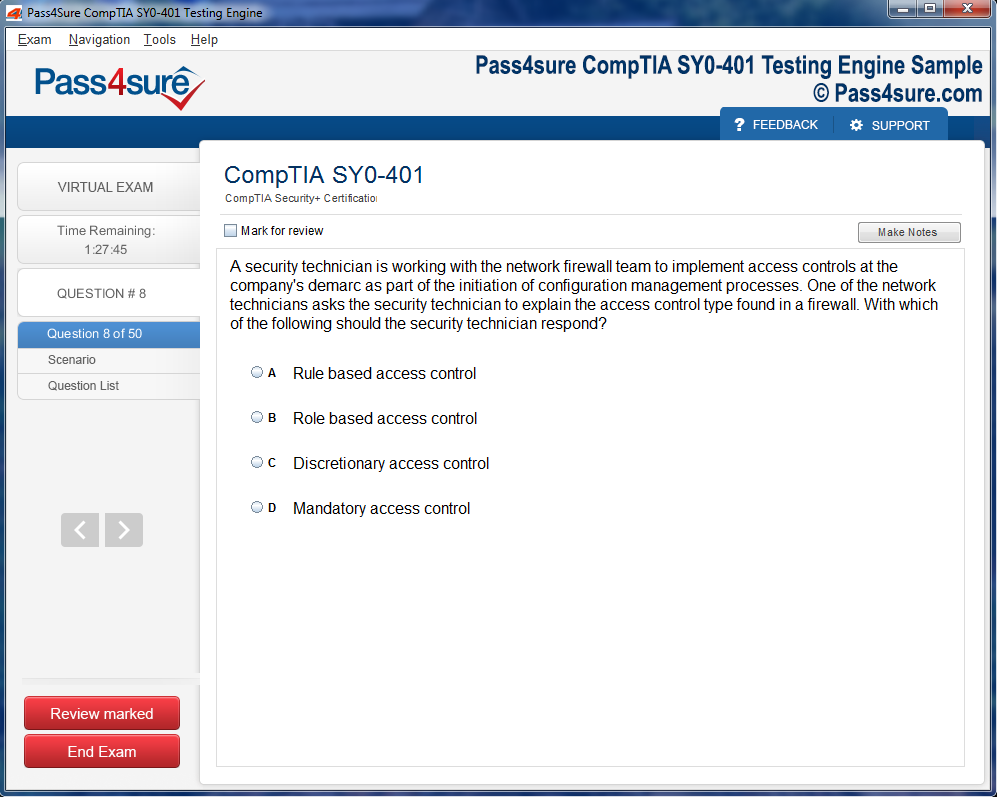
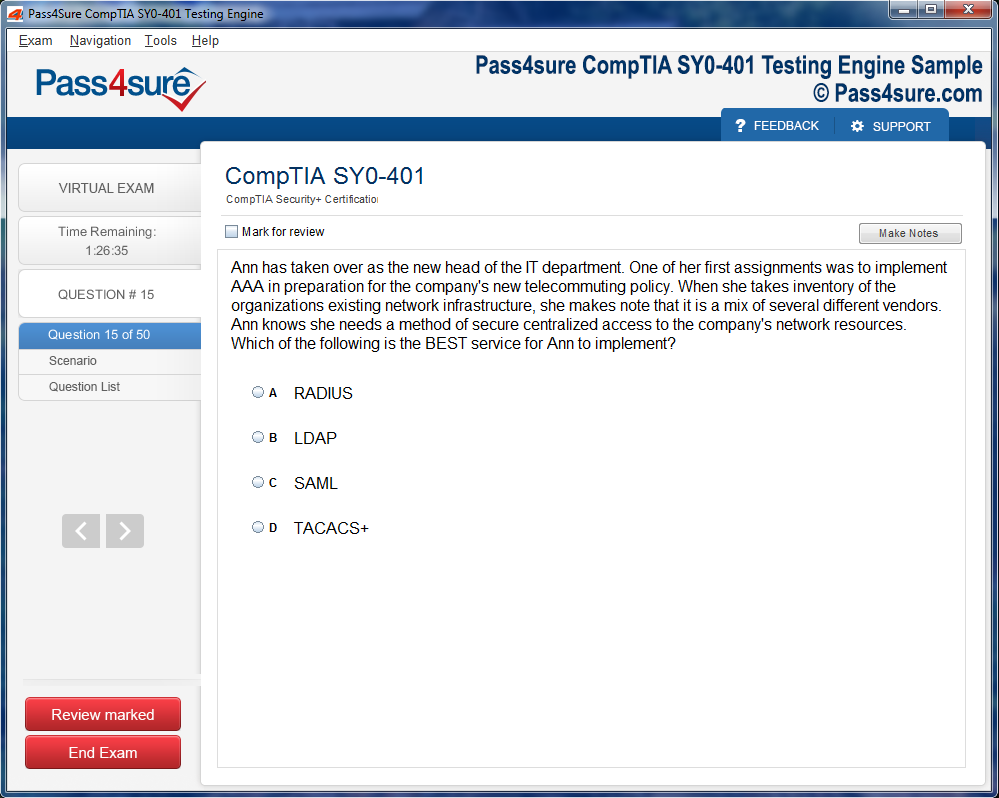
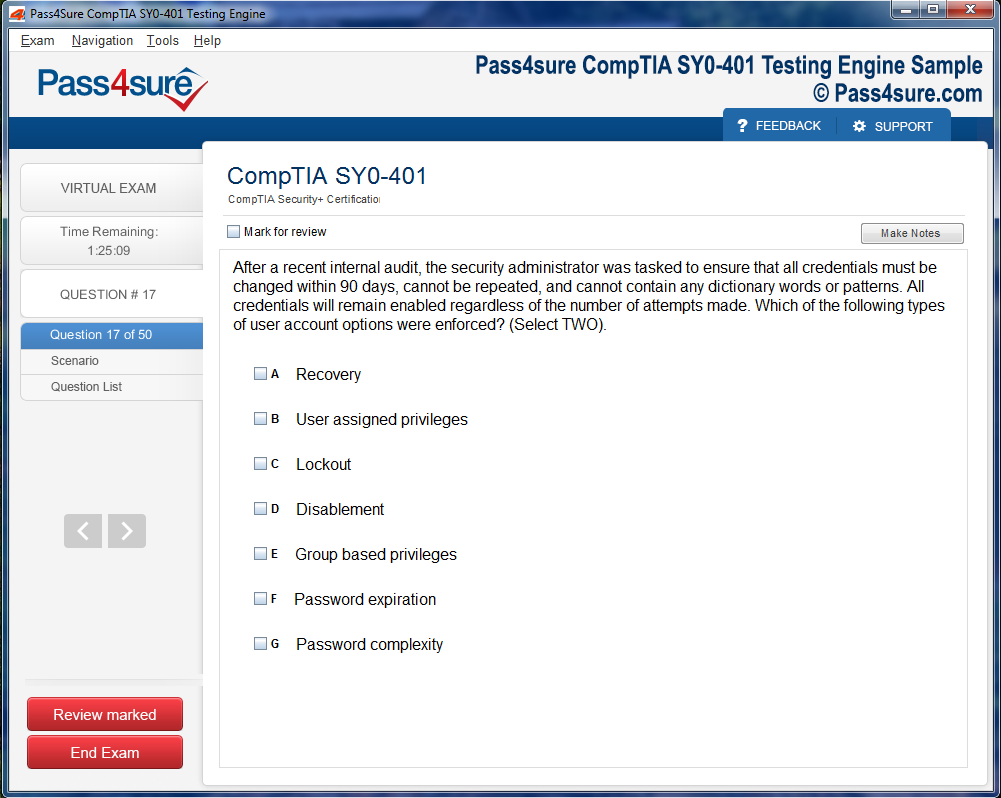
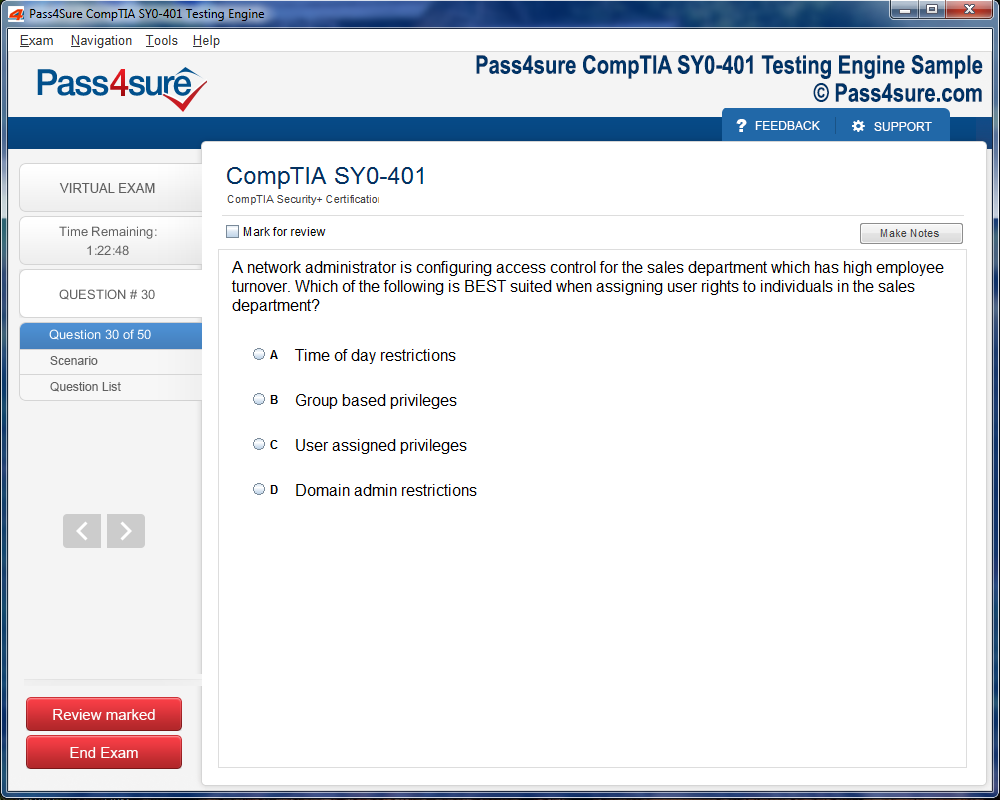
Product Screenshots



Frequently Asked Questions
How does your testing engine works?
Once download and installed on your PC, you can practise test questions, review your questions & answers using two different options 'practice exam' and 'virtual exam'. Virtual Exam - test yourself with exam questions with a time limit, as if you are taking exams in the Prometric or VUE testing centre. Practice exam - review exam questions one by one, see correct answers and explanations.
How can I get the products after purchase?
All products are available for download immediately from your Member's Area. Once you have made the payment, you will be transferred to Member's Area where you can login and download the products you have purchased to your computer.
How long can I use my product? Will it be valid forever?
Pass4sure products have a validity of 90 days from the date of purchase. This means that any updates to the products, including but not limited to new questions, or updates and changes by our editing team, will be automatically downloaded on to computer to make sure that you get latest exam prep materials during those 90 days.
Can I renew my product if when it's expired?
Yes, when the 90 days of your product validity are over, you have the option of renewing your expired products with a 30% discount. This can be done in your Member's Area.
Please note that you will not be able to use the product after it has expired if you don't renew it.
How often are the questions updated?
We always try to provide the latest pool of questions, Updates in the questions depend on the changes in actual pool of questions by different vendors. As soon as we know about the change in the exam question pool we try our best to update the products as fast as possible.
How many computers I can download Pass4sure software on?
You can download the Pass4sure products on the maximum number of 2 (two) computers or devices. If you need to use the software on more than two machines, you can purchase this option separately. Please email sales@pass4sure.com if you need to use more than 5 (five) computers.
What are the system requirements?
Minimum System Requirements:
- Windows XP or newer operating system
- Java Version 8 or newer
- 1+ GHz processor
- 1 GB Ram
- 50 MB available hard disk typically (products may vary)
What operating systems are supported by your Testing Engine software?
Our testing engine is supported by Windows. Andriod and IOS software is currently under development.
GPPA: GIAC Advanced Perimeter Protection Certification
In the contemporary cybernetic arena, where information flows like capricious torrents through intricate conduits, the demarcation between secure networks and external vectors has transformed into an enigmatic labyrinth. Advanced perimeter protection is no longer a mere defensive afterthought; it is the fulcrum of digital survivability. The GIAC Advanced Perimeter Protection Certification crystallizes this philosophy, guiding cybersecurity virtuosos to wield prescient strategies against adversarial incursions. It necessitates an understanding that extends far beyond conventional firewalls or rudimentary intrusion detection; it demands a cerebral acuity to anticipate, intercept, and neutralize threats before they crystallize.
The network perimeter is no longer a static boundary but a kinetic ecosystem wherein firewalls, honeypots, behavioral analytics, and adaptive protocols coalesce. Mastery of this domain requires a dialectical balance between technical rigor and strategic foresight. The GPPA curriculum instills this ethos by emphasizing not only the deployment of defense mechanisms but the cognitive agility to decipher emergent threat patterns, recognize cryptic vulnerabilities, and orchestrate countermeasures that evolve synchronously with cyber adversaries.
Sentinel Architecture and Traffic Cognition
Perimeter guardianship extends beyond rudimentary packet filtration. A firewall, when meticulously configured, functions as a sentient arbiter capable of discerning subtleties in traffic patterns. By differentiating between benign anomalies and malevolent manipulations, these digital sentinels can recalibrate defensive postures in real-time. Intrusion detection systems augment this intelligence with heuristic evaluation, detecting subtle behavioral deviations imperceptible to conventional signature-based frameworks.
Advanced practitioners are trained to synthesize these mechanisms into a cohesive security lattice. Each layer, from firewall to endpoint monitoring, contributes to an orchestrated resilience that can absorb and mitigate multi-vector incursions. This intricate interweaving of technology and analytical foresight transforms passive defenses into dynamic fortresses capable of continuous adaptation against cyber insurgencies.
Human Cognizance in Perimeter Resilience
While technical apparatuses are indispensable, the human dimension remains an omnipresent variable in cybersecurity calculus. Threat actors increasingly exploit cognitive susceptibilities, leveraging social engineering and operational blind spots to circumvent even the most formidable defenses. Within the GPPA paradigm, human factors are meticulously integrated into defense strategy. Certified professionals develop an acute comprehension of organizational behavioral patterns, identifying latent risk vectors and instituting protocols that harmonize operational efficiency with impervious security postures.
This duality underscores a central precept: resilient perimeter protection is predicated upon the symbiosis of technological acumen and human insight. Practitioners are not only adept at configuring devices and parsing logs; they cultivate anticipatory cognition, interpreting subtle organizational signals to preempt incidents before escalation.
Experiential Pedagogy and Tactical Synthesis
The GPPA curriculum transcends rote knowledge by immersing participants in experiential learning scenarios. Trainees navigate simulations designed to mimic dynamic, adversarial environments, compelling them to anticipate threat evolution and execute sophisticated counterstrategies. These exercises extend beyond rote technical deployment, emphasizing tactical synthesis where analytical reasoning, strategic planning, and technical execution converge.
Delving into network protocols, participants dissect the traversal of data across complex topologies, discerning potential vulnerabilities and evaluating risk propagation. This methodical immersion cultivates a mindset attuned to the protean nature of cyber threats, equipping professionals with the cognitive dexterity required to fortify, adapt, and sustain resilient perimeters.
Perpetual Vigilance and Iterative Fortification
In the cybernetic theater, stasis is vulnerability. Networks are besieged by incessant innovation in exploit methodologies, malware polymorphism, and adversarial stratagems. The GPPA framework instills a doctrine of perpetual vigilance, emphasizing continuous monitoring, iterative assessment, and adaptive fortification. Certified practitioners are empowered to integrate real-time threat intelligence, recalibrate defensive architectures, and refine policy frameworks, maintaining a dynamic equilibrium between security efficacy and operational fluidity.
This anticipatory paradigm distinguishes advanced perimeter professionals from reactive administrators. It cultivates a proactive posture where emergent risks are evaluated, neutralized, and assimilated into defensive heuristics, ensuring that the network remains a moving target impervious to exploitation.
Defense-in-Depth and Architectural Symbiosis
Layered security, often encapsulated by the aphorism defense-in-depth, constitutes the foundational axiom of advanced perimeter protection. Firewalls serve as the initial bastion, yet they operate optimally within a lattice of complementary measures: segmentation, encryption, endpoint hardening, and meticulous access governance. Each layer interlocks with the next, forming a multidimensional tapestry that diminishes the probability of catastrophic compromise.
The orchestration of these defenses is an art as much as it is a science. Certified professionals are trained to harmonize disparate mechanisms, ensuring that every vector, from physical endpoints to digital gateways, contributes to an interlocking shield. This multidimensional approach epitomizes the GPPA philosophy: perimeter protection is a composite endeavor, not an isolated toolset.
Strategic Implications and Executive Alignment
The influence of advanced perimeter protection extends into executive decision-making. Leaders benefit from comprehending how cybersecurity perimeters intersect with regulatory frameworks, risk tolerances, and operational continuity. GPPA-certified practitioners act as conduits, translating complex threat landscapes into strategic insights. This dual capacity—technical mastery coupled with organizational acumen—positions professionals as indispensable advisors, bridging the chasm between operational teams and executive governance.
Strategic alignment ensures that perimeter defense is not an insular concern but a critical enabler of enterprise resilience. It fosters policies where operational imperatives coexist with rigorous security mandates, mitigating exposure without impeding productivity.
Rigorous Assessment and Applied Competence
A hallmark of the GPPA certification process is the emphasis on applied competence. Assessments transcend theoretical evaluation, incorporating simulations, scenario-based problem solving, and hands-on exercises. Candidates must demonstrate proficiency in deploying, optimizing, and integrating perimeter defenses under conditions that replicate adversarial pressures.
This methodology guarantees that certification holders possess operational fluency, capable of navigating the nuanced interplay between technological apparatus, threat intelligence, and human behavior. The rigorous evaluation paradigm ensures that practitioners emerge not merely as theorists but as operationally adept custodians of complex cyber perimeters.
Adaptive Threat Intelligence and Cognitive Anticipation
Advanced perimeter protection is inseparable from the cultivation of cognitive anticipation. GPPA-certified professionals are trained to internalize threat intelligence, discerning patterns within the chaotic flux of cyber incidents. This interpretive competence enables the construction of preemptive strategies, transforming reactive protocols into anticipatory frameworks.
By integrating heuristic learning and behavioral analysis, practitioners develop an almost prescient understanding of adversary behavior. This capacity allows networks to self-adjust, policies to recalibrate, and defensive protocols to evolve in tandem with emergent threats. It is this fusion of intelligence and action that defines the advanced perimeter protection ethos.
Endpoint Synergy and Lateral Containment
The modern perimeter extends into the myriad endpoints that constitute an enterprise ecosystem. Each endpoint represents a potential ingress vector, yet when effectively integrated into a perimeter strategy, endpoints become nodes in a resilient lattice. GPPA instruction emphasizes endpoint synergy, incorporating adaptive monitoring, encryption, and containment mechanisms to prevent lateral movement in the event of compromise.
By harmonizing endpoint security with perimeter defenses, organizations achieve a distributed fortification model. Breaches are not merely repelled but contained, minimizing systemic exposure and preserving operational continuity even under sustained attack.
The architecture of contemporary digital fortresses extends far beyond conventional demarcations. In the era of ubiquitous cloud adoption, proliferating IoT devices, and mobile endpoints, the network perimeter is a protean entity—continuously shifting, mutable, and susceptible to surreptitious incursions. Mastery of advanced perimeter protection necessitates a sophisticated cognitive framework, one that amalgamates heuristic reasoning with empirical acumen. The GIAC Advanced Perimeter Protection Certification (GPPA) underscores the primacy of both theoretical perspicacity and experiential dexterity in fortifying these digital bastions.
Nuanced Traffic Analytics and Behavioral Reconnaissance
Network traffic is rarely a static phenomenon; it is a ceaseless flux of multifarious packets, protocols, and signals. Modern threat vectors often masquerade within legitimate flows, eluding cursory inspection. GPPA emphasizes meticulous traffic analytics, cultivating the practitioner’s ability to detect subtle aberrations—microscopic perturbations that presage adversarial activity. This involves a sophisticated interplay of deep packet inspection, heuristic anomaly detection, and temporal pattern analysis. By discerning deviations in packet cadence, session morphology, and protocol utilization, security architects can anticipate infiltration attempts before they crystallize into full-fledged intrusions.
A critical facet of this practice is the development of cyber-intuition. Experts cultivate an almost preternatural sensitivity to network “behavior,” discerning benign oscillations from malevolent perturbations. This cognitive acuity reduces dwell time for attackers, constricting the temporal aperture for potential compromise. The amalgamation of automated detection frameworks with human analytical oversight produces a resilient defensive posture, blending algorithmic precision with expert judgment.
Evolutionary Firewall Strategies
Firewalls have metamorphosed from rudimentary filters into intelligent arbiters of digital ingress and egress. Contemporary implementations encompass next-generation firewalls (NGFWs) endowed with application awareness, deep packet inspection, and user-centric policy enforcement. GPPA training immerses professionals in the orchestration of these systems, emphasizing the calibration of stateful and stateless inspections, intrusion prevention integration, and real-time logging analytics.
The objective transcends mere traffic filtration. Firewalls, when meticulously configured, act as sentient sentinels—capable of enforcing granular security mandates aligned with organizational risk stratification. By integrating firewall policies with endpoint telemetry and centralized threat intelligence, practitioners establish a multi-dimensional barrier that anticipates, detects, and neutralizes incursions with surgical precision.
Intrusion Detection and Adaptive Response
Intrusion Detection Systems (IDS) and Intrusion Prevention Systems (IPS) constitute the cerebral cortex of perimeter protection. Traditional signature-based detection is increasingly inadequate in the face of polymorphic malware, zero-day exploits, and adaptive adversaries. GPPA emphasizes behavioral modeling, anomaly recognition, and the integration of dynamic threat intelligence streams to transcend these limitations.
Practitioners learn to orchestrate IDS/IPS deployments across network and host strata, refining detection thresholds and instituting automated countermeasures. This approach not only diminishes false-positive incidences but also ensures immediate mitigation of genuine threats. By employing a layered detection framework, organizations cultivate an anticipatory posture, transforming reactive response into preemptive interdiction.
Encryption and Secure Channel Surveillance
The proliferation of encrypted communications has created a double-edged paradigm. While encryption safeguards legitimate data, it also provides a clandestine conduit for adversaries. GPPA instruction encompasses strategies for analyzing encrypted traffic without infringing on privacy or regulatory mandates. Techniques such as TLS/SSL interception, endpoint validation, and selective traffic decryption are explored in depth.
By mastering these methodologies, professionals ensure that encrypted channels do not become blind spots, maintaining holistic visibility across the network perimeter. This vigilance safeguards against stealthy command-and-control channels, covert exfiltration, and obfuscated malware propagation.
Segmentation, Micro-Zoning, and Containment
Advanced perimeter defense is inherently stratified. Segmentation and micro-zoning isolate network segments according to risk indices, sensitivity hierarchies, and operational roles. This stratification curtails lateral movement for intruders and localizes potential breaches. GPPA candidates are trained to implement sophisticated zoning architectures, leveraging VLANs, microsegmentation platforms, and dynamic policy orchestration.
Segmentation is not merely a defensive tactic—it is a proactive containment strategy. By architecting the network as a constellation of compartmentalized nodes, security professionals convert each segment into a fortified enclave, thereby constraining threat proliferation and mitigating systemic exposure.
Strategic Threat Modeling and Risk Cognition
Technical fortifications are insufficient without a cognizant appreciation of adversarial intent. GPPA emphasizes threat modeling and risk assessment as cognitive cornerstones of perimeter protection. Professionals are guided through the identification of attack vectors, probabilistic threat scenarios, and adversarial behavioral archetypes. This foresight informs resource allocation, fortification prioritization, and countermeasure development.
Scenario-driven exercises immerse candidates in adversarial simulations, bridging the chasm between abstract theory and operational praxis. Through this methodology, network defenses are harmonized with organizational strategy, regulatory compliance, and operational exigencies, yielding a cohesive, anticipatory security architecture.
Human-Centric Vulnerability Mitigation
Even the most sophisticated technological barriers are vulnerable to human frailty. Social engineering, phishing campaigns, and insider threats persist as pervasive attack vectors. GPPA accentuates the synthesis of human-centric policies with technological safeguards. Access governance, multi-factor authentication, and behavioral reinforcement programs are integral to a comprehensive defensive schema.
Cultivating a security-conscious organizational culture transforms personnel from potential liabilities into proactive guardians. By embedding cognitive and procedural discipline into everyday workflows, organizations achieve synergistic protection, where human vigilance amplifies technical efficacy.
Continuous Monitoring and Evolutionary Defense
The cyber threat landscape is inherently protean, evolving with unprecedented rapidity. Static defenses are insufficient; continuous surveillance and iterative refinement are imperative. GPPA-certified practitioners employ advanced SIEM systems, telemetry analysis, and feedback loops to maintain adaptive vigilance. Emerging threat trends are mapped in real-time, enabling recalibration of defensive postures and preemptive fortification against evolving adversarial strategies.
This paradigm of continuous improvement fosters a dynamic, resilient network perimeter, capable of sustaining organizational integrity in the face of sophisticated and persistent threats.
Integration of Threat Intelligence and Autonomous Response
A distinguishing hallmark of advanced perimeter mastery is the integration of threat intelligence with autonomous response mechanisms. Real-time ingestion of external intelligence feeds, coupled with internal anomaly data, empowers predictive interdiction. GPPA coursework explores the development of automated playbooks, enabling rapid neutralization of emergent threats without human latency.
This fusion of cognitive foresight and algorithmic responsiveness elevates perimeter protection from reactive enforcement to anticipatory dominion, transforming networks into active participants in their own defense.
Adaptive Policy Management and Contextual Security
Contextual awareness is an emergent property of high-level perimeter protection. Security policies must adapt dynamically to shifts in user behavior, device posture, and environmental variables. GPPA training includes the formulation of adaptive policy frameworks that respond to temporal, spatial, and contextual cues. This flexibility mitigates risk without imposing operational friction, preserving usability while ensuring robust defense.
Leveraging Micro-Forensics for Early Detection
Micro-forensics, the granular examination of discrete network artifacts, is increasingly essential for early threat detection. Packet metadata, ephemeral session footprints, and minor protocol anomalies serve as precursors to larger compromise events. GPPA emphasizes the development of forensic acuity, enabling practitioners to reconstruct attack vectors, anticipate escalation patterns, and implement preemptive containment.
By integrating micro-forensic insights with SIEM analytics, organizations achieve a synthesis of proactive detection and evidence-based response, fortifying the perimeter with unparalleled granularity.
In the intricate architecture of modern cybersecurity, the perimeter no longer represents a single tangible boundary but a dynamic confluence of interfaces, identities, and invisible vectors. The GIAC Advanced Perimeter Protection Certification (GPPA) illuminates the path from conceptual comprehension to executable mastery, transforming theoretical frameworks into pragmatic strategies that fortify enterprises against unseen incursions. It is not a course for mere technicians but for defenders who perceive networks as living ecosystems — entities pulsating with data, motion, and intent.
Advanced perimeter protection is, in essence, an art of controlled anticipation. It demands that practitioners perceive the network not only as a structure of cables and endpoints but as a breathing organism with patterns, anomalies, and behavioral rhythms. Within the GPPA paradigm, mastery emerges through relentless simulation, measured orchestration, and the continuous recalibration of defensive instruments. To navigate this realm, one must think like both guardian and adversary, embracing paradox — to protect, one must first understand how to destroy.
The modern network perimeter transcends traditional demarcations. It now sprawls across multi-cloud environments, ephemeral containers, remote user endpoints, IoT constellations, and data streams coursing through global infrastructures. Each node, each connection, becomes a potential fissure through which digital adversaries may whisper their malicious intent. The GPPA-certified professional is thus trained not merely to build barriers but to engineer adaptive, breathing fortifications that evolve with every new threat manifestation.
The Discipline of Threat Simulation
Threat simulation within the GPPA doctrine is not an exercise in chaos; it is a symphony of controlled disruption. Here, candidates are immersed in meticulously designed scenarios that replicate the cunning and cadence of modern adversaries. These simulations do not simply test defense mechanisms — they refine intuition. By emulating the adversary’s methodology, defenders cultivate an anticipatory mindset that transforms reaction into prediction.
In this crucible of experiential learning, participants encounter polymorphic malware, advanced persistent threats, and multi-vector infiltration campaigns that unfold in unpredictable rhythms. The simulation environment compels analytical sharpness — a capacity to interpret fragmentary telemetry, correlate obscure events, and distinguish signal from noise amid a maelstrom of digital chatter. Each failure becomes an education in resilience, each compromise a blueprint for architectural reformation.
Threat simulation also teaches the principle of temporal defense — the recognition that security effectiveness is perishable. What shields the enterprise today may crumble tomorrow under the weight of an emergent exploit. Therefore, iterative recalibration is woven into the GPPA ethos. The simulation arena becomes a perpetual proving ground where strategies are not immortalized but continuously reborn, tested, and transformed in the fire of evolving threat intelligence.
To simulate threat is to court controlled chaos, to balance precision with unpredictability, and to derive order from disarray. The GPPA practitioner thus emerges as a strategist who perceives defense not as rigidity but as choreography — a sequence of measured movements anticipating the adversary’s next step before it is even conceived.
Firewall Orchestration and the Fluid Perimeter
The firewall, long perceived as the sentry of the digital frontier, now functions as a component within a greater symphonic defense. The GPPA approach to firewall orchestration transcends static configurations, embracing contextual adaptability and situational intelligence. In dynamic network environments, security cannot remain inert. Every packet, every connection, carries contextual meaning: the role of a user, the sensitivity of an application, the behavioral anomalies of a device.
Advanced practitioners orchestrate firewalls with an artisan’s precision, crafting rule sets that evolve in tandem with the network’s pulse. Through adaptive policy engines, contextual metadata, and identity-based segmentation, the firewall becomes more than a barricade — it becomes an intelligent gatekeeper. It scrutinizes not merely the signature of data but its intention, purpose, and deviation from normative behavior.
In this orchestration, firewalls converse with intrusion prevention systems, endpoint detection frameworks, and behavioral analytics engines. Together, they form a multi-layered defensive phalanx that thrives on synchronization. Each layer augments the others, producing a resonance of resilience. The practitioner learns that isolation breeds weakness; it is the orchestration of components — not their independence — that sustains impenetrability.
Moreover, the GPPA-trained architect must master elasticity. Cloud environments, ephemeral containers, and virtualized segments require policies that materialize and dissipate in real time. Firewall orchestration thus demands both precision and transience, blending automation with oversight. The resulting infrastructure embodies the paradox of modern defense: structured yet fluid, rigid yet responsive, impenetrable yet adaptive.
The Geometry of Incident Response
In the labyrinth of cyber defense, incident response represents both art and science — a choreography of urgency, clarity, and precision. Within the GPPA framework, practitioners learn to construct incident response architectures that transcend reactionary improvisation. Every protocol, every escalation path, every line of communication is meticulously engineered to transform chaos into coherence.
When a breach pierces the perimeter, seconds morph into epochs. The GPPA doctrine teaches that panic is the first vulnerability; composure is the first defense. Certified professionals design response blueprints that align human cognition with technical execution. They choreograph the flow of information from detection to containment, ensuring that no alert falls into the void of ambiguity.
In this geometric order of response, clarity becomes a weapon. Each participant — analyst, engineer, manager — occupies a defined vertex within the response matrix. Lines of escalation are not theoretical but rehearsed through immersive drills that simulate the turbulence of a live intrusion. By the time an actual event manifests, the organization moves with a synchrony that defies improvisation.
Documentation assumes an almost sacred role. Every log entry, timestamp, and analytic inference contributes to a tapestry of forensic understanding. Within GPPA methodology, documentation is not bureaucracy; it is continuity. It ensures that every breach, no matter how transient, becomes a teacher for future fortifications.
The practitioner who masters incident response geometry learns to balance logic with intuition. They discern when to automate and when to intervene, when to isolate and when to observe. Through this mastery, the perimeter becomes not a fragile membrane but an intelligent boundary capable of healing and learning from its wounds.
The Science of Network Visibility and Behavioral Insight
Visibility is sovereignty. To defend, one must first see — not just the explicit flows of data but the invisible eddies of behavior that precede compromise. GPPA-certified practitioners are taught to cultivate a form of perceptual omniscience across the network’s expanse. Through the synergy of SIEM integration, behavioral analytics, and anomaly detection, they sculpt an environment where nothing moves unnoticed.
This form of visibility transcends logging. It is not about volume but about discernment — the ability to extract meaning from data streams that seem otherwise inert. The practitioner interprets latency deviations, packet entropy, and session irregularities as if reading the pulse of a living organism. Through machine learning algorithms and heuristic inference, subtle deviations become signals, whispers of intrusion before alarms are triggered.
Such insight enables what the GPPA ethos calls predictive defense — a philosophy that favors foresight over reaction. In this paradigm, the defender’s gaze extends beyond the present into probabilistic futures. They calculate trajectories of threat evolution, correlating micro-anomalies across disparate vectors to anticipate the adversary’s next maneuver.
Yet visibility also entails restraint. Too much observation can cloud discernment; too much data can drown intuition. Thus, the GPPA philosophy advocates for curated intelligence — the filtration of noise to reveal the essential. True mastery lies in perceiving patterns within chaos and extracting relevance from the abyss of information.
Encryption Paradox and the Alchemy of Hidden Traffic
Encryption, the sanctum of digital secrecy, embodies both protection and peril. Within GPPA study, encryption is dissected not as a binary mechanism but as a paradoxical entity — one that both conceals and endangers. While encryption shelters data in transit from interception, it simultaneously cloaks the movements of adversaries who exploit its opacity.
The GPPA curriculum trains professionals to pierce this veil without violating privacy. Through selective decryption and intelligent inspection, they achieve equilibrium between confidentiality and visibility. Traffic pattern analysis, endpoint validation, and metadata correlation become tools of cryptographic alchemy — revealing intent without unveiling content.
Practitioners must also navigate the ethical frontier of encrypted surveillance. In a world governed by regulatory mandates and privacy obligations, indiscriminate inspection is untenable. The GPPA defender thus becomes an arbiter between lawful oversight and digital liberty, wielding technical acumen with moral discernment.
To master encrypted networks is to wield dual power — to respect secrecy while unveiling subversion. It demands that the defender evolve from technologist to philosopher, understanding not just the mathematics of encryption but its sociotechnical implications. Every decryption decision becomes a moral calculus, a balance between vigilance and virtue.
The Discipline of Segmentation and Zonal Integrity
Segmentation stands as the architectural backbone of advanced perimeter defense. It is the principle that transforms a monolithic network into a constellation of guarded enclaves, each insulated from the contagion of compromise. In GPPA philosophy, segmentation is not mere partition — it is strategy rendered in topology.
Through dynamic zoning, practitioners sculpt perimeters within perimeters. Sensitive domains are cordoned off with access controls that respond to identity, behavior, and context. A compromise within one segment does not cascade into catastrophe; containment becomes instantaneous through automated isolation.
Segmentation further evolves through microsegmentation — a granular dissection of communication pathways that enforces security at the workload level. Here, policies follow workloads like shadows, independent of physical or virtual geography. The network ceases to be a static grid; it becomes a responsive organism where trust is earned continuously, not granted perpetually.
When integrated with behavioral analytics and adaptive access systems, segmentation transforms from a structural defense into an intelligent organism of self-preservation. Each node becomes aware of its neighbors, each zone aware of its integrity. The GPPA practitioner learns that resilience is not the absence of failure but the capacity to localize and survive it.
Human Vectors and the Culture of Perimeter Consciousness
No defense is impervious to the fallibility of human instinct. Within the GPPA doctrine, the human element is not treated as a variable but as a cornerstone. The curriculum integrates human-centric threat scenarios — social engineering, insider compromise, and access misconfigurations — to reveal that the most sophisticated defenses crumble under untrained cognition.
Practitioners are taught to cultivate perimeter consciousness across the organizational spectrum. Security awareness is reimagined not as compliance training but as cognitive conditioning. Employees evolve from passive participants to sentient sensors, capable of detecting anomalies in digital and behavioral patterns alike.
Moreover, GPPA exercises integrate sociotechnical psychology — the study of how humans interact with technology under stress. Simulated spear-phishing campaigns, deceptive communications, and privilege escalations test not only the system but the psyche. The goal is to build reflexive caution, transforming security from a procedural habit into a collective instinct.
Leadership plays a pivotal role in this cultural metamorphosis. The perimeter, after all, is not merely technical; it is emotional, organizational, and ideological. The GPPA professional must advocate for a security culture rooted in vigilance, curiosity, and mutual accountability. A fortified firewall defends machines; a fortified mindset defends civilizations.
The Convergence of Automation and Intelligence
As digital architectures expand into realms of automation, the GPPA practitioner must orchestrate the delicate marriage between machine intelligence and human oversight. Automation accelerates response, but without discernment it risks amplifying errors. Artificial intelligence, when guided by informed human reasoning, becomes the sentinel that never sleeps.
The GPPA framework teaches the fusion of AI-driven analysis with human interpretive depth. Machine learning engines parse terabytes of telemetry, identifying correlations beyond human reach, while analysts refine contextual interpretation. This hybrid model ensures both speed and wisdom — the machine’s precision governed by the human’s conscience.
Automation also permeates configuration, policy adaptation, and vulnerability remediation. Orchestration frameworks enable real-time enforcement of defense policies across hybrid infrastructures. Yet practitioners are reminded that automation is not autonomy. Every automated decision must be grounded in human intent, lest the perimeter devolve into algorithmic anarchy.
The GPPA ethos envisions automation as augmentation, not replacement. The goal is to liberate defenders from the monotony of repetitive tasks, allowing them to ascend into the higher cognitive strata of strategic foresight and adversarial psychology. Through this symbiosis, defense transcends reaction and becomes orchestration — a living, evolving ballet of code, cognition, and control.
Resilience Through Continuous Evolution
The final layer of GPPA mastery resides in resilience — the unyielding ability to adapt, recover, and strengthen after adversity. In the doctrine’s advanced stages, practitioners are conditioned to view breaches not as failures but as catalysts for metamorphosis. Every incident becomes an autopsy of assumptions, an opportunity to reengineer the perimeter with greater sophistication.
Resilience demands iterative adaptation. Configurations are refined, analytics recalibrated, human reflexes retrained. The organization becomes a living organism, capable of regeneration. Metrics shift from mere uptime to recovery velocity; success is measured not by the absence of intrusion but by the precision of response.
This philosophy transforms cybersecurity from a defensive discipline into an evolutionary pursuit. Perimeter protection becomes less about permanence and more about perpetual renewal. The GPPA professional thus embodies a rare synthesis of strategist, scientist, and philosopher — one who perceives defense as both an act of intellect and a testament of endurance.
In this continuum of vigilance, mastery is never final, and complacency is the first defeat. The GPPA ethos, therefore, endures as an eternal call to evolution — to defend not merely the network, but the very principle of adaptive survival in the digital age.
Strategic Foundations of Modern Perimeter Defense
In the evolving labyrinth of digital architectures, perimeter protection transcends its conventional definitions, evolving into a multifaceted discipline of foresight, vigilance, and adaptive resilience. The genesis of a fortified perimeter begins with strategic discernment—mapping every digital artery, node, and conduit that interlaces the organization’s technological anatomy. This cartographic endeavor is not merely infrastructural but philosophical, reflecting an awareness of interdependence between on-premises constructs and nebulous cloud fabrics. Practitioners orchestrating this protection must possess an architectural imagination that sees beyond static boundaries, perceiving fluid perimeters that expand, contract, and morph in concert with operational flux. The orchestration of defenses thus becomes an act of dynamic choreography, where each security mechanism—be it a gateway, a sensor, or a cryptographic lattice—performs harmoniously in the symphony of systemic protection.
The Ascendancy of Predictive Surveillance
In the citadel of next-generation cybersecurity, the sentinel’s gaze is not retrospective but prophetic. Advanced perimeter guardianship thrives on predictive surveillance—the art and science of foreknowing through data synthesis and behavioral analytics. Traditional intrusion detection relies on binary recognition of malicious signatures, but contemporary paradigms pursue anomaly awareness through contextual intelligence. Machine learning systems, entrenched in immense telemetry streams, decipher the imperceptible ripples that precede disruption. The process entails correlating temporal patterns, frequency anomalies, and subtle deviations that escape human cognition. Certified experts trained under advanced frameworks cultivate interpretive acuity—reading digital atmospheres much like meteorologists forecast storms. In these analytical theaters, data metamorphoses into prophecy, enabling proactive interdiction before threats crystallize into breaches.
Automation as the Nervous System of Cyber Defense
Automation, in its purest conceptual essence, serves as the nervous system of modern digital fortresses. In a world where latency translates to vulnerability, human reflexes falter before the velocity of machine-orchestrated incursions. The intelligent network, however, requires no hesitation. Through finely tuned automation scripts and orchestrated workflows, defenses adjust dynamically, sealing vulnerabilities as swiftly as they are perceived. Firewalls transfigure rulesets in real time; segmentation boundaries realign like tectonic plates under seismic duress; response systems engage autonomously to neutralize existential threats. Within this cybernetic environment, human oversight becomes strategic rather than reactionary, enabling experts to refine governance, calibrate algorithms, and maintain equilibrium across the sprawling expanse of connected systems. Automation’s brilliance lies not in its autonomy but in its symbiosis with human intellect—a partnership of intuition and precision ensuring perpetual fortification.
The Ethos of Zero Trust and Adaptive Validation
The zero-trust philosophy dismantles the antiquated notion of implicit confidence within networks. It predicates its doctrine on the axiom that nothing—neither user nor device—should be trusted by default. Every transaction, every handshake, and every credential exchange becomes a ritual of validation. This doctrine transforms perimeter architecture into an ecosystem of perpetual verification. Identity and access control converge with microsegmentation to form a web of conditional privileges, continuously reassessed through behavioral analytics and environmental context. Such frameworks require profound architectural understanding, as each validation event must balance security stringency with user fluidity. The adaptive perimeter, therefore, is not a wall but a living membrane—porous to legitimacy, impermeable to deceit. Within this framework, trust becomes a dynamic currency, constantly earned, never presumed.
Integrating Threat Intelligence for Dynamic Vigilance
True perimeter mastery demands communion with global threat ecosystems. Intelligence-driven defense transcends passive reactivity; it is an evolving dialogue between internal sensors and external signals. Analysts synthesize intelligence from adversarial patterns, dark web whispers, telemetry artifacts, and internal audits to sculpt adaptive security postures. This infusion of intelligence metamorphoses defense operations into learning organisms, perpetually refining themselves through experience. Predictive feeds alert systems to emergent malware typologies, adversarial behaviors, and geopolitical cyber shifts, allowing organizations to anticipate rather than endure assaults. Such integrative vigilance demands both technological sophistication and interpretive nuance—the ability to distinguish noise from narrative, trend from anomaly. Through this continuous enlightenment, the perimeter evolves into an intelligent organism that perceives, adapts, and endures.
Governance, Policy, and the Geometry of Compliance
No perimeter architecture, however advanced, sustains itself without the scaffolding of governance. Policies articulate the ethical and operational geometry of security—defining who may traverse, who may alter, and who may observe. Governance transforms raw technical capacity into accountable practice, embedding security within the organizational conscience. Policies concerning access, auditing, and incident response delineate the boundaries of legitimacy. Regulatory harmonization ensures that defenses not only deter adversaries but also satisfy juridical and ethical imperatives. Within this paradigm, security professionals are both guardians and philosophers—interpreting regulatory syntax while architecting pragmatic frameworks of enforcement. Their craftsmanship ensures that compliance is not a bureaucratic burden but an embodiment of disciplined integrity within the cyber domain.
The Evolution of Perimeter Consciousness
Perimeter protection is no longer an enterprise of barriers; it is an enterprise of cognition. The modern perimeter possesses an evolving consciousness—an intelligent infrastructure that senses, reasons, and acts. This conceptual metamorphosis marks the convergence of artificial cognition, human strategy, and environmental awareness. The delineation between inside and outside dissolves, replaced by an ecosystemic understanding of trust boundaries and behavioral landscapes. The practitioner, equipped with the knowledge and certification of advanced protection doctrines, becomes a strategist navigating complexity with both analytical rigor and creative foresight. Perimeter mastery thus ascends from mechanical defense to cognitive orchestration, where every decision reverberates through the continuum of digital existence.
The Artistry of Resilient Architecture
Beneath every resilient defense lies architectural artistry—a confluence of technical rigor and creative foresight. Designing for resilience requires comprehension of systemic interdependencies and failure probabilities. Redundancy becomes an aesthetic, not an afterthought. Adaptive segmentation, encrypted conduits, distributed validation nodes, and behavioral baselines converge into an intricate mosaic of protection. This mosaic is ever-shifting, reshaping itself to counter evolving threat geometries. Practitioners learn to architect for inevitability, constructing environments that bend without breaking, that absorb shock and respond with fortified intelligence. In this artistry, technology is the medium, but vision is the brushstroke—the silent architect of enduring defense.
The Symbiosis of Human Intellect and Machine Precision
Despite the ascendancy of automation and algorithmic intuition, the human mind remains the nucleus of strategic security. Machine intelligence executes flawlessly, yet it is human intuition that perceives context, nuance, and motive. In advanced perimeter protection, this symbiosis becomes the cornerstone of supremacy. Analysts interpret signals with empathy and foresight, discerning patterns that transcend computation. Training frameworks cultivate this hybrid expertise, teaching practitioners to converse fluently with machines—to guide, refine, and challenge their automated companions. The human-machine alliance thus becomes an evolutionary partnership—each amplifying the other’s strengths, each mitigating the other’s blind spots. The result is an intelligent perimeter alive with both precision and wisdom.
Sustaining Vigilance in Perpetual Motion
The digital cosmos exists in ceaseless motion; networks expand, threats evolve, and technologies transmute. Within this dynamic realm, vigilance is not an act but a state of being. Sustaining protection demands iterative learning, perpetual recalibration, and relentless curiosity. Continuous improvement cycles refine defense postures, adapting them to new operational realities and adversarial innovations. Monitoring systems must not only detect anomalies but also learn from them, enriching predictive models with each encounter. The vigilant organization becomes an organism of perpetual awareness—alert, adaptive, and anticipatory. Professionals who master this perpetual motion achieve a rare synthesis of technological prowess and philosophical equilibrium, ensuring that security remains both dynamic and enduring.
As the digital continuum expands beyond traditional boundaries, the sophistication of adversaries ascends into realms once considered theoretical. The contemporary security landscape is no longer defined by static fortifications but by adaptive bastions of intelligence, foresight, and perpetual evolution. Within this volatile matrix, GPPA-certified professionals emerge as the sentinels of advanced perimeter defense—architects of resilience who weave technology, intuition, and strategic foresight into an impregnable fabric of protection. Part 5 delves into the esoteric depths of advanced threat intelligence integration, the choreography of proactive defense, and the doctrine of perpetual refinement that distinguishes the expert from the merely competent.
The Alchemy of Threat Intelligence Integration
In the realm of advanced perimeter protection, threat intelligence transcends the simplistic aggregation of indicators and evolves into an intricate symphony of contextual understanding. It is not mere data—it is distilled cognition, a synthesis of behavioral analysis, adversarial psychology, and network telemetry. GPPA mastery demands that professionals harness this intelligence to preempt catastrophe rather than to merely react to it.
Every byte of intelligence—whether from malicious code dissection, deep web reconnaissance, or deception systems—possesses latent meaning. The GPPA practitioner learns to decipher this meaning through analytical convergence, correlating internal telemetry with external intelligence feeds. This process transforms inert information into predictive awareness, a form of digital clairvoyance that reveals vulnerabilities before they are exploited. Through semantic enrichment, pattern deconstruction, and statistical correlation, threat intelligence metamorphoses from static reports into a living organism—an adaptive neural network that learns, anticipates, and responds.
Such integration is not achieved through technological prowess alone. It requires a mind capable of abstraction—a security philosopher who perceives relationships invisible to conventional analysts. The GPPA professional cultivates an intuition sharpened by empirical rigor, capable of discerning the faint signatures of a brewing intrusion long before it manifests. This rarefied insight redefines perimeter defense as a cognitive art form, where knowledge itself becomes armor.
Proactive Defense as a Living Doctrine
Perimeter defense, in its advanced form, rejects the stagnation of reactive methodologies. GPPA-trained defenders adopt a doctrine of proactive engagement, perpetually testing, validating, and redefining their defensive perimeter. Through the orchestration of simulated incursions, red team exercises, and adversary emulation, they expose the invisible fractures in their fortifications before real adversaries can exploit them.
These simulations transcend traditional penetration testing. They mimic the evolving tactics, techniques, and procedures (TTPs) of real-world adversaries, embedding behavioral authenticity into every scenario. Each exercise becomes an experiential laboratory—a crucible where the organization’s cyber resilience is tempered by synthetic chaos. The insights extracted from these controlled conflicts feed directly into threat intelligence cycles, creating a feedback loop of continuous strengthening.
In this living doctrine of defense, automation operates as both ally and amplifier. The velocity of modern attacks outpaces human cognition; hence, the GPPA practitioner leverages algorithmic guardians—automated correlation engines, adaptive firewalls, and AI-driven anomaly detectors—to augment human decision-making. Automation, however, is not a replacement for expertise; it is an extension of it. The human intellect remains the nucleus, guiding automation with discernment and ethical precision.
Automation and the Symphony of Precision
Within the labyrinth of contemporary threat vectors, automation emerges not as a convenience but as an existential necessity. Manual analysis, though rich in nuance, is constrained by the finite pace of human cognition. GPPA experts orchestrate a symbiotic harmony between human intuition and machine acceleration. Automated systems tirelessly parse terabytes of data, illuminating anomalies that elude even seasoned analysts.
The sophistication of modern correlation engines allows them to detect deviations invisible to conventional monitoring. When fortified by machine learning, these systems evolve beyond static rulesets; they learn from every event, refining their understanding of normalcy and deviation alike. GPPA professionals architect these systems with surgical precision, ensuring that automation amplifies, rather than overshadows, human judgment.
Adaptive firewalls embody this philosophy. They metamorphose in real time, recalibrating their defensive parameters as adversaries modify their tactics. In tandem with intelligent intrusion detection systems, they form an ecosystem of self-learning resilience. Yet, automation’s potency demands restraint. Without human calibration, automated systems can enforce rigidity where flexibility is required. Thus, GPPA experts maintain equilibrium—a fusion of computational efficiency and human empathy for contextual subtleties.
Encryption, Obfuscation, and the Paradox of Privacy
Encryption, the guardian of confidentiality, conceals both virtue and vice. In its embrace, data remains secure from prying eyes—but so too can malevolent code hide its treachery. The GPPA professional must navigate this paradox, wielding visibility and privacy in delicate equilibrium. Advanced perimeter protection requires not blind trust in encryption, but enlightened scrutiny of what transpires beneath its veil.
Selective decryption becomes a tactical necessity. Rather than decrypting all traffic—a violation of privacy and compliance norms—GPPA practitioners implement intelligent inspection frameworks. These mechanisms apply contextual filters, decrypting only traffic that exhibits anomalous entropy, irregular timing, or suspicious payload signatures. Coupled with endpoint validation and behavioral traffic analysis, organizations retain the sanctity of privacy while ensuring operational visibility.
Traffic pattern analysis, particularly at the metadata level, provides another layer of insight. Even encrypted channels betray their origins through timing, frequency, and volumetric irregularities. GPPA professionals interpret these patterns as linguistic cues in a silent dialogue between systems, discerning intent without intrusion. This synthesis of cryptography and behavioral science transforms encryption from an obstacle into an instrument of awareness.
The Art of Adversary Emulation
The highest echelon of GPPA expertise demands an unsettling transformation: to defend like a master, one must think like a predator. Adversary emulation transcends traditional security testing; it is a psychological and technical exploration of the attacker’s mind. By internalizing adversarial logic, GPPA-trained defenders anticipate trajectories of exploitation before the first reconnaissance packet is ever sent.
These exercises demand intellectual duality. The professional must momentarily adopt the cognitive architecture of an intruder—parsing systems not as users, but as opportunities for subversion. Network topologies become strategic puzzles, authentication systems become gateways of manipulation, and human operators become exploitable vectors. The art lies in leveraging this understanding not for destruction, but for enlightenment.
Through adversary emulation, the organization’s perimeter becomes a living entity—constantly tested, refined, and restructured to withstand both the known and the unforeseen. The GPPA practitioner transforms from a passive guardian into a strategist of counter-predation, orchestrating defenses with anticipatory finesse. Every emulated intrusion enriches the organism of security, revealing its latent weaknesses and evolving its immune system.
Perpetual Refinement and the Doctrine of Adaptation
Cyber defense, unlike static engineering, is an organic process—one that thrives through mutation and adaptation. GPPA-certified professionals cultivate a culture of iterative improvement, where every anomaly, every alert, and every incident becomes a source of evolutionary insight. Continuous improvement is not a procedural checkbox; it is the philosophical backbone of advanced perimeter protection.
Analytics serve as the mirror of this evolution. By aggregating telemetry from diverse network layers and correlating them with global threat indicators, defenders craft a panoramic understanding of risk. This enables predictive adaptation: policies evolve not after breaches, but in anticipation of them. The GPPA doctrine advocates for cyclical evaluation—review, simulate, refine, repeat. Through this recursive process, defenses transcend their initial design, becoming living organisms of protection.
Simulations play a critical role in this doctrine. By staging controlled adversarial scenarios, organizations test not only their technologies but their human reflexes, communication channels, and crisis protocols. Each simulation uncovers inefficiencies hidden within operational inertia. When coupled with intelligence-driven analytics, the results of these exercises feed back into strategic recalibration, ensuring perpetual relevance in an ever-mutating threat environment.
Organizational Synergy and Strategic Translation
The pinnacle of GPPA proficiency is not technological supremacy alone, but the ability to bridge the abstract domain of cybersecurity with the pragmatic sphere of organizational governance. Advanced perimeter protection is not an isolated function—it is an institutional philosophy that permeates every department, every process, and every decision.
GPPA professionals act as translators between two worlds: the arcane language of cyber defense and the strategic lexicon of business leadership. They transform threat intelligence into operational insight, risk metrics into decision catalysts, and complex telemetry into coherent narratives that inform executive direction. This translation empowers leadership to prioritize security not as a cost, but as a cornerstone of resilience and trust.
In achieving this integration, security becomes not a silo, but an ecosystem. Policies align with risk appetite, compliance frameworks reinforce technical controls, and investments reflect both tactical urgency and strategic foresight. GPPA-certified defenders thus evolve into cyber diplomats—individuals capable of harmonizing the rigid precision of technology with the fluid pragmatism of organizational vision.
The architecture of cybersecurity in the contemporary era is neither static nor simplistic. It is a pulsating organism, continuously evolving as networks expand beyond the predictable confines of traditional infrastructure. Within this environment, the GIAC Advanced Perimeter Protection Certification (GPPA) emerges as both a credential and a philosophy — a framework for cultivating minds capable of fortifying organizational boundaries against a tide of complexity and innovation.
The culmination of this certification series delves into the strategic, organizational, and futuristic dimensions of perimeter defense. While the preceding segments emphasized technical dexterity and operational methodology, this segment transcends the technical strata, addressing the orchestration of foresight, leadership, and continuous evolution in digital fortification.
The Strategic Renaissance of Perimeter Defense
Perimeter security, once synonymous with firewalls and demilitarized zones, has transformed into an intricate ballet of intelligence, automation, and adaptive architecture. The GPPA-certified practitioner does not simply deploy security controls; they architect symphonies of resilience. The contemporary network perimeter is amorphous, stretched across multi-cloud fabrics, remote work ecosystems, and volatile IoT constellations.
Such an environment demands a security paradigm rooted in perpetual motion. Strategic mastery requires understanding that protection is no longer about static borders but about the orchestration of trust across dynamic digital ecosystems. This renaissance of perimeter defense transforms practitioners into both engineers and philosophers — synthesizing precision with vision, technology with intention.
These professionals are sculptors of digital resilience. Their work embodies the balance between accessibility and security, between innovation and vigilance. In an era where information flows like quicksilver, perimeter protection becomes a strategic expression of foresight, not fear.
Future-Proofing Through Adaptive Cyber Architecture
The art of future-proofing is the essence of advanced perimeter protection. Networks no longer exist in isolation; they are constellations of interdependence. Cloud migrations, hybrid models, and decentralized endpoints converge in a complex tapestry of vulnerabilities.
The GPPA-certified architect internalizes this complexity and transforms it into adaptive architecture — frameworks that evolve in tandem with technological acceleration. Predictive analytics, micro-segmentation, and zero-trust implementations converge to construct a perimeter that learns, adapts, and resists obsolescence.
Such adaptive architectures embody a principle of cyber fluidity. Policies evolve through iterative introspection. Incident data becomes not just historical record but a predictive oracle. Security, under this philosophy, ceases to be reactionary; it becomes anticipatory, infused with algorithmic foresight and human intuition.
In this context, future-proofing transcends technical configurations. It represents an intellectual posture — a refusal to allow the future to arrive uninvited. It is the embodiment of perpetual readiness.
The Organizational Symphony of Strategic Alignment
Perimeter protection detached from organizational purpose is a fortress without citizens. The brilliance of the GPPA philosophy lies in its integration of cybersecurity with strategic intent. Security becomes an enabler, not an impediment — an architecture of assurance that sustains both trust and productivity.
The certified professional operates as an interpreter between the technical and the executive realms. They translate the esoteric language of packets, firewalls, and intrusion vectors into the lexicon of risk management, compliance, and continuity. This synthesis transforms cybersecurity into a business accelerator.
Every defensive measure is mapped to an operational objective. Every control is contextualized through strategic necessity. This harmonization redefines perimeter protection as both shield and instrument — defensive in form, but enabling in function.
Through this symphonic alignment, organizations cultivate a culture of vigilance without paranoia, precision without rigidity, and innovation without fragility.
Resilience Beyond Response: The Lifecycle of Recovery
The GPPA framework does not view incident response as an isolated discipline. Instead, it embeds recovery, reflection, and renewal into the DNA of the organizational security lifecycle.
When a breach unfolds, the GPPA professional does not merely contain the intrusion — they decode it. Each incident is a cipher, revealing the evolutionary patterns of adversarial behavior. Through meticulous post-incident analysis, patterns become predictions, and predictions become prevention.
Recovery, in this context, extends beyond system restoration. It encompasses psychological resilience, procedural recalibration, and cultural reinforcement. Documentation transforms into doctrine. Lessons learned become living architecture.
Thus, the organization evolves with every challenge. Each intrusion becomes a catalyst for improvement, not merely a mark of vulnerability. Through this process of perpetual refinement, the perimeter evolves into a self-healing membrane — intelligent, introspective, and indomitable.
The Human Element: Architects of Cyber Vigilance
No perimeter, however advanced, can transcend the fallibility of human behavior. The GPPA philosophy acknowledges this reality not as a weakness but as an opportunity for empowerment.
Certified professionals become curators of awareness, guiding human interaction with technology into a realm of intentionality. Security awareness ceases to be a compliance checkbox and becomes an act of collective mindfulness.
Through education, narrative, and engagement, these professionals craft cultures of security consciousness. Access controls become psychological as much as procedural. The human firewall — the most ancient yet adaptable of defenses — becomes a living part of the perimeter architecture.
This synthesis of behavior and technology creates an ecosystem where vigilance is instinctive, not enforced. The GPPA-certified guardian understands that every keystroke, every connection, and every decision is an extension of the perimeter’s integrity.
The Convergence of Artificial Intelligence and Cyber Defense
Emerging technologies redefine not only the perimeter’s dimensions but also its cognitive capacity. Artificial intelligence now augments traditional defense mechanisms, creating layers of perception previously unattainable.
AI-driven monitoring enables systems to perceive anomalies before they manifest as breaches. Behavioral analytics deciphers deviations invisible to conventional detection. The GPPA-certified expert becomes a conductor of these intelligent instruments, harmonizing algorithms and human intuition into an orchestra of proactive defense.
Zero-trust models interlace with machine learning, enforcing identity validation at every junction. Data becomes both sentinel and strategist. The perimeter evolves from a boundary into an intelligent ecosystem — an organism capable of self-assessment and adaptive decision-making.
Through these integrations, the notion of defense transforms. It becomes neither passive nor reactive but dynamically sentient. The modern perimeter no longer guards; it anticipates, interprets, and orchestrates protection.
Cyber Governance: The Strategic Apex of GPPA Expertise
Beyond the corridors of technical mastery lies governance — the domain where security becomes policy, philosophy, and precedence. The GPPA-certified professional ascends to this apex as a strategic advisor, shaping cybersecurity investment and organizational doctrine.
They serve as the architect of policy frameworks that intertwine with regulatory obligations and ethical mandates. Governance becomes not merely a compliance instrument but a declaration of digital sovereignty.
Within boardrooms and leadership councils, GPPA experts articulate risk as narrative. They translate the abstractions of cyber threat intelligence into actionable strategies, influencing how organizations allocate resources, negotiate partnerships, and define operational continuity.
Their counsel transcends technical remediation; it shapes the organization’s cyber destiny. In this role, they embody duality — guardian and strategist, technologist and philosopher, sentinel and visionary.
The Philosophy of Continuous Evolution
The most profound tenet within the GPPA paradigm is evolution — the refusal to stagnate amid rapid digital metamorphosis.
Cyber threats mutate like biological organisms, adapting to every countermeasure, probing for every vulnerability. Against such adversaries, static defenses wither. The GPPA-certified practitioner, however, thrives in dynamism.
They perceive change as the natural state of cybersecurity — a force to be harnessed, not feared. Continuous assessment and iterative development become rituals of resilience. Policies are living manuscripts, perpetually rewritten in response to intelligence, incident, and innovation.
In this environment, complacency is the true vulnerability. The GPPA mindset cultivates adaptability as a virtue, making perpetual transformation the cornerstone of sustained protection.
Beyond the Horizon: Visionary Constructs of Cyber Resilience
As the digital frontier expands, the very notion of a perimeter dissolves into abstraction. Virtual networks sprawl across continents, devices negotiate identity in nanoseconds, and data migrates through clouds without tether.
GPPA-certified professionals envision protection not as containment but as orchestration — the intelligent synchronization of defense across limitless landscapes. They design architectures that transcend geography and operate through principles rather than perimeters.
Resilience becomes metaphysical — a convergence of adaptability, intelligence, and integrity. The organization itself becomes an entity of defense, capable of surviving disruption through cohesion and foresight.
This horizon-oriented philosophy situates GPPA mastery as more than certification. It is a mindset that perceives cybersecurity as civilization’s newest art form — the art of safeguarding trust within an ever-shifting cosmos of data and design.
The Cultural Infusion of Cyber Maturity
True security extends beyond devices and networks into the marrow of organizational culture. GPPA-trained professionals cultivate what can be called cyber maturity — a shared consciousness that binds people, process, and technology into a single rhythm of awareness.
Such maturity is not declared but demonstrated. It is visible in decision-making, in communication, and in the silent confidence with which employees engage digital systems. This culture of composure transforms chaos into control, uncertainty into anticipation.
When every employee becomes an extension of the perimeter, when every leader understands the language of risk, the organization transcends dependence on tools. It evolves into a sentient collective — resilient, agile, and perpetually aware.
The Ethical Dimension of Perimeter Mastery
Advanced perimeter protection is not merely a technical endeavor; it is an ethical covenant. Every defense mechanism, every policy, and every decision carries moral weight in an age where privacy and protection intersect with human dignity.
GPPA-certified professionals embody this ethical guardianship. They wield power over digital gateways but temper it with discretion, accountability, and transparency. Their expertise is governed by principle — an understanding that trust, once compromised, cannot be re-engineered.
Ethical awareness elevates perimeter protection from engineering to stewardship. It ensures that the defense of systems is inseparable from the defense of the individuals they serve.
Leadership in the Era of Cyber Uncertainty
The modern perimeter professional is also a leader — not necessarily by title, but by influence. They guide without commanding, inspire without declaring. Their authority is derived from competence, clarity, and calmness under duress.
In moments of digital crisis, when alarms shriek and dashboards illuminate with alerts, it is their composure that orchestrates order. Through them, incident response transforms from panic to precision.
This leadership dimension reflects the deeper value of the GPPA ethos: cybersecurity as stewardship of confidence. To lead in this realm is to personify resilience — to remain deliberate amid digital tempest.
The Continuum of Perimeter Intelligence
Perimeter protection has evolved into a discipline of intelligence. Data flows become narratives; alerts become insights. The GPPA professional operates within this continuum, synthesizing information from telemetry, analytics, and threat intelligence feeds into actionable wisdom.
By correlating signals across diverse environments, they unearth patterns of intrusion, motive, and methodology. Intelligence ceases to be a separate discipline; it becomes the bloodstream of perimeter strategy.
This integration transforms defense from static reaction into informed orchestration. The perimeter becomes not only a line of defense but a lens of perception — interpreting, anticipating, and adapting in real time.
The GPPA certification epitomizes the synthesis of defensive acumen, analytical foresight, and operational precision within the domain of network security. It distinguishes professionals who can not only comprehend but also architect intricate perimeter defense systems capable of withstanding evolving cyber offensives. Earning this credential signifies more than technical proficiency—it embodies a mindset grounded in anticipation, resilience, and strategic depth.
Candidates who pursue GPPA cultivate a rare blend of theoretical understanding and real-world pragmatism. Through rigorous study and applied practice, they refine their capacity to analyze vulnerabilities, design layered defense architectures, and implement proactive countermeasures against advanced threats. The journey toward GPPA certification demands meticulous preparation, yet it rewards practitioners with an enduring command of protective methodologies that transcend specific technologies or vendor frameworks.
In a digital landscape where threat vectors mutate relentlessly, the GPPA-certified professional stands as a sentinel of adaptive security. Their expertise not only fortifies organizational perimeters but also fosters a culture of continuous vigilance, ensuring that security evolves in tandem with innovation. The certification thus represents not a terminus, but a threshold—a continual commitment to mastering the art and science of perimeter protection in an ever-shifting cyber frontier.
Design, Optimization, and The Future of Fortinet Enterprise Security
As networks evolve toward edge computing, multicloud environments, and artificial-intelligence-driven operations, the enterprise firewall stands at the threshold of reinvention. Fortinet’s NSE7_EFW-7.0 certification culminates in the understanding that expertise is not static configuration knowledge but the ability to design adaptable systems. Part 6 concludes the series by exploring architecture, optimization, and the vision that guides Fortinet into the next era of defense.
Architectural Principles of FortiGate Design
Every secure network begins with architecture. FortiGate design involves aligning topology, performance, and policy intent. The expert must translate abstract goals—availability, compliance, scalability—into concrete design choices: interface segmentation, clustering strategy, and inspection depth.
A good architecture balances protection with efficiency. Excessive filtering slows the network; insufficient segmentation invites compromise. NSE7_EFW-7.0 candidates study reference designs for hub-and-spoke, mesh, and hybrid models. They learn to calculate throughput requirements, session capacity, and redundancy levels before deployment.
Designing for Scalability and Resilience
Scalability ensures that growth never becomes vulnerability. FortiGate supports clustering, virtual domains, and load distribution that allow expansion without redesign. Experts must plan address schemes, routing hierarchies, and resource allocation to avoid bottlenecks.
Resilience complements scalability. Redundant power supplies, dual WAN links, and HA clusters guard against single points of failure. The challenge lies in harmonizing these elements so that redundancy does not introduce complexity. Simplified design is stable design.
Policy Framework and Intent-Based Security
Intent-based policy design replaces manual rule building with logical intent. Instead of writing hundreds of discrete rules, administrators define objectives such as “allow finance applications between branches under strict inspection.” FortiGate translates these intentions into dynamic policies.
This paradigm shift reduces errors and speeds adaptation. Candidates preparing for advanced design scenarios must understand tag-based objects, dynamic address groups, and fabric connectors that import cloud metadata automatically. Intent-based design turns security from obstacle into enabler.
Network Segmentation and Zero-Trust Strategy
Zero-Trust architecture demands that no entity, internal or external, is implicitly trusted. FortiGate enforces this principle through micro-segmentation. Each user, device, or application communicates only after authentication and continuous verification.
Candidates explore segmentation using VLANs, VDOMs, and policy zones. Integration with FortiAuthenticator provides identity-driven enforcement. When combined with dynamic tagging and endpoint posture checks, the result is granular, adaptive access control across the enterprise.
Optimization and Performance Engineering
Even the best architecture fails if it cannot perform. Optimization begins with understanding hardware acceleration, flow-based inspection, and session handling. FortiGate’s NP and CP processors deliver wire-speed performance, but only when policies are designed intelligently.
Experts analyze policy order, consolidate overlapping rules, and use address groups to minimize lookup time. They employ session-helper tuning, routing optimization, and concurrent inspection balancing to maintain efficiency. Logging levels are adjusted to preserve resources without losing visibility.
Fine-tuning also extends to SD-WAN performance. Measuring latency, jitter, and packet loss enables path selection based on real-time quality. The firewall becomes a traffic conductor that chooses the best route automatically, preserving user experience even during link degradation.
Integration with Cloud and Automation Ecosystems
Cloud adoption redefines perimeter boundaries. FortiGate adapts by existing as both physical and virtual instances, unified by FortiManager. Experts design hybrid fabrics that synchronize policies between on-premises and cloud workloads.
Automation through REST APIs and scripting frameworks such as Ansible allows mass deployment and continuous compliance checking. The professional who masters these integrations transforms configuration into code, enabling infrastructure that rebuilds itself on demand.
Security Fabric Expansion and Third-Party Synergy
No enterprise lives in isolation. Integration with third-party platforms—SIEMs, orchestration tools, and endpoint management systems—extends the Security Fabric’s reach. Fortinet’s open APIs and connectors allow bidirectional data flow: threat intelligence in, response commands out.
Candidates demonstrate proficiency in building such bridges, ensuring that alerts from one system trigger actions across others. Unified ecosystems reduce reaction time and eliminate the fragmentation that attackers exploit.
Continuous Validation and Testing
Optimization is not a one-time act; it is continuous validation. FortiGate supports virtual test environments where administrators simulate failover, route changes, and attack scenarios. Candidates learn to design maintenance windows, firmware-upgrade strategies, and rollback plans.
Synthetic testing validates assumptions—confirming that HA failover preserves sessions, that new policies do not break applications, and that throughput meets expectations. Routine testing cultivates confidence, the invisible strength behind every stable network.
Security Analytics and Artificial Intelligence
The future of enterprise defense lies in analytics. FortiGate’s integration with AI-powered FortiAI and advanced FortiAnalyzer modules enables pattern recognition at machine speed. Instead of waiting for incidents, the system predicts them.
NSE7_EFW-7.0 candidates explore how machine learning correlates telemetry across devices, detecting anomalies invisible to manual inspection. This predictive capability shifts cybersecurity from reactive posture to anticipatory strategy. The expert’s role evolves into curator of algorithms and validator of outcomes.
The Human-Machine Partnership
Automation and AI do not replace human judgment; they amplify it. The Fortinet professional remains the interpreter of context, deciding when automation should act and when it should wait. The future demands hybrid intelligence—machines that learn, humans who guide.
Training, documentation, and culture sustain this partnership. The most secure enterprises are those where teams understand not only technology but also the rationale behind every policy.
Sustainability and Ethical Security
Security design now intersects with sustainability. Efficient architectures consume less energy, prolong hardware life, and reduce electronic waste. Ethical security extends beyond protection; it includes responsible resource use and respect for privacy.
FortiGate’s consolidated platform minimizes device sprawl, while unified inspection reduces duplicate processing. Experts who design with sustainability in mind contribute not only to corporate resilience but also to environmental stewardship.
The Path of Lifelong Learning
Fortinet updates its certifications to mirror technology’s pace. For the NSE7 professional, renewal is not a formality but a continuation of growth. Engaging with Fortinet communities, attending webinars, and experimenting in labs ensures that skills remain sharp.
The expert’s mindset values humility—the awareness that every configuration can improve. Lifelong learning is the final firewall against complacency.
Conclusion
As digital transformation accelerates, boundaries blur further. Edge computing, IoT proliferation, and quantum-resistant encryption will reshape defense strategies. FortiGate, with its modular design and AI integration, is already positioned for this evolution.
Tomorrow’s firewall will be an intelligent fabric rather than a box, capable of self-healing, self-optimizing, and self-training. The NSE7_EFW-7.0 certification lays the intellectual groundwork for that reality. Professionals who master it today will architect the secure networks of tomorrow.