

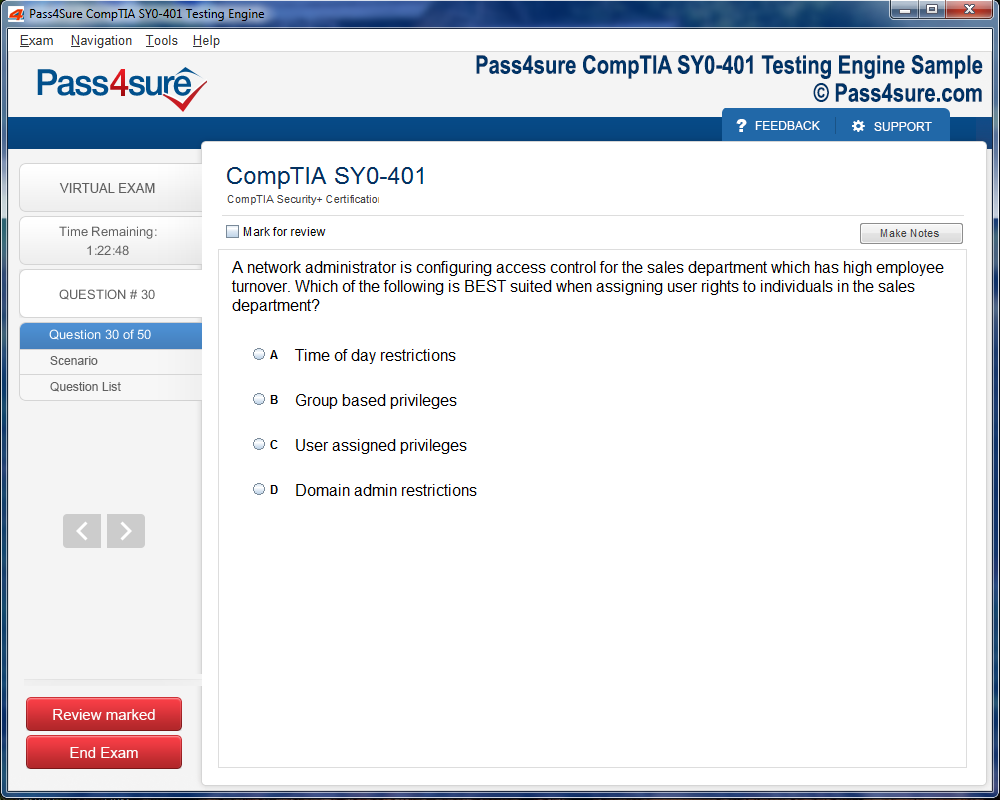
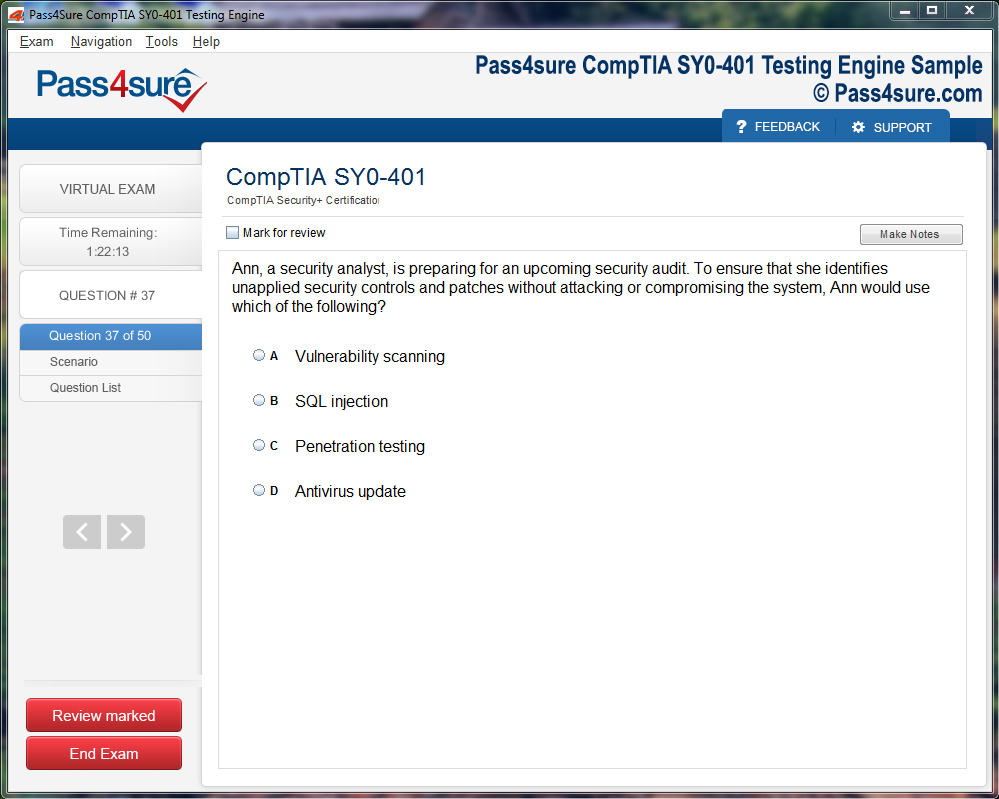
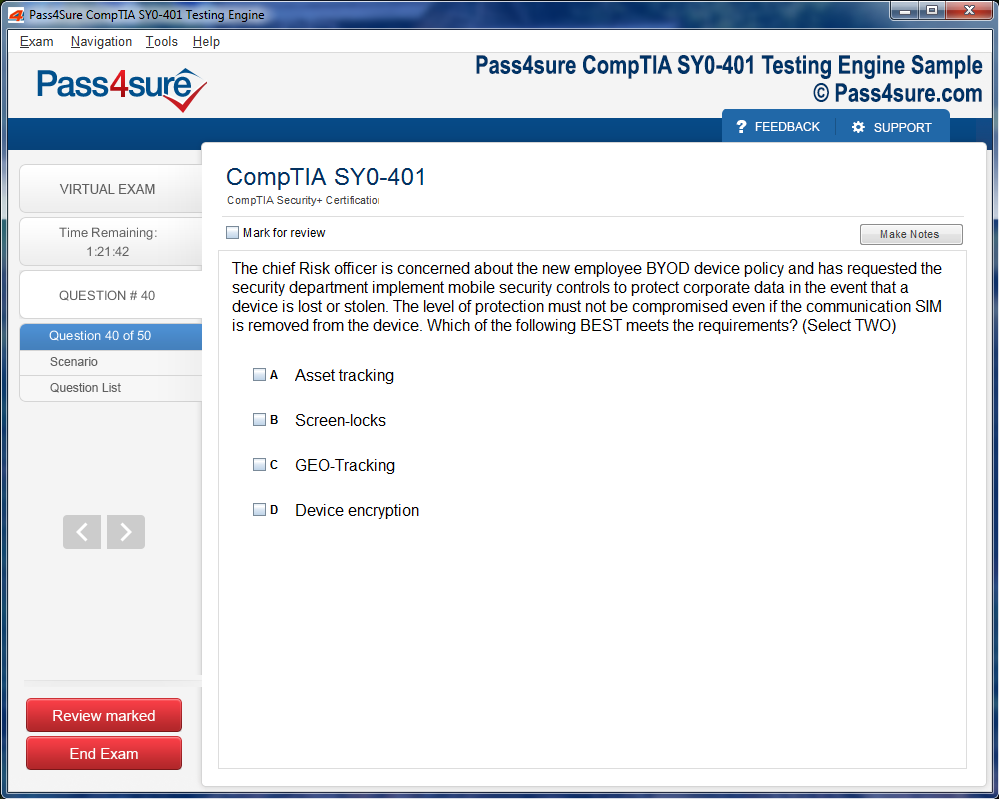
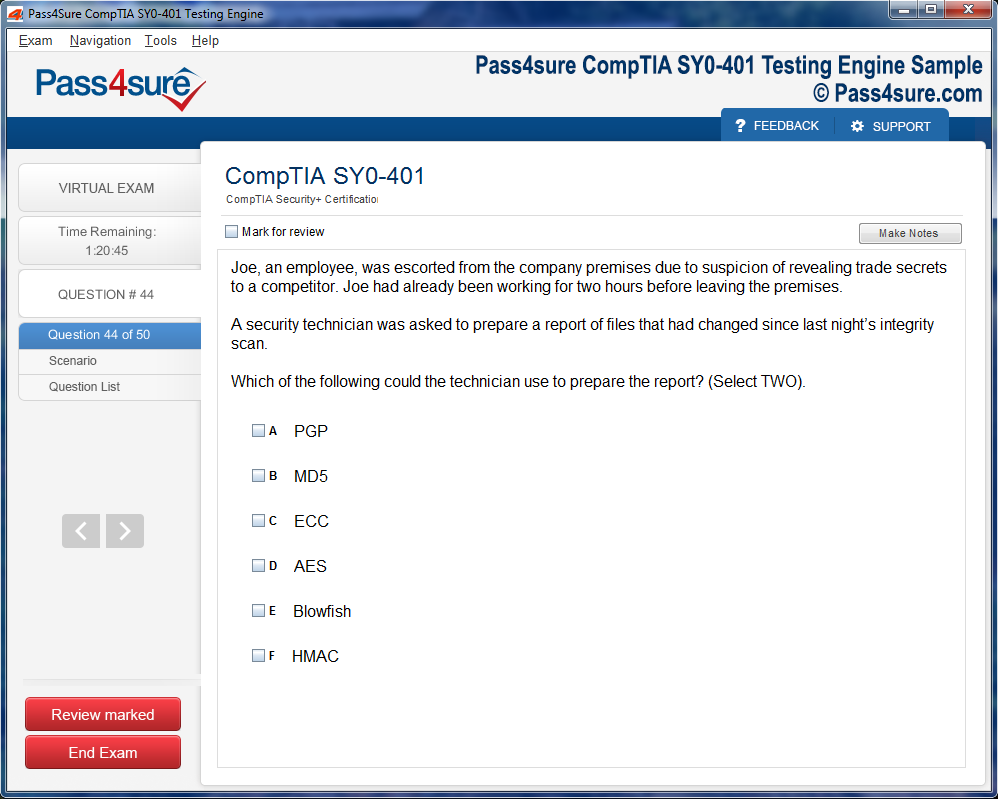
Product Screenshots
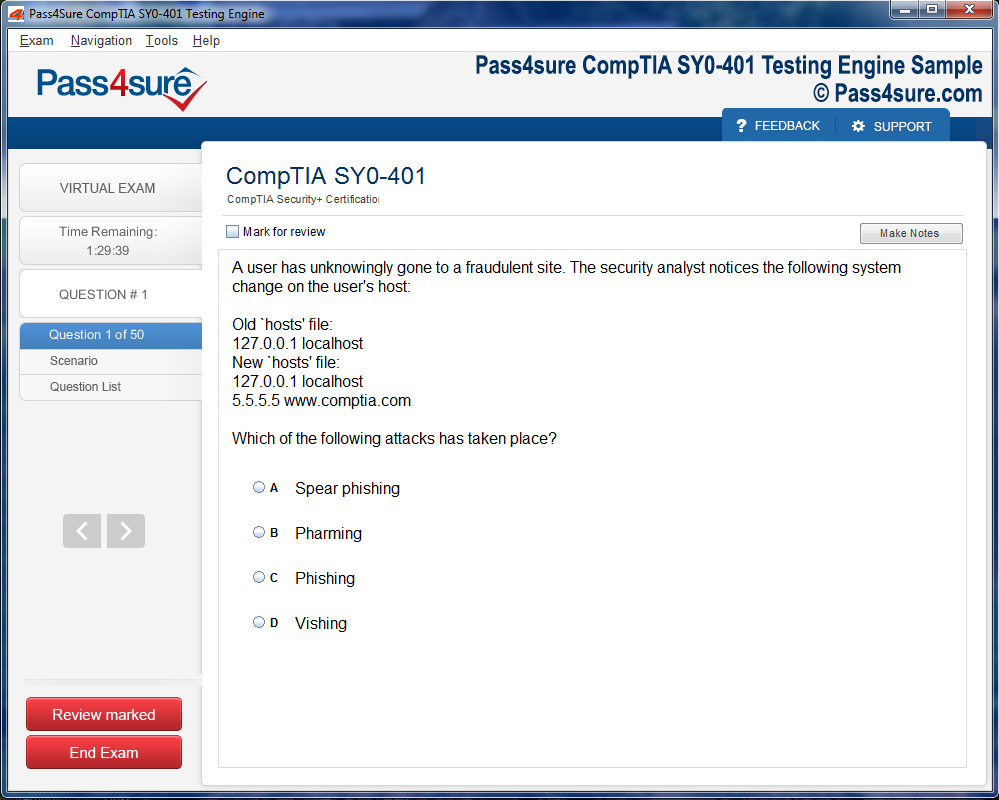

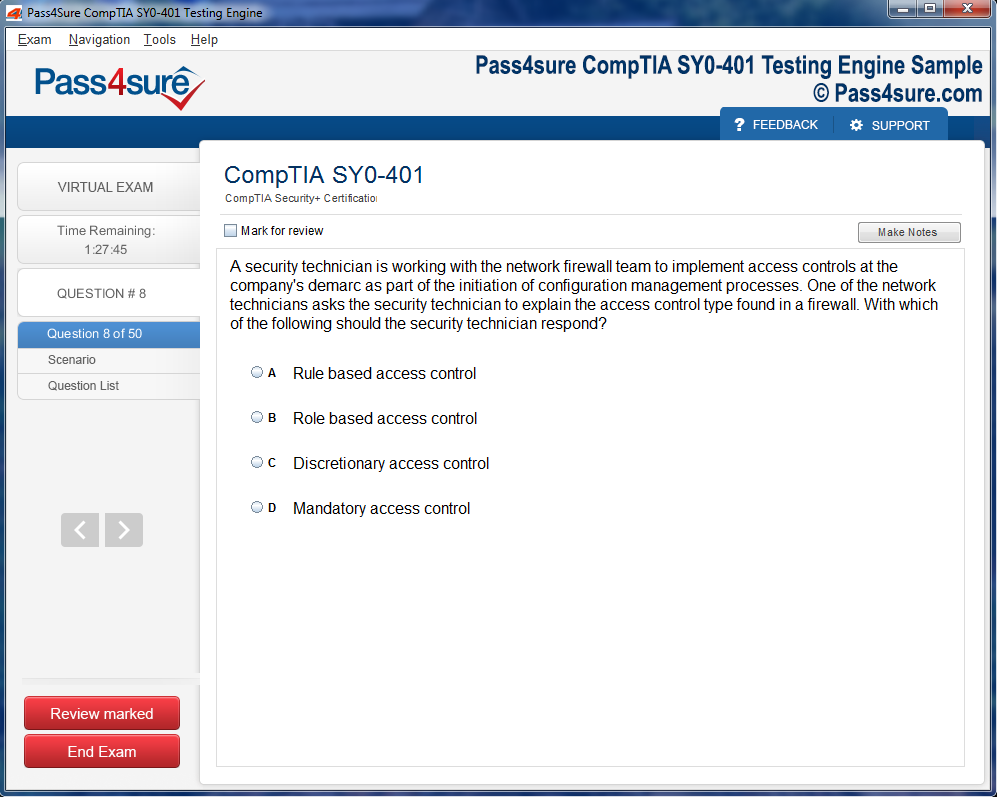

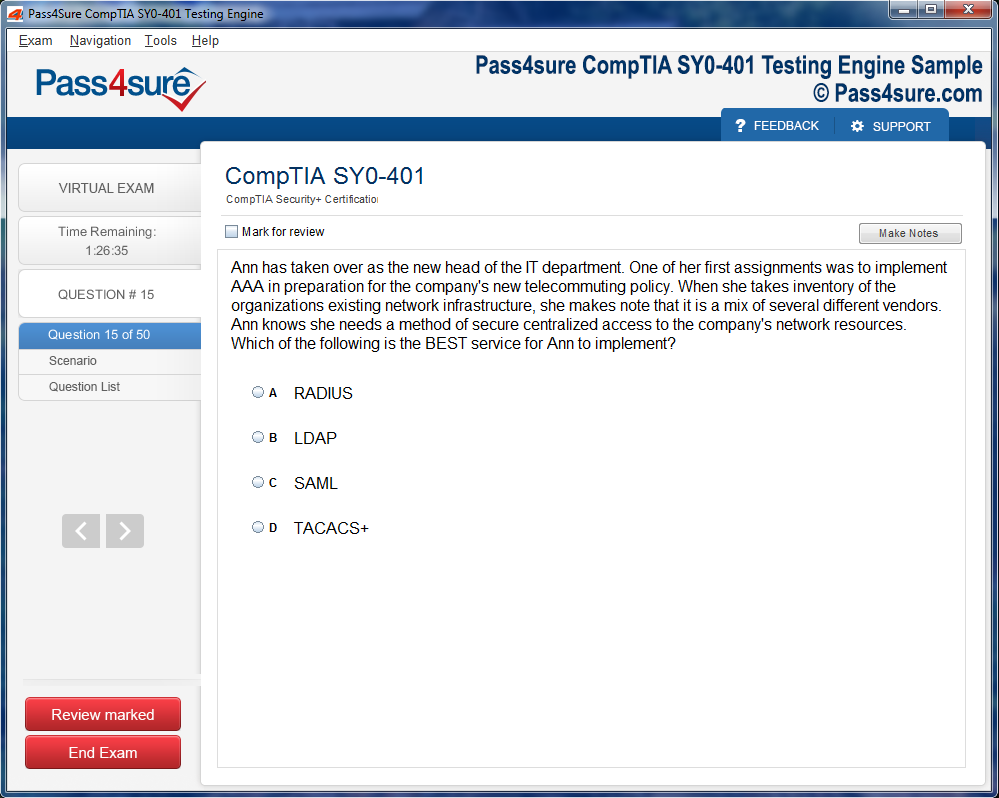
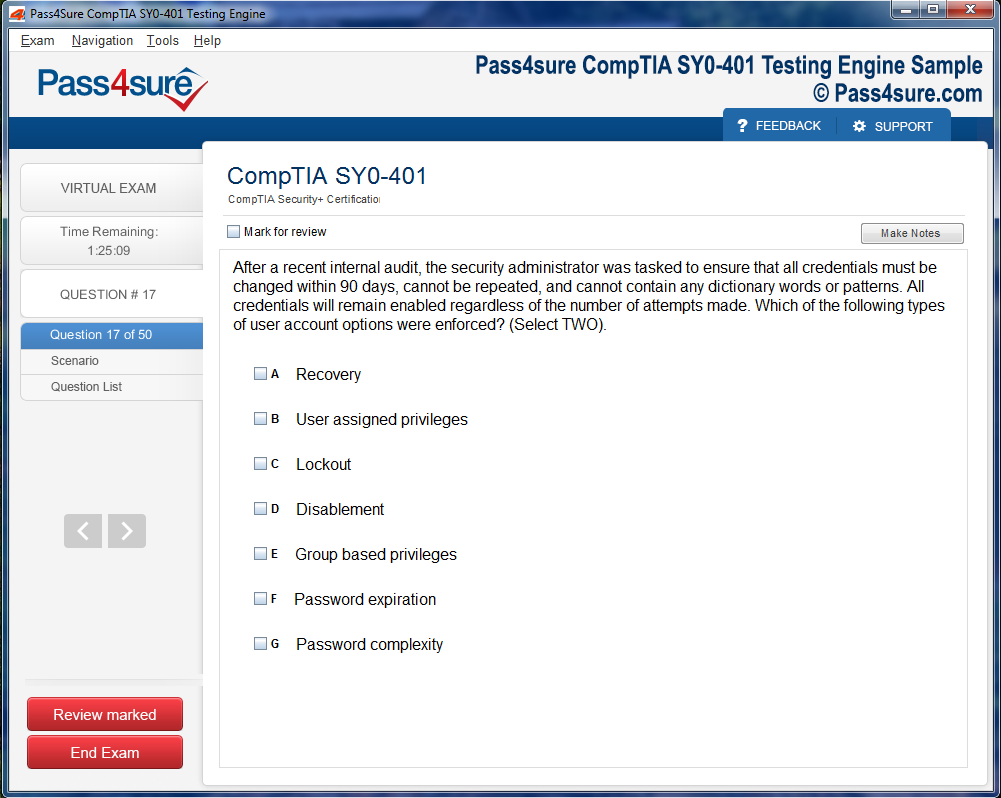
Frequently Asked Questions
How does your testing engine works?
Once download and installed on your PC, you can practise test questions, review your questions & answers using two different options 'practice exam' and 'virtual exam'. Virtual Exam - test yourself with exam questions with a time limit, as if you are taking exams in the Prometric or VUE testing centre. Practice exam - review exam questions one by one, see correct answers and explanations.
How can I get the products after purchase?
All products are available for download immediately from your Member's Area. Once you have made the payment, you will be transferred to Member's Area where you can login and download the products you have purchased to your computer.
How long can I use my product? Will it be valid forever?
Pass4sure products have a validity of 90 days from the date of purchase. This means that any updates to the products, including but not limited to new questions, or updates and changes by our editing team, will be automatically downloaded on to computer to make sure that you get latest exam prep materials during those 90 days.
Can I renew my product if when it's expired?
Yes, when the 90 days of your product validity are over, you have the option of renewing your expired products with a 30% discount. This can be done in your Member's Area.
Please note that you will not be able to use the product after it has expired if you don't renew it.
How often are the questions updated?
We always try to provide the latest pool of questions, Updates in the questions depend on the changes in actual pool of questions by different vendors. As soon as we know about the change in the exam question pool we try our best to update the products as fast as possible.
How many computers I can download Pass4sure software on?
You can download the Pass4sure products on the maximum number of 2 (two) computers or devices. If you need to use the software on more than two machines, you can purchase this option separately. Please email sales@pass4sure.com if you need to use more than 5 (five) computers.
What are the system requirements?
Minimum System Requirements:
- Windows XP or newer operating system
- Java Version 8 or newer
- 1+ GHz processor
- 1 GB Ram
- 50 MB available hard disk typically (products may vary)
What operating systems are supported by your Testing Engine software?
Our testing engine is supported by Windows. Andriod and IOS software is currently under development.
4A0-106: Step-by-Step Preparation for VPRN Exam Success
Embarking upon the journey toward the 4A0-106 VPRN certification evokes the sensation of traversing a labyrinthine network of arcane protocols, interlaced configurations, and subtle interdependencies. Many aspirants approach this odyssey with a sense of trepidation, uncertain which tributary of knowledge to follow first. The examination does not merely assess rote memorization; it scrutinizes the aspirant's capacity to synthesize complex routing paradigms, manipulate virtualized pathways, and troubleshoot with surgical precision. Success in this realm necessitates a methodical approach, one that integrates intellectual rigor with tactile experimentation, and forges a cognitive map that aligns with the exam’s intricate demands.
Demystifying the Exam Topography
Understanding the structural anatomy of the 4A0-106 exam is an indispensable preliminary step. Unlike conventional network assessments, the VPRN evaluation probes multiple dimensions of competence, encompassing route orchestration, traffic engineering, virtual private network instantiation, and diagnostic acuity. The test challenges candidates to engage with multilayered concepts that intertwine theoretical paradigms with real-world application. A strategic apprehension of this topography allows for the allocation of cognitive resources with deliberate precision, precluding the inefficiencies of ad hoc study methods and fostering a more lucid, goal-directed preparation trajectory.
Foundational Protocol Acumen
Before venturing into the labyrinth of advanced scenarios, one must cement an unwavering comprehension of foundational protocols. BGP, OSPF, and MPLS serve as the sine qua non of virtual private routed networks, and neglecting their nuanced mechanics can precipitate cascading misconfigurations. The aspirant must internalize the principles of route propagation, label distribution, and traffic optimization, cultivating a fluency that transcends superficial familiarity. By interrogating these protocols’ underlying logic and systemic interactions, candidates develop an analytical acumen capable of predicting network behavior under diverse contingencies.
Experiential Immersion in Virtual Environments
Practical engagement is the crucible in which theoretical knowledge is transformed into operative skill. Textual expositions and didactic tutorials provide essential scaffolding, yet tactile interaction with network devices crystallizes understanding. Emulating VPRN topologies within a controlled lab environment fosters an intuitive grasp of command sequences, propagation effects, and configuration repercussions. Candidates learn to anticipate anomalies, diagnose perturbations, and reconcile divergent routing outcomes, thereby cultivating a problem-solving agility that confers a decisive advantage in high-stakes examination scenarios.
Temporal Architecture of Study
Time management assumes a central role in orchestrating an effective preparatory regimen. Aspirants frequently encounter the paradox of depth versus breadth, struggling to reconcile intensive protocol analysis with comprehensive syllabus coverage. Segmenting the study plan into discrete temporal modules, alternating between theoretical deep-dives and hands-on experimentation, engenders an equilibrium that maximizes retention without sacrificing conceptual scope. Periodic evaluative interludes allow for recalibration, identifying lacunae in understanding and reinforcing cognitive consolidation, thus transforming preparation from a chaotic endeavor into a coherent, measurable progression.
Cultivating a Protean Learning Mindset
Success in VPRN mastery demands the cultivation of a protean, adaptive mindset. The examination evaluates not merely the retention of facts but the capacity to apply them dynamically across multifarious contexts. Exposure to diverse knowledge reservoirs—technical treatises, vendor documentation, and real-world network case studies—augments cognitive elasticity, equipping candidates to navigate edge-case scenarios and unorthodox configurations with aplomb. The aspirant's intellectual toolkit must be expansive, accommodating unconventional solutions and facilitating rapid recalibration in the face of unexpected obstacles.
Symbiosis of Mentorship and Peer Engagement
The social dimension of learning exerts an underappreciated influence upon mastery. Study groups and mentorship networks provide reciprocal scaffolding, allowing for the exchange of experiential wisdom and the illumination of nuanced procedural intricacies. Dialogue with experienced practitioners elucidates common pitfalls, highlights subtleties of exam design, and reinforces best practices. Simultaneously, the communal aspect fosters accountability and motivation, ensuring that solitary study is supplemented by a dynamic interplay of perspectives that accelerates conceptual assimilation.
Tactical Mastery of Troubleshooting
The troubleshooting component of the VPRN examination is often the crucible of distinction, demanding analytical rigor and methodical strategy. Candidates must develop an approach that isolates symptomatic deviations, hypothesizes potential causative factors, and executes corrective measures with precision. Simulated network failures offer a pedagogical microcosm in which candidates refine diagnostic heuristics, cultivating resilience and enhancing cognitive agility. This iterative engagement with problem-solving scenarios not only prepares aspirants for the exam but instills enduring professional competencies essential for real-world network administration.
Precision and Meticulousness in Execution
Attention to detail emerges as a defining characteristic of exemplary candidates. Subtle misconfigurations, overlooked label distributions, or incomplete parameterization can precipitate cascading failures. By internalizing meticulous practices—thorough documentation, deliberate configuration review, and systematic validation—candidates reinforce both reliability and conceptual mastery. Precision in thought and execution translates into heightened efficacy, imbuing the aspirant with the confidence to navigate complex scenarios without hesitation, a quality implicitly rewarded in the evaluative framework of the exam.
Sustaining Cognitive Resilience
The preparation for 4A0-106 is as much a mental endurance challenge as it is a technical endeavor. The cognitive demands, compounded by the intricacy of practical exercises, can precipitate fatigue and erode focus. Strategically integrating restorative intervals, reflective study, and reinforcement techniques mitigates cognitive attrition. Visualization of successful configuration outcomes, simulated exam rehearsals, and progress journaling construct a psychological scaffolding that supports sustained motivation. Resilience transforms preparation from an onerous obligation into an iterative process of growth, fostering both confidence and mastery.
Advanced MPLS Mechanisms and Label Orchestration
Mastering VPRN architectures necessitates a profound comprehension of MPLS underpinnings. Candidates must navigate the labyrinth of label distribution, understanding the nuances between Label Distribution Protocol and RSVP-TE, and how they orchestrate traffic flow. The concept of label stacking transcends mere operational knowledge; it is a method to engineer stratified routing layers, enabling intricate partitioning of multiple virtual networks. Deploying single-label versus multilabel hierarchies requires not only technical knowledge but an anticipatory grasp of traffic dynamics and network behavior under variable loads.
VPRN Topology Cognition and Strategic Design
VPRN design transcends rudimentary configuration—it is a cerebral exercise in topological foresight. Architects must envision not merely devices and interfaces but the interweaving of provider edge routers, customer edge nodes, and interstitial links. Robust designs integrate redundancy, failover mechanisms, and route reflection patterns to mitigate asymmetry and bottlenecks. Understanding potential pitfalls—suboptimal loops, erratic path selection, and latent congestion—imbues candidates with a predictive mindset, essential for crafting resilient virtual routed networks.
Traffic Engineering and Deterministic Performance
Traffic engineering is an art of balance between determinism and dynamism. Candidates must evaluate link capacity, assign hierarchical service priorities, and implement constraint-based routing where needed. MPLS-TE allows explicit delineation of label-switched paths, overriding dynamic metric deviations to assure predictable throughput. Hands-on simulation cultivates intuition for trade-offs between performance, redundancy, and resource allocation, converting theoretical principles into actionable expertise.
Optimization of Configuration for Scalability
Beyond connectivity, VPRN success hinges upon meticulous optimization. Fine-tuning route propagation, curating label distribution, and calibrating route-target policies are critical for operational efficiency. Advanced BGP manipulation, route filtering, and policy enforcement prevent propagation of erroneous paths, bolstering both network stability and security. Repeated lab application reinforces reflexive optimization instincts, which are highly prized in scenario-based evaluations, allowing aspirants to anticipate and remediate network anomalies with agility.
Control Plane Dynamics and Forwarding Cognizance
Excellence in VPRN architecture demands more than syntactic proficiency; it requires an intimate understanding of the interplay between control plane deliberations and data plane execution. Grasping the lifecycle of label assignment, label-switched path instantiation, and forwarding propagation equips candidates to preemptively diagnose and resolve routing conundrums. This cognition enables strategic design interventions that enhance packet delivery predictability while supporting complex multilayer topologies.
Security Integration within Virtualized Networks
Security in VPRN contexts is not ancillary; it is a fundamental pillar. Isolation of virtual networks, confidentiality of transit data, and integrity of routing information must be architected into the foundational design. Techniques such as VRF-aware access control, authentication of BGP peers, and meticulous route-target filtration are imperative. Continuous monitoring for anomalous traffic behavior or errant route updates strengthens the candidate's capability to enforce secure, fault-tolerant network topologies, mirroring operational realities.
Progressive Lab Immersion and Cognitive Reinforcement
Strategic mastery arises from deliberate, progressively complex lab exercises. Multi-site VPRNs, overlapping route-target scenarios, traffic class hierarchies, and induced misconfigurations provide a cognitive crucible for skill refinement. Documenting each experiment, tracking propagation patterns, and analyzing label behavior consolidates memory retention and fortifies problem-solving reflexes. Such rigorous immersion transforms rote practice into a repository of experiential insight that informs both exam responses and professional decision-making.
Scenario-Based Analytical Acumen
The VPRN assessment environment rewards analytical dexterity. Candidates confront ambiguous network situations requiring evaluative reasoning and trade-off decisions. Scenario-based exercises hone the ability to swiftly interpret topologies, anticipate propagation consequences, and implement corrective measures with precision. Over time, practitioners develop an intuitive capacity to predict network behavior, mitigating misconfigurations and optimizing performance under constrained timelines.
Mental Fortitude and Exam Resilience
Endurance of cognitive acuity under pressure is as vital as technical proficiency. The escalating complexity of VPRN concepts necessitates structured study, interspersed with reflective intervals and restorative practices. Visualization techniques, in which configurations are mentally rehearsed and outcomes anticipated, reinforce memory and decision-making efficiency. A disciplined approach to mental conditioning ensures that aspirants maintain focus, manage stress, and exhibit strategic clarity during high-stakes evaluations.
Diagnostic Acumen in VPRN Environments
Mastering the art of Virtual Private Routed Networks (VPRNs) requires more than rote memorization; it demands a cultivated diagnostic acumen capable of deciphering intricate labyrinths of MPLS design. In the nuanced landscape of Part 3 preparation, candidates confront challenges that are rarely superficial. Misaligned label distributions, errant route advertisements, and ephemeral interface inconsistencies converge to form convoluted failure patterns. Developing proficiency necessitates a systematic observation regimen, wherein every network component is scrutinized, protocol adjacencies verified, and routing tables analyzed with an almost forensic precision. Each anomaly, however minor, becomes a potential clue in unraveling a network's hidden dysfunctions, ensuring that performance integrity is preserved and that candidates cultivate a refined intuition for network behavior.
Methodical Monitoring for Preemptive Insight
Monitoring transcends the simple act of observation; it evolves into an anticipatory craft. Diagnostic commands, traffic flow visualization, and log analytics form the triad of surveillance tools essential for VPRN proficiency. Visualization techniques, particularly those illustrating MPLS labels and VRF instances, expose hidden misconfigurations that may elude conventional inspection. Candidates benefit from simulating lab environments that mirror real-world traffic intricacies, thereby internalizing expected patterns and acquiring the ability to discern aberrations swiftly. This preemptive insight transforms monitoring from a passive exercise into a proactive strategy, enhancing both exam readiness and operational competence.
Scenario-Based Troubleshooting Mastery
Examination scenarios often emulate the stochastic nature of live networks, presenting candidates with misconfigured route reflectors, inconsistent label allocations, or inaccessible customer nodes. The cognitive task is twofold: accurate fault identification and the expedient application of corrective strategies. By repeatedly engaging in scenario-based exercises, candidates cultivate mental reflexes that enable rapid triage and resolution. Each session reinforces an intuitive prioritization of symptoms, the isolation of root causes, and the application of surgical interventions—an alchemy of skill that significantly influences performance under the constraints of timed assessments.
Interwoven Complexity of Network Integration
VPRNs rarely function in isolation; they inhabit an ecosystem where MPLS services, conventional IP routing, and multi-protocol environments coalesce. Understanding the interplay between these layers is paramount. Candidates must grasp how shared backbone infrastructures, traffic engineering conduits, and segmented security zones interact, and how such interactions influence both operational efficacy and troubleshooting methodology. Integration competence is not merely theoretical; it is the practical awareness that network anomalies rarely reside in singular silos but propagate across interconnected domains, demanding holistic resolution strategies.
Optimization of Performance Subtleties
Functional networks can harbor latent inefficiencies. Suboptimal path selection, uneven label distribution, and asymmetric traffic loads subtly degrade service quality. Candidates should hone techniques for assessing throughput, latency, and jitter within virtualized contexts, employing MPLS traffic engineering methodologies to rectify inefficiencies. Cultivating sensitivity to these performance subtleties fosters an analytical mindset, enabling candidates to anticipate bottlenecks, balance loads, and elevate service integrity. Optimization, therefore, emerges not as an ancillary skill but as an indispensable aspect of advanced VPRN mastery.
Strategic Documentation and Cognitive Consolidation
The meticulous documentation of configurations, operational adjustments, and troubleshooting pathways is a cornerstone of sustained expertise. Beyond its utilitarian function, structured record-keeping enhances cognitive retention, allowing candidates to compare iterative outcomes, refine methodologies, and consolidate lessons learned. In professional practice, this discipline mitigates recurrent errors, while during exam preparation, it transforms complex experiential data into an accessible repository, fortifying both procedural memory and strategic insight.
Holistic Technological Familiarity
VPRN mastery is not insular; it thrives at the intersection of multiple routing paradigms. Peripheral knowledge of BGP communities, OSPF area architectures, VRF-lite implementations, and policy-based routing augments the core understanding of MPLS networks. Candidates benefit from weaving these elements into troubleshooting exercises, fostering a panoramic perspective that balances depth with breadth. This integrative approach empowers candidates to navigate examination challenges with both precision and adaptability, mitigating the risk of narrow, context-limited reasoning.
Cognitive Resilience and Analytical Poise
Technical mastery is intertwined with mental fortitude. Candidates are frequently assessed on their ability to maintain analytical poise under time pressure, navigating multiple concurrent failures without succumbing to cognitive overload. Practicing in timed, high-fidelity simulations cultivates resilience, while mindfulness techniques, intermittent reflection, and deliberate pacing sustain focus. The synthesis of cognitive discipline and procedural knowledge ensures that candidates approach both the VPRN exam and real-world network scenarios with an equilibrium of confidence and competence.
Applied Troubleshooting with Reflexive Precision
The culmination of Part 3 preparation is the ability to troubleshoot with reflexive precision. Each network anomaly becomes a narrative, where interface logs, MPLS label distributions, and VRF behavior collectively articulate a problem’s origin. Candidates refine a mental heuristic, enabling rapid fault isolation, targeted interventions, and performance optimization without reliance on rote procedural steps. This applied fluency distinguishes proficient candidates from merely prepared ones, establishing a level of operational sophistication aligned with both exam rigor and professional expectations.
Integrative Observational Analytics
Developing a keen eye for integrative observational analytics is essential. VPRN candidates must interpret the confluence of real-time traffic data, protocol state transitions, and route propagation patterns to anticipate potential disruptions. Such analytical foresight allows the identification of emergent anomalies before they manifest as operational failures. Through continuous exposure to simulated networks and methodical review of system behavior, candidates cultivate an anticipatory mindset—a cognitive framework that underpins both examination excellence and pragmatic network stewardship.
Tactical Scenario Simulation
Simulated tactical scenarios serve as crucibles for expertise. Candidates expose themselves to complex failures that mimic the stochastic behavior of operational networks. These exercises foster decisiveness, reinforcing the candidate’s ability to balance diagnostic rigor with expedient intervention. By internalizing patterns of misconfiguration and anomalous propagation, candidates enhance their capacity to deploy corrective measures swiftly, aligning theoretical knowledge with pragmatic action. Scenario simulation, therefore, functions as both a cognitive accelerator and a performance amplifier.
Synergistic Traffic Engineering
In the realm of VPRNs, traffic engineering emerges as a subtle yet transformative competency. Candidates engage with MPLS pathways, leveraging label-switching intricacies to influence data flow, optimize resource allocation, and mitigate congestion. Understanding the nuanced interplay between traffic patterns and network topology fosters an anticipatory mindset, allowing candidates to preempt bottlenecks and orchestrate seamless data delivery. Mastery of these techniques signals both a refined analytical ability and an elevated readiness for complex, multi-layered examination challenges.
Cognitive Integration of Peripheral Protocols
Peripheral protocols, while secondary to core MPLS concepts, function as critical adjuncts to comprehensive troubleshooting. Candidates explore the nuances of BGP path selection, OSPF area segmentation, and policy-driven routing behaviors, integrating these protocols into broader network diagnostics. This cognitive integration ensures that candidates do not isolate problems within narrow contexts, but rather approach each issue as part of an interconnected system. The resultant holistic perspective enhances both problem-solving agility and conceptual depth, reinforcing examination preparedness.
Reflective Lab Practice
Laboratory practice, coupled with reflective analysis, forms the backbone of sustained VPRN competence. Candidates document iterative trials, evaluate outcomes, and distill insights into procedural heuristics. This continuous feedback loop solidifies experiential knowledge, fostering the ability to anticipate anomalies, predict system behavior, and implement preemptive corrective measures. Reflective practice, therefore, is not ancillary but central to developing the nuanced expertise required for both examination mastery and professional network management.
Cognitive and Operational Symbiosis
Ultimately, Part 3 emphasizes a symbiosis between cognitive skill and operational execution. Candidates are challenged to translate theoretical comprehension into actionable diagnostics, to transform observation into insight, and to harmonize technical proficiency with analytical judgment. This duality underpins the candidate’s capacity to navigate complex VPRN environments, respond adaptively to emergent anomalies, and demonstrate a level of mastery commensurate with both exam expectations and practical network demands.
Advanced Security Paradigms in VPRN Deployments
As candidates traverse the intricate labyrinth of VPRN architectures, security emerges not merely as a procedural requisite but as a strategic imperative. Mastery of isolation techniques, route-target filtering, and peer authentication is paramount. Virtual Routing and Forwarding (VRF) environments demand a nuanced understanding of traffic segmentation, ensuring that disparate networks remain cryptographically and operationally insulated. Exploiting VRF-aware access control lists and BGP session authentication mechanisms enables engineers to mitigate unauthorized route propagation while preserving the agility of inter-site communication. The dexterity to anticipate potential vulnerabilities and preemptively design safeguards distinguishes the proficient candidate from the merely competent. Security is not static; it requires iterative analysis, predictive scenario modeling, and the meticulous orchestration of policy enforcement across a potentially sprawling multi-site ecosystem.
Advanced security extends beyond conventional access control into the realm of dynamic policy orchestration. Route-target manipulation and meticulous label distribution can influence how traffic is compartmentalized, thus creating microsegmented pathways that respond fluidly to operational exigencies. Candidates are expected to simulate potential attack vectors, including route injection and cross-site misconfigurations, in controlled lab environments. Such exercises cultivate an anticipatory mindset that blends technical precision with strategic foresight. The exam, in turn, assesses the capacity to implement these advanced methodologies under time constraints, requiring both analytical acumen and hands-on proficiency.
Multi-Site VPRN Design Complexities
Scaling a VPRN to accommodate multiple sites introduces a kaleidoscope of operational challenges. Each site possesses unique routing paradigms, bandwidth constraints, and redundancy expectations that necessitate granular attention to design subtleties. Candidates must comprehend the interplay between route-target allocation and label distribution, recognizing that a misaligned configuration can precipitate systemic inefficiencies or inter-site traffic blackholes. Multi-site simulations in lab environments are invaluable; they provide the canvas upon which engineers may experiment with failover scenarios, route convergence analysis, and cross-site traffic optimization. These simulations sharpen operational intuition while reinforcing conceptual rigor.
Designing for multi-site redundancy is an exercise in anticipatory engineering. Each branch or data center must possess failover pathways capable of absorbing disruptions without destabilizing the overarching VPRN topology. Candidates should familiarize themselves with both active-active and active-passive paradigms, understanding how MPLS labels propagate across redundant paths and how BGP policies can be tuned to prioritize resilience. A sophisticated grasp of multi-site dynamics also encompasses the capacity to balance load intelligently, prevent route oscillations, and ensure consistent policy enforcement across geographically dispersed nodes. Such exercises cultivate an integrated mindset where topology, performance, and resilience are evaluated concurrently.
Performance Optimization and Scalability Challenges
The crescendo of multi-site deployment is often a network dense with hundreds of routes and manifold traffic classes. Scaling VPRNs demands mastery of resource efficiency, encompassing both control-plane and data-plane optimization. Candidates must explore the art of minimizing route-flap propagation, thereby preventing cascading instability that could undermine high-availability objectives. MPLS path optimization, coupled with meticulous monitoring of control-plane overhead, fortifies networks against congestion and unplanned latencies.
Dynamic service-level requirements introduce an additional layer of complexity. Understanding how to reconcile differing QoS policies, traffic prioritization schemes, and bandwidth allocations requires candidates to synthesize analytical reasoning with empirical observation. Simulation of high-load scenarios, traffic bursts, and route recalculation events is imperative. These exercises not only solidify technical competence but also cultivate adaptive thinking, essential for both exam success and operational excellence. The proficient candidate learns to navigate the subtle interdependencies between performance, scalability, and security, crafting solutions that are robust yet agile.
Exam Strategy and Cognitive Engineering
Technical mastery alone does not guarantee VPRN exam success; strategic preparedness is equally pivotal. Candidates must hone an integrated approach where theoretical knowledge, hands-on lab proficiency, troubleshooting aptitude, and scenario-based reasoning converge seamlessly. Time management emerges as a nontrivial factor, with the necessity to prioritize high-yield tasks and methodically approach complex configurations under examination constraints. Reflection on practice exams, coupled with iterative refinement, facilitates a cyclical learning process that identifies weaknesses, reinforces strengths, and promotes cognitive resilience.
Mental fortitude is a frequently underestimated aspect of exam preparation. Multi-site topologies, advanced security constructs, and high-complexity questions can induce cognitive overload. Structured study schedules, reflective rehearsal of lab scenarios, and strategic mental visualization enhance focus and mitigate fatigue. Candidates who cultivate disciplined habits while embracing adaptive learning strategies gain a substantial advantage over those who rely solely on rote memorization. The VPRN exam challenges both technical dexterity and mental agility, rewarding those who can synthesize knowledge into practical, contextually relevant decisions.
Integrating Knowledge Across Advanced Domains
At this juncture, candidates are expected to synthesize diverse competencies into a coherent operational philosophy. Advanced security, multi-site topologies, performance optimization, and exam strategy are not isolated domains but interdependent facets of network engineering excellence. Mastery entails the capacity to perceive the systemic implications of configuration changes, anticipate failure vectors, and design resilient, scalable solutions that maintain operational integrity. The interplay between theory and practice is crucial; conceptual understanding informs lab experimentation, while empirical observations refine theoretical constructs.
The ability to navigate this complexity requires both deliberate practice and strategic reflection. Candidates should engage in iterative scenario simulations, exploring the nuances of policy enforcement, label distribution, and inter-site traffic dynamics. Lab exercises are not ends in themselves but vehicles for cultivating diagnostic precision, analytical reasoning, and adaptive problem-solving. By internalizing these processes, candidates develop an operational intuition that transcends rote memorization, enabling them to approach exam challenges with confidence and foresight.
Advanced Troubleshooting Methodologies
Troubleshooting in VPRN environments is an art that blends analytical reasoning with methodical exploration. Candidates must recognize subtle signs of misconfiguration, from anomalous route propagation to inconsistent label distribution. Techniques such as BGP route inspection, VRF-specific tracing, and control-plane monitoring form the backbone of diagnostic practice. Sophisticated troubleshooting requires not only identification of the immediate issue but also assessment of systemic ramifications, ensuring that corrective actions do not inadvertently compromise network stability.
Simulating failure conditions across multi-site topologies sharpens diagnostic acumen. Candidates should practice identifying root causes under constrained time conditions, learning to prioritize investigative pathways based on both likelihood and impact. This iterative rehearsal cultivates a mental framework that transforms complex, seemingly opaque problems into structured sequences of analysis, expediting resolution and reinforcing confidence in practical application.
Mental Models for Exam Cognition
Success in advanced VPRN certification demands more than rote technical ability; it necessitates the cultivation of robust mental models for cognitive efficiency. Candidates must internalize abstract concepts such as route-target propagation, MPLS label distribution, and inter-site redundancy as dynamic, interrelated systems rather than static configurations. Visualization, pattern recognition, and scenario rehearsal serve as cognitive scaffolds, enabling rapid assimilation of complex information and fluid adaptation to novel exam questions.
Effective mental models are honed through iterative reflection and deliberate experimentation. Candidates should continuously evaluate how theoretical constructs manifest in lab environments, correlating conceptual understanding with operational outcomes. This interplay between abstraction and practice fortifies memory retention, enhances problem-solving speed, and reduces cognitive load during high-pressure exam situations. Mastery of cognitive frameworks translates directly into improved performance, enabling candidates to navigate even the most intricate multi-site VPRN scenarios with composure and precision.
Continuous Refinement and Iterative Learning
At the apex of Part 4 preparation lies a commitment to continuous refinement. Advanced VPRN mastery is an evolving endeavor, requiring persistent assessment, recalibration, and augmentation of both technical and cognitive competencies. Candidates should engage in cyclical review, revisiting prior exercises, experimenting with alternative configurations, and challenging assumptions to uncover latent vulnerabilities. Iterative learning ensures that knowledge remains dynamic and adaptable, capable of accommodating the evolving complexity of both exam scenarios and real-world deployments.
This process encompasses not only technical validation but also reflective self-assessment. Candidates are encouraged to scrutinize their problem-solving methodologies, time management strategies, and mental resilience practices. Through iterative improvement, they cultivate a holistic skill set that integrates operational precision, strategic foresight, and cognitive agility. By the culmination of Part 4, candidates are positioned at the threshold of mastery, equipped to transition seamlessly into advanced exam simulation, practical application, and final preparation stages.
Immersive Examination Simulation for Cognitive Acuity
In the final corridors of VPRN mastery, candidates must immerse themselves in rigorous examination simulations. This process transcends superficial memorization, demanding an intricate interplay of cognitive dexterity, procedural recall, and rapid analytical reasoning. Creating an environment that mirrors the temporal and situational pressures of the 4A0-106 examination is paramount. The orchestration of simulated scenarios should encompass diverse topologies, misconfiguration intricacies, and multifaceted traffic anomalies, compelling aspirants to navigate labyrinthine problems with alacrity and precision.
Simulation serves as the crucible in which abstract knowledge is transmuted into applied proficiency. Candidates benefit from iterative exposure to complex routing schemes, VRF compartmentalization, MPLS label distribution irregularities, and nuanced BGP policy deviations. Each simulation reinforces synaptic associations, transforming episodic memory into procedural fluency. Repeated immersion in high-fidelity scenarios cultivates anticipatory cognition, enabling candidates to predict network behavior, preempt emergent faults, and implement corrective measures expeditiously. This embodiment of experiential learning fortifies mental schemas essential for instantaneous problem resolution during examination conditions.
Systematic Review and Conceptual Reinforcement
Structured review emerges as the linchpin of consolidation. Aspirants must undertake meticulous audits of core network constructs, revisiting MPLS mechanisms, label-switched path integrity, route-target intricacies, and traffic engineering paradigms. A deliberate and reflective approach ensures retention transcends superficial recognition, fostering deep comprehension capable of supporting improvisational troubleshooting.
Re-examining documented lab procedures, scrutinizing misconfiguration patterns, and dissecting past practice errors cultivates an analytic lens, enabling candidates to identify latent misconceptions. Targeted review emphasizes remediation in areas where recurrent errors were observed, converting previous weaknesses into reinforced competencies. By adopting a cyclical review strategy, candidates internalize both foundational principles and nuanced operational idiosyncrasies, facilitating adaptive proficiency across unanticipated scenario permutations.
Temporal Stratification of Revision Endeavors
Effective preparation necessitates disciplined temporal segmentation. Dividing the remaining preparation interval into well-defined study blocks, alternating between conceptual elucidation, practical configuration, and scenario deconstruction, maximizes cognitive efficiency while mitigating fatigue. Each study interlude should incorporate reflective incubation, allowing the mind to consolidate procedural sequences and rehearse diagnostic heuristics.
Strategic alternation between cognitive domains nurtures versatility. Oscillating between analytical problem-solving and manual configuration cultivates both accuracy and alacrity, critical attributes in a temporally constrained examination milieu. This temporal stratification ensures that candidates are neither overwhelmed by cognitive saturation nor deprived of depth, engendering a harmonious synthesis of knowledge and skill that is exam-relevant and resilient under pressure.
Cognitive Fortification Through Confidence Cultivation
Confidence is not a mere affective adjunct but a strategic enabler in high-stakes evaluation. Mental rehearsal, a process wherein candidates visualize the meticulous execution of configuration commands, traffic validation procedures, and fault remediation workflows, reinforces self-efficacy. This anticipatory enactment primes neural pathways for decisive action, attenuating hesitation and mitigating cognitive dissonance during real-time problem-solving.
Reflective appraisal of prior successes accentuates mastery. By cataloging scenarios executed flawlessly during lab simulations, candidates solidify their perception of competence, converting abstract assurance into tangible preparedness. Such psychological scaffolding reduces performance anxiety, augments decisional clarity, and transforms the examination environment from a source of stress into an arena for demonstrative expertise.
Scenario-Based Iteration for Adaptive Expertise
The quintessence of final-stage preparation resides in repetitive, scenario-based practice. Candidates should orchestrate labyrinthine multi-site VPRN deployments, introduce deliberate label mismatches, and provoke simulated traffic aberrations to challenge deductive agility. This iterative immersion nurtures an intuitive grasp of systemic interdependencies, enabling rapid fault localization and correction.
Scenario repetition cultivates cognitive plasticity, fostering adaptability when confronted with unanticipated network anomalies. Each iteration reinforces cause-effect associations, strengthens diagnostic heuristics, and expands the repertoire of contingency strategies. Over time, candidates develop a procedural intuition akin to expert practitioners, capable of navigating ambiguity with confidence and precision.
Feedback Integration and Reflective Iteration
Meticulous integration of feedback is a sine qua non of preparation. Aspirants should scrutinize practice exam outcomes, lab error patterns, and misconfiguration recurrences to distill insights. Maintaining a corrective action log ensures that weaknesses are systematically addressed, allowing learning to accrue cumulatively rather than episodically.
This iterative reflection consolidates procedural memory while fortifying conceptual understanding. By converting mistakes into structured learning experiences, candidates preempt error recurrence, enhance cognitive resilience, and refine analytical acumen. Feedback integration transforms preparation from a linear endeavor into a dynamic, self-correcting mechanism of continuous improvement.
Mental Resilience and Physiological Synchronization
Sustained peak performance demands the cultivation of mental resilience and physiological equilibrium. Techniques such as mindfulness meditation, deep-focus interludes, and brief restorative pauses alleviate cognitive strain, preserve attentional capacity, and mitigate stress-induced cognitive decline. Adequate sleep cycles, balanced nutrition, and moderate physical activity further potentiate neurocognitive function, creating an optimal substrate for memory retrieval, problem-solving, and procedural execution.
Candidates who harmonize rigorous technical practice with holistic well-being often demonstrate superior endurance and cognitive clarity. The interplay of mental fortitude and physiological readiness ensures sustained attentiveness, enabling candidates to approach intricate VPRN scenarios with composure, clarity, and precision.
Synthesis of Knowledge Through Experiential Application
Part 5 preparation transcends rote learning; it embodies synthesis through applied experience. Candidates should continually integrate theoretical comprehension, practical configuration skill, and scenario-driven intuition. Each session of simulation, review, or reflective practice represents an opportunity to solidify neural pathways linking concept, action, and outcome.
Through this experiential synthesis, aspirants internalize procedural patterns, anticipate emergent network behaviors, and cultivate rapid-response strategies. The culmination of these efforts is a refined operational intuition, permitting confident navigation of complex VPRN deployments under the temporal and cognitive constraints of the examination environment.
Cognitive Acceleration Through Pattern Recognition
Developing an ability to discern patterns across network behaviors accelerates diagnostic efficiency. Recognizing label distribution anomalies, traffic asymmetries, or BGP misalignments within seconds reduces cognitive load, allowing focus on corrective execution rather than problem identification. Pattern recognition, cultivated through repetitive exposure to variant scenarios, transforms laborious troubleshooting into a fluent, almost instinctual, process.
Candidates who master this form of cognitive acceleration approach the exam with heightened agility, capable of interpreting multifactorial network states and enacting remedial configurations with minimal hesitation. This skill differentiates aspirants who rely on methodical stepwise reasoning from those who operate with anticipatory, expert-level insight.
Strategic Mental Rehearsal for Operational Fluency
The technique of mental rehearsal is central to operational fluency. Candidates should vividly imagine executing configuration sequences, verifying traffic flows, and resolving emergent faults under realistic temporal constraints. This anticipatory mental simulation primes procedural memory, reducing execution latency during actual examination tasks.
Mental rehearsal reinforces neural patterns associated with high-stakes decision-making, bridging the gap between cognitive intent and physical implementation. By rehearsing scenarios repeatedly in the mind’s eye, aspirants cultivate a mental roadmap that guides their hands and attention during practical examination components, ensuring efficiency, accuracy, and composure.
Adaptive Troubleshooting and Cognitive Flexibility
VPRN examinations often present unanticipated network conditions requiring flexible problem-solving. Cognitive flexibility, the capacity to modify heuristics in response to novel stimuli, is developed through iterative exposure to diverse scenarios. Candidates must challenge themselves with atypical misconfigurations, intermittent connectivity failures, and ambiguous routing anomalies.
This adaptive approach ensures preparedness for scenarios that defy standard procedural scripts. Over time, candidates develop an intuitive sense of causality within complex networks, enabling them to generate hypotheses, test them expeditiously, and converge on solutions with confidence. Adaptive troubleshooting is not merely reactive; it is a proactive engagement with network dynamics, sharpening both insight and execution.
Harmonizing Cognitive Poise Before the VPRN Examination
Embarking upon the VPRN examination necessitates more than rote memorization; it requires a cultivated equilibrium of cognition and composure. Candidates must orchestrate mental lucidity, aligning focus with intentional recall. The art of visualization, wherein one meticulously envisions the orchestration of network topologies, MPLS label distribution, and VRF segmentation, cultivates anticipatory cognition. Traversing hypothetical troubleshooting labyrinths within the mind fosters resilience against examination-induced perturbations. Exam-day strategy is augmented by temporal orchestration, mapping task prioritization such that intricate scenario-based challenges are engaged initially while peripheral or straightforward queries are deferred to subsequent intervals. This cognitive choreography ensures efficiency, mitigates stress-induced lapses, and preserves operational clarity under pressure.
Intensifying Acumen Through Selective Revision
The final phase of preparation demands a judicious focus upon high-yield conceptual strata. Mastery of route-target conventions, nuanced BGP policy frameworks, and MPLS traffic engineering strategies underpins examination success. Candidates benefit from interrogating their own praxis through lab logs, previously encountered configuration anomalies, and scenario simulations. Emphasis upon recurring misconfigurations—such as misaligned labels, VRF leakage, or improper route redistribution—creates cognitive heuristics that expedite correct responses. Precision in revisiting multi-site deployment architectures enhances both memory retention and practical problem-solving agility. The deliberate retracing of prior troubleshooting expeditions fortifies neural pathways, enabling swift analytical transitions during timed conditions.
Systematic Methodology for Scenario Resolution
Structured analytical methodology constitutes the bedrock of efficacious problem-solving in the VPRN environment. Each question should be approached with deliberate sequencing, beginning with the identification of symptoms, hypothesizing probable causes, and culminating in the implementation of corrective actions. A methodical lens reduces cognitive drift and ensures comprehensive consideration of multifaceted network interactions. Candidates who internalize this structured approach often attain superior accuracy, as the regimen translates theoretical comprehension into executable operational tactics. Moreover, consistent application across diverse scenario typologies reinforces mental models, permitting adaptability in unexpected configurations or emergent network anomalies.
Precision and Vigilance in Configuration Execution
The intricacies of VPRN configuration reward meticulous scrutiny and a fastidious approach. Minor oversights, such as an omitted route-target or an erroneous MPLS label assignment, can propagate cascading errors despite overall conceptual mastery. Candidates must inculcate a practice of persistent verification—examining command syntax, cross-referencing route propagation, and confirming policy congruence. This meticulous disposition, refined over repeated lab engagements, translates into professional credibility. In the crucible of the examination, such scrupulousness not only mitigates avoidable errors but also manifests as cognitive discipline, a trait that distinguishes proficient network engineers from those whose expertise remains superficial.
Professional Application Beyond Certification
The acquisition of VPRN certification is not merely symbolic; it is a conduit to applied professional mastery. Network engineers leverage their understanding of MPLS architectures, multi-site topologies, and VRF segmentation to construct resilient, scalable, and secure infrastructures. The dexterity to anticipate network bottlenecks, implement performance optimization, and execute complex troubleshooting elevates practitioners to operational architects within their organizations. Knowledge gained during preparation extends beyond theory into real-world problem-solving, equipping professionals with a toolkit to navigate evolving technological landscapes while contributing strategic insight and operational excellence.
Cultivating Perpetual Learning and Innovation
The field of networking is in perpetual flux, demanding ongoing intellectual curiosity and adaptive learning. Engaging with professional communities, exploring vendor protocol updates, and participating in immersive lab simulations ensures sustained relevance and agility. Experimentation with emergent technologies and iterative practice in controlled environments stimulates innovation and enhances practical dexterity. Certification, in this context, functions as an inflection point—a solidified foundation upon which continuous competence and creativity flourish. Professionals who embrace this ethos of lifelong learning navigate both immediate operational challenges and the evolving complexity of global network ecosystems with foresight and precision.
Reflective Practice for Professional Refinement
Self-assessment and reflective practice are indispensable for long-term professional efficacy. Candidates benefit from critically evaluating their preparation strategies, scrutinizing the efficacy of lab exercises, and dissecting scenario-based approaches. This reflection cultivates meta-cognition, enabling practitioners to identify strengths, uncover latent weaknesses, and refine methodologies for both examination and operational deployment. By embedding reflective evaluation into their professional routine, candidates ensure sustained competency, bolster adaptability, and nurture a growth-oriented mindset that synergizes achievement with continuous improvement.
Navigating Complex Multi-Site Topologies
Mastery of multi-site topologies demands a comprehension that transcends rote procedural knowledge. Candidates must visualize the propagation of routes across disparate VRFs while considering redundancy, convergence, and failover scenarios. Each site represents a microcosm of interdependent network interactions where a single misalignment can cascade into broader connectivity disruptions. Analytical proficiency involves mentally mapping BGP peerings, MPLS tunnels, and label-switched paths while anticipating potential points of contention. Laboratory practice should emulate real-world unpredictability, allowing candidates to hone their capacity to troubleshoot emergent anomalies within geographically dispersed nodes. This immersive rehearsal cultivates situational awareness, a skill that examiners value and real-world operations necessitate.
Delineating MPLS Traffic Engineering Principles
Traffic engineering within MPLS networks is an intricate exercise in resource optimization. Candidates must grasp the subtleties of constraint-based routing, bandwidth allocation, and priority queuing. Understanding how to calculate optimal paths and manipulate explicit route objects ensures predictable traffic flow across complex networks. This knowledge extends beyond memorization, requiring the ability to evaluate the ramifications of design decisions on network resilience and latency. Simulation exercises that mimic congestion, packet loss, and route flapping provide invaluable practice. By internalizing these principles, candidates develop an intuitive sense of network dynamics, enabling both rapid problem-solving in exams and strategic foresight in operational deployments.
Advanced BGP Policy Articulation
BGP policy configuration is the fulcrum upon which scalable and secure VPRN architectures pivot. Competency entails more than executing standard commands; it requires the ability to synthesize community attributes, route maps, and prefix filtering into cohesive policy frameworks. Candidates must anticipate the interaction of multiple policy layers, discerning how local preferences, AS path manipulations, and route reflection strategies interplay. Practical exercises in policy orchestration expose potential conflicts and reinforce troubleshooting heuristics. These skills translate into operational acumen, empowering engineers to implement robust routing architectures that endure shifting network conditions without compromising performance or security.
Optimizing VRF Segmentation for Performance
Virtual Routing and Forwarding (VRF) segmentation is fundamental to isolating traffic and maintaining organizational security. Candidates should focus on the strategic deployment of VRFs, considering both logical separation and the efficient use of underlying physical resources. Evaluating potential overlap, import/export route policies, and interface assignment ensures maximal performance and minimal operational risk. Rigorous practice with VRF interconnectivity scenarios, route leaking, and policy propagation reinforces the mental models necessary for high-stakes examination and enterprise deployment. Developing an instinct for preemptively identifying misconfigurations enhances reliability and demonstrates professional sophistication.
Implementing Redundant MPLS Architectures
Resilience in network design is often predicated upon redundant MPLS architectures. Candidates must understand the nuances of primary and secondary LSP (Label Switched Path) creation, backup strategies, and failover testing. Redundancy is not a mere duplication of paths but a deliberate orchestration that minimizes downtime while preserving traffic integrity. Laboratory simulations that introduce controlled failures test the robustness of configuration choices and hone adaptive troubleshooting strategies. Mastery of redundancy principles ensures both exam success and operational stability, positioning professionals to deliver networks that endure both predictable and unforeseen stressors.
Precision Troubleshooting Methodologies
Effective troubleshooting is predicated upon a structured methodology that blends analytical rigor with adaptive intuition. Candidates should cultivate an approach that begins with meticulous data collection, followed by hypothesis formulation, verification, and corrective action. Complex VPRN environments demand the ability to parse logs, trace label distributions, and cross-verify route propagation. Scenario-based exercises that simulate anomalies in VRF separation, MPLS labels, or BGP peering reinforce problem-solving acumen. This disciplined approach reduces time-to-resolution in examinations and professional practice, ensuring that even nuanced misconfigurations are swiftly detected and remediated.
Strategic Utilization of Lab Simulations
Lab simulations serve as cognitive crucibles, where theoretical knowledge is stress-tested against dynamic network behavior. Candidates benefit from immersive exercises that replicate operational challenges, including multi-site deployments, traffic engineering anomalies, and inter-VRF misconfigurations. The iterative engagement with simulations fosters pattern recognition, reinforcing both memory retention and analytical agility. Advanced simulation practices involve intentionally introducing conflicts, latency, or partial failures to cultivate adaptability and mental resilience. Such preparation equips candidates with a repertoire of solutions that extend seamlessly from examination contexts to professional environments.
Integrating Emerging VPRN Technologies
The landscape of VPRN networking is continually enriched by emerging technologies, demanding a proactive stance toward integration. Candidates should familiarize themselves with enhancements in automation, SD-WAN overlays, and telemetry-driven monitoring. Understanding how these innovations interact with traditional MPLS and VRF architectures broadens strategic insight and operational flexibility. Experimental lab exercises with modern tooling cultivate confidence in deploying, troubleshooting, and optimizing networks that leverage both legacy protocols and contemporary enhancements. Professionals who internalize these advancements maintain relevance and competitive advantage in an evolving technological ecosystem.
Cognitive Mapping of Complex Scenarios
Developing cognitive maps of intricate network scenarios is an underappreciated yet critical skill. Candidates should practice deconstructing multi-layered configurations into manageable conceptual segments, identifying dependencies, potential bottlenecks, and points of interconnection. Visualization exercises enhance mental agility, enabling rapid assimilation of new information and dynamic problem-solving. The capacity to translate abstract configurations into structured cognitive frameworks empowers candidates to approach examination questions with clarity and precision, reducing cognitive overload and improving accuracy under time constraints.
Leveraging Protocol Interdependencies
Understanding the interplay between MPLS, BGP, and VRF is central to advanced VPRN proficiency. Candidates must recognize how modifications in one protocol influence the behavior of others, appreciating the delicate equilibrium that sustains network stability. Scenario exercises that emphasize protocol interdependencies sharpen analytical foresight, highlighting subtle misconfigurations that may manifest only under specific conditions. This integrated perspective nurtures both examination success and professional excellence, enabling engineers to anticipate unintended consequences and implement corrective measures preemptively.
Advanced Route Reflector Strategies
Route reflectors serve as pivotal instruments in scaling BGP architectures. Candidates should delve into reflector hierarchies, cluster configurations, and policy propagation, understanding both functional and performance implications. Complex topologies necessitate careful attention to route reflector placement, loop prevention, and policy enforcement. Laboratory scenarios that simulate reflector failures or suboptimal placements reinforce both technical acumen and adaptive troubleshooting. Mastery of these strategies conveys expertise that extends beyond exam requirements, positioning professionals to architect efficient, resilient networks at scale.
Performance Benchmarking and Optimization
Candidates should cultivate the ability to systematically measure and optimize network performance. This entails evaluating latency, jitter, bandwidth utilization, and label-switched path efficiency. Analytical proficiency includes leveraging diagnostic commands, interpreting performance metrics, and correlating data with traffic patterns. Practical exercises in performance optimization, such as tuning MPLS parameters, adjusting route preferences, and refining VRF segmentation, instill both technical dexterity and operational prudence. This focus on continuous performance enhancement ensures that candidates approach both examination scenarios and real-world deployments with a solutions-oriented mindset.
Intricate Label Distribution Analysis and Optimization
Understanding the subtleties of label distribution is crucial for VPRN mastery. Candidates should delve into the interplay between LDP, RSVP-TE, and segment routing protocols, recognizing how labels propagate, override, or conflict within complex topologies. Rather than mere rote memorization, aspirants must analyze label allocation patterns, label stacking hierarchies, and implicit/explicit null behaviors to preempt configuration anomalies.
Optimization is equally vital. By refining label utilization, candidates ensure minimal convergence delays and optimal traffic engineering. Awareness of label exhaustion scenarios, especially in multi-site environments with overlapping route-targets, cultivates proactive foresight. Regular examination of lab-generated topologies, with deliberate label conflicts or intentional misallocations, strengthens the candidate’s ability to diagnose obscure propagation anomalies under examination pressure.
Multi-Tier Routing Policies and Hierarchical Control
High-level VPRN deployment frequently involves the orchestration of multi-tier routing policies. Candidates must comprehend the nuances of route-maps, policy-based routing, and hierarchical route preference assignments. The ability to craft policies that are simultaneously efficient, scalable, and fault-tolerant is essential.
Hierarchical control allows candidates to segment decision-making across layers of the network. For example, edge-site policies might prioritize customer-specific VRFs, while core policies optimize backbone transit. Practicing the design of layered policies in lab environments develops strategic insight into the interplay between local and global routing decisions, fostering a mindset that anticipates and mitigates policy conflicts before they manifest in operational environments.
Advanced VRF Segmentation and Isolation Techniques
Effective VRF segmentation underpins secure, multi-tenant VPRN architectures. Candidates should explore isolation techniques beyond basic route-target separation, including selective import/export filtering, RT constriction strategies, and route-distinguisher synthesis. By experimenting with non-trivial VRF topologies, candidates gain intuition about unintended route leaks, cross-VRF interference, and optimal traffic separation strategies.
Isolation strategies must also account for scaling. Large-scale deployments can introduce subtle propagation anomalies when route-target assignments are non-uniform or hierarchical. By simulating scenarios with hundreds of VRFs, candidates develop resilience against emergent anomalies, ensuring that exam scenarios involving intricate VRF isolation are navigated with precision and speed.
Temporal Analysis of Traffic Engineering Scenarios
Traffic engineering extends beyond static configuration into temporal dynamics. Candidates must study the ramifications of bandwidth fluctuations, transient link failures, and latency-sensitive route recalculations. Temporal analysis involves tracking label-switched path behavior over simulated intervals, observing how MPLS or BGP recalculations affect traffic distribution and convergence times.
Integrating time-based simulation into preparation allows candidates to anticipate not just the immediate reaction to network events, but also the cascading consequences. This longitudinal perspective enhances the ability to prioritize interventions, select optimal rerouting strategies, and maintain high service availability under dynamic conditions, reflecting a level of mastery beyond basic procedural proficiency.
Redundancy Validation and Fault-Tolerant Topologies
Candidates must master the creation and evaluation of fault-tolerant topologies. Redundancy validation involves systematically introducing failures into simulated networks to ensure that alternative paths, load balancing mechanisms, and failover procedures operate correctly.
Beyond mere configuration, candidates should assess recovery latency, traffic redistribution efficiency, and the propagation of route withdrawals under controlled failure scenarios. Understanding the interplay between convergence mechanisms and redundancy protocols, such as BFD for rapid detection, enables candidates to optimize network resilience and anticipate potential pitfalls that could surface during the examination.
Cognitive Mapping of Complex Network Dependencies
Cognitive mapping is a potent tool for internalizing complex VPRN interdependencies. Candidates should mentally chart the relationships between VRFs, route-targets, MPLS labels, and core routing policies, creating conceptual diagrams that link cause and effect.
This mental scaffolding facilitates rapid troubleshooting. When confronted with anomalies, candidates can trace fault chains efficiently, predict collateral effects of configuration changes, and implement corrective measures without hesitation. Cognitive mapping transforms fragmented knowledge into coherent frameworks, reinforcing both speed and accuracy under exam conditions.
Heuristic Development for Rapid Diagnostics
Heuristics empower candidates to navigate complex networks with intuition-driven decision-making. By identifying recurring patterns in misconfigurations, traffic anomalies, or convergence delays, candidates can create personalized diagnostic rules that accelerate fault isolation.
Developing heuristics requires reflective practice. After each lab session, candidates should evaluate which interventions were most effective, which sequences produced optimal results, and which oversights led to failures. Over time, these distilled insights form a toolkit of mental shortcuts, allowing for rapid, confident decisions that balance efficiency and thoroughness during time-constrained examination scenarios.
Integration of Multi-Vendor Network Interactions
While the exam primarily focuses on protocol behavior and configuration syntax, understanding multi-vendor interactions enriches cognitive adaptability. Candidates can simulate heterogeneous network environments where subtle differences in MPLS implementation, BGP attribute interpretation, or VRF behavior occur.
By exploring cross-platform variations, aspirants anticipate incongruities that may appear in real-world scenarios, enhancing flexibility in conceptual thinking. This broadened perspective fosters resilience under examination conditions where unconventional scenarios challenge rigid procedural thinking, ensuring candidates can navigate non-standard behaviors without confusion or hesitation.
Meta-Cognition and Reflective Learning Strategies
Meta-cognition, the awareness and regulation of one’s cognitive processes, is pivotal in final-stage preparation. Candidates should actively monitor comprehension, identify cognitive biases, and recalibrate problem-solving strategies based on observed efficacy.
Reflective learning practices, such as journaling troubleshooting sequences or deconstructing failed simulations, reinforce understanding and uncover latent misconceptions. By iteratively analyzing thought processes, candidates refine both their procedural execution and strategic reasoning, cultivating an adaptive intelligence capable of thriving under unpredictable examination pressures.
Adaptive Scenario Generation for Stress Conditioning
Creating bespoke scenarios introduces controlled stress into preparation, simulating the cognitive load of examination conditions. Candidates can intentionally introduce multiple simultaneous failures, misconfigurations, or policy conflicts within a single lab topology.
This controlled chaos enhances resilience, training the mind to remain composed under uncertainty. By repeatedly engaging with adaptive scenarios, candidates develop endurance, sharpen multitasking abilities, and cultivate mental agility, ensuring that even high-pressure, multi-layered challenges are approached methodically and successfully during the exam.
Nuanced Route Redistribution and Policy Interaction
Route redistribution is often a subtle yet critical source of complexity in VPRN environments. Candidates must understand the intricacies of route-map precedence, metric manipulation, and selective redistribution to prevent inadvertent loops, policy conflicts, or traffic black-holing.
Practical exercises in diverse topologies, coupled with simulated misconfigurations, help candidates recognize scenarios where redistribution can produce unintended consequences. Mastery of this domain requires integrating conceptual knowledge with iterative troubleshooting, reinforcing both analytical precision and procedural fluency under exam constraints.
Proactive Error Anticipation and Preventive Configuration
Proactive preparation entails predicting potential misconfigurations before they manifest. Candidates should identify configuration areas historically prone to mistakes, such as RT misalignment, VRF overlap, or label mismatches, and apply preventive strategies.
This anticipatory approach transforms preparation from reactive problem-solving into a disciplined exercise of foresight. By systematically eliminating predictable pitfalls, candidates enhance confidence, reduce cognitive load during the exam, and cultivate an expert-level understanding of systemic vulnerabilities within VPRN deployments.
Stress Modulation and Cognitive Endurance Techniques
Examination success is influenced as much by psychological resilience as by technical expertise. Candidates should employ stress modulation techniques, such as controlled breathing, micro-break interludes, and focused visualization, to maintain cognitive clarity during sustained problem-solving.
Cognitive endurance is further enhanced through interval-based study practices, where complex scenarios are tackled in progressively extended sessions. This incremental exposure fortifies attentional stamina, ensuring that candidates remain agile, accurate, and decisive throughout prolonged examination sequences.
Synergistic Analysis of Inter-Protocol Dependencies
VPRN candidates must analyze the synergistic effects of inter-protocol dependencies, particularly between MPLS, BGP, and underlying IP routing. Understanding how perturbations in one layer cascade into others enables anticipatory corrective strategies.
This analytical approach requires examining hypothetical perturbations, predicting propagation paths, and assessing secondary impacts on VRF isolation, label distribution, and traffic engineering. By cultivating an integrative mindset, candidates develop holistic problem-solving capabilities, bridging the gap between isolated theoretical knowledge and comprehensive operational expertise.
Advanced Logging and Diagnostic Mastery
Effective examination strategy involves leveraging logging and diagnostic tools to their fullest. Candidates should practice interpreting verbose outputs, tracing label-switched paths, and decoding BGP or MPLS anomalies in real-time.
Mastery of diagnostic artifacts transforms raw data into actionable insight. By simulating failure scenarios and correlating log evidence with observed behavior, aspirants strengthen deductive reasoning, hone troubleshooting speed, and internalize nuanced patterns that often form the backbone of high-difficulty exam questions.
Anticipatory Contingency Planning
Anticipatory contingency planning is a hallmark of advanced candidates. This involves preemptively mapping out multiple corrective strategies for potential exam scenarios, assessing the risks and benefits of each, and selecting the optimal sequence of actions.
By rehearsing contingency plans in simulation, candidates reduce cognitive uncertainty and increase execution confidence. This strategic foresight ensures that even complex, multi-faceted problems are approached systematically, mitigating the risk of oversight and fostering rapid, accurate interventions.
Spatial Visualization of Multi-Site Topologies
Spatial visualization is an underutilized cognitive tool that enhances the understanding of multi-site VPRN topologies. Candidates should practice mentally reconstructing topologies, visualizing traffic flows, and predicting the impact of specific misconfigurations on end-to-end connectivity.
This mental mapping strengthens network intuition, enabling swift identification of anomalies and precise application of corrective measures. Visualization becomes especially potent in exams requiring rapid comprehension of abstract or poorly documented topologies, transforming potential confusion into clarity.
Dynamic Route Manipulation in Complex Topologies
In multi-site VPRN architectures, dynamic route manipulation is not merely a procedural skill but a strategic instrument. The ability to influence route preference, reassign labels, and recalibrate route-targets in response to real-time conditions can determine the operational resilience of the network. Candidates must comprehend the subtle interplay between BGP attributes, MPLS label propagation, and inter-site route convergence. Advanced techniques, such as route reflection optimization and selective advertisement, serve as keystones for orchestrating traffic flows that are both predictable and adaptive. Mastery of these methods allows candidates to anticipate network oscillations before they propagate, mitigating potential instability without compromising throughput or redundancy.
Effective route manipulation requires a deep understanding of the hierarchical nature of routing policies. Traffic prioritization, path selection algorithms, and label stacking intricacies all interact to define the ultimate behavior of multi-site networks. Practicing these adjustments in a lab environment enables engineers to internalize cause-and-effect relationships, transforming abstract configuration parameters into actionable network intelligence. Exam scenarios frequently challenge candidates to demonstrate this analytical acumen under temporal constraints, emphasizing both precision and cognitive agility.
Resilient Failover Architectures
Redundancy in multi-site VPRN deployment transcends simple duplication; it necessitates intelligent failover strategies designed for minimal disruption. Candidates must master diverse paradigms such as primary-secondary overlays, active-active interconnects, and dynamic rerouting predicated on real-time link health. Failover mechanisms extend beyond physical link redundancy to encompass logical resilience, ensuring that traffic persists along alternative paths even when a primary route experiences degradation.
Evaluating failover effectiveness requires rigorous testing in controlled lab topologies. Engineers should simulate sequential failures, latency spikes, and partial route suppression to observe the network’s adaptive behavior. The ability to analyze metrics, interpret route convergence timelines, and fine-tune MPLS and BGP parameters cultivates operational intuition. Within the examination context, demonstrating strategic foresight in failover planning often distinguishes candidates who can translate conceptual knowledge into tangible, real-world solutions.
Cross-Domain Policy Orchestration
Multi-site VPRNs often span heterogeneous environments with distinct operational policies. Candidates must become adept at harmonizing cross-domain configurations, ensuring that route distribution, label assignment, and access control policies coexist without conflict. Policy orchestration extends beyond alignment; it entails dynamic adaptation to emergent conditions such as fluctuating traffic patterns, asymmetric path failures, and interdependent service-level objectives.
This orchestration demands a meticulous understanding of both policy hierarchy and propagation mechanisms. Route-target inheritance, extended community tagging, and route-maps are instrumental in achieving fine-grained control. Laboratory exercises focusing on complex inter-domain interactions provide practical insight into how policy misalignments manifest as network inefficiencies or vulnerabilities. By cultivating this integrative skill set, candidates strengthen both their troubleshooting capacity and their strategic design acumen.
Latency Optimization in Multi-Hop Environments
Latency management in expansive VPRN topologies requires a confluence of analytical rigor and pragmatic adaptation. Candidates must understand how label-switched paths, BGP convergence intervals, and MPLS traffic engineering mechanisms interact to influence end-to-end delay. Techniques such as constraint-based path selection, TE tunnels, and selective route advertisement allow engineers to fine-tune latency-sensitive traffic flows while preserving overall network integrity.
Simulating high-latency or asymmetric link conditions provides candidates with practical experience in mitigating delay-induced performance degradation. The ability to anticipate how configuration modifications ripple through interconnected sites, and to preemptively address latency hotspots, underscores a candidate’s operational sophistication. Examination scenarios frequently emphasize the trade-offs between latency, redundancy, and scalability, necessitating a nuanced balance that reflects real-world network engineering challenges.
Advanced Security Auditing Techniques
Security auditing within VPRN deployments transcends simple compliance checks, demanding a proactive and anticipatory approach. Candidates should develop expertise in detecting anomalous route advertisements, unauthorized label injection, and potential segmentation violations. Auditing methodologies often leverage both control-plane inspection and data-plane monitoring to generate holistic insights into network integrity.
Candidate exercises may include deliberate introduction of misconfigurations in lab topologies to simulate potential exploitation scenarios. Observing how route-target inconsistencies, ACL misapplications, or BGP session irregularities manifest provides a deeper understanding of vulnerabilities and mitigation strategies. This proactive stance equips candidates to anticipate complex security challenges and demonstrates a level of preparedness highly valued in the examination context.
Multi-Tier Redundancy and Load Balancing
In large-scale VPRN deployments, a single layer of redundancy is insufficient to guarantee continuity. Multi-tier redundancy, encompassing both physical and logical pathways, ensures that traffic can traverse alternative routes without performance degradation. Load balancing between redundant links is critical, requiring the candidate to evaluate bandwidth allocation, path cost, and convergence behaviors simultaneously.
Advanced load-balancing strategies may involve per-flow, per-prefix, or per-class distribution, depending on traffic requirements. Candidates should practice the configuration and observation of these strategies in controlled environments, analyzing how traffic shifts under dynamic conditions. Mastery of this domain reflects an engineer’s capacity to design networks that are resilient, efficient, and responsive, aligning technical competence with strategic foresight.
Label Distribution Mastery
The sophistication of MPLS-based VPRNs hinges on nuanced label distribution. Candidates must understand label stacking, implicit-null versus explicit-null operations, and the propagation of labels across diverse site topologies. Mastery of label dynamics enables precise traffic engineering, controlled route advertisement, and efficient utilization of network resources.
Laboratory exercises should simulate diverse scenarios including multi-homed sites, label range exhaustion, and label reassignment under failover conditions. By internalizing these scenarios, candidates cultivate an instinctive understanding of label behavior and its implications for multi-site resilience, traffic optimization, and policy enforcement. Such expertise not only enhances examination performance but also provides operational advantages in real-world deployments.
Scenario-Based Troubleshooting Drills
A hallmark of Part 4 preparation is the application of scenario-based troubleshooting. Candidates are encouraged to devise complex, multi-layered network anomalies, then methodically isolate, diagnose, and remediate the underlying issues. This approach develops diagnostic acuity while reinforcing theoretical understanding.
Exercises should encompass multi-site BGP convergence failures, route-target conflicts, ACL misapplications, and label mismatches. By systematically observing symptom patterns, hypothesizing root causes, and validating resolutions, candidates cultivate a structured troubleshooting methodology. This reflective, analytical practice hones the capacity to perform under exam pressure and cultivates the cognitive resilience required for high-stakes, multi-faceted problem-solving.
Predictive Network Simulation
Predictive simulation represents an advanced approach to mastering VPRN behavior. Candidates can model anticipated network conditions, including traffic surges, link degradation, or partial topology failures, to evaluate potential impacts on routing stability and performance. Simulation techniques incorporate both deterministic and stochastic modeling, allowing engineers to anticipate emergent behaviors before they manifest in production or examination environments.
This predictive mindset fosters a proactive problem-solving philosophy, where candidates learn to preemptively address vulnerabilities and optimize configurations before they evolve into critical challenges. Exam questions often reward the ability to synthesize predictive insights with real-time analysis, reflecting the candidate’s capacity to integrate foresight with operational competence.
Cognitive Optimization for Exam Efficiency
As preparation advances, cognitive optimization becomes increasingly critical. Candidates should cultivate techniques for information retention, rapid scenario assessment, and stress mitigation. Mental mapping of multi-site topologies, rehearsal of troubleshooting sequences, and temporal partitioning of complex questions enhances both speed and accuracy.
Cognitive optimization extends to the anticipation of common pitfalls, such as over-reliance on rote memorization or misinterpretation of scenario nuances. By developing an adaptive mental framework, candidates convert intricate configurations into comprehensible patterns, enabling efficient navigation of the exam’s most demanding challenges. This integration of cognitive strategy with technical mastery exemplifies the holistic preparation required for advanced VPRN certification.
Policy-Driven Traffic Engineering
Traffic engineering in VPRN networks is increasingly guided by policy rather than static configurations. Candidates must develop expertise in crafting policies that influence path selection, prioritize critical flows, and enforce operational constraints dynamically. Techniques include constraint-based routing, bandwidth reservation, and path-preference manipulation based on class-of-service requirements.
Lab exercises should focus on evaluating how policy adjustments ripple across multi-site topologies, potentially influencing redundancy, convergence, and latency. Mastery of policy-driven traffic engineering reflects a candidate’s ability to orchestrate sophisticated networks where adaptability, performance, and security coexist harmoniously. Such skillsets are particularly valued in examination scenarios that challenge candidates to reconcile theoretical principles with operational pragmatism.
Multidimensional Analysis of Routing Anomalies
Beyond conventional troubleshooting, candidates must engage in multidimensional analysis of routing anomalies. This approach entails not merely identifying discrepancies but interpreting the interplay of route reflectors, label distribution protocols, and VRF instantiation within a dynamic MPLS fabric. Anomalies often present as subtle divergences in expected behavior, such as asymmetric route propagation or transient adjacency drops. Recognizing these deviations demands a sophisticated cognitive schema that integrates protocol hierarchies with temporal observations, enabling candidates to predict cascading effects before they manifest into tangible network disruptions.
Labyrinthine Label Distribution Challenges
The intricacies of label distribution within VPRNs extend beyond simple assignment. Candidates confront labyrinthine scenarios where overlapping label spaces, errant import/export policies, or delayed label withdrawals can induce service degradation. Mastery involves understanding the synchronization mechanisms of LDP and RSVP-TE, anticipating race conditions, and mitigating convergence delays. Through iterative lab experimentation, candidates cultivate the ability to trace label flows across multiple PE-CE and PE-PE segments, unraveling entangled configurations with surgical precision.
Temporal Network Behavior Assessment
Temporal analysis of network behavior offers profound insights into operational stability. Candidates are encouraged to examine time-series variations in routing updates, traffic oscillations, and label reassignment events. This longitudinal perspective exposes intermittent faults that static snapshots often obscure, such as periodic BGP flaps or transient jitter affecting latency-sensitive applications. By integrating temporal metrics into their diagnostic framework, candidates develop a predictive acuity, anticipating potential disruptions and preemptively formulating remediation strategies.
Cognitive Modeling of Failure Propagation
Understanding the propagation of network failures requires cognitive modeling skills. Candidates must mentally simulate how a misconfigured VRF, a looped route advertisement, or a misaligned traffic-engineered path cascades through the network. This mental rehearsal fosters rapid fault isolation and contextualizes observed anomalies within the broader topological landscape. Such modeling transforms abstract knowledge into applied intuition, enabling candidates to navigate complex failure scenarios without exhaustive trial-and-error procedures.
Advanced Route Redistribution Dynamics
Route redistribution in multi-protocol environments is a critical axis of complexity. Candidates encounter scenarios where OSPF, IS-IS, or static routes must coexist with MPLS VPNs while maintaining policy integrity. Missteps in redistribution can propagate incorrect routes, induce blackholes, or generate flapping prefixes. Mastery involves meticulous examination of route maps, careful alignment of import/export policies, and an understanding of potential conflicts arising from overlapping address spaces. By internalizing these dynamics, candidates strengthen both analytical rigor and operational foresight.
Micro-Optimization of MPLS Paths
Even within functional networks, micro-optimizations of MPLS paths can significantly enhance throughput and latency characteristics. Candidates explore techniques such as explicit path configuration, fast reroute deployment, and congestion-aware label allocation. These refinements require not only technical knowledge but also an appreciation for subtle performance trade-offs, such as the impact of asymmetric load balancing or label stacking on end-to-end delivery. Cultivating a nuanced sense of micro-optimization distinguishes proficient candidates in performance-sensitive examination scenarios.
Integration of Security Paradigms
Security considerations intersect intrinsically with VPRN design. Candidates must evaluate the impact of ACLs, route filters, and VPN-aware firewalls on label propagation and route visibility. Misaligned security policies can inadvertently isolate customer sites or disrupt inter-VRF communication. An advanced understanding encompasses both policy formulation and behavioral analysis, where candidates predict the interaction between security enforcement points and MPLS forwarding mechanisms. This integration ensures that troubleshooting remains comprehensive, addressing both functional and protective dimensions.
Hierarchical Troubleshooting Frameworks
The complexity of modern VPRNs necessitates hierarchical troubleshooting frameworks. Candidates benefit from structuring investigations in tiers, starting with physical connectivity, progressing to protocol adjacencies, and culminating with application-layer behavior. Each tier provides diagnostic granularity, allowing candidates to isolate root causes methodically rather than relying on superficial observations. The hierarchical approach fosters clarity, efficiency, and confidence, particularly when addressing compounded failures or multi-layered misconfigurations.
Latency and Jitter Dissection
Beyond connectivity, the examination assesses candidates’ ability to discern subtle performance anomalies such as latency spikes and jitter. Analytical techniques involve correlating traffic patterns with routing decisions, interface utilization, and label distribution dynamics. Candidates cultivate the ability to detect micro-variations that might impact VoIP, video conferencing, or real-time applications. Such skills are cultivated through persistent lab experimentation and reflective review, translating abstract performance indicators into actionable optimization strategies.
Redundancy Validation and Resilience Testing
Redundancy in VPRNs extends beyond the mere presence of multiple paths; it encompasses the operational resilience of the entire fabric. Candidates explore failure injection exercises, deliberately disabling PE-CE links, simulating route withdrawals, and observing failover behavior. These simulations underscore the importance of preemptive validation, where even minor inconsistencies in backup paths can result in packet loss, delayed convergence, or service degradation. Mastery entails both designing redundant topologies and critically assessing their operational efficacy.
Cross-Layer Traffic Visualization
Visualizing traffic across layers—from IP routing through MPLS labels to application flow—provides candidates with a holistic understanding of VPRN behavior. Advanced tools, lab simulations, and analytical exercises reveal patterns that raw configuration analysis often obscures. Candidates learn to interpret anomalies such as asymmetric traffic flows, underutilized paths, or unexpected label stacking, transforming observational data into actionable insights. This cross-layer comprehension strengthens both troubleshooting agility and conceptual depth.
Predictive Failure Analysis
Predictive failure analysis elevates troubleshooting from reactive to anticipatory. By studying patterns of intermittent flaps, convergence delays, and historical performance trends, candidates can forecast potential disruptions. This foresight allows for preemptive configuration adjustments, proactive monitoring, and strategic resource allocation. Incorporating predictive techniques into exam preparation not only enhances scenario responsiveness but also cultivates a mindset aligned with proactive network stewardship in professional practice.
Multi-VRF Coexistence Strategies
VPRNs often coexist with multiple VRFs on a single PE router, each with distinct route targets, labels, and policies. Candidates must comprehend the interactions, potential conflicts, and synchronization requirements among coexisting VRFs. Misalignment can result in leakage, routing loops, or unreachable sites. Strategies include methodical VRF mapping, consistent label space allocation, and verification of import/export policies. Proficiency in managing multi-VRF environments distinguishes high-performing candidates capable of addressing complex, multi-tenant scenarios.
Cognitive Prioritization of Fault Resolution
Effective fault resolution is predicated upon cognitive prioritization. Candidates must discern which anomalies warrant immediate remediation, which can be deferred, and which represent transient artifacts. This triage process requires both analytical insight and experiential judgment, honed through iterative lab exercises and scenario simulations. By prioritizing faults intelligently, candidates conserve cognitive bandwidth, reduce error propagation, and enhance their efficiency during time-sensitive examinations.
Dynamic Route Target Analysis
Route targets serve as the linchpin for VPRN segmentation and traffic isolation. Candidates encounter scenarios requiring meticulous verification of RT import/export configurations, alignment with customer VRFs, and conflict resolution in overlapping MPLS domains. Dynamic analysis involves tracking propagation patterns, correlating labels, and assessing adherence to intended traffic segmentation. Mastery ensures that candidates not only troubleshoot effectively but also design VPRNs with operational clarity and policy fidelity.
Advanced Policy-Based Routing Applications
Policy-based routing introduces an additional dimension of complexity, enabling traffic redirection based on criteria beyond standard destination-based forwarding. Candidates engage with PBR scenarios to influence MPLS traffic flows, enforce SLAs, and mitigate congestion. Understanding both the operational mechanics and potential pitfalls of PBR—including interaction with VRF-bound traffic and unintended path divergence—is critical. Mastery of PBR demonstrates both technical sophistication and strategic foresight in network management.
Recursive Diagnostics and Iterative Refinement
Recursive diagnostics involves iterative examination, whereby candidates revisit initial observations after implementing corrective actions. This approach ensures that solutions do not merely mask symptoms but address root causes. By embedding iterative refinement into troubleshooting methodology, candidates enhance both accuracy and efficiency. Recursive diagnostics reinforces a mindset of continuous improvement, aligning examination strategy with professional best practices.
End-to-End Service Assurance Validation
Candidates must extend their analysis beyond isolated devices to encompass end-to-end service assurance. This involves verifying PE-to-CE connectivity, VRF consistency, label integrity, and application-level delivery. Subtle disruptions, such as intermittent path oscillations or label misalignment, can compromise service even when individual devices appear healthy. Mastery requires holistic thinking, integrating physical, protocol, and application layers into a cohesive diagnostic framework.
Temporal Convergence Pattern Recognition
Networks exhibit temporal convergence patterns following topology changes or protocol updates. Candidates learn to recognize these patterns, distinguishing expected stabilization behaviors from anomalous delays. Understanding convergence kinetics—how quickly routes propagate, labels are reassigned, and adjacencies reestablish—is critical for both troubleshooting efficiency and exam scenario success. Temporal pattern recognition transforms abstract time-series events into actionable diagnostic cues.
Conclusion
The journey toward 4A0-106 VPRN certification is both challenging and rewarding. Across the six parts of this series, we have traversed the spectrum of preparation—from foundational networking concepts to advanced MPLS mechanics, multi-site deployment strategies, troubleshooting mastery, exam simulation, and professional application. Each stage of preparation builds upon the previous, creating a cumulative framework that equips candidates with both the knowledge and the confidence to succeed.
At the heart of VPRN mastery lies a balance between conceptual understanding and practical expertise. Foundational routing protocols, MPLS label distribution, and traffic engineering principles form the backbone of knowledge, while hands-on lab practice, scenario-based problem-solving, and meticulous troubleshooting cultivate applied skills. Together, these elements enable candidates not only to pass the exam but also to design, optimize, and secure real-world virtual private routed networks with proficiency.
Strategic preparation is equally essential. Time management, iterative review, targeted simulation, and reflective learning ensure that study efforts are focused, efficient, and effective. Candidates who integrate theory with practical exercises and cultivate an adaptive, analytical mindset are able to navigate complex exam scenarios with composure. Attention to detail, resilience under pressure, and systematic problem-solving are qualities that distinguish top-performing candidates and translate seamlessly into professional excellence.
The professional benefits of mastering VPRN extend far beyond certification. The skills acquired—advanced network design, secure multi-site deployment, performance optimization, and troubleshooting expertise—are highly sought after in contemporary networking roles. Certified individuals gain not only credibility but also the ability to contribute meaningfully to organizational network strategy, ensuring reliability, efficiency, and security across diverse infrastructures.
Ultimately, success in the 4A0-106 VPRN exam is a reflection of preparation, persistence, and practical mastery. By approaching study with a structured, holistic methodology, candidates cultivate both technical acumen and professional confidence. The journey requires dedication, curiosity, and consistent effort, but the reward is a profound understanding of virtual private routed networks and the ability to apply this knowledge with skill and authority.
As you complete this series and approach the exam, remember that preparation is a journey, not just a destination. Each lab practiced, scenario solved, and concept internalized strengthens your capability and sharpens your expertise. With disciplined study, strategic practice, and a mindset attuned to continuous learning, the 4A0-106 VPRN certification becomes not just a goal but a milestone in an ongoing career of network mastery.
The path may be intricate, but with perseverance, clarity, and confidence, success is attainable. This series has provided a roadmap, a set of strategies, and a wealth of practical guidance—but it is your commitment, curiosity, and effort that ultimately transform knowledge into achievement.
Top Nokia Exams
- 4A0-D01 - Nokia Data Center Fabric Fundamentals
- 4A0-C03 - Nokia NRS II Composite: IS-IS version
- 4A0-100 - Nokia IP Networks and Services Fundamentals
- 4A0-112 - Nokia IS-IS Routing Protocol
- 4A0-104 - Nokia Services Architecture
- 4A0-114 - Nokia Border Gateway Protocol Fundamentals for Services
- 4A0-AI1 - Nokia NSP IP Network Automation Professional Composite Exam
- 4A0-205 - Nokia Optical Networking Fundamentals
- 4A0-115 - Nokia Ethernet Virtual Private Network Services
- 4A0-D03 - Nokia SR Linux EVPN and Data Center Interconnect
- 4A0-103 - Nokia Multiprotocol Label Switching
- 4A0-107 - Nokia Quality of Service