

Exam Code: PEGAPCSSA87V1
Exam Name: Certified Pega Senior System Architect (PCSSA) 87V1
Certification Provider: Pegasystems
Corresponding Certification: Pega CSSA
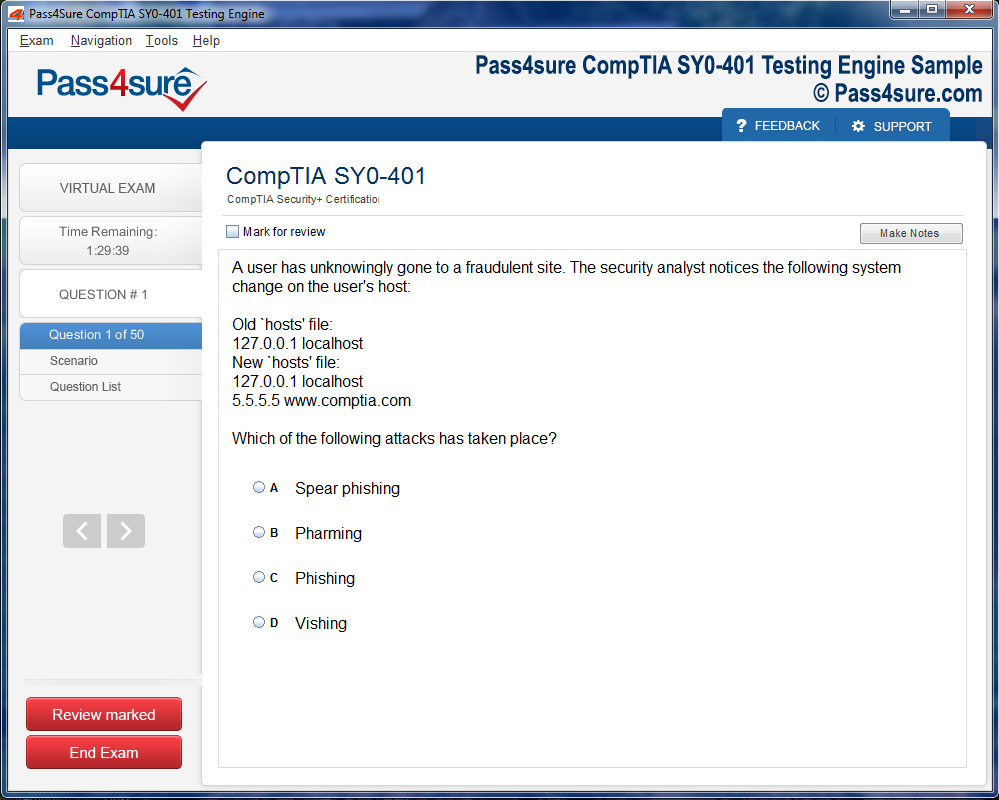
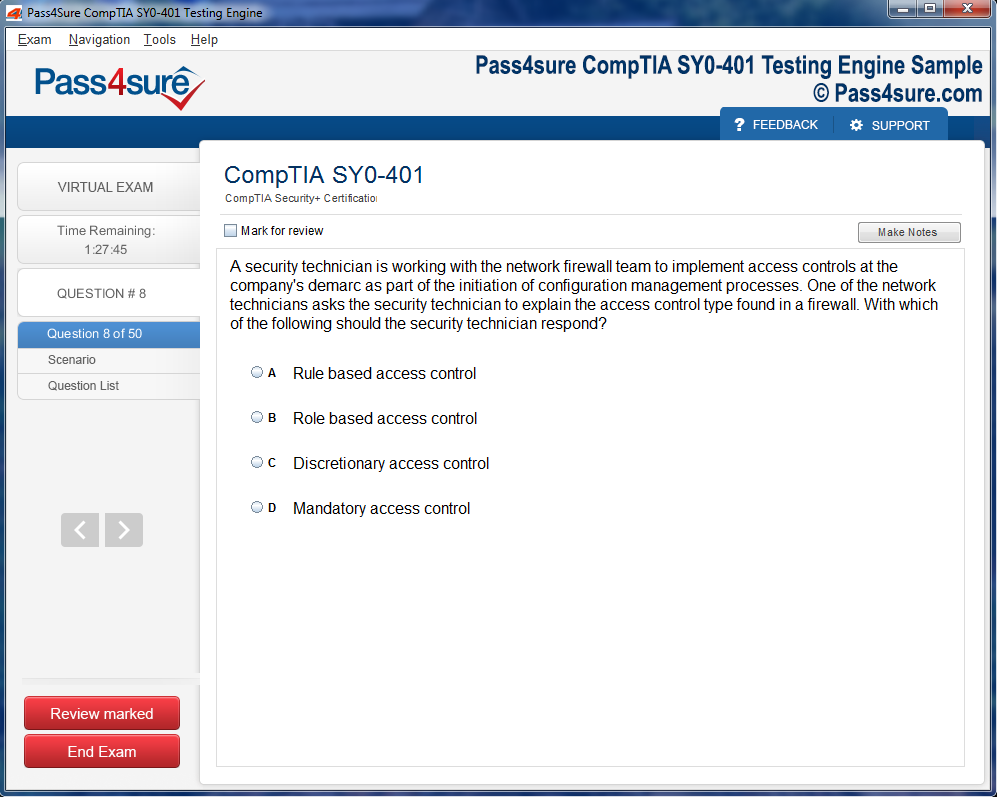
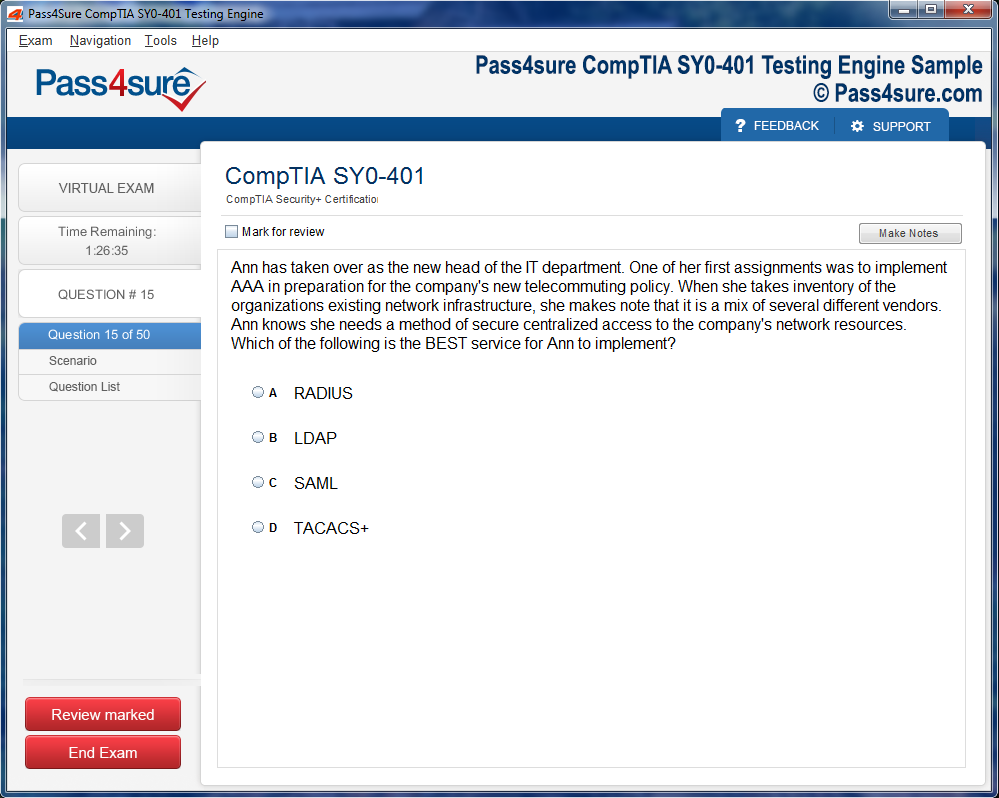
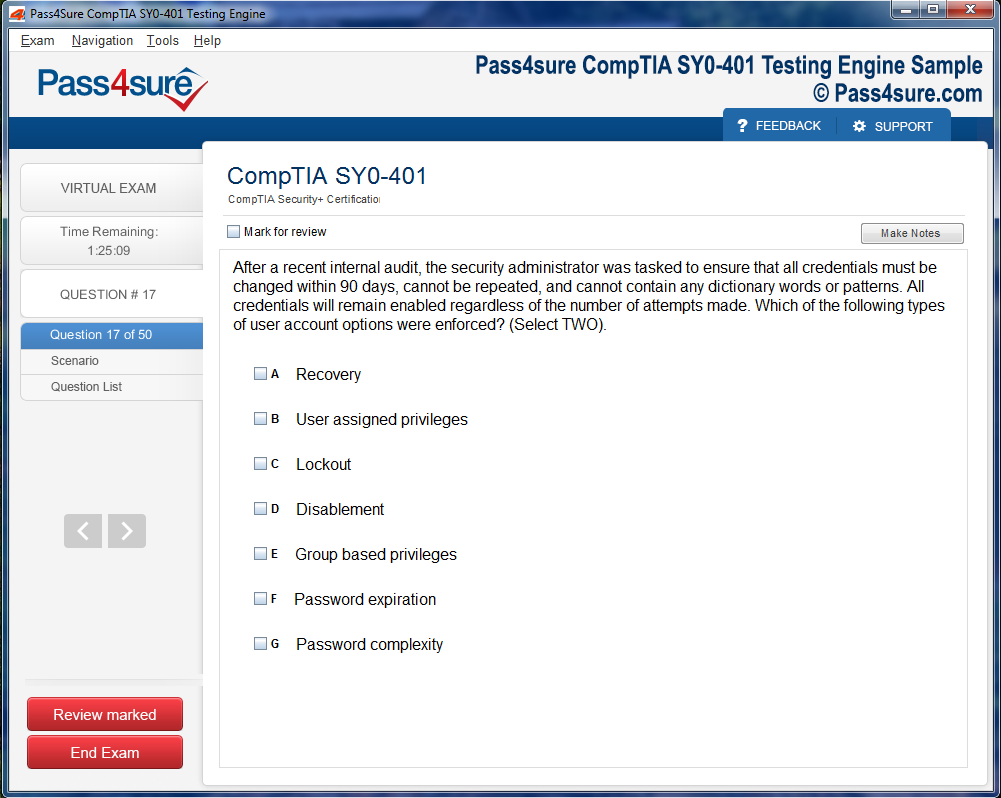
Product Screenshots




Frequently Asked Questions
How does your testing engine works?
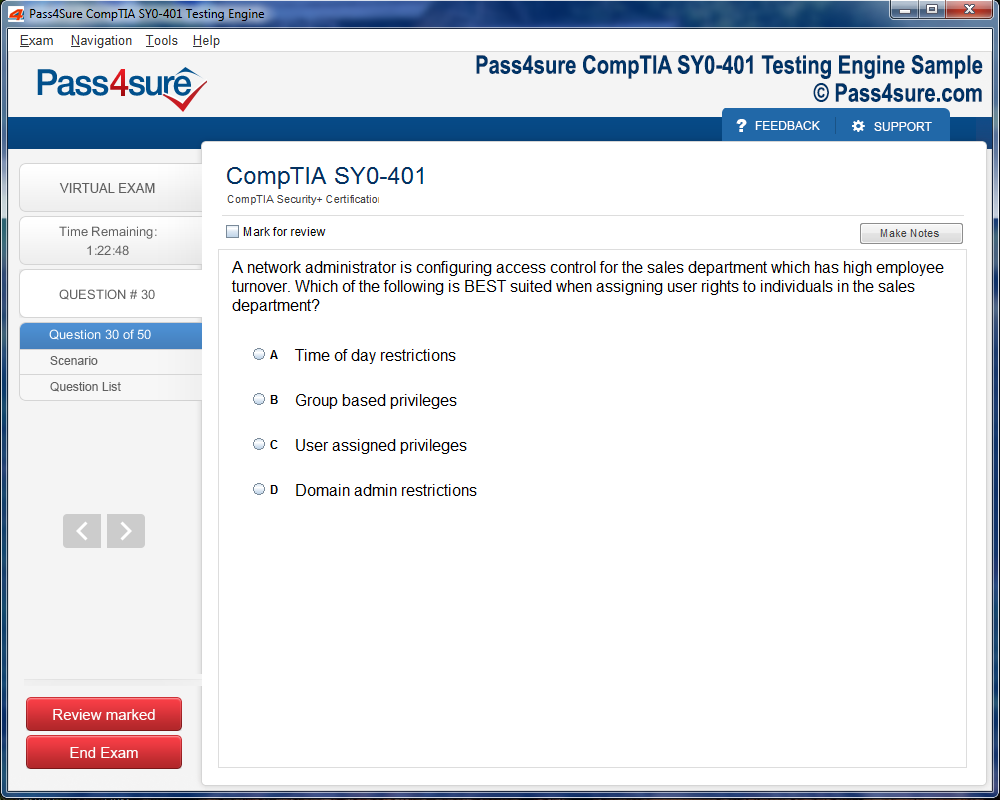
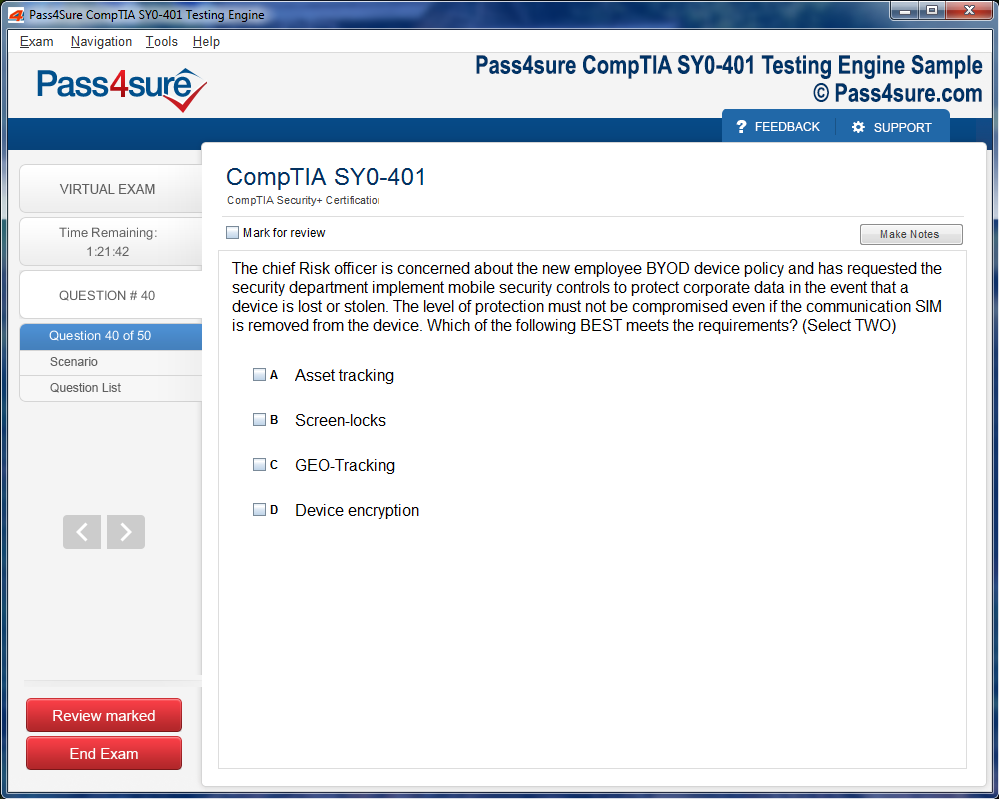
Once download and installed on your PC, you can practise test questions, review your questions & answers using two different options 'practice exam' and 'virtual exam'. Virtual Exam - test yourself with exam questions with a time limit, as if you are taking exams in the Prometric or VUE testing centre. Practice exam - review exam questions one by one, see correct answers and explanations.
How can I get the products after purchase?
All products are available for download immediately from your Member's Area. Once you have made the payment, you will be transferred to Member's Area where you can login and download the products you have purchased to your computer.
How long can I use my product? Will it be valid forever?
Pass4sure products have a validity of 90 days from the date of purchase. This means that any updates to the products, including but not limited to new questions, or updates and changes by our editing team, will be automatically downloaded on to computer to make sure that you get latest exam prep materials during those 90 days.
Can I renew my product if when it's expired?
Yes, when the 90 days of your product validity are over, you have the option of renewing your expired products with a 30% discount. This can be done in your Member's Area.
Please note that you will not be able to use the product after it has expired if you don't renew it.
How often are the questions updated?
We always try to provide the latest pool of questions, Updates in the questions depend on the changes in actual pool of questions by different vendors. As soon as we know about the change in the exam question pool we try our best to update the products as fast as possible.
How many computers I can download Pass4sure software on?
You can download the Pass4sure products on the maximum number of 2 (two) computers or devices. If you need to use the software on more than two machines, you can purchase this option separately. Please email sales@pass4sure.com if you need to use more than 5 (five) computers.
What are the system requirements?
Minimum System Requirements:
- Windows XP or newer operating system
- Java Version 8 or newer
- 1+ GHz processor
- 1 GB Ram
- 50 MB available hard disk typically (products may vary)
What operating systems are supported by your Testing Engine software?
Our testing engine is supported by Windows. Andriod and IOS software is currently under development.
Exam Success Strategies for Senior System Architects – PEGAPCSSA87V1
Embarking on the odyssey of enterprise architecture requires a cerebral dexterity that transcends mere technical proficiency. A Senior System Architect inhabits a cognitive space where abstraction intertwines with operational pragmatism. Understanding how micro-decisions cascade into macro-architectural consequences is paramount. Every rule, case type, and integration point contributes to a lattice of operational efficiency, resiliency, and adaptability. The architect must navigate this lattice with a precision that balances ingenuity with practicality.
Strategic cognition involves dissecting the enterprise into modular yet interdependent components. Each component—whether a case type, decision table, or integration—functions as both a self-contained entity and a cog within a larger mechanism. Recognizing these dualities fosters a mindset capable of anticipating bottlenecks, mitigating redundancies, and enhancing performance. This duality awareness is essential not only for the exam but also for real-world implementation, where misalignment of even a single component can propagate inefficiencies across the system.
Integrative Design Methodologies in Pega
Integrative design within Pega transcends mere configuration. It demands a deliberate orchestration of components, rules, and processes to generate cohesive, adaptive applications. Senior architects employ a mosaic approach, where each module is curated to complement and enhance the whole. Declarative processing, data transformation strategies, and reusable components serve as primary instruments in this symphony, enabling rapid adaptation and iterative refinement.
One of the core tenets of Pega’s integrative methodology is reusability. Architecting with reusability in mind requires envisioning applications not as static solutions but as evolving frameworks. Patterns established in one application must be readily adaptable to new business contexts, ensuring a multiplicative impact of design decisions. This approach fosters a culture of efficiency, reduces technical debt, and aligns with strategic imperatives for enterprise scalability.
Advanced Case Management Paradigms
Mastery of case management paradigms constitutes the backbone of senior-level proficiency. Cases in Pega are not merely containers of work but dynamic constructs capable of self-orchestration through declarative rules, automated flows, and event-driven behaviors. Senior architects must cultivate an intuitive understanding of case hierarchies, subcases, and parallel processing mechanisms, ensuring that business processes execute seamlessly under varying conditions.
Complexity often emerges not from individual cases but from their interrelations. Nested case structures, dependencies, and exception paths require architects to predict system behavior under multiple contingencies. Advanced case management emphasizes adaptability: processes must gracefully accommodate changes in business rules, fluctuating workloads, and evolving stakeholder requirements. Exam preparation benefits from constructing elaborate case hierarchies and simulating exception handling to internalize these dynamics.
Decisioning and Predictive Automation
In the realm of Pega architecture, decisioning transcends simple conditional logic. Senior architects orchestrate sophisticated decision strategies that integrate predictive analytics, propensity models, and dynamic prioritization. By leveraging decision tables, scorecards, and adaptive models, applications can execute context-sensitive actions that optimize outcomes while maintaining compliance and auditability.
Predictive automation relies on the architect’s capacity to balance deterministic and probabilistic reasoning. Decisions must align with business objectives while responding fluidly to emergent patterns in data. This necessitates a nuanced understanding of Pega’s decisioning framework, including adaptive learning rules, Next-Best-Action logic, and temporal event management. Preparation strategies involve constructing diverse decision scenarios, experimenting with alternative models, and rigorously evaluating outcomes for accuracy and alignment.
Integration Strategies for Scalable Solutions
Integration constitutes the connective tissue of enterprise applications. A Senior System Architect must design robust interfaces that facilitate seamless communication between internal modules and external systems. This requires expertise in connectors, services, REST and SOAP APIs, messaging frameworks, and orchestration patterns. The goal is to create a resilient architecture that accommodates evolving business requirements without compromising performance.
Architects must also consider transactional integrity, error handling, and latency optimization. Integration is not merely technical plumbing; it embodies a strategic lever for agility. By employing abstraction layers, reusable services, and decoupled design principles, architects enhance maintainability and reduce systemic fragility. Hands-on experimentation with multi-tiered integrations provides candidates with the confidence to implement scalable solutions and anticipate potential pitfalls during the exam.
Performance Optimization and System Resiliency
Performance optimization is a multidimensional endeavor requiring both analytical rigor and creative problem-solving. Senior architects examine execution paths, database efficiency, rule resolution strategies, and declarative logic propagation to identify potential bottlenecks. By monitoring and profiling applications, they can make informed adjustments that enhance throughput, reduce latency, and improve user experience.
Resiliency planning complements performance considerations. Systems must tolerate failures, maintain state consistency, and recover gracefully from disruptions. Senior architects employ techniques such as load balancing, caching strategies, and failover mechanisms to bolster reliability. Exam scenarios often test the candidate’s ability to foresee failure points and implement mitigation strategies, emphasizing the interplay between performance, resiliency, and user satisfaction.
UI/UX Alignment with Strategic Goals
While much of the Senior System Architect’s focus resides in backend processes, front-end design remains a critical dimension. Applications must not only function optimally but also provide intuitive, responsive, and accessible interfaces. Understanding Pega’s UI paradigms, harnessing harnessed layouts, dynamic sections, and harness-level rules empowers architects to create user-centric applications that align with strategic business outcomes.
Advanced UI/UX considerations involve anticipating user behavior, streamlining navigation, and minimizing cognitive load. Declarative UI rules, responsive designs, and contextual action flows contribute to a seamless experience that enhances adoption and operational efficiency. Integrating user experience insights into architectural design underscores the holistic nature of senior-level proficiency, where technical elegance converges with human-centric thinking.
Declarative Processing and Rule Propagation
Declarative processing embodies Pega’s ethos of model-driven, self-regulating systems. Senior architects must grasp how declarative rules, when strategically deployed, facilitate automatic updates, dependency resolution, and state synchronization. This capability reduces manual intervention, enforces consistency, and accelerates process execution.
Understanding the propagation of declarative rules is essential. Architects must predict how changes ripple through the system, ensuring that dependencies are managed without unintended side effects. Exam preparation benefits from constructing scenarios where multiple declarative rules interact, observing outcomes, and refining configurations to optimize correctness and efficiency.
Intricacies of Multi-Tiered Workflow Design
Senior architects must navigate the labyrinthine architecture of multi-tiered workflows, where each stratum encapsulates discrete operational intents yet remains interwoven with overarching objectives. These workflows demand a perspicacious approach to concurrency, ensuring tasks propagate fluidly across layers without engendering bottlenecks or informational discord. In essence, the architect becomes a choreographer of task symphony, orchestrating subprocesses that interlace with precision while preserving the autonomy of each module.
Dynamic orchestration entails not merely sequencing steps but anticipating contingencies. Case structures must accommodate sporadic disruptions, emergent priorities, and asynchronous interdependencies. This requires proficiency in event correlation, temporal hierarchies, and conditional branching. Sophisticated event-driven paradigms empower cases to metamorphose responsively, with minimal human intervention, thereby preserving operational momentum and mitigating risk exposure.
Subprocess Reusability and Modular Cognition
The linchpin of sustainable workflow engineering lies in modular cognition—the ability to fragment processes into discrete, reusable subprocesses that embody standardized logic yet retain flexibility for bespoke deployment. Modularization mitigates cognitive load during design, facilitating iterative refinement and cross-application portability. Subprocesses function as microcosms of procedural wisdom, allowing architects to replicate validated patterns across heterogeneous business domains while ensuring fidelity to compliance and quality standards.
Trigger mechanisms for subprocesses must be scrupulously defined. Milestone management and exception handling imbue the workflow with resiliency, ensuring that deviations from normative behavior are absorbed without compromising the integrity of downstream tasks. By harnessing the synergy of modular design and intelligent triggers, architects cultivate an ecosystem where complexity becomes manageable, predictable, and inherently scalable.
Dynamic Responsiveness and Event-Driven Cognition
In advanced case management, dynamic responsiveness transcends static configuration. Cases must exhibit chameleonic adaptability, responding in real time to mutable data landscapes, emergent events, or nuanced user interactions. This necessitates mastery of event-driven cognition, where rules, thresholds, and conditional logic converge to dictate procedural evolution. Decision points act as fulcrums, balancing operational efficiency with compliance mandates, while service-level agreements provide temporal scaffolding for expectation management.
By embedding adaptive logic, architects transform applications into living systems capable of self-regulation. Such systems do not merely follow prescribed paths; they anticipate and react to anomalies, dynamically reallocating resources or rerouting tasks to preserve continuity. The implications for organizational agility are profound, as real-time responsiveness translates to accelerated decision-making, reduced operational latency, and enhanced alignment with strategic imperatives.
Optimization of Performance and Scalability
As the breadth and depth of cases expand, inefficiencies manifest with exponential impact. Senior architects must embrace optimization as a continuous discipline, identifying redundancies, minimizing unnecessary computation, and leveraging declarative constructs judiciously. The interplay between structural elegance and procedural efficiency defines whether an application can sustain growth without succumbing to latency or errors.
Simulative testing under heterogeneous scenarios is indispensable. By modeling variable workloads, exception patterns, and concurrent user interactions, architects can discern performance bottlenecks and refine logic preemptively. Scalability, in this context, is not merely a question of infrastructure but of intelligent design—a preemptive scaffolding that accommodates growth while preserving throughput and reliability.
Human-Centric Integration and User Engagement
The efficacy of complex workflows is ultimately adjudicated by the human agents who interact with them. Senior architects must harmonize technical sophistication with human-centric design, cultivating interfaces that convey clarity, reduce cognitive friction, and foster engagement. Case views should illuminate status and context, while intuitive assignment structures ensure that users understand their responsibilities and priorities without ambiguity.
Actionable guidance embedded within workflows enhances compliance and reduces errors. By anticipating user pain points and providing contextual support, architects bridge the gap between procedural rigor and practical usability. This integration not only accelerates adoption but reinforces organizational confidence in automated systems, engendering a culture of trust and operational fluency.
Governance, Compliance, and Ethical Oversight
Advanced case management transcends operational efficiency; it intersects with governance, compliance, and ethical stewardship. Architecting workflows requires meticulous attention to regulatory frameworks, auditability, and traceability. Every decision point, data modification, and subprocess invocation must be recorded with granularity sufficient to satisfy internal and external scrutiny.
Ethical oversight emerges as an often-underappreciated dimension of workflow design. Architects must ensure that automated decisions adhere to organizational values, avoid unintended bias, and maintain equitable treatment of stakeholders. By embedding compliance checks and ethical heuristics into the workflow fabric, senior architects cultivate systems that are not only performant but principled.
The Intricacies of Decisioning Architecture
Decisioning within Pega applications transcends mere rule execution; it embodies the cerebral substrate of enterprise intelligence. Architects must navigate a labyrinthine matrix of interdependent rules, each capable of cascading effects that influence holistic application behavior. Decisioning strategies demand a perspicacious understanding of conditional hierarchies, prioritization schemas, and dynamic adaptability to fluctuating operational stimuli. A sophisticated decisioning framework orchestrates disparate rules to produce cohesive, contextually appropriate outcomes, reflecting not merely deterministic logic but strategic foresight.
In advanced deployments, decisioning is not static; it embodies anticipatory responsiveness. Applications must decipher the nuanced interplay between predictive scoring, behavioral patterns, and heuristic inference. This necessitates an adept comprehension of probabilistic reasoning and scenario modeling, equipping architects to sculpt systems that evolve organically with emergent data streams. The capability to anticipate divergent outcomes and adjust rule weightings dynamically constitutes the quintessence of high-caliber decisioning intelligence.
Declarative Logic and Automated Cognition
Declarative rules serve as the linchpin for automated cognition within enterprise applications. Unlike procedural logic, which necessitates explicit sequencing of operations, declarative paradigms enable properties and actions to self-adjust according to predetermined conditions. The judicious deployment of declarative logic minimizes redundancy, curtails human error, and engenders systemic coherence across multifaceted workflows.
Architects must exercise discernment in distinguishing scenarios where declarative rules optimize efficiency from those that mandate procedural interventions. This calculus involves evaluating performance implications, maintainability, and the fluidity of rule interactions. Mastery over declarative logic requires fluency in triggers, constraints, and propagation mechanisms that maintain data integrity while orchestrating complex conditional outcomes.
Declarative logic imbues applications with a semblance of sentience. By allowing rules to react autonomously to state changes, applications can anticipate user actions, preempt errors, and streamline operational throughput. This self-regulating mechanism fosters resilience, ensuring that applications remain robust under evolving business exigencies.
The Symbiosis of Predictive Models and Rule Prioritization
Integrating predictive analytics with rule-based frameworks is a hallmark of sophisticated decisioning ecosystems. Predictive models utilize historical data, probabilistic inference, and machine learning algorithms to anticipate outcomes, providing decision strategies with a prescient edge. When harmonized with rule prioritization, predictive insights enhance both accuracy and efficiency in decision-making.
Senior architects must possess an acute understanding of how predictive scores interface with rule hierarchies. Each rule’s weight and sequencing influence the trajectory of automated decisions, dictating case progression and subcase orchestration. An astute architect recognizes the interdependencies between scoring models and rule outcomes, optimizing configurations to mitigate latency, prevent conflicts, and elevate overall system intelligence.
The artful fusion of predictive intelligence and deterministic rules cultivates a dynamic environment where applications operate with both rigidity and flexibility. Rules maintain operational consistency, while predictive models inject adaptive foresight, producing systems capable of nuanced, contextually aware decisions.
Scenario Simulation and Robust Validation
Testing decision strategies is an exercise in meticulous foresight. Complex applications necessitate exhaustive scenario simulation, encompassing both normative and edge conditions. Architects must envisage atypical sequences, boundary conditions, and rare anomalies to ensure that decision logic performs with unwavering fidelity.
Simulation involves layering predictive models, declarative triggers, and procedural rules to observe emergent behaviors. Architects scrutinize outcomes for logical coherence, systemic stability, and alignment with organizational imperatives. This rigorous validation instills confidence, ensuring that decisioning frameworks exhibit resilience, adaptability, and precision under the spectrum of operational realities.
Validation also functions as a pedagogical tool. By iteratively analyzing rule behavior across variegated scenarios, architects refine their understanding of decision interdependencies, enhance foresight, and cultivate an anticipatory mindset crucial for high-stakes deployments.
Harmonizing Decisions Within Case Management
A critical dimension of decisioning is its seamless integration into case and subcase frameworks. Decisions rarely exist in isolation; they must interact fluidly with overarching workflows to maintain contextual coherence. Architects orchestrate rules to drive case progression, trigger subcase creation, and automate escalations without fragmenting systemic logic.
This requires dexterity in aligning rule execution with case lifecycle stages, ensuring that outcomes propagate appropriately across nested processes. Sophisticated architects employ decision orchestration patterns that reconcile rule precedence, manage dependencies, and optimize throughput. The resulting applications exhibit both agility and fidelity, capable of responding to fluctuating inputs without compromising procedural integrity.
By embedding decisioning deeply within case architecture, applications attain a degree of procedural autonomy. Cases evolve dynamically, subcases respond adaptively, and workflows maintain consistency, collectively forming an ecosystem that embodies operational intelligence.
Orchestrating Multi-System Workflows
In the contemporary digital tapestry, applications seldom exist in isolation. Senior architects must orchestrate intricate workflows that traverse multiple platforms, ensuring data streams remain coherent and synchronized. Such orchestration necessitates a perspicacious grasp of asynchronous messaging, event-driven triggers, and transactional idempotency to prevent duplicity or inconsistency. Architectures designed with sagacity embrace fault-tolerant paradigms and leverage queues or event buses to accommodate ephemeral service outages without compromising business continuity.
Integrating heterogeneous systems demands an appreciation for divergent communication protocols, data schemas, and operational tempos. Architects often navigate labyrinthine API hierarchies and negotiate throttling constraints while maintaining end-to-end observability. Instrumenting telemetry and logging mechanisms enables real-time monitoring, empowering proactive remediation and continuous optimization.
Nuanced Data Modeling and Semantic Fidelity
The cornerstone of resilient application architecture is data modeling imbued with semantic fidelity. Senior architects construct entity relationships that mirror real-world organizational complexity, ensuring that hierarchies, dependencies, and polymorphic behaviors are faithfully represented. Propensity for granular property definition and judicious use of derived attributes permits applications to respond dynamically to contextual changes without burdening performance.
Semantic alignment is paramount when integrating data from external sources. Mapping disparate taxonomies, normalizing data representations, and reconciling inconsistencies demand meticulous attention. Advanced Pega architectures employ declarative logic, transformation rules, and automated reconciliation routines to preserve integrity across convoluted data landscapes.
Declarative Transformations and Adaptive Integration
Declarative transformations underpin the adaptive prowess of enterprise applications. Senior architects leverage mapping rules, correspondence tables, and automated property propagation to harmonize disparate data formats and ensure that workflows remain cohesive. Such transformations are not merely mechanical; they embody the cognitive scaffolding that permits systems to respond intuitively to emergent scenarios.
Integration extends beyond rudimentary CRUD operations. Sophisticated applications incorporate event-driven updates, real-time synchronization, and conditional routing to orchestrate intelligent inter-system communication. Error handling strategies, including retry mechanisms, compensating transactions, and anomaly detection, are indispensable for sustaining operational robustness.
Simulative Testing for Operational Resilience
Testing integrations transcends conventional verification; it embodies a simulative rehearsal of operational exigencies. Senior architects employ synthetic datasets, latency simulations, and load-testing paradigms to emulate realistic conditions. This crucible of scrutiny elucidates hidden dependencies, performance bottlenecks, and edge-case anomalies.
Validation routines extend to response schemas, exception propagation, and concurrency handling, ensuring that applications maintain functional fidelity under duress. Iterative refinement of integration logic, guided by empirical observations, fortifies both reliability and maintainability.
Intelligent Interconnectivity and Evolutionary Scalability
Applications designed with an ethos of intelligent interconnectivity transcend mere automation. By combining advanced integration techniques with semantic-rich data modeling, architects construct systems capable of anticipatory behavior, adaptive routing, and contextual decision-making. Such systems exhibit resilience in the face of evolving requirements, scaling gracefully as organizational complexity proliferates.
The architectural mindset shifts from reactive problem-solving to proactive orchestration, emphasizing modularity, observability, and adaptability. Each component functions not as an isolated unit but as an integral node in a dynamic, self-organizing ecosystem.
Mastery of Integration Paradigms
Command over integration paradigms elevates an architect from technical proficiency to strategic influence. RESTful services, SOAP endpoints, messaging buses, and database connectors become instruments in a symphony of data fluidity. Senior architects judiciously select paradigms aligned with latency tolerances, transactional semantics, and operational idiosyncrasies.
Declarative logic, automated propagation, and semantic normalization converge to form a resilient lattice through which information traverses with fidelity and efficiency. Such mastery fosters not only application robustness but also organizational agility, enabling enterprises to pivot and innovate with confidence.
Observability and Continuous Assurance
In complex ecosystems, observability constitutes the linchpin of operational assurance. Senior architects implement logging, metrics, and tracing frameworks to capture real-time insights into inter-system interactions. Anomalous patterns, latency spikes, and data discrepancies are surfaced promptly, facilitating prescient intervention before they escalate into systemic disruptions.
Continuous assurance encompasses both performance validation and compliance adherence. By embedding automated audits, anomaly detection routines, and adaptive monitoring, architects ensure that applications remain congruent with business imperatives and regulatory mandates.
The Sublime Architecture of User Interface
The interface represents the ephemeral bridge between human cognition and computational orchestration. It is the locus where users’ intentions materialize into actions, and where the latent complexity of the underlying system must remain invisible yet accessible. Senior architects must cultivate a perspicuous design ethos, harmonizing cognitive load with operational fluency. Interfaces must radiate intuitive clarity, ensuring that each interaction is suffused with immediacy and purpose. Harnesses, layouts, and sections are not merely containers of data; they are conduits of comprehension, guiding users through intricate workflows with dexterity and elegance.
Choreographing Dynamic Interaction
Advanced user interfaces thrive on dynamism, weaving contextual relevance into every display element. Visibility must be deliberate, modulated by role-specific pertinence, temporal significance, and anticipated behavioral patterns. Personalization transcends superficial aesthetics, embedding anticipatory intelligence into the interface to present the precise information at the juncture it is most salient. Architects must contemplate the cognitive ramifications of each interface decision, crafting pathways that diminish ambiguity while amplifying comprehension. Error handling, guidance scaffolds, and interactive prompts serve as the silent interlocutors, steering users away from potential pitfalls and fostering confidence in system navigation.
Performance as an Artistic Tenet
An interface’s elegance is inseparable from its performance. Rapid rendering of sections, judicious deployment of dynamic layouts, and the excision of redundant processing elevate both functional and experiential value. Senior architects engage in a delicate equilibrium, balancing the opulence of rich interactivity with the economy of computational expedience. The interface must exude immediacy, with minimal latency and maximal responsiveness, reflecting a synergy between design artistry and technical acumen. Each millisecond saved in processing transforms into perceptual fluidity, enhancing user immersion and operational satisfaction.
Reusability and Strategic Frameworks
Application design within a senior architect’s purview extends beyond immediacy, venturing into the realm of sustainability and strategic foresight. Templates and reusable constructs form the substratum of scalable applications, allowing intricate functionalities to propagate across multiple projects with consistent integrity. These frameworks serve as both architectural blueprints and cognitive scaffolds for development teams, mitigating redundancy and enforcing coherent standards. Senior architects must wield these tools with precision, ensuring that the proliferation of reusable assets augments rather than constrains innovation.
Security and Role-Based Cognition
Architectural sophistication is incomplete without rigorous attention to security. Applications must differentiate access not merely on nominal hierarchies but through nuanced understanding of organizational roles and data sensitivity. Rule-based visibility, context-sensitive permissions, and encryption protocols constitute a latticework of protection, guarding against unauthorized access while maintaining seamless usability. Senior architects must anticipate potential vulnerabilities, embedding security considerations into design paradigms rather than relegating them to post-development inspection. Security, in this sense, is not an adjunct but an intrinsic facet of elegant design.
Cognitive Affordances and User Guidance
The orchestration of interfaces demands acute awareness of human cognition. Information architecture must scaffold understanding, presenting complex data in digestible segments and leveraging progressive disclosure to prevent overwhelm. Guidance mechanisms—tooltips, in-line instructions, and contextual alerts—function as cognitive beacons, illuminating pathways and preempting errors. Senior architects balance explicit instruction with intuitive affordances, enabling users to navigate complex processes with minimal external support. This interplay between clarity and autonomy cultivates an environment where users feel both empowered and competent.
Synergy of Design and Examination Readiness
In the crucible of senior-level certification and practical deployment, interface and application design coalesce into a singular measure of proficiency. Architects must demonstrate not only technical dexterity but also conceptual elegance, integrating aesthetics, performance, security, and usability into a cohesive framework. The ability to envision, implement, and maintain sophisticated interfaces signals mastery, reflecting both professional capability and preparedness for evaluative scrutiny. Each element—from layout to framework, from dynamic visibility to error mitigation—becomes an expression of intentionality and intellectual rigor.
Maintaining Elegance Amidst Complexity
Complexity is an ever-present specter in advanced applications. Senior architects mitigate its potential for chaos through modular design, abstraction of logic, and disciplined layering of interface elements. Each section and harness is curated with meticulous attention, minimizing cognitive dissonance while maximizing operational clarity. Elegance is not mere aesthetics; it is the synthesis of functional clarity, intuitive navigation, and resilient architecture. In such environments, users traverse workflows seamlessly, unaware of the intricate orchestration beneath the surface yet benefiting profoundly from its sophistication.
Harmonizing Relevance and Anticipation
Interfaces flourish when relevance is anticipatory rather than reactive. The senior architect’s task involves discerning patterns in user behavior, mapping contextual triggers, and deploying information in a temporally optimal fashion. By harmonizing predictive logic with responsive design, applications transcend mere functionality to become adaptive companions in workflow execution. Users experience a seamless convergence of expectation and delivery, where each interaction is preemptively tuned to their needs, preferences, and situational exigencies.
Integrating Cognitive Ergonomics with Technical Precision
The apex of interface design marries cognitive ergonomics with computational precision. Visual hierarchy, affordance signaling, and interaction feedback are interlaced with robust rule frameworks, efficient data processing, and responsive behavior. Senior architects calibrate these elements with surgical exactitude, ensuring that cognitive load is minimized while operational efficiency is maximized. This synthesis cultivates environments where users perform optimally, decision-making is expedited, and technical robustness remains invisible yet omnipresent.
Exam Strategy and Continuous Learning
Success in the PEGAPCSSA87V1 examination is not merely a measure of rote memorization, but an orchestration of sagacious strategy intertwined with profound conceptual mastery. Aspirants must cultivate a cognitive map of the platform, weaving theoretical understanding with pragmatic application. An intricate balance between didactic study and experiential practice cultivates not only knowledge retention but also dexterous problem-solving capabilities.
Cognitive Calibration and Temporal Management
Temporal dexterity is paramount in the crucible of high-stakes examinations. Candidates who can partition their cognitive resources judiciously, allocating specific temporal allotments to each domain, enhance their efficacy manifold. Practicing under simulated exam conditions galvanizes time management instincts and tempers exam-induced apprehension. It is not sufficient to merely understand; one must develop a metacognitive awareness of personal strengths and vulnerabilities within each domain, enabling dynamic adjustment of strategy mid-exam.
Scenario-Based Mastery
The PEGAPCSSA87V1 exam thrives on scenario-oriented interrogation, demanding a confluence of analytical acuity and practical intuition. Engaging with complex, real-world scenarios sharpens the ability to discern underlying patterns, anticipate pitfalls, and execute solutions with precision. Iterative engagement with scenario-based exercises fosters a scaffolded understanding, where each successive iteration builds upon prior cognitive imprints, reinforcing both comprehension and agility.
Documentation as an Instrument of Insight
The meticulous review of platform documentation constitutes an intellectual cornerstone. Beyond rote reading, documentation serves as an expansive reservoir of nuanced knowledge, offering insights into platform idiosyncrasies, edge cases, and latent functionalities. Immersive engagement with these resources allows candidates to internalize best practices and acquire an anticipatory understanding of how features interrelate within complex solutions.
Reflective Iteration and Error Analysis
An indispensable pillar of exam preparation is reflective iteration. Confronting errors and dissecting missteps cultivates a profound understanding of conceptual lacunae. This process of deliberate introspection and targeted remediation transforms mistakes into catalytic instruments of growth. Continual self-assessment engenders both cognitive resilience and strategic refinement, creating a virtuous cycle of improvement that transcends superficial familiarity with content.
Beyond Certification: Lifelong Cognitive Enrichment
Certification is a waypoint, not a terminus. Senior architects must embrace a paradigm of perpetual cognitive enrichment. Engaging with communities of practice, delving into emergent platform functionalities, and experimenting with complex implementations fosters innovation and adaptive expertise. Continuous engagement with evolving technological landscapes ensures that mastery is dynamic rather than static, propelling practitioners toward ever-expanding horizons of competence.
Integration of Strategy and Technical Prowess
The synthesis of tactical examination strategies with technical proficiency engenders unparalleled efficacy. Candidates who cultivate this integration navigate examinations with composure and execute solutions with elegance. This holistic approach equips architects to design systems that are not merely functional but intelligent, resilient, and scalable. Mastery is thus manifested in both the strategic orchestration of preparation and the technical virtuosity applied in professional contexts.
Adaptive Learning and Cognitive Agility
Adaptive learning is the keystone of enduring expertise. Architects must cultivate the ability to pivot methodologies, assimilate new paradigms, and respond to evolving challenges with cognitive agility. This entails a deliberate engagement with unfamiliar scenarios, reflective recalibration of approaches, and iterative experimentation. Such a mindset converts obstacles into opportunities for intellectual enrichment and professional advancement.
Experiential Synthesis and Knowledge Transcendence
True expertise emerges from the synthesis of experiential and theoretical knowledge. Engaging with tangible projects, simulating intricate workflows, and experimenting with complex integrations enable the internalization of abstract concepts. This embodied cognition allows architects to transcend rote procedural understanding, achieving a nuanced grasp of system behaviors, interdependencies, and performance optimization.
Strategic Confidence and Professional Gravitas
Confidence is cultivated through preparedness, iterative practice, and deep comprehension. A senior architect who approaches examinations and professional challenges with strategic poise demonstrates not merely knowledge, but an authoritative command of the domain. This professional gravitas engenders trust, facilitates leadership, and accelerates innovation, positioning the architect as a linchpin in organizational success.
Cognitive Resonance and Conceptual Amplification
Achieving mastery in the PEGAPCSSA87V1 landscape requires more than superficial engagement; it demands cognitive resonance—a deep, harmonious alignment between knowledge and comprehension. Conceptual amplification emerges when aspirants explore the interstices of platform functionality, discerning subtle connections between seemingly disparate modules. This intellectual entanglement cultivates a robust mental framework, allowing for agile application in novel scenarios and intricate problem-solving.
Heuristic Frameworks for Problem Solving
In navigating complex scenarios, heuristic frameworks act as navigational beacons. Rather than relying solely on prescriptive solutions, aspirants develop cognitive shortcuts grounded in systemic understanding. These heuristics, derived from iterative practice and experiential engagement, facilitate rapid assessment, identification of latent constraints, and synthesis of optimized solutions. The judicious application of heuristics balances analytical rigor with pragmatic efficiency.
Metacognitive Vigilance and Self-Audit
Metacognitive vigilance entails continuous self-monitoring of cognitive processes during both preparation and examination. Aspirants must cultivate an acute awareness of their own thinking patterns, biases, and recurring misjudgments. A structured self-audit regimen—documenting areas of uncertainty, recurring pitfalls, and emergent insights—enhances reflective cognition and accelerates mastery. This disciplined introspection transforms ordinary study into a dynamic, self-regulating process of intellectual growth.
Experiential Simulation and Scenario Immersion
Beyond conventional practice, aspirants benefit from immersive experiential simulations that mimic the nuanced realities of enterprise deployment. By constructing and deconstructing intricate scenarios—spanning case management, business rules, decision strategies, and service integrations—candidates acquire a visceral understanding of systemic interdependencies. This immersion reinforces procedural fluency while simultaneously fostering adaptive reasoning applicable to both examination and real-world environments.
Cognitive Flexibility and Adaptive Strategy
Adaptive strategy is anchored in cognitive flexibility, the ability to shift perspectives, techniques, and priorities in response to emergent challenges. In high-stakes examination contexts, this translates to agile problem selection, dynamic time allocation, and iterative recalibration of approach. Cultivating cognitive flexibility requires deliberate engagement with atypical scenarios, exposure to edge-case behaviors, and ongoing experimentation with alternative solutions.
Lexical Precision and Analytical Clarity
Proficiency in the PEGAPCSSA87V1 realm is augmented by lexical precision—the careful articulation of logic, assumptions, and procedural steps. Aspirants who cultivate precise terminology and methodical expression not only internalize complex processes more effectively but also enhance diagnostic reasoning during problem-solving. Analytical clarity emerges from this precision, reducing errors attributable to misinterpretation and fostering elegant, coherent solutions.
Iterative Cognitive Layering
Iterative cognitive layering is a technique of progressively reinforcing understanding through repeated engagement with content at increasing levels of complexity. Each iteration consolidates prior learning while introducing nuanced variables, forcing the mind to integrate and reorganize knowledge structures. Over time, this layered approach yields deep-seated expertise, allowing aspirants to navigate unfamiliar problems with confident dexterity.
Strategic Pattern Recognition
Excellence in platform mastery often hinges upon pattern recognition—the ability to discern recurring structures, dependencies, and problem archetypes. Through systematic exposure to varied case studies, aspirants internalize common motifs and anticipate potential complications. Strategic pattern recognition accelerates problem-solving, reduces cognitive load, and empowers candidates to approach questions with foresight rather than reactionary improvisation.
Experiential Cross-Pollination
Cross-pollination between domains enhances adaptability and creativity. Engaging with peripheral features of the platform, exploring integrations, and experimenting with unconventional workflows cultivates interdisciplinary insight. This breadth of exposure equips aspirants to synthesize innovative solutions, uncover latent efficiencies, and approach examination scenarios with a uniquely holistic perspective.
Resilience Under Cognitive Strain
Endurance under cognitive strain is a subtle yet decisive factor in high-stakes assessments. Techniques such as focused interval practice, mental rehearsal, and scenario stress-testing fortify cognitive stamina. By repeatedly confronting challenging problems within timed constraints, aspirants acclimate to the pressures of examination conditions, preserving clarity of thought and strategic composure under duress.
Knowledge Recontextualization
True mastery involves the ability to recontextualize knowledge—transposing principles and processes into unfamiliar or evolving scenarios. Aspirants who cultivate this skill can adapt learned methodologies to novel challenges, bridging gaps between procedural familiarity and situational innovation. Recontextualization transforms static comprehension into dynamic, actionable intelligence.
Integrative Process Modeling
Aspirants benefit from constructing integrative process models, mapping complex workflows and interdependencies across the platform. This modeling practice reinforces systemic understanding, elucidates potential bottlenecks, and highlights opportunities for optimization. By internalizing these models, candidates can anticipate emergent behaviors and devise solutions that align with overarching architectural objectives.
Reflective Scenario Journaling
Documenting experiences through reflective scenario journaling consolidates both learning and insight. By articulating thought processes, decision rationales, and outcome evaluations, aspirants externalize cognitive patterns for scrutiny and refinement. This practice cultivates metacognitive awareness, accelerates error correction, and transforms episodic experience into structured, transferable knowledge.
Adaptive Resource Orchestration
Effective preparation necessitates judicious orchestration of learning resources. Candidates must evaluate the utility of documentation, simulations, peer discussions, and practice exercises, strategically allocating time to resources that maximize cognitive yield. Adaptive orchestration ensures efficient progression, balancing breadth of exposure with depth of understanding in critical domains.
Semantic Structuring and Knowledge Architecture
Constructing a personal knowledge architecture enhances recall, comprehension, and problem-solving. By semantically structuring information—grouping related concepts, hierarchically organizing principles, and linking procedural sequences—aspirants create an internalized cognitive map of the platform. This mental schema facilitates rapid navigation of complex questions and enhances the capacity for integrative reasoning.
Reflexive Knowledge Calibration
Periodic reflexive calibration ensures alignment between perceived proficiency and actual capability. By systematically benchmarking performance against practice assessments, aspirants identify discrepancies and recalibrate focus areas. This ongoing feedback loop refines both study strategy and cognitive acuity, preventing complacency and reinforcing sustained progress.
Experiential Layering of Complexity
Introducing incremental complexity into practice scenarios fosters robust cognitive adaptation. By layering additional variables, constraints, or dependencies in exercises, candidates progressively expand their problem-solving repertoire. This deliberate escalation cultivates resilience, adaptability, and the ability to synthesize multifaceted solutions under examination conditions.
Cognitive Scaffolding Through Visualization
Visualization techniques enhance comprehension of abstract or intricate platform functionalities. Diagramming workflows, decision trees, and integration maps provides tangible cognitive scaffolds that support analytical reasoning. This externalization of complexity simplifies mental processing, aids in error detection, and accelerates strategic solution formulation.
Adaptive Meta-Learning
Meta-learning—the art of learning how to learn—is integral to enduring expertise. Aspirants refine strategies for acquisition, retention, and application, continuously adapting methods to optimize efficiency. Adaptive meta-learning ensures preparation is not static, allowing candidates to evolve study approaches in alignment with emerging challenges and personal cognitive strengths.
The Poetics of Workflow Visualization
In advanced application design, the choreography of workflow visualization is paramount. Users must apprehend the interstitial connections between tasks without cognitive strain. Senior architects sculpt case flows with deliberate granularity, ensuring each stage is demarcated, each transition transparent, and each dependency discernible. Visualization is not mere ornamentation; it is a cognitive cartography, mapping latent processes into perceptible sequences. Dynamic highlighting of active stages, conditional expansion of subtasks, and contextual emphasis of decision points imbue the interface with an intuitive rhythm, allowing users to navigate complexity with dexterity.
The Alchemy of Contextual Responsiveness
Contextual responsiveness elevates an interface from static presentation to adaptive intelligence. Applications must not merely react but anticipate, shifting display content, actionable controls, and data prioritization according to situational nuances. Role-based triggers, temporal relevance, and historical behavior inform real-time adaptations, transforming the interface into a symbiotic partner rather than a passive conduit. Senior architects orchestrate these adaptations with precision, balancing automation with discernible control, so that the user perceives agency while benefiting from predictive insight.
Semantic Layering in Interface Design
Semantic layering introduces an additional cognitive scaffold, wherein information is hierarchically structured according to meaning rather than mere placement. By distinguishing primary content from ancillary details, architects enable users to parse complexity incrementally. Sections, harnesses, and grids are imbued with semantic cues, guiding attention through visual weight, alignment, and spacing. This subtle orchestration reduces cognitive friction, allowing users to assimilate high-density data streams with clarity. Senior architects leverage semantic layering to cultivate an environment where comprehension is effortless, even amid voluminous operational demands.
Orchestrating Multi-Modal Interactions
Interfaces increasingly transcend singular input modalities, embracing touch, voice, gesture, and contextual sensors. Multi-modal design requires acute foresight to ensure coherence across divergent channels. Each interaction pathway must preserve logical consistency while exploiting modality-specific affordances. Senior architects anticipate potential conflicts, ensuring that a gesture does not contradict a click, a voice command does not bypass security constraints, and that input feedback remains immediate and intelligible. The result is a harmonized ecosystem, where users engage seamlessly across diverse modalities without dissonance.
Micro-Interactions and Cognitive Feedback Loops
Micro-interactions, often overlooked, constitute the subtext of user experience. Animations, hover effects, subtle transitions, and confirmation cues create a feedback loop that reassures, informs, and delights. Senior architects exploit these micro-interactions to reinforce user actions, mitigate errors, and subtly guide behavior. They operate on the principle that interface comprehension is iterative and experiential; each micro-interaction serves as a micro-lesson, calibrating expectations and fostering trust. In aggregate, these nuanced cues transform functional operations into perceptually coherent journeys.
Adaptive Layouts and Spatial Cognition
Spatial cognition is a latent factor in user engagement. The arrangement of interface components influences perception, memory retention, and decision-making speed. Adaptive layouts respond to device constraints, screen real estate, and user behavior, reorganizing content without dislocating mental models. Senior architects engineer these layouts with modular precision, ensuring that shifting elements retain relational integrity and cognitive continuity. The interplay of proportional scaling, responsive grids, and visual anchoring fosters a seamless user experience, unifying form with operational logic.
Cognitive Load Distribution and Decision Economy
Managing cognitive load is a nuanced art, involving both reduction and distribution. Applications must fragment complex workflows into digestible modules, yet maintain coherence across the operational continuum. Senior architects employ decision economy principles, presenting options only when contextually relevant and minimizing unnecessary cognitive exertion. Conditional rendering, progressive disclosure, and anticipatory filtering converge to create an environment where users act efficiently without experiencing overwhelm. This deliberate orchestration transforms cognitively taxing workflows into navigable and gratifying experiences.
Temporal Dynamics and Interaction Timing
The temporal dimension of interface design is often underappreciated. Response latency, animation pacing, and process transitions shape the user’s perception of speed, reliability, and control. Senior architects calibrate temporal dynamics meticulously, aligning system responses with expected mental models and operational rhythm. Visual cues indicate pending operations, asynchronous tasks are signaled without disruption, and animations are timed to reinforce causality. The strategic manipulation of temporal flow ensures that the interface communicates efficiency, predictability, and mastery over the underlying processes.
Information Density and Visual Breathing
Optimal information density balances comprehensiveness with legibility. Interfaces must convey requisite data without inducing visual congestion or perceptual fatigue. Senior architects employ visual breathing—strategic spacing, whitespace allocation, and hierarchical emphasis—to facilitate effortless scanning and comprehension. This design philosophy recognizes the interface as a cognitive ecosystem, where negative space is as instructive as explicit content. By modulating density, architects create visual hierarchies that allow users to intuitively prioritize attention and process information hierarchically.
Dynamic Data Filtering and Predictive Aggregation
Advanced applications benefit from dynamic filtering and predictive aggregation of data, enabling users to interact with the most relevant subset of information at any moment. Filters must be intelligent, context-aware, and non-intrusive, offering users precision without cognitive friction. Predictive aggregation leverages historical patterns, statistical inference, and operational heuristics to preemptively organize information. Senior architects integrate these mechanisms to transform data from a static repository into a living, adaptive narrative that actively supports user decisions.
Cross-Functional Integration and System Symbiosis
Interfaces do not exist in isolation; they are conduits for cross-functional integration. Senior architects design applications that interoperate seamlessly with ancillary systems, databases, and communication channels. Data flows are synchronized, contextual integrity is preserved, and feedback loops are coherent across platforms. System symbiosis ensures that each interaction reverberates across the operational landscape, allowing users to act with foresight, awareness, and precision. This integration demands foresight, meticulous planning, and an appreciation for both technical and human interdependencies.
Visual Semantics and Cognitive Anchoring
Visual semantics extend beyond mere aesthetics, encoding meaning into shapes, colors, and spatial arrangements. Cognitive anchoring leverages these visual cues to facilitate rapid comprehension, memory retention, and decision-making. Senior architects deploy consistent iconography, color coding, and typographical hierarchies to create a stable mental model for users. Anchoring ensures that even in novel scenarios, users can extrapolate from familiar visual patterns, reducing learning curves and enhancing operational fluency.
Error Anticipation and Recovery Mechanisms
Sophisticated applications anticipate potential errors and guide users toward resolution preemptively. Error prevention mechanisms—constraint validation, contextual prompts, and decision nudges—reduce operational friction and enhance confidence. Recovery mechanisms—undo options, rollback capabilities, and contextual assistance—mitigate the consequences of missteps. Senior architects design these mechanisms as integral features rather than afterthoughts, creating resilient systems where users can experiment, learn, and act without fear of irrevocable mistakes.
Cognitive Personalization and Adaptive Behavior
Personalization in advanced applications transcends superficial aesthetic adjustments. Cognitive personalization adapts interface behavior, information presentation, and interaction patterns to individual user profiles, behavioral trends, and operational contexts. Adaptive algorithms infer preferences, optimize task sequences, and highlight relevant content proactively. Senior architects integrate these capabilities judiciously, ensuring that personalization enhances efficiency without compromising consistency, predictability, or system integrity.
Microarchitecture of Interface Elements
Each interface element possesses a microarchitecture—internal logic, state management, and interactivity—that influences both usability and system performance. Senior architects analyze these microarchitectures with rigor, optimizing rendering pathways, event propagation, and dependency hierarchies. Efficient microarchitecture reduces latency, minimizes processing overhead, and maintains visual coherence. By attending to these microscopic details, architects ensure that the macroscopic experience remains fluid, responsive, and cognitively congruent.
Emergent Behavior in Complex Workflows
Complex workflows often exhibit emergent behavior, where interactions between elements produce unanticipated outcomes. Senior architects anticipate these behaviors through simulation, scenario analysis, and iterative testing. Interfaces are designed to manage emergent properties by providing predictive cues, exception handling, and dynamic adaptation. The ability to anticipate, visualize, and mitigate emergent behavior distinguishes mature design practice from reactive problem-solving, enabling applications to maintain stability under variable conditions.
Integrating Accessibility as a Design Imperative
Accessibility is no longer a peripheral concern but a core design principle. Applications must accommodate diverse sensory, cognitive, and motor abilities, providing alternative pathways for interaction, content consumption, and task completion. Senior architects integrate accessibility into the design DNA, leveraging adaptive layouts, keyboard navigation, screen reader compatibility, and color contrast strategies. By embedding inclusivity, architects expand the operational reach of applications and affirm ethical design principles without compromising functional sophistication.
Symbiotic Ecosystem Architecture
Modern enterprise solutions function not as discrete units but as symbiotic ecosystems, where each component contributes to a self-regulating architecture. Senior architects embrace this paradigm by designing applications that exhibit emergent behavior, adapting fluidly to shifts in operational demand. Interdependencies are meticulously codified, and feedback loops are embedded to enable dynamic recalibration without manual intervention.
Ecosystemic thinking necessitates attention to latency interplays, throughput harmonization, and resource arbitration. Architects employ asynchronous pipelines and event-driven orchestration to decouple modules, reducing contention while maintaining cohesive transactional integrity. Such ecosystems transcend mere workflow automation, evolving into cognitive infrastructures capable of predictive insight and autonomous decision-making.
Cognitive Workflow Automation
Automation has transcended the simplistic execution of tasks, entering the domain of cognitive orchestration. Advanced applications incorporate contextual awareness, probabilistic inference, and adaptive rule evaluation to perform actions with nuanced understanding. Senior architects leverage declarative logic alongside machine-assisted pattern recognition to build workflows that anticipate needs and optimize outcomes dynamically.
The design of cognitive workflows necessitates consideration of operational heuristics, exception scenarios, and priority arbitration. Automated decision nodes integrate seamlessly with human-in-the-loop controls, ensuring that critical judgment calls benefit from expert oversight while routine determinations remain efficient and consistent.
Event-Driven Intelligence
Event-driven architecture forms the fulcrum of modern adaptive systems. Each event, whether a data modification, user action, or external signal, acts as a catalyst for intelligent propagation and contextual response. Architects construct event meshes that prioritize events, manage dependencies, and trigger responsive transformations in real time.
Such architectures require nuanced understanding of event semantics, temporal causality, and conditional execution. Latency-sensitive operations are decoupled from lower-priority signals, and compensatory mechanisms are established to address missed or out-of-sequence events. The result is a system that behaves less like a deterministic machine and more like an organic network, capable of nuanced response under dynamic conditions.
Declarative Intelligence in Rule-Oriented Systems
Rule-oriented systems remain a cornerstone of enterprise application design, yet their power is amplified when integrated with declarative intelligence. Senior architects exploit conditional logic, property propagation, and decision tables not merely as static rules but as adaptive frameworks that evolve with contextual data.
Declarative intelligence enables the system to deduce outcomes dynamically, propagate decisions through dependent processes, and maintain operational consistency across divergent modules. The architecture becomes inherently self-regulating, reducing manual oversight while enhancing robustness and predictability.
Semantic Harmonization Across Heterogeneous Data Sources
Enterprises routinely aggregate data from heterogeneous sources, each with idiosyncratic taxonomies, formats, and constraints. Senior architects prioritize semantic harmonization, constructing ontologies and mapping schemas that reconcile differences while preserving operational meaning.
Techniques include adaptive normalization, type coercion, and contextual enrichment. Automated pipelines propagate transformations in a consistent and deterministic manner, ensuring that data retains its fidelity while being accessible for analytical processing. Semantic harmonization transforms raw data into actionable intelligence, enabling decision-makers to respond with agility and precision.
Transactional Resilience and Idempotency
Ensuring transactional resilience remains a critical challenge in distributed applications. Operations spanning multiple systems are vulnerable to partial failure, network latency, and concurrency conflicts. Senior architects address these challenges through idempotent design, compensating transactions, and distributed commit protocols.
Idempotency ensures that repeated operations produce consistent outcomes, a property essential for fault tolerance. Compensating transactions allow systems to revert partial operations gracefully, maintaining data integrity and operational coherence. By embedding these principles, architects construct workflows that are robust even under adverse conditions.
Adaptive Data Propagation and Synchronization
Data propagation within complex ecosystems must be both accurate and adaptive. Senior architects implement synchronization strategies that respond dynamically to changes in source data, network conditions, and operational priorities. Techniques include change data capture, event sourcing, and adaptive batching to optimize throughput without compromising consistency.
Adaptive propagation also incorporates conflict resolution strategies, prioritization heuristics, and temporal consistency checks. The system anticipates divergence and employs reconciliation routines to maintain uniformity, ensuring that all nodes within the ecosystem possess coherent, actionable information.
Observability-Driven Optimization
Observability transcends monitoring, evolving into a strategic instrument for optimization. Senior architects instrument systems with telemetry that captures fine-grained insights into workflow performance, data propagation latency, and inter-service dependencies.
Such instrumentation enables prescriptive analytics, allowing architects to anticipate bottlenecks, preempt failures, and optimize resource allocation dynamically. Observability also enhances accountability, providing a transparent audit trail of system behavior and decisions. The result is a continuously self-optimizing architecture capable of sustaining operational excellence over time.
Declarative Transformation Pipelines
Transformation pipelines form the backbone of adaptive integration. Senior architects design declarative pipelines that automatically reconcile, enrich, and propagate data across heterogeneous systems. These pipelines leverage rules engines, mapping constructs, and transformation functions to maintain semantic integrity while optimizing performance.
Declarative pipelines facilitate maintenance and evolution. Changes to business logic can be incorporated declaratively without necessitating invasive procedural rewrites. This agility enables enterprises to respond promptly to regulatory changes, market shifts, or internal operational innovations.
Contextual Exception Handling
Exceptions are inevitable in complex workflows, yet their management defines the resilience of an application. Senior architects implement contextual exception handling frameworks that interpret errors, classify severity, and initiate adaptive remediation.
Such frameworks integrate automated resolution strategies, human-in-the-loop escalations, and predictive anomaly detection. By embedding context-aware exception handling, architects transform failures from disruptive incidents into opportunities for proactive system enhancement and operational learning.
Cognitive Analytics Integration
Integrating analytics directly into workflows transforms reactive systems into proactive decision-making engines. Senior architects embed cognitive analytics within application logic, enabling real-time evaluation of patterns, correlations, and probabilistic outcomes.
Analytical insights inform routing decisions, resource allocation, and exception prioritization, creating a feedback loop between operational execution and strategic intelligence. This integration transforms data from a passive asset into an active agent within the enterprise ecosystem.
Scalable Micro-Orchestration
Micro-orchestration complements traditional orchestration by decomposing processes into granular, independently deployable units. Senior architects design micro-orchestrated workflows that enable precise scaling, fault isolation, and adaptive scheduling.
Each micro-orchestrated unit encapsulates specific business logic, communicates through well-defined interfaces, and operates autonomously while contributing to global workflow coherence. This approach allows enterprises to scale selectively, allocate resources dynamically, and respond to operational fluctuations without compromising systemic integrity.
Dynamic Policy Enforcement
Policy enforcement extends beyond static validation, encompassing dynamic interpretation of organizational rules and contextual constraints. Senior architects implement mechanisms that evaluate policies in real time, adjusting system behavior based on evolving conditions.
Dynamic enforcement integrates seamlessly with exception handling, decision automation, and cognitive analytics. By embedding policy as an active participant in operational workflows, architects ensure compliance, mitigate risk, and maintain alignment with strategic objectives.
Event Correlation and Temporal Intelligence
Sophisticated systems analyze not only individual events but the temporal relationships between them. Event correlation enables detection of patterns, dependencies, and emergent anomalies across distributed workflows.
Temporal intelligence allows applications to respond to sequences of events with predictive action, preempting failures or optimizing outcomes. Senior architects leverage correlation algorithms, sliding-window analytics, and pattern recognition to construct systems capable of temporal reasoning, bridging the gap between reactive processes and anticipatory intelligence.
Federated Data Governance
In distributed enterprises, data governance must reconcile autonomy with uniformity. Senior architects design federated governance frameworks that delegate local control while maintaining global oversight.
Federated governance establishes standards for quality, consistency, and security, while allowing individual domains to operate with context-specific flexibility. Automated validation, reconciliation routines, and auditability mechanisms ensure that governance scales without imposing rigid, brittle structures.
Adaptive Workflow Evolution
Workflows are no longer static; they evolve in response to environmental stimuli, organizational changes, and operational feedback. Senior architects embed mechanisms for adaptive evolution, allowing processes to self-tune and restructure without downtime.
Evolutionary mechanisms incorporate predictive heuristics, performance monitoring, and contextual triggers. Applications thereby achieve a form of operational intelligence, dynamically reconfiguring to optimize efficiency, resilience, and compliance in real time.
Knowledge-Infused Automation
Augmenting automation with embedded knowledge transforms repetitive execution into informed action. Senior architects encode domain expertise, heuristics, and best practices directly into workflow logic.
Knowledge-infused automation permits systems to contextualize tasks, prioritize intelligently, and make decisions aligned with strategic objectives. The resulting applications are both autonomous and discerning, capable of adapting intelligently as organizational requirements evolve.
Conclusion
Preparing for the PEGAPCSSA87V1 certification is a journey that extends far beyond memorizing rules or following instructions. It represents the culmination of advanced skills in application design, case management, decisioning, data modeling, integration, and user interface optimization. Senior system architects are expected to not only understand complex Pega concepts but also to apply them strategically, creating applications that are scalable, efficient, and aligned with business objectives.
Success in the exam depends on blending conceptual knowledge with practical experience. Candidates who engage in hands-on exercises, simulate real-world scenarios, and iteratively test their designs gain a deeper understanding of the platform. Mastery of reusable components, dynamic case behavior, declarative logic, and advanced integrations ensures that architects can tackle complex workflows and decisioning challenges with confidence.
Equally important is the development of strategic thinking and problem-solving skills. Senior architects must anticipate potential bottlenecks, optimize performance, and design interfaces that are both intuitive and functional. The ability to balance technical rigor with user experience reflects true expertise and is a hallmark of those who excel in the certification exam.
Finally, continuous learning and engagement with the evolving Pega ecosystem strengthen long-term proficiency. By combining disciplined preparation, thoughtful application of knowledge, and a mindset oriented toward innovation, candidates not only achieve certification success but also position themselves as influential contributors to enterprise applications. Completing the PEGAPCSSA87V1 preparation is not merely a milestone—it is a testament to an architect’s capability to design intelligent, adaptive, and high-performing solutions in real-world scenarios.