

Exam Code: CAU201
Exam Name: CyberArk Defender
Certification Provider: CyberArk
Corresponding Certification: CyberArk Certified Defender
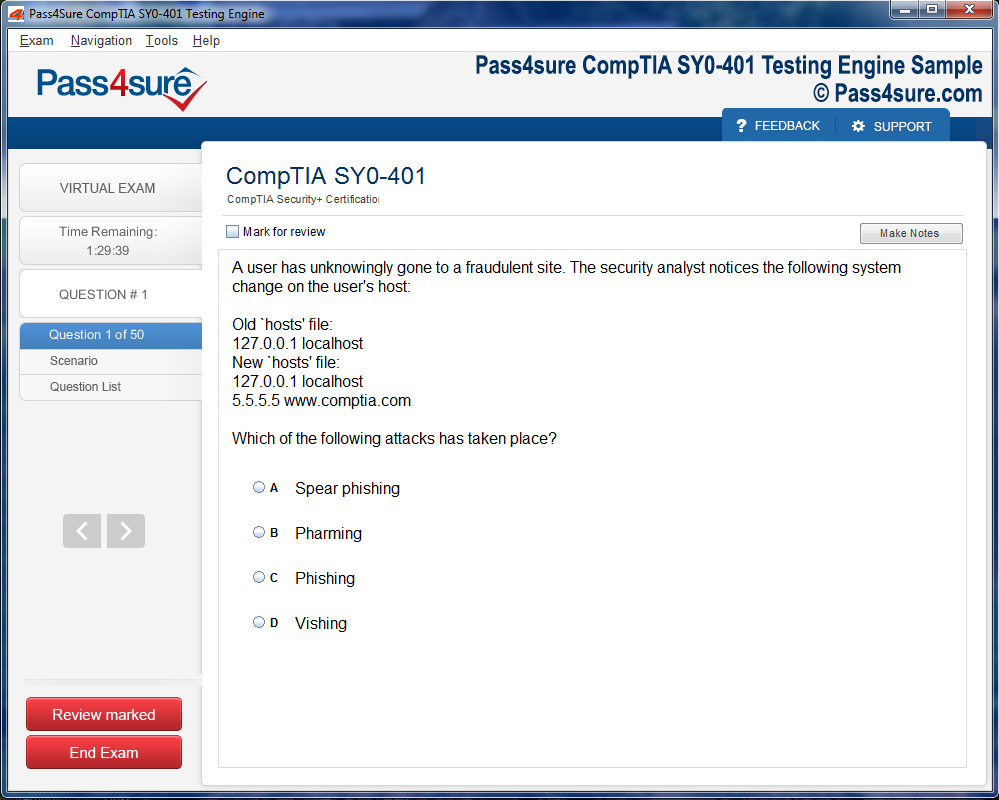
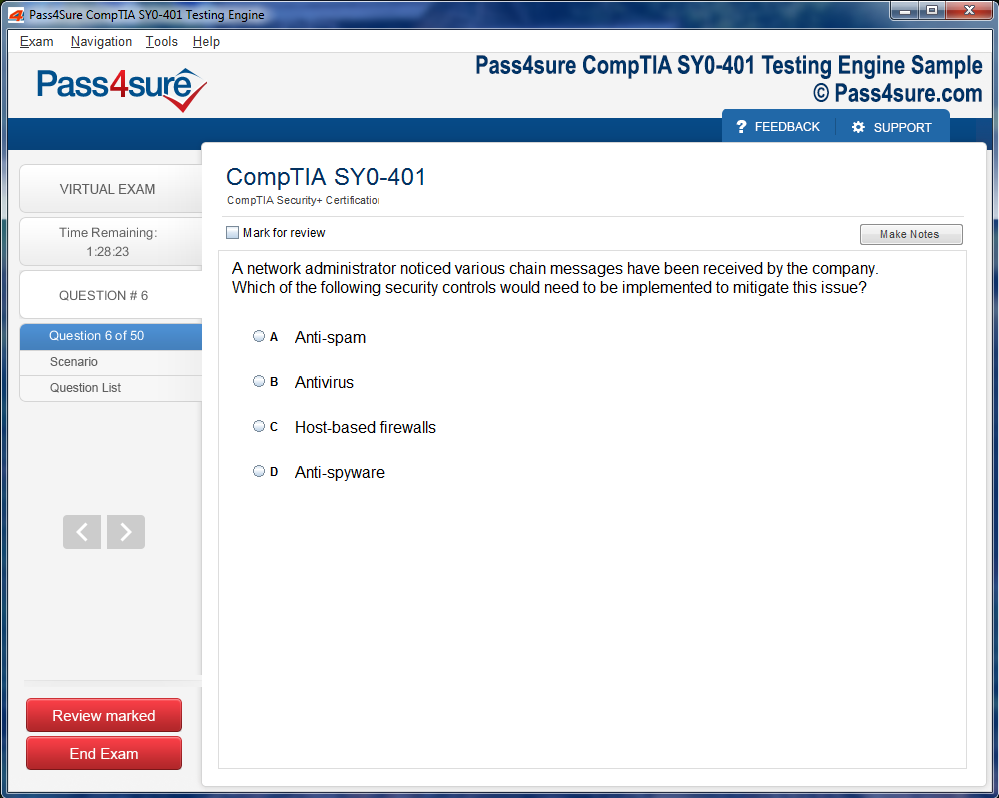
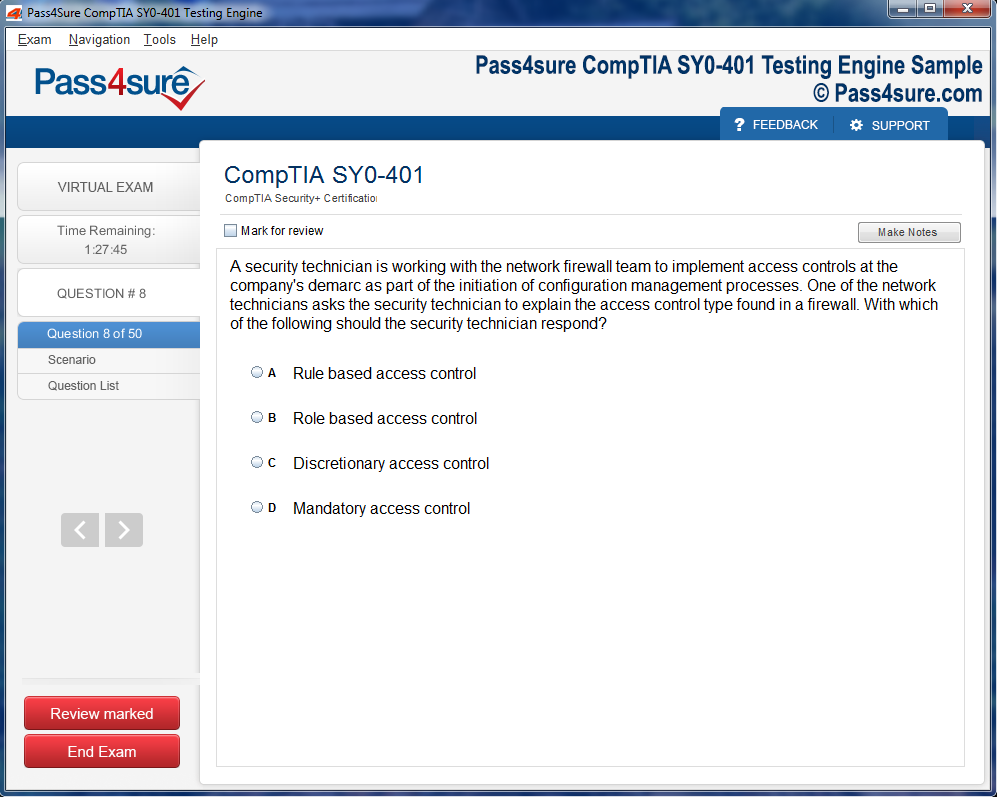
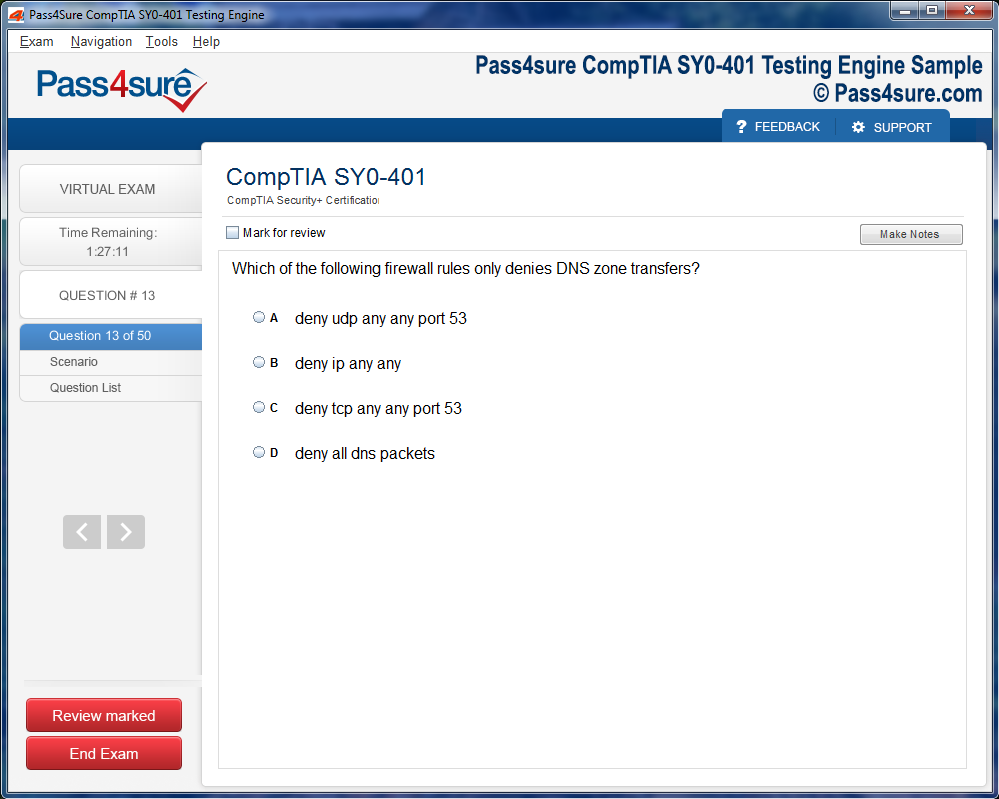
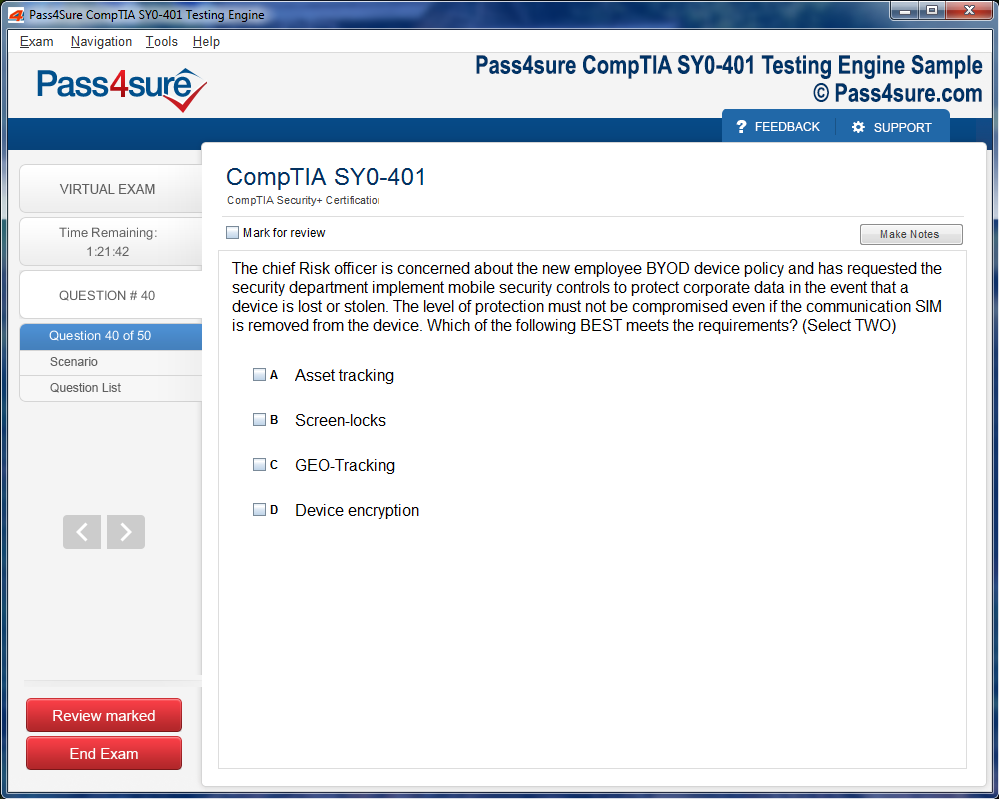
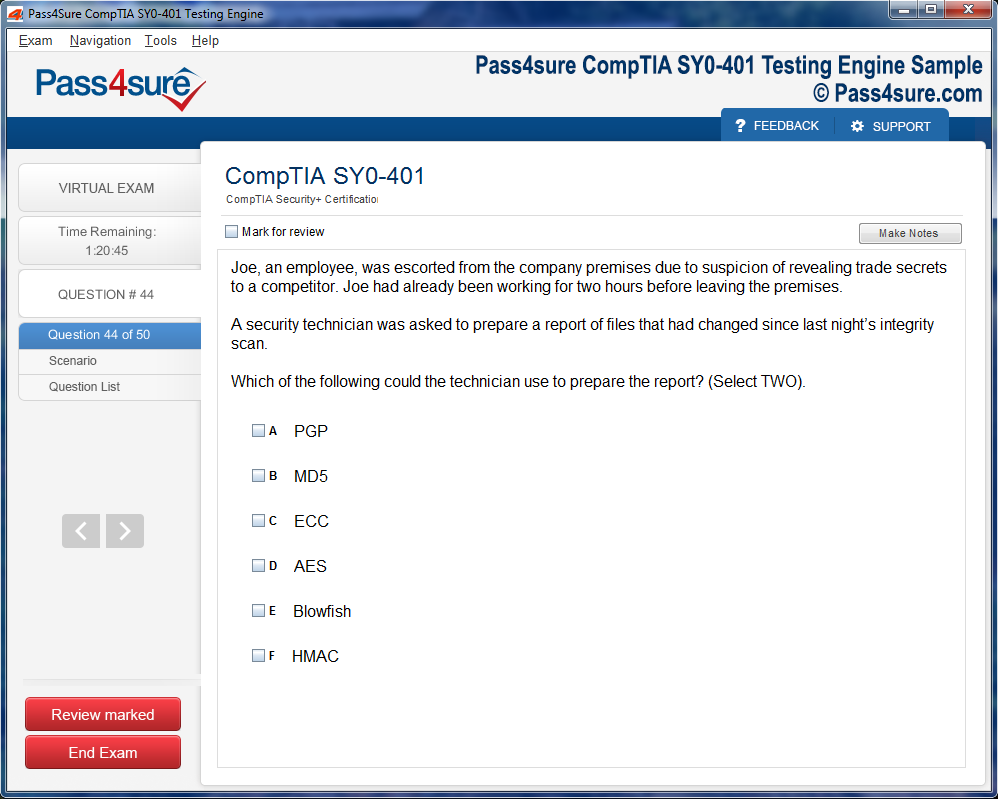
Product Screenshots
Frequently Asked Questions
How does your testing engine works?
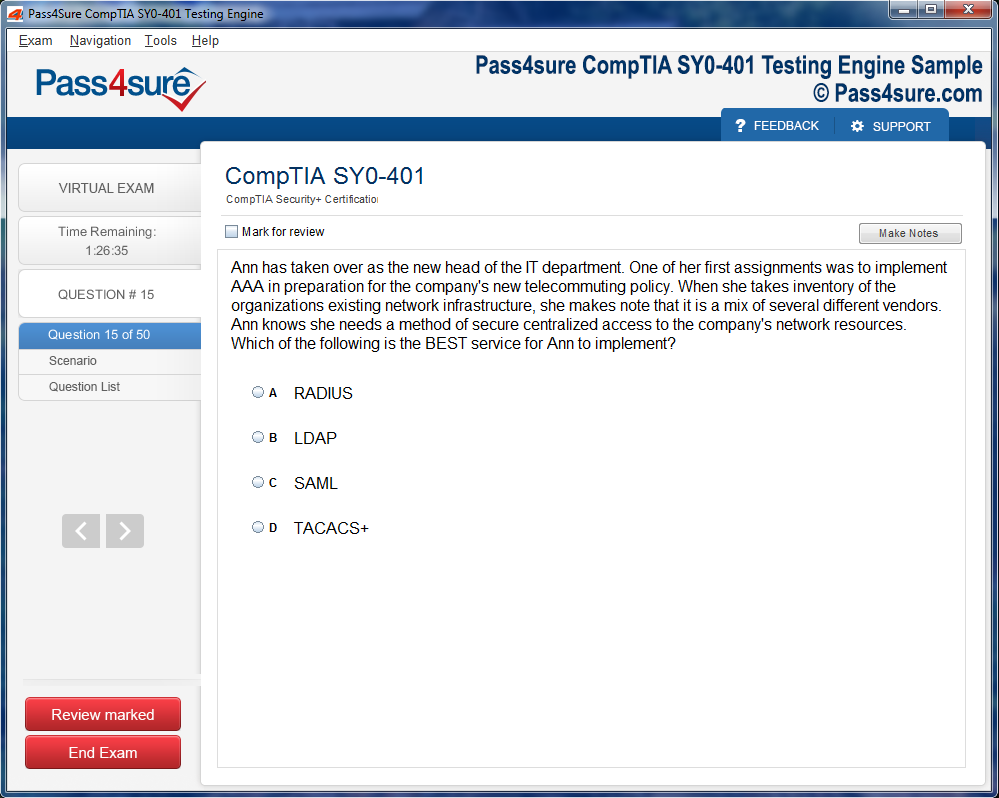
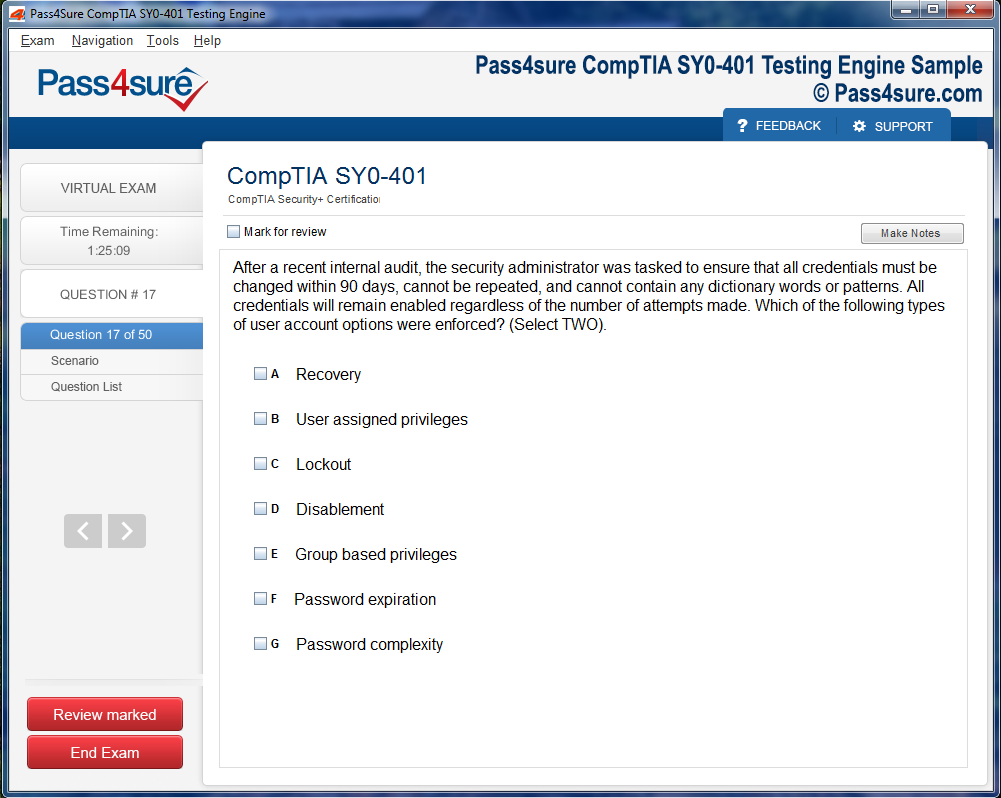
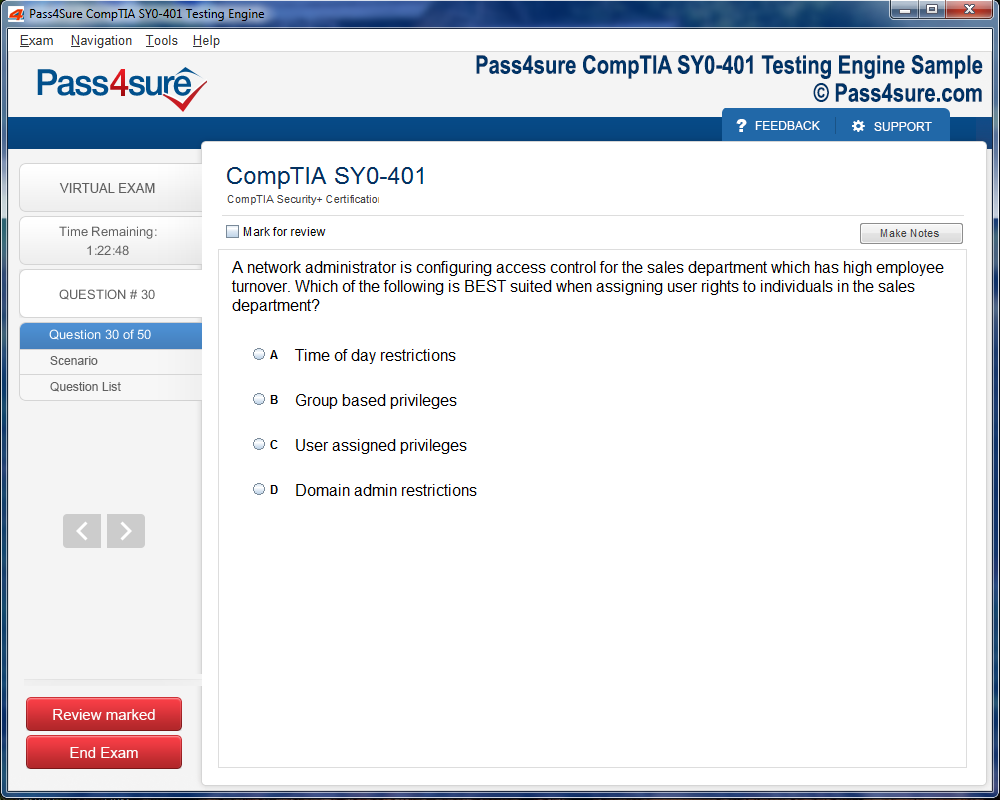
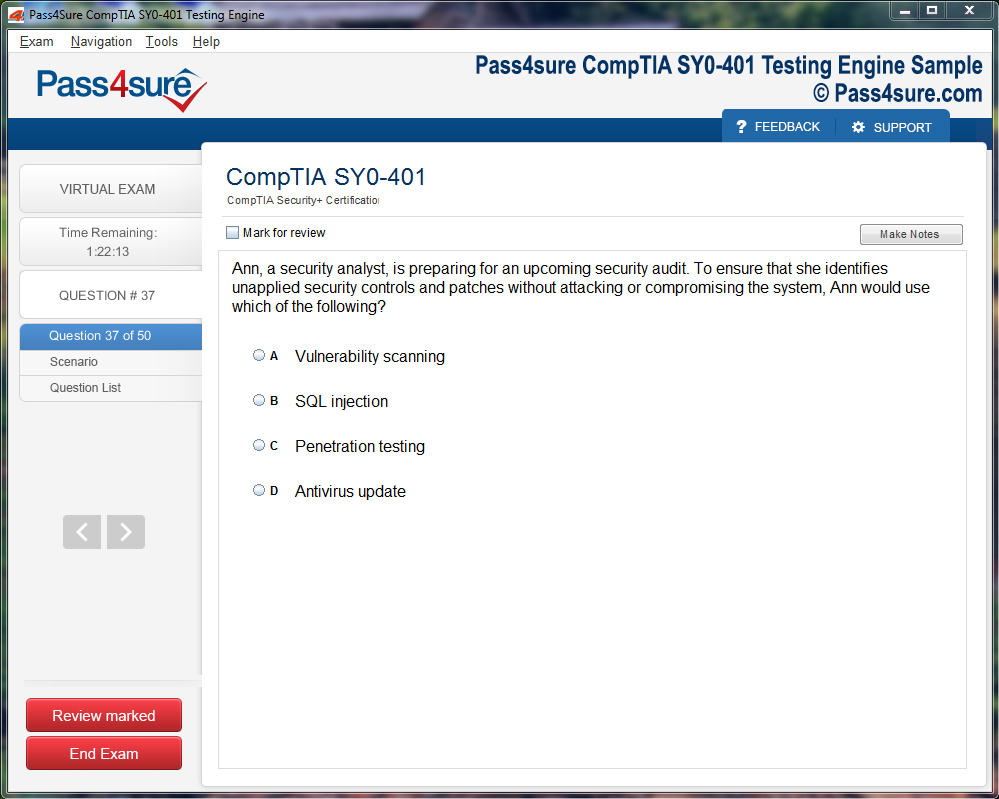
Once download and installed on your PC, you can practise test questions, review your questions & answers using two different options 'practice exam' and 'virtual exam'. Virtual Exam - test yourself with exam questions with a time limit, as if you are taking exams in the Prometric or VUE testing centre. Practice exam - review exam questions one by one, see correct answers and explanations.
How can I get the products after purchase?
All products are available for download immediately from your Member's Area. Once you have made the payment, you will be transferred to Member's Area where you can login and download the products you have purchased to your computer.
How long can I use my product? Will it be valid forever?
Pass4sure products have a validity of 90 days from the date of purchase. This means that any updates to the products, including but not limited to new questions, or updates and changes by our editing team, will be automatically downloaded on to computer to make sure that you get latest exam prep materials during those 90 days.
Can I renew my product if when it's expired?
Yes, when the 90 days of your product validity are over, you have the option of renewing your expired products with a 30% discount. This can be done in your Member's Area.
Please note that you will not be able to use the product after it has expired if you don't renew it.
How often are the questions updated?
We always try to provide the latest pool of questions, Updates in the questions depend on the changes in actual pool of questions by different vendors. As soon as we know about the change in the exam question pool we try our best to update the products as fast as possible.
How many computers I can download Pass4sure software on?
You can download the Pass4sure products on the maximum number of 2 (two) computers or devices. If you need to use the software on more than two machines, you can purchase this option separately. Please email sales@pass4sure.com if you need to use more than 5 (five) computers.
What are the system requirements?
Minimum System Requirements:
- Windows XP or newer operating system
- Java Version 8 or newer
- 1+ GHz processor
- 1 GB Ram
- 50 MB available hard disk typically (products may vary)
What operating systems are supported by your Testing Engine software?
Our testing engine is supported by Windows. Andriod and IOS software is currently under development.
From Beginner to Pro: CyberArk CAU201 Certification Guide
In every digital ecosystem, privileged access management serves as the invisible backbone of security. It governs who holds the keys to critical systems, ensuring that those with elevated permissions wield them responsibly. The CyberArk CAU201 Certification crystallizes this philosophy by turning abstract theories into actionable expertise. It immerses learners in an intricate study of protecting credentials, monitoring activities, and fortifying the invisible corridors of enterprise systems.
Privileged accounts are gateways to immense control. They exist in servers, databases, and applications—acting as unseen guardians or potential vulnerabilities. Mismanagement of these accounts can trigger security breaches of catastrophic proportions. Hence, CyberArk’s vision is to empower administrators with precision tools that safeguard, track, and control every privileged interaction. The CAU201 path introduces candidates to the deep mechanisms behind this protection, aligning theoretical frameworks with practical execution.
The Core Framework of CyberArk
The heart of CyberArk beats through its core components—each a carefully engineered mechanism designed for impenetrable defense. The Digital Vault serves as the nucleus, storing credentials with unparalleled encryption and multi-layered access control. The Central Policy Manager enforces governance, dictating when and how credentials can be retrieved. Password Vault Web Access acts as the interactive surface where users perform secured operations, while the Privileged Session Manager oversees the activity trail, capturing every keystroke and command for compliance and investigation.
For a beginner, mastering this framework begins with visualization. Each component interconnects seamlessly, forming a cohesive barrier against unauthorized intrusions. Learners should conceptualize the architecture as a living organism where each module supports and strengthens the other. This visualization bridges theoretical learning with cognitive comprehension, transforming the memorization process into an organic understanding of function and flow.
The Anatomy of the Certification Journey
The CAU201 Certification does not merely test factual knowledge—it assesses analytical comprehension and situational adaptability. The questions are structured to measure depth rather than surface familiarity. Multiple-choice scenarios evaluate technical precision, while case-based challenges test how one applies knowledge under simulated conditions.
To navigate this journey effectively, candidates should approach it with layered preparation. The initial phase involves absorbing theoretical materials—understanding terminologies, functions, and interrelationships among CyberArk modules. The second phase demands practice—hands-on configurations, troubleshooting, and environment simulation. The final stage calls for consolidation—where theory and practice merge into an intuitive rhythm of recognition and response.
Installation as a Foundational Discipline
Every CyberArk professional begins their practical journey by mastering installation. Setting up the Digital Vault is more than a procedural task—it’s a test of meticulousness. One must configure operating system parameters, adjust firewall permissions, and validate service dependencies. These seemingly minute steps shape the reliability of the system, and skipping or mismanaging them can compromise the entire infrastructure.
Through installation, learners comprehend not only technical workflows but also CyberArk’s architectural philosophy. The process reinforces discipline and order—qualities that resonate throughout the certification. Installing, validating, and verifying configurations repeatedly cultivates a structured mindset that later becomes vital when managing large-scale environments.
Hands-On Exploration and Administrative Mastery
Beyond theory, hands-on exploration is the crucible of true understanding. Within CyberArk’s administrative console, learners create safes—logical vaults that hold credentials with defined permissions. They assign users, establish access policies, and customize authentication methods that align with organizational hierarchies. Each configuration mirrors real-world operational needs, turning the learning environment into a miniature enterprise simulation.
Experimentation in this phase solidifies abstract knowledge. For instance, observing how a password rotation occurs within a safe or how an authentication failure triggers specific system logs transforms conceptual curiosity into applied skill. By engaging actively with the platform, candidates uncover hidden relationships and patterns that theoretical study alone cannot reveal.
Navigating the Labyrinth of Troubleshooting
Troubleshooting represents the soul of operational excellence. Within CyberArk environments, issues can emerge from unexpected corners—delayed credential rotations, policy mismatches, or synchronization disruptions. A skilled professional knows where to investigate first. Understanding the architecture helps narrow down fault points swiftly, saving valuable time.
Interpreting logs becomes a detective’s art. Each log file holds clues—timestamps, user actions, and system responses that map out the narrative of events. Developing fluency in reading and correlating these logs distinguishes experts from novices. Over time, pattern recognition emerges naturally, making troubleshooting less about guesswork and more about structured diagnosis.
Integration and Enterprise Synergy
In the modern enterprise, isolation no longer exists. Systems communicate across domains, and CyberArk thrives in this interconnected environment. It integrates seamlessly with directory services, ticketing systems, and monitoring solutions. Such integrations not only centralize governance but also reinforce the layers of accountability that organizations depend on.
Understanding integration processes gives learners a panoramic view of enterprise architecture. For instance, linking CyberArk with an identity management system ensures synchronized provisioning and de-provisioning. Integrating with analytics or event monitoring tools magnifies visibility, allowing security teams to detect anomalies in real time. These practices elevate a candidate’s profile, showcasing adaptability beyond the immediate CyberArk platform.
The Discipline of Governance and Compliance
Beyond configuration and integration lies governance—the silent yet formidable dimension of privileged access management. Governance ensures that every credential, every access request, and every session aligns with established security policies. The CAU201 curriculum subtly embeds this awareness, training learners to think like auditors as well as administrators.
Understanding governance involves recognizing risk exposure points and developing mitigation strategies. Candidates learn how CyberArk enforces compliance through detailed reporting, automated session recordings, and granular access control. Such features empower organizations to maintain not just operational efficiency but also regulatory integrity.
Transforming Theory into Application
Knowledge without application remains inert. The CAU201 path encourages active learning—transforming every theoretical concept into a living exercise. Candidates should constantly test their comprehension through mock labs and self-designed challenges. Recreating system configurations, experimenting with different policy settings, and simulating privilege escalations embed learning deeply.
Immersion learning not only builds competence but also cultivates intuition. Over time, a learner begins to anticipate issues before they occur, recognizing subtle system behaviors that precede disruptions. This foresight marks the transition from beginner to practitioner—a milestone that reflects CyberArk’s true educational intent.
Cultivating the Mindset of a Security Professional
Behind every certification lies an attitude—a disciplined commitment to vigilance, precision, and responsibility. CyberArk professionals safeguard the most sensitive layers of enterprise ecosystems. They handle data, identities, and access keys that, if mishandled, could lead to catastrophic outcomes. The CAU201 journey instills a mindset where caution becomes instinct and precision becomes habit.
Consistency and curiosity fuel mastery. Candidates who revisit configurations, reanalyze logs, and continuously refine their understanding progress faster than those who rely solely on rote memorization. Every repetition uncovers a new nuance, every practice session sharpens intuition, and every error becomes a stepping stone toward expertise.
The Evolution of Mastery
The CAU201 Certification is not an endpoint—it is the threshold to continuous evolution. Once the foundational skills are secured, learners can pursue advanced certifications, exploring areas like Defender or Sentry. Each level deepens the engagement with CyberArk’s complex architecture and introduces more intricate configurations and integrations.
Mastery, however, is not just technical—it is philosophical. It means understanding why security matters at a fundamental level. It means viewing privileged access not as a restriction but as a structured liberty—freedom within boundaries. This perspective redefines how one perceives digital defense, transforming security from a burden into a craft.
The Invisible Architecture of Motivation
Finally, the journey toward CAU201 success thrives on internal motivation. The certification demands patience, persistence, and adaptability. Some days will bring clarity; others will challenge comprehension. Yet it is within these fluctuations that growth happens. Those who maintain discipline and dedication find the process transforming—not just professionally but intellectually.
Every revision sharpens retention, every lab refines confidence, and every self-assessment illuminates new learning horizons. With each incremental improvement, the learner inches closer to mastery. Over time, CyberArk ceases to feel like a tool and becomes a language—a medium through which the professional communicates security, governance, and trust.
Through the foundation of CyberArk CAU201, learners don’t just acquire a certification; they acquire a worldview—one where privilege is managed with integrity, access is guarded with intelligence, and digital fortresses are maintained with precision and pride.
Understanding the CyberArk Architectural Core
The CyberArk architecture operates like an intricately woven security tapestry, where each thread—each component—plays a specific role in safeguarding the privileged identity landscape. To truly master it, one must go beyond memorizing definitions and instead develop a panoramic comprehension of how these elements harmonize under stringent control. CyberArk’s architecture is not confined to a single domain; it breathes across systems, networks, and administrative boundaries. It transforms abstract security theory into an operational fortress capable of sustaining enterprise-grade protection.
At the very nucleus of this system lies the Digital Vault, the sacred repository where all privileged data finds sanctuary. The vault is isolated from traditional access layers, existing as a self-contained entity built on layers of cryptographic fortification. It employs symmetric and asymmetric encryption, split-key methods, and multi-level authentication. The vault’s isolation from domain environments ensures that even if external networks are compromised, privileged credentials remain sealed within impenetrable cryptographic walls. Candidates preparing for the CyberArk CAU201 certification must internalize this principle—understanding the vault is akin to mastering the foundation of all other CyberArk modules.
The Digital Vault: The Heartbeat of Security
The Digital Vault functions as both a custodian and a sentinel. Unlike ordinary data storage systems, its architecture follows a zero-trust philosophy—no process or entity is inherently trusted. Access is only permitted after multi-layer validation through digital certificates and policy-bound credentials. The architecture of the vault also emphasizes redundancy, ensuring operational continuity through replicated vault clusters and periodic backups.
Learning about the vault includes exploring the PrivateArk Server, the engine that enforces all vault communication. Students must also understand the Vault Server Configuration Console, where administrative parameters such as encryption layers, authentication hierarchies, and logging protocols are fine-tuned. Another core aspect is the Disaster Recovery Vault, an essential backup mechanism designed for high-availability environments. Its synchronization intervals, encryption parity, and heartbeat validation processes ensure uninterrupted credential access during critical downtimes.
Furthermore, network segmentation plays an indispensable role. The vault should be isolated within a restricted security zone, typically shielded by firewalls and accessible only via predefined ports. The understanding of vault topology, including how it interacts with the Central Policy Manager and Password Vault Web Access modules, defines the proficiency of an advanced CyberArk architect.
The Central Policy Manager: Orchestrating Dynamic Control
Moving beyond storage lies the Central Policy Manager (CPM), a dynamic automation entity that governs password lifecycles. This component acts as the pulse of CyberArk’s policy framework, ensuring that passwords never stagnate in time. The CPM periodically rotates, updates, and reconciles credentials based on pre-configured policy definitions. By automating credential management, it eliminates human dependency and reduces risk exposure.
For candidates mastering architecture, it is essential to understand how CPM communicates with target systems. It leverages network credentials, connectors, and policy objects to interface with various endpoints—Windows servers, databases, and network appliances. When CPM retrieves a password, it authenticates with the vault, validates the account policy, executes the change, and stores the new credential securely.
Learning how to configure CPM requires practice in defining policy parameters such as rotation frequency, character composition, and expiration behavior. Candidates must also grasp CPM log analysis, an often-overlooked skill that helps identify misconfigurations and synchronization failures. Understanding error codes, transaction logs, and the reconciliation process grants a deeper appreciation of the operational fluidity within the system.
Password Vault Web Access: The Gateway for Interaction
The Password Vault Web Access (PVWA) serves as the human interface of the CyberArk ecosystem. It is where administrators, auditors, and authorized users interact with privileged data. The PVWA’s web console allows credential retrieval, request approvals, and session monitoring—all through an encrypted HTTPS channel fortified by certificates and multifactor authentication.
A deep understanding of PVWA’s architecture entails knowing its web server dependencies, communication channels with the vault, and API structures. PVWA not only serves as a visual management platform but also as a compliance instrument. Through role-based access control (RBAC), it ensures that every user’s actions align with organizational governance.
In practical environments, PVWA is integrated with directory services such as LDAP or SAML for identity federation. Understanding these configurations helps align privilege management with enterprise identity ecosystems. Moreover, administrators must comprehend workflows, such as password checkout and dual-authorization processes, that ensure credentials are used responsibly.
The PVWA also logs all interactions, enabling traceability. Each request, retrieval, and approval action becomes part of an immutable audit trail. This functionality ensures accountability, a central pillar in privileged access management.
Privileged Session Manager: Sentinel of Real-Time Oversight
The Privileged Session Manager (PSM) extends CyberArk’s capabilities into the realm of surveillance and behavioral oversight. It intercepts and mediates all privileged connections between users and target systems, acting as a secure proxy. Instead of allowing direct system logins, PSM launches sessions on behalf of users—this means credentials never reach the endpoint directly.
From a structural perspective, the PSM consists of connectors—specific configurations that define how it interacts with each system type, such as SSH for Unix or RDP for Windows. Understanding these connectors and their security configurations is critical. Candidates must also study recording storage, where every privileged session is documented. These recordings are not mere surveillance tools but are vital for auditing and forensic analysis.
Session management also introduces real-time monitoring, where suspicious activities—like unauthorized file transfers or command execution—can trigger alerts. The ability to configure thresholds, filters, and response mechanisms within PSM transforms it from a passive recorder to an active defender. This dynamic oversight capability is integral to CyberArk’s layered defense model.
Privileged Threat Analytics: The Mind of Detection
Privileged Threat Analytics (PTA) infuses intelligence into the CyberArk framework. It observes behavioral anomalies, correlates patterns, and identifies deviations that could signal insider threats or credential misuse. PTA operates on a continuous data stream, drawing insights from session logs, credential activities, and user patterns.
Architecturally, PTA integrates with the vault and PSM through secure APIs. Its detection engine relies on statistical baselines and behavioral models, evolving with usage data over time. Candidates should understand how PTA’s analytics engine processes inputs, generates risk scores, and produces alerts.
Comprehending PTA’s architecture involves dissecting its data ingestion process, event correlation algorithms, and how it aligns with SIEM solutions. It provides an additional line of defense that transcends static security models by introducing adaptivity and context awareness.
For learners, practicing PTA dashboard interpretation is invaluable. Recognizing the difference between false positives and genuine anomalies sharpens analytical intuition—an essential trait for professionals managing real-world privileged access environments.
Integrating Network and Architectural Layers
No CyberArk deployment exists in isolation; its efficiency depends on its network environment. Candidates must master network zoning, firewall configuration, and communication encryption among components. Each component—Vault, CPM, PVWA, and PSM—must operate within secure, delineated network segments.
Firewalls must restrict lateral movement, ensuring that traffic between modules flows only through predefined, encrypted channels. Understanding certificate-based communication helps candidates secure data-in-transit using TLS or SSL. Furthermore, they must learn how network proxies and load balancers affect system availability and latency.
Architectural comprehension also includes designing redundancy models. High-availability vaults, standby CPM servers, and clustered PVWA nodes ensure resilience against hardware failure. In large enterprises, professionals must also configure Geo-distributed environments, where regional vault replicas operate synchronously, guaranteeing operational continuity.
Policy Framework and Administrative Layers
A system is only as strong as its governing policies. CyberArk’s policy layer dictates how credentials are used, rotated, and monitored. It defines access durations, approval workflows, and audit visibility. Candidates must be fluent in creating and enforcing policies that adhere to organizational and compliance mandates.
Policy creation involves striking a balance between security and operational flexibility. Overly restrictive policies hinder productivity, while lenient ones compromise safety. CyberArk’s structure allows granular customization, enabling policies at the vault, platform, or user level.
Understanding the administrative model also requires exploring Safe Management. Safes are logical containers within the vault where accounts are stored based on department, function, or security classification. Assigning ownership, access groups, and permission levels to these safes ensures hierarchical control.
Documentation and Governance Practices
Documentation is not an optional task but a discipline that defines the difference between technical aptitude and professional mastery. Maintaining configuration logs, change records, and audit references enables traceability and smooth troubleshooting. These habits also mirror enterprise-level governance where compliance demands historical visibility of every configuration and event.
Candidates preparing for CyberArk CAU201 should develop personal documentation systems—such as architectural diagrams, module notes, and operational flowcharts. This process reinforces understanding by transforming abstract systems into tangible knowledge artifacts.
Effective documentation also supports disaster recovery and change management. When incidents occur, well-documented architecture guides swift remediation without guesswork. Professionals who cultivate such rigor stand out for their reliability and foresight.
Transforming Knowledge into Expertise
Mastering CyberArk architecture transcends rote learning. It is an iterative journey of immersion, experimentation, and synthesis. The architecture is dynamic; it demands that candidates constantly interact with its modules, simulate real-world scenarios, and refine their conceptual frameworks.
By diagramming interactions, configuring mock deployments, and analyzing outcomes, learners convert theory into operational mastery. Understanding how each component—Vault, CPM, PVWA, PSM, and PTA—intertwines within the larger fabric of enterprise infrastructure elevates comprehension from academic to experiential.
Those who approach this stage with patience, curiosity, and disciplined study emerge as practitioners, not merely certificate holders. True mastery is achieved when the architecture ceases to appear as separate parts and becomes perceived as one intelligent, breathing ecosystem of defense.
The Architecture of Practical Configuration and Implementation
The realm of practical configuration embodies the transformation of abstract comprehension into tangible expertise. When learners advance to this pivotal juncture, their engagement transitions from theoretical insight to direct manipulation of intricate frameworks. Each action performed becomes a narrative of understanding — where configuration decisions, validations, and alignments form the foundation of technical maturity. This evolution demands patience, precision, and an unrelenting focus on the minutiae of digital structure.
Preparation for Deployment
Before diving into the labyrinth of configuration, one must cultivate readiness in both the system and the self. Every successful deployment begins with meticulous groundwork — verifying host environments, assessing compatibility matrices, and ensuring that operating systems and dependencies are harmonized. This preparatory ritual prevents disruptions later in the process. A disciplined practitioner treats installation prerequisites as sacred guidelines, recognizing that even a minor deviation can cascade into an operational impasse.
The installation of the Digital Vault — the nucleus of secure credential management — requires unyielding accuracy. Its architecture thrives on precise configuration, where encryption layers, storage directories, and authentication gateways interlock to create a fortress of trust. Each screen, each prompt during installation carries significance. Documenting each decision not only serves as a reference but also crystallizes understanding of how parameters coalesce to sustain system integrity.
The Genesis of Safes
Once the Vault emerges operational, the next frontier lies in the creation and management of safes. These safes symbolize both order and security — digital sanctuaries where privileged information resides under guarded custody. Designing safes demands structural thinking: who governs access, who observes, and who is restricted. Access control lists evolve from theoretical constructs into living blueprints that shape organizational dynamics.
Through this exercise, students witness hierarchy manifest digitally. Ownership and access become measurable constructs, defined by parameters rather than abstractions. Implementing dual control — where two approvals are necessary for sensitive operations — introduces a rhythm of accountability. The repetitive act of creating, testing, and refining safes engrains muscle memory, transforming abstract governance into reflexive administration.
Connection to Targets
Integration represents the pulse of practicality. Connecting to target systems — be they servers, databases, or applications — unveils the ecosystemic nature of configuration. Every target connection is a bridge where authentication, encryption, and automation meet. Learners construct account platforms, define connection components, and align password rotation cycles with enterprise cadence.
The rotation lifecycle becomes an orchestral motion — passwords born, utilized, and retired in a perpetual rhythm of renewal. Observing these cycles in real-time introduces the learner to the heartbeat of automation. Here, one recognizes how misalignment between components can disrupt harmony, teaching the importance of synchronization. The exercise transforms passive understanding into active vigilance, as each configuration step demands verification through observation.
Session Management Framework
Beyond access lies control — the art of monitoring and managing interactions. Integrating session management introduces learners to behavioral governance within digital boundaries. Configuring a session manager transforms mere access into supervised engagement. Every user session, once initiated, becomes a traceable event governed by policies, timings, and surveillance parameters.
Testing live connections builds intuitive fluency. By initiating controlled sessions, observing logs, and validating recordings, practitioners internalize how boundaries safeguard integrity. Time-bound access and automatic termination illustrate how policy translates into protection. Each configuration of a session rule reinforces the discipline of limitation — where technology teaches the virtue of restraint.
Integration with Identity Structures
In enterprise ecosystems, no configuration exists in isolation. Synchronization with identity directories such as LDAP or Active Directory introduces the learner to the concept of unity — a digital choreography where users, roles, and permissions coexist seamlessly. Mapping organizational hierarchies to technical schemas becomes a test of comprehension and foresight.
Understanding inheritance patterns and synchronization intervals requires conceptual precision. A misstep in mapping can lead to chaos, where unauthorized access proliferates undetected. Hence, students must approach identity integration as both science and art. Properly executed, it yields harmony — a central hub from which authentication radiates uniformly, reducing redundancy and fortifying security.
Backup and Recovery Practices
Resilience defines mastery. The capacity to restore operations after disruption distinguishes the practitioner from the novice. Backup and recovery configuration therefore transcend routine exercise — they embody the philosophy of preparedness. Simulating vault backups, verifying restoration, and safeguarding encryption keys create an unbreakable link between foresight and continuity.
Learners must internalize the principle that every backup is a narrative of protection. The vault’s encrypted state, once restored successfully, reaffirms one’s understanding of digital permanence. Secure transfer mechanisms, key escrow management, and archival verification become not just technical steps but manifestations of responsibility. The exercise imprints upon the learner an ethos of perpetual readiness.
The Discipline of Troubleshooting
Even the most perfect configuration encounters turbulence. Troubleshooting transforms confusion into clarity. Within the labyrinth of system logs and diagnostic messages, learners develop interpretive literacy — the ability to read patterns of malfunction and respond with precision.
Analyzing log sequences, deciphering error codes, and recognizing systemic inconsistencies form the essence of technical empathy. It is through troubleshooting that learners experience true understanding — no longer reciting procedures but interpreting the system’s language. By recreating controlled failures, one learns resilience through practice. Common disruptions such as credential mismatches or connection delays become opportunities for mastery rather than frustration.
The art of remediation evolves naturally from repetition. Through every iteration, the learner develops an instinctive sense for causality — the ability to predict, prevent, and repair. This stage transforms practitioners into problem-solvers capable of navigating uncertainty with composure.
Compliance and Audit Mastery
Every configuration exists within a framework of accountability. Configuring audit trails and compliance reports ensures visibility and traceability. Each generated report becomes a testament to governance — recording actions, changes, and events in meticulous sequence. Learners must treat reporting as a reflection of transparency, not an afterthought.
Through audit configuration, one understands the ethical spine of system management. Reports reveal more than actions; they narrate intentions. They help identify anomalies, expose irregularities, and reinforce adherence to standards. This exercise not only aligns with certification objectives but cultivates a mindset grounded in integrity.
Automation and RESTful Integration
The pursuit of efficiency leads naturally to automation. Through RESTful APIs, learners unlock the ability to control, query, and extend system capabilities programmatically. Automation scripts introduce a rhythm of autonomy — where repetitive tasks dissolve into code-driven precision.
Learning to execute automated password rotations, initiate reports, or retrieve vault metadata through REST interfaces elevates the practitioner’s proficiency. The once-manual landscape transforms into an orchestrated flow, guided by logic and governed by security. This capacity to blend manual expertise with automated execution represents the future of digital administration.
Every API call embodies both freedom and caution. It empowers but also demands precision. Thus, understanding authentication tokens, rate limits, and error handling becomes crucial. The deeper one delves, the more apparent it becomes that automation is not merely efficiency — it is evolution.
The Cultivation of Professional Dexterity
Practical implementation serves as the crucible of professional transformation. Here, conceptual knowledge ignites into tangible ability. Repetition, observation, and refinement forge confidence. Each successfully executed configuration reinforces internal structure — discipline, patience, and awareness.
Learners begin to perceive interdependencies: how a misaligned policy affects authentication, how an incomplete backup endangers continuity, how an unchecked configuration opens vulnerabilities. Through such realizations, one learns not merely to operate but to anticipate. This foresight marks the ascent from student to practitioner.
At this juncture, learners stand not as passive absorbers but as active architects. Their actions influence digital ecosystems; their understanding maintains equilibrium. The configuration process becomes a mirror of professional character — meticulous, deliberate, and adaptive.
The Essence of Experiential Learning
This stage in one’s journey epitomizes the fusion of cognition and execution. The classroom’s theoretical precision transforms into tactile experience. Installing, configuring, monitoring, and repairing cease to be isolated tasks and merge into a continuous act of comprehension.
Hands-on engagement stimulates intuition. The learner begins to sense rather than merely know — to anticipate failures before they emerge, to predict system behavior from subtle cues. Practical engagement thus transcends technical proficiency; it becomes an act of internalization.
The iterative cycle of configure-test-correct solidifies understanding. Every command executed, every setting modified, carries weight. Each correction transforms confusion into competence. Through deliberate practice, one evolves toward fluency — where actions become instinctive, and understanding intuitive.
Integration of Knowledge and Intuition
True expertise arises when knowledge synchronizes with instinct. Configuration exercises, repeated across various modules, begin to merge seamlessly. The learner no longer views vaults, safes, sessions, and backups as isolated constructs but as interconnected dimensions of a unified architecture.
This cognitive integration mirrors how musicians internalize rhythm — through repetition, correction, and listening. Similarly, administrators learn through trial, adjustment, and observation. Over time, procedures dissolve into natural flow. The practitioner becomes fluent in both execution and anticipation, interpreting systems like an artist reads patterns.
In this synthesis, knowledge attains motion — dynamic, responsive, and adaptive. One’s understanding no longer resides solely in memory but in behavior. This harmony between cognition and action defines the spirit of practical mastery.
The Evolution Toward Mastery
As learners persist, they develop a quiet confidence born from lived experience. Each configuration, each test, each correction contributes to an expanding internal atlas of understanding. The once intimidating console becomes familiar terrain. Logs and alerts cease to be noise; they become narratives.
Through disciplined iteration, learners ascend from procedural followers to strategic thinkers. They not only know how to implement but also why each step exists. Their comprehension expands from mechanical repetition to conceptual fluency — an ability to adapt configuration logic to evolving contexts.
Mastery manifests not as perfection but as adaptability. It is the readiness to face anomalies without panic, to diagnose without haste, and to repair without hesitation. This transformation — from learner to adept — represents the ultimate purpose of practical configuration and implementation.
Sustaining the Cycle of Refinement
The practice of configuration never concludes. Systems evolve, updates emerge, and integrations shift. Thus, continual learning becomes inseparable from sustained competence. A diligent practitioner revisits configurations periodically, reassessing parameters, reinforcing security, and refining automation.
In this unending rhythm lies the beauty of practical mastery — a state where learning becomes perpetual motion. Each new challenge refines precision, each failure deepens understanding, and each success reinforces humility. Through continuous evolution, the practitioner remains both learner and teacher, embodying adaptability as the essence of skill.
Exam Strategy and Study Blueprint
Achieving a professional certification requires not only technical knowledge but also disciplined strategy, consistency, and psychological composure. Success in an advanced assessment like the CAU201 exam is not achieved through memorization alone—it is earned through deliberate mastery, immersive understanding, and mindful execution. Each concept must be cultivated into comprehension, and every study session should have purpose and rhythm.
Understanding the Exam Terrain
Before diving into complex preparation, begin by charting the syllabus terrain. Every topic, from installation mechanics to troubleshooting protocols, forms a piece of the greater conceptual mosaic. Understanding how these elements interlink transforms overwhelming content into an organized structure. When learners segment large subjects into thematic clusters, comprehension deepens, and cognitive fatigue lessens. The objective is not speed but sustainable progress—studying at a pace that ensures retention rather than short-lived familiarity.
Constructing a Weekly Cadence
The human mind thrives on rhythm. Construct a weekly study schedule that incorporates alternating modes of engagement—reading, note-making, revising, and practicing. Each week should focus on distinct modules, integrating both theoretical review and practical simulation. Allow flexibility but maintain direction. When study time becomes habitual rather than forced, mental endurance expands, allowing deeper absorption of intricate material. Gradual progression prevents exhaustion and fosters confidence that grows organically.
Transforming Theory into Practice
In the CyberArk domain, knowledge without practical execution is fragile. Configure lab environments to replicate real-world conditions and experiment with scenarios. Observe how configurations interact, identify system behaviors under pressure, and troubleshoot inconsistencies. This form of experiential learning ignites cognitive curiosity—it converts passive reading into tactile wisdom. Through simulation, learners develop an instinctive familiarity with processes that no written explanation can replicate.
The Role of Consistent Review
Knowledge unreviewed is knowledge forgotten. Establish a recurring pattern of review sessions—short but frequent. Revisiting material at spaced intervals strengthens neural pathways and solidifies recall. Begin each session by summarizing previous content from memory before revisiting notes. This small ritual of self-recollection transforms revision into active reinforcement rather than rote repetition. With time, information migrates from temporary awareness into lasting mastery.
Assessing Readiness Through Mock Evaluations
Mock exams are the mirror reflecting your preparedness. They reveal both strengths and vulnerabilities. Treat each simulation as a diagnostic instrument—an opportunity to recalibrate focus rather than a simple test. Analyze incorrect answers meticulously to understand not just what went wrong, but why. Over time, a discernible pattern of improvement emerges, showing you precisely where to intensify your study. By repeating this cycle—practice, review, refine—you craft an upward trajectory of performance.
Collaborative Learning as Cognitive Expansion
While individual effort forms the core of preparation, collaboration often becomes the catalyst for clarity. Discussing concepts aloud reorganizes your mental framework. Teaching others sharpens your articulation of complex processes. Within a study group, varied interpretations reveal alternative angles of understanding, expanding your analytical horizon. Intellectual exchange transforms isolated learners into dynamic thinkers capable of perceiving problems through multiple lenses.
Precision in Resource Selection
The abundance of materials can lead to distraction rather than depth. Limit resources to a refined selection that aligns directly with the exam objectives. Avoid gathering countless references that fragment attention. Immersing deeply in a smaller collection of high-quality sources yields superior comprehension. The focus must remain on precision, not volume. Mastery emerges when learners engage intimately with material rather than grazing across countless pages.
The Psychology of Learning Efficiency
Mental resilience enhances intellectual efficiency. A fatigued or anxious mind retains little, no matter the hours invested. Integrate moments of rest, silence, and mindfulness into your study schedule. Simple acts like breathing exercises, a brief walk, or reflective journaling restore cognitive balance. Emotional composure transforms stress into stamina. The equilibrium between mental health and academic ambition ensures sustainable growth without burnout.
Crafting the Study Environment
The environment in which you study shapes your mental engagement. Choose a space that radiates focus—well-lit, uncluttered, and minimally distracting. Surround yourself with reminders of purpose—notes, flowcharts, or personal goals. Ambient calm nurtures attention. When the external world mirrors internal order, the mind functions with heightened clarity. This environmental harmony amplifies concentration and promotes prolonged immersion in study.
Engaging with Real-World Application
Understanding principles theoretically is only half the journey; applying them in real-world simulations transforms comprehension into competence. Recreate vault configurations, modify policies, and observe results through trial and error. This iterative process strengthens adaptability. When confronted with exam questions framed in unfamiliar contexts, experience will guide intuition. Repeated exposure to diverse scenarios ensures flexibility under pressure.
The Art of Note Creation
Handwritten notes, distilled from dense content, serve as personalized cognitive maps. Writing triggers deeper neural encoding, engraving information more firmly into memory. Each page should encapsulate concepts in your own phrasing rather than copied text. These notes become not only revision tools but reflections of your intellectual evolution. As exam day approaches, revisiting these compact summaries reinforces both knowledge and confidence.
Mindful Revision Cycles
Revision should follow a deliberate pattern: overview, reinforcement, and reflection. Begin with high-level summaries, then narrow focus onto weaker areas. Conclude each cycle with a self-assessment to gauge progress. Repetition at increasing intervals ensures long-term retention. Avoid overloading your memory at once—knowledge matures gradually through repetition and time. This structured cycle transforms revision into a powerful rhythm of retention.
Time Management Under Examination Pressure
During the exam, time behaves like quicksilver—slipping rapidly through moments of hesitation. Begin by scanning all questions to gauge their complexity. Address simpler problems first to build momentum, reserving intricate ones for later. Maintain awareness of time distribution, never allowing one challenge to consume disproportionate minutes. The equilibrium between accuracy and speed defines efficient performance. Calm decisiveness emerges from repeated timed practice.
Building Inner Composure Before the Exam
In the final days before examination, serenity becomes your strongest ally. Reduce exposure to new material and instead revisit your concise notes. Engage in light review, maintaining the rhythm without overexertion. Visualize success, rehearse confidence, and focus on clarity rather than panic. Rest adequately—the mind assimilates during stillness. Composure on exam day mirrors preparation depth; it is the silent strength behind every accurate response.
Adaptive Thinking During the Exam
Real-world certifications test more than memory—they measure adaptability. When faced with unexpected scenarios, draw upon conceptual logic rather than rote recall. Pause briefly, analyze context, and deconstruct the problem systematically. Structured reasoning leads to accurate conclusions. Adaptability reflects not superficial memorization but genuine comprehension—the ability to think fluidly under constraint.
The Momentum of Continuous Improvement
Preparation for such an exam should never stagnate. Even as confidence grows, curiosity must remain alive. Continue exploring adjacent domains, revisiting overlooked details, and integrating feedback from each mock attempt. Every incremental improvement builds toward a comprehensive command over the subject. Growth is cumulative—each hour compounds into expertise when directed with purpose.
The Interplay of Confidence and Discipline
Confidence without discipline leads to complacency; discipline without confidence breeds anxiety. Success lies in balancing both. Confidence emerges naturally from consistent effort, while discipline sustains that effort through fatigue. Nurture both qualities simultaneously—one fuels motivation, the other ensures direction. Together, they create an unshakeable foundation for achievement.
Mastery Through Repetition and Reflection
Repetition is the sculptor of mastery. Every reattempt, every simulation, chisels precision into understanding. Reflect after each session—what improved, what faltered, what patterns persist? Reflection transforms practice into wisdom. Over time, repetition fortified by introspection turns ordinary learners into refined professionals capable of handling complexity with elegance.
Sustaining Long-Term Retention
Learning for certification must transcend short-term memorization. Use mnemonic techniques, analogies, and real-life correlations to link information meaningfully. Reinforce knowledge periodically, even post-certification, to preserve mastery. Consistent engagement ensures your expertise remains fresh and responsive to evolving technologies. Sustained learning reflects true professional maturity.
Strategic Execution on the Final Day
On exam day, efficiency is born from familiarity. Begin with structured breathing to stabilize nerves. Approach questions analytically, dissecting key terms before forming responses. Maintain rhythm, avoid distractions, and revisit flagged items only after completing easier ones. Precision matters more than haste. The discipline built through preparation translates into steady composure under real assessment pressure.
Transforming Study into Mastery
Ultimately, preparation for CAU201 evolves beyond passing an exam—it becomes a process of professional refinement. Each concept mastered enhances both competence and confidence. The learner who studies with purpose, practices with discipline, and reflects with intent transforms knowledge into artistry. Exam strategy thus becomes a lifelong method of continuous improvement, blending intellect with perseverance and turning learning into lasting expertise.
Real-World Application and Career Advancement
The CyberArk CAU201 certification transcends the realm of technical validation—it becomes a mark of transformation, guiding professionals from theoretical comprehension toward tangible mastery in safeguarding digital identities. Once earned, the credential evolves from a certificate into a career catalyst, enabling individuals to actualize their knowledge in dynamic, high-stakes environments where privileged access management defines the integrity of entire organizations.
Translating Certification into Operational Expertise
Within contemporary enterprises, privileged accounts operate as the lifeblood of infrastructure control. A CyberArk-certified professional is entrusted with managing, automating, and securing this circulation of credentials. Real-world application demands a meticulous balance of vigilance and adaptability. Every password rotation, session log, and privilege escalation must align with security policy while preserving operational continuity.
The CAU201 graduate applies these concepts through tangible workflows—designing automated credential vaulting systems, enforcing least privilege access, and responding to anomalies in real time. Each activity reinforces a disciplined mindset, transforming theoretical awareness into procedural precision. The capacity to interpret session logs or recognize irregular authentication patterns demonstrates the hallmark of professional maturity.
The Strategic Relevance of CyberArk Expertise
In an era of relentless cyber escalation, organizations increasingly measure their resilience by how effectively they protect privileged identities. The CAU201 certification, therefore, signifies readiness not merely to operate CyberArk but to strategize around it—to embed its framework into organizational policy and risk management protocols.
Certified professionals become pivotal advisors in digital defense, ensuring that privileged access mechanisms remain invulnerable to misuse or exploitation. Their presence elevates the organization’s posture, contributing to both compliance assurance and strategic foresight. Through precise configuration, careful monitoring, and decisive response, they fortify the unseen but essential architecture of trust.
Expanding Career Horizons
The acquisition of this certification ushers professionals toward an expansive array of roles. Titles such as Privileged Access Administrator, Identity Security Analyst, and CyberArk Engineer become attainable stepping stones, while seasoned professionals ascend into architectural or consultancy domains. These roles combine both analytical rigor and visionary design, demanding the capability to orchestrate multifaceted environments spanning hybrid clouds, on-premises data centers, and global access networks.
Each milestone introduces deeper engagements with automation, zero-trust methodologies, and governance models. As responsibilities broaden, so does influence—professionals begin shaping enterprise-wide policies, advising executive boards, and mentoring junior analysts in best practices for privilege management.
Technical Precision and Adaptive Agility
Real-world CyberArk operations test more than theoretical knowledge; they challenge adaptability. Enterprise ecosystems evolve rapidly, demanding agile integration with third-party platforms, identity providers, and threat detection systems. Understanding API communication, event forwarding, and advanced policy scripting transforms a certified professional into a problem solver capable of harmonizing security with business agility.
In hybrid infrastructures, CyberArk must coexist with a constellation of technologies—cloud-native services, network monitoring systems, and automated orchestration pipelines. The certified practitioner interprets this complexity as an opportunity to refine processes, establishing unified visibility and control across platforms.
The Value of Continuous Learning
Cybersecurity remains in perpetual flux. New vulnerabilities emerge, and systems evolve to counter them. Continuous learning ensures the CyberArk professional remains current with innovations in vaulting mechanisms, session monitoring techniques, and privilege analytics.
The CAU201 journey never truly ends at certification—it matures through practice, experimentation, and self-refinement. Immersing oneself in simulated environments, exploring new functionalities, and exchanging insights within professional circles enhances expertise beyond static learning. This persistence transforms certified individuals into thought leaders within their domain.
The Power of Soft Skills in Technical Arenas
Technical brilliance alone seldom guarantees sustained success. Effective communication, precise documentation, and empathetic collaboration elevate the technical expert into a trusted organizational asset. Certified professionals capable of translating complex configurations into clear, business-oriented insights bridge the gap between cybersecurity teams and executive leadership.
Articulating risk implications, proposing mitigation strategies, and mentoring cross-functional teams foster influence that extends far beyond the IT department. These soft skills amplify professional reputation, making the CyberArk-certified expert indispensable during audits, compliance evaluations, or crisis response.
Integration and Innovation in Enterprise Contexts
CyberArk’s utility magnifies when integrated with broader ecosystems. Professionals well-versed in its extensibility leverage APIs to synchronize with identity management platforms, cloud security tools, and behavioral analytics systems. They transform CyberArk into a nerve center of enterprise defense—where events are correlated, privileges are dynamically adjusted, and compliance data flows seamlessly.
Mastering such integration demands both creativity and structured thought. Whether enabling multi-factor authentication synchronization or crafting automation scripts that trigger instant credential resets, innovation drives operational excellence. Through iterative improvement, professionals elevate not just the system’s security posture but its contribution to organizational agility.
Building Enduring Professional Credibility
A CyberArk certification symbolizes more than passing an exam—it embodies discipline, perseverance, and precision. Employers recognize it as a reflection of reliability and strategic awareness. Certified professionals command trust in scenarios where access management intersects with compliance, privacy, and corporate integrity.
Their decisions influence audit outcomes, regulatory readiness, and the organization’s resilience against breaches. Over time, this credibility evolves into authority—an earned recognition that enhances both professional stability and career momentum.
From Practitioner to Architect
With experience, the CyberArk specialist transitions from executor to designer. The architect envisions scalable infrastructures that accommodate thousands of privileged identities while ensuring seamless automation and uncompromised security.
Designing such architectures involves predictive thinking—anticipating how future technologies, mergers, or regulatory changes may influence privileged access structures. The ability to craft sustainable systems marks the highest echelon of CyberArk expertise, where mastery meets foresight.
The Evolution Toward Leadership
Beyond technical and architectural roles lies another trajectory—leadership. Those who harness both analytical skill and interpersonal finesse often ascend to managerial or advisory positions. Their experience navigating operational complexities enables them to lead teams, align projects with strategic objectives, and guide organizations toward security maturity.
Leadership also brings mentorship opportunities. Certified professionals who share insights with peers cultivate a culture of learning within their organizations. By doing so, they extend the legacy of their certification, transforming individual achievement into collective progress.
Resilience Through Real-World Challenges
True expertise is refined under pressure. System misconfigurations, unanticipated access denials, or sudden audit demands test composure as much as competence. The CyberArk-certified professional develops resilience—a calm adaptability that thrives in uncertainty.
Every troubleshooting incident reinforces analytical acuity; each recovery strengthens confidence. Over time, this resilience becomes second nature, empowering professionals to confront crises with poise and insight. The mental endurance developed through such experiences carries over into leadership, planning, and strategic execution.
Advancing to Higher Certification Levels
The CAU201 serves as the foundation of a broader continuum. As professionals seek advanced certifications, such as Defender or Guardian levels, they deepen their expertise in specialized domains. These advanced credentials cultivate mastery in architecture optimization, enterprise integration, and large-scale automation.
Pursuing these pathways signifies more than ambition—it reflects dedication to continual refinement. Each level expands conceptual horizons, fostering a profound understanding of CyberArk’s role within the evolving landscape of identity security.
Sustaining Growth Through Community Engagement
The cybersecurity ecosystem thrives on collaboration. Engaging in professional networks, contributing to knowledge exchanges, and participating in workshops fosters shared growth. Within these circles, certified individuals exchange real-world insights, troubleshoot challenges collectively, and inspire innovation.
Community participation not only enhances problem-solving capacity but also strengthens professional presence. Being recognized as an active contributor reinforces credibility, while exposure to diverse experiences enriches one’s adaptability across different organizational contexts.
CyberArk as a Catalyst for Broader Cybersecurity Understanding
Mastery of privileged access management naturally broadens into an appreciation of the entire cybersecurity landscape. The CyberArk-certified expert understands how privilege misuse correlates with data breaches, insider threats, and governance failures. This comprehension fosters a holistic security mindset—one that balances prevention, detection, and recovery with architectural insight.
Professionals equipped with this perspective often extend their influence into strategic cybersecurity planning. They become integral to decision-making, guiding investments and shaping organizational policy frameworks that prioritize sustainable, proactive defense mechanisms.
The Enduring Legacy of Certification
Ultimately, the CyberArk CAU201 journey represents a transformation that blends technical precision with intellectual curiosity and ethical accountability. The certification’s impact endures beyond systems and audits—it molds individuals into architects of digital trust.
In the vast expanse of cybersecurity, such individuals stand as sentinels of integrity, ensuring that privilege remains a controlled power rather than a vulnerability. Through continuous learning, thoughtful application, and unwavering dedication, they embody the essence of professional evolution—a fusion of skill, insight, and purpose that defines the true spirit of advancement.
Reassessing the Foundations of Mastery
In the intricate architecture of knowledge retention, true mastery arises not merely from study but from reflective immersion. Revisiting the foundational concepts of the CyberArk framework ensures each component becomes an intuitive extension of one’s cognitive map. By consciously retracing the steps taken through architecture, configuration, and operation, one strengthens both technical dexterity and conceptual depth.
Re-examining the architecture diagrams is not an idle exercise—it is a reactivation of memory. Redrawing connections between elements such as the Vault, CPM, PVWA, and PSM transforms abstract recollection into tangible comprehension. This act solidifies the symbiosis among modules, refining both structural understanding and functional intuition.
The process of visual reconstruction heightens spatial intelligence. When diagrams are not just memorized but reimagined, one internalizes the flow of data, the security boundaries, and the orchestration of communication between components. Through these sketches, the mind maps out the ecosystem, crafting a mental topology of CyberArk’s inner workings.
The Discipline of Repetition
Repetition, though simple, is the cornerstone of mastery. Each reinstallation, each configuration tweak, and each test environment rebuild polishes the practitioner’s competence. Adjusting parameters repeatedly under varied conditions fosters muscle memory for digital systems. With every cycle, one uncovers overlooked dependencies and hidden correlations that enrich practical acumen.
The secret lies in purposeful iteration. Rather than rote repetition, each session should focus on discovering a fresh angle—whether refining synchronization intervals, recalibrating password rotation timings, or troubleshooting integration errors. Every deliberate act engraves deeper neural imprints, translating fleeting knowledge into reflexive expertise.
Scenario-Based Reinforcement
Real learning manifests through context. Creating hypothetical incidents, such as failed password rotations or session interruptions, compels the learner to apply diagnostic reasoning. Each scenario tests comprehension and adaptability. When faced with simulated failures, one’s responses become sharper, aligning with real-world exigencies.
These analytical simulations cultivate agility—the capacity to respond intuitively rather than mechanically. Thinking through anomalies, anticipating potential points of failure, and testing remedial strategies infuse practicality into theoretical frameworks. It is within these rehearsed crises that mastery takes form.
Curating a Living Repository
Documentation is not merely a storage of data but an evolving reflection of intellect. Updating personal notes with condensed clarity transforms them into quick-reference anchors. By converting elaborate paragraphs into succinct keywords, one accelerates recall and strengthens conceptual hierarchy.
Organizing material under sections such as architecture, configuration, troubleshooting, and policy optimization ensures systematic retrieval. Over time, this repository matures into a bespoke manual—an artifact of personal evolution within the domain. It becomes the practitioner’s compass when navigating intricate implementations or preparing for advanced discussions.
The Cycle of Self-Evaluation
Testing oneself bridges the gap between familiarity and fluency. Regular self-assessments sustain momentum and ensure retention does not erode over time. Speaking answers aloud stimulates active recall, a mental exercise proven to strengthen neural pathways associated with memory.
Introducing random question sessions maintains spontaneity in recollection. Rather than rehearsing predictable queries, exploring unexpected angles trains cognitive elasticity. The result is confidence grounded not in memorization but in understanding.
Knowledge Through Teaching
Articulation cements awareness. When one teaches, explains, or even informally discusses CyberArk processes with peers, fragmented insights align into coherent narratives. Teaching transforms passive learning into deliberate mastery.
Explaining the mechanics of safes or the enforcement parameters of PSM nurtures articulation precision. It compels one to simplify without diluting accuracy—a skill indispensable for both leadership and collaboration. Peer discussions also expose alternative perspectives, enriching collective understanding.
Immersive Practice for Real Proficiency
Theory, no matter how elegant, matures only through execution. Engaging in real or simulated projects nurtures a tactile relationship with the technology. Building internal labs, experimenting with new configurations, and volunteering for CyberArk implementations reinforce intuition.
This experiential learning bridges the divide between academic comprehension and operational intelligence. It transforms one from a reader of documentation into a creator of solutions. The hands-on application cultivates instinctive foresight, the rare ability to anticipate issues before they manifest.
The Continuous Thread of Curiosity
Curiosity is the sustaining flame of expertise. To master CyberArk is to appreciate the philosophy it embodies—protection, privilege, and precision. Yet, mastery does not conclude within its boundaries. The concepts extend into adjacent realms such as zero-trust architecture, identity analytics, and adaptive authentication.
Exploring these interconnected landscapes expands intellectual flexibility. One begins to perceive CyberArk not as an isolated tool but as part of a greater narrative in digital identity and access management. Curiosity fuels progression, ensuring that learning remains dynamic rather than static.
Integrating Mastery with Professional Growth
Achieving certification represents only a milestone. The true trajectory unfolds through application and contribution. Aligning newfound expertise with organizational security strategies enhances professional value. Practitioners evolve from implementers into advisors—individuals capable of influencing architecture-level decisions.
Mastery further manifests in initiative. Whether through automating recurring tasks, optimizing safes, or enhancing monitoring workflows, innovation reinforces proficiency. The capacity to think beyond procedural execution distinguishes a specialist from a strategist.
Refinement Through Continuous Feedback
Feedback loops, whether from peers, mentors, or personal reflection, refine the edges of expertise. Constructive critique unveils blind spots that self-perception may overlook. Each suggestion or correction becomes a stepping stone toward precision.
Recording lessons learned from projects and reviews builds cumulative wisdom. Over time, this archive of adjustments and observations becomes a priceless guide for future implementations. It embodies the philosophy of progressive enhancement—constant, deliberate refinement of skill.
Sustaining Momentum in the Mastery Pathway
The path of mastery is not linear; it is cyclical. Revisiting earlier topics periodically revitalizes familiarity. What was once challenging becomes intuitive, and what was once intuitive can reveal new complexities. This iterative learning rhythm keeps proficiency alive and adaptable.
Integrating brief review sessions into weekly schedules ensures that knowledge remains active. It prevents decay, transforms fleeting expertise into enduring command, and preserves mental clarity over time.
Cultivating Professional Identity
Mastery transcends technical boundaries—it shapes professional identity. A practitioner who consistently revisits, reflects, and refines cultivates reliability and trustworthiness. Such individuals radiate confidence born of competence.
By embodying continuous learning, professionals become mentors, advocates, and innovators within their circles. This transformation marks the transition from mere certification to leadership—a stage where one no longer follows the path but illuminates it for others.
Expanding Vision Beyond Certification
While the certification signifies competence, the ultimate goal is evolution. CyberArk serves as a gateway into the ever-expanding realm of cybersecurity architecture. Understanding its ecosystem instills awareness of broader mechanisms—data governance, cloud privilege management, and behavioral analytics.
By exploring these areas, professionals position themselves as adaptive contributors to future security paradigms. The world of identity and access management evolves rapidly, and those with an insatiable curiosity remain at its forefront.
The Enduring Ethos of Mastery
At its essence, mastery is less about finality and more about continuity. Each review, simulation, and reflection becomes part of an unending journey toward deeper understanding. In this rhythm of learning and re-learning, knowledge transforms from static information into living wisdom.
The final review, therefore, is not an end but a renewal—a reaffirmation of purpose and precision. Those who embrace this philosophy find themselves not merely certified but transformed: capable of innovation, mentorship, and leadership in the evolving landscape of privileged access security.
Conclusion
The journey from beginner to pro in CyberArk CAU201 is not merely about passing an exam—it is about evolving into a guardian of digital trust. From understanding foundational principles to mastering architecture and real-world deployment, each stage develops both technical acumen and strategic awareness.
This guide’s progression mirrors a professional’s growth: beginning with curiosity, advancing through discipline, and culminating in mastery. The CyberArk CAU201 Certification serves as a bridge between aspiration and expertise, transforming learners into practitioners capable of protecting the digital backbone of modern enterprises.
Through consistent study, practical experimentation, and reflective learning, anyone can transition from uncertainty to confidence. Success lies in persistence and the relentless pursuit of understanding how every component strengthens enterprise resilience.
Becoming a CyberArk-certified professional signifies more than competence—it represents a commitment to safeguarding privilege, maintaining integrity, and ensuring that trust remains unbroken within the ever-evolving digital realm.