

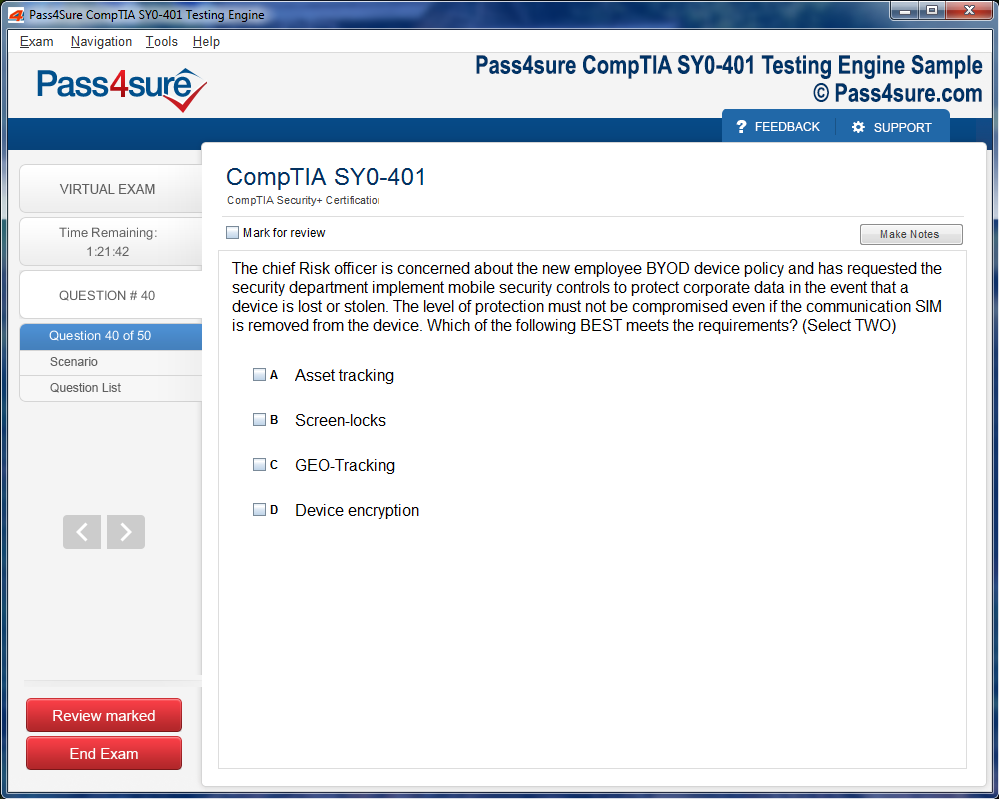
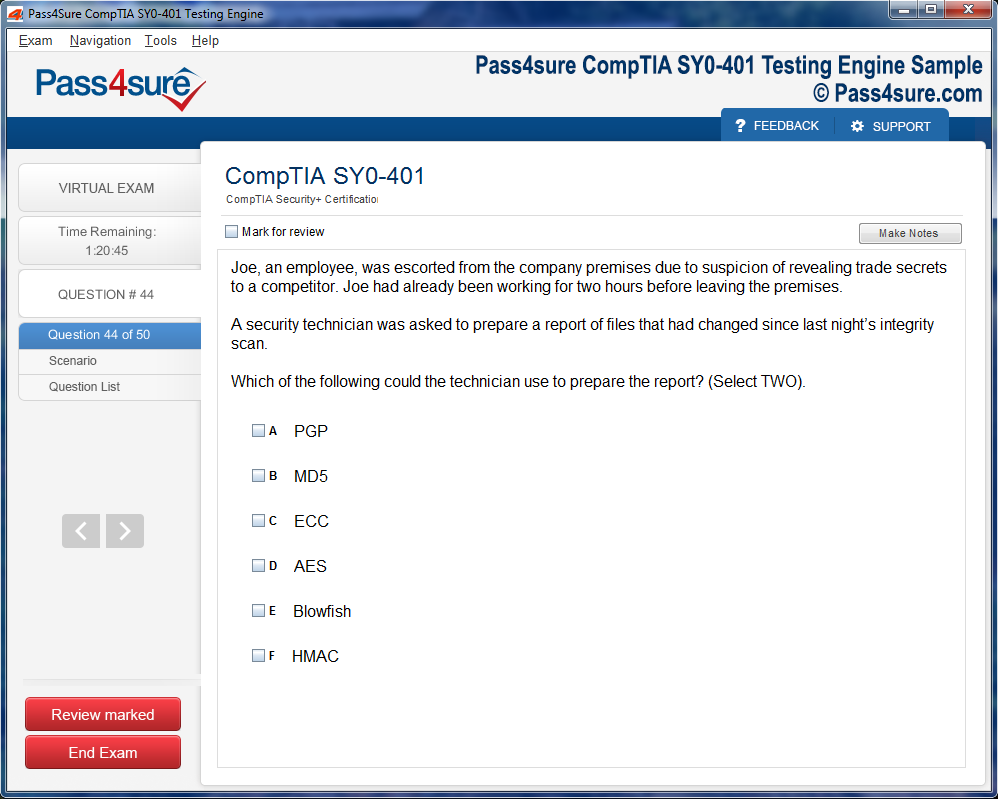
Product Screenshots
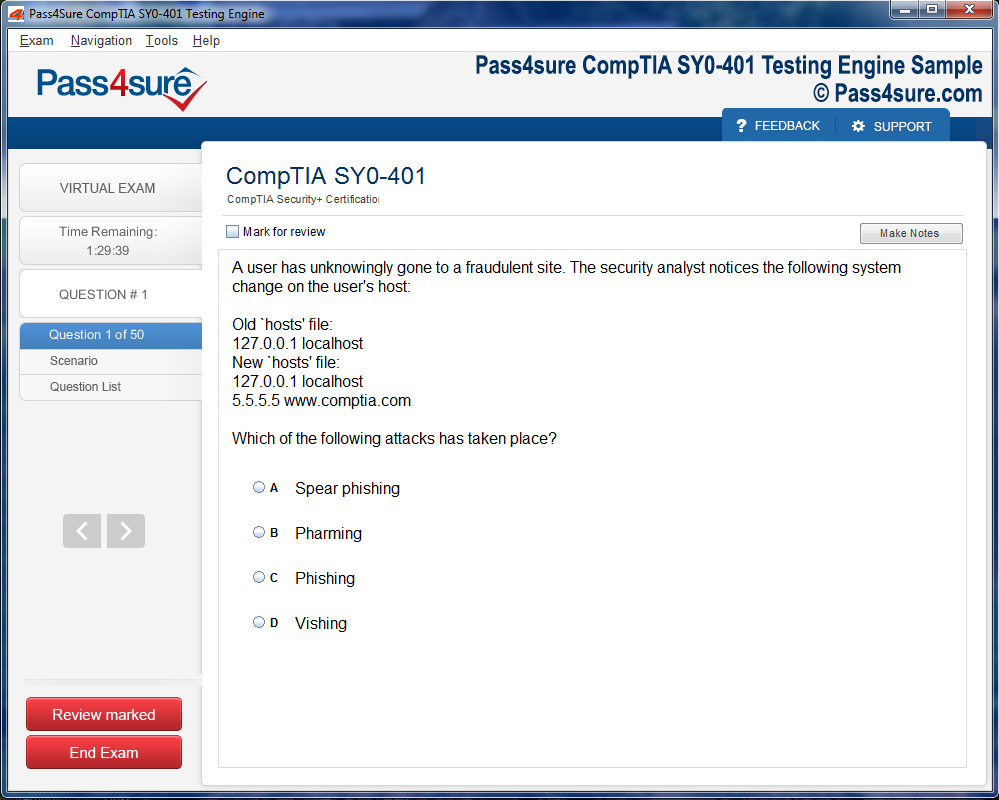
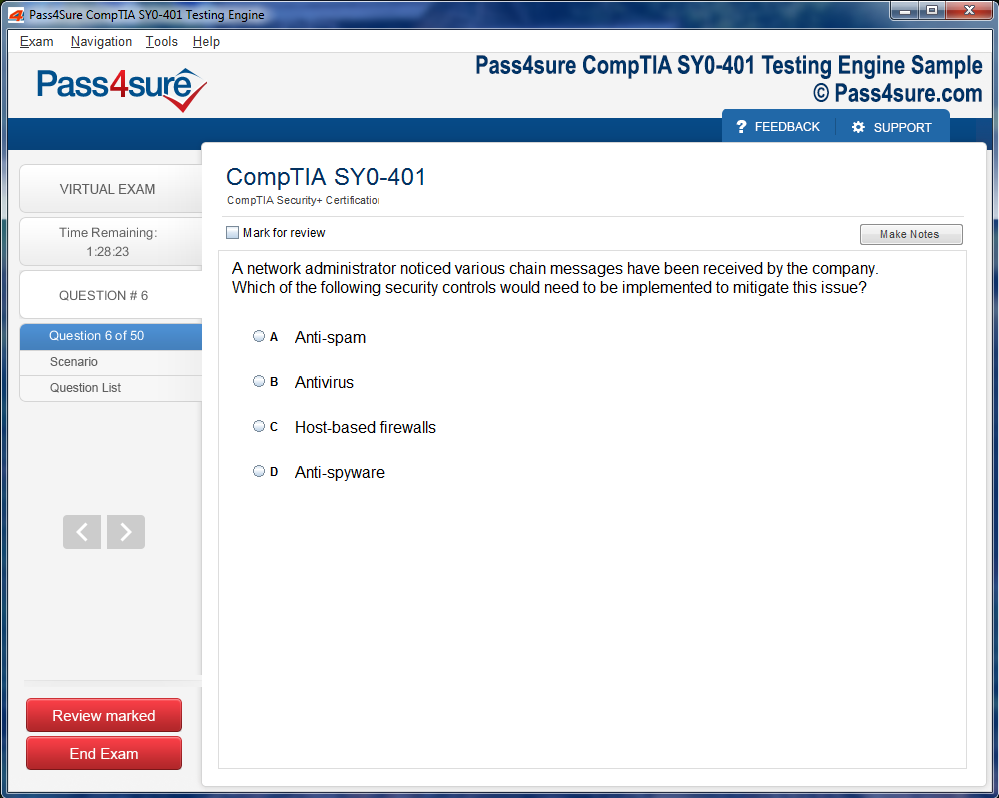
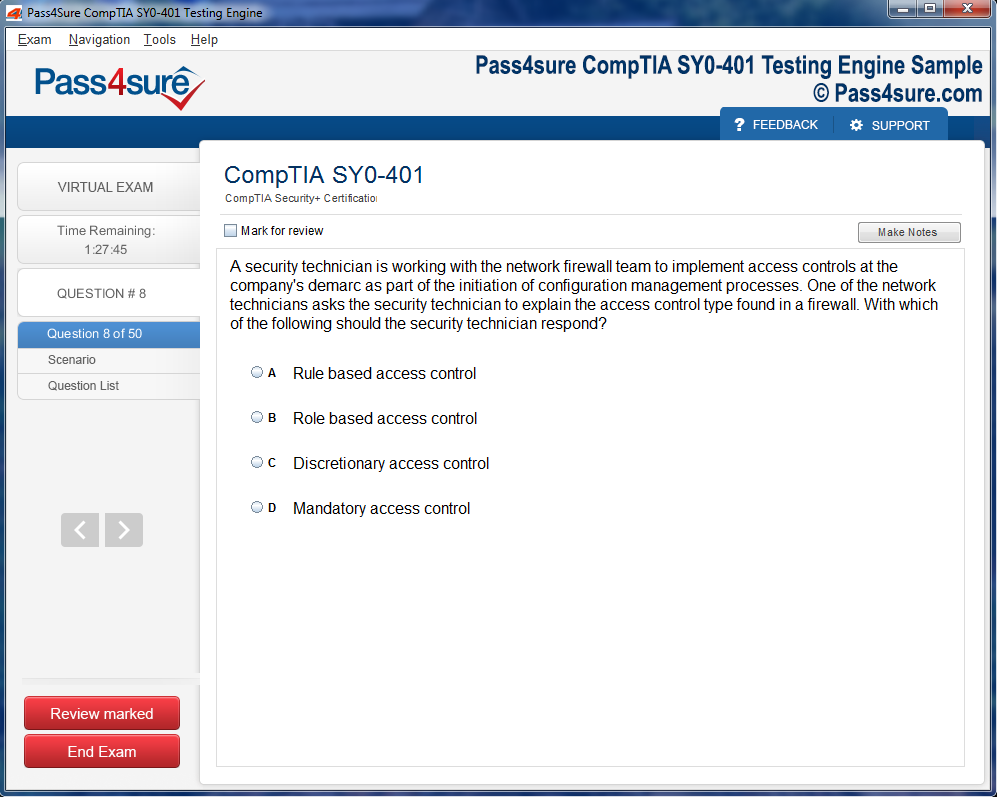
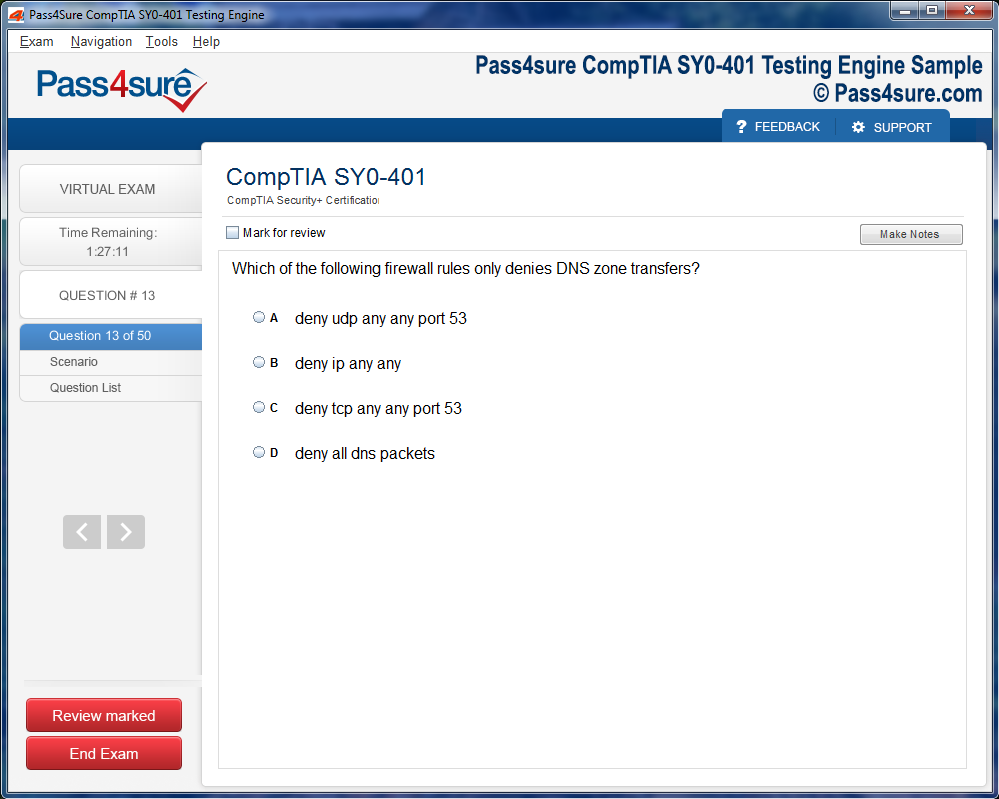
Frequently Asked Questions
How does your testing engine works?
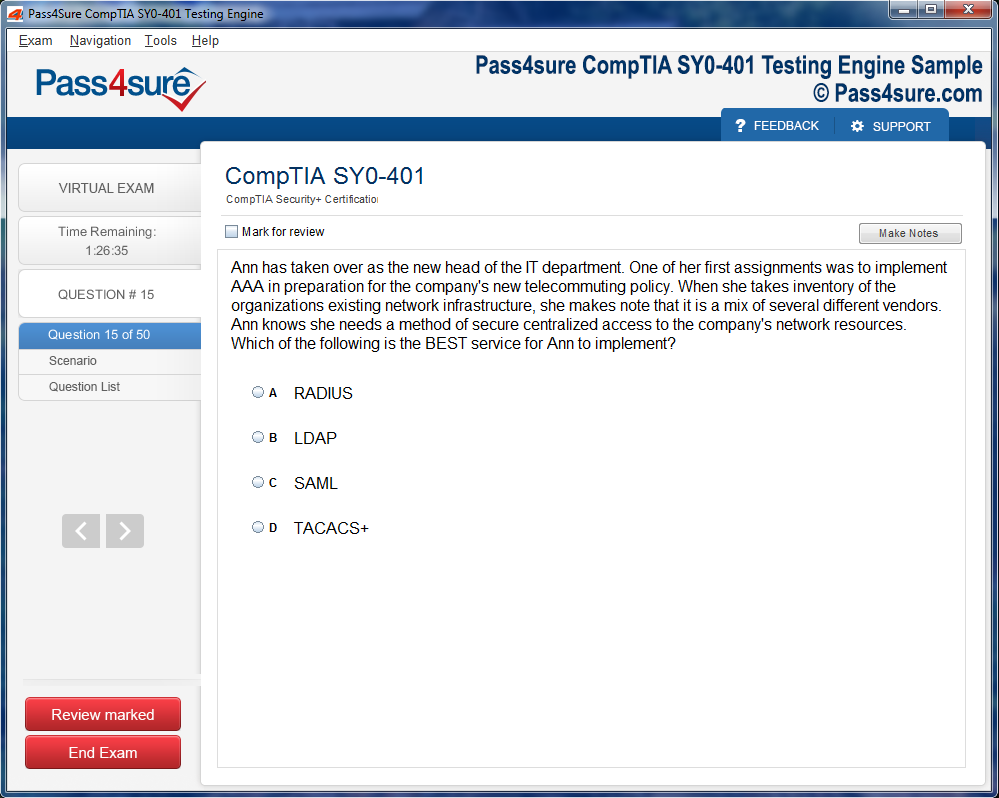
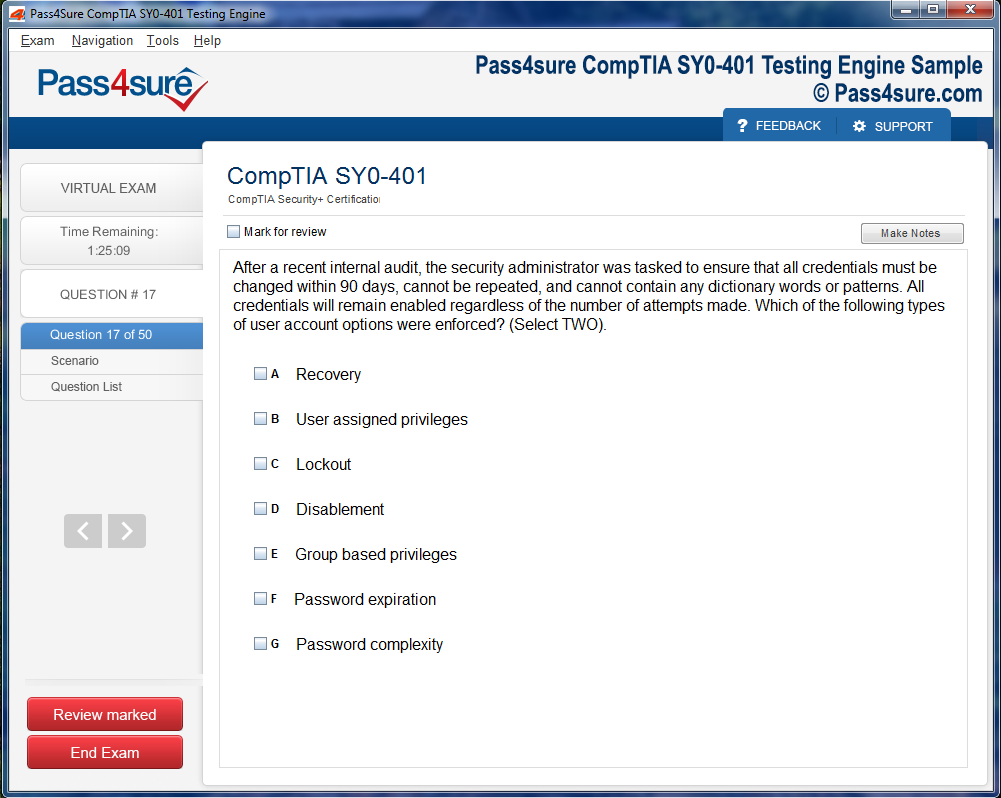
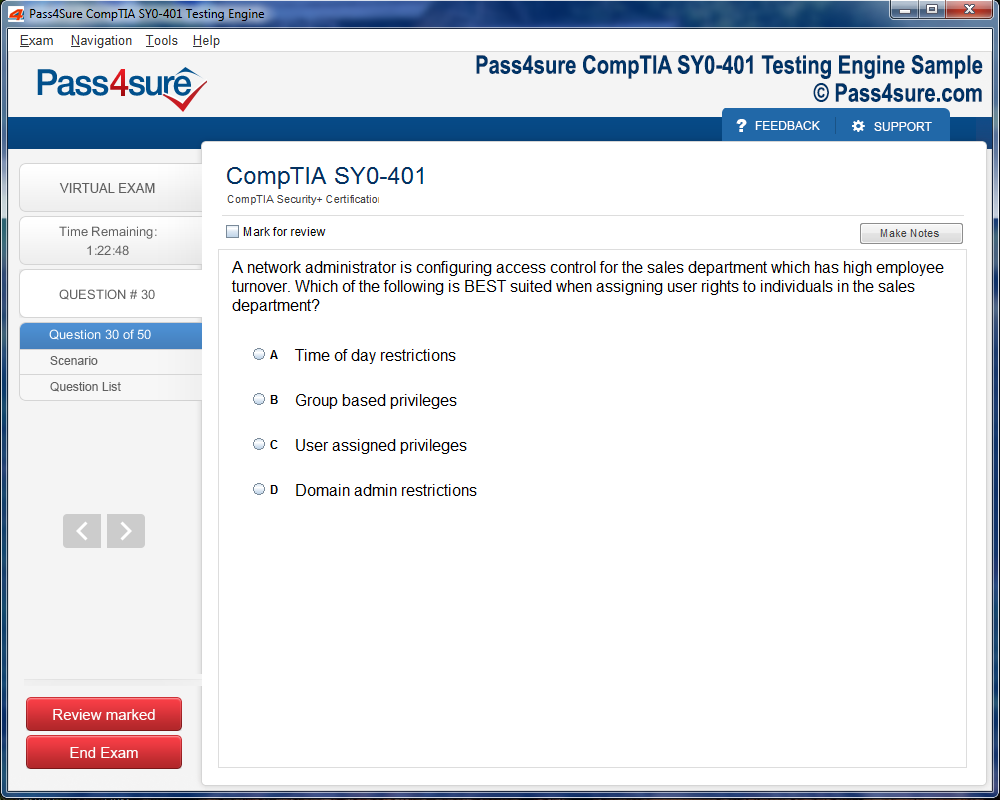
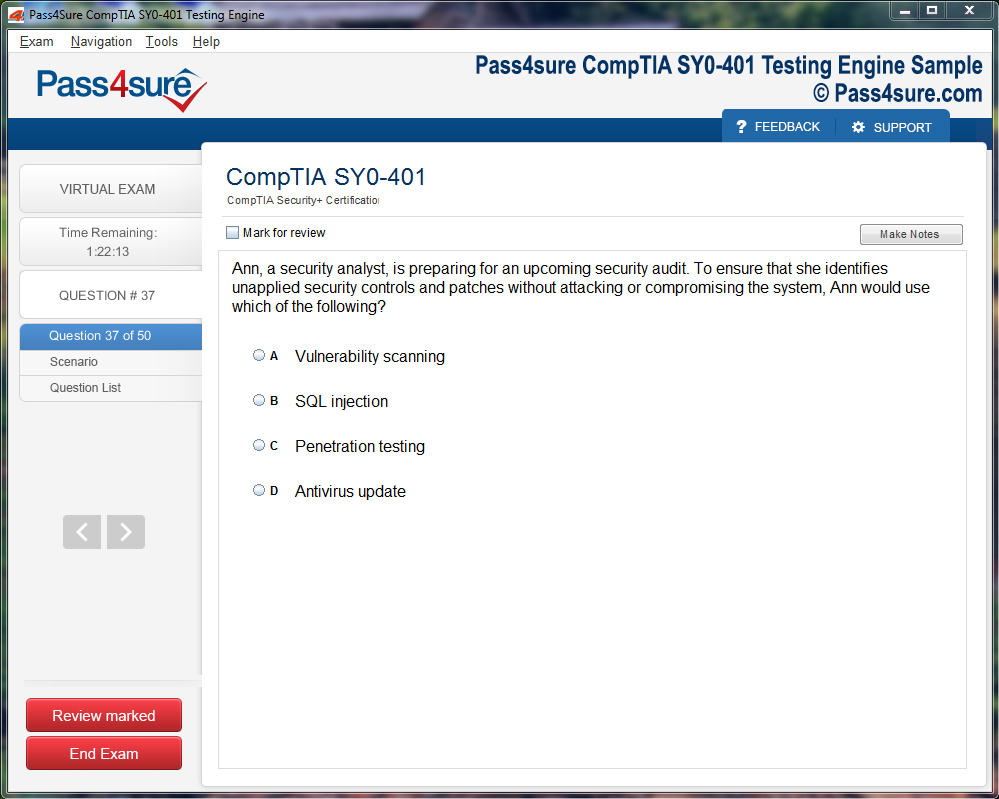
Once download and installed on your PC, you can practise test questions, review your questions & answers using two different options 'practice exam' and 'virtual exam'. Virtual Exam - test yourself with exam questions with a time limit, as if you are taking exams in the Prometric or VUE testing centre. Practice exam - review exam questions one by one, see correct answers and explanations.
How can I get the products after purchase?
All products are available for download immediately from your Member's Area. Once you have made the payment, you will be transferred to Member's Area where you can login and download the products you have purchased to your computer.
How long can I use my product? Will it be valid forever?
Pass4sure products have a validity of 90 days from the date of purchase. This means that any updates to the products, including but not limited to new questions, or updates and changes by our editing team, will be automatically downloaded on to computer to make sure that you get latest exam prep materials during those 90 days.
Can I renew my product if when it's expired?
Yes, when the 90 days of your product validity are over, you have the option of renewing your expired products with a 30% discount. This can be done in your Member's Area.
Please note that you will not be able to use the product after it has expired if you don't renew it.
How often are the questions updated?
We always try to provide the latest pool of questions, Updates in the questions depend on the changes in actual pool of questions by different vendors. As soon as we know about the change in the exam question pool we try our best to update the products as fast as possible.
How many computers I can download Pass4sure software on?
You can download the Pass4sure products on the maximum number of 2 (two) computers or devices. If you need to use the software on more than two machines, you can purchase this option separately. Please email sales@pass4sure.com if you need to use more than 5 (five) computers.
What are the system requirements?
Minimum System Requirements:
- Windows XP or newer operating system
- Java Version 8 or newer
- 1+ GHz processor
- 1 GB Ram
- 50 MB available hard disk typically (products may vary)
What operating systems are supported by your Testing Engine software?
Our testing engine is supported by Windows. Andriod and IOS software is currently under development.
Beginner’s Guide to Microsoft 77-888 Certification Success
Microsoft 77-888 meticulously evaluates a tapestry of technical competencies, intertwining conceptual understanding with pragmatic execution. At the heart of the certification lies the ability to configure, administer, and optimize Microsoft environments across diverse infrastructures. Candidates are expected to demonstrate fluency in orchestrating both on-premises and cloud-based systems, including hybrid configurations that amalgamate the strengths of each.
A critical competency domain involves identity and access management. Mastery here requires familiarity with authentication protocols, role-based access controls, and conditional access policies. The certification challenges aspirants to envision secure yet efficient access paradigms that scale with organizational demands. Misconfigurations in this domain often have cascading effects, highlighting the necessity of precision and foresight.
Equally paramount is proficiency in system maintenance and troubleshooting. Microsoft 77-888 does not merely test rote memorization of commands; it probes the candidate’s ability to diagnose anomalies, remediate failures, and preempt potential bottlenecks. Developing a mental catalog of error signatures, system logs, and diagnostic patterns can dramatically enhance problem-solving efficiency.
Automation and scripting form another vital pillar. Proficiency with PowerShell or equivalent automation tools enables candidates to streamline repetitive tasks, enforce consistency, and optimize resource utilization. The exam emphasizes not only syntactic knowledge but also the capacity to architect scripts that balance efficacy with maintainability. Here, iterative practice and scenario-based exercises are indispensable.
Networking concepts constitute a subtle yet significant facet. Understanding network segmentation, routing paradigms, and firewall configurations ensures that administrators can safeguard connectivity while preserving operational fluidity. The interplay between network topology and Microsoft services often presents nuanced challenges, requiring candidates to think holistically rather than in isolated silos.
Finally, candidates must demonstrate aptitude in monitoring and performance optimization. Recognizing trends, analyzing metrics, and proactively implementing enhancements prevent degradation of system efficacy. The ability to discern subtle performance anomalies before they escalate into critical issues reflects not only technical prowess but also anticipatory thinking.
Crafting an Effective Study Paradigm
A bespoke study paradigm is integral to navigating the labyrinthine complexities of Microsoft 77-888. Success hinges upon a methodology that harmonizes theoretical mastery with experiential immersion. Begin by constructing a framework that delineates core topics, allocating time proportional to domain complexity and personal proficiency.
Incorporating hands-on practice is non-negotiable. Virtual labs, sandbox environments, and simulation exercises enable aspirants to contextualize abstract concepts within tangible scenarios. This kinesthetic approach fosters retention and equips candidates with practical insights that transcend textual comprehension.
Incremental learning, coupled with cyclical revision, forms the backbone of knowledge consolidation. Rather than attempting exhaustive coverage in a linear fashion, adopt a layered approach. Foundational principles such as directory services, security frameworks, and system architecture should precede advanced integrations and automation. Revisiting previously studied topics at regular intervals strengthens cognitive scaffolding and mitigates the erosion of newly acquired skills.
Peer interaction amplifies learning outcomes exponentially. Participating in study groups, discussion forums, or mentorship sessions exposes aspirants to diverse problem-solving strategies. Articulating solutions to peers consolidates internal understanding while revealing latent misconceptions. Observing the cognitive pathways of others enriches perspective, fostering adaptive thinking essential for real-world application.
Time management strategies are pivotal. Practice examinations conducted under strict time constraints condition candidates to navigate complex queries with agility. Learning to balance analytical depth with response efficiency distinguishes proficient aspirants from those who falter under temporal pressure.
Finally, resource curation is essential. Curating a compendium of high-fidelity study materials, including official Microsoft documentation, interactive labs, and structured tutorials, ensures that preparation is targeted and effective. Personal notes, quick reference guides, and diagnostic checklists serve as indispensable tools during intensive revision sessions.
Leveraging Problem-Solving for Exam Excellence
The Microsoft 77-888 exam foregrounds applied problem-solving, emphasizing scenarios that mirror professional exigencies. Candidates must cultivate the capacity to dissect multifaceted challenges, identify root causes, and implement sustainable solutions.
A systematic approach begins with accurate problem identification. Recognizing symptomatic patterns within system logs, error messages, or performance metrics enables aspirants to isolate core issues efficiently. Developing a mental lexicon of common anomalies and their remediation pathways reduces reliance on trial-and-error methodologies.
Scenario simulation enhances preparedness. Crafting bespoke challenges or replicating historical case studies exposes candidates to unpredictable contingencies, fostering adaptive thinking. This approach mirrors professional exigencies, where administrators often confront ambiguous or emergent problems demanding rapid, yet precise, responses.
Critical thinking interlaces with technical knowledge. Candidates must evaluate multiple solution pathways, balancing immediate remediation with long-term operational sustainability. The ability to anticipate side effects, assess risk, and select optimal interventions distinguishes exemplary professionals from competent practitioners.
Moreover, troubleshooting extends beyond mere technical rectification. It encompasses communication, documentation, and knowledge dissemination. Articulating problem resolution steps, maintaining detailed logs, and advising stakeholders cultivates holistic competence—qualities the 77-888 exam subtly rewards.
Psychological Strategies for Optimal Performance
Certification success is as much a mental endeavor as a technical one. The cognitive landscape navigated during the Microsoft 77-888 exam demands resilience, focus, and strategic mental conditioning.
Stress management techniques, such as mindfulness exercises, controlled breathing, or cognitive rehearsal, enhance concentration and mitigate anxiety. Establishing a pre-exam ritual that primes mental clarity can significantly influence performance outcomes.
Confidence is cultivated through incremental achievement. Celebrating small victories during practice sessions reinforces self-efficacy, while reflective assessment of errors transforms setbacks into actionable insights. Persistence, coupled with disciplined study routines, fosters both competence and assurance.
Visualization techniques can also be transformative. Mentally simulating the exam environment, anticipating question formats, and rehearsing strategic responses reduce cognitive friction during actual assessment. By envisioning successful navigation of complex scenarios, candidates anchor confidence and operational readiness.
Sleep hygiene and cognitive replenishment are frequently underestimated. Adequate rest consolidates memory, enhances problem-solving agility, and sustains attention. Integrating structured breaks during study cycles prevents mental fatigue, ensuring consistent assimilation of intricate technical content.
Mastering Core Microsoft Concepts
An indispensable facet of exam preparation is the comprehensive mastery of foundational Microsoft concepts. Candidates must move beyond rote memorization, immersing themselves in the underlying principles that govern system functionality. Understanding the interplay between various Microsoft tools, operating systems, and cloud frameworks equips learners with the analytical agility necessary for complex problem-solving scenarios.
For instance, grasping the intricacies of Windows server management, Active Directory hierarchies, and permission schemas is paramount. Beyond simple procedural knowledge, one should apprehend the rationale behind system configurations and network topology. This cognitive depth allows learners to anticipate potential issues and apply preventative strategies, transforming theoretical comprehension into actionable expertise.
Emphasizing pattern recognition within software workflows enhances predictive reasoning. By analyzing recurring operational sequences, learners can identify efficiency bottlenecks and preemptively deploy automation scripts. This proactive mindset not only augments exam readiness but cultivates professional dexterity, fostering a capacity for innovation within enterprise environments.
Leveraging Simulation and Scenario-Based Learning
Immersive simulation is a catalytic component of skill acquisition for Microsoft 77-888 aspirants. Virtual labs, scenario-driven exercises, and sandbox environments offer a risk-free space to experiment with configurations and commands. By replicating authentic organizational infrastructures, learners encounter challenges akin to real-world operational dilemmas, reinforcing practical competence.
Scenario-based learning extends beyond technical execution. It engenders strategic thinking, requiring learners to diagnose, troubleshoot, and resolve multifaceted problems. For example, integrating cloud services with on-premises infrastructure demands comprehension of networking principles, security protocols, and data governance frameworks. Through iterative engagement with such scenarios, learners cultivate a cognitive flexibility essential for both examination success and professional application.
Furthermore, adaptive simulations can provide instant feedback, highlighting misconfigurations or suboptimal approaches. This immediacy accelerates learning, enabling swift correction of errors and fostering an internalization of best practices. By combining repetition, reflection, and experimentation, candidates solidify competencies in a manner that transcends conventional study methodologies.
Strategic Memorization and Cognitive Reinforcement
While conceptual understanding is critical, strategic memorization remains a cornerstone of effective study. Employing mnemonic devices, analogical reasoning, and cognitive chunking facilitates retention of complex sequences, from command syntaxes to protocol hierarchies.
Visualization techniques further augment memory consolidation. Mapping network topologies, creating layered process diagrams, and employing color-coded flowcharts allow learners to internalize abstract relationships. Kinesthetic reinforcement, such as hands-on scripting exercises or role-playing system administration scenarios, ensures that knowledge is encoded across multiple cognitive modalities, reinforcing durability and recall under exam conditions.
Periodic interleaving of topics enhances long-term retention. Alternating between domains—security, automation, and system management—prevents cognitive stagnation and fosters integrative thinking. This cross-pollination of concepts enables learners to perceive systemic interdependencies, sharpening analytical acumen and supporting holistic mastery.
Harnessing Peer Collaboration and Knowledge Exchange
The social dimension of learning amplifies engagement and depth of understanding. Collaborating with study groups, online cohorts, or discussion forums introduces diverse perspectives that challenge entrenched assumptions. Peer interaction encourages the articulation of thought processes, honing explanatory precision and conceptual clarity.
Engaging in collaborative problem-solving also cultivates accountability. Structured group activities, such as timed practice tests or joint troubleshooting exercises, reinforce adherence to study schedules and encourage consistent progress. Exposure to varied approaches deepens comprehension, revealing nuances that may be overlooked in solitary study. Additionally, mentorship from seasoned professionals offers insights into strategic exam preparation, practical shortcuts, and industry-relevant applications.
Progress Tracking and Iterative Refinement
Monitoring progress is integral to sustaining motivation and ensuring effective resource allocation. Maintaining detailed study logs, completion charts, or competency matrices allows learners to visualize growth and identify persistent gaps. This iterative feedback loop fosters metacognitive awareness, prompting strategic adjustments to study techniques or focus areas.
Incorporating reflective practices further enhances study efficacy. Post-exercise analysis, error categorization, and corrective planning convert mistakes into actionable learning experiences. Over time, this method cultivates resilience, transforming initial weaknesses into demonstrable strengths. By combining quantitative tracking with qualitative reflection, learners establish a dynamic, adaptive approach to exam preparation.
Cultivating Resilience and Adaptive Thinking
A hallmark of successful Microsoft 77-888 candidates is the capacity for resilience and adaptive cognition. Encountering complex practice questions or unfamiliar scenarios is inevitable, yet framing these challenges as learning opportunities enhances cognitive growth. Embracing iterative cycles of practice, evaluation, and recalibration fosters a mindset attuned to continuous improvement.
Adaptive thinking extends to exam strategy as well. Recognizing question patterns, anticipating multi-layered problem requirements, and deploying strategic prioritization allows learners to manage time efficiently while optimizing accuracy. This synthesis of preparation, reflection, and tactical execution embodies the core attributes of a proficient Microsoft professional.
System Configuration Mastery for Novices
Embarking on the Microsoft 77-888 journey requires an intimate acquaintance with system configuration, the bedrock of technical acumen. System configuration is not merely about toggling settings; it is an intricate ballet of user management, file hierarchies, permissions orchestration, and resource allocation. Beginners frequently stumble when navigating nested directories, inheritance patterns, and dependency chains, yet these challenges are surmountable with methodical practice.
Command-line proficiency forms the backbone of configuration fluency. Mastery of utilities such as PowerShell or command prompt commands allows for swift navigation and manipulation of system parameters. When novices engage in deliberate, iterative experimentation, they internalize the logic underlying operating systems, forging a cognitive map that transforms abstract theory into executable skill.
System auditing constitutes another pillar. Understanding logs, event tracking, and diagnostic tools enables practitioners to preempt malfunctions and optimize performance. For beginners, cultivating a mindset attuned to both granular details and overarching system coherence is pivotal. By conceptualizing each configuration task as a node in a dynamic network, learners can anticipate interdependencies and mitigate errors before they propagate.
Network Management and Connectivity Fluency
Networking is frequently perceived as arcane, yet it is indispensable for Microsoft 77-888 proficiency. The domain encompasses IP stratagems, subnet calculations, routing topologies, and connectivity diagnostics. Novices may initially find the conceptual density formidable; however, experiential exposure through simulation software or controlled lab environments illuminates these abstractions.
Subnetting, in particular, requires both analytical dexterity and procedural familiarity. By dissecting IP ranges and practicing address allocation, candidates cultivate the precision necessary to prevent bottlenecks or conflicts. Complementary exercises in routing and packet analysis instill a nuanced comprehension of traffic flow, latency, and fault isolation.
Beyond theory, network troubleshooting hones resilience and ingenuity. Real-world scenarios—ranging from misconfigured gateways to DNS anomalies—offer fertile ground for applied learning. Progressive engagement with increasingly complex topologies fosters adaptive reasoning, a skill that resonates in both examination settings and professional practice.
Security Protocols: From Theory to Operational Excellence
The security domain demands vigilance, precision, and strategic insight. Candidates must navigate authentication mechanisms, encryption standards, access control matrices, and vulnerability assessment frameworks. For beginners, these topics initially appear daunting due to the multiplicity of vectors and potential attack surfaces, yet structured practice transforms apprehension into proficiency.
Encryption comprehension is particularly vital. Understanding symmetric versus asymmetric methods, certificate management, and secure channel establishment empowers candidates to architect resilient systems. Access control exercises, such as role-based permission assignments or group policy enforcement, further reinforce operational fluency.
Scenario-based simulations elevate security literacy. By confronting hypothetical breaches or misconfigurations, learners internalize response protocols and develop a preventative mindset. Security, in essence, is both an art and a science, blending theoretical rigor with anticipatory problem-solving.
Cloud Services and Virtualization Expertise
In the contemporary IT landscape, cloud services and virtualization are no longer peripheral—they are central. Microsoft 77-888 candidates must exhibit dexterity in integrating cloud infrastructure, deploying virtual machines, and managing hybrid environments. Practical engagement with platforms such as Azure or Windows Server virtualization modules cultivates this fluency.
Understanding cloud paradigms involves more than procedural know-how; it requires strategic foresight. Candidates must appreciate resource scaling, cost optimization, and redundancy planning. Experimentation with deployment templates and orchestration scripts enhances operational agility, enabling learners to navigate both the exam and real-world infrastructures with confidence.
Hybrid environments, blending on-premises systems with cloud services, demand integrative thinking. Beginners often find synchronization and identity federation complex, yet consistent practice illuminates the principles underlying networked resource management. By internalizing these concepts, learners translate abstract architectures into executable workflows.
Automation Scripting as a Force Multiplier
Automation scripting represents the pinnacle of competency in Microsoft 77-888. Proficiency in PowerShell, batch files, or command-line utilities allows candidates to expedite routine tasks, enforce procedural consistency, and optimize system operations. Although intimidating initially, scripting is fundamentally modular: simple commands coalesce into robust, reusable routines.
Beginners should adopt a progressive strategy, beginning with elementary scripts to manipulate files or adjust system settings. Gradual complexity, including conditional logic, loops, and function encapsulation, cultivates confidence while demonstrating the transformative potential of automation.
Scripting also reinforces integrative thinking. By linking configuration, network management, and security enforcement within scripts, learners develop a holistic perspective. This capacity to harmonize disparate domains is emblematic of the seasoned Microsoft professional, and it is highly valued both in examinations and industry applications.
Holistic Competency and Integrative Practice
The interdependence of exam domains underscores the necessity of holistic preparation. Mastery is not merely the accumulation of discrete skills; it is the ability to synthesize knowledge across system configuration, networking, security, cloud deployment, and automation.
Multi-step scenario exercises are invaluable. For instance, a candidate might configure a virtual machine, establish network connectivity, implement access controls, and script maintenance tasks sequentially. This methodology mirrors real-world problem-solving, reinforcing cognitive flexibility and procedural fluency.
Continual self-assessment enhances this integrative approach. Timed practice exams, lab simulations, and scenario-based drills expose both proficiency and gaps, offering a roadmap for targeted improvement. Beginners frequently underestimate the value of repetition; however, iterative engagement solidifies recall, reinforces logic pathways, and reduces error under pressure.
Adaptability in a Rapidly Evolving Landscape
Finally, adaptability is crucial for enduring success. Microsoft technologies evolve rapidly, and static knowledge quickly becomes obsolete. Candidates must cultivate a mindset of continuous learning, integrating updates, patches, and emerging methodologies into their skillset.
Engagement with official documentation, interactive tutorials, and experiential experimentation ensures currency. Participating in community forums or discussion groups fosters collaborative problem-solving and exposes learners to diverse perspectives. By embracing adaptability, candidates position themselves for not only examination success but also long-term professional excellence.
Immersive Familiarization with Microsoft Tools
Success in the Microsoft 77-888 certification journey commences with profound familiarity with the ecosystem of Microsoft tools. Novices often underestimate the significance of immersive exposure, yet exploring the intricate labyrinth of interfaces, utilities, and integrated modules lays a sturdy groundwork. Deliberate exploration—clicking through menus, observing interactive elements, and probing feature functionalities—fosters a granular understanding that transcends rote memorization. The more tactile and sensory the engagement, the more intuitive the learning becomes, enabling candidates to navigate complex environments effortlessly during both practical exercises and real-world applications.
Simulated Labs and Virtual Environments
The utilization of simulated laboratories and virtual environments is not merely optional; it is transformative. Such platforms replicate authentic configurations and operational contexts without the peril of jeopardizing live systems. For instance, configuring virtual networks, deploying user accounts, or instituting permission hierarchies within a sandboxed environment cultivates procedural dexterity. Repetition within these controlled scenarios builds a robust procedural memory while alleviating the trepidation associated with live system errors. By exploring failures safely, learners internalize corrective strategies and develop an anticipatory problem-solving mindset, a trait indispensable in both examination settings and professional engagements.
Scenario-Based Problem Solving
Practical preparation demands scenario-based problem-solving as a cornerstone methodology. Constructing intricate, real-world scenarios enables aspirants to grapple with multifaceted challenges akin to those encountered in professional environments. Consider simulating a sudden network outage, tracing the sequence of system logs, diagnosing the disruption, and restoring functionality while observing stringent security protocols. This methodology hones analytical cognition, fortifies troubleshooting agility, and reinforces procedural fluency. The iterative engagement with diverse problem structures enhances adaptability, ensuring candidates can address novel and unpredictable scenarios during examinations with composed precision.
Timed Practice Drills
Time-bound exercises impart a vital dimension of readiness. Simulating temporal constraints encountered in exams cultivates efficiency and resilience. Beginners frequently falter due to disproportionate focus on intricate tasks or hasty completion of simpler operations. Structured timed drills condition the mind to allocate attention judiciously, balancing accuracy with velocity. Over repeated sessions, candidates develop a calibrated intuition for time management, which translates to seamless navigation of complex exam landscapes while sustaining a high performance standard.
Systematic Documentation and Note-Taking
Systematic documentation constitutes an indispensable pillar of preparation. Recording command syntaxes, stepwise configuration processes, troubleshooting methodologies, and emergent insights transforms ephemeral learning into a structured knowledge repository. Categorizing notes according to domains such as networking, security protocols, and automation scripts enhances retrievability and clarity. This compendium becomes not merely a revision tool but a living archive of procedural wisdom, enabling rapid recall under exam pressure and serving as an enduring professional reference long after certification.
Collaborative Learning and Peer Engagement
The cultivation of collaborative learning networks accelerates comprehension and retention. Engaging in study partnerships, online forums, or professional communities exposes learners to diverse perspectives and alternative problem-solving heuristics. Explaining procedures to peers, rationalizing configuration choices, and debating troubleshooting strategies consolidates personal understanding while illuminating overlooked nuances. This dialogic approach nurtures cognitive elasticity, fostering an enriched understanding that solitary study cannot fully replicate. Peer engagement transforms knowledge acquisition into an interactive, iterative process, sharpening both technical acumen and communicative clarity.
Adaptive Feedback and Reflective Analysis
Incorporating adaptive feedback loops into preparation maximizes efficacy. Following each practical lab or mock assessment, a meticulous reflection on errors and inefficiencies reveals the subtleties of conceptual misunderstandings. Whether arising from misapplied scripts, misinterpreted network logs, or overlooked security measures, identifying the precise locus of error permits targeted remediation. This reflective practice not only converts mistakes into instructive experiences but also cultivates a mindset oriented toward continuous improvement—a critical competency for lifelong professional growth.
Harmonizing Theory and Practice
Equilibrium between theoretical understanding and procedural execution forms the linchpin of effective preparation. While practical exercises solidify hands-on skills, deep engagement with theoretical constructs ensures contextual comprehension and adaptability. Revisiting foundational principles, examining detailed documentation, and perusing advanced guides reinforce conceptual scaffolding. This synthesis guarantees that learners can navigate unfamiliar challenges fluidly, applying principles innovatively rather than mechanically, thereby enhancing both examination performance and professional problem-solving agility.
Incremental Mastery through Repetition
Mastery emerges incrementally through disciplined, iterative practice. Structured repetition in both virtual and physical environments engrains procedural fluency, fortifies memory retention, and sharpens analytical precision. Repeated exposure to analogous configurations, command sets, and troubleshooting scenarios establishes an intuitive operational framework. Candidates internalize not only the “how” but also the “why” behind each action, cultivating an adaptable and confident approach to both anticipated and unforeseen challenges.
Cognitive Resilience and Exam Readiness
Developing cognitive resilience is an often-overlooked yet crucial aspect of preparation. Exposure to progressively complex scenarios, time constraints, and simulated failures fortifies mental endurance. Candidates learn to sustain focus under pressure, mitigate anxiety, and maintain procedural clarity amidst cognitive load. This resilience transcends rote knowledge, enabling nuanced judgment, agile decision-making, and poise during examination conditions, which collectively heighten the probability of success.
Integration of Automation and Efficiency Techniques
Practical preparation increasingly incorporates automation to streamline repetitive tasks and enhance operational efficiency. Leveraging scripts, macros, and automated workflows reduces manual redundancy while deepening comprehension of underlying processes. Candidates who cultivate fluency in automation can simulate real-world efficiencies, translating these skills directly into professional environments. Understanding the interplay between manual execution and automated solutions is not only a hallmark of technical competence but also a differentiator in competitive job markets.
Iterative Testing and Scenario Variation
To fully internalize practical skills, iterative testing across variant scenarios is essential. Reconfiguring parameters, introducing anomalies, or simulating environmental changes challenges candidates to adapt dynamically. This methodology cultivates flexible cognition and prepares aspirants to tackle unpredictable contingencies both during certification assessments and professional deployments. Each variation refines problem-solving strategies, reinforces procedural memory, and elevates confidence levels.
Personalized Learning Pathways
Acknowledging individual learning styles enhances the efficacy of preparation. Visual learners benefit from schematic diagrams and flowcharts, while kinesthetic learners thrive through tactile engagement with interfaces and scripts. Auditory learners gain from verbal explanations, discussions, or recorded walkthroughs. Customizing study strategies to align with cognitive preferences accelerates comprehension, retention, and practical application, ultimately fostering a personalized trajectory toward mastery.
Simulating Enterprise-Level Complexity
Preparation is most impactful when it emulates enterprise-scale complexity. By constructing multi-layered network environments, interdependent systems, and cross-platform integrations, candidates encounter authentic operational intricacies. This exposure bridges the chasm between controlled practice and real-world applicability, fostering comprehensive problem-solving acumen. Grappling with sophisticated scenarios cultivates foresight, strategic planning, and nuanced troubleshooting capabilities that are indispensable for advanced professional roles.
Harnessing Authoritative Literature for Deep Comprehension
In the pursuit of mastery over Microsoft 77-888 certification, leveraging authoritative literature is indispensable. Official manuals and comprehensive guides are repositories of meticulously curated knowledge, presenting intricate processes with exacting clarity. Delving into these texts equips candidates with a nuanced understanding of exam domains, elucidating both fundamental principles and sophisticated workflows. For novices, these resources are akin to cartographic instruments, charting the terrain of knowledge with precision and mitigating the risk of misdirected effort. Iterative study of these guides not only fosters retention but also cultivates an instinctive familiarity with procedural logic that is crucial for real-world application.
Integrating Multimodal Learning Pathways
Augmenting traditional reading with multimodal learning avenues significantly accelerates comprehension. Video expositions, interactive modules, and scenario-based simulations cater to diverse cognitive inclinations, converting abstract concepts into tangible experiences. Observational learning, particularly through well-structured demonstrations, empowers beginners to internalize complex sequences before attempting autonomous execution. This synthesis of visual, auditory, and tactile engagement engenders a holistic grasp of concepts, rendering them more accessible and memorable. Multimodal learning is not merely a pedagogical convenience; it is a cognitive catalyst, amplifying neural connectivity and reinforcing conceptual retention.
Simulated Environments for Experiential Fluency
The cultivation of procedural fluency necessitates immersive practice within controlled, simulated environments. Virtual laboratories replicate authentic system interfaces, providing learners with the opportunity to configure, troubleshoot, and automate operations without risk. Such experiential practice sharpens dexterity and builds resilience, transforming theoretical knowledge into actionable competence. Regular interaction with simulations acclimatizes candidates to operational nuances and unforeseen contingencies, fostering adaptive problem-solving skills. In this way, virtual labs function as cognitive rehearsal arenas, where iterative engagement cultivates confidence and operational agility.
Strategic Utilization of Practice Assessments
Practice examinations serve as invaluable diagnostic instruments, offering insight into both conceptual mastery and strategic test-taking acumen. Frequent exposure to question typologies acclimatizes learners to structural conventions and temporal constraints, diminishing cognitive strain during the actual examination. More than mere evaluative tools, these assessments illuminate latent weaknesses, providing a roadmap for targeted revision. Systematic analysis of errors reveals subtle misconceptions, guiding recalibration of study strategies and reinforcing knowledge integrity. For beginners, practice tests are a compass, orienting preparation efforts and instilling both confidence and precision.
Community Engagement as a Knowledge Amplifier
Peer interaction within professional forums and discussion platforms is a catalyst for cognitive enrichment. Exposure to diverse perspectives, problem-solving methodologies, and practical anecdotes expands understanding beyond the confines of structured guides. Dialogues with experienced practitioners reveal latent pitfalls, emerging trends, and nuanced operational tactics that may escape conventional study materials. Moreover, sustained engagement fosters accountability, motivation, and a sense of shared endeavor, creating a dynamic feedback loop that reinforces both technical acumen and interpersonal growth. For those embarking on certification, community discourse is a conduit for experiential wisdom and collaborative resilience.
Organizational Methodologies for Cognitive Optimization
Maximizing study efficacy necessitates disciplined organizational frameworks. Structured note-taking, domain-based categorization, and progressive revision schedules streamline cognitive processing and facilitate rapid retrieval. By prioritizing content based on complexity, relevance, or frequency of examination, learners optimize time allocation and minimize cognitive entropy. Maintaining meticulously curated logs of completed modules, erroneous attempts, and reflective insights nurtures a transparent trajectory of progress, enhancing motivation and strategic foresight. These methodologies transform preparation from a passive endeavor into a deliberate, analytically orchestrated pursuit of competence.
Iterative Synthesis and Reflective Reinforcement
A cyclical approach to resource integration—encompassing reading, practice, assessment, and reflection—ensures the consolidation of knowledge and the internalization of complex procedures. Alternating between cognitive absorption and applied execution reinforces memory pathways, deepens understanding, and cultivates adaptive problem-solving capacity. Reflection, in particular, engenders metacognitive awareness, enabling learners to discern patterns, anticipate challenges, and refine strategies with increasing sophistication. Beginners who embrace iterative synthesis cultivate not only exam readiness but also enduring professional proficiency, seamlessly translating theoretical comprehension into practical mastery.
Cultivating Resilience Through Adaptive Strategies
Preparation for Microsoft 77-888 certification extends beyond rote memorization; it demands resilience and adaptive cognition. Encountering challenging modules or initially inscrutable concepts is inevitable, yet these experiences serve as crucibles for intellectual fortitude. By adopting flexible study strategies, integrating diverse resources, and seeking iterative feedback, learners transform obstacles into opportunities for growth. Resilience is further reinforced through incremental goal-setting, where successive achievements reinforce self-efficacy and sustain engagement. Over time, this adaptive approach fosters a robust, agile mindset capable of navigating both exam rigor and real-world operational challenges.
Leveraging Technological Ecosystems for Efficiency
Modern certification preparation thrives within interconnected technological ecosystems. Learning management systems, cloud-based collaboration tools, and automation platforms streamline access to resources, track progress, and facilitate collaborative engagement. Efficient utilization of these tools reduces friction in the learning process, enabling candidates to focus on conceptual mastery rather than logistical impediments. For beginners, embracing technological augmentation is a force multiplier, accelerating comprehension, refining practice, and consolidating knowledge within an integrated digital framework.
Strategic Reflection for Enhanced Knowledge Retention
Reflection constitutes the keystone of effective preparation. Beyond mere review, reflective practice entails systematic contemplation of procedural logic, error patterns, and cognitive strategies. By analyzing successes and setbacks within the broader context of operational objectives, learners cultivate an enduring, transferable understanding of system functionality. Reflective synthesis reinforces neural pathways, enhances analytical acuity, and fosters a deep, instinctive grasp of domain knowledge. Beginners who prioritize reflection transform transient familiarity into enduring mastery, equipping themselves for both exam success and professional excellence.
The Crucible of Confidence
Confidence is not merely a fleeting feeling; it is the alchemy of preparation and self-belief. Within the labyrinth of Microsoft 77-888 certification, beginners often encounter cognitive turbulence that can derail focus. Cultivating confidence demands a ritualized approach: iterative practice interlaced with reflective pauses fortifies neural pathways, embedding mastery in both memory and intuition. Each completed practice module acts as a micro-victory, transforming trepidation into poised readiness. The mind, when habituated to incremental triumphs, begins to perceive challenges not as insurmountable obstacles but as navigable puzzles, fostering a resilient, growth-oriented psyche.
Motivation as a Perpetual Engine
Motivation is the enigmatic fuel that propels aspirants through the protracted rigors of certification. Unlike superficial incentives, profound motivation emerges from purposeful alignment of goals with intrinsic values. Structuring study sessions around clearly delineated objectives—micro-goals for daily learning, competency targets for weekly milestones—renders preparation tangible and gratifying. Interspersing tangible achievements with ephemeral rewards, such as personal reflection or professional recognition, cultivates a sustainable momentum. Motivation, in this framework, becomes a self-reinforcing engine: progress amplifies engagement, which in turn accelerates mastery, creating a spiraling ascent toward proficiency.
Navigating Exam-Day Dynamics
Examination day is an orchestration of mental acuity, strategic pacing, and emotional equilibrium. Beginners often confront an unfamiliar testing ecosystem, where interface nuances, question sequencing, and time constraints intertwine to provoke stress. Familiarity is a formidable antidote. Simulated exams, faithfully mirroring real-world conditions, train candidates to maneuver through procedural intricacies, optimizing time allocation and minimizing surprises. The cognitive ease derived from anticipatory rehearsal reduces extraneous anxiety, allowing analytical faculties to function unimpeded.
Strategic Allocation of Cognitive Resources
Effective time management is not mere chronological discipline; it is a tactical deployment of mental resources. The certification examination encompasses heterogeneous question typologies, from algorithmic manipulations to scenario-based analysis. Allocating attention according to perceived complexity ensures high-yield returns on cognitive investment. Easier questions, swiftly resolved, free mental bandwidth for complex, multi-step problems. Meanwhile, uncertain items are earmarked for reevaluation, preventing stagnation and maintaining fluid momentum. This strategic choreography maximizes scoring potential while conserving psychological capital.
Stress Modulation and Cognitive Poise
The cerebral crucible of the exam is exacerbated by stress, which, if unmanaged, distorts judgment and induces errors. Incorporating stress modulation techniques—such as diaphragmatic breathing, brief kinesthetic resets, or mindful observation of thought patterns—enhances cognitive clarity. The efficacy of these interventions hinges upon rehearsal: practicing stress modulation during study sessions habituates neural circuits, rendering their application automatic under duress. Composure, in this context, functions as a cognitive lubricant, reducing friction between knowledge and execution, and permitting the seamless application of learned principles.
Post-Exam Reflection and Meta-Learning
The conclusion of the exam is merely a waypoint in the continuum of professional growth. Reflective analysis, undertaken post-assessment, transforms experiences into enduring insights. Systematic evaluation of performance—identifying conceptual gaps, procedural inefficiencies, and patterns of error—enables meta-learning, wherein the candidate refines not only content knowledge but also cognitive strategies. Documentation of reflections, from fleeting observations to structured retrospectives, constructs a personalized compendium of expertise, equipping learners with a durable schema for future challenges.
Adaptive Mindset and Lifelong Learning
The trajectory of Microsoft technologies is inherently dynamic; mastery is therefore not a static endpoint but a perpetually evolving endeavor. Cultivating adaptability entails embracing continuous learning and remaining receptive to novel methodologies, updated protocols, and emergent tools. Professionals who internalize this mindset transform disruption into opportunity, leveraging change as a catalyst for innovation and enhanced competence. The synthesis of technical proficiency with psychological agility ensures not merely success in certification, but enduring professional ascendancy.
Rituals for Cognitive Fortification
The journey to 77-888 mastery benefits from structured cognitive rituals. Ritualized practice schedules, designed to interleave theory, practical application, and reflective pauses, reinforce long-term retention. Incorporating mnemonic devices, analogical reasoning, and mental rehearsal augments neural encoding, fostering recall under pressure. By transforming learning into ritualized engagement, beginners elevate preparation from a utilitarian task to an immersive intellectual discipline.
The Role of Intrinsic Satisfaction
Intrinsic satisfaction operates as a subtle yet potent motivator. Beyond grades or credentialing, the gratification derived from intellectual conquest sustains engagement. Beginners attuned to this satisfaction perceive mastery as an iterative dialogue with their own capabilities. Each solved problem or executed script represents a tangible manifestation of competence, reinforcing the aspirant’s identity as a capable and resourceful professional. The internalization of this gratification promotes resilience, fortifying motivation against the vicissitudes of complex preparation.
Interpersonal and Collaborative Synergy
Even ostensibly solitary preparation benefits from deliberate interpersonal engagement. Peer discussions, collaborative problem-solving, and mentorship offer external perspectives, revealing conceptual blind spots and procedural efficiencies. Engaging in structured knowledge exchange cultivates both cognitive flexibility and adaptive thinking. Collaborative synergy, when integrated with individual study routines, accelerates mastery while enriching the learner’s experiential landscape, providing nuanced insights that solitary preparation may overlook.
Cognitive Calibration Through Iteration
Iterative refinement, a cornerstone of effective preparation, encompasses continuous assessment, adjustment, and strategic recalibration. Practice exams serve not merely as diagnostic instruments but as vectors for iterative improvement. Analysis of performance metrics—accuracy, pacing, and error typology—enables precise calibration of study strategies. Beginners who adopt this iterative mindset transform preparation into a dynamic, self-correcting process, progressively aligning their capabilities with the stringent demands of the Microsoft 77-888 certification.
Embracing Uncertainty as a Catalyst
Uncertainty, a pervasive element of high-stakes assessments, can be reframed as an impetus for cognitive expansion. Encountering ambiguous scenarios compels analytical creativity, compelling candidates to synthesize principles, anticipate outcomes, and apply heuristics. Cultivating comfort with uncertainty engenders mental dexterity, equipping beginners to navigate both examination challenges and real-world problem-solving with equanimity. The capacity to thrive amid indeterminate conditions distinguishes proficient professionals from those constrained by rigid procedural adherence.
Advanced Modules and Real-World Application
Microsoft 77-888 certification transcends mere theoretical knowledge, immersing candidates in sophisticated modules that mirror contemporary enterprise demands. Advanced modules test the capacity to integrate, optimize, and troubleshoot multifaceted systems with precision. Understanding these modules is pivotal for aspirants aiming to translate certification into tangible career leverage.
One critical component involves hybrid cloud architectures. Candidates are expected to deploy and manage systems that seamlessly span on-premises infrastructure and cloud platforms. This requires a nuanced understanding of synchronization protocols, redundancy planning, and data integrity strategies. Hybrid solutions often pose subtle challenges, demanding foresight in security implementation and operational orchestration. Mastery here positions professionals as indispensable assets in organizations pursuing scalable and resilient IT environments.
Data governance and compliance modules constitute another cornerstone. Beyond configuring access controls, candidates must ensure adherence to regulatory frameworks such as GDPR, HIPAA, or industry-specific mandates. Understanding audit trails, retention policies, and encryption methodologies ensures that systems not only perform efficiently but also withstand legal and organizational scrutiny. The exam emphasizes scenario-based queries, requiring aspirants to reconcile compliance with operational expediency—a skill that distinguishes seasoned administrators from novices.
Virtualization and containerization are increasingly central to modern IT landscapes. Microsoft 77-888 evaluates the ability to deploy virtual machines, manage resource allocation, and orchestrate containerized applications. Competency here demands both technical agility and architectural vision, as improper configuration can lead to resource contention, performance degradation, or security vulnerabilities. Practical exercises simulating high-load environments or multi-tenant deployments cultivate a deeper, intuitive understanding of these technologies.
Security remains a persistent, pervasive focus. Candidates must demonstrate proficiency in threat mitigation, intrusion detection, and proactive defense mechanisms. The certification evaluates knowledge of firewalls, endpoint protection, and network monitoring while challenging aspirants to apply these principles in dynamic, unpredictable contexts. Security-focused scenarios often test analytical rigor, requiring practitioners to discern subtle anomalies, evaluate risk, and implement mitigation strategies with foresight and precision.
Disaster recovery and business continuity modules underscore the importance of resilience. Candidates are expected to architect and validate recovery solutions, including backup strategies, failover configurations, and restoration protocols. The exam emphasizes both planning and execution, encouraging aspirants to anticipate potential disruptions and design solutions that minimize downtime while preserving data integrity. Developing contingency playbooks and testing scenarios enhances preparedness, aligning certification training with practical enterprise exigencies.
Automation in advanced modules extends beyond scripting basics. Candidates must orchestrate complex workflows, enforce policy-driven configurations, and optimize task automation across heterogeneous environments. Proficiency in tools like PowerShell, Azure Automation, or equivalent platforms ensures that administrators can reduce repetitive tasks, standardize processes, and maintain consistency at scale. Iterative lab exercises simulating real-world automation pipelines solidify understanding and build operational confidence.
Monitoring and performance analytics form another sophisticated dimension. Candidates are challenged to interpret telemetry data, identify trends, and implement preemptive optimizations. Mastery of performance counters, log analytics, and reporting dashboards enables proactive system management. The ability to translate raw data into actionable insights distinguishes practitioners who can anticipate operational issues before they escalate.
Interpersonal communication is subtly woven into these advanced modules. While technical expertise is central, Microsoft 77-888 also evaluates the capacity to document solutions, report system health, and advise stakeholders. Effective communication ensures that technical interventions are understood, accepted, and implemented correctly, bridging the gap between IT teams and organizational leadership.
Real-world application of these modules solidifies conceptual knowledge. Aspiring candidates are encouraged to design lab scenarios that replicate enterprise complexities: multi-site deployments, hybrid cloud configurations, or multi-domain authentication hierarchies. This immersive practice cultivates adaptability and resilience, critical traits for any professional navigating dynamic technological ecosystems.
Strategically, candidates benefit from cross-referencing modules. Understanding the interplay between automation, security, compliance, and monitoring creates a cohesive mental model. For example, automating patch deployment while ensuring compliance requires simultaneous consideration of configuration scripts, security policies, and audit logs. Developing this multidimensional thinking enhances both exam performance and professional competence.
The incorporation of case studies into study routines is highly advantageous. Analyzing prior incidents, remediation strategies, and best practices exposes candidates to unconventional problem-solving pathways. Engaging with these narratives fosters a mindset capable of discerning patterns, anticipating challenges, and crafting solutions that transcend rote methodologies.
Strategic Career Advantages Post-Certification
Achieving Microsoft 77-888 certification catalyzes profound professional transformation. Beyond the immediate validation of technical acumen, certification signals a commitment to excellence and continuous learning. For aspirants seeking career acceleration, the certification unlocks opportunities across administrative, consultative, and strategic roles within IT ecosystems.
One salient advantage is enhanced employability. Organizations increasingly prioritize certified professionals, recognizing that structured training correlates with reduced error rates, efficient troubleshooting, and streamlined operations. Holding the 77-888 credential positions candidates favorably during recruitment, often resulting in higher starting salaries and preferential consideration for complex projects.
Leadership potential is another consequential benefit. Mastery of advanced modules fosters strategic thinking, empowering professionals to contribute to infrastructure planning, security policy formulation, and systems optimization. Certification cultivates confidence in decision-making, enabling individuals to mentor peers, lead projects, and influence organizational IT strategy.
The certification also serves as a springboard for specialization. Candidates may pursue advanced tracks in cloud administration, cybersecurity, or enterprise architecture. The foundational knowledge from 77-888 ensures that further study is both efficient and impactful, allowing professionals to ascend technical hierarchies with a well-established competency base.
Networking within the certification community yields subtle yet potent advantages. Engaging with peers, mentors, and industry forums exposes professionals to emerging trends, innovative practices, and collaborative opportunities. These interactions often catalyze career advancement, offering visibility and credibility in both local and global contexts.
Professional resilience is augmented through certification. In rapidly evolving technological landscapes, the ability to validate skills and demonstrate adaptability ensures long-term relevance. Employers value candidates who possess both current knowledge and a proven capacity to integrate new tools, paradigms, and methodologies seamlessly.
Strategic career planning benefits from the credential’s versatility. Professionals may transition between operational, managerial, or consultative roles with relative fluidity. The certification underscores technical credibility, which supports lateral movement within organizations or across industries. This flexibility enhances employability while broadening experiential horizons.
Finally, achieving certification fosters personal growth. The rigorous preparation process develops discipline, analytical acumen, and problem-solving sophistication. These competencies transcend professional contexts, contributing to cognitive resilience, structured thinking, and the ability to navigate complex, high-stakes challenges in diverse domains.
Exam Preparation Tips for Maximum Efficacy
Success in Microsoft 77-888 hinges upon deliberate, methodical preparation. Aspirants benefit from a multifaceted approach that balances conceptual understanding with practical engagement.
Structured scheduling is foundational. Dividing study sessions into targeted segments ensures comprehensive coverage while preventing cognitive overload. Allocating dedicated time for hands-on practice, conceptual review, and scenario simulation fosters balanced proficiency across domains.
Active learning strategies amplify retention. Candidates should engage with content through problem-solving exercises, flashcards, and scenario analysis rather than passive reading. This kinesthetic approach strengthens neural pathways associated with applied knowledge, facilitating rapid recall during exam conditions.
Self-assessment is indispensable. Periodic practice exams, timed simulations, and competency evaluations highlight areas of weakness and inform targeted remediation. Tracking progress over successive iterations enhances focus, reduces redundancy, and maximizes preparation efficiency.
Collaborative study methods are equally beneficial. Engaging with peers, mentors, or online forums introduces diverse problem-solving perspectives. Explaining complex topics reinforces understanding, while exposure to alternative approaches cultivates adaptive thinking—essential for tackling unpredictable exam scenarios.
Resource optimization enhances preparation efficacy. High-quality study materials, including official guides, simulation labs, and structured tutorials, ensure that effort translates into meaningful competence. Candidates are encouraged to maintain personal repositories of notes, quick-reference charts, and troubleshooting templates to facilitate iterative review.
Time management during exam practice is critical. Candidates must balance analytical depth with completion speed, cultivating the ability to discern question intent, prioritize tasks, and allocate effort judiciously. Developing pacing strategies mitigates the risk of overanalysis or cursory responses.
Psychological readiness complements technical preparation. Techniques such as visualization, controlled breathing, and cognitive rehearsal enhance focus and reduce performance anxiety. Maintaining physical and mental well-being through adequate rest, nutrition, and structured breaks ensures that cognitive faculties remain optimal.
Finally, embracing a mindset of iterative improvement is vital. Every practice session, simulation, and review iteration contributes to incremental mastery. By reflecting on errors, adapting strategies, and reinforcing strengths, candidates build a resilient, high-functioning preparation paradigm that aligns with both exam requirements and professional application.
Conclusion
Achieving success in the Microsoft 77-888 certification represents a significant milestone in professional development, combining technical mastery, practical experience, and strategic preparation. Throughout this guide, beginners have explored structured study methods, immersive hands-on practice, effective resource utilization, and essential exam-day strategies. The journey emphasizes not only acquiring knowledge but also cultivating resilience, confidence, and adaptability—qualities that extend far beyond the exam itself. By integrating incremental learning, reflective practice, and deliberate engagement with both theory and application, candidates position themselves for long-term success in Microsoft environments. Ultimately, the certification serves as both a testament to competence and a gateway to broader career opportunities, equipping learners with the skills and mindset necessary to thrive in a rapidly evolving technological landscape.
Top Microsoft Exams
- AZ-104 - Microsoft Azure Administrator
- AI-103 - Developing AI Apps and Agents on Azure
- AB-100 - Agentic AI Business Solutions Architect
- SC-500 - Implementing End-to-End Security Controls for Cloud and AI Workloads
- AI-901 - Microsoft Azure AI Fundamentals
- DP-700 - Implementing Data Engineering Solutions Using Microsoft Fabric
- SC-300 - Microsoft Identity and Access Administrator
- AZ-305 - Designing Microsoft Azure Infrastructure Solutions
- AB-900 - Microsoft 365 Copilot and Agent Administration Fundamentals
- GH-300 - GitHub Copilot
- AB-620 - Designing and Building Integrated AI Agent Solutions in Copilot Studio
- PL-300 - Microsoft Power BI Data Analyst
- MD-102 - Endpoint Administrator
- AZ-900 - Microsoft Azure Fundamentals
- SC-401 - Administering Information Security in Microsoft 365
- DP-600 - Implementing Analytics Solutions Using Microsoft Fabric
- SC-200 - Microsoft Security Operations Analyst
- SC-100 - Microsoft Cybersecurity Architect
- MS-102 - Microsoft 365 Administrator
- DP-800 - Developing AI-Enabled Database Solutions
- AB-730 - AI Business Professional
- AB-731 - AI Transformation Leader
- AZ-700 - Designing and Implementing Microsoft Azure Networking Solutions
- AI-200 - Developing AI Cloud Solutions on Azure
- AB-410 - Building Intelligent Applications
- AZ-801 - Configuring Windows Server Hybrid Advanced Services
- AZ-400 - Designing and Implementing Microsoft DevOps Solutions
- DP-750 - Implementing Data Engineering Solutions Using Azure Databricks
- PL-400 - Microsoft Power Platform Developer
- AZ-500 - Microsoft Azure Security Technologies
- SC-900 - Microsoft Security, Compliance, and Identity Fundamentals
- AZ-140 - Configuring and Operating Microsoft Azure Virtual Desktop
- MS-700 - Managing Microsoft Teams
- DP-300 - Administering Microsoft Azure SQL Solutions
- AI-300 - Operationalizing Machine Learning and Generative AI Solutions
- PL-900 - Microsoft Power Platform Fundamentals
- AZ-800 - Administering Windows Server Hybrid Core Infrastructure
- DP-900 - Microsoft Azure Data Fundamentals
- MB-310 - Microsoft Dynamics 365 Finance Functional Consultant
- GH-600 - Developing in Agentic AI Systems
- MB-800 - Microsoft Dynamics 365 Business Central Functional Consultant
- PL-200 - Microsoft Power Platform Functional Consultant
- MB-230 - Microsoft Dynamics 365 Customer Service Functional Consultant
- MB-330 - Microsoft Dynamics 365 Supply Chain Management
- MB-820 - Microsoft Dynamics 365 Business Central Developer
- AZ-802 - Administering Windows Server
- AZ-204 - Developing Solutions for Microsoft Azure
- AI-900 - Microsoft Azure AI Fundamentals
- MS-721 - Collaboration Communications Systems Engineer
- GH-900 - GitHub Foundations
- GH-200 - GitHub Actions
- GH-100 - GitHub Administration
- AI-500 - Designing and Implementing Multi-Agent AI Solutions
- AB-250 - Transforming Contact Center Experiences with AI in Dynamics 365
- MB-500 - Microsoft Dynamics 365: Finance and Operations Apps Developer
- GH-500 - GitHub Advanced Security
- DP-420 - Designing and Implementing Cloud-Native Applications Using Microsoft Azure Cosmos DB
- AI-102 - Designing and Implementing a Microsoft Azure AI Solution
- AZ-120 - Planning and Administering Microsoft Azure for SAP Workloads
- MB-280 - Microsoft Dynamics 365 Customer Experience Analyst
- AB-650 - Administering Microsoft 365 and AI Services
- SC-400 - Microsoft Information Protection Administrator
- PL-600 - Microsoft Power Platform Solution Architect
- MS-900 - Microsoft 365 Fundamentals
- MB-910 - Microsoft Dynamics 365 Fundamentals Customer Engagement Apps (CRM)
- MB-700 - Microsoft Dynamics 365: Finance and Operations Apps Solution Architect