

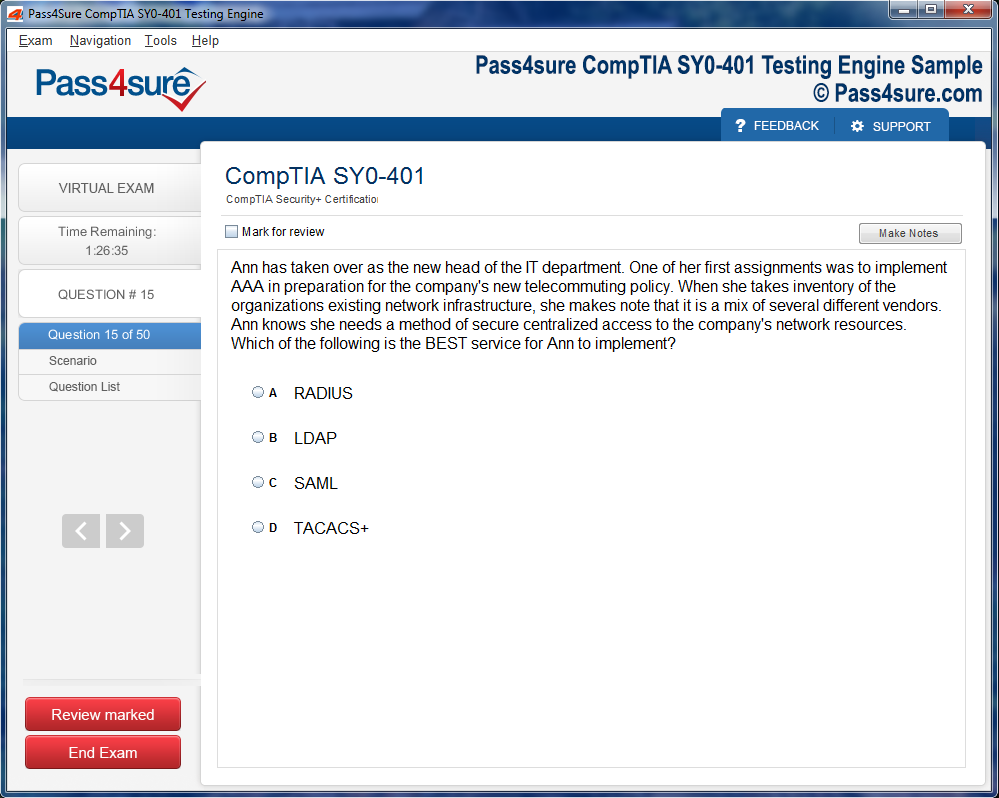
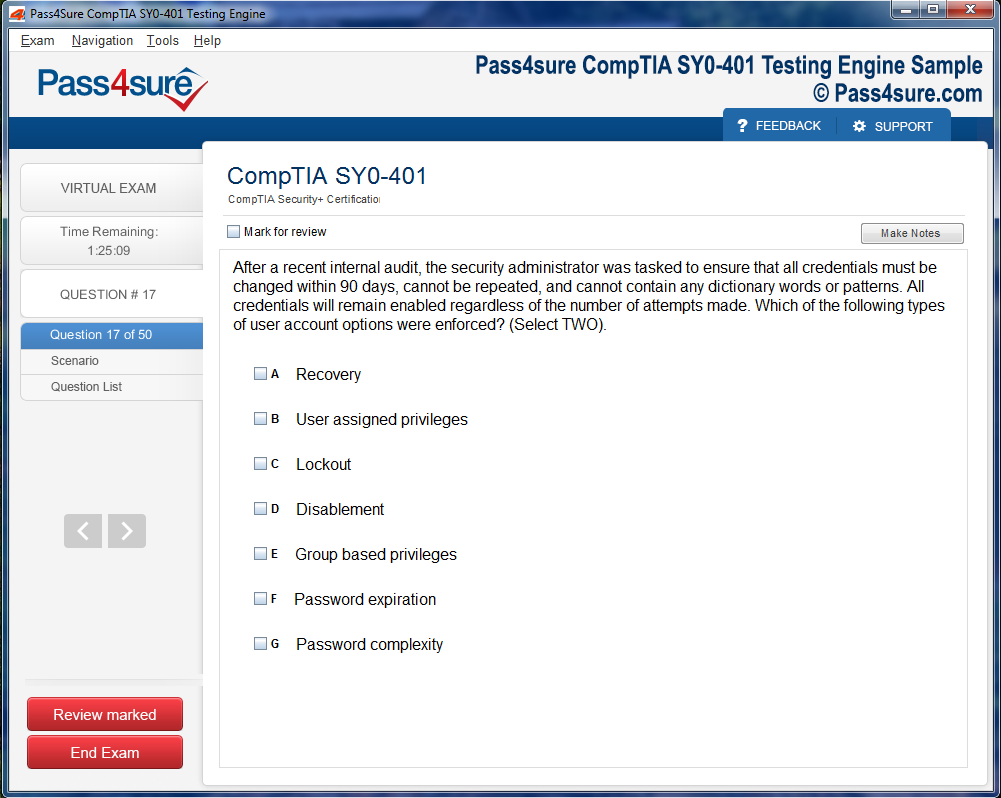
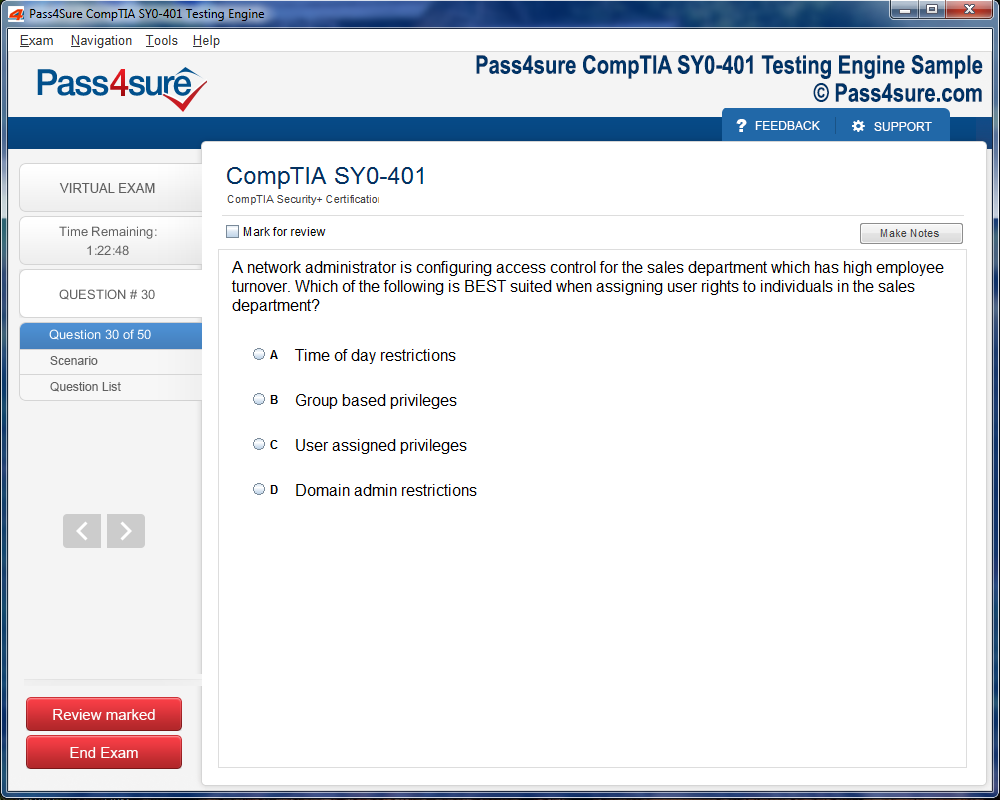
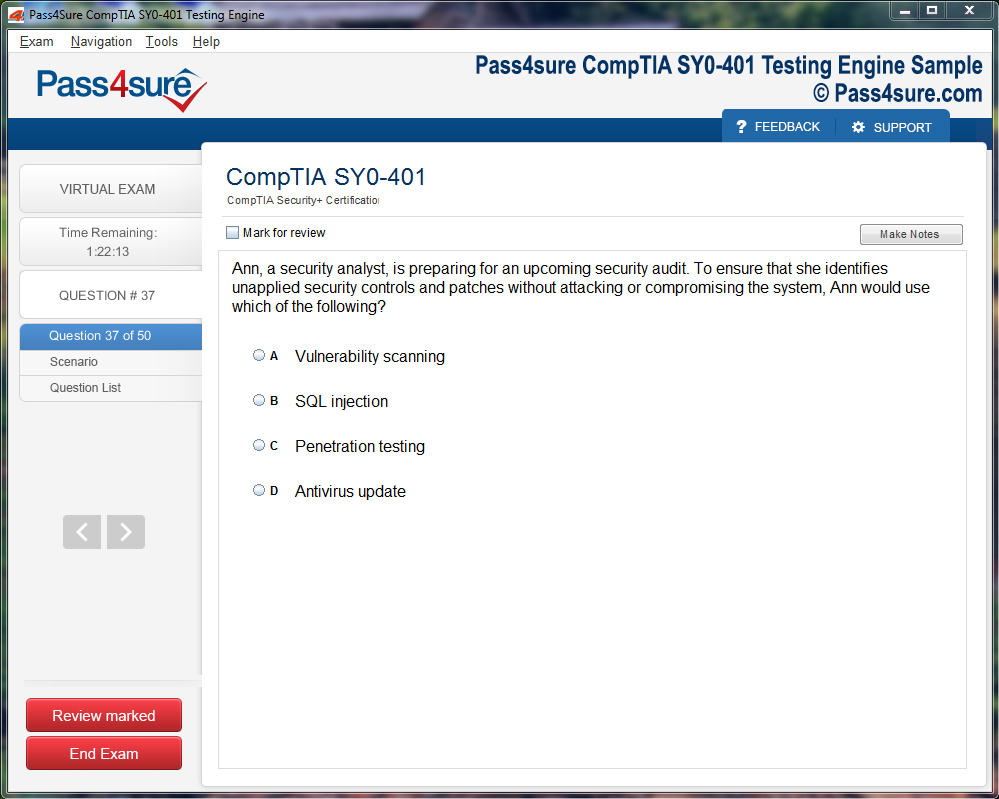
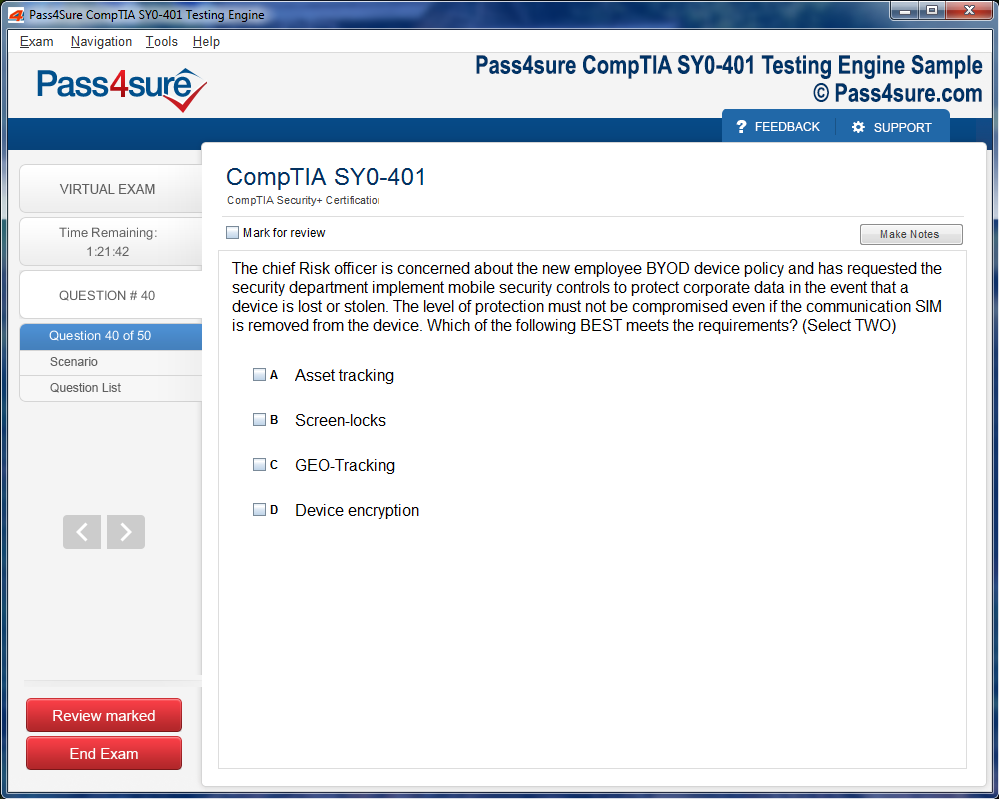
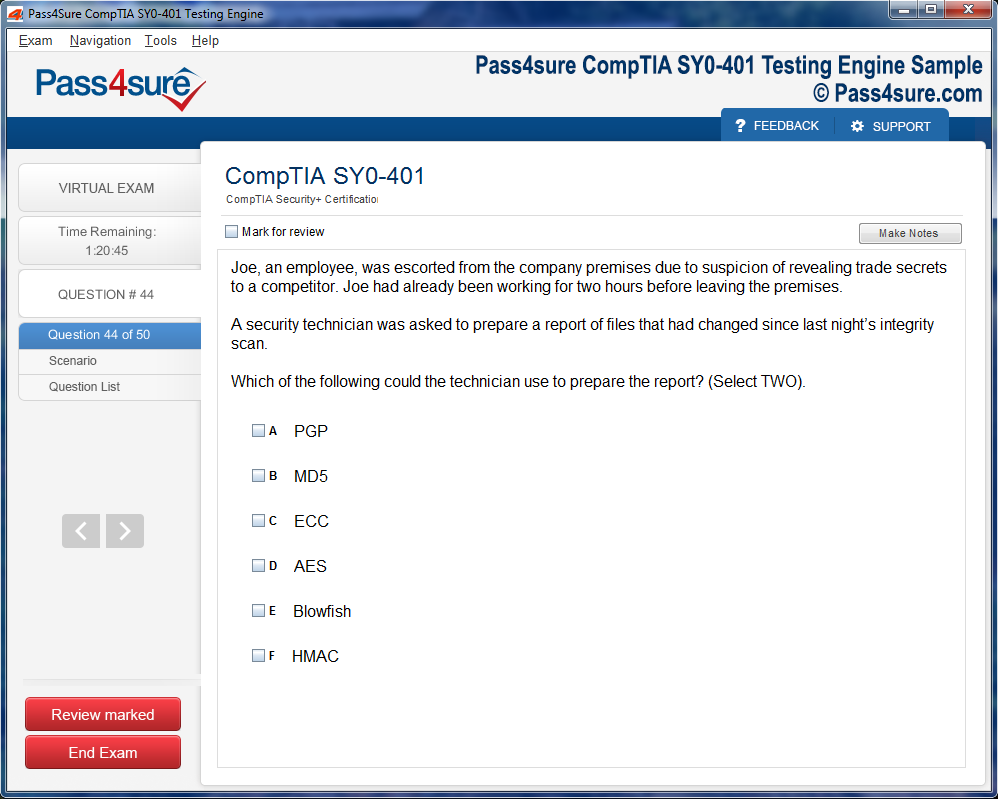
Product Screenshots
Frequently Asked Questions
How does your testing engine works?
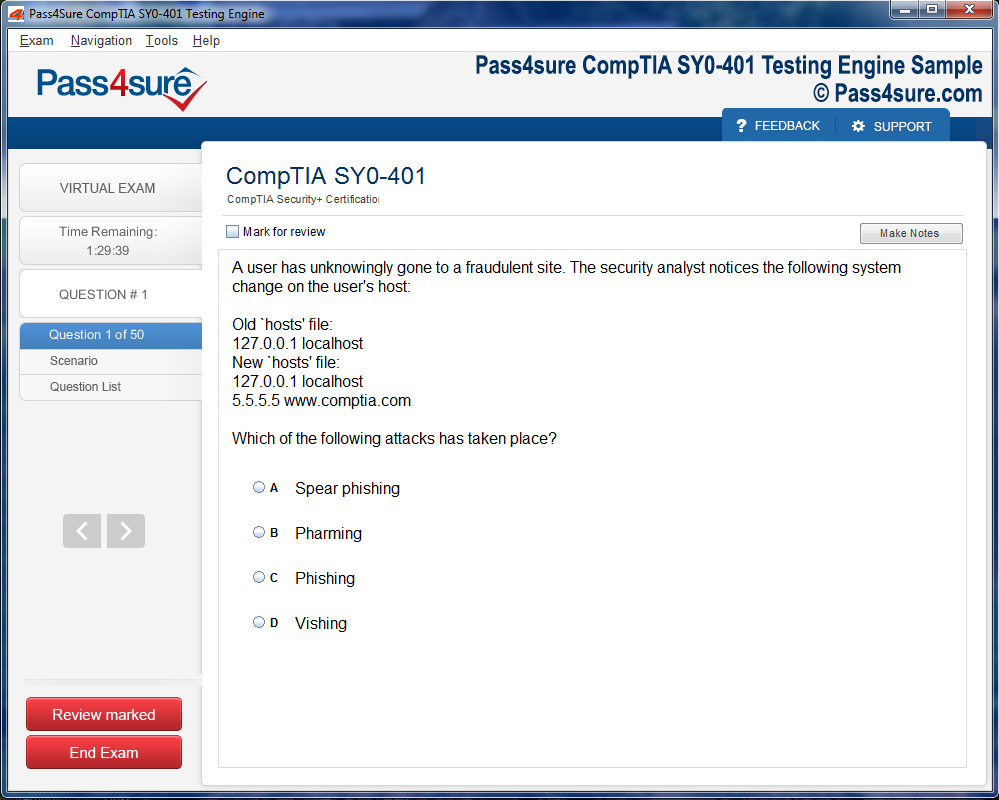
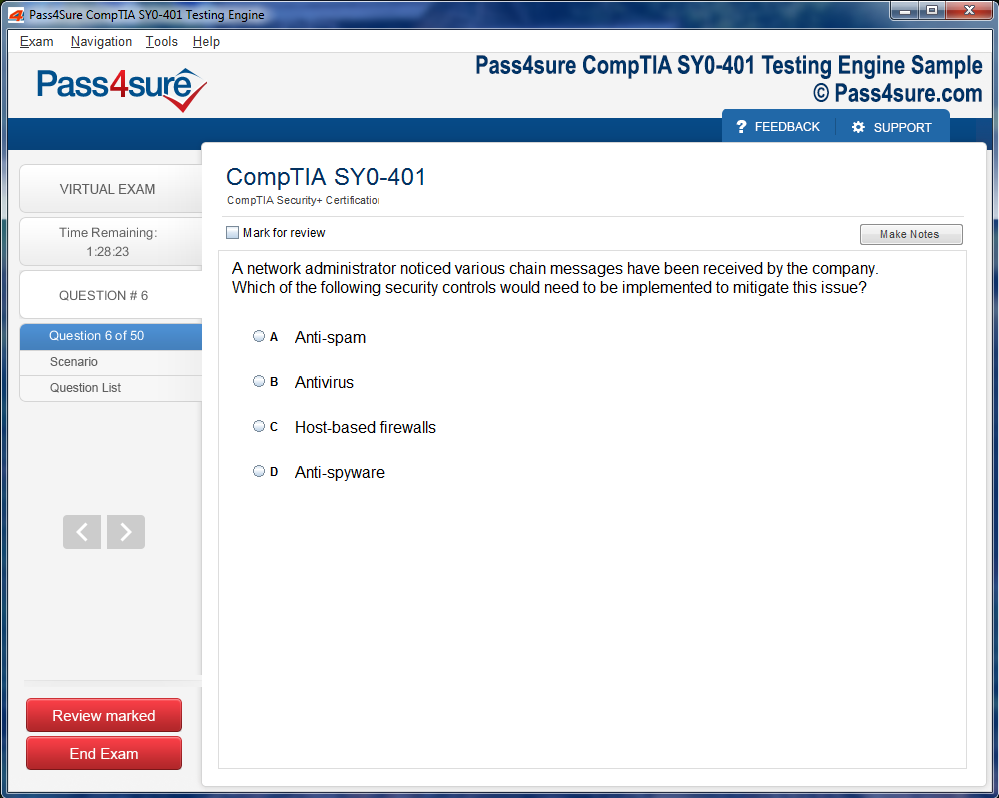
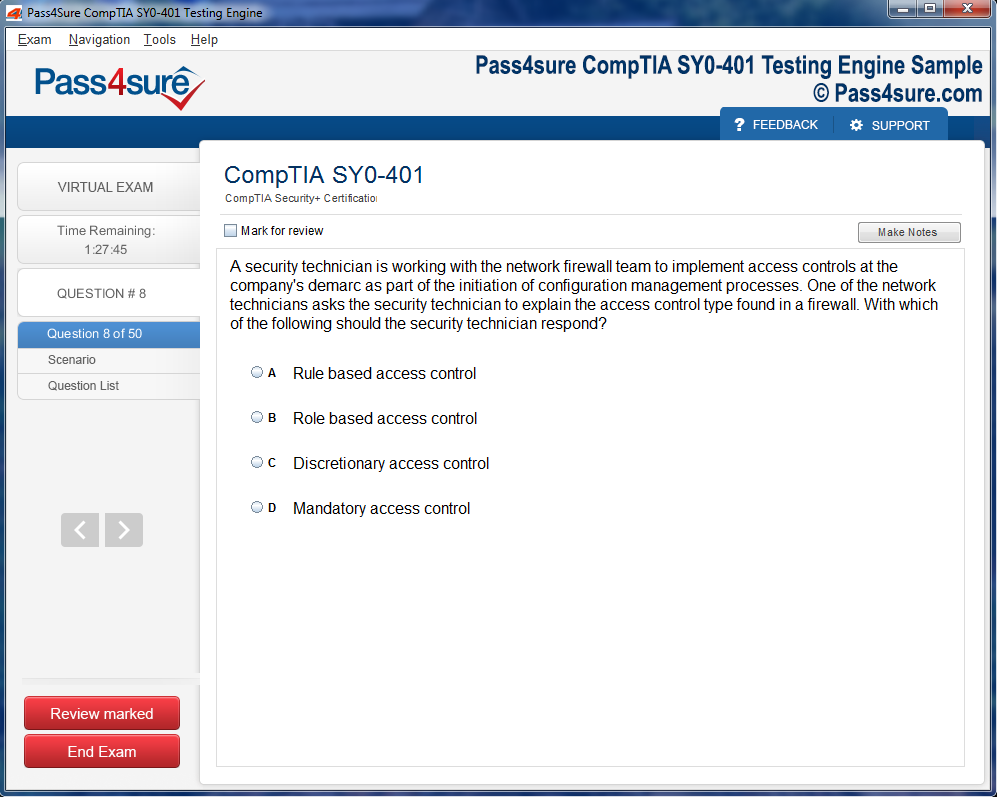
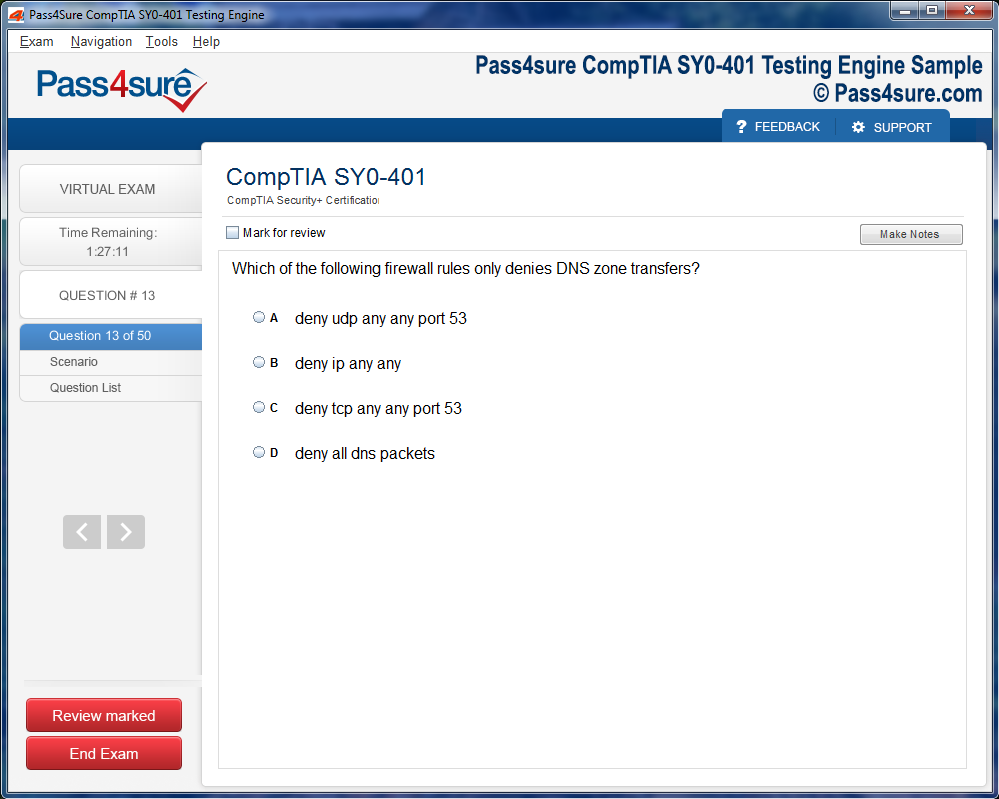
Once download and installed on your PC, you can practise test questions, review your questions & answers using two different options 'practice exam' and 'virtual exam'. Virtual Exam - test yourself with exam questions with a time limit, as if you are taking exams in the Prometric or VUE testing centre. Practice exam - review exam questions one by one, see correct answers and explanations.
How can I get the products after purchase?
All products are available for download immediately from your Member's Area. Once you have made the payment, you will be transferred to Member's Area where you can login and download the products you have purchased to your computer.
How long can I use my product? Will it be valid forever?
Pass4sure products have a validity of 90 days from the date of purchase. This means that any updates to the products, including but not limited to new questions, or updates and changes by our editing team, will be automatically downloaded on to computer to make sure that you get latest exam prep materials during those 90 days.
Can I renew my product if when it's expired?
Yes, when the 90 days of your product validity are over, you have the option of renewing your expired products with a 30% discount. This can be done in your Member's Area.
Please note that you will not be able to use the product after it has expired if you don't renew it.
How often are the questions updated?
We always try to provide the latest pool of questions, Updates in the questions depend on the changes in actual pool of questions by different vendors. As soon as we know about the change in the exam question pool we try our best to update the products as fast as possible.
How many computers I can download Pass4sure software on?
You can download the Pass4sure products on the maximum number of 2 (two) computers or devices. If you need to use the software on more than two machines, you can purchase this option separately. Please email sales@pass4sure.com if you need to use more than 5 (five) computers.
What are the system requirements?
Minimum System Requirements:
- Windows XP or newer operating system
- Java Version 8 or newer
- 1+ GHz processor
- 1 GB Ram
- 50 MB available hard disk typically (products may vary)
What operating systems are supported by your Testing Engine software?
Our testing engine is supported by Windows. Andriod and IOS software is currently under development.
GH-100 Certification: Advancing Your Career in GitHub Administration
The GH-100 certification is not merely a technical ornament; it is an emblem of cognitive dexterity and organizational foresight. It transcends the realm of procedural expertise, evolving into an emblem of strategic consciousness and professional ascendancy. Those who acquire this credential do not simply administer repositories; they orchestrate ecosystems of collaboration, innovation, and disciplined evolution. The modern enterprise thrives on the velocity of transformation, and the GH-100 professional becomes the sentinel of that momentum.
Within the ever-expanding sphere of software orchestration, certified individuals manifest as architects of precision. Their stewardship is not confined to the technical substrate of version control; it expands into the metaphysical plane of governance, adaptation, and sustainable growth. The GH-100 holder embodies an unbroken continuum between abstract thought and applied ingenuity, forming a bridge between the mechanics of code and the intentions of corporate vision.
Employers discern the resonance of this certification as a marker of reliability, self-discipline, and visionary acuity. It signifies a mind trained to navigate complexity without surrendering clarity. A GH-100 administrator brings to the table a rare amalgam of operational granularity and executive insight, producing results that are both scalable and profound. In an era defined by rapid iteration and constant flux, this equilibrium becomes a form of silent authority.
The certification’s essence lies in its ability to expand perception. The certified professional sees not only the current configuration but the potential trajectories of development. They anticipate dependencies, mitigate latent conflicts, and weave coherence where fragmentation once reigned. Their influence radiates beyond the console; it enters the architecture of policy, ethics, and collaboration. The GH-100 designation transforms the ordinary practitioner into a curator of technological civilization.
The Metamorphosis of Professional Identity
The acquisition of GH-100 certification does more than validate skill—it reconstructs identity. The professional, once constrained by operational routine, becomes an intellectual strategist whose domain extends into cultural and systemic design. Through this transformation, work ceases to be a sequence of mechanical acts; it becomes an expression of creative governance. The certified individual learns to perceive the organization as a living organism, where repositories resemble arteries of knowledge and workflows pulse with the vitality of shared intelligence.
This metamorphosis unfolds not through accumulation but through refinement. The GH-100 journey instills a cultivated restraint—the art of knowing when to act and when to observe. In the labyrinth of modern software development, this restraint becomes wisdom. The certified mind learns to listen to the cadence of systems, sensing imbalance before disruption manifests. Such subtle awareness transforms mere administration into artistry.
With this metamorphosis, a new form of confidence emerges. It is not the arrogance of expertise but the serenity of comprehension. The GH-100 professional becomes both a mentor and a mediator, guiding teams toward alignment without imposing rigidity. Their mastery lies in making complex processes appear intuitive, transforming procedural friction into seamless fluidity. In doing so, they embody the ideal synthesis of intellect and empathy—qualities that define leadership in its purest form.
Strategic Resonance within Organizational Hierarchies
The strategic resonance of GH-100 certification permeates the entire organizational hierarchy. Executives view certified professionals as interpreters of technological language—individuals who translate complexity into clarity, enabling informed decision-making. Middle management regards them as catalysts of coherence, weaving departmental objectives into an integrated whole. At the operational level, they are beacons of precision, ensuring that every line of code contributes to a symphony of systemic balance.
This resonance manifests as influence rather than authority. The GH-100 holder does not dominate through hierarchy but through intellectual gravity. Their insight attracts trust, their foresight commands respect, and their consistency inspires emulation. In the subtle architecture of influence, these qualities become invaluable. They transform the professional into a strategic axis around which teams align and decisions coalesce.
The presence of a GH-100 professional recalibrates the organizational rhythm. Their methodologies foster predictability without stifling creativity. Their governance frameworks cultivate autonomy within boundaries, ensuring innovation flourishes within an ecosystem of discipline. Through this equilibrium, the certified administrator orchestrates not just workflows but cultures of performance. The organization, once reactive, becomes anticipatory—its actions guided by vision rather than circumstance.
Intellectual Agility and the Art of Anticipation
To possess the GH-100 certification is to embody intellectual agility. The certified professional moves with fluidity through shifting paradigms, perceiving not just the evolution of tools but the transformation of purpose. The art of anticipation becomes second nature—a capacity to foresee the intersection of technological evolution and organizational intent. In a landscape where obsolescence lurks at every threshold, this agility is the truest form of resilience.
Anticipation here is not guesswork; it is pattern recognition refined to an almost intuitive science. The GH-100 holder discerns emerging trends not as novelties but as inevitabilities. They navigate the horizon of change with composure, adapting strategies before disruption demands reaction. This quality transforms them from mere implementers into innovators—visionaries whose foresight shields organizations from stagnation.
Such agility demands continuous learning. The certified professional treats every update, every release, and every industry shift as a canvas for growth. Knowledge becomes a living organism—perpetually expanding, self-renewing, and dynamically responsive. The GH-100 certification instills a discipline of curiosity, ensuring that complacency never takes root. This intellectual vigilance transforms careers into journeys of perpetual renaissance.
The Confluence of Technical Mastery and Strategic Vision
At the heart of GH-100 certification lies a rare synthesis—the confluence of technical mastery and strategic vision. It is one thing to command tools; it is another to understand their philosophical implications. The certified professional perceives GitHub not merely as a platform but as an embodiment of collective intelligence. Through this lens, repositories become repositories of thought, and commits become chronicles of evolution.
This synthesis manifests in decision-making. The GH-100 administrator balances precision with perspective, ensuring that immediate efficiency never compromises long-term adaptability. Every policy they design, every permission they grant, and every automation they deploy reflects an awareness of systemic consequence. They see the invisible threads that connect individual actions to organizational destiny.
The result is leadership through understanding rather than authority. The GH-100 professional leads by demonstrating coherence—aligning intention with execution, vision with action. Their technical fluency enables them to converse with engineers, while their strategic acuity allows them to counsel executives. In this dual fluency lies their true power: the ability to unite fragmented perspectives into a single, purposeful direction.
The Architecture of Influence and Credibility
Credibility, in the context of GH-100 certification, is not bestowed; it is earned through constancy of competence. The certified professional becomes an emblem of reliability, one whose recommendations carry weight and whose actions inspire replication. Their credibility arises not only from what they know but from how they apply that knowledge—with clarity, humility, and discernment.
Influence radiates from this credibility. Teams instinctively align with individuals who combine mastery with composure. The GH-100 holder, through consistent demonstration of insight, becomes a gravitational center within collaborative structures. Their presence elevates the collective standard, setting a tone of intellectual discipline and methodological integrity. Over time, this influence reshapes the cultural DNA of entire departments.
This architecture of influence transcends personality. It is built upon reputation, reinforced by results, and sustained by authenticity. In environments saturated with transient expertise, the GH-100 professional stands as a rare constant—an anchor of trust amid volatility. Their credibility becomes currency, their perspective a compass by which others navigate complexity.
The Strategic Imperative of Continuous Evolution
The GH-100 certification is not an endpoint but an invitation to perpetual metamorphosis. Technology evolves with mercurial swiftness, and so must those who govern its application. Certified professionals embrace this flux as an ally rather than a threat, recognizing that relevance is a living construct, sustained through deliberate renewal. The discipline of learning thus becomes existential—a defining rhythm of professional longevity.
Continuous evolution demands both humility and hunger. The GH-100 professional acknowledges that mastery is never final, that every innovation dismantles a fragment of yesterday’s certainty. This awareness cultivates adaptability, the capacity to reconstruct understanding without anxiety. In this dynamic mindset lies the secret to enduring success. The certified individual becomes a perpetual student, sculpting knowledge into relevance through reflection and experimentation.
Through continuous evolution, the GH-100 holder preserves vitality—intellectual, creative, and operational. They move beyond the binaries of competence and incompetence into a state of perpetual becoming. This state, though demanding, is profoundly liberating. It transforms the professional into a vessel of renewal, a conduit through which organizations perpetually rediscover their own potential.
The Catalyst of Organizational Transformation
Every GH-100 professional carries within them the potential to catalyze transformation. Their mastery of repositories and workflows is not an end in itself but a mechanism for reimagining how organizations function. They identify inefficiencies not as flaws but as opportunities for evolution. Through their stewardship, processes are refined, communication is harmonized, and innovation finds fertile ground.
Transformation begins with perception. The GH-100 holder sees interconnections invisible to others. They detect the subtle frictions that impede velocity and devise architectures that dissolve them. This capacity to diagnose systemic inertia and replace it with clarity transforms the administrator into an architect of cultural metamorphosis. Their work redefines productivity as harmony—the seamless orchestration of human intellect and technological precision.
Such transformation ripples outward. Departments that once operated in isolation begin to converge, inspired by the efficiency of integrated design. Leadership takes note of the newfound coherence, translating it into strategic advantage. The organization evolves, not through upheaval, but through enlightened refinement—a metamorphosis so seamless it feels organic. The GH-100 certification becomes the seed of this evolution, and the professional its cultivator.
The Psychology of Strategic Empowerment
Beyond skills and systems lies the psychology of empowerment that the GH-100 certification instills. The certified professional develops a sense of authorship—a recognition that their work shapes not only infrastructure but destiny. This sense of agency transforms engagement from obligation into passion. Every decision becomes an act of purpose, every challenge an invitation to demonstrate ingenuity.
Empowerment nurtures resilience. The GH-100 professional does not recoil from complexity; they welcome it as a proving ground. Obstacles become exercises in refinement, each one deepening composure and sharpening insight. This psychological evolution distinguishes them from transient specialists. They become strategists of equilibrium—individuals who maintain clarity even when systems falter.
This internal empowerment extends outward. Teams led by GH-100 professionals exhibit heightened morale, not through command but through inspiration. The leader’s confidence becomes contagious, dissolving hesitation and fostering initiative. The result is a culture of mutual elevation—a shared belief that excellence is attainable and sustainable through collective mindfulness.
The Future Trajectory of Certified Leadership
As technology continues its relentless evolution, the role of the GH-100 professional will expand from technical stewardship to strategic orchestration. They will occupy pivotal positions at the convergence of automation, governance, and ethical foresight. Their expertise will not merely manage code; it will shape the philosophical and procedural frameworks by which organizations evolve. The GH-100 certification, thus, becomes a harbinger of leadership redefined.
The certified professional will increasingly be called upon to interpret artificial intelligence governance, integrate continuous delivery pipelines, and align innovation with human-centered design. Their influence will permeate boardrooms, policy sessions, and strategic councils. What begins as administrative mastery will mature into institutional vision. The GH-100 professional will no longer be the custodian of platforms but the composer of technological symphonies.
As organizations navigate the intricate tapestry of the digital epoch, the presence of GH-100-certified leaders will signify equilibrium between innovation and integrity. Their synthesis of precision, foresight, and adaptability will become the template for future leadership. In this evolution lies the testament of the GH-100 ethos: a perpetual dialogue between mastery and meaning, between execution and enlightenment.
The Esoteric Anatomy of GitHub Repositories
Repositories in GitHub transcend mere digital storage; they are intricate microcosms where code, documentation, and collaboration coalesce into an ever-evolving lattice. Each repository harbors latent potential, its structure sculpted to accommodate multifarious workflows while retaining semantic clarity. Novices often underestimate the cognitive topography implicit in repository organization, yet mastery demands fluency in hierarchies, subdirectories, and the interplay of configuration files with operational scripts. A well-architected repository serves as both compass and conduit, guiding contributors through a labyrinth of tasks while preserving a coherent narrative of project evolution.
Branching as a Mechanism of Temporal Experimentation
Branching within repositories is not a mere technical contrivance; it is an epistemic device enabling teams to explore alternative developmental trajectories without perturbing the stability of the canonical codebase. Each branch embodies a provisional universe, a sandbox wherein features are incubated, defects are dissected, and novel hypotheses are stress-tested. The choice between Git Flow, trunk-based development, or hybrid strategies is not merely procedural—it reflects a philosophical disposition toward risk, integration cadence, and collaborative synchronicity. Mastery of branching thus entails both tactical acumen and a nuanced understanding of temporal project dynamics.
Workflow Automation as a Cognitive Amplifier
Automating repetitive sequences within GitHub transcends efficiency—it becomes a cognitive amplifier, freeing human attention for ideation rather than mechanistic repetition. GitHub Actions, with its triggers, scripts, and pipelines, functions as an autonomous orchestration engine, executing multifaceted tasks with preternatural consistency. Crafting workflows that seamlessly integrate testing, linting, deployment, and code analysis requires an appreciation for interdependent sequences and error propagation. Each workflow is a choreography of computational intent, designed to minimize friction while maximizing reliability and maintainability across distributed teams.
Permissions Architecture and the Alchemy of Access
Advanced repository management necessitates a sophisticated understanding of permissions and access hierarchies. Fine-grained controls delineate not only who may read or write but also who may orchestrate pivotal merges, deploy applications, or configure integrations. The administration of these privileges resembles a delicate alchemy, balancing openness and innovation against the imperatives of security and compliance. Savvy administrators engineer ecosystems where contributors enjoy the autonomy to innovate, yet sensitive operations remain insulated from inadvertent disruption.
The Artistry of Repository Maintenance
Repositories are living entities, subject to entropy if left unmanaged. Archival practices, pull request audits, branch pruning, and documentation upkeep constitute the vital rituals of repository stewardship. Dormant branches and unresolved requests are not mere clutter—they are latent vectors of confusion, inefficiency, and latent risk. Advanced practitioners adopt anticipatory maintenance, deploying scripts that automate housekeeping while preserving historical fidelity. Documentation becomes a mnemonic scaffold, ensuring that knowledge persists even as contributors rotate and projects evolve. In this sense, repository maintenance is a dialectic between impermanence and preservation.
Semantic Cohesion and Workflow Ergonomics
Beyond mechanics, repository efficacy is contingent upon semantic cohesion. File nomenclature, directory hierarchy, and modular decomposition communicate intent and reduce cognitive load. Contributors traverse the repository not as explorers of a foreign land but as interpreters of an intelligible system. Workflow ergonomics, informed by principles of cognitive science and human-computer interaction, dictate the sequencing of tasks, integration of testing pipelines, and structuring of review cycles. Harmonizing technical architecture with human perceptual tendencies amplifies efficiency and reduces the frequency of cognitive bottlenecks.
Integrative Strategies for Collaborative Synchronicity
In multi-contributor environments, the orchestration of parallel efforts demands more than technical skill; it requires anticipatory strategy. Pull requests, issue tracking, and code reviews are vectors of collaboration, each laden with potential conflicts and dependencies. By judiciously sequencing merges and prioritizing high-impact branches, administrators mitigate friction while fostering synchronous progress. The GH-100 paradigm emphasizes a fusion of procedural rigor with empathic foresight, cultivating collaborative environments where creativity is scaffolded rather than constrained.
Automation Pipelines as Predictive Instruments
Automation pipelines do more than mechanize workflows; they act as predictive instruments, anticipating errors, regressions, and integration bottlenecks. Continuous integration and continuous deployment pipelines become sensors within the repository ecosystem, generating signals that guide both human and machine actors. Through carefully configured tests, static analysis, and deployment simulations, administrators anticipate deviations before they propagate, transforming uncertainty into actionable intelligence. These pipelines embody a philosophy of proactive stewardship, wherein risk is mitigated through foresight rather than reaction.
Dynamic Repository Taxonomies
Repositories are rarely static; they evolve in response to project scope, contributor expertise, and technological flux. Dynamic taxonomies facilitate this evolution, allowing administrators to reconfigure structures, reclassify modules, and reassign responsibilities without disrupting ongoing work. Conceptual schemas intersect with pragmatic file organization, creating a lattice of relationships that supports both exploration and exploitation of code assets. The dexterity to manipulate such taxonomies distinguishes advanced practitioners, who perceive repositories not as static containers but as malleable ecosystems.
The Interplay of Documentation and Institutional Memory
Documentation within repositories is both functional and mnemonic. Beyond instructions, it encodes the rationale behind architectural choices, branching strategies, and workflow configurations. Institutional memory resides within commit histories, annotated pull requests, and persistent issue logs, collectively forming a repository’s cognitive backbone. Effective administrators cultivate this memory, ensuring that knowledge is accessible, comprehensible, and actionable for present and future contributors. In the absence of such stewardship, projects risk cyclical rediscovery, inefficiency, and latent misalignment.
Holistic Governance and Cultural Ecology
Repository management is not solely technical—it is cultural. Policies, norms, and tacit expectations shape contributor behavior as profoundly as scripts and configuration files. Holistic governance encompasses not only access control and workflow design but also mentorship, code review ethos, and collaborative rituals. Administrators serve as cultural custodians, curating an environment where procedural rigor and creative freedom coexist symbiotically. The GH-100 ethos envisions repository managers as both architects and anthropologists, mediating between code, cognition, and collective aspiration.
Monitoring, Metrics, and Continuous Reflexivity
The sophistication of repository management is amplified by continuous monitoring. Metrics on commit frequency, pull request latency, branch health, and deployment success offer diagnostic insight into operational vitality. Reflexive practices—reviewing workflows, assessing permission efficacy, and auditing documentation—ensure that repositories evolve adaptively. These practices convert abstract data into actionable intelligence, enabling administrators to preempt inefficiencies and optimize collaboration. In essence, metrics transform repositories into self-aware ecosystems capable of iterative self-improvement.
Synthesis of Philosophy and Procedure
At the zenith of repository mastery lies synthesis—the convergence of philosophy and procedure. Technical commands are executed with awareness of human cognitive constraints, collaborative dynamics, and temporal contingencies. Administrators navigate a liminal space between order and exploration, balancing consistency with flexibility, security with innovation, and procedural orthodoxy with pragmatic adaptation. Within this synthesis, repositories become living instruments of creativity, structured yet fluid, rigorous yet inviting.
The Ascendancy of Automated Paradigms
In the labyrinthine expanse of modern software orchestration, automation has transcended mere utility, evolving into a crucible for ingenuity and operational alacrity. Within the GH-100 framework, practitioners are indoctrinated into an ecosystem where manual tedium is subjugated to self-regulating architectures. The ethereal cadence of continuous integration and deployment pipelines is not merely procedural; it is a manifestation of computational symbiosis, where code metamorphoses from conception to production with barely perceptible friction.
GitHub Actions emerges as the fulcrum of this paradigm, a conduit through which developers harness the latent potential of prescriptive workflows. Every commit, merge, or issue becomes an incantation, triggering a choreographed sequence that propagates through build, test, and deployment strata. This is not an exercise in automation for its own sake; it is an intricate ballet of dependencies, conditioned upon contextual triggers and the deliberate orchestration of matrixed permutations. The GH-100 aspirant must cultivate an acumen that balances technical sagacity with strategic foresight, ensuring that workflows do not merely execute but resonate with the broader operational cadence.
Amidst this symphony of automation, the nuances of conditional logic, reusable templates, and matrixed workflows emerge as instruments of exponential leverage. Each pattern, each reusable segment, is a lattice through which redundancy is purged and scalability is inscribed into the architecture. The administrator’s role morphs into that of a vigilant architect, one who anticipates systemic friction before it manifests, who designs not only for today’s exigencies but for the unforeseen complexities of tomorrow’s deployments.
Optimization as an Ethos
Beyond automation, performance optimization becomes an ethos, a philosophical commitment to the refinement of both process and repository. The GH-100 candidate is initiated into the practice of profiling tasks with meticulous granularity, identifying inefficiencies that lurk in the shadowed recesses of workflows. Script execution is deconstructed, resource consumption scrutinized, and branching strategies reconsidered, all with the objective of minimizing latency and dissolving bottlenecks. These refinements are neither trivial nor cosmetic; they serve as accelerants for collaboration, amplifying the velocity of contribution while maintaining the integrity of code quality.
Optimization is not a monolithic endeavor but a multidimensional pursuit, encompassing computational efficiency, procedural elegance, and cognitive clarity. Every pipeline is evaluated as a living organism, its metabolic rhythms analyzed, its interactions with repositories and external systems measured for harmony. GH-100 practitioners learn to apply principles of concurrency, asynchronous execution, and intelligent caching, transmuting sluggish processes into ephemeral sequences of precision. Here, the mundane act of deploying code is elevated into a deliberate orchestration of performance, where every microsecond conserved is a testament to foresight and dexterity.
The artistry of performance optimization extends into the realm of monitoring and feedback loops. By instrumenting workflows with analytical probes and performance dashboards, administrators gain an omniscient perspective over operational cadence. These insights are not static; they provoke iterative refinement, a recursive dialogue between process and practitioner. GH-100 candidates cultivate the discernment to identify patterns that portend inefficiency, to anticipate resource contention, and to implement preemptive rectifications that sustain optimal throughput.
Interfacing Ecosystems
A pivotal dimension of GitHub administration lies in the seamless interfacing with ancillary systems. Security scanners, deployment platforms, analytics engines, and observability tools form an interconnected lattice, extending both oversight and control. GH-100 professionals learn to integrate these conduits with finesse, ensuring that the flux of information enhances responsiveness without destabilizing the underlying architecture. The act of integration becomes an exercise in symbiotic design, where disparate tools coalesce into a coherent, self-reinforcing ecosystem.
Each integration demands a nuanced understanding of API protocols, authentication schemas, and orchestration semantics. The administrator orchestrates this confluence with the deftness of a conductor, attuning the tempo of data exchange, harmonizing asynchronous responses, and mitigating potential latencies. The resultant ecosystem is neither rigid nor brittle; it is resilient, adaptive, and capable of evolving in response to emergent demands. GH-100 certification instills in candidates a mindset attuned to the subtleties of interconnectivity, where the efficacy of each integration is measured not only by its immediate function but by its contribution to systemic equilibrium.
Moreover, this interfacing empowers a richer spectrum of intelligence. Security insights, performance metrics, and deployment feedback converge to form actionable intelligence, which informs subsequent iterations of workflow design. Automation, optimization, and integration coalesce into a triad of operational mastery, transforming administrators into orchestrators of continuous innovation. Within such an ecosystem, contributors are liberated to focus on creative problem-solving, assured that the substratum of their endeavors operates with unwavering precision and foresight.
Proactive System Architecture
The apex of GH-100 expertise resides in proactive system architecture. Administrators are no longer mere custodians of workflows; they evolve into architects of resilience, designers of self-optimizing ecosystems. Each pipeline, each integration, each conditional trigger is conceived with the foresight of a sculptor, chiseled to anticipate friction and preempt inefficiency. The system is imbued with reflexive intelligence, capable of self-correction, self-monitoring, and incremental refinement.
In this domain, the philosophy of DevOps transcends operational necessity, becoming a testament to the elegance of premeditated orchestration. GH-100 candidates cultivate the ability to envision the lifecycle of repositories as dynamic, adaptive organisms, where every interaction is both monitored and optimized. Redundancies are pruned, dependencies are clarified, and pathways for escalation and rollback are pre-encoded into the system’s very DNA. The result is an operational milieu in which human ingenuity and computational rigor are symbiotically intertwined, each amplifying the other.
Proactivity in system architecture also manifests in risk anticipation. By simulating potential failures, stress-testing workflows, and instituting automated remediation strategies, administrators reduce uncertainty to a minimum. The GH-100 practitioner internalizes the art of foresight, transforming the reactive posture of conventional administration into a proactive paradigm. In this environment, innovation flourishes, unimpeded by the friction of manual oversight, and the organization achieves a cadence of delivery that is both rapid and resilient.
The Alchemy of Collaborative Synergy
In the intricate labyrinth of modern organizational structures, collaboration manifests not merely as a functional necessity but as a delicate alchemy of cognitive resonance and interpersonal attunement. Teams are no longer collections of individuals executing tasks; they are ecosystems pulsating with tacit knowledge, divergent experiences, and subtle affective currents. Effective administration within such a milieu demands an orchestration that transcends rote management, invoking an almost orchestral coordination of human faculties and procedural frameworks. Within this paradigm, administrators navigate the liminal spaces between autonomy and oversight, fostering a symbiotic nexus where each participant’s unique proclivities converge into collective ingenuity.
The lexicon of collaboration is suffused with nuances that evade conventional comprehension. Linguistic subtleties, unspoken expectations, and the cadence of synchronous activity all coalesce to form a substratum upon which productive engagement flourishes. Administrators attuned to these undercurrents cultivate environments where friction becomes a catalyst rather than a hindrance, and where divergent cognitive schemas intersect to generate novel problem-solving modalities. In such atmospheres, the boundaries between individual initiative and collective purpose dissolve, giving rise to emergent phenomena that are greater than the sum of their constituent parts.
Strategic Cartography of Team Dynamics
Organizational dynamics are rarely linear; they resemble topographical terrains replete with peaks of influence, valleys of reticence, and meandering streams of informal communication. GH-100 principles illuminate the art of strategic cartography, enabling administrators to map these landscapes with precision. By discerning nodes of expertise, loci of potential friction, and conduits of informal knowledge exchange, leaders craft operational architectures that optimize both efficiency and creative latitude. Role delineation becomes an act of strategic foresight rather than bureaucratic compulsion, providing clarity without constraining the organic flow of initiative.
Within this topography, conflict assumes a dual nature. It is simultaneously a disruptive force and an engine of innovation, contingent upon the administrator’s ability to channel discord into constructive dialogue. Mediation, in this context, is less about adjudication and more about sculpting shared understanding. Techniques borrowed from cognitive empathy, behavioral scaffolding, and narrative reframing allow leaders to transform competing priorities into complementary trajectories. Such interventions are subtle, often invisible, yet they underpin the durable cohesion of high-functioning teams, ensuring that collaborative energy remains dynamic rather than dissipative.
Orchestrating Cognitive Constellations
The most adept administrators recognize that human capital is not merely a collection of skills but a constellation of cognitive patterns, emotional tendencies, and motivational vectors. The orchestration of such constellations requires an appreciation for the heterogeneity of thought and the symmetries that can be leveraged to amplify creativity. Teams flourish when the interplay of analytical rigor, imaginative ideation, and affective resonance is consciously nurtured, creating an ecosystem in which insight proliferates with minimal friction.
Documentation, often underestimated, emerges as a linchpin in this orchestration. Beyond procedural instructions, it captures the gestalt of collective cognition, preserving ephemeral insights that might otherwise dissipate with turnover or temporal distance. Templates, wikis, and knowledge repositories are not mere repositories; they are instruments of continuity, scaffolding the cognitive architecture of the organization. When integrated thoughtfully, they reduce redundant cognitive load, facilitate rapid onboarding, and crystallize best practices into living, evolving artifacts of organizational intelligence.
Cultural Symphonies and Organizational Ethos
The subtle architecture of collaboration is inseparable from the cultural ethos that permeates an organization. Administrators serve as curators of this ethos, shaping the tacit norms, rituals, and expectations that govern behavior. The cultivation of psychological safety, mutual respect, and a shared sense of purpose is paramount, for these intangible factors dictate the velocity and resilience of collaborative endeavors. In teams where trust is abundant and hierarchies are navigated with transparency, innovation is unshackled, and contributors feel empowered to transcend procedural rigidity in pursuit of imaginative breakthroughs.
Ethos is not static; it is a dynamic symphony that evolves in response to internal and external stimuli. Administrators attuned to its rhythms deploy interventions that reinforce alignment, mitigate entropy, and harness emergent potential. Feedback loops, reflective practices, and iterative recalibrations are instruments through which culture is continuously tuned, ensuring that the organization’s internal resonance remains harmonious even amidst the cacophony of shifting demands and competing priorities.
Navigating the Confluence of Autonomy and Governance
One of the most delicate balances in organizational stewardship is the interplay between autonomy and governance. Teams require freedom to explore, experiment, and iterate, yet unbridled autonomy risks fragmentation, inefficiency, and misalignment. GH-100 paradigms emphasize the design of governance structures that are minimally invasive yet maximally supportive, providing scaffolding for decision-making without smothering creative initiative. Policies, permissions, and procedural checkpoints are calibrated with surgical precision, ensuring that oversight is felt as guidance rather than constraint.
Empowerment, in this schema, is both ethical and strategic. Administrators cultivate agency by articulating clear expectations, providing requisite resources, and fostering a milieu of reciprocal accountability. Contributors, in turn, internalize organizational objectives and navigate their responsibilities with discretion, contributing to an ecosystem where innovation and operational discipline coalesce seamlessly. In such settings, the organization transcends hierarchical imperatives, evolving into a living organism capable of adaptive responsiveness and sustained growth.
Temporal Rhythms and Organizational Flow
Time, in collaborative contexts, is a fluid dimension shaped by perception, prioritization, and collective momentum. Administrators who master temporal orchestration attune themselves to the rhythms of the team, aligning cycles of intensive focus, reflection, and iterative feedback. Sprints, stand-ups, and review cadences are orchestrated not merely as procedural necessities but as instruments to harmonize cognitive tempo, maintain engagement, and prevent the dissipation of collective energy. Awareness of temporal asymmetries allows leaders to anticipate bottlenecks, redistribute cognitive load, and optimize throughput without inducing fatigue or burnout.
Flow states, those elusive zones of heightened productivity and creative absorption, are cultivated through deliberate structuring of work and environmental affordances. Administrators ensure that contributors are shielded from extraneous interruptions, have clarity of objectives, and receive timely recognition of achievements. Such stewardship transforms the mundane mechanics of task execution into an immersive experience, where participants feel both challenged and supported, and where the collective cadence of the team resonates with purpose.
Ephemeral Structures and Adaptive Continuity
Organizational resilience is predicated on the capacity to adapt without forfeiting continuity. Teams are inherently transient, influenced by turnover, shifting priorities, and evolving technologies. Administrators cultivate ephemeral structures that provide coherence in flux, using modular workflows, adaptable frameworks, and transferable knowledge artifacts to sustain performance. These constructs are not rigid hierarchies but elastic scaffolds that maintain alignment while accommodating variability, ensuring that progress is neither arrested by change nor undermined by rigidity.
Adaptive continuity is further reinforced through reflective mechanisms. Retrospectives, post-mortems, and continuous learning initiatives capture lessons from both triumphs and failures, embedding them within organizational memory. By codifying insight and disseminating it across teams, administrators transform ephemeral experiences into enduring knowledge, enabling the organization to evolve intelligently rather than reactively.
The lifeblood of any development enterprise pulses within its repositories. These digital archives encapsulate not only lines of code but also the creative ethos of the collective intellect behind them. To administer a repository effectively is to preside over a living organism—a dynamic entity that evolves with each commit, merges with precision, and bifurcates through branching strategies that embody both foresight and adaptability.
A GitHub administrator must perceive a repository not as a static container, but as a vibrant ecosystem of innovation. Every pull request, every fork, and every merge becomes an act of architectural engineering. Repository governance involves sculpting this architecture to encourage both discipline and flexibility. The GH-100 certification frames this understanding through methodical exploration of structural integrity—how repositories can be fortified against entropy, how naming conventions shape perception, and how branching philosophies can orchestrate seamless progression from concept to deployment.
Security overlays this architecture like an invisible lattice of trust. Access permissions, audit logs, and encryption parameters become instruments of order in a symphony of complexity. An adept administrator curates these permissions with surgical precision, ensuring that collaboration remains frictionless yet fortified. Within this realm, the GH-100 certification cultivates a mindset of anticipatory vigilance—where every potential vulnerability is discerned, analyzed, and neutralized before it can fracture the sanctity of the codebase.
The repository, thus governed, becomes more than a technical construct; it becomes an artifact of organizational culture. It mirrors the discipline of its custodians, the foresight of its architects, and the collaborative spirit of its contributors. The GH-100 administrator does not simply maintain repositories—they orchestrate digital habitats capable of perpetual evolution.
The Alchemy of Workflow Optimization and Automation
In the crucible of modern software development, efficiency is transmuted through automation. Workflow optimization within GitHub transcends routine management—it embodies the synthesis of logic and artistry. Automation pipelines breathe kinetic energy into development lifecycles, transfiguring manual tedium into fluid precision. Through GitHub Actions, administrators wield a form of digital alchemy, scripting event-driven sequences that maintain repositories in continuous equilibrium.
Each action defined within a workflow becomes a ritual of refinement. Code quality checks, integration verifications, deployment automations—all converge into a choreography of synchronized movement. The GH-100 certification immerses candidates in the anatomy of this automation, guiding them to perceive workflows not as procedural blueprints but as intelligent organisms capable of self-regulation.
True optimization emerges not from relentless speed but from measured orchestration. The GH-100 philosophy underscores this truth, teaching administrators to identify the inflection points where automation amplifies human potential rather than replaces it. Every triggered build, every synchronized branch, every automated issue triage represents a dialogue between human ingenuity and machine precision.
The architecture of automation must also remain elastic. As projects expand and technologies metamorphose, workflows must adapt without fracture. Versioning of workflows, contextual triggers, and secret management constitute the subtle mechanics that sustain operational continuity. The certified administrator becomes both an engineer and a curator—balancing complexity with clarity, scale with simplicity, and innovation with control.
The Paradigm of Security Stewardship and Ethical Oversight
Security within GitHub administration is neither a procedural checklist nor a transient concern—it is an enduring philosophy. It dwells in the interstices between code, configuration, and cognition. The GH-100 certification enshrines security stewardship as a principal doctrine, demanding from administrators an unwavering vigilance anchored in ethical foresight.
The modern repository, interconnected and exposed through myriad integrations, becomes a tapestry woven with potential vulnerabilities. Secrets management, branch protection rules, dependency scanning, and audit logs form the intricate threads of its resilience. Yet, beyond technical fortification, the administrator must embody ethical guardianship—a sensitivity to the unseen implications of access, ownership, and transparency.
Every collaborator invited into a repository enters a compact of trust. The administrator becomes both gatekeeper and guardian, enforcing boundaries not through restriction but through responsibility. Encryption protocols, token management, and compliance alignment are manifestations of this ethos. They translate ethical imperatives into operational practices, ensuring that innovation unfolds within the sanctum of integrity.
The GH-100 certification molds this consciousness through immersive engagement with real-world security paradigms. It demands fluency in recognizing not only overt threats but also latent weaknesses—those subtle misconfigurations that can cascade into systemic risk. The certified professional learns to anticipate, mitigate, and document every safeguard with the precision of a strategist and the prudence of a custodian.
Security, in its truest form, becomes an act of stewardship. It transcends the mechanical realm of access control to embrace a moral dimension—where every administrative action reverberates with the responsibility to preserve both code and community.
The Symphony of Collaboration and Distributed Synergy
In the digital agora of modern development, collaboration is both art and infrastructure. GitHub stands as its grand amphitheater, where developers across continents converge in asynchronous harmony. To administer this environment is to conduct an orchestra of intellects, ensuring that each contributor resonates within the collective rhythm of progress.
The GH-100 certification dissects this orchestration with surgical depth. It trains administrators to refine collaborative architectures—defining contribution guidelines, optimizing review flows, and calibrating permissions so that creativity thrives without chaos. The administrator becomes an enabler of velocity, harmonizing the divergent cadences of distributed teams into cohesive motion.
Communication within such a matrix is not mere discourse; it is a structured dialect of innovation. Pull requests become philosophical dialogues, issue threads evolve into chronicles of problem-solving, and commits serve as footprints of collective cognition. The administrator curates this communication with intentionality—structuring review workflows, codifying etiquette, and nurturing transparency as the medium through which trust circulates.
Yet collaboration extends beyond individuals. Integrations with continuous integration systems, project boards, and external APIs weave a larger symphony of interconnectivity. The GH-100 credential holder learns to orchestrate this connectivity, ensuring that every integration enhances rather than entangles the workflow.
In this realm, the administrator’s role transcends management—it becomes mentorship. They are not merely facilitators of contribution but architects of cohesion, ensuring that the ethos of collaboration endures even as the scale of participation multiplies.
The Metaphysics of Version Control and Evolutionary Design
At the core of GitHub lies the principle of version control—a digital embodiment of memory and transformation. Each commit immortalizes a moment of insight, each branch manifests an alternate trajectory of thought. The GH-100 certification delves into this metaphysical dimension, teaching administrators to perceive versioning not as an archival mechanism but as a chronicle of evolution.
Version control, in its essence, captures the duality of permanence and impermanence. Code evolves, yet its history remains immutable—a paradox that grants both accountability and adaptability. Administrators must learn to navigate this paradox with grace, understanding that the act of merging is as much philosophical as it is technical. It represents convergence, reconciliation, and renewal.
The discipline of branching strategies becomes a form of evolutionary design. Feature branches sprout like conceptual extensions, release branches crystallize stability, and hotfix branches emerge as responsive adaptations to disruption. The administrator’s mastery lies in maintaining this organic ecosystem—ensuring that it expands with intentionality, yet remains comprehensible to all who traverse it.
The GH-100 curriculum cultivates a deep fluency in these principles. It transforms the administrator’s perception from mechanical executor to evolutionary designer—one who perceives repositories as chronicles of transformation and uses versioning as a language of progress.
The Ethos of Documentation and Institutional Memory
Amid the flux of code and innovation, documentation stands as the sentinel of continuity. It preserves the intellect of the past and illuminates the pathways of the future. For the GitHub administrator, documentation is not a peripheral chore—it is the bedrock of operational immortality.
The GH-100 certification situates documentation at the heart of governance. It compels administrators to architect living documents that evolve alongside repositories, ensuring that institutional memory remains lucid and accessible. README files, contribution guidelines, and workflow manifests become sacred texts of transparency, guiding contributors through the labyrinth of development without dependence on oral transmission.
Language, in this context, becomes an instrument of precision. Every phrase inscribed in documentation must convey not only instruction but also intent. The administrator, therefore, becomes a translator—transposing abstract processes into articulate clarity. In doing so, they dissolve ambiguity, foster alignment, and perpetuate knowledge across temporal boundaries.
Documentation, when curated with devotion, becomes more than an artifact—it becomes the conscience of the repository. It encapsulates rationale, context, and evolution, ensuring that every future iteration remains tethered to its lineage. Within the philosophy of the GH-100, this practice is revered as both discipline and art.
The Continuum of Adaptability and Cognitive Resilience
The domain of GitHub administration is in perpetual metamorphosis. New integrations emerge, security paradigms shift, and collaborative models evolve. Within this turbulence, adaptability becomes the administrator’s supreme virtue. The GH-100 certification forges this adaptability into reflex—an intrinsic readiness to evolve without disarray.
Cognitive resilience manifests in the administrator’s capacity to assimilate transformation without fragmentation. Whether confronting infrastructural overhauls or philosophical paradigm shifts, they maintain equilibrium between learning and leading. The certification process immerses candidates in simulated flux, compelling them to recalibrate their understanding with agility and composure.
Adaptability also extends to interpersonal dimensions. As distributed teams diversify across cultures, languages, and disciplines, the administrator must embody inclusivity as an operational principle. The ability to reconcile divergent communication styles, time zones, and technical proficiencies becomes an art of empathetic governance.
In the end, adaptability crystallizes into wisdom—the wisdom to evolve without erosion, to lead without rigidity, and to preserve coherence amid perpetual transformation. This principle, enshrined at the core of the GH-100 ethos, distinguishes the competent from the visionary.
In a digital cosmos brimming with ceaseless innovation, GitHub emerges not merely as a platform of code collaboration but as a crucible of trust. Every repository becomes an artifact of intellect, and every commit an imprint of collective ingenuity. Within this ecosystem, the gravity of security transcends the mundane. It metamorphoses into an orchestration of vigilance, a symphony of invisible defenses choreographed to repel infiltration and safeguard digital sanctity.
Security in GitHub administration is not a static doctrine but an evolving dialect. The GH-100 certification instills this ethos, urging administrators to cultivate both proactive acuity and reactive resilience. Each setting, permission, and key must operate not as an isolated measure but as part of a vast constellation of protection. In this intricate web, even the most minuscule misconfiguration can morph into an aperture for exploitation. Thus, the custodian of repositories must wield both foresight and precision, transforming the abstract notion of cybersecurity into tangible, institutional fortitude.
The Architecture of Access and Authentication
The fortress of a repository is defined by its gates—its access controls and authentication mechanisms. GitHub’s architecture endows administrators with multifaceted tools: from two-factor authentication to SSH cryptography and OAuth frameworks that intertwine with organizational identity providers. Yet mastery is not attained by mere activation; it is achieved through harmonization.
An administrator versed in GH-100 principles perceives access control not as a barrier but as a finely calibrated equilibrium. Too much rigidity breeds creative suffocation; excessive leniency cultivates peril. The adept professional constructs an environment where security coexists with seamless collaboration. Keys are rotated with ritualistic regularity, permissions are pruned with surgical precision, and authentication tokens are orchestrated as ephemeral instruments of trust.
Authentication in this paradigm is not merely verification—it is affirmation of digital identity. Every credential becomes an attestation of legitimacy, a ciphered handshake in a landscape that values both autonomy and accountability. In this realm, vigilance must never slumber, for the anatomy of intrusion evolves faster than complacency can notice.
The Meticulous Craft of Monitoring and Auditing
Security without observation is akin to architecture without foundation. Within GitHub’s realm, the art of monitoring becomes the sentinel of integrity. Logs, audit trails, and commit histories breathe life into transparency, transforming abstract activities into analyzable phenomena.
Administrators trained under the GH-100 doctrine master the alchemy of interpretation. They do not merely collect logs—they decipher narratives. Every anomalous commit, every unsanctioned branch creation, every sudden permission escalation becomes a thread in the tapestry of threat intelligence. Through analytical discernment, raw data ascends into foresight, allowing the administrator to anticipate breaches before they materialize.
Auditing within GitHub transcends mere compliance checklists; it is a ritual of accountability. Each trace, each artifact, each temporal imprint offers insight into the anatomy of operations. The refined administrator develops an almost forensic sensitivity—detecting deviations, diagnosing causes, and designing deterrents.
The Paradigm of Regulatory Adherence
Compliance, within the GitHub continuum, exists as both obligation and philosophy. It signifies a covenant between innovation and legality, ensuring that creativity does not transgress the boundaries of ethical governance. GH-100 certification embeds this consciousness deeply within the administrator’s psyche, transforming compliance from bureaucratic formality into strategic architecture.
Regulatory landscapes differ across domains—some governed by financial transparency, others by healthcare confidentiality or governmental classification. Yet, the underlying principle remains immutable: data sovereignty must never be compromised. Administrators must ensure repositories align with frameworks of auditability, retention, and traceability.
The artistry of compliance lies in subtlety—embedding protective mechanisms so seamlessly that workflow remains unimpeded. The GH-100 adept does not encumber development with red tape; instead, they weave compliance into the very syntax of collaboration. Repository histories become immutable chronicles; code provenance transforms into a lineage of trust; and audit-ready documentation emerges as a testament to institutional integrity.
The Discipline of Risk Management
Risk within GitHub is an ever-morphing entity—a shape-shifting adversary that thrives on oversight and apathy. The adept administrator perceives risk not as a monolith but as a dynamic spectrum of potentialities. Each commit, each merge, each external dependency is a node of vulnerability waiting for illumination.
GH-100 certification equips professionals to engage in risk management as both science and intuition. They perform vulnerability analysis with the precision of cartographers charting unseen terrain. Merge conflicts in sensitive branches are not mere inconveniences but latent gateways to instability. The accidental exposure of credentials becomes a narrative of urgency, demanding swift remediation and systemic introspection.
True mastery lies in the establishment of contingencies—not as reactions, but as premonitions. Disaster recovery protocols, access revocation strategies, and incident communication hierarchies must exist not as afterthoughts but as ingrained reflexes. The administrator becomes a sentinel of possibility, orchestrating defenses that adapt as threats evolve.
The Ethos of Vigilance and Behavioral Governance
Technology, however advanced, remains inert without human stewardship. Thus, the nucleus of GitHub security resides not solely in encryption or authentication but in behavioral governance. Administrators trained in GH-100 philosophy understand that every breach originates not in code but in conduct.
Vigilance must be nurtured as culture. Contributors must internalize the ethics of confidentiality, the discipline of version control hygiene, and the sanctity of access management. The administrator’s role extends beyond configuration—it transforms into mentorship. Through workshops, documentation, and communal reinforcement, a climate of security consciousness flourishes.
Such behavioral ecosystems thrive on transparency and trust. Contributors should feel both empowered and accountable. When vigilance becomes habitual, security transcends enforcement—it becomes identity.
The Symbiosis of Automation and Oversight
In the labyrinthine architecture of modern development, manual oversight alone cannot suffice. Automation emerges as both ally and amplifier. Within GitHub’s ecosystem, workflows can be automated to conduct security scans, dependency checks, and compliance verifications. Yet, automation is no panacea—it requires governance.
The GH-100-trained administrator curates automation as one would conduct an orchestra. Each script, webhook, or bot must operate with minimal privilege, maximum purpose, and absolute transparency. Automation must enhance—not eclipse—human discernment. Oversight ensures that the system remains self-correcting, capable of adapting to anomalies rather than blindly perpetuating them.
Through intelligent orchestration, automation transcends routine; it becomes sentience within the repository. It observes, reacts, and adapts—forming a cybernetic equilibrium between precision and prudence.
The Art of Secret Management
Within every repository lies a latent peril—the inadvertent exposure of secrets. Tokens, API keys, and credentials can become Achilles’ heels if left unguarded. GH-100 certification inculcates the discipline of secret management as a ritual of digital sanctity.
Administrators employ encryption not merely as technique but as philosophy. Secrets must never traverse repositories unshrouded; they must reside within secure vaults or masked through environmental configurations. Detection tools must continuously scour commits for anomalies, ensuring that nothing sensitive slips through the sieve of oversight.
The true artistry lies in balancing accessibility with discretion. Teams must function fluidly without compromising confidentiality. A well-governed environment transforms secrets from liabilities into silent instruments of trust, harmonizing protection with productivity.
The Continuum of Incident Response
Even the most fortified system must prepare for the improbable. Incident response, in the GitHub context, is not an admission of failure but a manifestation of readiness. GH-100-trained administrators approach incidents as opportunities for enlightenment rather than panic.
When anomalies arise—whether through compromised credentials, malicious commits, or dependency vulnerabilities—the administrator enacts premeditated choreography. Communication protocols activate, forensic analyses commence, and containment strategies unfurl. Every incident transforms into an educational prism through which processes are refined.
Documentation becomes the silent witness of resilience. Lessons distilled from chaos crystallize into procedural refinement. Over time, this iterative resilience becomes the defining hallmark of a mature GitHub ecosystem—one where learning is continuous, and failure is but a prelude to fortification.
The Metaphysics of Governance
Beneath the procedural and technical strata of GitHub security lies a deeper dimension: governance as philosophy. The GH-100 certification does not merely teach configuration—it imparts an ideology. Governance becomes the unseen hand that molds policies into behavior, behavior into culture, and culture into continuity.
True governance rejects autocracy; it embraces participation. Policies are not imposed—they are co-authored by those they govern. The administrator serves as mediator between technological possibility and organizational conscience. Within this dialogue, repositories evolve into self-regulating ecosystems where compliance is intrinsic, not enforced.
Such governance is not static. It evolves in tandem with technological metamorphosis. As GitHub expands its capabilities, so too must the ethical scaffolding that sustains it. Governance, then, becomes an infinite pursuit—a continuum where policy and practice entwine to preserve equilibrium amid perpetual change.
The Nexus of Trust and Transparency
Trust is the ethereal currency of all collaboration. In GitHub’s realm, it manifests through transparency—through open histories, auditable changes, and visible accountability. Security, when intertwined with transparency, ceases to be restrictive; it becomes liberating.
Administrators who embody the GH-100 philosophy understand that secrecy breeds suspicion, whereas structured transparency cultivates reliability. The visibility of changes, the traceability of actions, and the immutability of histories form the triad of trust. When users can see, verify, and understand, they participate more conscientiously.
This nexus transforms the repository from a mere coding platform into a bastion of integrity. Every merge, every branch, every log becomes a testament to collective reliability. Within this architecture, trust is not granted—it is earned continuously.
The Evolution of Ethical Cyber Stewardship
At the zenith of GitHub security lies the notion of ethical stewardship—the realization that code, though intangible, shapes tangible destinies. Administrators are not mere custodians of repositories; they are custodians of consequence. Every policy enacted, every configuration adjusted, reverberates through networks of creation and innovation.
GH-100 certification cultivates this ethos of responsibility. It teaches that technological guardianship must be infused with ethical awareness. To secure a repository is to preserve not only data but dignity—to ensure that intellectual labor remains uncorrupted, equitable, and enduring.
Such stewardship extends beyond the perimeter of the platform. It influences organizational consciousness, shaping the way teams perceive responsibility, ownership, and trust. Through this lens, security and compliance transcend obligation; they become acts of integrity—manifestations of respect for the very fabric of collaboration.
Conclusion
The journey through GitHub administration, culminating in the GH-100 certification, is more than a technical expedition—it is a transformation of professional perspective. Administrators evolve from executing commands to orchestrating complex ecosystems where collaboration, security, and automation converge seamlessly. Each repository becomes a canvas, each workflow a symphony of efficiency, and each policy a safeguard for organizational resilience.
By integrating best practices in workflow design, security governance, automation, and team management, GH-100 professionals acquire a rare blend of technical mastery and strategic foresight. They learn to anticipate challenges, mitigate risks, and foster environments where innovation thrives without sacrificing order or accountability. This certification signals not only competence but also a commitment to excellence, elevating the role of the administrator from custodian of code to architect of collaborative success.
Moreover, the value of GH-100 extends beyond individual skill enhancement. Organizations benefit from administrators capable of streamlining processes, enforcing security protocols, and nurturing productive teams. The certification cultivates leaders who understand the interplay between technology and human dynamics, ensuring that projects proceed efficiently, securely, and with clarity.
In essence, achieving GH-100 certification is a declaration: that the professional is equipped to navigate the intricacies of modern software development, to implement robust solutions, and to inspire confidence among collaborators and stakeholders alike. For those seeking to advance their careers, influence organizational success, and master the art of GitHub administration, GH-100 provides the roadmap, the tools, and the recognition to excel in an increasingly complex digital landscape.
Top Microsoft Exams
- AZ-104 - Microsoft Azure Administrator
- AI-103 - Developing AI Apps and Agents on Azure
- AB-100 - Agentic AI Business Solutions Architect
- SC-500 - Implementing End-to-End Security Controls for Cloud and AI Workloads
- AI-901 - Microsoft Azure AI Fundamentals
- DP-700 - Implementing Data Engineering Solutions Using Microsoft Fabric
- SC-300 - Microsoft Identity and Access Administrator
- AZ-305 - Designing Microsoft Azure Infrastructure Solutions
- AB-900 - Microsoft 365 Copilot and Agent Administration Fundamentals
- GH-300 - GitHub Copilot
- AB-620 - Designing and Building Integrated AI Agent Solutions in Copilot Studio
- PL-300 - Microsoft Power BI Data Analyst
- MD-102 - Endpoint Administrator
- AZ-900 - Microsoft Azure Fundamentals
- SC-401 - Administering Information Security in Microsoft 365
- DP-600 - Implementing Analytics Solutions Using Microsoft Fabric
- SC-200 - Microsoft Security Operations Analyst
- SC-100 - Microsoft Cybersecurity Architect
- MS-102 - Microsoft 365 Administrator
- DP-800 - Developing AI-Enabled Database Solutions
- AB-730 - AI Business Professional
- AB-731 - AI Transformation Leader
- AZ-700 - Designing and Implementing Microsoft Azure Networking Solutions
- AI-200 - Developing AI Cloud Solutions on Azure
- AB-410 - Building Intelligent Applications
- AZ-801 - Configuring Windows Server Hybrid Advanced Services
- AZ-400 - Designing and Implementing Microsoft DevOps Solutions
- DP-750 - Implementing Data Engineering Solutions Using Azure Databricks
- AZ-500 - Microsoft Azure Security Technologies
- PL-400 - Microsoft Power Platform Developer
- SC-900 - Microsoft Security, Compliance, and Identity Fundamentals
- AZ-140 - Configuring and Operating Microsoft Azure Virtual Desktop
- MS-700 - Managing Microsoft Teams
- AI-300 - Operationalizing Machine Learning and Generative AI Solutions
- DP-300 - Administering Microsoft Azure SQL Solutions
- PL-900 - Microsoft Power Platform Fundamentals
- AZ-800 - Administering Windows Server Hybrid Core Infrastructure
- MB-800 - Microsoft Dynamics 365 Business Central Functional Consultant
- PL-200 - Microsoft Power Platform Functional Consultant
- GH-600 - Developing in Agentic AI Systems
- DP-900 - Microsoft Azure Data Fundamentals
- MB-310 - Microsoft Dynamics 365 Finance Functional Consultant
- MB-230 - Microsoft Dynamics 365 Customer Service Functional Consultant
- AZ-204 - Developing Solutions for Microsoft Azure
- MB-330 - Microsoft Dynamics 365 Supply Chain Management
- MB-820 - Microsoft Dynamics 365 Business Central Developer
- AZ-802 - Administering Windows Server
- AI-900 - Microsoft Azure AI Fundamentals
- GH-200 - GitHub Actions
- MS-721 - Collaboration Communications Systems Engineer
- GH-900 - GitHub Foundations
- GH-100 - GitHub Administration
- MB-500 - Microsoft Dynamics 365: Finance and Operations Apps Developer
- AB-250 - Transforming Contact Center Experiences with AI in Dynamics 365
- GH-500 - GitHub Advanced Security
- MB-280 - Microsoft Dynamics 365 Customer Experience Analyst
- DP-420 - Designing and Implementing Cloud-Native Applications Using Microsoft Azure Cosmos DB
- AI-500 - Designing and Implementing Multi-Agent AI Solutions
- AI-102 - Designing and Implementing a Microsoft Azure AI Solution
- AB-650 - Administering Microsoft 365 and AI Services
- AZ-120 - Planning and Administering Microsoft Azure for SAP Workloads
- SC-400 - Microsoft Information Protection Administrator
- PL-600 - Microsoft Power Platform Solution Architect
- MS-900 - Microsoft 365 Fundamentals
- MB-910 - Microsoft Dynamics 365 Fundamentals Customer Engagement Apps (CRM)
- MB-700 - Microsoft Dynamics 365: Finance and Operations Apps Solution Architect