

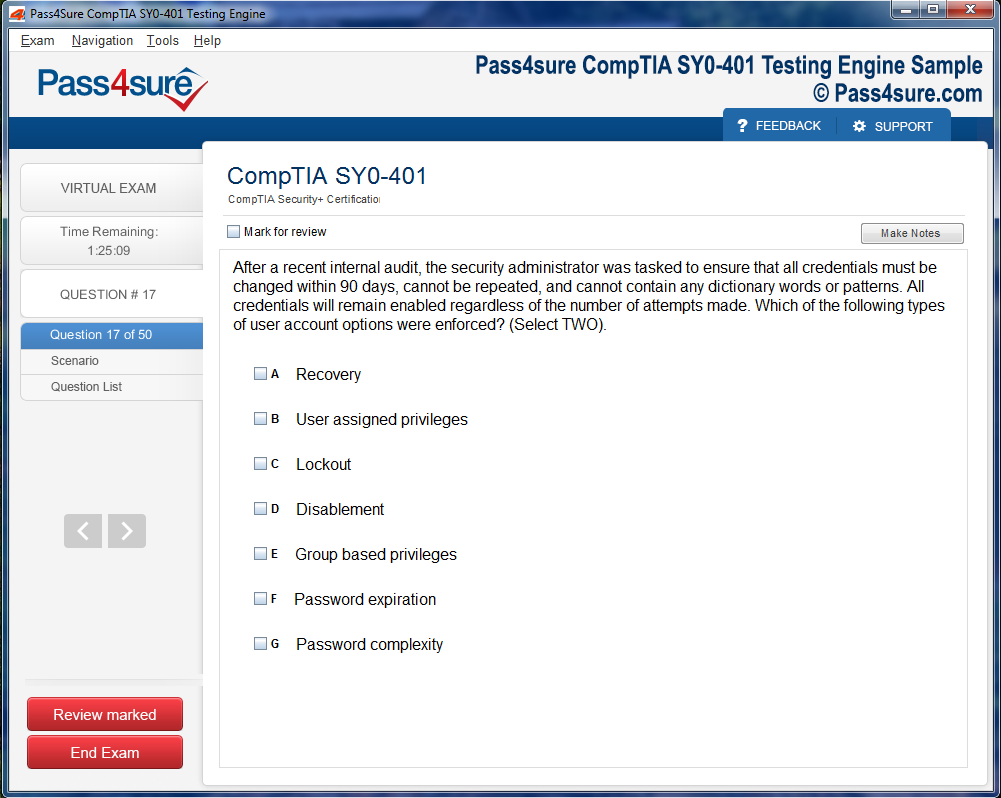
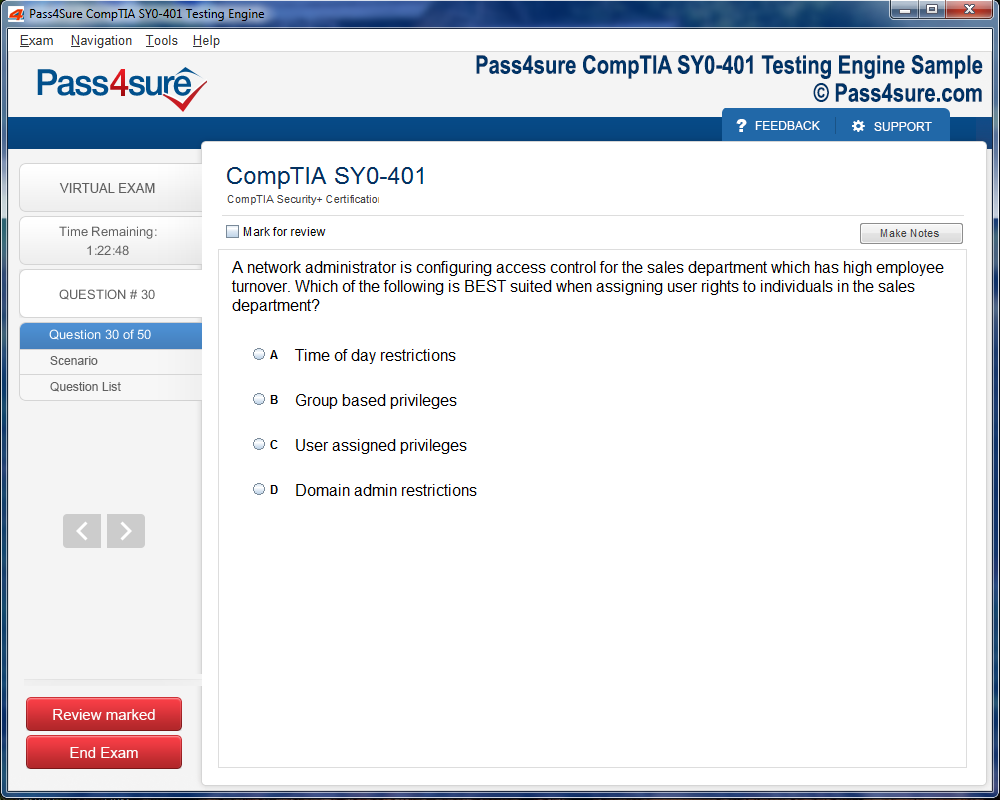
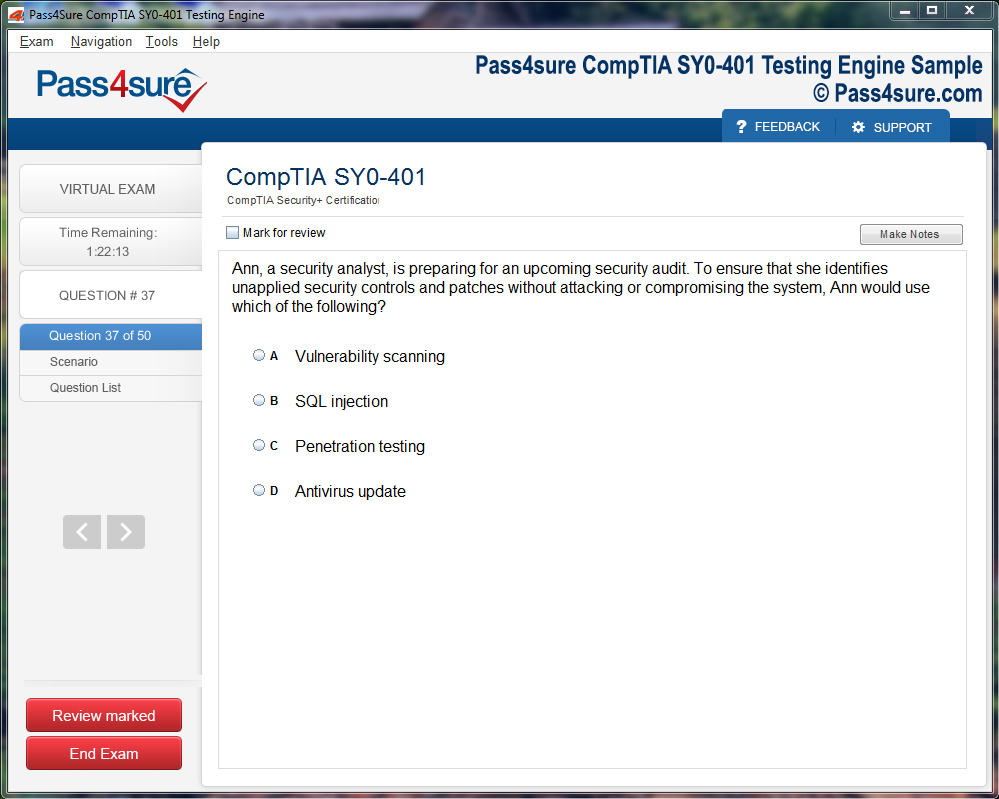
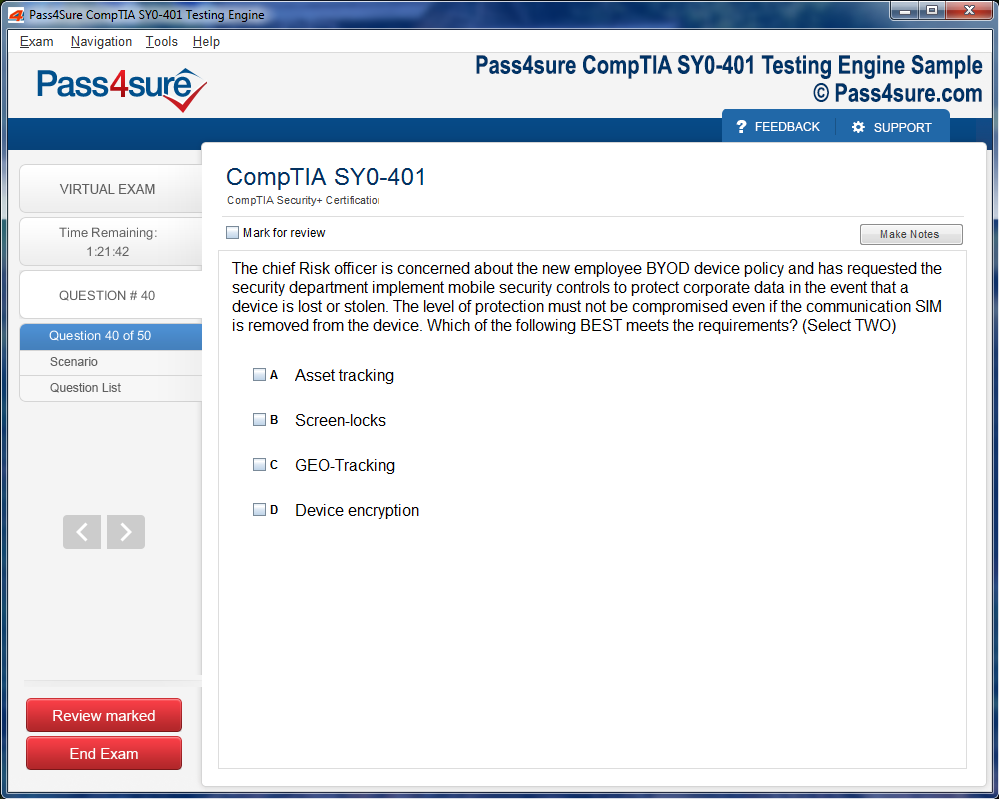
Product Screenshots

Frequently Asked Questions
How does your testing engine works?
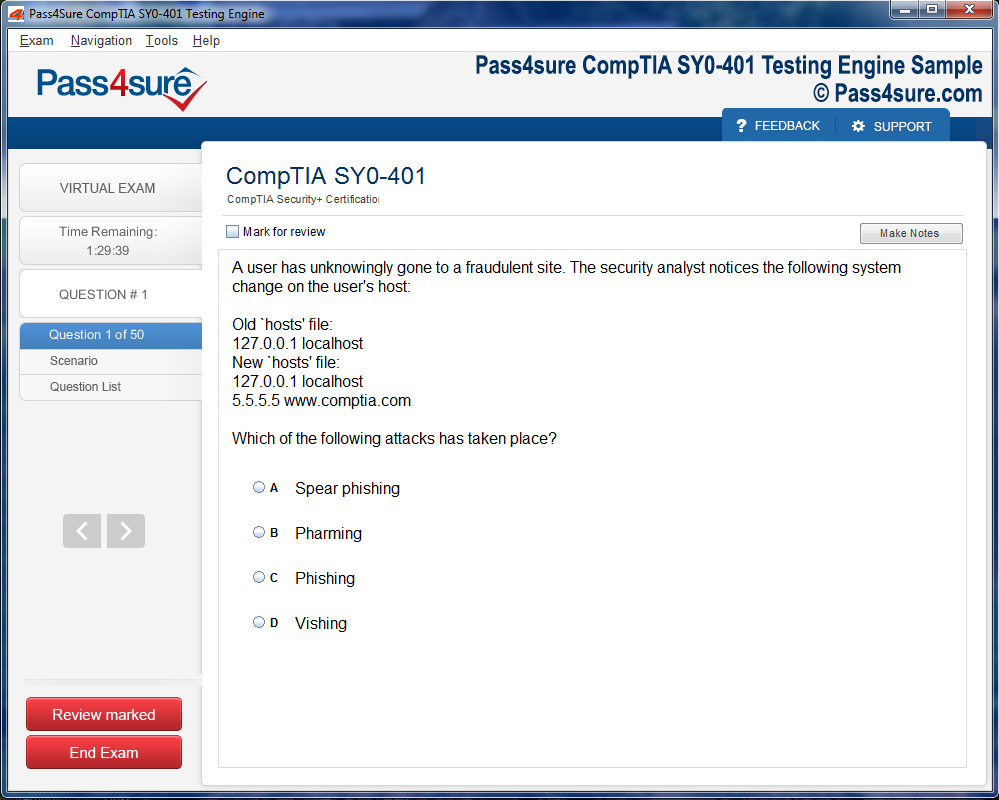
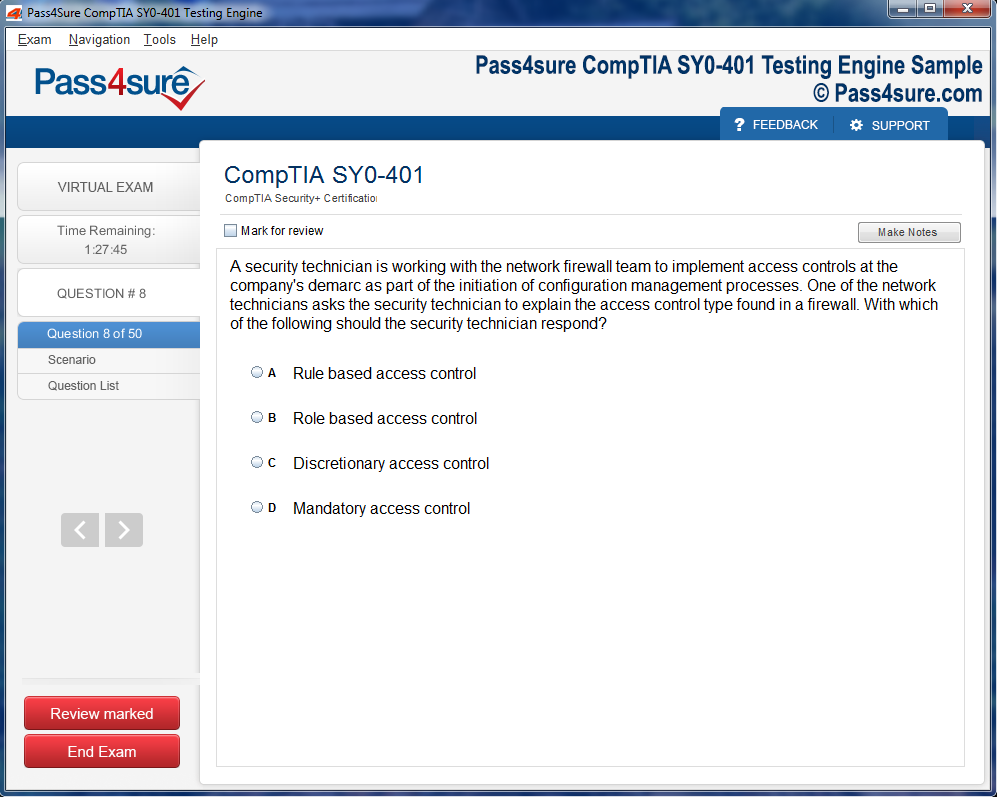
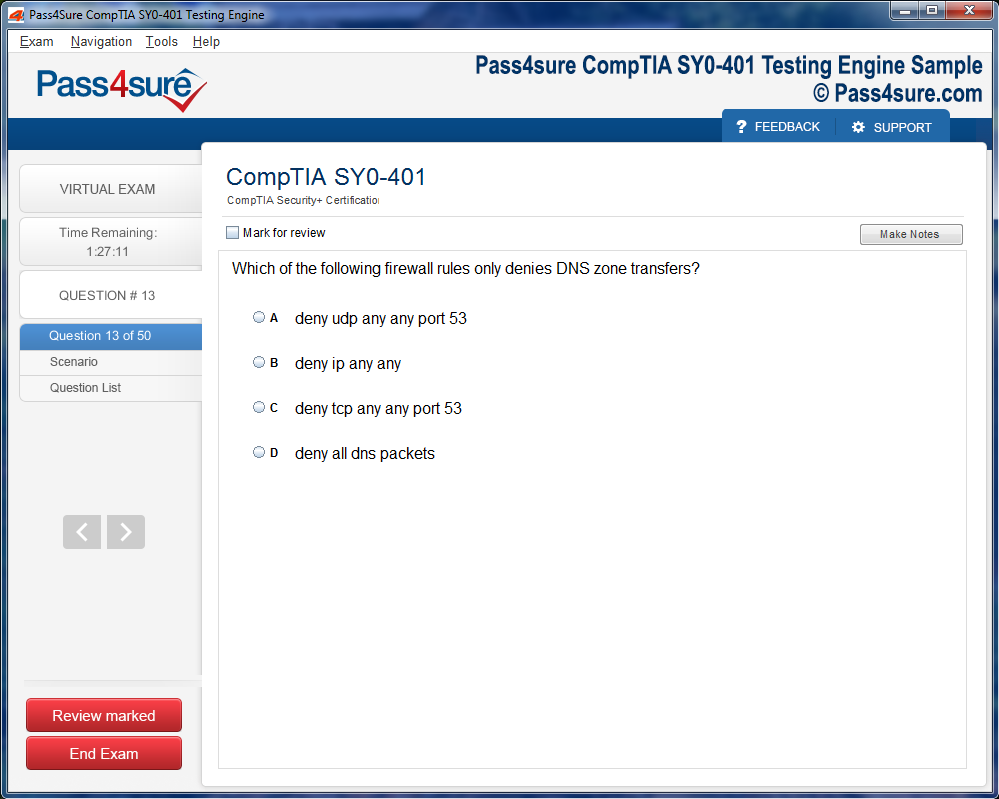
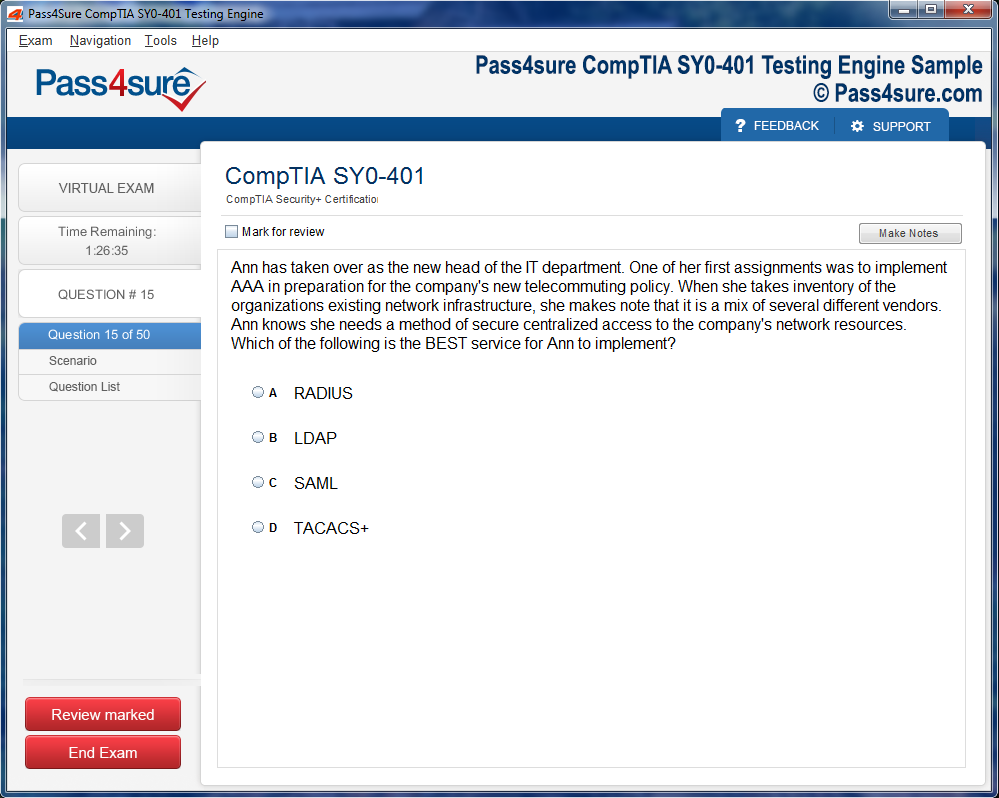
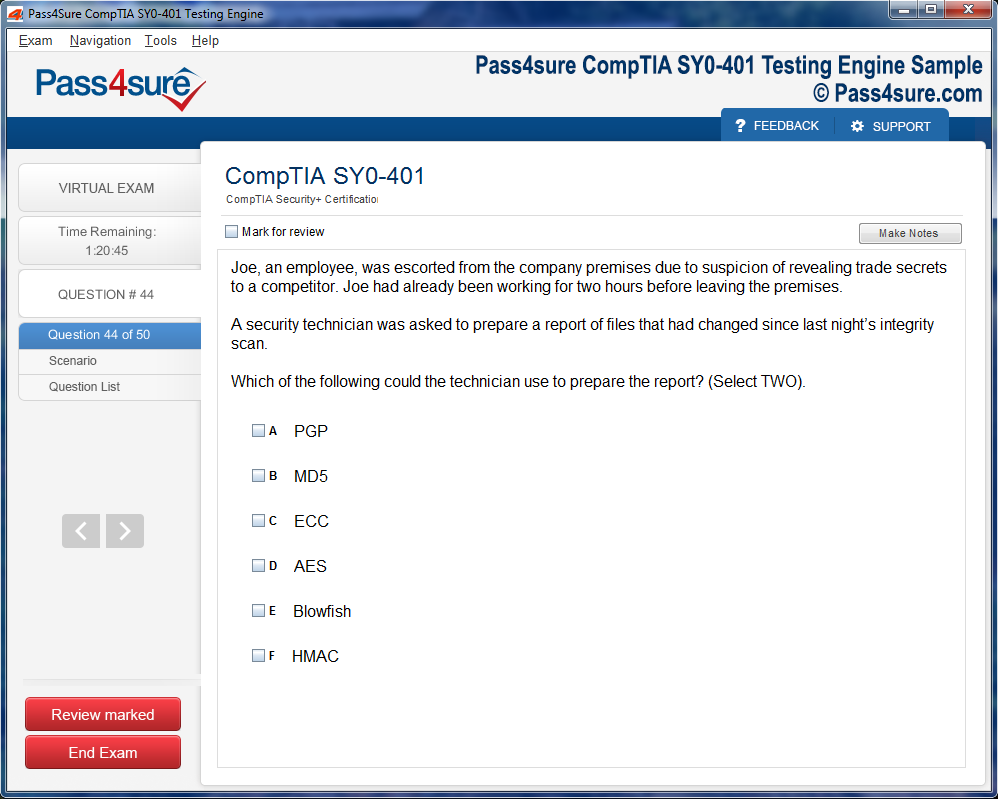
Once download and installed on your PC, you can practise test questions, review your questions & answers using two different options 'practice exam' and 'virtual exam'. Virtual Exam - test yourself with exam questions with a time limit, as if you are taking exams in the Prometric or VUE testing centre. Practice exam - review exam questions one by one, see correct answers and explanations.
How can I get the products after purchase?
All products are available for download immediately from your Member's Area. Once you have made the payment, you will be transferred to Member's Area where you can login and download the products you have purchased to your computer.
How long can I use my product? Will it be valid forever?
Pass4sure products have a validity of 90 days from the date of purchase. This means that any updates to the products, including but not limited to new questions, or updates and changes by our editing team, will be automatically downloaded on to computer to make sure that you get latest exam prep materials during those 90 days.
Can I renew my product if when it's expired?
Yes, when the 90 days of your product validity are over, you have the option of renewing your expired products with a 30% discount. This can be done in your Member's Area.
Please note that you will not be able to use the product after it has expired if you don't renew it.
How often are the questions updated?
We always try to provide the latest pool of questions, Updates in the questions depend on the changes in actual pool of questions by different vendors. As soon as we know about the change in the exam question pool we try our best to update the products as fast as possible.
How many computers I can download Pass4sure software on?
You can download the Pass4sure products on the maximum number of 2 (two) computers or devices. If you need to use the software on more than two machines, you can purchase this option separately. Please email sales@pass4sure.com if you need to use more than 5 (five) computers.
What are the system requirements?
Minimum System Requirements:
- Windows XP or newer operating system
- Java Version 8 or newer
- 1+ GHz processor
- 1 GB Ram
- 50 MB available hard disk typically (products may vary)
What operating systems are supported by your Testing Engine software?
Our testing engine is supported by Windows. Andriod and IOS software is currently under development.
E22-214 Exam Guide: Your Path to Juniper Certification Success
Achieving mastery over the E22-214 exam demands more than rote memorization; it necessitates a deep conceptual fluency. Grapple with the intricate lattice of cloud architectures, understanding how components interact in ephemeral and persistent layers. Engage in mental simulations of network topologies and envision the data flow as though it were an intricate symphony, each packet a note in a harmonious arrangement. This cognitive rehearsal nurtures an intuitive grasp of cloud mechanics, which becomes indispensable under exam conditions.
Navigating the Nuances of Junos OS
Junos OS serves as the linchpin of Juniper's cloud offerings, and navigating its idiosyncrasies is critical. Explore the command-line interface with meticulous attention, discerning subtle behavioral variations across configuration hierarchies. Embrace the ethereal complexity of routing policies, firewall filters, and interface management, allowing each operation to crystallize into procedural memory. The depth of understanding cultivated here is not merely academic; it is a portal to agile troubleshooting and sophisticated automation.
Embracing Automation and Orchestration
The future of cloud networking is inextricably intertwined with automation and orchestration. Acquaint yourself with scripting paradigms, leveraging Python and Junos PyEZ to construct dynamic workflows. Contemplate the philosophical underpinnings of declarative versus imperative configurations, and discern when each paradigm yields optimal results. Orchestration transcends mere task automation; it embodies a strategic alignment of resources and policies, transforming static infrastructure into a responsive, self-regulating ecosystem.
Security Paradigms in the Cloud Ecosystem
Cloud security is not a mere appendage; it is the scaffolding that sustains operational integrity. Delve into the nuanced frameworks of identity management, access control, and microsegmentation. Consider the subtle interplay of encryption protocols and the alchemy of key management within multi-tenant environments. Engage in scenario-based exploration of potential vulnerabilities, cultivating a prescient understanding that enables proactive mitigation rather than reactive remediation.
Immersive Lab Exercises
Beyond theoretical mastery, immersion in lab exercises fortifies cognitive retention. Construct virtualized cloud environments, simulating realistic workloads and deployment scenarios. Experiment with high-availability configurations and stress-test network resiliency under duress. These exercises act as cognitive crucibles, forging intuition, and dexterity. The repetition of such experiential learning hones problem-solving acuity and acclimates candidates to the pressures inherent in operational decision-making.
Harnessing Analytical Reasoning
Analytical reasoning elevates preparation from procedural competence to strategic acumen. Engage in meticulous deconstruction of network topologies, discerning bottlenecks and latent vulnerabilities. Exercise lateral thinking by juxtaposing multiple deployment strategies and evaluating their long-term ramifications. This dialectical approach nurtures an anticipatory mindset, transforming exam questions from static prompts into dynamic problem-solving canvases.
Synergizing Theory and Practice
The juncture of theory and practice is where true proficiency emerges. Each conceptual insight must be validated through applied experimentation, forging a bidirectional conduit between knowledge and skill. Develop mini-projects that integrate routing, security, and automation, ensuring each module reinforces the others. This synergy cultivates a holistic perspective, enabling candidates to navigate complex scenarios with composure and clarity.
Psychological Resilience and Focus
Preparation is as much a psychological endeavor as a technical one. Cultivate resilience against cognitive fatigue and exam anxiety through structured mental exercises. Visualization techniques, mindfulness practices, and deliberate focus sessions enhance concentration, ensuring that knowledge manifests reliably under scrutiny. Resilience, coupled with meticulous preparation, transforms uncertainty into confident action.
Adaptive Learning Techniques
Static study methods often falter in the face of complex examinations. Adopt adaptive learning techniques that respond to your evolving comprehension. Employ spaced repetition to consolidate memory, interleave topics to foster cognitive flexibility, and implement metacognitive reflection to identify gaps in understanding. Such dynamic strategies transform study sessions into precision instruments of intellectual refinement.
Engaging with Emerging Trends
The technological landscape of cloud networking is in constant flux. Engage proactively with emerging paradigms, from hybrid cloud integrations to AI-driven orchestration frameworks. Contemplate their potential impact on operational methodologies and exam content relevance. This forward-looking engagement cultivates intellectual agility, allowing candidates to contextualize foundational knowledge within a rapidly evolving ecosystem.
Navigating Cloud Orchestration and Automation Paradigms
In the contemporary landscape of cloud engineering, orchestration transcends mere task automation. It embodies the symphony of interwoven services, APIs, and virtual infrastructures. A proficient Juniper cloud engineer must comprehend the subtle choreography between resource allocation, workload scheduling, and policy-driven automation. Understanding orchestration frameworks allows one to preempt latency pitfalls, optimize throughput, and maintain systemic equilibrium across multifaceted deployments.
Automation, on the other hand, is the crucible where repeatability and precision coalesce. Crafting scripts that dynamically adapt to changing workloads requires a nuanced grasp of declarative versus imperative paradigms. Explore the idiosyncrasies of Junos PyEZ, Ansible modules, and programmatic interfaces that facilitate seamless orchestration. The cognitive leap from manual configuration to automated workflows enhances operational dexterity and liberates engineers to focus on strategic infrastructure improvements rather than procedural monotony.
To fully assimilate these paradigms, immersive experimentation is indispensable. Construct sandbox environments where automation scripts interact with virtual topologies, simulate service disruptions, and measure response fidelity. Observing the ramifications of automated remediation strategies instills an intuitive understanding of systemic interdependencies, ensuring engineers can orchestrate resilient, adaptive cloud networks under real-world pressures.
Deepening Insight into Advanced Routing Constructs
The substratum of any cloud network is its routing architecture, and advanced comprehension distinguishes proficient engineers from mere practitioners. Beyond foundational IP schemas lies a labyrinth of overlay networks, route redistribution mechanisms, and policy-based path selection. Grasping these intricacies demands more than rote memorization; it requires analytical foresight and pattern recognition to predict traffic convergence, loop formation, and potential points of congestion.
Virtual routing instances, logical interfaces, and dynamic multipath strategies are indispensable tools in a Juniper engineer’s arsenal. Engage with BGP communities, route reflectors, and OSPF area hierarchies to understand how micro-decisions ripple through global topologies. Appreciating the subtleties of metric manipulation and policy precedence allows for nuanced control over path selection and latency optimization, translating into tangible improvements in application performance.
Augment theoretical comprehension with iterative testing in controlled virtual environments. Introduce asymmetrical paths, observe protocol convergence behaviors, and simulate high-availability scenarios. Such rigorous exploration hones the intuition necessary to preempt disruptions and implement robust, self-healing network designs that withstand the unpredictable exigencies of cloud operations.
Fortifying Security Postures with Proactive Intelligence
Security in cloud ecosystems is an evolving discipline, demanding anticipatory insight rather than reactive defense. Contemporary threats exploit ephemeral workloads, lateral movement potential, and misconfigurations, necessitating a proactive, intelligence-driven approach. Engineers must internalize the principles of zero-trust architectures, microsegmentation, and cryptographic integrity to safeguard assets in volatile cloud terrains.
Examine how Juniper SRX devices enforce granular security policies, integrate threat intelligence feeds, and provide real-time anomaly detection. Understanding the interplay between stateful firewalls, intrusion prevention systems, and secure gateways allows for dynamic adaptation to emergent threats. Additionally, mastering encryption standards, certificate management, and multi-factor authentication protocols ensures that authentication and authorization frameworks remain resilient against sophisticated intrusion attempts.
Practical exposure remains paramount. Conduct red-teaming exercises in virtual labs, test policy enforcement under stress conditions, and evaluate the efficacy of automated mitigation scripts. Such experiential endeavors bridge the theoretical-practical divide, enabling engineers to internalize security best practices and cultivate a vigilant, anticipatory mindset essential for safeguarding complex cloud infrastructures.
Synthesizing Performance Optimization and Troubleshooting Acumen
Operational excellence in cloud networks requires an amalgamation of performance optimization and incisive troubleshooting capabilities. Every configuration choice, from route prioritization to firewall rule sequencing, bears implications on latency, throughput, and fault tolerance. Engineers must cultivate the ability to dissect systemic behavior, identify subtle inefficiencies, and implement corrective measures with surgical precision.
Analytical methodologies, such as packet tracing, latency mapping, and flow analysis, become invaluable. Junos operational commands, logging mechanisms, and telemetry interfaces provide granular visibility into network performance, illuminating the interplay between virtualized workloads and underlying infrastructure. Beyond diagnosis, engineers must anticipate cascading failures, simulate stress scenarios, and implement resilient designs that preempt performance degradation.
Incorporate iterative learning through hands-on labs, scenario-based troubleshooting, and retrospective evaluation of incident responses. This immersive approach enhances pattern recognition, fosters proactive mitigation strategies, and instills confidence in tackling emergent networking challenges. The resultant expertise transcends exam preparation, embedding a pragmatic, solution-oriented ethos indispensable in production environments.
Embracing Cognitive Networking Paradigms
The modern network is no longer a static construct but a dynamic cognitive entity, capable of self-reflection and anticipatory adjustment. Cognitive networking integrates machine learning algorithms with telemetry data, enabling networks to preempt anomalies and autonomously recalibrate. For those preparing for advanced Juniper certifications, understanding this paradigm is imperative. Delve into the mechanisms by which predictive analytics interpret traffic patterns, detect incipient bottlenecks, and orchestrate preemptive rerouting without human intervention. Engage with synthetic datasets to simulate congestion scenarios, observing how autonomous decisions emerge from algorithmic inference. The cognitive approach emphasizes adaptation over reaction, fostering a network ecosystem that is resilient, self-optimizing, and exceptionally responsive.
Quantum-Inspired Routing Methodologies
Routing has evolved beyond deterministic path selection, venturing into probabilistic and quantum-inspired frameworks. Quantum-inspired algorithms exploit principles such as superposition and entanglement to compute multiple potential routes simultaneously, optimizing latency and throughput in complex topologies. While actual quantum routers remain in research phases, the underlying logic informs cutting-edge simulation and orchestration tools. Study how routing tables adapt under probabilistic heuristics, allowing dynamic path recalibration in response to fluctuating traffic and emergent network failures. This realm demands an appreciation for non-linear problem solving and stochastic optimization, expanding one’s capability to manage networks with unparalleled foresight.
Telemetry-Driven Decision Ecosystems
The proliferation of sensors, probes, and virtualized endpoints generates an avalanche of telemetry data, each datum a microscopic clue into the network’s health. Harnessing this deluge requires more than mere monitoring; it necessitates the creation of decision ecosystems where data feeds algorithmic engines that propagate actionable insights. Investigate how Juniper’s telemetry interfaces collect granular performance metrics, which, when coupled with event-driven automation, allow for near-instantaneous remediation of anomalies. Explore scenarios where telemetry streams inform dynamic QoS policies, optimize resource allocation, and anticipate capacity thresholds, rendering networks increasingly autonomous and intelligent.
Multidimensional Security Fabrication
Security in cloud-native environments demands a multidimensional fabric, integrating micro-segmentation, anomaly detection, and policy orchestration. Traditional perimeter-based approaches falter against lateral threats and ephemeral workloads. Focus on constructing security matrices where identity, behavior, and context converge to enforce adaptive access controls. Juniper’s advanced security frameworks allow administrators to codify policies as modular, reusable constructs, automatically applied across virtualized and physical topologies. Experiment with anomaly-driven policy triggers that adapt in real time, enhancing resilience against sophisticated cyber threats and reducing manual oversight.
Programmable Infrastructure Constellations
The future of network management resides in programmable infrastructure constellations, where heterogeneous resources converge under a unified, scriptable control plane. These constellations encapsulate compute, storage, and networking elements, orchestrated through declarative frameworks that define desired states rather than procedural steps. Explore the abstractions that decouple physical topology from operational intent, enabling seamless scaling and rapid service deployment. By mastering declarative configuration paradigms and API-driven control, you cultivate the ability to shape an infrastructure that is both malleable and self-regulating, meeting the demands of modern digital enterprises with unprecedented agility.
Event-Driven Ecosystemic Response
Networks are increasingly reactive entities, capable of responding to discrete events with surgical precision. Event-driven frameworks transform telemetry signals, log anomalies, or policy breaches into automated remediation processes. Investigate how these frameworks integrate with orchestration tools to trigger cascading actions, such as load redistribution, firewall reconfiguration, or virtual machine provisioning. The cognitive sophistication lies in predicting downstream effects, avoiding oscillations or inadvertent conflicts. Simulation exercises provide fertile ground for exploring these dynamics, revealing the intricate choreography required for ecosystems to respond in real time while maintaining equilibrium.
Semantic Network Intelligence
Emerging paradigms in semantic network intelligence explore the synthesis of data meaning and operational behavior. Beyond raw metrics, semantic intelligence interprets the context, intent, and relationships among network entities. This allows for anticipatory policy generation, intelligent fault localization, and predictive scaling. Engage with tools that integrate metadata analysis, graph modeling, and intent-based automation to construct networks that “understand” their own operational narrative. This intellectual framework not only enhances problem-solving acuity but also cultivates a mindset oriented toward strategic foresight rather than reactive troubleshooting.
Navigating Cognitive Biases in Exam Scenarios
Exam performance is often undermined not by lack of knowledge, but by insidious cognitive biases that warp judgment. Anchoring bias, for instance, can skew your initial impression of a question, causing premature closure on a seemingly obvious answer. Availability bias may lure you toward recently studied concepts even when a more nuanced solution is warranted. Cultivating metacognitive awareness—an introspective understanding of one’s own thought patterns—can mitigate these pitfalls. Regularly pausing to question your assumptions during practice cultivates mental agility, allowing you to pivot effectively when confronted with convoluted scenarios.
Synthesizing Conceptual Frameworks
Beyond rote memorization, mastery emerges from the ability to synthesize disparate conceptual frameworks into cohesive mental models. The E22-214 exam rewards candidates who can traverse abstraction layers, connecting procedural knowledge to underlying principles. Visualizing systems holistically—imagining interdependencies, potential failures, and cascading effects—enables rapid problem-solving under time pressure. Diagrammatic representations, though simple in execution, often crystallize relationships between multifaceted concepts, providing cognitive scaffolding that enhances recall and precision during the exam.
Precision in Analytical Reasoning
Analytical reasoning in high-stakes assessments demands more than linear logic; it requires dialectical thinking, where contradictions are reconciled through rigorous evaluation. Encountering a scenario-based question, approach it by delineating constraints, identifying latent variables, and mapping probable outcomes. Train your mind to anticipate distractors and false dichotomies embedded within questions. The capacity to parse linguistic nuance—recognizing modifiers, conditional phrasing, and exceptions—distinguishes superficial understanding from profound mastery. Developing this acuity during preparation transforms the exam from a test of memory into a demonstration of intellectual dexterity.
Optimizing Cognitive Endurance
Sustained focus over the course of an extensive examination relies on cognitive endurance as much as technical knowledge. Neural fatigue can impair even the most meticulously prepared candidates, making intermittent cognitive resets essential. Techniques such as focused micro-meditations, alternating between intense concentration and brief restorative pauses, preserve mental acuity. Nutritional strategies, hydration, and strategic sleep cycles further augment cerebral performance, ensuring that the mind remains responsive to complex problem-solving demands. Recognizing your own circadian rhythms allows alignment of study and revision sessions with peak cognitive energy periods.
Iterative Mastery Through Feedback Loops
Learning in isolation seldom produces enduring competence; iterative feedback loops accelerate skill acquisition. After each practice session, meticulously dissect errors to extract underlying misconceptions. Embrace a cyclical process of trial, reflection, and refinement. Annotate patterns of mistakes and recurring oversights to inform subsequent study sessions. This disciplined introspection fosters self-regulatory learning, where each iteration not only corrects previous inaccuracies but also fortifies the neural pathways associated with critical reasoning. The result is an adaptive, evolving knowledge architecture capable of withstanding the pressures of the exam environment.
Harnessing Scenario Simulation
Scenario simulations elevate preparation from theoretical absorption to applied intelligence. Construct mock problem spaces that mirror the exam’s complexity, integrating multiple variables and conditional dependencies. By rehearsing responses to these synthetic scenarios, candidates internalize problem-solving heuristics that reduce cognitive load during actual examination. Furthermore, simulation cultivates resilience against ambiguity, teaching the mind to navigate uncertainty with composure. Over time, these rehearsals embed procedural fluency and strategic foresight, translating preparation into confidence that is palpable during the exam itself.
Cultivating Emotional Equanimity
Performance under pressure is as much an emotional endeavor as an intellectual one. Anxiety can disrupt working memory, erode analytical clarity, and induce hasty decisions. Cultivating emotional equanimity—an enduring state of calm attentiveness—empowers candidates to respond to stressors without reactive impulsivity. Techniques including mindful breathing, visualization of success scenarios, and controlled exposure to timed practice exams strengthen this inner equilibrium. Emotional mastery, intertwined with cognitive rigor, transforms the examination experience from a fraught trial into a controlled, deliberate display of competence.
Strategizing Time Allocation
Effective time allocation is a choreography of discernment and efficiency. Begin by appraising the complexity of questions relative to allocated time, then deploy cognitive resources proportionally. Establish priority hierarchies: initial sweeps target low-hanging opportunities to secure easy points, followed by iterative revisits to high-difficulty scenarios. Temporal awareness must be dynamic; candidates must remain flexible, adjusting pace according to emergent challenges. Mastery of temporal orchestration minimizes wasted cognitive energy and maximizes score potential, reinforcing the principle that judicious strategy is as critical as knowledge depth.
Sustaining Expertise Beyond Certification Milestones
Achieving the E22-214 certification signifies a notable accomplishment, yet the quintessence of professional mastery manifests through relentless refinement and practical engagement. The cloud networking realm is in perpetual flux, and the vigilant practitioner recognizes that static knowledge is ephemeral. Continuous assimilation of emerging paradigms ensures that proficiency retains both pertinence and potency.
Revisiting Foundational Concepts as Dynamic Knowledge
Merely recalling theoretical principles without context renders them inert. Instead, revisit foundational concepts with an analytical lens, discerning how they evolve with technological innovations. Engage with junctures where theory intersects with emergent practice, attending to nuances in protocol updates, architectural shifts, and ecosystem transformations. Subscribing to curated newsletters, attending webinars, or participating in digital symposia furnishes real-time intel, enhancing the practitioner's anticipatory acuity.
Hands-On Experimentation and Cognitive Sculpting
Practical engagement transcends rote application. Expand experimental environments, whether through meticulously configured home labs or ephemeral cloud sandboxes. Explore labyrinthine network topologies, simulate anomalous traffic conditions, and probe automation mechanisms with experimental rigor. Such exercises cultivate dexterity in troubleshooting, foster cognitive elasticity, and underpin adaptive problem-solving strategies that theoretical study alone cannot impart.
Cultivating Collaborative Cognition
Professional evolution is rarely solitary. Immersing oneself in communities of practice amplifies growth through dialectical exchange. Participate in forums, professional guilds, and virtual enclaves where practitioners converge, sharing both triumphs and conundrums. Exposure to heterogeneous perspectives catalyzes inventive solutions, encouraging synthesis of unconventional strategies while deepening conceptual comprehension.
Augmenting Skills with Complementary Expertise
Certification is a threshold, not a terminus. Pursuing allied competencies—such as cloud security fortification, orchestration mechanics, and intricate automation scripting—imbues the practitioner with multidimensional dexterity. These domains not only consolidate foundational knowledge but also confer a competitive edge, facilitating fluid navigation across complex, interdependent network environments.
Archiving Knowledge for Cognitive Perpetuity
The act of documenting configurations, scripts, and troubleshooting insights transforms ephemeral experience into enduring intellectual capital. A meticulously curated repository functions as both mnemonic scaffold and strategic resource, enabling efficient recall and accelerated problem resolution. Additionally, it serves as a mentorship instrument, allowing practitioners to disseminate accumulated wisdom and cultivate emergent talent within professional ecosystems.
Adaptive Vigilance in an Evolving Ecosystem
Cloud networking is characterized by relentless evolution, and maintaining relevance necessitates adaptive vigilance. Regularly assimilate protocol revisions, software updates, and architectural innovations, integrating them into practical frameworks. Anticipatory engagement with nascent technologies fosters proactive competence, ensuring practitioners are not merely reactive participants but architects of emergent solutions.
Sustaining Expertise Beyond Certification Milestones
Attaining the E22-214 certification is not merely a badge of accomplishment; it is a gateway into a realm where knowledge demands perpetual cultivation. Mastery in cloud networking is not a static achievement but a continuous journey, wherein every advancement in technology redefines the practitioner’s landscape. Remaining attuned to emergent paradigms, evolving standards, and sophisticated network architectures ensures that one’s competencies are not obsolescent but dynamically relevant. In this flux, the seasoned professional embraces both introspection and experimentation as dual engines of sustained excellence.
Revisiting Foundational Concepts as Dynamic Knowledge
The profundity of expertise lies in perceiving foundational principles not as inert rules but as living, adaptable frameworks. Revisiting these concepts involves more than cursory review; it requires deep interrogation of how established protocols behave under evolving conditions. Engage with network updates, track vendor releases, and dissect case studies of deployment anomalies. Each nuance, from protocol handshake refinements to latency optimization strategies, enriches understanding and primes the mind for complex, real-world problem solving.
Subscribing to specialized newsletters or attending advanced webinars serves as a conduit for ephemeral yet critical insights. These engagements transform passive knowledge into anticipatory intelligence, enabling practitioners to foresee industry shifts and preemptively refine their strategies. The dynamic interplay between historical understanding and emergent innovation creates a mental scaffolding that undergirds long-term professional dexterity.
Hands-On Experimentation and Cognitive Sculpting
True mastery emerges not from memorization but from iterative experimentation. Establishing a home lab or utilizing cloud sandboxes permits immersive interaction with complex network configurations. Practitioners can simulate multifaceted scenarios: cascading failures, intricate routing anomalies, or hybrid network interdependencies. Such simulations cultivate both precision and resilience, refining not only technical acumen but also cognitive agility.
Beyond simulation, integrating automation and scripting exercises elevates problem-solving capabilities. Experimenting with orchestration scripts, dynamic provisioning, and automated remediation imbues the practitioner with a mechanistic understanding of systems behavior. This iterative cycle of experimentation, observation, and adjustment sharpens analytical faculties and reinforces a mindset oriented toward proactive troubleshooting rather than reactive response.
Cultivating Collaborative Cognition
Isolation diminishes the scope of insight, whereas interaction catalyzes intellectual expansion. Immersion in professional communities—be they online forums, guilds, or virtual discussion circles—unveils diverse perspectives and novel approaches. Dialogue with peers, seasoned experts, and cross-disciplinary specialists often illuminates latent solutions that might remain obscured in solitary practice.
Engagement with these communities also nurtures rhetorical acuity and strategic thinking. Articulating complex concepts, debating architectural trade-offs, and synthesizing collective insights fosters mental dexterity, reinforcing both comprehension and retention. Furthermore, exposure to multifarious problem-solving methodologies enhances adaptive flexibility, a critical trait in a domain where technological upheavals are the norm rather than the exception.
Augmenting Skills with Complementary Expertise
Certification lays the groundwork, yet holistic proficiency necessitates expansion into synergistic domains. Security, orchestration, and advanced automation are not mere adjuncts but integral components of a multidimensional skill set. Immersing oneself in these domains deepens comprehension of systemic interdependencies, enabling practitioners to architect solutions that are simultaneously robust, scalable, and resilient.
Delving into cloud security, for instance, illuminates potential vulnerabilities in network topology, authentication protocols, and encryption strategies. Orchestration expertise facilitates seamless integration of distributed systems, while automation mastery reduces operational friction and accelerates deployment cycles. Each complementary discipline reinforces foundational knowledge, transforming isolated competence into holistic, strategic expertise capable of navigating the intricacies of contemporary network ecosystems.
Archiving Knowledge for Cognitive Perpetuity
Documentation is an underappreciated vector of skill reinforcement. Meticulously curating configurations, automation scripts, and troubleshooting narratives transforms transient experience into enduring intellectual capital. Such repositories serve as mnemonic scaffolds, supporting rapid recall, iterative refinement, and informed experimentation.
Beyond individual utility, these archives function as conduits for knowledge transfer. Mentoring colleagues, contributing to community knowledge bases, or compiling case studies disseminates expertise and fosters a culture of continuous learning. Practitioners who cultivate such repositories not only consolidate their understanding but also catalyze collective advancement within the professional ecosystem, transforming personal mastery into communal enrichment.
Adaptive Vigilance in an Evolving Ecosystem
The cloud networking sphere is characterized by relentless innovation. Latent within each protocol update, software release, or architectural shift lies both opportunity and challenge. Practitioners who maintain adaptive vigilance cultivate an anticipatory mindset, integrating nascent technologies into their cognitive framework before they become industry standards.
This anticipatory competence extends beyond technical proficiency. It encompasses strategic foresight: identifying emergent trends, evaluating potential operational impacts, and preparing for systemic integration. The vigilant practitioner is thus not a passive observer but an active architect of innovation, shaping networks that are resilient, scalable, and future-ready.
Integrating Continuous Feedback Loops
Maintaining proficiency requires more than engagement with external knowledge; it necessitates the cultivation of self-reflective mechanisms. Implementing continuous feedback loops—through performance reviews, self-assessment, and iterative testing—enables practitioners to detect gaps, recalibrate strategies, and reinforce skill acquisition.
Such loops also facilitate the refinement of cognitive heuristics, allowing for more efficient diagnosis of complex network anomalies. By systematically evaluating outcomes and adapting methodologies, professionals cultivate a metacognitive awareness that transforms challenges into structured learning experiences, ensuring sustained skill evolution.
Exploring Interdisciplinary Synergies
Cloud networking does not exist in isolation; it intersects with data analytics, artificial intelligence, and operational technology. Engaging with these adjacent disciplines expands problem-solving repertoires and illuminates novel application paradigms. Understanding AI-driven network optimization, for instance, permits practitioners to leverage predictive analytics for preemptive fault mitigation, while insights from operational technology inform the design of resilient hybrid networks.
Interdisciplinary exploration fosters cognitive versatility, enabling professionals to synthesize diverse frameworks into cohesive strategies. This intellectual cross-pollination is instrumental in cultivating innovative solutions, transforming conventional practices into forward-looking methodologies that anticipate and embrace technological convergence.
Metacognitive Calibration in Study Regimens
Metacognition—an acute awareness of one’s cognitive processes—forms the linchpin of effective exam preparation. Candidates who actively monitor their comprehension and reasoning can anticipate errors before they manifest. This requires an iterative approach to self-assessment: after each study session, pause to interrogate the material, asking whether concepts are fully internalized or superficially memorized. Utilize reflective journaling to chronicle insights, difficulties, and emergent patterns of misunderstanding. Such calibration fosters a feedback-rich environment where each session contributes to a progressively refined mental schema, transforming rote study into deliberate cognitive engineering.
Integrating Multisensory Learning Modalities
The human brain thrives on multisensory input. Incorporating visual, auditory, and kinesthetic elements into study routines amplifies retention and engagement. Diagrammatic sketches, flowcharts, and schematic representations render abstract processes tangible. Reading aloud complex passages or explaining solutions verbally reinforces neural encoding. Kinesthetic techniques—gestural problem-solving, writing by hand, or manipulating physical models—create additional neural pathways, anchoring knowledge more robustly. Integrating these modalities reduces cognitive monotony, heightens attention, and solidifies understanding in ways that purely textual study rarely achieves.
Semantic Network Construction
Deep comprehension emerges when isolated facts coalesce into interconnected networks of meaning. Constructing semantic maps enables candidates to visualize relationships among concepts, hierarchies of principles, and interdependencies between systems. Each node within a network should represent a core concept, while edges delineate causal or procedural relationships. This methodology facilitates lateral thinking, allowing the candidate to draw insights from one domain and apply them adaptively in another. Semantic network construction transforms knowledge from discrete memorization into a dynamic, navigable mental architecture, primed for rapid retrieval during examination scenarios.
Strategic Anticipation of Exam Pitfalls
Examination success is often contingent upon the anticipation of subtle pitfalls deliberately embedded within questions. Ambiguous modifiers, conditional statements, and nested clauses are frequent sources of error. Develop a habit of scanning questions for linguistic nuances, paying particular attention to negations, double negatives, and superlative qualifiers. Scenario-based questions frequently include embedded constraints that, if overlooked, can invalidate an otherwise correct approach. By honing the capacity to detect these subtleties in practice sessions, candidates cultivate vigilance that minimizes preventable mistakes under timed conditions.
Cognitive Load Optimization
The human working memory is inherently limited, necessitating deliberate strategies to optimize cognitive load during preparation and examination. Chunking related information into cohesive units reduces mental strain, while hierarchical categorization prioritizes salient over peripheral details. Mnemonic devices, analogical reasoning, and pattern recognition serve as scaffolds that compress complex information into retrievable formats. Training the mind to offload trivial or repetitive tasks onto automated strategies preserves bandwidth for high-order analysis, enabling sustained analytical performance even under intense temporal pressure.
Resilience Through Adaptive Stress Conditioning
Stress, when unmitigated, can undermine both reasoning and recall. However, controlled exposure to stress-inducing conditions can cultivate adaptive resilience. Implement timed practice exams that mimic real testing environments, gradually increasing difficulty and complexity. Consciously engage with scenarios that provoke uncertainty or ambiguity, monitoring physiological and psychological reactions. Over successive iterations, the mind acclimates to pressure, converting anxiety into heightened alertness rather than paralyzing tension. This form of adaptive conditioning ensures that candidates retain composure and clarity when confronted with unexpected challenges during the actual examination.
Tactical Review and Knowledge Reinforcement
Review sessions must transcend superficial repetition to achieve enduring mastery. Employ a technique of strategic retrieval, where previously studied material is revisited without consulting reference sources. This active recall reinforces memory consolidation and highlights areas of persistent weakness. Cross-linking related concepts during review sessions strengthens semantic networks and fosters integrative thinking. Additionally, interleaving subjects—alternating between distinct domains—prevents cognitive stagnation and encourages flexible problem-solving. Through disciplined, tactical review, preparation evolves from accumulation of facts into genuine expertise.
Leveraging Probabilistic Reasoning
Many scenario-based questions reward probabilistic reasoning—assessing outcomes under conditions of uncertainty. Candidates should cultivate the ability to weigh competing hypotheses, evaluate likelihoods, and anticipate consequences. Quantitative literacy, though beneficial, is complemented by qualitative probabilistic judgment: discerning which scenario is more plausible given partial information. Practice with hypothetical constructs and case studies sharpens this skill, enabling candidates to navigate incomplete data with methodical confidence. Probabilistic reasoning transforms ambiguity from a barrier into an instrument for strategic decision-making.
Cultivating Mental Flexibility
Exams often challenge candidates to shift between diverse cognitive modes, from abstract conceptualization to concrete procedural application. Mental flexibility—the capacity to pivot effortlessly between frameworks—prevents rigid thinking that can derail problem-solving. Engage in exercises that require reinterpretation of familiar material under new constraints, or that demand alternate solution pathways for identical problems. Such practice enhances cognitive agility, preparing candidates to encounter unconventional scenarios without hesitation. Flexibility, paired with disciplined knowledge, produces a resilient, adaptive intellect.
Pre-Examination Rituals for Peak Performance
Preparation extends beyond study into deliberate pre-examination rituals. Rituals serve to signal to the brain a transition into a focused, high-performance state. These may include structured breathing exercises, light physical activity to stimulate circulation, or visualization of prior successes. Timing and sequencing of these rituals should be consistent, creating a predictable neural cue that fosters calm, focused attention. When integrated into preparation, these micro-habits optimize mental readiness, ensuring that candidates approach the exam with both clarity and controlled confidence.
Iterative Problem-Solving Strategies
A hallmark of expert performance lies in iterative problem-solving. Rather than attempting to reach a perfect solution immediately, candidates should embrace cyclical refinement: hypothesize, test, analyze outcomes, and adjust. This methodology applies to both conceptual and scenario-based questions. By adopting an iterative approach, errors are not failures but informative data points, guiding successive attempts toward optimal solutions. Over time, this strategy nurtures a mindset of analytical perseverance, where resilience and adaptability are as valued as knowledge itself.
Neurocognitive Priming Techniques
Priming—activating relevant neural circuits prior to complex tasks—can enhance both speed and accuracy. Techniques include brief exposure to related problems, revisiting critical definitions, or engaging in rapid mental rehearsals of procedural steps. By pre-activating these pathways, the brain achieves readiness for high-demand reasoning, minimizing latency in problem-solving. Priming complements traditional study methods, offering a subtle yet powerful boost to cognitive performance during high-stakes examinations.
Embedding Meticulous Documentation Practices
Maintaining meticulous documentation of study progress, mistakes, and corrective strategies yields compounding benefits. A well-structured logbook captures insights that might otherwise fade, facilitates pattern recognition in recurring errors, and serves as a roadmap for targeted revision. Documentation should extend beyond mere recording, encompassing reflective analysis, alternative strategies, and emergent hypotheses. Through this disciplined archival practice, candidates cultivate meta-knowledge about their own learning, transforming preparation into a structured, self-directed intelligence system.
Hyper-Automated Cloud Fabric Dynamics
Hyper-automation transcends simple scripting or task automation, venturing into an ecosystem where workflows self-generate, adapt, and optimize. In cloud fabric environments, this entails the confluence of artificial intelligence, orchestration engines, and event-driven triggers that collectively anticipate operational requirements. Examine scenarios where provisioning virtual networks, instantiating security policies, and load balancing workloads occur without human initiation. The hyper-automated fabric monitors not only the health of individual nodes but also systemic interdependencies, predicting cascading effects from micro-level fluctuations. By cultivating familiarity with these autonomous constructs, practitioners gain the ability to orchestrate networks that behave as living, self-regulating organisms.
Intent-Based Architectural Manifestation
Intent-based networking (IBN) transforms abstract objectives into tangible configurations. Unlike conventional declarative methods, IBN interprets desired outcomes—such as latency thresholds, throughput targets, or compliance requirements—and translates them into actionable commands that permeate the network. Study the algorithms that validate intent against real-time state, ensuring alignment without manual oversight. Engage in exercises where strategic goals, like end-to-end encrypted traffic or multi-zone redundancy, automatically translate into orchestrated micro-policies. This approach cultivates a proactive mindset, allowing administrators to steer infrastructure according to strategic imperatives rather than reactively adjusting individual devices.
Emergent Service Mesh Intelligence
Service meshes have evolved from simple traffic routers into intelligent, context-aware entities that govern inter-service communications across distributed applications. They provide observability, security, and dynamic routing without altering application code. Explore how advanced service meshes, when coupled with telemetry and automation, enable granular traffic shaping, anomaly-driven policy adaptation, and seamless failover. By conceptualizing service meshes as autonomous communicative organisms, practitioners can anticipate the ripple effects of workload migrations, service scaling, or network partitioning. Hands-on experimentation with simulated microservices environments reinforces the understanding of these emergent behaviors, ensuring mastery over complex, distributed orchestration.
Algorithmic Resilience Engineering
Resilience in modern networks is not merely redundancy; it is algorithmic, predictive, and self-healing. Algorithmic resilience engineering leverages statistical inference, anomaly detection, and automated remediation loops to maintain service continuity under stress. Investigate how machine learning models predict resource exhaustion, detect early signs of failure, and preemptively redistribute workloads. Simulate stress scenarios where storage, compute, or network congestion occurs and observe how algorithmic intervention restores equilibrium. This methodology instills the capability to foresee failures before they manifest, cultivating operational environments that are robust, adaptive, and minimally dependent on human intervention.
Polyglot Automation Strategies
In polyglot infrastructures, multiple languages, platforms, and protocols coexist, necessitating diverse automation strategies. Mastering polyglot automation involves fluency in Python, YAML, RESTful API integrations, and domain-specific orchestration languages. Focus on interoperability, ensuring that disparate components—legacy systems, cloud-native applications, and virtualized network functions—communicate seamlessly. Construct complex workflows where policy updates, provisioning tasks, and telemetry-based triggers traverse multiple ecosystems without friction. By embracing polyglot paradigms, administrators achieve holistic orchestration, mitigating silos and fostering a unified operational continuum.
Topology-Aware Predictive Analytics
Networks are spatially and hierarchically complex, and topology-aware predictive analytics allows administrators to harness these structures for strategic advantage. By mapping logical, physical, and virtual topologies, predictive models simulate network behavior under various perturbations. Engage with analytics tools that forecast latency spikes, identify congestion-prone nodes, and anticipate cross-domain policy conflicts. These predictive insights, when coupled with automation, enable preemptive configuration adjustments and resource reallocation. Topology-aware analytics transform networks into forward-looking entities, capable of self-optimization and intelligent load distribution.
Zero-Trust Microsegmentation Techniques
Zero-trust principles demand rigorous verification of every interaction, regardless of origin. Microsegmentation operationalizes zero-trust by partitioning networks into granular zones, each governed by context-aware policies. Explore the deployment of dynamic microsegments, where security rules adapt based on identity, behavior, and temporal conditions. Implement automation scripts that adjust access in real time, responding to anomalies or policy violations. This dynamic segmentation enhances containment, reducing lateral movement risk and enforcing continuous compliance. Mastery of zero-trust microsegmentation equips practitioners to manage highly fluid, high-stakes environments with precision and agility.
Adaptive Workload Orchestration
Modern workloads are ephemeral, scaling rapidly in response to demand. Adaptive workload orchestration ensures that computational, storage, and networking resources dynamically align with shifting workloads. Examine orchestration frameworks capable of autoscaling virtual machines, redistributing containerized applications, and adjusting QoS parameters on-the-fly. Experiment with workload simulations where demand surges trigger automated resource provisioning, latency-sensitive paths are prioritized, and redundant resources are temporarily spun up. This approach underscores the importance of not only reactive orchestration but predictive, workload-aware planning that maintains service continuity while optimizing efficiency.
Semantic Telemetry Fusion
Semantic telemetry fusion synthesizes raw monitoring data into actionable intelligence by interpreting meaning, context, and causality. Beyond simple metric aggregation, this approach combines multi-source telemetry streams to infer trends, anticipate anomalies, and guide automated responses. Delve into techniques for correlating traffic patterns, application behaviors, and device logs, transforming them into strategic insights. Use synthetic experiments to test how semantic fusion informs automated policy changes or resource redistribution, reinforcing understanding of its practical impact. Semantic telemetry elevates network management from reactive monitoring to predictive orchestration, enhancing both agility and resilience.
Cognitive Fault Isolation
Fault isolation in complex, orchestrated networks is a formidable challenge. Cognitive fault isolation leverages AI-driven reasoning, dependency mapping, and probabilistic inference to pinpoint root causes rapidly. Study scenarios where simultaneous failures occur across virtual, physical, and cloud layers, observing how cognitive models prioritize likely causes and recommend corrective actions. Implementing automated remediation alongside cognitive analysis creates self-healing networks that minimize downtime. Mastery of this approach empowers administrators to respond to intricate, multi-layered incidents with speed, precision, and minimal human intervention.
Emergent Compliance Automation
Regulatory and operational compliance is an ongoing challenge in dynamic infrastructures. Emergent compliance automation integrates policy codification, continuous monitoring, and automated remediation to ensure adherence in real time. Explore systems that detect deviations from security benchmarks, industry regulations, or internal governance rules, triggering corrective workflows automatically. By practicing emergent compliance automation, administrators reduce risk, maintain audit readiness, and enforce consistent policy application across heterogeneous environments. This capability not only streamlines operational governance but also strengthens organizational resilience in highly regulated contexts.
Multi-Layer Observability Constructs
Observability has transcended metrics collection; multi-layer constructs encompass application, network, and infrastructure layers simultaneously. Develop familiarity with frameworks that integrate logs, traces, metrics, and events into cohesive, contextualized views. Experiment with visualization and anomaly detection tools to detect subtle interdependencies that may affect performance or security. Multi-layer observability empowers practitioners to identify latent issues before they manifest, providing a proactive foundation for automation, orchestration, and cognitive decision-making across complex infrastructures.
Navigating Hybrid and Multi-Cloud Topologies
Hybrid and multi-cloud strategies demand an engineer to reconcile disparate infrastructures into a cohesive operational fabric. The challenge lies not merely in connectivity but in orchestrating workloads across environments with varying latency, throughput, and policy constraints. A nuanced understanding of inter-cloud routing, gateway orchestration, and service abstraction enables engineers to ensure seamless interoperability without sacrificing performance or security.
Cloud-native constructs, such as virtual private clouds and isolated subnets, must harmonize with on-premises VLANs and physical routers. Recognizing the subtleties of route propagation, traffic engineering, and endpoint security across heterogeneous platforms is vital. Engineers adept at modeling hybrid topologies can preempt bottlenecks, reduce failure domains, and optimize cost efficiency while maintaining service level agreements.
Experimentation within lab environments is critical for internalizing these concepts. Simulate cross-cloud failovers, test routing policies under asymmetric loads, and evaluate latency impacts on real-time services. Observing the interactions between distinct network fabrics provides invaluable insight into design choices and operational trade-offs, fostering an adaptive mindset essential for multi-cloud orchestration.
Elevating Observability and Telemetry Intelligence
Observability in cloud networks transcends rudimentary monitoring; it is an epistemic lens into the intricate dynamics of system behavior. Engineers must integrate telemetry, logging, and analytical pipelines to derive actionable intelligence from ephemeral and persistent workloads. Understanding metrics, traces, and logs as cohesive signals allows for proactive performance tuning and anomaly detection before service degradation manifests.
Juniper’s telemetry capabilities provide granular insight into routing behaviors, firewall efficacy, and interface health. Leveraging these tools in concert with time-series analytics, event correlation, and predictive modeling cultivates a proactive operational posture. By anticipating system stressors, engineers can deploy automated remediation, redistribute traffic dynamically, and maintain optimal performance under fluctuating demands.
Practicing observability entails constructing dashboards, generating synthetic workloads, and analyzing resultant telemetry streams. The experiential component transforms abstract metrics into intuitive operational awareness, allowing engineers to correlate network patterns with application performance and security postures. This proficiency is indispensable for maintaining resilient, high-performing cloud infrastructures.
Harnessing Advanced Policy-Based Traffic Engineering
Policy-based traffic engineering embodies the convergence of routing logic, performance optimization, and security compliance. Engineers must craft policies that direct traffic based not solely on shortest paths but on nuanced criteria, including application priority, latency sensitivity, and security posture. Mastery of route maps, policy filters, and community attributes in Junos OS provides the toolkit necessary for sophisticated traffic orchestration.
By embedding intelligence into routing decisions, networks can achieve granular control over load balancing, congestion avoidance, and failover strategies. Traffic engineering, when paired with dynamic protocol tuning and predictive analytics, mitigates bottlenecks and ensures that mission-critical applications maintain consistent performance even under unpredictable load variations.
Hands-on exercises solidify comprehension. Construct scenarios where multiple traffic flows compete for limited bandwidth, apply policy-based adjustments, and observe systemic impacts. Iteratively refining these configurations fosters an intuitive understanding of network elasticity and reinforces the engineer’s ability to anticipate emergent behaviors in production environments.
Integrating Cloud-Native Security Architectures
Modern cloud environments demand security architectures that are intrinsic to the platform rather than layered externally. Engineers must internalize the principles of microsegmentation, service mesh security, and container-aware defenses to safeguard dynamic workloads. The challenge lies in balancing granular control with operational scalability, ensuring that security enforcement does not impede application performance or agility.
Encryption, tokenization, and identity federation form the core pillars of cloud-native security. Engineers must understand how these mechanisms integrate with Juniper SRX series devices, leveraging built-in capabilities for threat detection, policy enforcement, and anomaly mitigation. Anticipating attack vectors, lateral movement, and privilege escalation in ephemeral environments equips engineers to proactively fortify networks rather than merely react to incidents.
Practical experimentation remains essential. Deploy isolated service clusters, simulate lateral attacks, and monitor the efficacy of automated containment policies. Observing the immediate and cascading effects of security enforcement deepens comprehension, enabling engineers to design architectures that maintain integrity under adversarial conditions.
Mastery of Latency and Throughput Optimization
Performance optimization in cloud networks extends beyond simple bandwidth calculations. Engineers must consider the stochastic nature of traffic flows, the propagation delays inherent in virtualized paths, and the processing overhead imposed by security and orchestration layers. By modeling latency-sensitive applications, including real-time analytics and streaming services, engineers gain insight into architectural trade-offs and optimization levers.
Techniques such as traffic shaping, priority queuing, and congestion avoidance strategies become indispensable. Understanding the interplay between TCP windowing, buffer sizing, and virtual routing overhead enables engineers to fine-tune network paths for maximal throughput and minimal jitter. Pairing these theoretical constructs with rigorous lab testing reinforces an experiential understanding of systemic performance dynamics.
Observational drills, such as stress-testing synthetic workloads across multiple network segments, allow engineers to validate configurations and iteratively enhance performance. The resultant expertise ensures that latency-sensitive applications operate consistently, even under unpredictable cloud conditions, cementing the engineer’s reputation as a master of optimized network design.
Anticipating Emerging Cloud Networking Trends
Cloud networking is an evolutionary frontier, continually reshaped by innovations in virtualization, AI-driven orchestration, and quantum-resilient encryption. Engineers must cultivate a mindset that anticipates, rather than merely reacts to, these technological shifts. Awareness of emerging protocols, automated policy synthesis, and AI-enhanced network telemetry provides a competitive edge in designing future-proof infrastructures.
The integration of machine learning models for predictive traffic routing and anomaly detection exemplifies the frontier of cloud networking. Engineers proficient in synthesizing data streams, extracting actionable patterns, and implementing automated policy adjustments position themselves as architects of adaptive, self-healing networks capable of responding to real-time fluctuations without manual intervention.
Engagement with experimental labs, pilot deployments, and iterative testing cycles transforms theoretical anticipation into practical skill. By interacting with nascent technologies, engineers internalize their potential, limitations, and operational nuances, ensuring that their designs remain robust, agile, and aligned with the trajectory of cloud evolution.
Mastering Cloud Networking Topologies
Cloud networking is not a monolithic entity; it is a labyrinthine architecture of interwoven pathways and ephemeral nodes. Mastery begins with comprehending the scaffolding of virtual networks, subnets, and overlays. Envision the dynamic interplay of VXLANs, VLANs, and routing instances as conduits of information flowing with choreographed precision. Each segment represents both opportunity and vulnerability, demanding a cognitive dexterity that allows rapid adaptation to shifting conditions. The nuanced understanding of these topologies ensures that when confronted with exam scenarios, you can mentally architect solutions that are both efficient and resilient.
The Art of Routing Intelligence
Routing intelligence extends beyond memorizing protocols; it is a sophisticated exercise in anticipation and pattern recognition. Examine the subtleties of BGP, OSPF, and static routing in multi-cloud environments, tracing the propagation of prefixes and evaluating policy implications. Contemplate convergence scenarios under stress conditions and observe how route redistribution can produce emergent behaviors. This cerebral engagement with routing fosters a form of intellectual intuition, allowing one to predict outcomes of network events before they manifest.
Deep-Dive into Security Architectures
Security is a multidimensional construct that envelops authentication, authorization, auditing, and anomaly detection. Engage with advanced concepts such as zero-trust paradigms, role-based access frameworks, and context-aware policy enforcement. Explore the calculus of risk in hybrid deployments, balancing accessibility against exposure. Through iterative scenario analysis, develop an anticipatory mindset that allows preemptive fortification of network boundaries. This form of strategic foresight is indispensable for both exam success and real-world cloud management.
Automation as Cognitive Amplifier
Automation is not merely operational convenience; it is an amplifier of cognitive bandwidth. Explore the symbiosis between declarative templates, imperative scripts, and event-driven workflows. Consider the orchestration of microservices and API interactions as an exercise in systems-level thinking, where every automation sequence must harmonize with overarching architectural objectives. By internalizing these relationships, candidates cultivate a mental model that transcends rote configuration, enabling rapid adaptation to unexpected operational exigencies.
Experiential Synthesis Through Labs
Practical labs are crucibles where theoretical constructs solidify into actionable expertise. Construct layered environments incorporating virtual routers, firewalls, and orchestrated workloads. Observe the emergent properties of latency, throughput, and redundancy as they respond to simulated failures. Each lab session serves as a rehearsal, embedding reflexive patterns that translate seamlessly into exam problem-solving scenarios. By engaging with the infrastructure in a tactile manner, learners convert abstract knowledge into embodied comprehension.
Cognitive Strategies for Complex Problem Solving
Complex problem solving in the E22-214 context demands an analytical agility akin to that of a chess grandmaster. Approach each scenario as a networked puzzle, identifying interdependencies and latent constraints. Employ mental simulations, hypothetical constructs, and counterfactual reasoning to explore solution spaces. This strategic engagement enhances both speed and accuracy, equipping candidates to navigate convoluted exam questions with deliberate confidence.
Integrating Policy and Compliance Understanding
Policy comprehension is the nexus between technical aptitude and operational governance. Delve into the intricacies of network policies, compliance frameworks, and regulatory imperatives. Contemplate how configuration decisions ripple across organizational and legal landscapes, influencing both security posture and service reliability. By internalizing these interconnections, candidates gain a multidimensional perspective, enabling them to reconcile technical proficiency with procedural adherence.
Strategic Utilization of Learning Resources
Optimizing the use of learning resources requires discernment and intentionality. Beyond foundational guides, seek scenario-based exercises, nuanced case studies, and cognitive challenges that stretch reasoning capabilities. Evaluate each resource for its capacity to simulate real-world complexity, rather than merely reiterating superficial concepts. By curating a high-fidelity study ecosystem, candidates amplify retention and accelerate mastery.
Developing Adaptive Troubleshooting Skills
Troubleshooting in cloud environments is both an art and a science. Develop an adaptive methodology that synthesizes diagnostic frameworks with intuitive pattern recognition. Consider fault propagation, cascading failures, and systemic dependencies when evaluating network anomalies. By practicing iterative problem decomposition, learners cultivate an agile mindset that excels under both examination and operational pressure.
Harnessing Cognitive Load Management
Efficient study is contingent on effective cognitive load management. Segment learning into high-density, focused intervals interspersed with reflective pauses. Engage in metacognitive exercises to identify knowledge gaps, reinforce schema integration, and prevent mental saturation. This deliberate pacing ensures that information transitions from transient memory to durable comprehension, preparing candidates for sustained intellectual performance.
The Synergy of Conceptual and Procedural Knowledge
True proficiency emerges from the synthesis of conceptual understanding with procedural fluency. Each theoretical insight must be anchored in practical application, while each operational skill must be contextualized within a broader conceptual framework. Develop integrative exercises that interlace security, routing, and automation, cultivating a mental architecture where knowledge domains reinforce one another. This holistic perspective transforms preparation from fragmented memorization into cohesive expertise.
Embracing Emerging Cloud Paradigms
Remaining attuned to emergent paradigms in cloud computing enriches both preparation and professional foresight. Explore innovations such as serverless orchestration, AI-driven network optimization, and multi-cloud interoperability. Consider how these paradigms challenge traditional operational assumptions and necessitate recalibrated approaches. By engaging with the forefront of technological evolution, candidates develop an intellectual elasticity that extends beyond the exam, preparing them for a career in dynamic cloud environments.
Psychological Endurance and Exam Performance
Examination success is inseparable from psychological endurance. Cultivate strategies that fortify concentration, mitigate anxiety, and sustain motivation across prolonged cognitive exertion. Engage in visualization exercises that simulate exam conditions, reinforcing both confidence and procedural fluency. Psychological resilience functions as the scaffold upon which technical mastery can reliably manifest, converting preparation into performance.
Continuous Iterative Learning
Preparation is not a linear endeavor but an iterative process of refinement and reinforcement. Revisit challenging topics, re-examine failed exercises, and recalibrate strategies based on ongoing assessment. This cyclic approach consolidates understanding, ensuring that knowledge deepens rather than decays over time. Iterative learning transforms preparation from a temporary effort into a durable intellectual asset.
Constructing Mental Models of Cloud Ecosystems
The final frontier of mastery lies in constructing comprehensive mental models of cloud ecosystems. Visualize interdependent services, orchestration pipelines, and security frameworks as an interconnected whole. Anticipate the cascading effects of configuration changes and network events, cultivating a predictive rather than reactive mindset. This high-order cognitive mapping enables candidates to navigate complexity with both confidence and creativity.
Conclusion
Preparing for the E22-214 exam is a journey that blends knowledge, strategy, and practical experience. From building a solid foundation in networking and cloud fundamentals to mastering automation, orchestration, and security principles, every step contributes to your overall competence. Equally important are the strategies for effective study, time management, and exam readiness, which ensure that your skills are accurately reflected under exam conditions.
Achieving certification is not the final destination but a stepping stone toward continuous growth. By maintaining hands-on practice, staying informed about emerging technologies, and engaging with professional communities, you transform your certification into a dynamic, long-term asset. The skills cultivated throughout this journey empower you to design, secure, and optimize cloud networks with confidence, creativity, and efficiency.
Ultimately, success in the E22-214 exam demonstrates both technical proficiency and a commitment to professional development. With preparation, persistence, and a mindset oriented toward continuous improvement, you are well-equipped to excel not only in the exam but also in the evolving world of Juniper cloud networking. Your journey may begin with study guides and lab exercises, but it extends far beyond—shaping a career defined by innovation, adaptability, and mastery.