

Exam Code: BCP-410
Exam Name: Maintaining a BlackBerry Enterprise Server in a Microsoft Exchange Environment
Certification Provider: BlackBerry
Product Screenshots


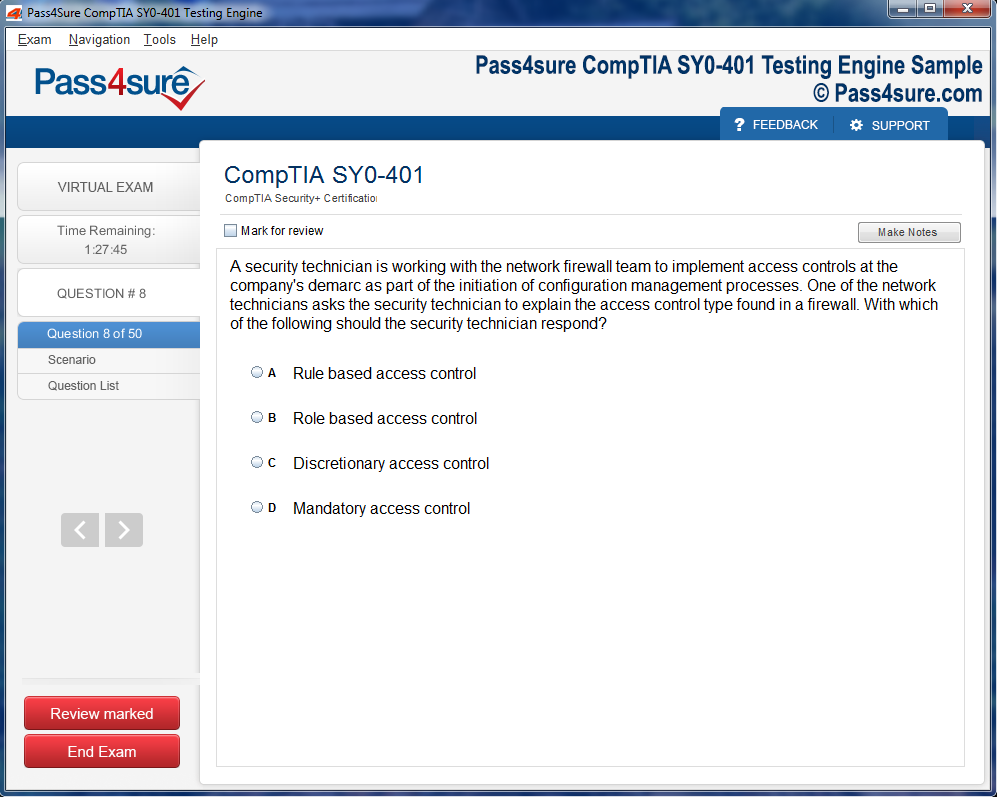

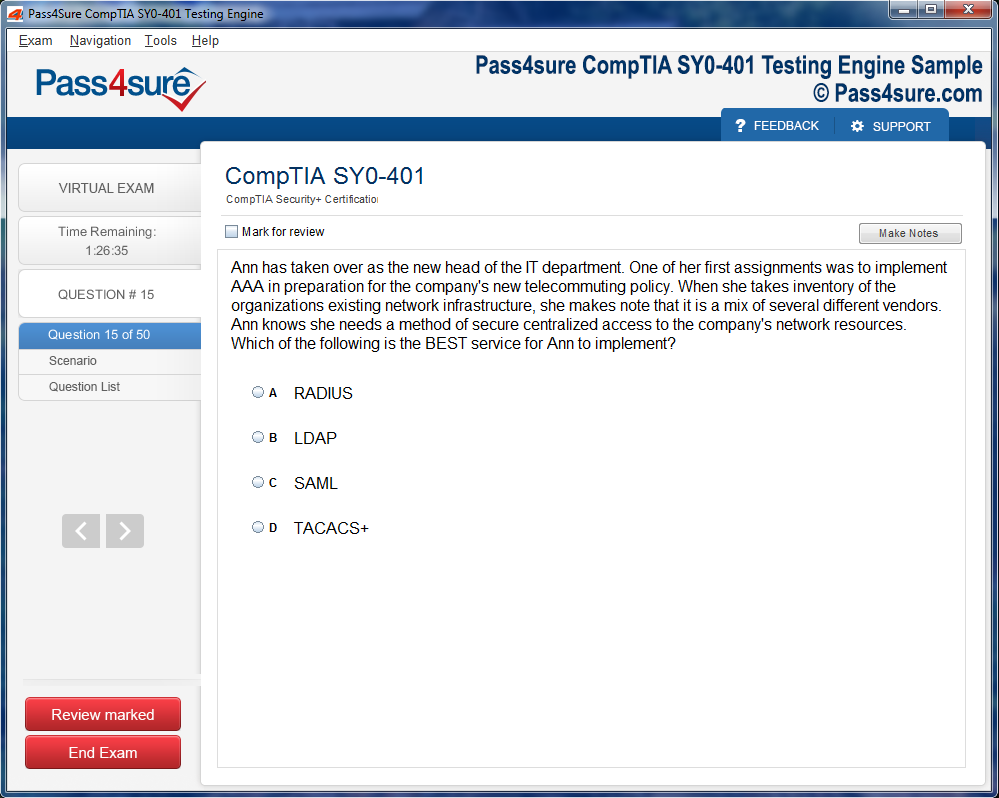
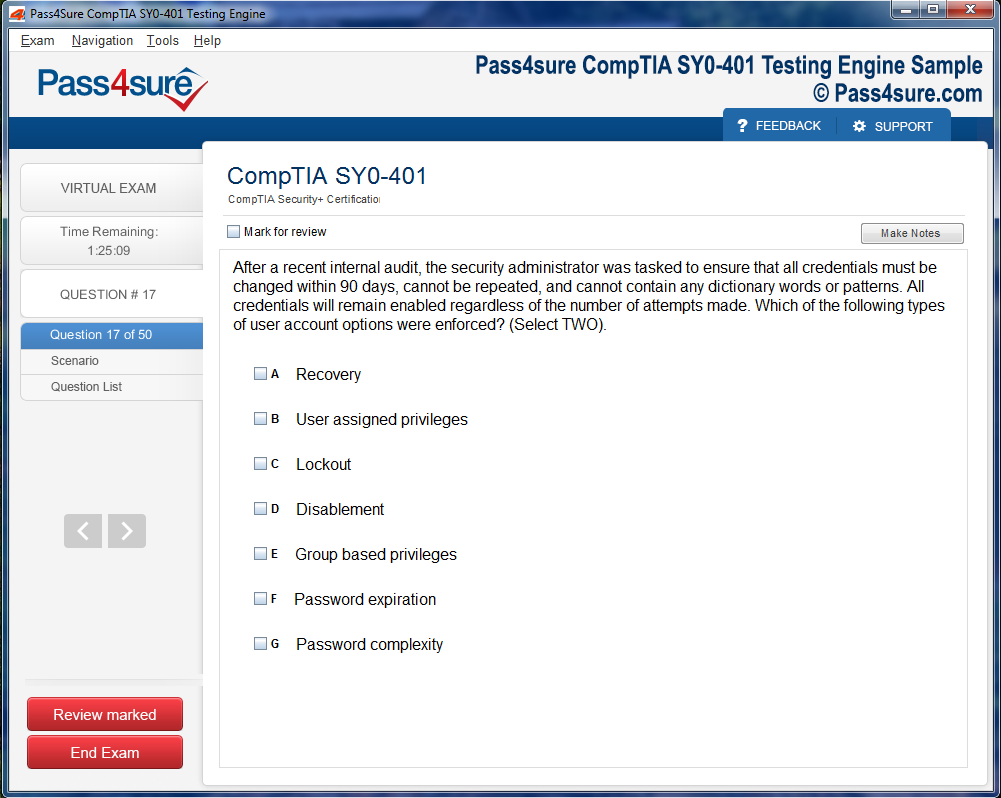


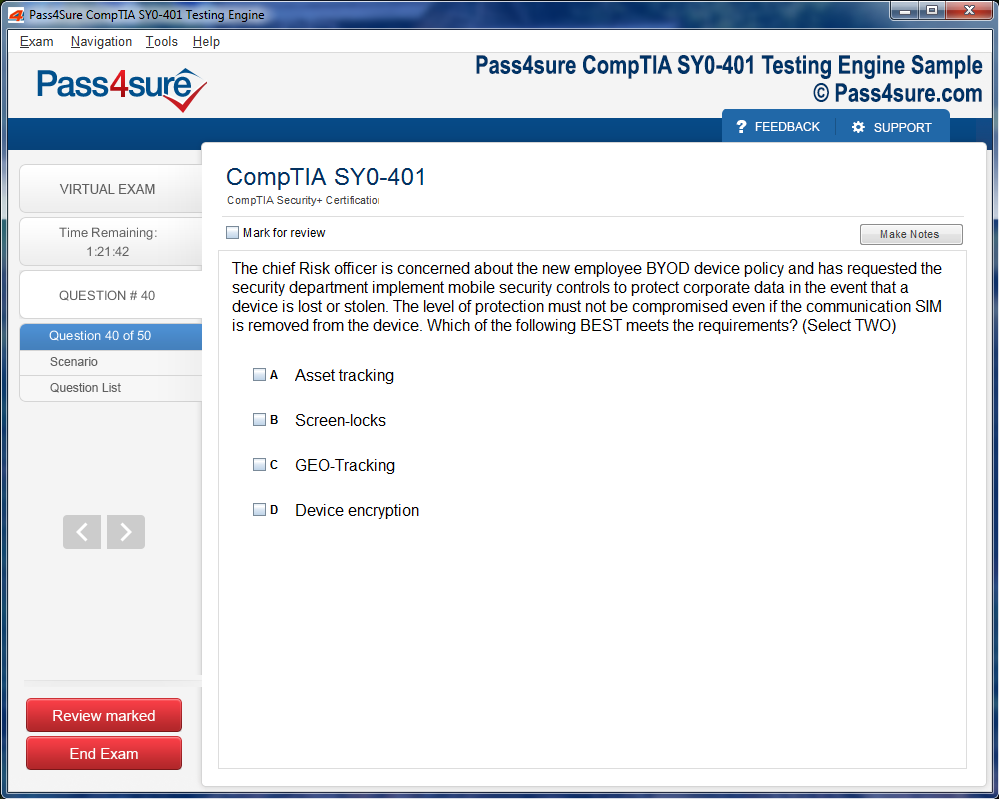

Frequently Asked Questions
How does your testing engine works?
Once download and installed on your PC, you can practise test questions, review your questions & answers using two different options 'practice exam' and 'virtual exam'. Virtual Exam - test yourself with exam questions with a time limit, as if you are taking exams in the Prometric or VUE testing centre. Practice exam - review exam questions one by one, see correct answers and explanations.
How can I get the products after purchase?
All products are available for download immediately from your Member's Area. Once you have made the payment, you will be transferred to Member's Area where you can login and download the products you have purchased to your computer.
How long can I use my product? Will it be valid forever?
Pass4sure products have a validity of 90 days from the date of purchase. This means that any updates to the products, including but not limited to new questions, or updates and changes by our editing team, will be automatically downloaded on to computer to make sure that you get latest exam prep materials during those 90 days.
Can I renew my product if when it's expired?
Yes, when the 90 days of your product validity are over, you have the option of renewing your expired products with a 30% discount. This can be done in your Member's Area.
Please note that you will not be able to use the product after it has expired if you don't renew it.
How often are the questions updated?
We always try to provide the latest pool of questions, Updates in the questions depend on the changes in actual pool of questions by different vendors. As soon as we know about the change in the exam question pool we try our best to update the products as fast as possible.
How many computers I can download Pass4sure software on?
You can download the Pass4sure products on the maximum number of 2 (two) computers or devices. If you need to use the software on more than two machines, you can purchase this option separately. Please email sales@pass4sure.com if you need to use more than 5 (five) computers.
What are the system requirements?
Minimum System Requirements:
- Windows XP or newer operating system
- Java Version 8 or newer
- 1+ GHz processor
- 1 GB Ram
- 50 MB available hard disk typically (products may vary)
What operating systems are supported by your Testing Engine software?
Our testing engine is supported by Windows. Andriod and IOS software is currently under development.
BlackBerry Solution Architect Certification: Complete BCP-410 Guide
Unified Endpoint Management is the linchpin of BlackBerry’s enterprise strategy, harmonizing devices, applications, and data under a singular governance framework. A solution architect’s purview extends beyond mere configuration; it encompasses the orchestration of policies, compliance rules, and operational telemetry to create a cohesive digital ecosystem. UEM acts as both a sentinel and an enabler, permitting productivity while imposing granular security controls.
Architects must grasp the variegated landscapes of endpoints, from mobile devices to IoT nodes, each possessing idiosyncratic capabilities and vulnerabilities. The architecture mandates policy stratification, balancing stringent security with operational fluidity. For instance, geofencing, containerization, and selective wipe mechanisms exemplify the nuanced approaches to mitigating risk without impeding usability.
Equally critical is the dynamic interplay between the UEM console and back-end systems. Telemetry data from endpoints informs adaptive policy adjustments, predictive threat modeling, and automated remediation workflows. By interpreting this data intelligently, architects can preempt breaches, optimize device performance, and refine user experience.
Cryptography and Secure Communications
Security within BlackBerry’s solutions is inextricably entwined with sophisticated cryptography. Solution architects must navigate a labyrinth of encryption algorithms, key management protocols, and secure channel establishment methods. Cryptographic rigor underpins not only data-at-rest protection but also secure messaging, VPN connections, and inter-device synchronization.
The architect’s challenge lies in harmonizing strong encryption with operational pragmatism. Excessive security can cripple productivity, whereas lax protocols invite compromise. Mastery involves configuring certificate hierarchies, managing asymmetric and symmetric keys, and ensuring seamless interoperability across heterogeneous systems.
Secure communications extend into the realm of real-time threat detection. By leveraging anomaly detection, behavioral analytics, and endpoint attestation, architects craft environments where data flows freely but remains impervious to interception. Each decision regarding authentication schemes or encryption standards reverberates throughout the enterprise ecosystem, demanding meticulous foresight.
Application Lifecycle Management in BlackBerry Environments
Mobile applications represent both opportunity and vulnerability. Solution architects must discern which applications are integral to business objectives, how they interact with enterprise data, and which controls are necessary to safeguard information. This requires a sophisticated understanding of application lifecycle management within the UEM framework.
From provisioning to decommissioning, applications traverse a controlled continuum. Architects orchestrate installation policies, runtime permissions, and update mechanisms to ensure seamless operation without compromising compliance. They also evaluate the security posture of third-party applications, integrating them judiciously into the managed environment while mitigating potential threats.
The convergence of application telemetry, usage analytics, and user behavior insights empowers architects to refine application strategy continuously. By monitoring adoption patterns and system interactions, they can preempt operational bottlenecks, enforce policy adherence, and enhance overall digital agility.
Architecting Resilient and Scalable Ecosystems
Scalability is not merely a technical objective but a philosophical imperative within BlackBerry solution design. Enterprises evolve, networks expand, and user demands fluctuate. A solution architect must anticipate these dynamics, designing architectures that accommodate growth without sacrificing security or performance.
Resilience intertwines with scalability. Redundancy, failover mechanisms, and disaster recovery strategies are meticulously integrated into every layer of the ecosystem. Architects simulate failure scenarios, model risk propagation, and implement safeguards to ensure continuous operational integrity. The goal is to create systems that are self-healing, adaptable, and future-proof.
Beyond infrastructure, scalability encompasses policy management, user provisioning, and administrative delegation. Automated workflows, hierarchical policy templates, and context-aware access controls allow organizations to scale efficiently while retaining granular oversight.
Enterprise Integration and Workflow Synchronization
BlackBerry solution architects must navigate the complexities of integrating disparate enterprise systems. Applications, databases, identity services, and collaboration tools each follow distinct protocols, architectures, and update cadences. Achieving coherent workflow synchronization demands strategic orchestration and meticulous configuration.
Integration is not a mere technical exercise but an act of harmonizing disparate digital rhythms. Architects employ middleware, API gateways, and secure connectors to bridge silos, ensuring that data flows seamlessly while preserving integrity and compliance. They must also anticipate latency, data normalization challenges, and interoperability constraints, crafting solutions that deliver both speed and reliability.
Workflow synchronization extends to policy enforcement and user experience. Conditional access rules, context-aware authentication, and application-specific controls converge to create frictionless yet secure interactions. The architect’s vision ensures that enterprise mobility becomes a catalyst for productivity rather than a source of complexity.
Proactive Threat Mitigation and Endpoint Hygiene
Security vigilance in BlackBerry architectures is an ongoing, dynamic process. Solution architects adopt proactive threat mitigation strategies, employing continuous monitoring, anomaly detection, and adaptive risk management. Endpoint hygiene—ensuring devices are patched, configured correctly, and free from compromise—is fundamental.
Architects analyze telemetry, scrutinize logs, and apply predictive analytics to identify potential vulnerabilities before they escalate. They configure automated remediation routines, enforce compliance reporting, and leverage threat intelligence feeds to stay ahead of adversaries. The holistic approach transforms security from reactive firefighting into anticipatory stewardship.
The Quintessence of Unified Endpoint Management
Unified Endpoint Management is no longer a peripheral consideration; it has become the fulcrum upon which modern enterprises pivot their mobility strategies. Within this intricate lattice of technology, devices transform into sentinels guarding the most sensitive corridors of corporate intelligence. UEM transcends mere oversight—it orchestrates a symphony of device interactions, policy mandates, and application governance, knitting heterogeneous ecosystems into an interlaced tapestry of operational coherence. The dexterity of UEM lies in its capacity to render variegated technological landscapes intelligible, manageable, and, above all, secure.
Architectural Stratagems of Endpoint Control
At the heart of any UEM initiative lies architectural sagacity. The edifice of management rests upon a layered paradigm comprising device registration, policy orchestration, application stewardship, and continuous surveillance. Each layer constitutes a vital cog within the machinery, demanding meticulous calibration to harmonize security imperatives with usability expectations. Solution architects navigate this labyrinth by meticulously aligning infrastructural schemas with enterprise exigencies, cognizant of device heterogeneity, operational cadence, and regulatory strictures. Crafting a robust architecture entails envisioning both the present deployment milieu and prospective scalability trajectories, ensuring that the UEM framework evolves symbiotically with the organization.
Deployment Paradigms and Phased Integration
The art of deployment demands a choreography that balances ambition with prudence. A phased integration model often serves as the lodestar, inaugurating with foundational capabilities before incrementally introducing advanced functionalities. Such stratagem enables iterative feedback, early identification of anomalies, and assimilation of user comportment into deployment refinements. Furthermore, foresight in capacity planning ensures that the framework can gracefully accommodate proliferating device counts, cross-continental expansions, and integration with ancillary enterprise applications. Thoughtful deployment is less an act of installation and more an exercise in anticipatory orchestration.
Security as an Omnipresent Imperative
Every decision within UEM is suffused with security ramifications. Administrators leverage the platform to enforce encryption protocols, delineate access hierarchies, and meticulously regulate data transit across applications and endpoints. The solution architect assumes the role of a digital sentry, crafting policies that thwart unauthorized incursions without impeding workflow fluidity. Multifactor authentication, federation with corporate identity directories, and meticulous adherence to regulatory mandates constitute the bedrock of secure operations. In this context, security transcends prophylactic measures—it becomes an intrinsic characteristic of every operational layer.
Application Stewardship and Operational Cohesion
Application management emerges as a crucible of both innovation and control. Enterprises often inhabit a landscape populated by an eclectic blend of proprietary and third-party applications, each bearing idiosyncratic security contours and operational exigencies. The UEM architect curates this landscape, ensuring secure deployment, vigilant monitoring, and streamlined update processes. Centralized governance reduces operational entropy while enhancing resilience, establishing a dynamic equilibrium between functionality and protection. The nuanced orchestration of application ecosystems distinguishes ephemeral management from enduring operational excellence.
Proactive Monitoring and Analytical Vigilance
Monitoring is not merely diagnostic; it is anticipatory, furnishing the intelligence required for proactive intervention. Real-time analytics illuminate vulnerabilities, delineate device health trajectories, and empower administrators to forestall potential disruptions. Solution architects architect monitoring infrastructures that balance granularity with cognitive manageability, ensuring insights translate into actionable directives rather than informational deluge. The selection of bespoke dashboards, the calibration of alert thresholds, and the seamless integration of notifications into existing operational channels constitute the sinews of a resilient monitoring framework.
Harmonizing Security and User Experience
Security devoid of user empathy engenders friction, while permissiveness compromises institutional integrity. Architects must navigate this dialectic with precision, calibrating policies to mirror organizational culture while safeguarding operational objectives. Excessive constraints precipitate shadow IT behaviors, whereas leniency cultivates systemic vulnerability. Optimal UEM deployment harmonizes these vectors, rendering security unobtrusive yet omnipresent, facilitating productivity while fortifying the enterprise against internal and external threats. This equilibrium is neither accidental nor superficial—it is an art of strategic consonance.
Scalability and Evolutionary Foresight
The enterprise ecosystem is perennially in flux, and UEM solutions must be both adaptive and anticipatory. Architects embed scalability as a foundational principle, crafting solutions that anticipate device proliferation, geographic expansion, and integration with emergent technologies. Forward-looking deployment strategies recognize that static frameworks stagnate, whereas adaptive architectures perpetually recalibrate to meet evolving demands. This foresight transforms UEM from a reactive instrument into a proactive enabler of strategic agility.
Security as the Pillar of Enterprise Mobility
Security is the sine qua non of enterprise mobility, a fulcrum upon which operational continuity pivots. In a milieu dominated by sophisticated adversarial exploits, architects are tasked with weaving labyrinthine safeguards into mobile infrastructures. The quintessence of secure mobility transcends mere compliance; it demands anticipatory stratagems, seamless encryption deployment, and vigilant oversight across endpoints, networks, and cloud ecosystems.
Encryption and Cryptographic Stewardship
At the heart of data sanctity lies encryption, a cryptographic bulwark against prying eyes. End-to-end encryption transforms sensitive information into inscrutable ciphers as it traverses device ecosystems and cloud conduits. Solution architects must grapple with esoteric constructs of symmetric and asymmetric cryptography, key rotation cadences, and certificate hierarchies. Proper orchestration ensures information remains impervious to interception, corruption, or exfiltration, thereby buttressing corporate trust and operational resilience.
Authentication Paradigms and Access Governance
Robust authentication undergirds a resilient security posture. Architecting identity verification involves integrating multifactor mechanisms, federated identity providers, and single sign-on frameworks. Role-based access governance delineates the boundaries of resource interaction, constraining privileges to operational necessity and curtailing potential vectors of insider malfeasance. Such meticulous orchestration engenders a principled equilibrium between usability and protection, mitigating inadvertent exposure without impeding workflow efficiency.
Threat Mitigation Across Multilayered Vectors
Enterprise threat landscapes are protean, encompassing endpoints, network conduits, and applications. Architects must embed antimalware fortifications, anomaly detection protocols, and intrusion identification algorithms into a cohesive defense lattice. Contemporary mobile threat defense incorporates heuristic and behavioral analysis, enabling real-time recognition of aberrant patterns before they metastasize into systemic breaches. The symbiosis of proactive monitoring and automated remediation cultivates a milieu of anticipatory defense rather than reactive patchwork.
Policy Orchestration and Compliance Dynamics
Policy frameworks constitute the operational scaffolding of security resilience. Architects delineate device compliance mandates, conditional access matrices, and acceptable use edicts that morph dynamically in response to evolving risk metrics. Noncompliant devices can be quarantined or constrained until remediation, reinforcing adherence without resorting to punitive interventions. This dynamic governance fosters a culture of accountability while sustaining enterprise agility, ensuring that security enforcement is both rigorous and adaptive.
Incident Response Architecture
Incident response is a critical, often underestimated vector of enterprise defense. Architects must devise workflows that facilitate immediate detection, containment, and remediation of security aberrations. Automated alerts, preconfigured containment protocols, and orchestrated communication channels minimize disruption while preserving data integrity. This prescriptive approach to incident management converts reactive fire-fighting into a streamlined, predictable process capable of attenuating operational impact.
Integration with Threat Intelligence Ecosystems
Effective security demands not only detection but contextual understanding. Architects integrate mobile threat intelligence platforms, correlating disparate signals to reveal latent vulnerabilities and systemic susceptibilities. Real-time dashboards provide granular insight into device health, anomalous activity, and emergent threat patterns. By translating raw intelligence into actionable strategy, enterprises cultivate a continuously adaptive security posture capable of preempting sophisticated incursions.
Human-Centric Security Imperatives
Even the most sophisticated technical frameworks falter without human comprehension. Solution architects collaborate with training teams to propagate a culture of vigilance, emphasizing phishing awareness, secure device handling, and adherence to policy protocols. The human element is both the most vulnerable and the most malleable vector in enterprise security. Continuous education transforms users into proactive agents of protection, harmonizing human behavior with technological safeguards.
Orchestrating Holistic Security Resilience
Achieving a resilient security ecosystem necessitates the fusion of cryptography, access governance, threat detection, policy enforcement, and human education into an orchestrated whole. Architects must navigate the dialectic between security rigor and operational fluidity, ensuring that safeguards do not ossify into frictional impediments. Vigilance, adaptability, and foresight are the hallmarks of mastery in enterprise security, transforming reactive defense into anticipatory stewardship.
Advanced Integration and Enterprise Workflows
Modern enterprises navigate an intricate lattice of applications, platforms, and services, each woven into the operational fabric with nuanced dependencies. A BlackBerry Solution Architect embarks on the task of orchestrating integrations that transcend mere connectivity, constructing a symphony of processes wherein security and compliance resonate as foundational motifs. Integration is not a superficial linkage of endpoints; it constitutes a deliberate choreography of workflows, automated sequences, and data fidelity assurances across multifarious systems.
To architect these integrations effectively, one must first dissect the existing IT ecosystem, which often encompasses archaic legacy systems, ephemeral cloud services, relational and non-relational databases, and collaborative platforms that defy uniformity. Mapping the topography of data flow, identifying latent friction points, and elucidating potential vulnerabilities is pivotal. This cognitive cartography enables architects to engineer solutions that harmonize throughput with resiliency, ensuring operational fluidity without compromising security.
Within the Unified Endpoint Management (UEM) paradigm, application integration demands meticulous scrutiny. Architects probe applications for compatibility, scrutinize security matrices, and analyze usage telemetry to predict potential disruptions. Advanced deployment strategies, such as containerization or sandboxing, are employed to segregate corporate data from personal device interactions, cultivating a balance between operational efficiency and data sanctity. Such techniques preserve productivity while erecting invisible bulwarks against inadvertent breaches or policy violations.
Workflow automation emerges as another linchpin in enterprise integration. Automated approval hierarchies, dynamic policy enforcement, and real-time compliance audits supplant labor-intensive manual processes, mitigating human error and accelerating procedural throughput. These orchestrated automations generate traceable, auditable records that bolster both regulatory adherence and internal governance frameworks. The elegance of automation lies in its duality: operational efficiency intertwined with accountability, creating a self-reinforcing loop of continuous improvement.
Scalability is an omnipresent concern in dynamic enterprise environments. As organizations expand, the proliferation of applications, devices, and end-users necessitates integration architectures that are not merely robust but malleable. Modular topologies, API-centric frameworks, and standardized communication protocols form the substratum upon which future enhancements are layered with minimal disruption. The foresight to design for scale prevents integration sprawl and ensures that growth does not catalyze chaos.
A critical facet of modern integration is real-time data synchronization. Enterprise operations demand that updates—whether to applications, configurations, or security mandates—propagate instantaneously across all endpoints. Architecting such systems requires an intimate understanding of latency tolerances, transactional integrity, and conflict resolution mechanisms. Ensuring data coherence across a labyrinthine network of devices prevents operational discord and enables agile responses to emergent business exigencies.
Collaboration with diverse stakeholders imbues integration projects with clarity and direction. Solution architects must maintain continuous dialogue with application owners, IT custodians, and executive leadership, aligning integration strategies with strategic objectives. This interpersonal vigilance anticipates challenges, mitigates misalignments, and smooths the trajectory of implementation. The architect becomes both a technologist and a liaison, translating technical intricacies into actionable insights while shepherding organizational consensus.
Architects often deploy observability frameworks that provide real-time telemetry and analytic insights into system behavior. These frameworks illuminate hidden inefficiencies, uncover latent bottlenecks, and empower proactive interventions. By leveraging predictive analytics, enterprises can anticipate systemic stress points and preempt disruptions before they cascade into operational setbacks. Such intelligence transforms integration from a reactive endeavor into a proactive, anticipatory strategy.
Security remains an omnipresent leitmotif across every integration touchpoint. Architects embed security protocols into the very architecture of workflows, ensuring that data in transit and at rest is encrypted, authenticated, and resilient against both internal misconfigurations and external threats. Role-based access controls, continuous monitoring, and adaptive threat mitigation strategies are woven into the operational tapestry, rendering the integration not merely functional but impervious to exploitation.
Enterprise integrations also demand sensitivity to heterogeneity in device ecosystems. Organizations often contend with an amalgam of operating systems, hardware configurations, and user profiles. Designing integration solutions that operate seamlessly across this diversity requires abstraction, standardization, and sometimes bespoke adapters. The goal is to create a unified operational continuum where heterogeneity does not impede performance or compromise security.
Finally, iterative refinement underscores the lifecycle of integration. Architectures are not static constructs; they evolve in response to emerging business imperatives, technological advancements, and shifting regulatory landscapes. Continuous feedback loops, rigorous testing regimes, and post-implementation audits are indispensable. They ensure that the integration ecosystem remains adaptive, resilient, and perpetually optimized for the enterprise’s evolving ambitions.
The Intricacies of Deployment Ecosystems
Deploying BlackBerry solutions within a sprawling enterprise ecosystem transcends mere installation; it is an intricate choreography of technological synapses and human adaptation. Architects must navigate labyrinthine infrastructures, balancing latency, bandwidth, and heterogeneous device landscapes. Each deployment bears the potential for disruption, yet meticulous preconfiguration transforms chaos into a seamless cascade of operational efficacy. The initial reconnaissance of the technological topography often reveals latent bottlenecks that, if unaddressed, can metastasize into systemic inefficiencies.
Meticulous Environment Appraisal
The fulcrum of deployment optimization rests upon a granular comprehension of the operational environment. Architects dissect network conduits, scrutinize device heterogeneity, and map geographic distributions with forensic precision. This environmental cognition enables the formulation of deployment trajectories that mitigate downtime and foster uniform performance across divergent endpoints. Each variable, from signal attenuation in remote offices to firmware idiosyncrasies, must be codified into a strategic matrix that anticipates potential friction points before they manifest.
Configuration Symphonics
Configuration management constitutes the symphonic heart of deployment orchestration. Policies, security parameters, and application schemas converge into an intricate lattice that must be harmonized with absolute consistency. Architects wield templates, automated scripts, and policy engines as instruments to enforce uniformity, thereby obviating human error and preserving regulatory fidelity. The convergence of these mechanisms ensures that each endpoint resonates in synchronized compliance, transforming a sprawling technological milieu into a coherent operational symphony.
Troubleshooting Methodologies
Inevitably, deployment engenders anomalies that demand diagnostic acuity. Troubleshooting evolves into a systematic dialectic between problem identification and solution synthesis. Architects dissect registration anomalies, connectivity lapses, and policy incongruities with analytical exactitude. The application of diagnostic frameworks and telemetry tools transforms seemingly capricious failures into decipherable patterns. Rapid remediation not only reinstates functionality but also fortifies the enterprise against recurrence, cultivating a resilient technological substrate.
Telemetry and Analytical Feedback
Continuous optimization thrives on the vigilant scrutiny of telemetry data and performance indices. Real-time analytics illuminate usage patterns, policy adherence, and device performance anomalies. Architects extrapolate from these datasets, discerning subtle trends that presage systemic inefficiencies or latent user friction. Feedback loops transform raw metrics into actionable intelligence, enabling adaptive configuration that evolves with organizational dynamics. This iterative process is tantamount to a living organism, perpetually refining itself in response to environmental stimuli.
User Acclimatization and Support Infrastructure
Technology adoption is intrinsically tethered to human comprehension. Users must internalize system paradigms, navigate new interfaces, and adhere to security protocols. Architects collaborate with support teams to craft immersive training regimes, lucid documentation, and responsive helpdesk mechanisms. This symbiosis ensures that technological sophistication is complemented by cognitive assimilation, mitigating user-induced disruptions and engendering confident interaction with enterprise systems.
Contingency Architecture and Redundancy
No deployment is impervious to perturbation. Architects must architect contingency scaffolds, embedding redundancy and failover contingencies into the deployment schema. Backup strategies, mirrored infrastructures, and dynamic failover protocols serve as bulwarks against operational interruptions. This preemptive orchestration transforms vulnerability into resilience, ensuring that mission-critical workflows endure even amidst unforeseen disruptions. The enterprise is thus fortified, and stakeholder confidence is perpetually reinforced.
Adaptive Iteration and Continuous Refinement
Deployment optimization is not a static milestone but an evolutionary continuum. Architects engage in perpetual observation, recalibration, and refinement, responding to shifting organizational exigencies and emergent technological paradigms. Each iteration incorporates lessons from telemetry, user feedback, and systemic anomalies, fostering an adaptive deployment architecture that is simultaneously robust and malleable. Through this ongoing evolution, enterprises achieve not merely operational functionality but a dynamic equilibrium of efficiency, reliability, and user engagement.
Diagnostic Alchemy
The art of troubleshooting borders on alchemy, transforming obfuscation into clarity. Architects synthesize root cause analysis with predictive heuristics to preemptively neutralize potential failures. The deployment ecosystem becomes a responsive organism, capable of self-diagnosis and adaptive correction. This diagnostic alchemy imbues the enterprise with operational grace, where errors are transient perturbations rather than disruptive catastrophes, and resolution is not reactionary but anticipatory.
Holistic Performance Harmonization
Optimized deployments transcend mere technical efficiency; they cultivate a holistic harmony between systems, users, and workflows. Architects calibrate latency, throughput, and policy enforcement in concert with cognitive ergonomics, ensuring that technology amplifies productivity without encumbering the user experience. Performance harmonization is a multidimensional pursuit, balancing technical metrics with human factors, and transforming enterprise deployment into an art form as much as a science.
Navigating Complex Mobility Landscapes
The role of a BlackBerry Solution Architect transcends mere technical acumen; it demands the dexterity to navigate intricate mobility ecosystems with foresight and precision. Enterprises operate amidst multifaceted landscapes where device heterogeneity, fluctuating network topologies, and disparate endpoint capabilities converge. Architects are entrusted with orchestrating seamless functionality across these vectors, ensuring operational continuity without compromising security or performance. In such labyrinthine environments, adaptive strategies are paramount, requiring an interplay of predictive analytics, contextual awareness, and nuanced policy frameworks.
Harmonizing Distributed Workforces
A quintessential challenge involves harmonizing globally distributed personnel. Employees dispersed across continents encounter varying network latencies, regulatory constraints, and device ecosystems. Architects must devise frameworks that reconcile these disparities, enabling secure, uninterrupted access irrespective of geographical boundaries. This entails configuring dynamic access policies that adjust to contextual anomalies, instituting remote monitoring protocols, and establishing encrypted communication conduits that resist interception. The orchestration of these mechanisms demands a synthesis of technical prowess and strategic empathy, balancing enterprise objectives with user fluidity.
Integrating Legacy Infrastructures with Modern Paradigms
Legacy systems often present an enigmatic puzzle for architects. Antiquated infrastructures, entrenched in protocols and standards now deemed obsolete, require thoughtful mediation to coexist with contemporary mobile applications. Employing middleware, robust APIs, and secure data bridges, architects can integrate legacy ecosystems while safeguarding critical enterprise assets. This delicate alchemy preserves organizational investment, mitigates operational risk, and cultivates an environment conducive to iterative innovation. The ability to navigate this juxtaposition of antiquity and modernity distinguishes proficient architects from the merely competent.
Embracing Modular and Resilient Architectures
A preeminent best practice involves the embrace of modular architecture. By partitioning complex systems into discrete, interchangeable components, architects achieve remarkable flexibility. Updates, replacements, or enhancements can occur with minimal systemic disruption, fostering agility in dynamic operational contexts. Layered security further fortifies these constructs, implementing multi-tiered defenses that shield sensitive data and critical processes from an array of threats. Continuous surveillance, leveraging real-time monitoring and anomaly detection, ensures emergent vulnerabilities are addressed with alacrity, reinforcing the architecture’s resilience against unforeseen perturbations.
Governance and Documentation as Strategic Pillars
Documentation and governance constitute the scaffolding upon which durable architectures are built. Exhaustive records of system designs, policy frameworks, workflow schematics, and configuration matrices underpin organizational transparency. They facilitate audit compliance, accelerate onboarding, and provide a reference for iterative enhancement. Governance frameworks codify decision-making protocols, ensuring consistency, traceability, and accountability. By embedding governance into operational paradigms, architects instill discipline, preempt lapses, and engender confidence among stakeholders navigating intricate technological landscapes.
Leveraging Artificial Intelligence and Predictive Analytics
The trajectory of enterprise mobility is inexorably intertwined with emergent intelligence technologies. Artificial intelligence and machine learning infuse architectures with predictive capabilities, enabling preemptive threat detection and automated enforcement of security policies. Sophisticated algorithms analyze behavioral anomalies across endpoints, networks, and applications, preempting breaches before they materialize. Predictive analytics further optimize resource allocation, informing decisions regarding deployment, scaling, and resilience. Architects who harness these technologies cultivate systems that anticipate, adapt, and evolve in synchrony with shifting operational exigencies.
Cloud Integration and Endpoint Convergence
The proliferation of cloud paradigms has redefined enterprise mobility. Solution architects are now tasked with harmonizing on-premises assets with cloud-native environments, orchestrating hybrid architectures that exploit elasticity, redundancy, and distributed scalability. Endpoint convergence, wherein diverse devices are integrated into a unified management framework, complements this evolution. These convergent strategies reduce operational complexity, enhance visibility across heterogeneous devices, and streamline security enforcement. Architects must design these convergent systems with an eye toward seamless interoperability, robust compliance, and future-proof adaptability.
Zero-Trust Architectures in Contemporary Enterprise Security
Zero-trust philosophies are increasingly indispensable in contemporary enterprise security. Architects implement frameworks wherein no entity is implicitly trusted, enforcing rigorous verification protocols across users, devices, and applications. This paradigm shifts the security posture from reactive containment to proactive deterrence, mitigating lateral movement and exposure to sophisticated cyber threats. Integrating zero-trust principles demands meticulous planning, continuous validation, and precise orchestration across network and endpoint layers, establishing a resilient foundation upon which modern enterprise operations can thrive.
Orchestrating Secure and Scalable Deployments
Deployment orchestration is a crucible for architectural acumen. Architects must calibrate solutions to scale seamlessly while retaining uncompromising security. This involves preemptive stress-testing, latency optimization, and adaptive policy configuration that accommodates both predictable and unforeseen workloads. Deployments are not static installations; they are living constructs that evolve alongside organizational growth, device proliferation, and threat landscapes. Successful orchestration requires iterative evaluation, meticulous configuration management, and a keen understanding of the interplay between technical and human variables.
Positioning Architects as Strategic Leaders
The consummate BlackBerry Solution Architect embodies a duality of expertise: technical mastery intertwined with strategic vision. Beyond coding, configuring, or integrating, architects are entrusted with translating enterprise aspirations into executable, resilient, and secure mobility frameworks. Their insights guide policy formulation, operational optimization, and technological investment, rendering them indispensable leaders in an increasingly mobile-centric enterprise milieu. Certification in this domain attests not merely to knowledge acquisition but to the capacity for sophisticated, context-sensitive application in scenarios that challenge both ingenuity and foresight.
Adaptive Strategies for Rapidly Evolving Threats
In the contemporary enterprise ecosystem, cyber threats exhibit protean characteristics, mutating with unprecedented velocity and sophistication. BlackBerry Solution Architects must cultivate adaptive strategies, employing anticipatory frameworks that reconcile operational imperatives with emergent vulnerabilities. The architecture must not merely withstand intrusion attempts but anticipate attack vectors through predictive modeling and behavioral analytics. This proactive posture transforms reactive defense into a dynamic, continuously evolving safeguard, where every endpoint, network channel, and application instance becomes a sentinel in a broader security tapestry.
Context-Aware Access Management
Context-aware access management epitomizes a paradigm shift in secure mobility. Static authentication mechanisms are insufficient in an environment where device, location, time, and behavior are constantly fluctuating. Architects integrate adaptive policies that evaluate contextual cues, permitting or denying access based on real-time intelligence. Machine learning models interpret usage patterns, flag anomalies, and dynamically recalibrate access thresholds, ensuring that legitimate users encounter minimal friction while potential threats are mitigated before exploitation. This equilibrium between usability and security embodies the sophisticated orchestration expected of a solution architect.
Orchestrating Endpoint Diversity
The proliferation of heterogeneous endpoints, encompassing smartphones, tablets, IoT devices, and legacy hardware, imposes significant complexity. Architects must establish unifying frameworks capable of consistent policy enforcement across disparate devices. Endpoint management solutions must reconcile variances in operating systems, firmware versions, and communication protocols without impairing performance or usability. By leveraging abstraction layers and secure middleware, architects ensure that security and functionality coalesce seamlessly, transforming a heterogeneous landscape into an interoperable, resilient infrastructure.
Middleware as a Catalyst for Innovation
Middleware serves as an indispensable catalyst in bridging legacy systems with modern architectures. Beyond mere connectivity, it facilitates orchestration, data translation, and secure intermediation between incompatible components. Architects harness middleware to enable iterative innovation without necessitating wholesale infrastructure replacement, preserving capital expenditure while fostering agility. Robust middleware solutions encapsulate complex transformations, allowing applications and endpoints to interact fluidly, all under the vigilant oversight of adaptive security protocols that preclude compromise.
Data Sovereignty and Compliance Nuances
Global enterprises operate under an intricate lattice of data sovereignty regulations. Architects must navigate regulatory heterogeneity, ensuring that data residency, access, and transmission conform to jurisdictional mandates. This entails the deployment of intelligent routing, encryption at rest and in transit, and audit-ready logging mechanisms. The solution architect must balance operational flexibility with stringent compliance, devising architectures that are both legally robust and operationally efficient. Misalignment in this domain can precipitate not only operational disruptions but also substantial reputational and financial liabilities.
Continuous Threat Intelligence Integration
The velocity of threat evolution necessitates continuous integration of threat intelligence into architectural planning. Architects utilize feeds from diverse sources, synthesizing insights into actionable policies that preempt attack vectors. Threat intelligence informs firewall configurations, endpoint behavior baselines, and anomaly detection thresholds, enabling proactive defense at scale. This dynamic feedback loop ensures that security mechanisms are perpetually calibrated, evolving in concert with the shifting cyber threat landscape and reinforcing the enterprise’s resilience.
Automated Policy Enforcement and Orchestration
Automation emerges as a linchpin in contemporary solution architecture. Manually enforcing security policies across thousands of endpoints is impractical; automation ensures consistency, speed, and precision. Architects implement rule-based engines and AI-driven orchestration to enforce configurations, remediate deviations, and propagate updates instantaneously. By reducing human intervention, organizations minimize the potential for error, accelerate response times, and free skilled personnel to focus on strategic initiatives. This automation-driven paradigm is emblematic of mature, forward-looking mobility management.
Securing Hybrid and Multi-Cloud Environments
The shift toward hybrid and multi-cloud infrastructures amplifies both opportunity and complexity. Architects must reconcile on-premises controls with cloud-native security paradigms, ensuring that policies, identity management, and monitoring are unified across distributed environments. This orchestration encompasses encryption standards, access policies, network segmentation, and real-time compliance auditing. By integrating hybrid intelligence, architects can mitigate shadow IT risks, maintain end-to-end visibility, and optimize resource allocation across cloud instances, reinforcing both security and operational efficiency.
Proactive Disaster Recovery and Business Continuity Planning
Resilience extends beyond active defense; it encompasses meticulous disaster recovery and business continuity planning. Architects design redundant architectures capable of sustaining operations despite endpoint failures, network outages, or catastrophic events. By leveraging automated failover, data replication, and geographically distributed resources, organizations can maintain operational continuity while minimizing downtime and mitigating reputational damage. The architect’s foresight in these domains ensures that enterprise mobility remains uninterrupted under adverse conditions, reinforcing stakeholder confidence and operational robustness.
Leveraging Predictive Analytics for Operational Efficiency
Predictive analytics transcends traditional monitoring by anticipating system bottlenecks, user behavior anomalies, and resource constraints before they impact operations. Architects deploy analytical models to forecast peak loads, identify inefficiencies, and preemptively reallocate resources. This proactive optimization enhances system responsiveness, reduces latency, and ensures that security mechanisms remain uncompromised under fluctuating workloads. By embedding predictive capabilities into operational frameworks, architects cultivate environments that are not only secure but also optimally efficient.
Embedding Resilience into System Design
Resilience is not an afterthought but an intrinsic design principle. Architects integrate redundancy, modularity, and fault-tolerant mechanisms into every layer of the system, ensuring that no single failure propagates systemic disruption. Resilient architectures anticipate potential points of failure, from network congestion to endpoint compromise, and embed contingency measures to sustain functionality. This approach fosters confidence among stakeholders, as enterprises can operate dynamically while minimizing the impact of unforeseen contingencies.
Cultivating a Culture of Security and Awareness
Technology alone cannot ensure enterprise security; human behavior remains a pivotal factor. Architects collaborate with organizational leadership to cultivate a culture of security awareness, embedding protocols, training programs, and behavioral nudges into the corporate ethos. Employees become active participants in the defense ecosystem, recognizing threats, adhering to policies, and contributing to continuous improvement. This sociotechnical integration amplifies the effectiveness of technical controls, bridging the gap between human agency and technological enforcement.
Future-Proofing Through Strategic Vision
Ultimately, the hallmark of an exceptional BlackBerry Solution Architect lies in strategic vision. Architects anticipate technological evolution, regulatory shifts, and operational demands, designing solutions that remain adaptable and robust over time. By harmonizing emergent trends—AI-driven analytics, zero-trust frameworks, cloud integration, and endpoint convergence—architects sculpt infrastructures that evolve in tandem with the enterprise. This future-focused mindset ensures that mobility strategies are resilient, scalable, and capable of supporting innovation long after initial deployment.
Synergistic Integration Across Platforms
Enterprise deployment is seldom isolated; BlackBerry solutions must interlace with a multitude of existing systems, each with its own protocols and idiosyncrasies. Architects engage in synergistic integration, ensuring that disparate software, middleware, and hardware coalesce seamlessly. Interoperability is not merely technical—it is a delicate negotiation between legacy structures and modern innovations. Each API call, authentication handshake, and data transaction must be orchestrated to prevent latency creep, data inconsistencies, or operational friction. The success of integration is measured not only in functionality but in the imperceptible fluency with which systems interact, creating an illusion of singular coherence in a complex technological lattice.
Latency Sculpting and Network Fluidity
Performance optimization demands rigorous attention to latency and network fluidity. Architects dissect packet flows, transmission windows, and jitter phenomena to sculpt an environment where data flows with predictable cadence. High latency or erratic connectivity can cascade into user frustration and operational stagnation. Strategic placement of servers, intelligent load balancing, and meticulous configuration of access points ensure that each data packet navigates the network with minimal friction. This sculpting is less an engineering exercise and more a choreography, where every node, gateway, and client device performs in synchronized temporal alignment.
Security Enclaves and Policy Fortification
Deployment is inextricable from security. Architects construct fortified enclaves, enforcing policies that protect sensitive information while maintaining operational agility. Security parameters must be applied uniformly yet remain adaptable to emerging threats. Multi-tiered access control, encrypted communication channels, and automated compliance audits converge to form a resilient perimeter around enterprise data. This dual pursuit of protection and usability requires acute discernment; overly rigid enforcement can stifle workflow, while lax policies invite vulnerability. Security thus becomes an art of balance, a continuous calibration of risk and efficiency.
Diagnostic Lattices and Predictive Analytics
Modern deployment optimization transcends reactive troubleshooting; it embraces predictive foresight. Architects leverage diagnostic lattices—interconnected systems of telemetry, anomaly detection, and behavioral analytics—to anticipate potential failures before they manifest. Machine learning-infused monitoring tools can detect subtle shifts in device behavior, signaling policy conflicts, firmware degradation, or emergent network instability. By decoding these early warnings, architects transform potential disruptions into manageable adjustments, cultivating a deployment ecosystem that exhibits preemptive resilience rather than reactive fragility.
Cognitive Ergonomics in Deployment Strategy
Human interaction with technology is as critical as the technical deployment itself. Cognitive ergonomics—the study of how users perceive, process, and interact with systems—must inform every deployment decision. Architects consider mental load, interface clarity, and error mitigation to ensure that users can navigate devices intuitively. Misalignment between cognitive expectations and system behavior can generate cascading inefficiencies, undermining even the most technically flawless deployment. By embedding user-centered design principles into deployment strategy, enterprises achieve a harmonious fusion of technological sophistication and human accessibility.
Redundancy Engineering and Continuity Architecture
Ensuring uninterrupted operations necessitates an architecture of redundancy. Architects implement multifaceted continuity strategies, embedding mirrored nodes, failover protocols, and adaptive backup mechanisms. Each component must be capable of autonomous recovery while maintaining systemic coherence. This continuity architecture is akin to an intricate latticework: each node supports others, and failure in one segment triggers an orchestrated redistribution of load. Enterprises benefit not merely from minimized downtime but from the assurance that operational resilience is intrinsic to the architecture, not an external contingency.
Iterative Refinement and Adaptive Deployment
Deployment is not a monolithic event; it is an iterative, adaptive process. Architects continually refine configurations, recalibrate policies, and optimize workflows in response to telemetry, user feedback, and technological evolution. This dynamic process transforms deployments into living systems, capable of self-improvement and adaptation. Each iteration incorporates lessons from anomalies, emerging best practices, and user behavior trends, creating a deployment environment that is simultaneously robust, flexible, and anticipatory of future challenges. The enterprise becomes a self-regulating ecosystem where change is absorbed gracefully rather than imposed disruptively.
Interdisciplinary Collaboration
Optimized deployment necessitates collaboration across disciplinary boundaries. Architects interface with network engineers, security analysts, application developers, and support personnel to synchronize objectives and operational nuances. This interdisciplinary approach fosters holistic solutions, as decisions are informed by multiple perspectives and specialized insights. By bridging silos, architects ensure that deployment strategies are comprehensive, resilient, and attuned to both technical imperatives and organizational dynamics. The deployment ecosystem thus becomes a nexus of collaborative intelligence rather than a sequence of isolated procedures.
Telemetry-Driven Evolution
Real-time telemetry serves as both compass and barometer for deployment efficacy. Architects utilize data streams to assess device performance, application responsiveness, and policy adherence across the enterprise. Patterns of deviation, however subtle, inform preemptive recalibration. Telemetry transforms deployment from a static construct into an evolutionary process, where decisions are continuously informed by empirical evidence rather than conjecture. This data-driven evolution engenders a culture of continuous improvement, ensuring that enterprise systems remain agile and resilient amid shifting technological landscapes.
Contingency Cognizance
Architects cultivate a mindset of contingency cognizance, anticipating potential points of failure and embedding preemptive safeguards. Scenario planning encompasses network disruptions, device malfunctions, user errors, and external threats, each addressed with redundant protocols and adaptive response frameworks. This proactive stance mitigates operational risk, transforms uncertainty into manageable variance, and instills organizational confidence in the stability of enterprise systems. Contingency cognizance is less a defensive posture than a proactive strategy for sustaining uninterrupted operations in a complex and dynamic environment.
Adaptive Policy Mechanisms
Static policies are ill-suited for dynamic enterprises. Architects implement adaptive policy mechanisms that can respond to contextual fluctuations, including device types, user behavior, and threat landscapes. Policies are not merely applied—they are continuously evaluated and refined in real time. This adaptive approach ensures that security, compliance, and operational efficiency remain aligned even as enterprise conditions evolve. By embedding flexibility into the very fabric of governance, deployment becomes both secure and agile, able to absorb shocks without compromising performance or user satisfaction.
Temporal Orchestration of Deployment
The temporal dimension of deployment is often underappreciated. Architects choreograph the rollout of devices, applications, and policies with temporal precision, staggering releases to minimize disruption and maximize observational granularity. Timing considerations include user activity cycles, network traffic patterns, and interdependent system updates. Temporal orchestration allows for rapid detection and rectification of anomalies while maintaining continuity of business operations. Deployment thus becomes a rhythmic, measured process rather than a chaotic surge, enabling enterprises to balance operational demands with technical exigencies.
Advanced Integration and Enterprise Workflows
The intricate lattice of enterprise integration demands an architect’s cognizance not merely of technical schematics but also of organizational ethos. Every endpoint, application, and service exists within a contextual framework of business objectives, user expectations, and regulatory constraints. A BlackBerry Solution Architect must synthesize these dimensions, constructing integrations that operate as cohesive, intelligent conduits of information rather than mere conduits of connectivity.
An essential facet of integration lies in metadata orchestration. Enterprises often possess sprawling datasets, each tagged with disparate schema conventions, version histories, and provenance markers. Architects implement metadata harmonization strategies to standardize nomenclature, enforce schema fidelity, and track lineage across systems. This facilitates precise data transformations, accelerates analytic computations, and preempts ambiguities that could cascade into operational inconsistencies. In essence, metadata becomes the scaffold upon which reliable, auditable, and interpretable integrations are constructed.
Advanced integration frameworks frequently leverage event-driven architectures. Instead of relying on static polling mechanisms, architects implement event brokers, message queues, and notification systems that respond dynamically to changes in state. This paradigm ensures that updates propagate instantaneously, that anomalies trigger automatic remediation sequences, and that enterprise processes operate in a near-synchronous cadence. Event-driven strategies reduce latency, improve responsiveness, and cultivate a self-healing operational environment.
Application containerization extends beyond security isolation; it enables portability and adaptability. By encapsulating applications and their dependencies into ephemeral containers, architects facilitate seamless deployment across heterogeneous environments. Whether applications reside on-premises, within private clouds, or in hybrid configurations, containerized deployments ensure consistency, simplify patch management, and provide rapid rollback capabilities in the event of anomalies. Container orchestration platforms further enhance this capability, automating scaling, health monitoring, and lifecycle management with minimal human intervention.
Workflow automation, when coupled with intelligent decision engines, transforms static processes into cognitive sequences. Rules-based engines, augmented by machine learning models, enable the system to predict approval bottlenecks, preempt policy violations, and optimize resource allocation in real time. Such cognitive workflows reduce operational latency, bolster compliance rigor, and free human operators from repetitive, error-prone tasks. The resultant environment is one of continuous optimization, where automation and intelligence coexist symbiotically.
Data integrity, particularly in multi-system integrations, is of paramount importance. Architects implement advanced reconciliation mechanisms, transaction rollbacks, and cross-system verification routines to prevent divergence between critical datasets. Data anomalies are identified in real time, with automated remediation triggered to restore consistency. By enforcing these rigorous controls, enterprises mitigate the risk of downstream analytical inaccuracies, reporting errors, and compliance breaches, thereby safeguarding decision-making and operational reliability.
Another dimension of integration involves policy-driven configuration management. Architects establish configuration templates, enforce standardized provisioning, and employ version-controlled change management pipelines. These strategies ensure that any deviation from established baselines is immediately detected and rectified, mitigating configuration drift—a common source of operational fragility. Policy-driven configurations also streamline onboarding of new devices, applications, or users, creating a reproducible, secure, and auditable integration environment.
Enterprises increasingly demand that integration architectures exhibit adaptive resilience. This entails designing systems that dynamically respond to workload fluctuations, network latency variations, and security incidents without human intervention. Resilient architectures employ load balancing, failover clustering, and predictive scaling algorithms to maintain operational continuity under stress. Moreover, these systems anticipate potential disruptions, preemptively reallocating resources or reconfiguring workflows to prevent downtime. This proactive posture ensures that enterprise operations remain impervious to both routine perturbations and extraordinary contingencies.
Collaboration between stakeholders is not merely procedural but deeply strategic. Architects engage in continuous discourse with departmental heads, application owners, and compliance officers to align technical integrations with overarching business strategies. This iterative dialogue informs prioritization, highlights latent operational dependencies, and fosters consensus on risk mitigation strategies. Through this engagement, integration projects transition from being isolated technical exercises to becoming enablers of enterprise agility and innovation.
Real-time observability and analytic instrumentation form the nervous system of enterprise integration. By embedding telemetry agents, centralized logging frameworks, and anomaly detection algorithms, architects gain granular insight into system behavior. These observability tools reveal not only performance metrics but also latent inefficiencies, potential security gaps, and emerging usage patterns. Through predictive analytics, enterprises can anticipate operational stress points, optimize resource allocation, and implement preventive measures before minor irregularities escalate into systemic failures.
Security considerations permeate every layer of integration architecture. Beyond conventional encryption and access controls, architects employ behavioral analytics, anomaly detection, and adaptive threat mitigation to safeguard enterprise ecosystems. Security is no longer a static perimeter but a dynamic, intelligence-driven layer that continuously monitors, evaluates, and responds to potential vulnerabilities. This proactive security posture ensures that integrations remain impervious to both internal misconfigurations and external adversarial incursions.
A critical yet often overlooked aspect of integration is cross-platform interoperability. Enterprises operate in ecosystems where devices, operating systems, and software versions vary widely. Architects employ abstraction layers, translation adapters, and standardized communication protocols to ensure seamless interoperability. By mitigating incompatibilities at the architecture level, organizations preserve user experience, prevent operational bottlenecks, and maintain consistent security postures across heterogeneous endpoints.
Integration also necessitates rigorous lifecycle governance. Solutions are continuously monitored, refined, and validated against evolving business requirements, regulatory landscapes, and technological advancements. Post-implementation audits, feedback loops, and iterative enhancements prevent obsolescence, ensuring that integrations remain responsive to shifting enterprise priorities. The lifecycle approach transforms integration from a one-time deployment into a perpetually evolving strategic capability.
In addition, architects increasingly integrate predictive analytics and artificial intelligence into workflow orchestration. By harnessing machine learning models, systems can forecast operational bottlenecks, recommend optimal routing for approval chains, and anticipate compliance deviations before they manifest. This predictive intelligence transforms enterprise workflows into anticipatory networks, capable of self-optimization and proactive decision-making. Human operators are thus empowered with prescriptive insights rather than reactive instructions, enhancing both efficiency and strategic foresight.
Data residency and sovereignty further complicate enterprise integration. In global organizations, regulatory requirements dictate how and where data may reside, move, and be processed. Architects implement geofenced integrations, encryption-at-rest strategies, and localized processing pipelines to ensure compliance with regional legislation. Such considerations are meticulously embedded into integration design, ensuring that global expansion does not inadvertently contravene regulatory frameworks or expose the enterprise to legal liabilities.
High-availability and disaster recovery mechanisms are indispensable in contemporary integration strategies. Architects design systems capable of tolerating component failures without disrupting operational continuity. Redundant pathways, automated failover protocols, and synchronized data replication strategies guarantee that critical enterprise services remain uninterrupted. These mechanisms are rigorously tested under simulated stress conditions to validate resilience, ensuring that contingency planning transcends theoretical constructs and functions effectively in live environments.
Finally, integration strategies embrace the principles of continuous learning and evolution. Architects cultivate environments where feedback, telemetry insights, and user behavior patterns inform ongoing enhancements. By continuously iterating on workflows, data pipelines, and automation sequences, enterprises achieve an adaptive integration ecosystem—one that grows smarter, more efficient, and more resilient with every operational cycle.
Advanced Endpoint Fortifications
Endpoints are the corporeal touchpoints of enterprise mobility, yet they are often the most susceptible vectors for intrusion. Architects implement intricate fortifications at the device layer, encompassing device attestation, firmware integrity verification, and application sandboxing. These measures render devices resilient against tampering, unauthorized rooting, or jailbreak exploits. Endpoint monitoring solutions deploy heuristic analytics, capable of discerning subtle deviations in process execution or network communication, flagging potential threats before they evolve into manifest breaches. By transforming endpoints into self-defending entities, enterprises mitigate risk at the earliest point of potential compromise.
Cloud Security Symbiosis
In contemporary mobility paradigms, cloud ecosystems serve as both repositories and conduits of sensitive data. Solution architects must orchestrate security protocols that harmonize with cloud-native architectures. This entails encryption in transit and at rest, key lifecycle management, and granular role-based access control within cloud applications. Integration with identity providers ensures seamless authentication, while anomaly detection algorithms scrutinize cloud access patterns for irregularities. Such comprehensive measures create a symbiotic relationship between mobility endpoints and cloud environments, ensuring that neither becomes a vector for exfiltration or compromise.
Network Defense Stratagems
The enterprise network functions as the vascular system of digital operations, channeling data across a web of interconnected nodes. Architects must design defenses that are both pervasive and adaptive, including microsegmentation, secure tunneling, and encrypted traffic inspection. Network intrusion detection systems employ advanced machine learning heuristics, capable of identifying both signature-based and zero-day threats. Segmentation ensures that a localized compromise does not metastasize into systemic failure. By engineering networks with these anticipatory defenses, enterprises maintain operational continuity even amidst escalating threat sophistication.
Behavioral Analytics and Anomaly Detection
Traditional security approaches rely heavily on static rules and signature-based detection, yet modern threat actors exploit dynamic vectors that evade conventional defenses. Behavioral analytics introduces a paradigm shift by analyzing normal operational patterns and flagging deviations. Architects configure machine learning models to recognize atypical login times, anomalous data transfers, and irregular device usage. By correlating these patterns across endpoints and network nodes, security teams gain foresight into potential compromise scenarios. This anticipatory detection transforms latent threats into actionable intelligence before adversaries can capitalize on them.
Secure Messaging and Data Exfiltration Prevention
Messaging channels are increasingly exploited for clandestine data exfiltration and social engineering attacks. Architecting secure messaging infrastructures involves deploying end-to-end encrypted communication, ephemeral message lifecycles, and controlled document sharing mechanisms. Data Loss Prevention (DLP) policies augment these capabilities, enforcing content inspection, contextual restrictions, and automated quarantine of sensitive material. By intertwining messaging protocols with rigorous monitoring, enterprises preserve confidentiality while maintaining operational fluidity, neutralizing one of the most insidious avenues of corporate espionage.
Threat Intelligence Correlation and Orchestration
Raw threat intelligence in isolation offers limited strategic advantage. Architects must aggregate, correlate, and contextualize intelligence streams to construct a holistic risk map. Integrating threat feeds with Security Information and Event Management (SIEM) platforms enables real-time synthesis of alerts, historical trends, and predictive indicators. This orchestration transforms fragmented data into coherent insight, allowing preemptive measures against emergent attack vectors. Enterprises equipped with such intelligence-driven frameworks shift from reactive defense to strategic foresight, mitigating both known and unknown adversarial tactics.
Adaptive Policy Frameworks
Static policies are ill-suited for the fluid threat environment of modern enterprise mobility. Architects must implement adaptive policy frameworks that recalibrate dynamically in response to environmental shifts. Conditional access policies respond to device posture, geolocation anomalies, or network risk scores, modifying permissions and authentication requirements in real time. Compliance mandates evolve alongside emerging regulatory and threat landscapes, ensuring continuous alignment with both security objectives and operational mandates. Adaptive policy frameworks bridge the gap between rigid control and agile security, embedding resilience at the core of enterprise operations.
Zero Trust Implementation
Zero Trust is more than a buzzword; it is a philosophical and practical pivot in enterprise security design. The principle of “never trust, always verify” mandates rigorous identity validation, microsegmentation, and least-privilege access at every interaction point. Architects implement continuous authentication, scrutinizing user behavior, device health, and environmental cues to dynamically adjust access levels. Even authenticated users operate within constrained boundaries, ensuring that lateral movement within the network is curtailed. By embedding Zero Trust principles, enterprises dismantle traditional perimeter reliance, replacing it with a resilient lattice of verification and accountability.
Mobile Threat Defense Ecosystems
Mobile Threat Defense (MTD) platforms provide a comprehensive lens through which threat vectors can be monitored, detected, and mitigated. Architects evaluate device telemetry, application behavior, and network communication patterns, feeding this data into centralized dashboards for correlation and analysis. MTD solutions often incorporate sandboxing of suspect applications, emulation of malicious activity, and automated remediation triggers. This ecosystemic approach ensures that threats are not only intercepted but understood within a broader operational and strategic context, enhancing overall enterprise resilience.
Cryptographic Key Management
Cryptographic protection is only as robust as the underlying key management strategy. Architects deploy hierarchical key architectures, automated key rotation policies, and secure hardware modules to safeguard encryption material. Ensuring integrity in key storage and distribution mitigates the risk of compromise, enabling encryption systems to function effectively across diverse device ecosystems. Advanced practices, such as split-key or multi-party computation approaches, further obfuscate potential attack surfaces, rendering cryptographic assets impervious to conventional compromise techniques.
Endpoint Behavioral Forensics
When breaches occur, forensic insight becomes invaluable. Endpoint behavioral forensics involves reconstructing device activities, user interactions, and anomalous system behaviors to elucidate attack vectors and potential vulnerabilities. Architects employ logging frameworks, tamper-resistant audit trails, and temporal analysis to track compromise trajectories. This forensic intelligence informs both immediate remediation and long-term architectural improvements, transforming incident aftermaths into opportunities for fortification.
Regulatory Compliance Integration
Enterprise mobility exists within a lattice of regulatory frameworks that dictate data handling, privacy, and security standards. Architects must intertwine security practices with compliance mandates, ensuring adherence to GDPR, CCPA, HIPAA, or sector-specific directives. Automated compliance audits, policy enforcement engines, and secure data retention protocols bridge the operational and regulatory imperatives, allowing mobility initiatives to thrive without risking legal exposure. This confluence of regulation and security fosters trust, credibility, and operational legitimacy.
Proactive Vulnerability Management
Proactive vulnerability management extends beyond reactive patching; it encompasses anticipatory identification, risk quantification, and remediation orchestration. Architects conduct continuous vulnerability scanning, threat modeling, and penetration testing, prioritizing risk exposure according to business criticality. Integrating these practices into automated deployment pipelines ensures that emerging vulnerabilities are addressed promptly, reducing the window of opportunity for adversaries. By institutionalizing vigilance, enterprises transform vulnerability from a latent hazard into a controlled variable.
Human-Machine Symbiosis in Security
The interplay between human cognition and automated security systems defines modern defense efficacy. Architects design interfaces and workflows that empower security teams to act on alerts, interpret behavioral insights, and deploy remediation with minimal latency. Simultaneously, machine learning systems assimilate human feedback, refining detection accuracy and reducing false positives. This symbiotic relationship magnifies organizational capability, ensuring that neither human oversight nor algorithmic rigidity undermines defense objectives.
Data Sovereignty and Mobility Governance
Global mobility operations often span jurisdictions with divergent data sovereignty laws. Architects navigate these complex legal landscapes by implementing geofencing, data localization, and jurisdiction-aware access policies. Ensuring that corporate data resides within compliant territories while maintaining operational accessibility is paramount. Mobility governance frameworks integrate these considerations, balancing legal adherence with uninterrupted productivity, and mitigating the risk of inadvertent regulatory violations.
Threat Simulation and Red Team Exercises
Anticipatory defense benefits immensely from simulated adversarial activity. Architects design red team exercises, penetration simulations, and threat-hunting scenarios to stress-test defenses under controlled conditions. These exercises reveal latent weaknesses, human error vectors, and architectural gaps that may not manifest under normal operations. By institutionalizing regular simulation, enterprises cultivate resilience, transforming hypothetical attack vectors into actionable mitigation strategies before adversaries exploit them.
Conclusion
The journey to becoming a proficient BlackBerry Solution Architect is both challenging and rewarding. Throughout this guide, we explored the essential pillars of enterprise mobility: understanding core architecture, mastering Unified Endpoint Management, implementing robust security frameworks, integrating complex workflows, optimizing deployments, and applying solutions to real-world scenarios. Each part emphasized not only technical skills but also strategic thinking, adaptability, and foresight.
Certification is more than a credential—it represents the ability to design, implement, and manage secure, scalable, and efficient mobile ecosystems in a constantly evolving technological landscape. A solution architect must balance security, usability, and operational efficiency while anticipating organizational growth and emerging threats. This requires continuous learning, vigilance, and an appreciation for the interplay between technology and business objectives.
By embracing best practices, leveraging advanced tools, and applying knowledge to practical scenarios, architects can deliver solutions that safeguard enterprise data, enhance productivity, and enable innovation. The role demands meticulous planning, proactive monitoring, and seamless communication with stakeholders to ensure that solutions align with organizational goals.
Looking forward, emerging technologies such as AI-driven threat detection, cloud convergence, and zero-trust security models will continue to shape the enterprise mobility landscape. Architects who remain curious, adaptable, and forward-thinking will not only succeed in certification but also lead transformative initiatives that redefine secure enterprise mobility.
In essence, mastery of BlackBerry solution architecture is a journey of continuous growth. It is the intersection of technical expertise, strategic vision, and practical application that empowers architects to deliver systems that are resilient, secure, and poised for the future. Achieving certification is a milestone, but the true measure of success lies in the ability to create impactful, sustainable solutions that drive organizational excellence.