

Exam Code: 201
Exam Name: TMOS Administration
Certification Provider: F5
Corresponding Certification: F5-CA
Product Screenshots








Frequently Asked Questions
How does your testing engine works?
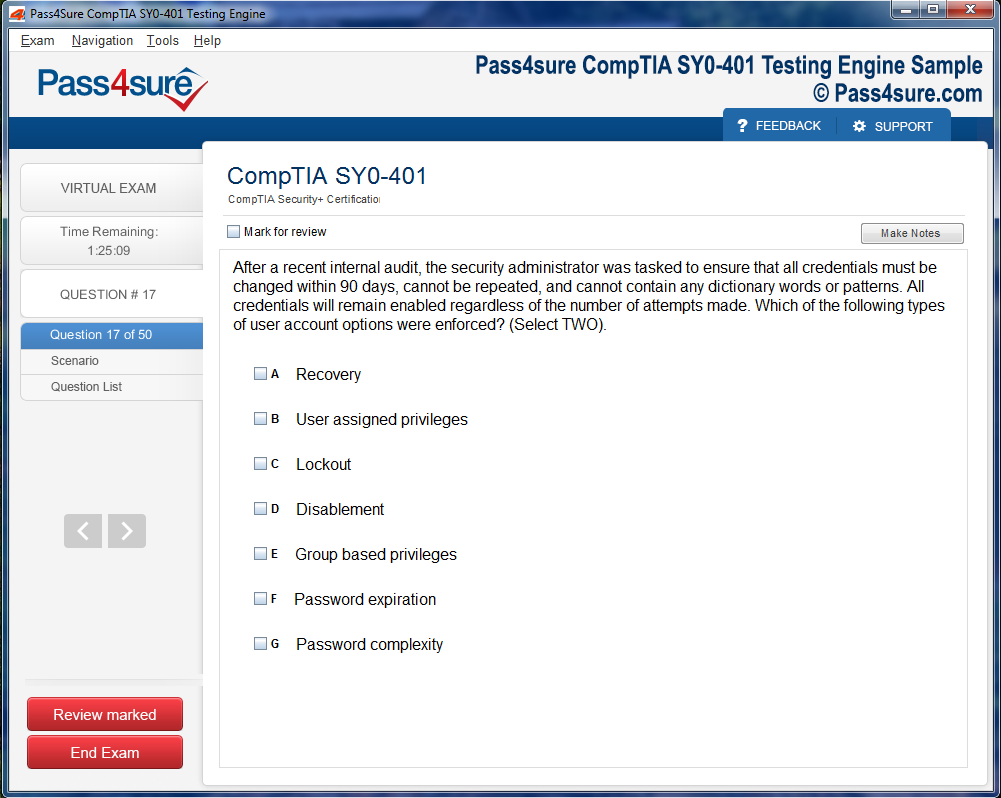
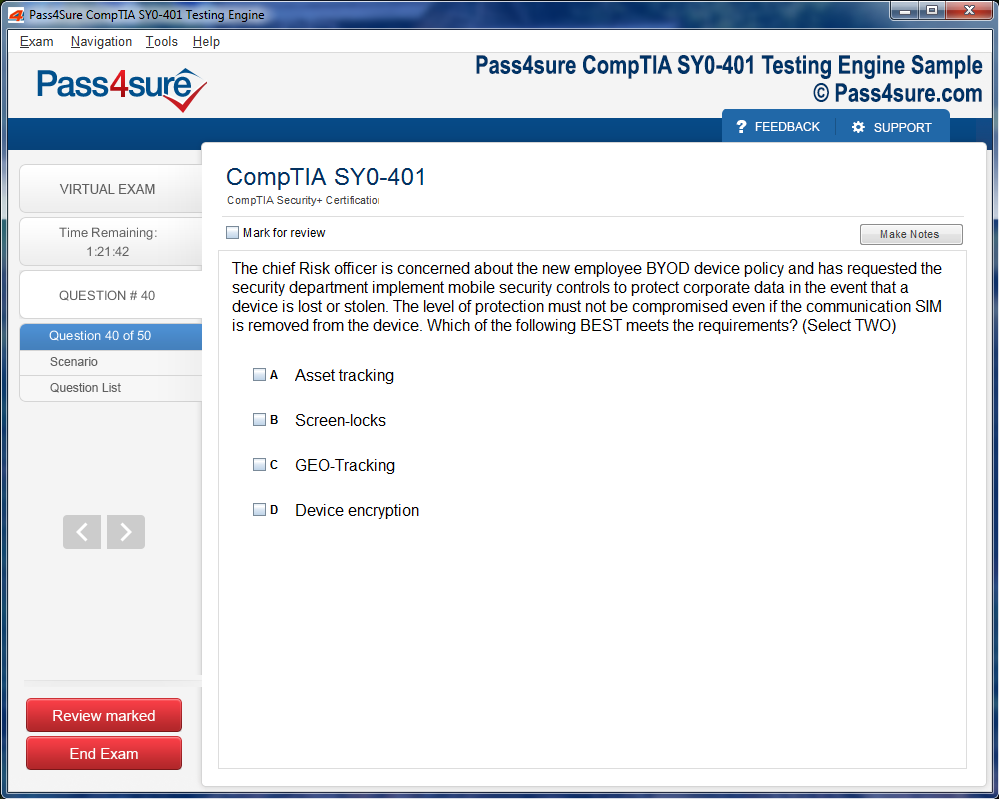
Once download and installed on your PC, you can practise test questions, review your questions & answers using two different options 'practice exam' and 'virtual exam'. Virtual Exam - test yourself with exam questions with a time limit, as if you are taking exams in the Prometric or VUE testing centre. Practice exam - review exam questions one by one, see correct answers and explanations.
How can I get the products after purchase?
All products are available for download immediately from your Member's Area. Once you have made the payment, you will be transferred to Member's Area where you can login and download the products you have purchased to your computer.
How long can I use my product? Will it be valid forever?
Pass4sure products have a validity of 90 days from the date of purchase. This means that any updates to the products, including but not limited to new questions, or updates and changes by our editing team, will be automatically downloaded on to computer to make sure that you get latest exam prep materials during those 90 days.
Can I renew my product if when it's expired?
Yes, when the 90 days of your product validity are over, you have the option of renewing your expired products with a 30% discount. This can be done in your Member's Area.
Please note that you will not be able to use the product after it has expired if you don't renew it.
How often are the questions updated?
We always try to provide the latest pool of questions, Updates in the questions depend on the changes in actual pool of questions by different vendors. As soon as we know about the change in the exam question pool we try our best to update the products as fast as possible.
How many computers I can download Pass4sure software on?
You can download the Pass4sure products on the maximum number of 2 (two) computers or devices. If you need to use the software on more than two machines, you can purchase this option separately. Please email sales@pass4sure.com if you need to use more than 5 (five) computers.
What are the system requirements?
Minimum System Requirements:
- Windows XP or newer operating system
- Java Version 8 or newer
- 1+ GHz processor
- 1 GB Ram
- 50 MB available hard disk typically (products may vary)
What operating systems are supported by your Testing Engine software?
Our testing engine is supported by Windows. Andriod and IOS software is currently under development.
Certified F5 TMOS Administrator – F5 201
The digital landscape has transformed the ways enterprises manage their applications and networks. Among the most pivotal technologies enabling seamless traffic management and high availability is the F5 TMOS, an advanced platform that ensures security, performance, and reliability. Understanding its role requires appreciating the responsibilities of an F5 TMOS administrator. These specialists are entrusted with maintaining application delivery controllers, configuring load balancing, and optimizing network traffic flow. Their expertise ensures that applications remain resilient against spikes, outages, or potential cyber threats.
At the core, TMOS, or Traffic Management Operating System, orchestrates how network traffic is routed efficiently across multiple servers. An adept administrator does not merely configure rules; they anticipate traffic bottlenecks, implement redundancy strategies, and guarantee that applications maintain high responsiveness. In essence, TMOS serves as a vigilant conductor, harmonizing requests across servers while upholding stringent security protocols.
Becoming a certified administrator begins with a foundational understanding of network protocols, such as TCP/IP, DNS, and HTTP. Mastery over these protocols allows professionals to decipher intricate traffic behaviors and predict anomalies. Moreover, administrators must grasp the essence of virtual servers, pools, nodes, and persistence methods, ensuring that end-users enjoy uninterrupted connectivity. The ability to manipulate and optimize these components directly correlates to an organization's operational resilience.
Security is another critical dimension. With cyberattacks growing more sophisticated, administrators leverage F5 TMOS features to implement SSL offloading, enforce application-layer firewalls, and maintain compliance with corporate and regulatory standards. By doing so, they prevent vulnerabilities from becoming gateways for malicious actors. Additionally, monitoring and logging provide insight into traffic patterns, enabling proactive troubleshooting and ensuring systems remain robust under fluctuating loads.
An effective F5 TMOS administrator also cultivates a mindset of continuous learning. The technological ecosystem evolves rapidly, and administrators must stay abreast of emerging threats, protocol changes, and platform enhancements. In this regard, certification acts not just as a credential but as a testament to a professional’s ability to navigate complex network landscapes, solve multifaceted problems, and optimize application delivery with precision.
As organizations increasingly embrace cloud-native architectures, hybrid environments, and microservices, the administrator’s role becomes even more vital. The ability to integrate F5 solutions seamlessly with cloud platforms, container orchestration systems, and automation tools positions administrators as indispensable architects of digital reliability. Therefore, embarking on the journey to become a certified F5 TMOS administrator is more than an educational pursuit—it is a strategic investment in a career that shapes the backbone of modern digital infrastructure.
Architectural Foundations and Traffic Orchestration
The architecture of F5 TMOS is a labyrinthine symphony of virtual constructs, each meticulously engineered to manipulate and shepherd network traffic with finesse. Its nucleus, the BIG-IP system, encompasses modules that transcend conventional load balancing. Administrators interface with virtual servers that function as ephemeral conduits, seamlessly directing traffic to pools—collections of nodes that embody the physical or virtual endpoints. Within this framework, the persistence methodologies, such as cookie-based, source-IP affinity, or SSL session persistence, act as the adhesive that guarantees consistent and coherent client-server interactions.
This orchestration extends beyond mere distribution. TMOS integrates intelligent health monitors, capable of discerning subtle latency deviations, packet loss anomalies, or erratic response times. Administrators configure these monitors to implement dynamic failover mechanisms, ensuring that servers succumbing to duress are automatically excised from the traffic path. The result is a resilient lattice of operational continuity, impervious to transient or protracted service perturbations.
Additionally, the platform’s iRules scripting environment imbues administrators with near-magical dexterity. With TCL-based syntax, one can inspect, manipulate, and redirect traffic in ways that are contextually aware and adaptive. This allows for intricate policies, from granular header inspection to sophisticated request routing contingent upon application-layer parameters. The administrator, therefore, becomes a digital choreographer, orchestrating traffic flows with precision that borders on preternatural insight.
Advanced Security Paradigms and Threat Mitigation
In the current cyber milieu, where attack vectors evolve with mercurial rapidity, TMOS serves as a bulwark against both mundane and exotic threats. Administrators harness the Advanced Firewall Manager (AFM) and Application Security Manager (ASM) modules to implement defense-in-depth strategies. AFM is predicated upon network-layer filtration, mitigating volumetric assaults, while ASM delves into the application layer, detecting injection attempts, cross-site scripting, and anomalous behavioral patterns.
The nuanced application of SSL/TLS offloading further accentuates security while optimizing performance. By terminating encrypted connections at the BIG-IP appliance, administrators relieve backend servers of computational burdens, simultaneously enforcing rigorous encryption standards. Coupled with meticulous logging and real-time analytics, this methodology enables not only reactive defense but anticipatory interdiction—allowing anomalous patterns to be flagged and quarantined before they escalate into systemic compromise.
Additionally, the paradigm of zero-trust networking finds embodiment within TMOS. By orchestrating role-based access control, granular partitioning, and microsegmentation, administrators cultivate an environment where trust is never implicit but continually validated. The result is a fortified digital terrain where the probability of lateral movement by malicious actors is drastically diminished.
Automation, Scripting, and Operational Efficacy
One of the hallmarks of proficient TMOS administration is the seamless fusion of manual dexterity and automated rigor. Administrators deploy automation frameworks to codify routine operations, from pool member addition to configuration rollbacks. The iControl REST API and Terraform integrations afford declarative control, enabling infrastructure-as-code paradigms that enhance reproducibility, traceability, and auditability.
Scripting extends beyond mere operational convenience; it becomes a conduit for predictive analytics. By logging metrics and analyzing historical traffic patterns, administrators can preempt congestion points, optimize resource allocation, and refine persistence strategies. This preemptive orchestration converts TMOS from a reactive appliance into a proactive sentinel, capable of self-optimizing in the face of fluctuating demands.
Moreover, the integration of TMOS into CI/CD pipelines epitomizes modern operational philosophy. By embedding traffic management into deployment workflows, administrators ensure that new application versions are exposed gradually, monitored for aberrant behaviors, and rolled back automatically if thresholds are breached. This synergy between deployment and traffic orchestration transforms operational resilience from an aspirational concept into a tangible, measurable reality.
Cloud Integration and Hybrid Environments
As enterprises traverse the complexities of hybrid and multi-cloud topologies, TMOS administrators find themselves navigating an intricate lattice of connectivity paradigms. The platform’s compatibility with cloud providers allows for the seamless deployment of virtual editions that mirror on-premises capabilities. This ubiquity enables administrators to maintain consistent security policies, load balancing algorithms, and traffic orchestration methodologies across heterogeneous environments.
In hybrid contexts, TMOS acts as an interstitial fabric, harmonizing traffic between private data centers and public cloud endpoints. Administrators configure global traffic managers to implement DNS-based load balancing, ensuring optimal resource utilization, latency minimization, and geographic failover. This orchestration transcends mere technical execution; it becomes an exercise in strategic architecture, aligning network topology with business imperatives.
Furthermore, containerized workloads and microservices architectures introduce ephemeral endpoints that demand dynamic traffic management. Administrators leverage service discovery integrations and automated scaling triggers to maintain application responsiveness, even as container instances proliferate or dissipate. TMOS thus evolves into an adaptive ecosystem, capable of fluidly reconfiguring itself in response to transient topological shifts.
The Quintessence of Network Traffic Orchestration
Network traffic orchestration embodies a sophisticated ballet of data packets traversing digital conduits. Far beyond the pedestrian notions of mere routing, it requires an intimate cognizance of latency oscillations, ephemeral congestion, and asymmetric workloads. Administrators navigating these labyrinthine pathways leverage predictive heuristics and adaptive algorithms, ensuring that digital effluxes flow seamlessly even under stochastic loads. This orchestration is not merely an operational necessity; it is an intellectual exercise in harmonizing efficiency with resilience.
Adaptive Load Distribution Paradigms
Load balancing, in its most erudite expression, entails dynamically apportioning traffic across multiple computational nodes based on multifaceted criteria. Rather than relying on rote round-robin sequences, modern paradigms evaluate real-time server vitality, processing latency, and historical responsiveness. Least-connection strategies, weighted distribution, and ratio-based heuristics converge to generate a self-regulating network, mitigating hot spots and diminishing request queuing. This level of sophistication transforms network architecture from static scaffolding into a sentient ecosystem.
Persistence and Affinity: Sustaining Transactional Continuity
Transactional continuity is an indispensable tenet of enterprise-grade applications. Cookie-based persistence, source IP affinity, and session-aware routing mechanisms ensure that ephemeral interactions are coherently tethered to designated computational nodes. These strategies are particularly vital in sectors where transactional fidelity is paramount, such as e-commerce portals, fintech platforms, and interactive SaaS ecosystems. The meticulous orchestration of affinity preserves not just performance but also end-user trust.
Virtual Server Configurations: Gateways to Intelligent Routing
Virtual servers constitute the epicenter of intelligent traffic management. Functioning as the digital sentinels of the network, they intercept, aggregate, and judiciously redirect requests based on preordained policies. Pools of backend servers, composed of individual nodes, are meticulously monitored to ensure operational integrity. Monitors and health probes confer a preemptive resilience, rerouting requests instantaneously upon detecting anomalies. This proactive framework forestalls downtime, optimizes throughput, and nurtures a seamless user experience.
Protocol Optimization and Payload Intelligence
Intricate manipulation of protocol behaviors can exponentially enhance network efficacy. Administrators may recalibrate HTTP headers to accelerate caching mechanisms, compress payloads, or implement geo-aware redirects. SSL offloading not only fortifies encryption integrity but also alleviates server load, engendering higher transaction throughput. The introduction of scripting frameworks, such as iRules, enables bespoke responses to multifarious conditions, empowering administrators with unparalleled flexibility to navigate esoteric business requisites.
Granular Control Through Real-Time Analytics
Analytics are the cerebral cortex of traffic orchestration, enabling introspection into performance dynamics. Real-time dashboards furnish visibility into throughput fluctuations, anomaly detection, and resource utilization. By correlating traffic patterns with application responsiveness, administrators cultivate anticipatory insight, identifying potential bottlenecks prior to user impact. This data-driven foresight metamorphoses reactive interventions into preemptive governance, elevating network stewardship to a strategic discipline.
Resilience Engineering and Failover Mechanisms
Robust load balancing necessitates the incorporation of resilience engineering principles. Failover strategies, whether hot, cold, or warm standby configurations, ensure uninterrupted service continuity. Traffic rerouting upon node failure is executed with minimal latency, preserving application integrity. Multi-tier redundancy, coupled with adaptive health monitoring, transforms vulnerability into assured reliability, establishing a resilient lattice capable of weathering stochastic disruptions.
Session Intelligence and Stateful Routing
Beyond mere packet redirection lies the imperative of session intelligence. Stateful routing mechanisms retain contextual awareness across sequential interactions, preserving session integrity across distributed infrastructures. By maintaining state fidelity, administrators avert inconsistencies, facilitate authentication continuity, and uphold transactional veracity. This nuanced orchestration is indispensable for real-time applications, financial transactions, and interactive multimedia services.
Edge Traffic Management and Latency Mitigation
The digital edge presents a unique crucible for traffic optimization. By strategically positioning processing nodes proximate to end-users, latency is minimized, and network congestion is alleviated. Edge caching, content delivery optimization, and geo-distributed routing coalesce to deliver a seamless experience even under voluminous, geographically dispersed workloads. This strategic dispersal exemplifies modern network sophistication, emphasizing proximity, responsiveness, and user-centric performance.
Scripted Customization and Dynamic Rule Enforcement
The employment of programmable frameworks enables dynamic policy enforcement. Scripted rules can intercept, modify, or redirect traffic in response to temporal conditions, anomalous patterns, or business-defined triggers. This programmable agility transforms load balancing into a living, adaptable architecture capable of responding to emergent demands. Administrators harness these tools to enact complex traffic heuristics without necessitating structural overhaul, ensuring both flexibility and continuity.
Observability and Predictive Network Intelligence
Observability extends beyond metrics collection; it encompasses predictive foresight and anomaly prognostication. Advanced telemetry captures packet-level nuances, response-time distributions, and request lineage, feeding machine-learning-informed decision engines. Predictive modeling anticipates resource saturation, informing preemptive scaling or redistribution. This intelligence converts raw telemetry into actionable insight, allowing networks to self-optimize with minimal human intervention.
Traffic Shaping and Congestion Containment
Traffic shaping strategies sculpt network behavior under fluctuating loads. By modulating bandwidth allocation, prioritizing latency-sensitive requests, and deferring non-critical payloads, administrators achieve equilibrium between throughput and responsiveness. Congestion containment mechanisms prevent bottleneck amplification, while rate-limiting and burst control policies mitigate erratic surges. This meticulous orchestration safeguards both performance and stability in high-density traffic environments.
Multilayered Security Integration
Security is an inseparable component of traffic management. By embedding SSL/TLS termination, DDoS mitigation, and application-layer firewalls directly within the load-balancing fabric, administrators consolidate protection and performance. Threat detection at ingress points curtails exploitation, while encrypted traffic offloading enhances processing efficiency. The interweaving of security and performance creates a fortified yet agile network posture.
Confluence of Orchestration and Business Continuity
Effective load balancing transcends technical dexterity, intertwining with strategic business continuity objectives. Traffic orchestration ensures operational reliability, mitigates financial risk, and enhances user satisfaction. By aligning network behavior with organizational imperatives, administrators become custodians of not just infrastructure, but enterprise resilience. Intelligent load balancing transforms computational nodes into strategic assets, optimizing both digital and commercial outcomes.
The Quintessence of Configuration Mastery
In the labyrinthine corridors of digital infrastructure, configuration emerges not merely as a technical prerequisite but as an art form, a symbiosis of logic and intuition. Administrators traverse the liminal space between code and architecture, translating abstract theoretical paradigms into tangible operational reality. Each virtual server instantiated, each iRule authored, and each policy enforced constitutes a microcosm of deliberate design, resonating across the network’s architecture. Configurations are seldom static; they embody a dynamic dialogue between evolving requirements and emergent technological capabilities.
The process necessitates meticulous scrutiny of load-balancing algorithms, SSL certificates, and traffic orchestration. Administrators must anticipate potential bottlenecks and systemic anomalies before they manifest, requiring a blend of predictive analytics and heuristic insight. In this arena, even subtle misalignments can cascade into systemic latency, highlighting the intricate interdependence of configuration parameters. The artistry lies in harmonizing redundancy, efficiency, and security without compromising agility or user experience.
Strategizing Implementation with Meticulous Precision
Implementation is the nexus where strategy converges with execution. It commences with granular network mapping, dissecting traffic topologies and user behavior into quantifiable insights. Capacity planning is an indispensable precursor, ensuring that server clusters and virtual instances accommodate peak loads without succumbing to throttling or unanticipated failures. Administrators segment pools with surgical precision, calibrating redundancies to preempt single points of failure while maintaining optimal resource utilization.
Virtual servers operate as the orchestrators of this symphony, binding pools to meticulously defined traffic directives. Monitors are instantiated to maintain ceaseless vigilance, detecting anomalies and rerouting traffic in real-time. The implementation phase demands not only technical dexterity but anticipatory foresight—each choice echoes across operational metrics, influencing latency, throughput, and resilience.
Security Integration as a Core Tenet
Within the matrix of configuration, security is both omnipresent and omnipotent. SSL profiles, access controls, firewall constructs, and intrusion detection systems are harmonized to form an impervious bastion against cyber threats. Every security measure is designed to operate unobtrusively, ensuring service continuity while mitigating vulnerabilities. Logging and audit trails constitute an invisible ledger, chronicling administrative interventions and traffic flows, enabling forensic analysis and regulatory compliance with unwavering precision.
Attack vectors evolve ceaselessly, rendering static defenses insufficient. Adaptive strategies—ranging from dynamic rule enforcement to anomaly-based threat detection—are critical. Administrators must cultivate a vigilant mindset, perpetually refining policies to anticipate emergent threats. The interleaving of security protocols with operational workflows exemplifies a philosophy wherein protection is inseparable from performance, not an auxiliary consideration.
Documentation and Strategic Continuity
In the orchestration of configuration, documentation transcends clerical necessity and becomes a cornerstone of operational continuity. Every configuration change, rationale, and procedural nuance must be meticulously recorded. These chronicles function as cognitive scaffolding for future administrators, enabling them to comprehend antecedent decisions and extend them with informed precision. The depth and clarity of documentation can delineate the boundary between operational fragility and systemic robustness.
Periodic testing amplifies this continuity, encompassing failover simulations, stress assessments, and penetration probes. By subjecting infrastructure to controlled adversities, administrators derive empirical insights into system behavior under duress. Automation and API-driven deployment further augment reliability, facilitating repeatable and error-resistant rollouts while minimizing human fallibility.
Cultivating Adaptive Excellence
Excellence in configuration is inseparable from adaptability. In an ecosystem characterized by rapid technological evolution and mutable business imperatives, no configuration remains optimal indefinitely. Administrators must anticipate shifting demands, recalibrate thresholds, and integrate novel tools and protocols. This adaptive ethos distinguishes exceptional practitioners from merely competent custodians of infrastructure.
Continuous optimization requires a synthesis of analytical rigor and experiential intuition. Performance metrics, historical trends, and predictive modeling inform iterative refinements, ensuring that systems remain not only functional but performant and resilient. Administrators engage in a constant dialogue with their infrastructure, discerning patterns and anomalies, and proactively recalibrating resources to preempt degradation.
The Nexus of Science and Art
Configuration embodies a duality, straddling the empirical and the aesthetic. It demands a scientific mindset for analytical rigor and a creative sensibility for orchestrating complex, dynamic systems. Each architectural decision reflects both a technical calculus and an intuitive understanding of systemic behavior. The interplay of redundancy, load distribution, security fortification, and scalability exemplifies this delicate equilibrium.
The outcomes of this meticulous orchestration are tangible yet elegant. Infrastructure becomes a living ecosystem, responsive, resilient, and primed for growth. Administrators who master this nexus cultivate environments where systems operate with seamless fluidity, security, and foresight. Their configurations are not merely functional; they are anticipatory, adaptive, and emblematic of operational virtuosity.
Leveraging Predictive Metrics
Predictive metrics serve as navigational beacons in the intricate topography of system administration. By analyzing historical traffic patterns, anomaly frequencies, and resource utilization trends, administrators can forecast potential disruptions and proactively implement mitigation strategies. Predictive analytics transforms reactive administration into a proactive discipline, enabling preemptive adjustments that preserve service integrity and operational continuity.
Metrics also inform resource optimization, guiding load redistribution, capacity augmentation, and redundancy calibration. Administrators leverage these insights to balance efficiency with resilience, ensuring optimal performance without excess expenditure or risk exposure. Predictive approaches elevate administration from mechanistic execution to strategic stewardship, reinforcing infrastructure stability amid fluctuating demands.
Dynamic Policy Enforcement
Policies are the sinews of configuration, translating abstract objectives into executable directives. Dynamic enforcement ensures that policies adapt to real-time conditions, enabling responsive traffic routing, automatic failover, and adaptive security measures. Administrators craft policies that are granular, context-aware, and hierarchically structured, permitting nuanced control over system behavior under diverse scenarios.
The dynamic paradigm extends beyond reactive mechanisms, incorporating anticipatory triggers based on predictive insights. Policies evolve in concert with environmental variables, traffic anomalies, and security signals, forming an intelligent lattice that harmonizes operational performance with regulatory and organizational mandates.
Automation as the Architect of Consistency
Automation represents a paradigm shift in system orchestration, transforming repetitive and error-prone processes into deterministic, scalable workflows. Administrators employ scripts, APIs, and orchestration frameworks to codify procedures, ensuring that deployments, updates, and policy applications adhere to rigorous standards. Automation mitigates human error, accelerates operational tempo, and fosters consistency across distributed infrastructures.
Moreover, automation empowers administrators to experiment and iterate with minimal risk. By simulating scenarios, deploying changes in controlled environments, and rolling back deviations efficiently, administrators achieve a balance between innovation and operational stability. The synergy of automation and strategic oversight enhances both agility and reliability.
Anticipating Technological Evolution
In the realm of digital infrastructure, stagnation equates to obsolescence. Administrators must maintain vigilance over emerging paradigms, including advances in virtualization, container orchestration, edge computing, and cloud-native architectures. The foresight to integrate nascent technologies proactively positions infrastructure to exploit opportunities, mitigate risks, and accommodate expanding operational demands.
This anticipatory approach extends to security paradigms as well. Threat landscapes evolve in tandem with technological innovations, necessitating preemptive adoption of novel detection, mitigation, and compliance frameworks. Administrators become custodians of future-ready ecosystems, balancing innovation with continuity, agility with stability.
Resilience Engineering and Systemic Integrity
Resilience is both an objective and a discipline. Administrators cultivate systems capable of absorbing perturbations, recovering gracefully from failures, and maintaining operational continuity under duress. Techniques such as failover clustering, load redistribution, and latency optimization constitute the scaffolding of resilience. Monitoring frameworks, predictive alerts, and automated remediation mechanisms ensure that disruptions are anticipated and neutralized with minimal impact.
Systemic integrity is the corollary of resilience. Administrators preserve coherence across distributed nodes, ensuring consistency, reliability, and trustworthiness. Integrity extends to data flows, policy enforcement, and security postures, forming an interdependent lattice that underpins both performance and compliance.
Cognitive Approaches to Network Orchestration
Administrators increasingly leverage cognitive strategies to navigate complex infrastructures. Pattern recognition, anomaly detection, and scenario modeling facilitate informed decision-making amid voluminous telemetry. By synthesizing quantitative metrics with qualitative insight, administrators discern latent inefficiencies, optimize resource allocation, and preemptively address emergent risks.
Cognitive orchestration encompasses both reactive and proactive dimensions, harmonizing automated interventions with human judgment. This duality amplifies operational efficacy, enabling administrators to transcend mechanistic management and exercise strategic stewardship over complex, evolving ecosystems.
Security and Compliance Considerations
In the contemporary digital stratosphere, where cyber incursions proliferate with insidious subtlety, the imperatives of security in F5 TMOS administration transcend mere protocol. Administrators are tasked with orchestrating an intricate lattice of safeguards, wherein encryption, authentication, and vigilant policy enforcement converge to form a bulwark against nefarious incursions. SSL/TLS orchestration underpins the integrity of data in transit, shielding communications from clandestine interception, while stateful firewalls and advanced traffic heuristics thwart malevolent packets that could compromise the ecosystem. Seamless integration with enterprise security schemas ensures that F5 frameworks act not in isolation but as pivotal nodes in a holistic defense architecture.
Traffic Scrutiny and Anomaly Detection
The aegis of network security is reinforced through meticulous traffic inspection and anomaly detection. iRules empower administrators to craft bespoke responses to aberrant activity, allowing real-time mitigation of incursions before they metastasize into systemic compromise. Sophisticated heuristics, combined with dynamic rate limiting and connection throttling, erect barriers against volumetric assaults, ensuring that authentic traffic traverses the network unimpeded, even amidst adversarial pressure. This vigilance transforms the TMOS environment from a passive conduit into an active sentinel, capable of discerning subtle patterns that presage potential threats.
Regulatory Compliance Imperatives
Compliance with regulatory codes introduces another stratum of exigency. Industries governed by PCI DSS, HIPAA, GDPR, or bespoke regulatory mandates necessitate exacting configurations, continuous surveillance, and scrupulous logging of all system modifications. Audit-ready documentation—encompassing access hierarchies, traffic management, and policy enforcement—renders organizations capable of demonstrating adherence to statutory and internal standards. Such diligence fosters accountability while minimizing exposure to legal and operational liabilities. Compliance in this context is not merely a bureaucratic requisite but a proactive instrument in fortifying the enterprise’s cyber posture.
Proactive Threat Intelligence
In the realm of cyber fortification, foresight is tantamount to resilience. Administrators who cultivate a proactive intelligence posture remain apprised of emergent exploits, expeditiously remediate vulnerabilities, and simulate adversarial maneuvers to stress-test defenses. This anticipatory approach transmutes security from a reactive obligation into a strategic competency, mitigating risk while preserving organizational credibility. By internalizing threat vectors and behavioral heuristics, administrators cultivate an environment where potential disruptions are preemptively neutralized, rendering the digital infrastructure both robust and adaptive.
Cryptographic Rigor and Key Management
The foundation of digital trust rests upon cryptographic rigor. Within TMOS ecosystems, the judicious deployment of key management protocols ensures the sanctity of data-at-rest and data-in-transit. Administrators must implement key rotation policies, manage certificate lifecycles, and enforce cipher suite strategies that balance performance with impenetrability. The interweaving of cryptographic controls with application delivery policies engenders a security paradigm wherein the compromise of one node does not precipitate systemic collapse, thereby fortifying resilience against sophisticated intrusion vectors.
Policy Orchestration and Governance
Beyond technical measures, the stewardship of security policies underpins systemic integrity. Governance mechanisms that codify access hierarchies, privilege boundaries, and procedural protocols are indispensable in preempting inadvertent exposure. Policy orchestration, augmented with automated enforcement, diminishes human error while reinforcing adherence to security baselines. In the TMOS milieu, where high-velocity traffic flows demand rapid yet precise interventions, automated governance becomes a sine qua non for maintaining operational continuity and safeguarding sensitive assets.
Behavioral Analytics and Real-Time Mitigation
Advanced behavioral analytics constitute an emergent frontier in the defense arsenal. By scrutinizing transactional patterns, connection frequencies, and payload signatures, administrators can discern anomalies indicative of compromise. Integration with real-time mitigation engines permits instantaneous countermeasures, ranging from adaptive throttling to dynamic content filtering. The confluence of predictive analytics and automated response cultivates a self-reinforcing defense architecture, wherein potential breaches are neutralized at inception, minimizing both operational disruption and reputational harm.
Integration with Enterprise Security Ecosystems
The efficacy of F5 TMOS security is magnified when seamlessly integrated into broader enterprise security ecosystems. Correlation with SIEM platforms, orchestration of endpoint protections, and interoperability with intrusion detection networks create a cohesive defense mesh. Such integration ensures that threats are contextualized across the organizational perimeter, allowing for coordinated responses and consolidated visibility. Administrators operating within this paradigm evolve from custodians of a singular platform to architects of an interdependent, resilient security infrastructure.
Continuous Monitoring and Observability
Observability forms the linchpin of a preemptive security strategy. Continuous monitoring of traffic flows, access events, and policy adherence enables administrators to detect subtle deviations that may presage compromise. By leveraging granular telemetry, anomaly scoring, and event correlation, potential vulnerabilities are illuminated before they are exploited. In the TMOS context, such vigilance fosters a culture of continuous improvement, wherein iterative feedback loops enhance both defensive posture and operational efficiency.
Resilience Engineering and Adaptive Architecture
Security in isolation is insufficient; resilience must be engineered into the very fabric of the application delivery ecosystem. Adaptive architectures—capable of rerouting traffic, isolating compromised nodes, and dynamically reconfiguring policies—ensure continuity even under adversarial conditions. Administrators who prioritize resilience cultivate environments where failure is contained, recovery is swift, and systemic integrity is preserved. This paradigm positions security not as a static barrier but as an evolving, responsive entity, integral to sustainable digital operations.
The Imperative of Observational Vigilance
In the labyrinthine architecture of contemporary digital ecosystems, observational vigilance emerges as the linchpin of operational integrity. Perpetual scrutiny of traffic cadence, server vitality, and application responsiveness empowers administrators to intercept subtle aberrations before they metastasize into systemic disruptions. Dashboards, telemetry streams, and event logs coalesce into an analytical lattice, illuminating cryptic patterns that evade casual inspection. This continuous surveillance fosters preemptive interventions, safeguarding service continuity and user gratification.
Dissecting Anomalies with Methodical Precision
Troubleshooting in high-velocity networks demands a perspicacious and methodical lens. Administrators dissect latency oscillations, protocol inconsistencies, and cryptic error codices to distill the root genesis of operational perturbations. A nuanced comprehension of protocol choreography, load-balancing heuristics, and server symbiosis permits the identification of misconfigurations, infrastructural constraints, or clandestine intrusions. Rapid and precise remediation mitigates downtime, sustaining the experiential fidelity for end-users and stakeholders alike.
Optimization as an Art Form
Optimization transcends mere configuration; it is a disciplined craft requiring sagacious judgment. Adjusting load-balancing algorithms, recalibrating session persistence paradigms, and refining cache hierarchies augment system throughput while curtailing latency. Strategic deployment of SSL offloading, compression schemes, and asynchronous processing attenuates server strain, engendering a network environment that is simultaneously robust and agile. Iterative audits of traffic telemetry catalyze incremental enhancements, gradually transmuting the infrastructure into a self-tuning, anticipatory organism.
The Subtle Nuances of Load Distribution
The orchestration of traffic flow involves an intricate ballet of algorithmic choices. Round-robin, least-connections, and dynamic ratio strategies each impart distinct performance ramifications, contingent upon workload characteristics. Understanding the temporal dynamics of user sessions, the idiosyncrasies of backend responsiveness, and the stochastic variance of network jitter permits administrators to tailor load-balancing schemas with surgical exactitude. These calibrated interventions ensure equitable resource allocation while mitigating bottlenecks and systemic latency spikes.
Logarithmic Insights from Telemetry Streams
Event logs and telemetry streams constitute a fecund repository of operational intelligence. Beyond superficial error enumeration lies the potential for profound insight: trends, anomalies, and latent performance degradations emerge through meticulous parsing and correlation. Employing advanced filtering, statistical aggregation, and heuristic algorithms, administrators can unearth subtle deviations that presage more substantial disruptions. This data-centric vigilance not only precludes service interruptions but also informs strategic architectural refinements.
Harmonizing Interdisciplinary Collaboration
Operational excellence is seldom the product of a solitary endeavor. Synergistic engagement with developers, network architects, and cybersecurity operatives ensures that infrastructural decisions resonate harmoniously with organizational imperatives. Knowledge exchange and coordinated troubleshooting efforts magnify efficacy, fostering a culture steeped in continuous enhancement and anticipatory problem-solving. Such cross-functional collaboration transmutes operational challenges into opportunities for innovation and resilience.
Predictive Analytics and Proactive Remediation
The frontier of monitoring lies in predictive analytics, wherein historical telemetry and behavioral modeling converge to forecast potential anomalies. By leveraging statistical inference, machine learning paradigms, and temporal pattern recognition, administrators gain the capacity to implement proactive remediations prior to the manifestation of critical failures. These anticipatory strategies cultivate an ecosystem wherein performance degradation is mitigated in situ, rather than reactively, enhancing overall system dependability.
Fine-Tuning Performance Parameters
Optimization extends beyond algorithmic finesse to encompass the meticulous calibration of environmental parameters. Memory allocation, thread concurrency, and network socket tuning represent subtle yet impactful levers that dictate system responsiveness. Through iterative experimentation and telemetry-informed adjustments, administrators achieve a harmonious equilibrium between computational throughput, latency minimization, and resource conservation. These enhancements coalesce to form a resilient and highly performant infrastructure.
The Dynamics of Resilience Engineering
Resilience in networked systems is the product of deliberate design and sustained oversight. Incorporating redundancy protocols, failover mechanisms, and adaptive routing strategies fortifies the infrastructure against unpredictable contingencies. Administrators cultivate an anticipatory posture, wherein potential points of failure are identified, mitigated, and monitored continuously. This dynamic equilibrium ensures uninterrupted service availability and maintains user confidence, even amidst volatile operational conditions.
Career Growth and Future Prospects
Becoming a certified F5 TMOS administrator engenders a rarefied trajectory through the labyrinthine corridors of contemporary IT infrastructure. Such professionals inhabit a nexus where networking sophistication converges with the imperatives of cybersecurity and application delivery. Organizations increasingly cognize the strategic leverage these administrators confer, often extending corridors of opportunity into enterprise IT, cloud orchestration, and hybridized DevOps ecosystems. Certification crystallizes expertise, amplifies professional gravitas, and fortifies one’s stature amid a saturated labor market where proficiency alone rarely suffices.
The trajectory is not static; it is a dynamic continuum. Emerging paradigms such as cloud-native architectures, containerized ecosystems, and microservices proliferation necessitate administrators capable of symbiotic integration of F5 solutions into complex, heterogeneous infrastructures. Automation, coupled with orchestration frameworks, transmutes routine deployments into agile, intelligent constructs, optimizing resource allocation while mitigating operational entropy. Professionals who embrace these avant-garde modalities position themselves not merely as technicians but as architects of digital resilience, presiding over the symphony of modern application delivery.
Navigating Technological Frontiers
The technological frontier is perennially mutable, characterized by flux and emergent modalities that challenge conventional praxis. The advent of edge computing, augmented reality applications, and AI-driven network analytics demands administrators who are adept at predictive modeling, anomaly detection, and proactive remediation. Mastery of TMOS provides the scaffolding upon which such competencies are constructed, enabling practitioners to anticipate and neutralize performance degradation, security incursions, and operational bottlenecks before they metastasize into systemic failures.
F5 administrators frequently assume custodial roles over high-stakes digital ecosystems. Their purview often encompasses load balancing, traffic optimization, and SSL termination, yet the essence of their craft transcends rote configurations. It is an intellectual odyssey wherein strategic foresight, algorithmic understanding, and adaptive problem-solving coalesce. In such an environment, rarefied expertise is not merely advantageous; it becomes indispensable.
Amplifying Professional Visibility
Professional visibility is amplified through deliberate engagement with specialized communities. Participation in forums, symposia, and knowledge-sharing initiatives cultivates both cognitive dexterity and social capital. These interactions serve as conduits for exposure to pioneering methodologies, emerging best practices, and the collective wisdom of seasoned practitioners. For the discerning administrator, such networks are crucibles where ideas are refined, collaborative ventures incubated, and reputational capital accrued.
Mentorship is another vector of influence. Guiding nascent professionals through the intricacies of TMOS administration fosters a dual enrichment: mentees acquire a roadmap to operational proficiency, while mentors consolidate their expertise, distilling years of tacit knowledge into actionable guidance. This cyclical enrichment nurtures an ecosystem of continuous professional ascension, wherein learning is perpetual and influence exponentially magnified.
Integrating Automation and Orchestration
Automation and orchestration are no longer ancillary; they are central to operational efficacy. Tools enabling Infrastructure as Code (IaC), automated configuration, and predictive scaling reduce human error and accelerate deployment cycles. An adept F5 administrator leverages these mechanisms not merely to execute routine tasks but to architect intelligent, self-optimizing systems. The resultant infrastructure exhibits resilience, adaptability, and responsiveness that would be unattainable through manual oversight alone.
These innovations are especially potent within hybrid and multi-cloud frameworks. The ability to harmonize F5 solutions across disparate platforms, ensuring seamless traffic routing, load distribution, and security enforcement, constitutes a formidable professional advantage. As enterprises migrate toward ephemeral, containerized workloads, administrators capable of orchestrating complex, automated deployments will occupy a strategic echelon within organizational hierarchies.
Cultivating Strategic Thinking
Technical mastery alone is insufficient; strategic cognition is requisite for career ascension. Administrators must decipher business objectives, anticipate technological disruptions, and architect solutions that reconcile operational imperatives with organizational vision. This strategic acumen transforms practitioners from operational executors into architects of innovation, capable of aligning digital infrastructure with broader enterprise aspirations.
Strategic thinking also encompasses risk management and contingency planning. In high-availability environments, the capacity to preemptively identify single points of failure, evaluate mitigation strategies, and implement resilient designs distinguishes exceptional administrators from merely competent ones. The synergy of tactical execution and strategic foresight cultivates a rarefied professional profile, conferring influence and authority across multiple organizational domains.
Pathways to Advanced Roles
Longitudinal career progression may evolve into roles such as solutions architect, network engineer, or security specialist. Each trajectory leverages the foundational knowledge accrued through TMOS administration, expanding the practitioner’s influence over broader technical and business ecosystems. Solutions architects synthesize technical and operational data into coherent blueprints, orchestrating cross-functional initiatives with precision. Security specialists, conversely, fortify organizational perimeters, employing predictive analytics and threat intelligence to preempt incursions.
These trajectories are underpinned by adaptability. As the technological landscape mutates, the administrator who continuously augments their skillset with emerging tools, methodologies, and paradigms maintains professional relevance and marketability. Rarely does the confluence of technical dexterity, strategic insight, and adaptive learning fail to yield a career trajectory characterized by both opportunity and fulfillment.
Mastery Through Continuous Learning
Continuous learning is a sine qua non of sustained professional elevation. TMOS administration, while foundational, constitutes merely the initial tier in a stratified edifice of expertise. Successive layers involve mastery of ancillary technologies, integration paradigms, and emerging operational frameworks. Each incremental acquisition enhances the administrator’s capacity to navigate complex infrastructures with prescient precision and operational alacrity.
The cognitive discipline cultivated through persistent learning extends beyond technical proficiency. Problem-solving acuity, critical analysis, and anticipatory reasoning flourish, equipping administrators to tackle unprecedented challenges with composure and ingenuity. Within this continuum, learning is not episodic but iterative, each cycle refining both technical and cognitive faculties.
Shaping Digital Resilience
Digital resilience is the hallmark of a consummate F5 administrator. It transcends rudimentary uptime metrics, encompassing systemic robustness, operational elasticity, and adaptive recovery. Resilient infrastructures anticipate perturbations, absorb stressors, and recalibrate dynamically, mitigating risk while sustaining performance. Administrators who engineer such environments occupy pivotal roles in organizational continuity, their decisions echoing across technical, operational, and strategic domains.
The orchestration of resilient infrastructures requires a holistic understanding. It entails the synthesis of load balancing, application delivery, security protocols, and automation frameworks into a coherent operational ecosystem. The administrator’s role is both guardian and innovator, stewarding reliability while catalyzing transformation.
Embracing Future-Oriented Technologies
Future-oriented technologies such as AI-assisted monitoring, predictive analytics, and self-healing networks will redefine TMOS administration. The adept practitioner anticipates these shifts, experimenting with nascent tools, integrating machine learning algorithms, and adopting proactive orchestration methodologies. Early adoption fosters competitive advantage, enabling administrators to architect infrastructures that not only respond to contemporary demands but preemptively address emergent contingencies.
Integration of these technologies mandates an interdisciplinary perspective. Networking, cybersecurity, cloud operations, and AI converge within a sophisticated, interdependent matrix. Administrators capable of navigating these intersections with dexterity will influence both technical outcomes and strategic trajectories, becoming indispensable architects of enterprise resilience.
Mentorship and Community Influence
Mentorship and community involvement reinforce professional identity and expand influence. Active participation in specialized forums, symposia, and collaborative projects cultivates intellectual cross-pollination, exposing practitioners to divergent perspectives and innovative methodologies. The resultant network of professional alliances enhances visibility, enriches expertise, and catalyzes collaborative opportunities with high operational impact.
Mentorship perpetuates this cycle of growth. Guiding emerging professionals consolidates tacit knowledge, enhances leadership acumen, and reinforces strategic foresight. Administrators who engage with these communal structures achieve a dual advantage: they accelerate collective professional growth while simultaneously fortifying their own position within the industry’s upper echelons.
Transformative Professional Journey
The journey from novice to certified F5 TMOS administrator is transformative, fostering technical dexterity, analytical acuity, and holistic comprehension of modern IT ecosystems. Beyond credentialing, it cultivates a mindset of proactive problem-solving, continuous learning, and strategic foresight. For those who embrace this trajectory, the career path is not merely a sequence of roles but an odyssey of professional evolution, marked by innovation, resilience, and enduring relevance within the ever-shifting technological landscape.
Performance Optimization and Latency Mitigation
In high-stakes digital environments, the performance of applications is tantamount to organizational credibility. TMOS administrators orchestrate sophisticated mechanisms to mitigate latency, ensure optimal throughput, and maintain predictable performance under fluctuating loads. Beyond conventional load balancing, TMOS incorporates traffic shaping algorithms that prioritize packets based on defined service-level objectives, session criticality, or protocol-specific characteristics.
Connection multiplexing, a cornerstone of performance optimization, enables administrators to consolidate multiple client sessions over a single backend connection. This reduces overhead, diminishes TCP handshake proliferation, and accelerates content delivery. Complementing this, caching mechanisms—both in-memory and disk-based—alleviate repetitive request processing by storing frequently accessed data at strategic ingress points. By fine-tuning cache expiration policies, administrators ensure data freshness while minimizing redundant server interactions.
Moreover, adaptive compression techniques serve as instrumental accelerators. By dynamically compressing response payloads, TMOS reduces network bandwidth utilization without compromising data integrity. This is particularly impactful in globalized architectures, where intercontinental latencies can significantly impair user experience. When coupled with persistent monitoring, administrators can detect micro-latency spikes and recalibrate traffic paths, ensuring that the end-user experience remains seamless.
Observability, Analytics, and Predictive Maintenance
Operational acuity is predicated upon actionable insight. TMOS administrators leverage comprehensive observability frameworks that extend beyond rudimentary metrics. By collecting telemetry data at granular levels—including request headers, session durations, payload sizes, and node responsiveness—they cultivate a rich informational substrate upon which predictive models can operate.
Advanced analytics, often leveraging machine learning algorithms, empower administrators to detect incipient anomalies. For instance, subtle deviations in response time distributions or connection resets may prelude hardware degradation, application misconfigurations, or emergent security threats. Through such predictive maintenance, system interruptions are preempted, reducing downtime and safeguarding user satisfaction.
Visualization interfaces consolidate multidimensional datasets into comprehensible dashboards, enabling rapid comprehension of system health. Administrators can juxtapose throughput, error rates, and geographic request distributions, allowing for holistic decision-making. The combination of observability and analytics transforms the administrator role from reactive technician to strategic sentinel.
High Availability and Redundancy Strategies
The architecture of resilience in TMOS is predicated upon redundancy and high availability constructs. Administrators configure failover clusters, leveraging both active-standby and active-active topologies, to mitigate single points of failure. These clusters synchronize state information, session persistence data, and configuration parameters, ensuring seamless continuity during node outages.
Global Traffic Manager (GTM) deployments further extend resilience across geographic expanses. By monitoring regional endpoints and dynamically redirecting traffic, administrators maintain operational consistency even amidst catastrophic local failures. This geodistributed approach is complemented by topology-aware routing, wherein traffic is directed to the most performant or proximal data center based on real-time metrics.
Intriguingly, administrators often employ hybrid redundancy strategies. For example, combining hardware-based failover with virtualized instances enables cost-effective scalability without sacrificing reliability. The nuanced orchestration of these strategies requires a profound understanding of network topology, application architecture, and traffic patterns, underscoring the administrator’s pivotal role.
Advanced iRules Strategies and Traffic Manipulation
The iRules scripting environment imbues TMOS administrators with almost omnipotent control over traffic flows. By leveraging this TCL-based domain-specific language, administrators can implement contextual routing, dynamic content switching, and request transformation with surgical precision.
For instance, administrators may employ payload inspection to route HTTP requests to specialized application nodes based on query parameters, cookies, or custom headers. Similarly, iRules can facilitate granular security enforcement, such as terminating suspicious sessions, blacklisting malicious IP ranges, or triggering alerts on anomalous request signatures. The versatility of iRules transforms TMOS into a programmable traffic canvas, allowing nuanced policies that exceed conventional static configurations.
Additionally, administrators increasingly integrate iRules with external orchestration tools and APIs. By correlating traffic behavior with business analytics, automated scaling decisions, or user segmentation, the platform evolves from a reactive network appliance to a proactive participant in strategic decision-making.
SSL Offloading, Cryptography, and Encryption Management
Encryption is no longer optional; it is a prerequisite for secure digital communication. TMOS administrators manage SSL/TLS termination with meticulous attention to cryptographic robustness. By offloading encryption workloads to the BIG-IP system, backend servers are relieved from CPU-intensive operations, enhancing overall throughput.
Administrators curate cipher suites, enforce minimum protocol versions, and manage certificate lifecycles. Automated certificate renewal frameworks further reduce human error, ensuring uninterrupted secure communications. Beyond termination, SSL bridging and re-encryption strategies enable end-to-end encryption, satisfying regulatory mandates and preserving confidentiality across intermediate inspection points.
Emerging cryptographic paradigms, such as elliptic-curve cryptography (ECC) and post-quantum algorithms, increasingly influence administrator strategies. By adopting advanced cryptography, administrators future-proof their infrastructure against both current and speculative threat vectors.
Integration with DevOps and CI/CD Pipelines
Modern application deployment is inseparable from continuous integration and continuous delivery (CI/CD) paradigms. TMOS administrators integrate traffic management directly into deployment workflows, ensuring that applications are not only released but also released reliably. By leveraging automation tools such as Ansible, Terraform, or Jenkins, administrators codify configurations, replicate environments, and orchestrate staged deployments.
This integration facilitates blue-green deployments, canary releases, and progressive rollouts, all while maintaining traffic continuity. Administrators can monitor performance metrics, error rates, and user experience indicators, dynamically adjusting traffic distribution in response to operational realities. Consequently, TMOS evolves from a static appliance into a dynamic participant in agile delivery frameworks.
Hybrid Cloud Strategies and Multi-Environment Orchestration
As enterprises navigate the complexities of hybrid and multi-cloud ecosystems, TMOS administrators are called upon to harmonize disparate environments. Virtual editions of BIG-IP enable consistent feature parity between on-premises data centers and cloud infrastructures. This consistency ensures that security policies, load balancing algorithms, and persistence strategies are uniformly enforced.
Multi-environment orchestration also requires sophisticated DNS-based traffic management. By integrating GTM with cloud-native routing constructs, administrators achieve latency-aware, geographically optimized, and fault-tolerant traffic distribution. Moreover, dynamic auto-scaling and container orchestration integrations allow ephemeral endpoints to be seamlessly incorporated into traffic management paradigms, preserving both performance and reliability.
Application Security Beyond Conventional Firewalls
TMOS transcends traditional perimeter defenses by embedding security within the application delivery layer. Administrators employ the ASM module to inspect, validate, and filter requests, defending against injection attacks, cross-site scripting, and other application-layer exploits. Behavioral analysis algorithms augment static signatures, enabling anomaly detection based on request patterns, session attributes, and usage heuristics.
In high-security contexts, administrators also implement rate-limiting, IP reputation checks, and bot mitigation strategies. By fusing these mechanisms with logging and alerting frameworks, TMOS serves as both shield and sensor, providing actionable intelligence while actively mitigating threats.
Advanced Monitoring and Telemetry Strategies
Observability is incomplete without nuanced telemetry. Administrators deploy advanced monitoring frameworks to capture session-level metrics, network latencies, and system health indicators. By analyzing these metrics in real time, anomalies such as packet drops, retransmissions, or slow responses can be rapidly detected and remediated.
Synthetic monitoring techniques supplement passive telemetry, simulating user interactions to uncover latent bottlenecks or misconfigurations. Combined with alerting systems and predictive analytics, these strategies empower administrators to maintain near-zero downtime, ensuring optimal user experience.
Role of Certification and Continuous Professional Development
The F5 TMOS administrator’s journey is not static; it is a continuum of skill acquisition, validation, and refinement. Certification programs validate proficiency across deployment, configuration, troubleshooting, and security management. Beyond credentialing, continuous professional development is crucial due to evolving threats, protocol enhancements, and emerging technologies such as microservices, edge computing, and zero-trust paradigms.
Administrators engage in sandbox experimentation, lab simulations, and community knowledge-sharing to maintain acumen. By cultivating both practical experience and theoretical knowledge, they remain capable of architecting resilient, performant, and secure application delivery ecosystems.
Algorithmic Sophistication in Load Balancing
Modern load balancing transcends mere distribution; it embodies algorithmic sophistication. Administrators deploy an array of heuristics to allocate resources dynamically. Least-connections, weighted-response, and adaptive ratio algorithms harmonize traffic to server capacity. Advanced implementations leverage historical performance metrics, real-time latency, and predictive heuristics to anticipate resource saturation. This algorithmic foresight ensures equilibrium, reduces jitter, and minimizes packet queuing. Networks become proactive ecosystems rather than reactive conduits, capable of self-adjusting under stochastic loads.
Predictive Routing and Telemetry-Driven Decisions
Telemetry is the nervous system of contemporary traffic management. By analyzing granular metrics—such as microsecond-level response times, throughput distribution, and node health indices—administrators anticipate potential bottlenecks before they manifest. Predictive routing algorithms use this telemetry to proactively divert traffic, avoiding hotspots and dynamically scaling resources. Machine learning models can forecast traffic surges, rerouting preemptively to mitigate latency and maintain consistent service quality. In this context, network orchestration becomes an exercise in anticipatory cognition.
Granular Traffic Engineering at Layer 7
Layer 7 orchestration introduces a realm of granularity where administrators operate at the application protocol level. HTTP headers, cookies, and URL parameters become instruments for intelligent routing. Payload inspection enables decisions based on content type, user session attributes, or geographic origin. By leveraging this granularity, networks can provide differential service quality, prioritize latency-sensitive transactions, and enforce custom business logic. Layer 7 intelligence is particularly vital in microservice architectures, where inter-service communication patterns demand context-aware routing.
Edge Computing and Latency Reduction
The proliferation of edge computing has redefined traffic management strategies. By positioning compute nodes near end-users, latency is minimized, and congestion along core network pathways is alleviated. Edge orchestration involves geo-aware traffic routing, localized caching, and distributed processing. Content Delivery Networks (CDNs) integrated with load-balancing mechanisms enable near-instantaneous response times. Administrators must navigate trade-offs between replication overhead and latency reduction, optimizing for both efficiency and resource utilization.
Resilient Architectures through Redundancy
Redundancy is the linchpin of resilient load-balanced infrastructures. Multi-tier failover configurations—comprising hot, warm, and cold standby nodes—ensure continuity during unplanned outages. Administrators implement proactive health probes to detect anomalies at the node, pool, or virtual server level. Traffic is seamlessly redirected upon failure, preserving session integrity and mitigating user disruption. Advanced redundancy strategies incorporate dynamic scaling, elastic provisioning, and adaptive rerouting to maintain operational fidelity under variable load conditions.
Stateful Session Preservation
Session intelligence underpins transactional reliability in distributed architectures. Stateful routing mechanisms maintain context across successive interactions, ensuring that session continuity is preserved even when nodes are dynamically reassigned. Techniques such as cookie persistence, IP affinity, and token-based session binding prevent transaction fragmentation and maintain coherent application behavior. Stateful orchestration is critical for applications with stringent transactional consistency requirements, including financial platforms, e-commerce systems, and interactive SaaS offerings.
Traffic Shaping and Congestion Control
Traffic shaping strategies sculpt network flows to balance throughput with responsiveness. Bandwidth allocation, request prioritization, and burst management mechanisms prevent congestion amplification. Rate limiting, queue management, and deferred processing ensure that latency-sensitive operations remain uninterrupted during high-traffic episodes. By applying these techniques, administrators transform volatile traffic into a regulated, predictable flow, enhancing both reliability and user experience. Congestion control, when integrated with predictive routing, forms a cohesive framework for network stability.
Dynamic Policy Enforcement through Scripting
Scripting frameworks, such as iRules, provide a dynamic interface for policy enforcement. Administrators can intercept, modify, and reroute traffic based on temporal conditions, user attributes, or emergent network anomalies. These programmable rules empower networks to respond to unforeseen events, implement complex load-balancing heuristics, and execute adaptive behaviors without structural reconfiguration. The combination of scripting flexibility and real-time telemetry forms a resilient, intelligent orchestration layer capable of continuous optimization.
SSL/TLS Offloading and Security Integration
Encryption, while essential for secure communications, imposes computational overhead on backend servers. SSL/TLS offloading redistributes this burden to dedicated devices or virtual servers, enhancing performance without compromising security. Integrating security directly into load-balancing infrastructure allows simultaneous enforcement of DDoS mitigation, application-layer firewalls, and intrusion detection. This convergence of performance and protection ensures that security does not become a bottleneck, but a seamless component of traffic orchestration.
Observability and Real-Time Insight
Effective traffic management relies on deep observability. Advanced dashboards and telemetry platforms provide real-time insight into throughput, request distribution, latency metrics, and error rates. By correlating these indicators with server performance, administrators gain predictive foresight into emerging issues. Observability transforms raw data into actionable intelligence, enabling preemptive scaling, routing adjustments, and resource allocation. The network evolves from a static conduit into a self-aware, continuously optimizing system.
Intelligent Failover Strategies
Failover mechanisms are critical for ensuring high availability. Intelligent failover involves automatic detection of node failures, rerouting traffic to operational nodes, and dynamically adjusting pool allocations. Administrators can configure failover priorities, health-check intervals, and escalation policies to optimize service continuity. Combined with predictive telemetry, failover strategies minimize latency during rerouting and reduce the risk of cascading failures across the network ecosystem.
Microservice-Aware Load Balancing
Microservice architectures present unique traffic management challenges. Each service instance may require specific routing policies, dependency-aware orchestration, and granular health monitoring. Administrators employ service discovery, dynamic routing tables, and container-level telemetry to balance loads effectively across ephemeral service instances. The orchestration must account for inter-service dependencies, response time variability, and resource heterogeneity, ensuring consistent application behavior across distributed microservices.
Predictive Auto-Scaling and Elastic Infrastructure
Modern orchestration integrates predictive auto-scaling to match fluctuating demand. Machine learning models analyze historical traffic patterns, current utilization, and performance metrics to anticipate load spikes. Virtual servers, pools, and nodes can be provisioned or decommissioned dynamically, ensuring optimal resource allocation. This elasticity reduces cost, maintains performance, and enhances resilience. Predictive scaling transforms static infrastructures into adaptive, self-regulating networks capable of responding in near real-time to workload variability.
Geospatial Traffic Optimization
Geo-aware routing leverages user location to optimize latency, distribute load, and comply with regulatory constraints. Administrators configure policies that direct requests to the nearest or least-congested nodes, balancing efficiency with compliance. Combined with edge caching, content replication, and proximity-based load distribution, geospatial optimization ensures rapid response times and a uniform user experience. In global-scale deployments, this approach minimizes cross-continental traffic and reduces network strain.
Anomaly Detection and Remediation
Traffic anomalies—such as sudden spikes, unusual request patterns, or degraded response times—can indicate security threats, misconfigurations, or hardware failures. Advanced systems employ anomaly detection algorithms, leveraging statistical models, thresholds, and machine learning to identify deviations. Once detected, automated remediation protocols, including rerouting, rate limiting, or alerting, are enacted. This proactive detection reduces downtime, maintains quality of service, and strengthens operational resilience.
Layered Observability and Holistic Performance Monitoring
Observability extends beyond individual nodes to encompass holistic network performance. Multi-layered dashboards capture packet flow, protocol behavior, and server-level metrics concurrently. Correlating these layers allows administrators to pinpoint root causes rapidly, optimize load-balancing algorithms, and predict cascading failures. This approach transforms visibility from reactive monitoring into a predictive intelligence layer, guiding strategic infrastructure decisions and operational fine-tuning.
Business-Aligned Traffic Orchestration
Load balancing is not merely technical; it aligns directly with business continuity and customer experience. Transactional fidelity, uptime guarantees, and responsive application performance translate into financial outcomes and brand reputation. Intelligent orchestration ensures that resources are allocated efficiently, latency is minimized, and high-priority services are preserved. Administrators become strategic operators, translating network behavior into measurable business advantages and operational resilience.
Cross-Domain Integration and Hybrid Architectures
Enterprise networks increasingly span hybrid and multi-cloud architectures. Load-balancing strategies must integrate seamlessly across on-premises infrastructure, private clouds, and public cloud environments. Cross-domain orchestration involves unified policy enforcement, telemetry correlation, and resilient failover mechanisms across heterogeneous platforms. This integration ensures consistent performance, simplifies management, and enhances scalability, establishing a cohesive operational ecosystem despite infrastructural diversity.
Architectural Symbiosis in Virtual Ecosystems
The architecture of virtual ecosystems embodies an intricate choreography where software-defined constructs interact with physical substrates. Each virtual server, load balancer, and pool is not merely a functional component but a node in a broader systemic lattice. Administrators craft these ecosystems with an eye for both structural cohesion and operational fluidity, understanding that local modifications ripple across the infrastructure. Achieving this equilibrium demands an appreciation of systemic interdependencies, where redundancy, failover mechanisms, and traffic orchestration coalesce into a resilient and adaptive framework.
Topology design transcends mere placement of nodes; it encompasses logical segmentation, hierarchical policy propagation, and resource orchestration. Administrators must evaluate latency profiles, inter-node bandwidth, and computational load, forging a network that harmonizes speed with stability. The elegance of architecture lies not only in performance but in the predictability of behavior under strain, ensuring that emergent anomalies are absorbed or redirected without systemic disruption.
Granular Traffic Orchestration
At the heart of operational efficacy lies granular traffic orchestration. Traffic flow is the lifeblood of digital ecosystems, and its nuanced management differentiates high-performance infrastructure from fragile deployments. Administrators deploy rules that dynamically direct traffic based on application type, session persistence, and load metrics. Granularity extends to payload inspection, protocol-specific routing, and session affinity, allowing administrators to optimize every micro-interaction between clients and servers.
Dynamic routing mechanisms are often paired with predictive load balancing, wherein historical traffic patterns inform real-time distribution. These mechanisms anticipate spikes, preemptively allocate resources, and adjust priorities without human intervention. Granular orchestration ensures not only performance continuity but also security compliance, as sensitive requests can be channeled through heightened monitoring pathways while general traffic flows through optimized conduits.
Resilient Failover Strategies
Failover strategies epitomize the art of anticipating failure without compromising operational continuity. Administrators design multiple tiers of redundancy, employing primary and secondary clusters, synchronous and asynchronous replication, and active-active or active-passive configurations. Failover is not merely reactive; predictive analytics enable administrators to detect subtle signs of degradation and enact preemptive rerouting before service interruptions occur.
The orchestration of failover events is both technical and psychological. Automated mechanisms must be tested against edge-case scenarios, while human operators interpret alerts and contextualize system behavior. Simulation of catastrophic failures ensures that the architecture responds as intended, reinforcing confidence in the system’s integrity and reliability.
Security Paradigms Beyond Conventional Boundaries
The security landscape has evolved into a labyrinthine spectrum where threats manifest in increasingly sophisticated forms. Administrators integrate multi-layered defenses that encompass packet inspection, anomaly detection, intrusion prevention, and adaptive firewall policies. Security is embedded at every tier, from transport layer encryption to application-layer controls, ensuring holistic protection without impeding performance.
Beyond conventional protections, modern security paradigms emphasize behavioral analytics, predictive threat modeling, and automated incident response. By leveraging machine learning to identify anomalous traffic patterns and suspicious administrative activity, administrators can preempt threats with unprecedented precision. Security becomes not only a shield but a cognitive extension of operational intelligence, augmenting decision-making and reinforcing systemic resilience.
Auditability and Compliance Vigilance
Compliance is no longer a perfunctory checkbox; it is a pervasive aspect of infrastructure governance. Administrators implement comprehensive logging and auditing frameworks, capturing granular details of configuration changes, user interactions, and traffic anomalies. These records serve multiple purposes: forensic analysis, regulatory verification, and operational optimization.
Auditability extends to proactive compliance enforcement. Policies can be codified as automated checks that verify adherence to internal standards, regulatory mandates, and best practices. Deviations trigger alerts, workflows, or automated remediations, ensuring continuous alignment with governance expectations. Administrators cultivate a culture where transparency and accountability are woven into the operational fabric.
Automation as Strategic Leverage
Automation transcends operational convenience, evolving into a strategic lever that amplifies agility and precision. By codifying repetitive tasks—deployment sequences, policy applications, and monitoring workflows—administrators reduce latency, mitigate errors, and free cognitive bandwidth for higher-order decision-making. Automation frameworks integrate seamlessly with orchestration tools, enabling declarative configurations, event-driven responses, and continuous integration pipelines.
Strategic leverage arises from the ability to iterate rapidly. Administrators can simulate hypothetical scenarios, deploy changes in controlled environments, and propagate validated configurations across production systems with minimal disruption. Automation thus functions as a multiplier, transforming the pace, reliability, and scope of operational interventions while preserving systemic integrity.
Predictive Analytics for Proactive Administration
Predictive analytics is an indispensable tool in proactive administration. Historical telemetry, performance metrics, and traffic logs coalesce into a predictive lens, illuminating latent vulnerabilities and forecasting load trajectories. Administrators leverage these insights to preempt congestion, allocate resources optimally, and calibrate redundancy thresholds.
Predictive models also inform security postures. By recognizing behavioral anomalies and correlating patterns across disparate nodes, administrators can anticipate potential breaches or exploit attempts. The fusion of predictive intelligence with operational control ensures that infrastructure is not only reactive but anticipatory, capable of mitigating disruptions before they manifest.
Cognitive Decision-Making in Dynamic Environments
Cognitive approaches to infrastructure management elevate administration from procedural execution to strategic orchestration. Pattern recognition, anomaly correlation, and scenario simulation enable administrators to discern subtle system behaviors that elude conventional monitoring. Cognitive methodologies blend empirical data with experiential intuition, allowing administrators to make nuanced decisions under uncertainty.
This paradigm fosters adaptive resilience. Administrators anticipate traffic surges, detect security deviations, and optimize resource allocation with contextual awareness. Cognitive decision-making complements automated workflows, ensuring that interventions are both timely and judicious, preserving continuity while enabling innovation.
High-Fidelity Monitoring and Telemetry
Monitoring forms the sensory nervous system of modern infrastructures. High-fidelity telemetry captures granular metrics spanning CPU utilization, memory consumption, network latency, transaction throughput, and security events. Administrators synthesize this data to construct real-time operational maps, facilitating rapid identification of anomalies and informed decision-making.
The depth and granularity of monitoring influence both responsiveness and foresight. By integrating telemetry with predictive and cognitive tools, administrators create a self-reinforcing feedback loop, wherein insights inform adjustments, and adjustments generate new data for analysis. This continuous loop fosters an ecosystem of adaptive intelligence.
Orchestrating Hybrid Environments
Hybrid environments, comprising on-premises systems, private clouds, and public cloud instances, demand intricate orchestration. Administrators must navigate heterogeneity, reconciling divergent performance profiles, security paradigms, and management interfaces. Unified orchestration strategies ensure that workloads are dynamically distributed across disparate nodes, maximizing efficiency while maintaining security and compliance.
Hybrid orchestration relies on abstraction layers, standardization of interfaces, and dynamic policy enforcement. Administrators engineer flexible pipelines that accommodate evolving workloads, seamlessly shifting traffic or computational resources in response to demand fluctuations. The orchestration is simultaneously structural and procedural, harmonizing disparate elements into a coherent operational continuum.
Microsegmentation and Traffic Isolation
Microsegmentation exemplifies advanced security and traffic management practices. By partitioning networks into isolated segments, administrators contain potential breaches and enforce precise traffic policies. Each segment operates with tailored controls, ensuring that vulnerabilities are localized rather than systemic.
Traffic isolation enhances performance by preventing congestion propagation and optimizing routing within each segment. Administrators implement segmentation policies based on functional roles, sensitivity of data, and compliance requirements. The granularity of microsegmentation provides both operational efficiency and security resilience, reinforcing systemic integrity.
Edge Optimization and Latency Reduction
Edge optimization is critical in environments where latency and responsiveness dictate user experience. Administrators deploy caching strategies, distributed load balancing, and intelligent routing at edge nodes to minimize round-trip times and enhance service availability. By strategically positioning computational resources closer to end-users, administrators alleviate central bottlenecks and reduce systemic stress.
Edge optimization also complements security frameworks. Distributed inspection points allow localized detection and mitigation of threats, reducing propagation risk and ensuring consistent enforcement of policies. This integration of performance and protection exemplifies holistic operational design.
Conclusion
Continuous iteration is the lifeblood of resilient administration. Administrators treat configurations as living constructs, evolving in response to new requirements, emergent threats, and technological innovations. Iterative refinement encompasses performance tuning, security policy updates, redundancy calibration, and workflow optimization.
The iterative process is data-driven yet guided by strategic vision. Administrators leverage telemetry, predictive models, and cognitive insights to inform changes, then validate them through simulation, controlled deployment, and monitoring. This cycle of observation, adjustment, and verification ensures that infrastructure remains agile, secure, and performant.
Top F5 Exams
- F5CABR - F5 Certified Administrator, BIG-IP Recertification
- F5CAB1 - BIG-IP Administration Install, Initial Configuration, and Upgrade
- 301b - BIG-IP Local Traffic Manager (LTM) Specialist: Maintain & Troubleshoot
- F5CAB3 - BIG-IP Administration Data Plane Configuration
- F5CAB5 - BIG-IP Administration Support and Troubleshooting
- F5CAB4 - BIG-IP Administration Control Plane Administration