

Exam Code: ST0-250
Exam Name: Symantec Messaging Gateway 10.5 Technical Assessment (Broadcom)
Certification Provider: Symantec
Corresponding Certification: STS Messaging Gateway
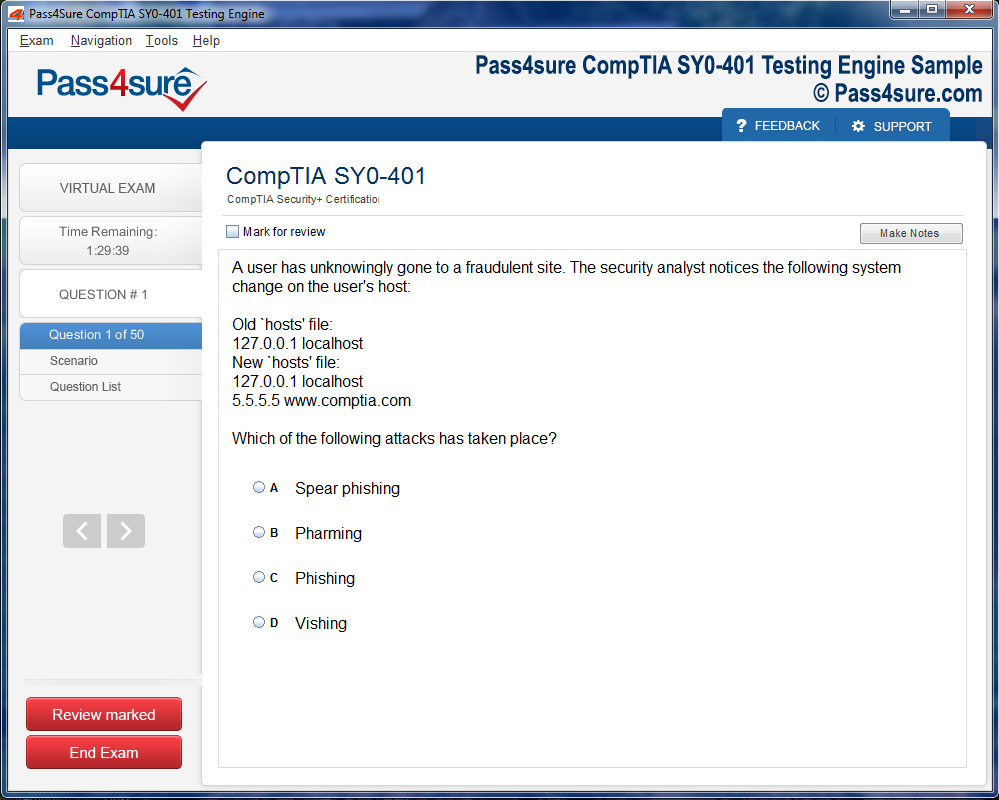
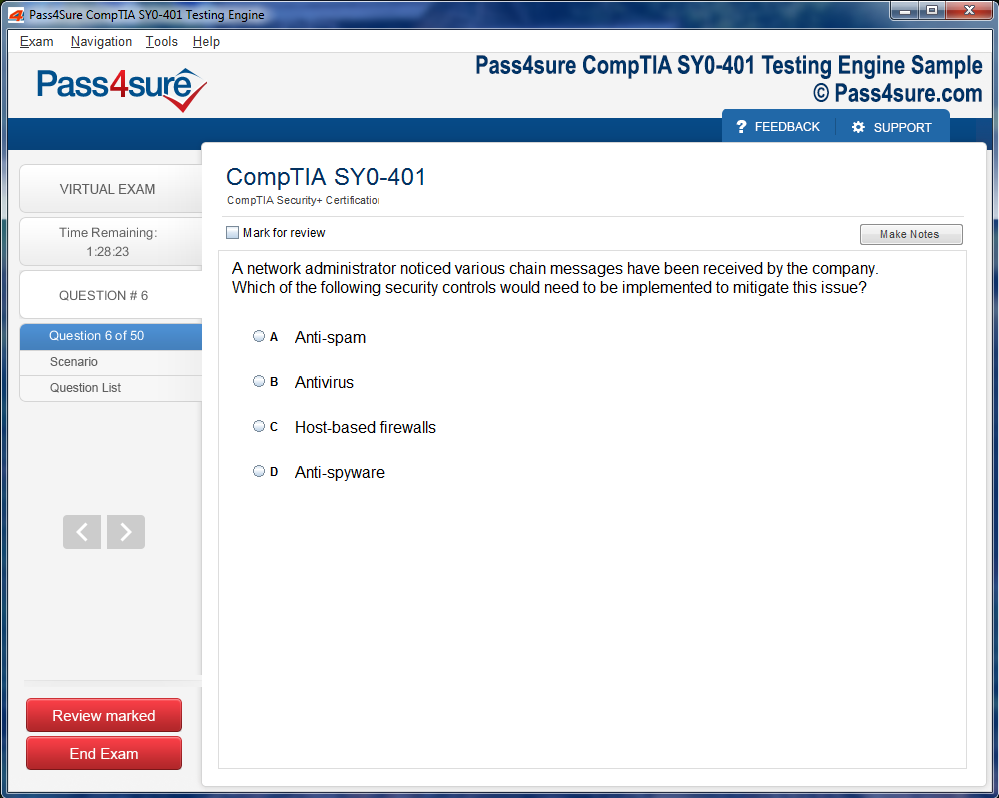
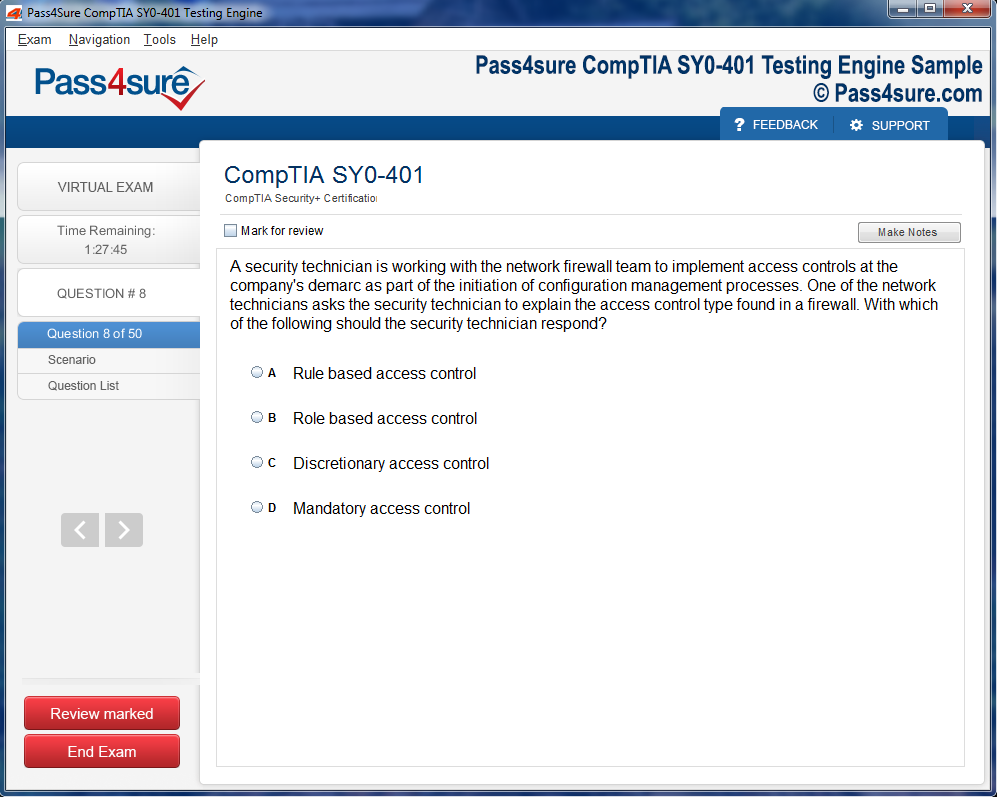
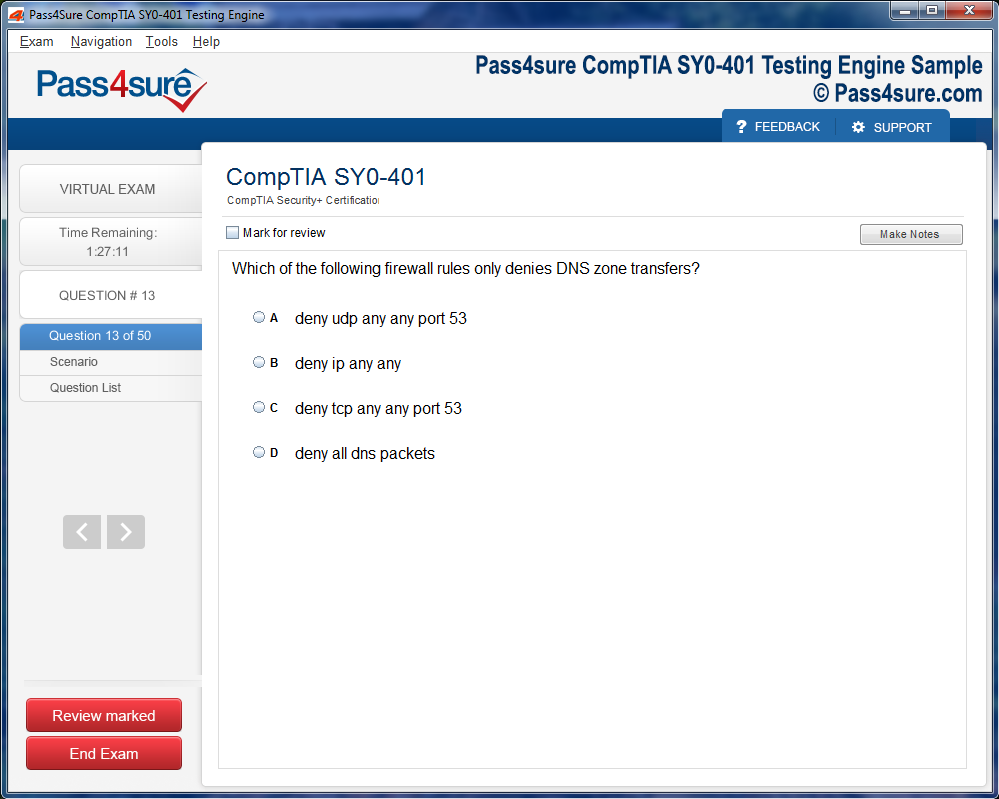
Product Screenshots
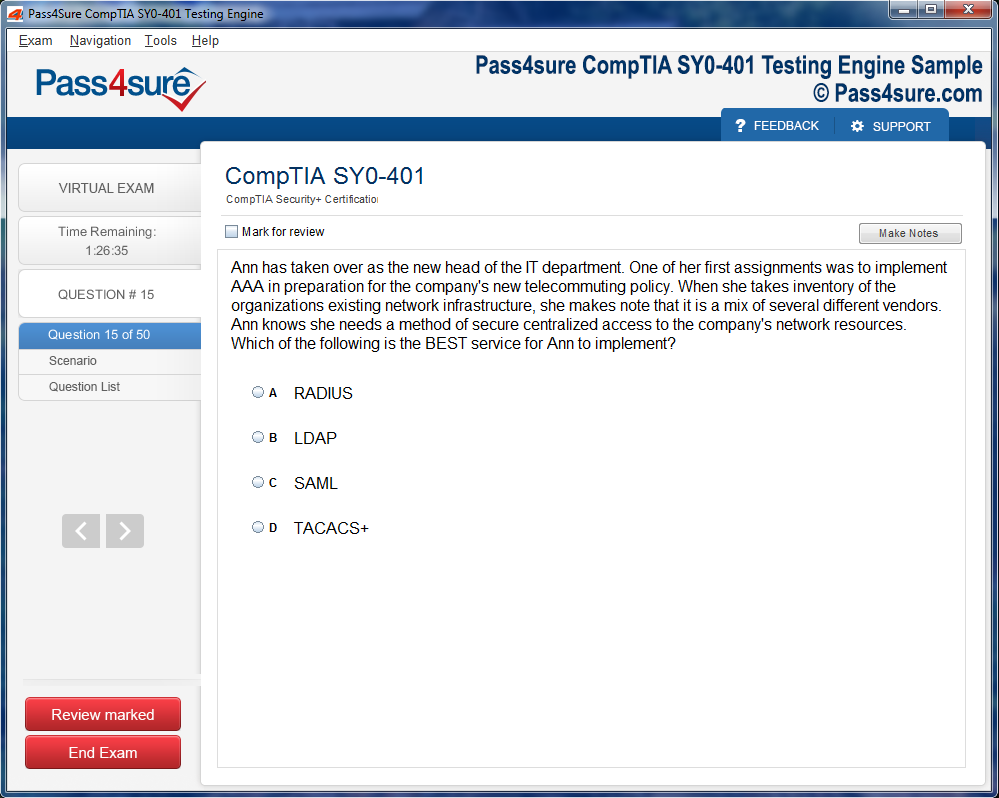
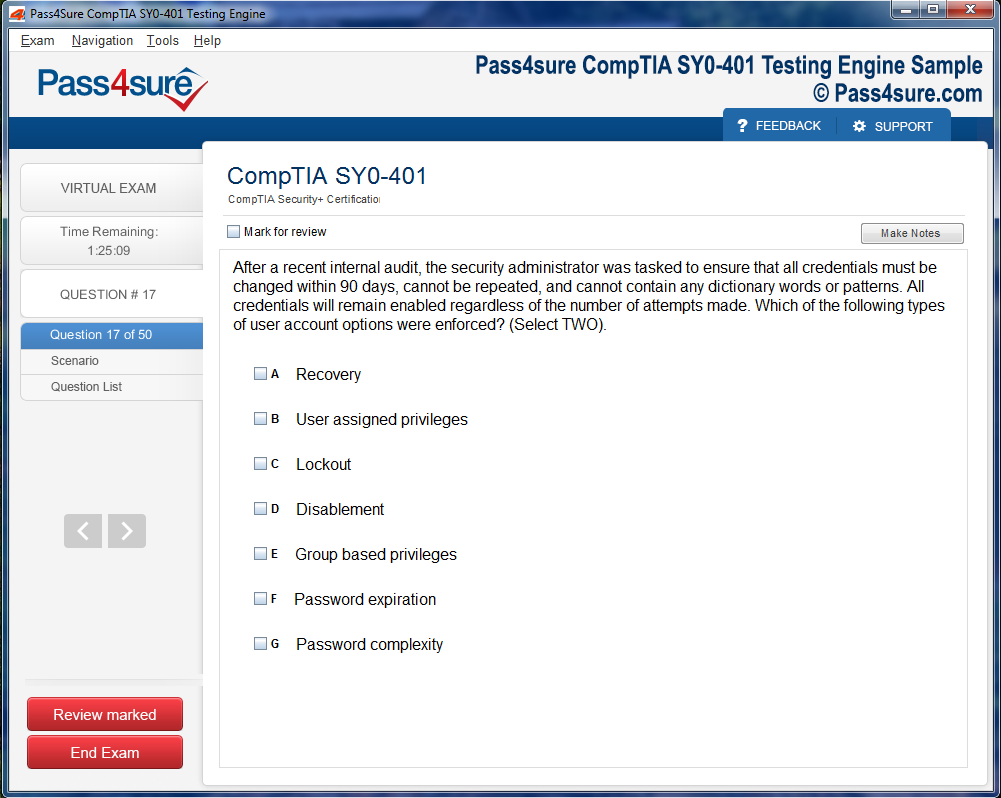
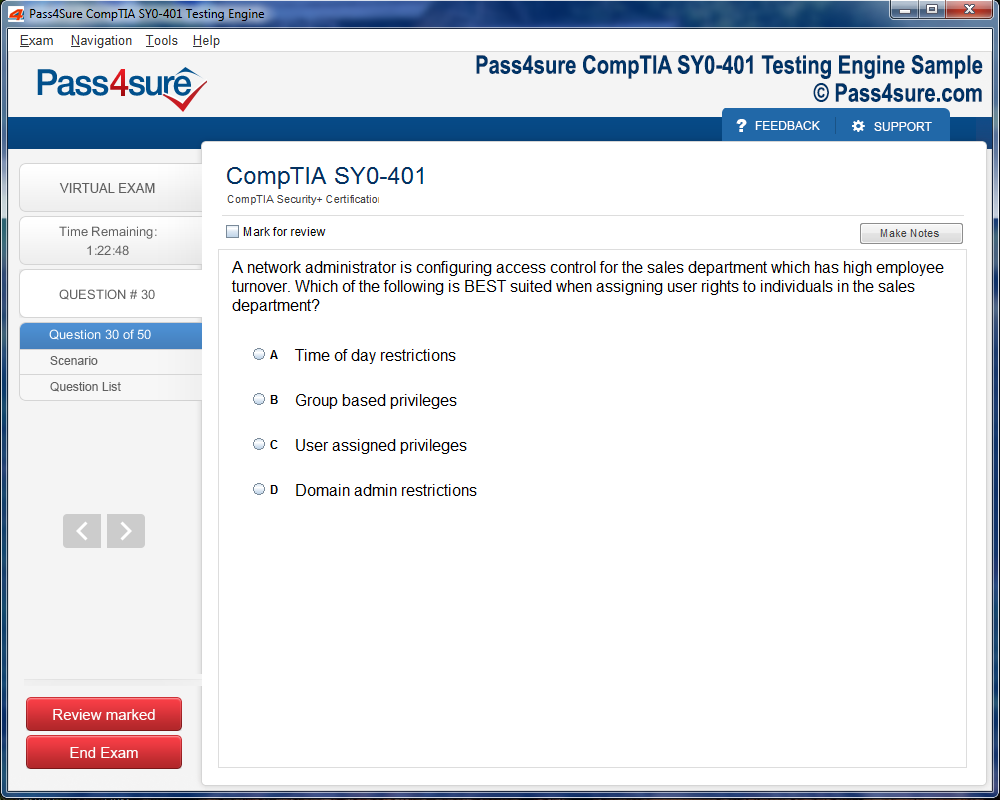
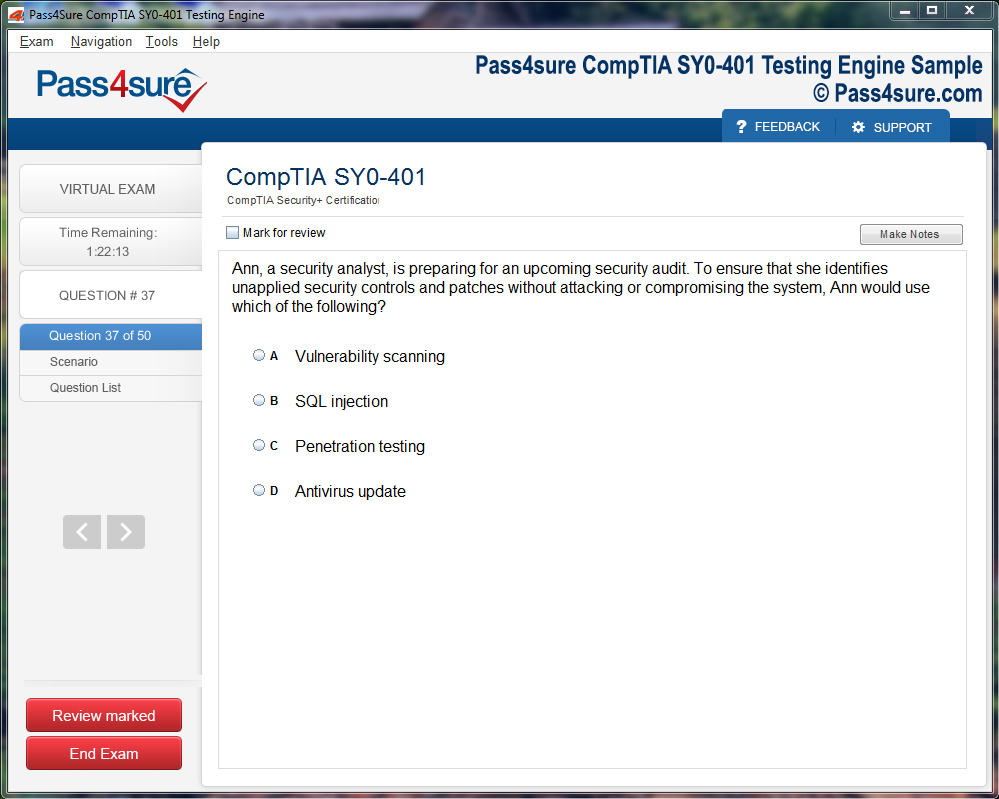
Frequently Asked Questions
How does your testing engine works?
Once download and installed on your PC, you can practise test questions, review your questions & answers using two different options 'practice exam' and 'virtual exam'. Virtual Exam - test yourself with exam questions with a time limit, as if you are taking exams in the Prometric or VUE testing centre. Practice exam - review exam questions one by one, see correct answers and explanations.
How can I get the products after purchase?
All products are available for download immediately from your Member's Area. Once you have made the payment, you will be transferred to Member's Area where you can login and download the products you have purchased to your computer.
How long can I use my product? Will it be valid forever?
Pass4sure products have a validity of 90 days from the date of purchase. This means that any updates to the products, including but not limited to new questions, or updates and changes by our editing team, will be automatically downloaded on to computer to make sure that you get latest exam prep materials during those 90 days.
Can I renew my product if when it's expired?
Yes, when the 90 days of your product validity are over, you have the option of renewing your expired products with a 30% discount. This can be done in your Member's Area.
Please note that you will not be able to use the product after it has expired if you don't renew it.
How often are the questions updated?
We always try to provide the latest pool of questions, Updates in the questions depend on the changes in actual pool of questions by different vendors. As soon as we know about the change in the exam question pool we try our best to update the products as fast as possible.
How many computers I can download Pass4sure software on?
You can download the Pass4sure products on the maximum number of 2 (two) computers or devices. If you need to use the software on more than two machines, you can purchase this option separately. Please email sales@pass4sure.com if you need to use more than 5 (five) computers.
What are the system requirements?
Minimum System Requirements:
- Windows XP or newer operating system
- Java Version 8 or newer
- 1+ GHz processor
- 1 GB Ram
- 50 MB available hard disk typically (products may vary)
What operating systems are supported by your Testing Engine software?
Our testing engine is supported by Windows. Andriod and IOS software is currently under development.
How to Ace Symantec ST0-250 on Your First Attempt
The pathway toward mastering enterprise-level data protection through the ST0-250 certification begins not with memorization but with deep comprehension. The essence of this examination lies in understanding the logic that governs Symantec NetBackup’s ecosystem. This platform embodies an intricate blend of policy-based control, media handling, and recovery strategies that define the heartbeat of organizational data security. To prepare efficiently, one must develop an intuitive awareness of how these mechanisms interconnect. Every policy, every job, and every log entry has meaning, and those meanings combine to reveal the true nature of data protection management. Success in this certification emerges from internalizing this rhythm, interpreting each function as a part of a larger operational narrative rather than a static technical function.
The architecture of Symantec NetBackup is structured around collaboration between master servers, media servers, and clients. Understanding how this distributed design operates is vital because it mirrors how modern enterprises function—distributed, dynamic, and interdependent. Each backup job represents a promise of reliability, and every policy defines how that promise is fulfilled. When these elements operate in perfect synchronization, the environment achieves balance, enabling resilience against system failures, storage constraints, and unpredictable data loss events. Candidates preparing for the ST0-250 must not only grasp these concepts theoretically but should experience them practically by experimenting with test environments that reveal how backups flow through the ecosystem.
The Anatomy of the Symantec ST0-250 Certification
The ST0-250 examination is a comprehensive assessment that measures the depth of understanding rather than the breadth of memorization. Its questions are not designed as simple recall tests; they are crafted to test analytical interpretation. Each scenario often hides subtle layers of meaning, requiring the candidate to think like an administrator under pressure. The exam challenges one’s ability to diagnose, analyze, and correct configurations with precision. A simple misinterpretation of a log entry or an overlooked dependency between storage units can alter the outcome entirely. Hence, learning to dissect questions patiently is an essential skill for success.
Candidates who excel approach the exam as a cohesive story. Each section flows into another, mirroring the lifecycle of data protection. Installation, configuration, maintenance, and recovery are interconnected themes. The ability to visualize this lifecycle enables you to anticipate the intention behind each question. In the ST0-250, timing is secondary to understanding. Speed may save seconds, but accuracy preserves points. Thus, the ideal strategy is one of composure, awareness, and clarity.
Familiarity with real-world environments gives an invaluable advantage. NetBackup operates across heterogeneous systems—different operating platforms, cloud interfaces, and hardware architectures. The candidate must learn to navigate through these hybrid complexities. Understanding how NetBackup communicates through protocols, authenticates users, and allocates storage space demonstrates the kind of holistic insight that the certification aims to validate.
Building Core Expertise Through Immersive Practice
Knowledge becomes powerful only when it is experienced. Reading guides and documentation can provide structure, but real understanding emerges through applied learning. Creating a personal test lab is the cornerstone of efficient preparation. Whether using virtual machines or a simulated cluster, this environment serves as the laboratory where theory transforms into instinct. Through practice, one can explore how backup schedules interact with retention policies, how deduplication conserves space, and how catalog management ensures restoration reliability.
As you perform each operation, it becomes easier to understand the underlying logic that drives the system. Configuring policies repeatedly trains the mind to recognize subtle variations in settings that affect job outcomes. Observing how failed backups behave, how logs reveal the roots of failure, and how proper scheduling enhances throughput builds a mental map of cause and effect. By internalizing these experiences, you create a foundation strong enough to handle the nuanced scenarios presented in the ST0-250 exam.
Equally important is the cultivation of troubleshooting intuition. Troubleshooting within NetBackup is not simply fixing errors; it is about recognizing patterns and understanding the root cause of disruptions. Successful administrators treat every failure as an opportunity to refine their foresight. This proactive approach is precisely what Symantec evaluates through its examination. When candidates can foresee risks before they emerge, it demonstrates an advanced level of operational maturity—an essential quality in enterprise backup management.
Developing Strategic Study Discipline
Preparing for this certification requires discipline rooted in consistency rather than intensity. Long study marathons often lead to fatigue, whereas structured intervals of focused learning yield better retention. Candidates should divide their preparation time between reading, practice, and analysis. Reading builds conceptual clarity; practice translates concepts into muscle memory; analysis strengthens reasoning. Each component feeds the other, creating a balanced approach that eliminates superficial understanding.
It is also critical to align one’s mindset with the nature of enterprise operations. NetBackup professionals are not merely technicians; they are guardians of digital continuity. Understanding the gravity of that role helps channel preparation with purpose. Every configuration parameter, policy, and media selection decision directly affects the business’s ability to recover from data loss. The exam mirrors this accountability by testing whether you can uphold such responsibility under pressure.
Exam-day readiness extends beyond technical knowledge. Mental composure is equally essential. The ability to remain calm, read carefully, and trust one’s preparation is what differentiates those who pass from those who almost pass. Anxiety fragments attention, and fragmented attention misses the small distinctions that questions often hinge upon. Practicing mindfulness, time management, and mental endurance enhances not only your focus but also your confidence.
Interpreting Documentation as a Narrative of Logic
Symantec’s documentation often appears dense, yet it holds the core of the exam’s structure. Reading it effectively means shifting perception—from manual reading to narrative interpretation. Each instruction, table, and example is part of a logical sequence. Instead of treating these guides as static pages, envision them as a story that unfolds the cause-and-effect nature of system administration. This method transforms complex material into digestible logic.
When you read about backup policies, imagine their execution sequence. When exploring error codes, visualize the operational conditions that produce them. This mental modeling helps internalize the subject matter deeply. Over time, you begin to anticipate outcomes before they occur, mirroring the predictive mindset expected of certified professionals.
Additionally, you must understand that documentation reflects real design philosophies. It illustrates not only how to execute tasks but also why they are executed in specific ways. That “why” is the invisible thread that connects all areas of NetBackup management. The exam frequently draws upon this reasoning rather than isolated commands. By perceiving the intent behind every configuration principle, you gain insight into the examination’s underlying logic.
Mastering the Art of Scenario Analysis
Scenario-based questions are the backbone of the ST0-250 examination. They simulate the challenges administrators encounter in real environments. Each scenario presents a narrative that requires dissection. To master this skill, candidates must cultivate the ability to separate symptoms from causes. A failed backup, for example, might not stem from the media server but from a policy misalignment or network bottleneck. Analytical depth allows you to connect the dots that define such outcomes.
The art of scenario analysis involves observing, interpreting, and validating assumptions. In an exam setting, this translates into reading every word carefully, identifying contextual clues, and mapping them to potential system behaviors. Those who train themselves to visualize the situation in real operational terms often find that the correct answer naturally reveals itself. This level of reasoning is only achievable through repeated exposure to practical exercises and post-lab reflections.
Effective analysis also involves mental flexibility. No two environments behave identically. Understanding that there can be multiple valid approaches within a single framework is key. The ST0-250 challenges rigidity and rewards adaptability. Therefore, developing a mindset that welcomes unconventional but logical solutions aligns perfectly with the exam’s philosophy.
Cultivating Professional Identity Through Certification
Beyond the technical layer, the ST0-250 represents a declaration of professional integrity. To pass this examination is to demonstrate not only competence but responsibility. Certified professionals are entrusted with the invisible backbone of enterprise operations—the data that sustains business continuity. In this light, the certification becomes a reflection of one’s reliability and ethical commitment. It signals to employers and peers alike that the individual understands the seriousness of safeguarding information assets.
Preparation should, therefore, transcend mere technical mastery. It should nurture a mindset grounded in accountability. Those who perceive data protection as a living discipline rather than a mechanical task find deeper motivation in their studies. Their goal is not only to pass but to embody the very standards that the certification represents. This transformation of intent—studying to serve rather than to succeed—creates a sustainable drive that endures beyond the exam.
Earning the ST0-250 also integrates you into a professional ecosystem that values precision, resilience, and foresight. It validates your capacity to handle complexity with grace and to translate challenges into opportunities for optimization. The process of preparing and passing this examination sharpens problem-solving instincts that remain applicable across diverse technological landscapes.
The Continuous Evolution of Knowledge
Certification is not an endpoint but a milestone in an ongoing journey of learning. The domain of data protection evolves constantly. Technologies shift, architectures transform, and new paradigms emerge. Those who treat their certification as a dynamic responsibility rather than a static achievement maintain relevance in a competitive field. The same analytical thinking, curiosity, and adaptability that enable success in the ST0-250 exam also empower long-term professional growth.
To sustain mastery, one must remain engaged with evolving methodologies, stay attuned to new system updates, and continually refine one’s understanding of enterprise resilience. Continuous exploration transforms knowledge into intuition. Over time, managing NetBackup environments ceases to feel like executing procedures and begins to resemble orchestrating harmony across technological elements. This harmony is the ultimate expression of expertise—calm control amid complexity.
By internalizing the spirit of lifelong learning, professionals ensure that the value of their certification compounds with experience. The ST0-250 then becomes not merely a symbol of achievement but a living testament to intellectual endurance and dedication to excellence.
The Core of NetBackup Architecture
The architecture of NetBackup is a layered ecosystem, designed with precision to ensure that every piece of data is accounted for. At its nucleus lies the master server, a governing authority that dictates how and when data is preserved. Acting as the strategist of the entire environment, the master server is responsible for catalog management, job scheduling, and policy distribution. Without it, the rest of the infrastructure would drift aimlessly. Understanding this orchestration is not a matter of memorization but of visualization—imagining how each command radiates outward, influencing the behavior of subordinate components.
Policies serve as the genetic code of data protection. They define the scope, timing, and nature of every backup. Through them, the administrator molds the protection plan that determines what data is secured, the retention period it follows, and the storage destination that houses it. Beneath this apparent simplicity lies the complexity of synchronization—ensuring that policies align with backup windows and system availability. When schedules overlap or windows are misaligned, backups fail to complete, resulting in gaps that can haunt an enterprise. Those preparing for the ST0-250 must recognize that mastery over policy configuration forms the foundation of operational resilience.
The master server is more than a coordinator; it is a repository of the organization’s digital memory. Its catalog, a database of all backup metadata, represents the heartbeat of recoverability. Understanding how to safeguard this catalog is essential. Backup administrators often misjudge the importance of catalog redundancy until a disaster strikes. The ability to restore a catalog swiftly defines how fast a business recovers from a catastrophic loss. Thus, the catalog must never reside in isolation—it requires consistent protection through scheduled copies and offsite replication, both of which are tested concepts in the ST0-250 examination.
The Functionality of Media Servers
Media servers exist as the laborers of the backup ecosystem. They manage the transmission of data between clients and storage destinations. Their role demands computational strength, optimized network throughput, and well-balanced configuration parameters. In large enterprises, multiple media servers work in concert, forming a distributed network of efficiency. Understanding their interplay allows one to anticipate bottlenecks and engineer solutions before they materialize.
Multiplexing and multistreaming are techniques that elevate the performance of media servers. Multiplexing allows several data streams to be written to a single storage device simultaneously, enhancing utilization but sometimes complicating restores. Multistreaming, by contrast, enables multiple concurrent jobs for a single client, reducing the backup window while consuming more system resources. Grasping when to apply each technique is an art of balance. Exam questions may present scenarios that appear benign yet require deep discernment of throughput trade-offs and reliability concerns.
Deduplication technology reinforces this efficiency. By identifying redundant blocks of data before they are stored, deduplication reduces storage consumption and accelerates recovery times. Candidates must understand that deduplication can be performed at different levels—source, media server, or target. Each choice impacts bandwidth, CPU utilization, and storage efficiency differently. Recognizing the proper deployment model is a matter of architectural strategy rather than rote memory.
The Intricacies of Client Interaction
Clients form the outermost layer of the NetBackup structure. They are the systems being protected—the endpoints whose data is gathered, indexed, and secured. Their diversity introduces complexity. A network may consist of Windows, Linux, and UNIX systems, each communicating differently with the master and media servers. The ST0-250 challenges candidates to interpret these variations and diagnose failures arising from misconfigurations or environmental inconsistencies.
Authentication and communication between clients and servers rely on established trust. Certificates, firewalls, and network routing all play a role in maintaining seamless dialogue. When one piece fails, backups halt. The ability to interpret log files, identify communication breakdowns, and restore trust relationships is vital. Successful candidates in the ST0-250 exam exhibit the intuition to trace failures from symptom to source, using their conceptual understanding of network architecture.
In virtual environments, particularly those involving VMware, the client layer becomes abstract. Instead of backing up physical disks, administrators deal with virtual machine images, snapshots, and proxy hosts. Recognizing the difference between image-level and file-level backups helps in optimizing performance. Furthermore, integration with APIs enables efficient management of virtual resources, making virtualization support an essential part of modern NetBackup knowledge.
Catalog Management and Protection
Within the symphony of NetBackup operations, catalog management stands as the conductor’s score—the record that ensures every backup can be replayed precisely as it was performed. The catalog contains metadata about each operation, mapping which files were stored, where they reside, and when they expire. Without it, restores are blind attempts, impossible to execute with accuracy.
Safeguarding the catalog requires careful scheduling. Administrators must define dedicated backup jobs for catalog protection, distinct from data backups. Disaster recovery copies of the catalog must be stored separately, often on remote storage, to ensure resilience against site-level incidents. The subtlety lies in timing—catalog backups must be coordinated so that they capture the latest job records without overlapping running tasks.
The ST0-250 exam often frames questions around this subtle dance of timing and placement. A candidate who comprehends not just the process but the reasoning behind it—why certain storage types are chosen for catalog protection, why specific retention policies are applied—demonstrates mastery beyond theoretical knowledge. Catalog management is the spine of the NetBackup organism, and protecting it ensures continuity in the face of chaos.
Integration Across Platforms and Environments
NetBackup’s strength lies in its versatility. It does not confine itself to one environment but thrives across diverse systems. Understanding cross-platform integration is therefore not an optional skill—it is a necessity. Windows environments rely on service-based architecture, while UNIX and Linux employ daemons and scripts. This difference affects installation, configuration, and troubleshooting. Recognizing the unique traits of each platform enables administrators to act swiftly when complications arise.
In multi-environment infrastructures, communication issues frequently surface. Firewalls may block essential ports, permissions may restrict access, or hostname resolution might fail. These scenarios appear frequently in the ST0-250 exam. Success depends on the candidate’s ability to visualize the path of communication from client to master server, understanding every checkpoint that data traverses.
As modern infrastructures migrate toward virtualized and hybrid environments, NetBackup has evolved to include agents and plugins for hypervisors and cloud systems. Comprehension of these integrations ensures a smooth transition from traditional on-premises systems to more elastic architectures. Mastering cloud connectors, encryption management, and bandwidth throttling allows for the design of efficient policies that accommodate fluctuating workloads.
The Principle of Deduplication and Efficiency
Deduplication embodies the philosophy of doing more with less. By storing only unique data segments, NetBackup minimizes storage waste and accelerates retrieval operations. The technique identifies repeated patterns within data streams and references them rather than duplicating them. The underlying mathematics of this process may be complex, yet its purpose is simple—efficiency through intelligence.
Understanding deduplication also requires knowledge of where it occurs. Source-side deduplication reduces network load by eliminating redundant data before transmission, while target-side deduplication optimizes storage efficiency after the data has been received. Media server deduplication pools combine these advantages, balancing computational and storage workloads. The exam often evaluates one’s ability to distinguish between these models and choose the most suitable for given scenarios.
Performance tuning within deduplication environments requires attention to concurrency, storage bandwidth, and CPU load. Too much parallelism can overwhelm processing resources, while too little leads to underutilization. The balance between speed and stability is the hallmark of a well-designed NetBackup environment.
The Evolution Toward Cloud-Centric Protection
The evolution of data protection has mirrored the digital transformation of enterprises. NetBackup, once bound by tape libraries and disk arrays, now extends its capabilities to hybrid and multi-cloud architectures. The ST0-250 examination mirrors this progression, emphasizing the candidate’s understanding of modern cloud integrations.
Cloud storage introduces new challenges: latency, cost optimization, and data sovereignty. Administrators must design policies that respect geographical regulations while maintaining accessibility and security. Encryption becomes non-negotiable; every data stream must be wrapped in cryptographic protection to prevent unauthorized access during transit and at rest. Understanding key management and encryption protocols is no longer a niche skill but a core competency.
Hybrid models blend on-premises systems with cloud repositories, demanding synchronization between distinct environments. This interplay introduces the concept of bandwidth optimization, ensuring that backups utilize available network capacity efficiently without disrupting other operations. Exam questions often test one’s ability to predict how these configurations behave under varying conditions.
The cloud has also redefined disaster recovery. Instead of relying solely on physical replication, administrators now deploy virtual appliances and automate recovery workflows. Understanding how NetBackup interacts with these components demonstrates not just technical knowledge but strategic awareness of evolving infrastructure paradigms.
The Interconnected Nature of Knowledge
Every component of NetBackup, from the master server to the cloud connector, functions as part of an intricate web. Grasping one concept in isolation leads only to partial comprehension. True expertise emerges when one perceives the interdependence that unites them all. The master server’s policies dictate the behavior of media servers, which in turn rely on clients for data input, while the catalog silently records every interaction. This dynamic resembles an ecosystem—self-regulating, adaptive, and resilient.
Studying for the ST0-250 exam requires a mindset attuned to relationships rather than fragments. Understanding how configuration adjustments ripple across the environment distinguishes the analytical thinker from the memorizer. The exam’s design rewards those who perceive systems holistically, who can diagnose not just what went wrong but why.
Building this depth of knowledge transforms an administrator from a technician into a strategist. The process of preparation becomes an act of intellectual craftsmanship, where each learned concept fits seamlessly into a broader architecture. In mastering the orchestration of NetBackup, one gains more than exam readiness—one acquires the fluency of digital preservation itself, the capacity to ensure continuity in a world driven by data.
Mastering Practical Skills and Real-World Scenarios
Practical expertise forms the very essence of the ST0-250 journey. Beyond theoretical comprehension, this stage demands a dynamic ability to translate knowledge into tangible configurations, refined troubleshooting, and instinctive operational control. To attain genuine fluency, your engagement with NetBackup must evolve from passive study to active manipulation. Each click, each failed job, and every successful restore imprints procedural intelligence within your mind, turning abstract understanding into operational certainty.
The examination reflects Symantec’s real-world orientation, which emphasizes functional competency over memorized responses. You are not assessed for recalling isolated facts, but for interpreting the living behavior of NetBackup systems under fluctuating circumstances. Hence, hands-on practice becomes your most valuable tutor. It is in laboratories—real or virtual—where expertise is forged.
Building a Realistic Laboratory Foundation
The foundation of practical mastery lies in creating your own experimental environment. Even if access to enterprise hardware is limited, virtual machines can replicate realistic infrastructures with surprising authenticity. Construct a master server, integrate media servers, and configure multiple clients that mimic diverse operating systems. This simulated ecosystem becomes your learning sanctuary.
Once operational, begin to orchestrate backup and restore activities. Observe how NetBackup communicates across components, how job logs evolve during execution, and how minor configuration tweaks impact the outcome. Every success reinforces procedural memory, while every failure chisels diagnostic precision. Over time, you will develop a fluid understanding of NetBackup’s internal logic—an understanding that transcends rote memorization.
By deliberately creating failures, you invite insight. Introduce incorrect storage paths, misconfigure client parameters, or interrupt network connectivity. When you troubleshoot these deliberate faults, your reasoning deepens. You start recognizing patterns in error messages, understanding which logs offer the most clarity, and discerning how different subsystems interrelate.
Mastering the Art of Troubleshooting
Troubleshooting is not a reaction; it is a cultivated art of reading digital narratives. The ST0-250 often challenges candidates with failure scenarios that mirror authentic operational mishaps. Backups might fail midway, restores might miss expected data, or performance might degrade without apparent cause. Each of these problems invites structured investigation.
Logs serve as the language of these narratives. Learning to interpret bptm, bpbrm, and bpcd logs is central to practical fluency. Each one tells a sequential story—initiation, data handling, completion, or failure. As you examine these patterns, you learn to connect job behaviors to their corresponding logs. A sudden drop in throughput may point toward a disk bottleneck, a connection reset may indicate client instability, and a media error might highlight tape wear or misalignment.
You must train yourself to navigate these diagnostics calmly and methodically. Trace errors backward from the symptom to the cause. Over time, recurring problem types will start forming mental templates. This pattern recognition is what separates a novice from a proficient administrator. During the exam, when faced with similar cases, this instinctual recall transforms complex scenarios into familiar puzzles.
Storage Configuration and System Optimization
Within NetBackup’s architecture, storage configuration holds critical importance. The exam tests your ability to design, manage, and rectify various storage entities such as disk pools, storage units, and deduplication folders. Understanding the hierarchy of how NetBackup indexes and references storage structures ensures accuracy and reliability.
When you create a disk pool or define a deduplication folder, every parameter—from fragment size to concurrent job limit—affects system behavior. Misconfigurations here are frequent exam traps. The difference between a functioning and a failing setup often lies in a single overlooked value. Practice constructing and deconstructing these configurations repeatedly until the process becomes second nature.
Beyond configuration lies the art of optimization. Backup operations are rarely static; they fluctuate with data volume, system load, and network conditions. Experiment with multiplexing and multistreaming parameters to discover how throughput changes. Adjust buffer counts, fine-tune fragment sizes, and observe how NetBackup allocates resources. Real-world administrators must balance efficiency with reliability—learning when to sacrifice speed for stability and when to leverage concurrency for performance.
The examination frequently introduces performance dilemmas that test this awareness. You might encounter a scenario describing a slow backup over a high-bandwidth connection. Recognizing whether the cause lies in network latency, buffer misconfiguration, or improper deduplication setup requires practical familiarity rather than theoretical speculation. Only hands-on experience grants that sensitivity.
Security and Role-Based Administration
Modern backup environments operate within stringent security frameworks. The ST0-250 expects you to demonstrate mastery of NetBackup’s integrated protection mechanisms. Encryption, role-based access control, and secure communication protocols ensure data integrity across the system.
Your task is to understand how these features coexist without compromising functionality. Practice enabling encryption at both client and storage levels, ensuring key management aligns with enterprise policies. Configure role-based access control to limit administrative privileges according to operational necessity. Observe how each role interacts with specific components, preventing unauthorized access without hindering essential tasks.
Through such exercises, you will not only satisfy exam expectations but also internalize the ethical foundation of system administration. Security in practice transcends technicality—it becomes a mindset of vigilance and responsibility. Every adjustment, every permission granted or revoked, shapes the balance between protection and productivity.
Virtualization and Cloud Integration
The evolving nature of IT ecosystems demands proficiency beyond traditional setups. Virtualized and cloud environments dominate modern infrastructures, and the ST0-250 mirrors this reality. NetBackup’s compatibility with virtual machines and cloud connectors represents a vital practical domain that candidates must explore extensively.
Begin by integrating NetBackup with virtualized platforms such as VMware. Configure image-based backups, manage snapshots, and execute full and incremental recoveries. Pay close attention to the catalog structure that supports these operations. Virtual machine protection is inherently layered, and your success in managing it relies on a precise grasp of how NetBackup interacts with hypervisors.
Next, extend your practice toward cloud integration. Experiment with object storage connectors and understand how data moves between on-premises servers and cloud repositories. Simulate hybrid scenarios where backups transition from local disk pools to remote storage. Such experiments reveal the complexity of latency management, cost efficiency, and bandwidth utilization—all factors frequently embedded in examination questions.
As automation becomes a defining trait of modern data protection, familiarize yourself with API-based integration. NetBackup exposes interfaces that allow scripted control over backups, restores, and reporting. Learning to use these interfaces introduces efficiency and agility—attributes that distinguish advanced practitioners.
Realistic Scenarios and Diagnostic Maturity
True mastery develops when you confront unpredictable realities. Simulate scenarios that extend beyond textbook examples. For instance, create conditions where a client system suffers intermittent packet loss. Observe how NetBackup retries connections, how long it tolerates disconnections, and which timeout parameters control these responses.
Through these exercises, your understanding matures from procedural to conceptual. You no longer see errors as obstacles but as opportunities for analysis. The discipline of simulation fosters diagnostic agility—the ability to assess a problem from multiple angles before acting. When you face similar situations during the exam, the correct response emerges naturally from experience rather than speculation.
Another exercise involves deliberate restoration failures. Attempt to restore data from corrupted catalogs, misaligned media sets, or inconsistent deduplication stores. Each failed attempt teaches you the anatomy of recovery. You learn which logs to examine, which commands to rerun, and how to rebuild catalog components when necessary. This practical resilience cannot be memorized—it must be earned through deliberate experimentation.
The Essence of Backup and Recovery Symmetry
In data protection, backup is merely half the equation. Restoration defines the true value of your work. The ST0-250 evaluates your ability to restore efficiently, accurately, and with minimal disruption. To excel, you must internalize the concept of symmetry—the realization that every backup process anticipates its own restoration.
Practice restoring entire systems, individual directories, and specific files. Experiment with point-in-time recovery to appreciate how NetBackup reconstructs previous data states. Observe catalog dependencies, ensuring you understand how image records map to physical data segments. Each exercise reveals the intricate architecture beneath the system’s surface.
When you restore from virtual machine images or cloud repositories, note how NetBackup orchestrates these layered interactions. Comprehending catalog synchronization, metadata validation, and mount point integrity empowers you to recover confidently in any context. Such confidence not only ensures exam success but also defines your professional identity as a dependable administrator.
As your familiarity deepens, restoration becomes intuitive. You will sense, even before execution, whether a restore will succeed or fail. That intuition stems from lived experience—a synthesis of observation, repetition, and reflection.
Cultivating Operational Intuition
At the heart of mastery lies intuition—the silent awareness that guides every technical decision. Through relentless practice, this intuition blossoms naturally. Each configuration, adjustment, and troubleshooting attempt builds a reservoir of experiential memory. Over time, you cease to think mechanically and begin to respond instinctively.
In the ST0-250 examination, such intuition becomes your invisible ally. When faced with complex multi-step questions, your mind retrieves patterns from prior lab experiences. The correlation between configuration errors and log responses, between performance anomalies and parameter adjustments, reveals itself instantly.
Operational intuition cannot be faked or hurried. It emerges from patience, curiosity, and perseverance. The more you immerse yourself in real or simulated environments, the more fluent your technical reflexes become. You stop reacting to problems and start predicting them.
Mastery in this domain is not about perfect memorization but about internalized logic. Every failure you encounter contributes to your comprehension, every successful recovery reinforces confidence. By living within NetBackup’s ecosystem—configuring, breaking, fixing, and optimizing—you evolve from a candidate into a practitioner.
In this way, practical preparation transcends examination goals. It transforms into professional transformation. When you can navigate NetBackup’s landscape without hesitation, when troubleshooting feels natural rather than stressful, and when each log entry tells a clear story, you have achieved the level of practical fluency that the ST0-250 was designed to measure.
Your preparation thus culminates not merely in readiness but in mastery—a condition where every task, no matter how complex, feels like a familiar rhythm of logic and precision.
The Art of Final Preparation
In the final stretch before a certification examination, the rhythm of study transforms from expansion to refinement. The broad learning phase gives way to a deeper, more meticulous alignment of knowledge. This period is not about chasing novelty but mastering familiarity. The human mind retains information best when clarity replaces chaos, and the last two weeks before your exam should become a sanctuary of structured calm. Begin each day by revisiting key concepts you have already mastered. Summarize them in your own words, reorganizing information into simplified, visual sequences that your mind can recall effortlessly. Every repetition should aim to strengthen neural pathways, turning previously learned material into instinctive recall. When you encounter areas of uncertainty, do not panic. Instead, analyze why confusion persists—whether it arises from misunderstanding definitions, forgetting process sequences, or mixing similar terminologies. Precision now matters more than volume. The successful candidate is not the one who studied endlessly but the one who studied intentionally.
Create a final revision calendar dedicated to reviewing critical domains rather than discovering new ones. Devote each day to revisiting clusters of related topics, interlacing practical review sessions with brief theoretical refreshers. Focused consistency matters more than marathon sessions. A fatigued mind absorbs little, while a calm, alert one transforms review into retention. Each evening, reflect briefly on what you have re-strengthened. This ritual not only consolidates information but also builds emotional stability. Anxiety shrinks under routine; confidence expands through repetition.
The Power of Practice Tests
Practice examinations are not mere assessments—they are rehearsals of the mind. Each simulated test mirrors the rhythm, pressure, and unpredictability of the actual certification environment. The goal is not to achieve perfection but to expose blind spots. When you take a mock exam, recreate authentic conditions. Sit at a quiet desk, set a timer identical to the real test’s duration, and forbid interruptions. Treat the test as if it determines your credential in that very moment. When finished, resist the temptation to check scores immediately. Instead, analyze results with purpose.
Examine patterns within your mistakes. Are they conceptual, procedural, or interpretative? A wrong answer reveals far more than a correct one—it directs you toward the next improvement. Document every question that challenged you and write a short explanation afterward describing the logic behind the correct answer. This active reflection converts uncertainty into mastery. Over time, you will notice recurring weaknesses gradually vanish, replaced by steady understanding.
Time-based tests also enhance rhythm. You learn to distribute energy across questions, knowing when to pause and when to move forward. This balance between speed and accuracy can be the defining factor between passing and failing. Remember that the certification exam rewards clarity, not haste. A steady, analytical approach always surpasses frantic guessing. Practice sessions cultivate that rhythm until it feels natural on the real day.
The Mental Conditioning of an Examinee
Beyond the intellect lies the psychological architecture of success. Mental equilibrium is a silent companion during any high-stakes assessment. As the day nears, your objective shifts from study to stability. Sleep becomes sacred. A rested mind is vastly superior to one drowned in sleepless repetition. Nutrition, too, plays a subtle role; light, balanced meals preserve alertness and prevent sluggishness. Hydration keeps the brain oxygenated, improving cognitive sharpness.
On the morning of your exam, maintain simplicity. Avoid revisiting complex topics or cramming new information—it breeds anxiety more than clarity. Instead, engage in calm review of your summary notes, reaffirming concepts that you already understand. Walk through the testing center in your imagination: the login screen, the question format, the countdown clock. Visualization diminishes uncertainty by converting the unfamiliar into routine.
Once seated for the exam, breathe deliberately. Let the first few seconds center you. Skim the initial questions without panic. Certification exams often present wording designed to test comprehension rather than memorization. Each phrase hides intention. Read twice before committing to an answer. When a question seems unclear, strip it down mentally until its core concept reveals itself. Logic nearly always lives beneath the surface.
Navigating the Exam with Strategy
During the actual test, every decision becomes a reflection of training. Begin with questions that seem approachable, building early momentum. The confidence from early correct responses establishes rhythm. When confronted with a difficult question, mark it and proceed. Do not linger. Often, later questions will trigger recall or context that clarifies earlier confusion. This technique prevents stagnation and maintains flow.
Time allocation must remain disciplined. Divide total available minutes by the number of questions, leaving a small buffer for review. This mathematical awareness prevents panic during the final section of the exam. Treat time as currency—spend it wisely, invest it strategically, and avoid impulsive expenditure.
When uncertainty arises, use elimination. Remove clearly incorrect answers first; even if the correct one seems elusive, statistical advantage increases as options decrease. Maintain composure when encountering unfamiliar scenarios. Most complex questions integrate known principles in novel combinations. Decode them by relating back to foundational knowledge. Every problem, however layered, ultimately relies on basic logic.
When nearing the final minutes, revisit flagged questions. Approach them with fresh perspective. But avoid changing answers based purely on doubt. Switch only when you can justify the change through logical reasoning or memory correction. Most first choices made after careful thought remain correct. Impulsiveness, on the other hand, often introduces error.
The Emotional Architecture of Success
Performance under pressure is not purely cognitive—it is emotional endurance sculpted through preparation. Anxiety often stems from fear of uncertainty, but familiarity neutralizes it. The more often you simulate exam conditions, the less intimidating they become. Confidence does not emerge magically on exam day; it is constructed piece by piece through disciplined repetition.
During moments of tension, remind yourself that you have encountered these concepts countless times. You are not guessing; you are recalling. Shift perspective: instead of viewing the exam as a test of worth, treat it as a demonstration of skill. This redefinition transforms nervousness into focus. Professionals perform under evaluation every day; this is simply another such performance.
Breathing exercises can anchor composure. A deep inhale through the nose, held for a brief pause, followed by a measured exhale, calms both pulse and thought. Small physical adjustments—relaxing shoulders, unclenching hands—signal safety to the mind, allowing logic to resume control.
When fatigue strikes mid-exam, refocus by visualizing progress rather than exhaustion. Every question answered correctly moves you closer to certification. The finish line is not a distant concept; it is unfolding with each deliberate click. That awareness transforms fatigue into determination.
The Final Review and Reflection
As the examination draws to its close, the final review becomes a period of verification rather than exploration. Scan through your responses methodically. Ensure each answer reflects clear reasoning. Avoid excessive editing; trust your trained intuition. Over-analysis often clouds rather than clarifies judgment. If extra time remains, revisit only questions that genuinely warrant re-evaluation.
When submitting the test, do so with calm acceptance. Whether success or setback awaits, your effort has already built competence. A score merely measures a moment, not your capacity. However, if you have prepared consistently, the outcome naturally aligns with your dedication.
Once results arrive and success greets you, do not rush past it. Pause and recognize the discipline that carried you here—the late nights, the persistent study, the countless revisions. Document the insights you gathered about your own learning style. Note which study patterns worked best, which topics required repeated attention, and which resources strengthened your comprehension most efficiently. This reflection is not vanity; it is evolution. Every successful certification builds the foundation for the next.
The act of reviewing your journey transforms achievement into understanding. It reveals the intricate balance between endurance and intellect, between discipline and adaptability. Through reflection, you convert success into wisdom that guides future aspirations.
Sustaining Momentum Beyond Certification
Achievement in an exam does not mark an end but a beginning. The real purpose of such preparation is transformation—of knowledge, mindset, and professional identity. After certification, continue practicing what you have mastered. The skills that carried you through the exam remain vital in real-world implementation.
Revisit practical scenarios that once challenged you. Recreate lab environments, experiment with alternative methods, and refine your efficiency. Learning deepens through application. Share insights with peers or colleagues; teaching what you know reinforces retention and expands perspective. Knowledge multiplies when communicated.
Maintain curiosity even after success. The technology landscape evolves continually, and so must your expertise. Schedule periodic refreshers to stay aligned with updates. Each revision session should not only preserve competence but also nurture adaptability. Certification may validate ability, but continuous learning defines mastery.
Resist the temptation to rest completely after passing. Instead, let accomplishment motivate you toward further exploration. Your mindset during the final preparation—disciplined, focused, and determined—should become a permanent trait, guiding every new challenge.
Success in any professional exam mirrors success in life itself: a cycle of preparation, application, reflection, and renewal. Every phase refines the next. The candidate who learns to balance composure with effort emerges not only certified but transformed.
The Lasting Essence of Certification and Its Lifelong Influence
When an individual accomplishes the Symantec ST0-250 certification, it does not merely symbolize the completion of a technical exam. It represents the beginning of a lifelong intellectual commitment to technological mastery. This certification holds an enduring influence that reaches far beyond professional titles or digital badges. It transforms how a specialist interprets infrastructure reliability, how they approach backup architectures, and how they cultivate resilience in every operation they touch. Through the discipline of preparation, one begins to perceive data not as fragmented units of storage but as the lifeblood of organizational continuity. The certification becomes a compass, orienting professionals toward precision, foresight, and structured judgment.
This sense of accomplishment often marks a critical milestone in one’s career. It establishes a technical identity rooted in trust and dependability. Within enterprises that rely on seamless data protection, a certified engineer stands as a beacon of assurance. The ability to recover mission-critical workloads during failure, design sustainable storage solutions, and optimize NetBackup performance positions these individuals as indispensable assets. Their expertise does not reside in memorized procedures but in the cultivated habit of diagnosing, refining, and evolving.
As the technological landscape shifts ceaselessly, the foundational essence of the certification remains intact—discipline, accuracy, and a determination to maintain operational integrity. The value of the ST0-250 certification continues to echo across years, guiding professionals through changing methodologies, architectures, and innovations. It becomes not a single success but an evolving identity within the ecosystem of modern data management.
The Continuum of Learning and Adaptability
Sustaining the worth of this credential demands more than passive retention; it requires a living rhythm of learning. Technologies metamorphose rapidly, with new NetBackup releases introducing features, integrations, and security paradigms. To maintain certification’s vitality, one must continuously interpret, experiment, and integrate those shifts into practical understanding. Engaging with fresh documentation, exploring updated modules, and participating in virtual labs ensure that knowledge remains functional rather than fossilized.
This adaptability forms the cornerstone of professional endurance. A certified professional cannot allow knowledge to stagnate. Instead, the learning curve must remain fluid, rising steadily with each technical evolution. Subscription to official bulletins, immersion in release notes, and participation in technical workshops nurture this constant renewal. These experiences preserve relevance and enable professionals to respond to emerging data complexities with clarity.
Beyond technical updates, adaptability also involves cognitive flexibility—the ability to unlearn outdated processes and replace them with optimized frameworks. As cloud ecosystems merge with traditional infrastructures, backup strategies must evolve to include virtual workloads, containerized environments, and distributed data lakes. The certified expert, guided by principles embedded during ST0-250 preparation, adapts with composure and insight. This dynamic capacity turns certification into a living organism—ever-growing, ever-refining, and always responsive to transformation.
The Ethical Core of Data Guardianship
Behind every certification lies an ethical foundation. The Symantec ST0-250 credential is not merely a recognition of skill but a declaration of responsibility. The professional who holds it becomes a custodian of digital trust. Each dataset secured, each backup validated, and each recovery orchestrated contributes to the broader integrity of an organization’s existence. This trust extends beyond corporate systems; it reaches into the sphere of human confidence in technology itself.
The ethical dimension manifests in subtle forms. Precision in backup scheduling protects against loss. Accuracy in encryption safeguards confidentiality. Transparency in restoration processes ensures accountability. The certified professional carries this ethical awareness not as an external mandate but as an internal compass. The decisions taken in daily configurations or troubleshooting sessions reflect an unspoken code of diligence.
In an era of intensifying cyber threats, this moral layer becomes vital. The professional’s vigilance, sharpened through the ST0-250 learning path, becomes a line of defense against intrusion and negligence. As new vulnerabilities surface, the ethical obligation to stay informed and act conscientiously deepens. Thus, maintaining certification transcends mere technical renewal; it evolves into the lifelong practice of digital stewardship—protecting the invisible architecture of global data reliance.
The Expanding Professional Horizon
Once certification is achieved, the boundaries of opportunity widen remarkably. Organizations interpret it as evidence of competence, stability, and foresight. The professional bearing this credential becomes eligible for advanced roles—data protection architect, backup strategist, or infrastructure consultant. These roles demand not only technical mastery but an ability to envision continuity strategies that harmonize with organizational missions.
The ST0-250 serves as a cornerstone upon which higher certifications can be constructed. Each additional qualification refines expertise and expands employability. A progression toward advanced design or performance tuning certifications amplifies one’s contribution to strategic projects. The learning discipline fostered during initial preparation transforms into the backbone of sustained advancement.
In this expanding horizon, career growth becomes multidimensional. Technical capability merges with communication fluency, analytical depth, and leadership poise. As certified professionals contribute to multi-environment architectures—hybrid, on-premise, and cloud—they demonstrate versatility. Employers perceive this breadth as invaluable. It represents reliability under pressure and precision during crisis recovery. Over time, such competence cultivates not only professional growth but also an enduring personal identity grounded in mastery and credibility.
The Art of Applying Knowledge Practically
Knowledge achieves permanence only through application. Every theoretical lesson absorbed during certification preparation finds its real worth in workplace experimentation. When professionals configure backup schedules that minimize downtime, refine deduplication techniques to optimize storage, or troubleshoot catalog inconsistencies with efficiency, they transform static learning into living skill. These practical actions shape professional intuition—the instinct to identify root causes quickly, to predict potential disruptions, and to design preventive measures with subtle precision.
Real-world practice deepens the connection between conceptual understanding and operational behavior. The repeated cycle of testing, failure, and refinement enhances memory retention. Over time, patterns emerge—diagnostic rhythms, configuration insights, and recovery reflexes—that form the subconscious architecture of expertise. Through this process, the certification evolves from a credential into an extension of personal capability.
Practical application also strengthens collaboration. Within teams, certified professionals often guide others, clarifying procedures or introducing streamlined workflows. This mentorship extends the influence of certification beyond individual performance, embedding it within organizational culture. Each shared technique or refined configuration multiplies value, proving that knowledge, when distributed, expands rather than diminishes.
The Cycle of Renewal and the Spirit of Perseverance
Maintaining the long-term relevance of certification requires an attitude of perseverance. Renewal is not limited to examination updates or version alignment; it reflects the continual evolution of one’s mindset. As technologies shift, so must curiosity, patience, and analytical sharpness. Regular interaction with evolving software environments, experimental setups, and performance benchmarking cultivates resilience.
This renewal process is both technical and psychological. It involves the courage to confront complex scenarios without reliance on memorized patterns. It means staying open to alternative methodologies, embracing automation, and exploring orchestration frameworks that redefine data protection paradigms. Each adaptation reflects the enduring spirit that once fueled exam preparation—the desire to excel through understanding, not imitation.
Over time, perseverance shapes character. It transforms professional routine into an ongoing pursuit of refinement. The same diligence that guided one through long nights of study now manifests in precise problem-solving, patient mentoring, and strategic decision-making. This cycle of continuous renewal ensures that certification does not fade into formality but matures into wisdom.
The Legacy of Professional Identity
Beyond recognition, beyond opportunity, the ultimate value of the Symantec ST0-250 certification lies in the legacy it builds. It becomes part of a professional’s narrative, shaping perception both internally and externally. Colleagues view certified individuals as reference points for reliability. Employers perceive them as architects of stability. Most importantly, these professionals begin to view themselves not merely as system administrators but as curators of continuity.
The legacy strengthens through consistent contribution. Each backup successfully restored, each system optimized, and each training session conducted reinforces reputation. The certification, once obtained through concentrated study, evolves into an emblem of trust earned repeatedly through performance. It becomes a silent testimony of capability—the kind that does not demand validation but naturally commands respect.
Over years, this identity intertwines with professional purpose. The holder of the ST0-250 certification no longer seeks short-term recognition but long-term influence. They become mentors, strategists, and guides to those entering the domain of data protection. Their presence elevates standards and fosters a culture of accountability. Through this transformation, the certification outlives its original scope; it becomes a personal creed of excellence, diligence, and humility.
The Enduring Path of Mastery
Every journey through certification begins with ambition and concludes with insight. Yet, the true journey never truly concludes. The professional who passes the ST0-250 exam steps into a continuum of responsibility—a realm where mastery demands renewal and relevance demands reflection. This enduring path transforms a single achievement into an unending narrative of evolution.
The same curiosity that once guided study sessions becomes the driving force behind lifelong inquiry. Each technological advancement invites reinterpretation, each professional challenge prompts reinvention. Through dedication and openness to change, the certified individual sustains the light of learning through shifting landscapes.
Ultimately, certification becomes more than an accomplishment; it becomes a philosophy. It teaches patience amid complexity, precision amid uncertainty, and confidence amid transformation. The lessons it imparts—resilience, adaptability, and humility—extend into every domain of work and leadership. Those who embody these qualities turn technical knowledge into timeless artistry. They remind the world that true expertise is not measured by credentials alone but by the consistency of excellence through change.
Conclusion
The journey toward mastering the Symantec ST0-250 exam begins with awareness and ends with transformation. It is not merely a pursuit of passing marks but a test of discipline, foresight, and technical clarity. From understanding NetBackup’s architecture to practicing real-world troubleshooting, every step along this path shapes a more confident and capable professional. Success on the first attempt results from a steady fusion of preparation, experimentation, and mental composure.
Each stage of learning—from absorbing documentation to configuring test environments—engrains deeper comprehension of how Symantec NetBackup safeguards the lifeblood of organizations: their data. Those who approach the certification as an exploration rather than a challenge discover that every error becomes instruction and every obstacle becomes an invitation to grow. The exam’s value lies not only in the credential it bestows but in the precision and accountability it cultivates within your work ethic.
Beyond the certificate, true mastery manifests through continuous learning and professional contribution. By maintaining your certification, exploring new NetBackup versions, and applying your insights to evolving infrastructures, you transform the qualification into enduring expertise. The ST0-250 becomes a foundation upon which you can build leadership, innovation, and trust in every technical environment you serve.
Ultimately, to ace the Symantec ST0-250 on your first attempt is to embrace a mindset that blends curiosity with commitment, patience with persistence, and technical knowledge with practical wisdom. The journey refines not only your skills but your confidence as a data protection professional. When preparation meets purpose, success ceases to be uncertain—it becomes inevitable.